By Michael Nielsen, Publisher | 15+ Years in Diesel Repair
Last Updated: November 2026
⏱ Estimated reading time: 14 minutes
A diesel engine won’t start cold when something in the starting chain fails at low temperature: not enough heat in the cylinders, not enough electrical power to crank the engine, or fuel that cannot flow. A diesel ignites fuel with the heat of compression and no spark, so a cold engine that pulls heat out of the air and a weak battery both make starting harder.
This Heavy Duty Journal guide shows fleet managers and diesel technicians how to diagnose why a diesel engine won’t start cold, fix it and prevent it.
Key Takeaways
- ✓Three failure points: Cold-start problems come from heat, power or fuel, and the engine's symptom usually shows which one.
- ✓Read the cranking: Slow cranking points to the battery or cables, normal cranking without firing points to fuel or heat, and firing then dying points to fuel flow.
- ✓Fuel needs preparation: Cloud point varies by fuel and season, so confirm that your fuel carries cold-flow protection before the freeze.
- ✓Water is a top culprit: Water in diesel freezes in filters and lines, so keep tanks full and drain water separators.
- ✓Prevention wins: A fall check of batteries, heaters, filters and fuel prevents most winter no-starts.
In This Guide
- Why a Diesel Engine Won’t Start Cold
- Diagnosing Why a Diesel Engine Won’t Start Cold
- Glow Plugs, Intake Heaters and Other Cold-Start Aids
- Battery and Cable Problems in Cold Weather
- Diesel Fuel Gelling and Cold Flow Problems
- Water, Filters and Air in the Fuel System
- Starter and Electrical System Problems
- Engine Compression and Mechanical Condition
- Cold Weather Starting Solutions
- Pre-Winter Preparation Checklist
- Frequently Asked Questions
- The Bottom Line
Why a Diesel Engine Won’t Start Cold
A diesel engine won’t start cold when cold air, cold metal, cold oil, a weak battery or restricted fuel stops it from reaching ignition. Diesel engines rely on compression to heat the air in the cylinder enough to ignite injected fuel, and cold weather works against every part of that process.
Heat: Compression Ignition in the Cold
Cold engine parts pull heat out of the compressed air, so the air reaches a lower temperature and fuel may not ignite or burn cleanly. Starting aids such as glow plugs, intake air heaters and block heaters exist to add heat before and during cranking. White smoke and rough running at start-up are signs of incomplete combustion, and HDJ's Diesel Engine Smoking: Complete Diagnostic Guide explains what different smoke colors mean.
Power: Battery and Starter Demand
A cold battery delivers less power, while cold oil and a cold engine make the starter work harder. Cranking speed falls, and a slow engine builds less compression heat, which compounds the problem. Heavy-duty engines also use preheating devices that draw electrical current, so the electrical system is working hard just when it is weakest.
Fuel: Wax, Water and Flow
Diesel contains paraffin wax that forms crystals as the fuel gets cold. The crystals can plug filters and starve the engine even when the bulk fuel looks liquid. Water in the fuel can freeze and block lines and filters as well, and the sections below cover both problems.
Key Recommendation
Diagnose by what the engine does, not by what you suspect. Note whether it cranks slowly, cranks normally without firing, or fires and then dies, and check the fuel and the battery before replacing any part. The three symptoms point to different systems, and a ten-minute look at the filter and the cables often finds the cause before a parts order does.
Diagnosing Why a Diesel Engine Won’t Start Cold
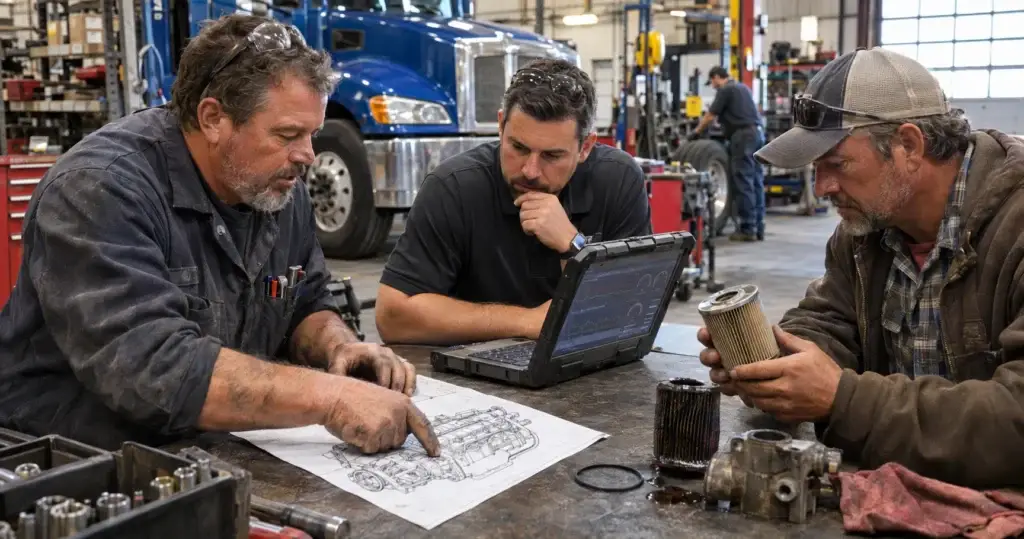
Diagnosing why a diesel engine won’t start cold begins with how the engine behaves when you try to start it. Slow cranking, normal cranking with no start, and a start followed by a stall each point toward a different system, so listen and observe before testing.
| Symptom | Likely Cause | First Check |
|---|---|---|
| Slow cranking | Weak or cold battery, corroded cables, thick oil | Battery condition and cable connections |
| No cranking, or a single click | Dead battery, bad connection or starter fault | Battery voltage under load, cables and the starter circuit |
| Cranks normally but does not fire | Fuel not reaching the injectors or no start-aid heat | Fuel filter, fuel flow and glow plug or heater operation |
| Starts, then dies | Restricted fuel flow from wax or water in the filter | Fuel filter and water separator |
| White smoke and rough running | Incomplete combustion | Start-aid operation, compression and injection |
Slow Cranking or No Cranking
Slow cranking usually means the engine is not being turned fast enough, and the battery and cables are the first suspects. A weak battery, corroded terminals or a loose ground cable limit current. A complete silence or a single click points to a dead battery, a bad connection or a starter fault. HDJ's Diesel Starter Motor Troubleshooting: A Complete Guide covers the starter side.
Cranks Normally but Will Not Fire
When the engine turns at a normal speed but does not start, the battery and starter are probably fine, and the problem shifts to fuel or heat. Gelled or waxed fuel, a plugged filter, water in the fuel, air in the system or failed start aids can each produce this symptom, and the next sections cover them in order.
Starts Then Dies
A truck that fires and then stalls after a short time often has restricted fuel flow. A filter partly blocked with wax or ice can pass enough fuel for a moment and then starve the engine. Check the filter and the water separator before looking at electrical or mechanical causes.
Glow Plugs, Intake Heaters and Other Cold-Start Aids
Cold-start aids add heat to the combustion chamber or the intake air so the engine can ignite fuel when it is cold. The aid depends on the engine, and some use glow plugs while others use an intake air heater, so check the manufacturer's documentation for your engine.
How Glow Plugs and Intake Heaters Work
Glow plugs are electric heating elements in the cylinders that preheat the chamber before cranking, and the dash indicator shows when the preheat cycle is active. Wait for the cycle to finish before cranking, as the maker instructs. An intake air heater warms the air entering the engine instead, and the same wait-and-crank routine applies.
Testing a Failed Heating Element
Test each glow plug or heater element against the engine maker's procedure and specification. A resistance reading outside the stated range, or no reading at all, marks a failed element, and a failed relay, wiring fault or control module can also stop the heater from working. Test the supply and control side before replacing a whole set.
Pull a failed glow plug carefully. Let the engine cool, disconnect the battery, apply penetrating oil if the maker allows and never force a stuck plug, because it can break off in the head. Use the torque in the service manual, and replace plugs with parts that meet the maker's specification.
Battery and Cable Problems in Cold Weather
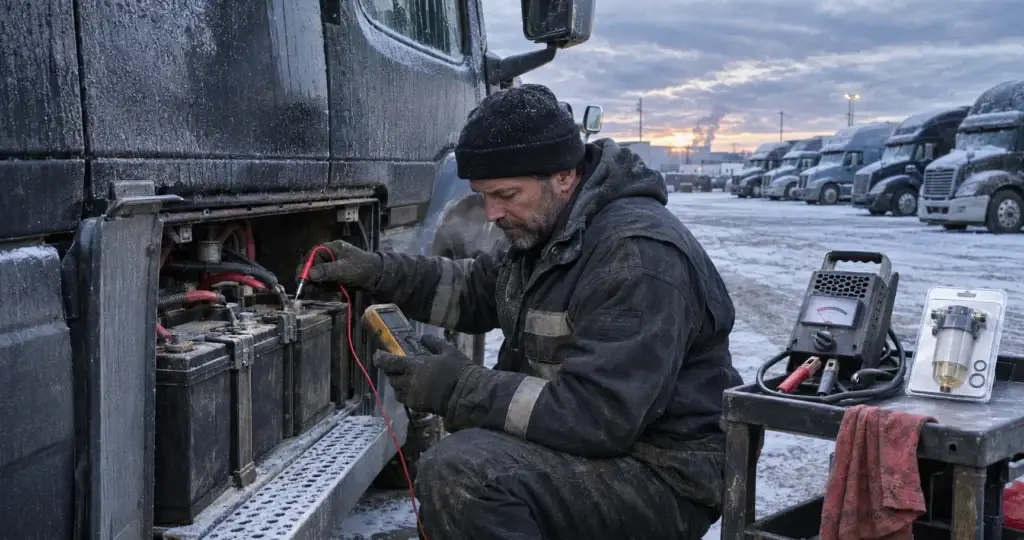
Cold weather reduces what a battery can deliver while it increases what the engine demands, which makes the battery the most common cause of slow cranking. The reduced chemical activity in a cold battery means less starting current precisely when thicker oil and preheating devices demand more.
Test Before the Freeze
Test batteries in the fall with a load test, following the battery maker's and your shop's procedure, instead of relying on a voltage reading alone. A battery that reads acceptable at rest can fail under load. HDJ's Heavy Duty Battery Load Tester: Practical Fleet Shop Guide compares load testers, and Commercial Truck Battery Maintenance: Complete Fleet Guide covers the maintenance program.
Cables and Connections
Corroded or loose terminals and cables create resistance that costs starting power. Clean terminals to bright metal, protect them, tighten the connections and check ground cables as carefully as positive ones. A voltage drop test across a cable shows hidden resistance. A battery that keeps going flat overnight may have a parasitic draw, which HDJ covers in Parasitic Battery Drain: Complete Fleet Diagnostic Guide.
Battery Warmers and Chargers
Battery blankets, heaters and tenders help keep batteries warm and charged during idle periods. Use equipment sized for the battery, follow its instructions and check it before winter, since a failed warmer protects nothing.
Diesel Fuel Gelling and Cold Flow Problems
Diesel fuel gelling happens when paraffin wax crystallizes in cold fuel and blocks filters and lines. The cloud point is the temperature at which wax crystals first begin to appear, and fuel can plug filters at temperatures above its gel point.
| Term | What It Means | Why It Matters |
|---|---|---|
| Cloud point | Temperature where wax crystals first form and the fuel turns cloudy | Filters can begin to plug when fuel is near or below it |
| Cold filter plugging point | Temperature where wax can block a filter | Often the practical limit for trucks, and usually lower than the cloud point |
| Gel point | Temperature where the fuel loses its flow | The fuel cannot be pumped |
Cloud Point Depends on the Fuel
As of November 2026, the Minnesota Department of Agriculture's biodiesel handling guide says No. 2 diesel typically has a cloud point of -5°F to 5°F and No. 1 diesel has a cloud point of -40°F or less. It says fuel bought in July has no cold-flow additives unless you request them, so the fuel in your tank may not match the weather.
The same guide lists No. 1 diesel, cold-flow additives and fuel heating systems as ways to keep fuel from gelling below its cloud point, and says winter additives should be added when the fuel is at least 10°F above the cloud point. Once wax has formed, additives are far less effective.
⚠️ Safety Warning
Never use an open flame, torch or heat gun to thaw fuel lines or filters, because diesel vapor and the heat can start a fire. Move the truck to a heated space and let it thaw. Do not spray starting fluid into an engine unless the manufacturer permits it, since it can be dangerous with intake air heaters, and keep sparks and flames away from batteries, which can give off flammable gas.
Recognizing Gelled Fuel
Gelled fuel often shows up as an engine that cranks normally and will not start, or one that starts and then dies as the filter plugs. Do not keep cranking, which can strain the starter and wear the battery. Move the truck to a heated space, allow it to thaw, and replace the fuel filters, since wax can remain in the media.
Preventing Gelling
Use fuel that matches the expected low temperature, and treat it before the cold arrives. Confirm with your fuel supplier what cold-flow treatment the fuel carries. HDJ's Diesel Fuel Additives for Commercial Trucks: A Fleet Guide explains additive types, and Complete Diesel Truck Winterization Guide for Fleets covers the wider winter program.
Water, Filters and Air in the Fuel System
Water and restricted filters cause many cold-weather no-starts, and the Minnesota guide calls water the number one cause of filter plugging issues in diesel engines. Water freezes below 32°F, and the ice can block filters, lines and injection components.
Water in the Fuel
Water enters through condensation in partly filled tanks, contaminated fuel and poor seals. Because it is heavier than diesel, it settles at the bottom of the tank where the pickup draws it in. The Minnesota guide recommends keeping tanks full to reduce air space, filling at the end of each day, and checking tank bottoms for water in spring, fall and before cold weather.
Drain water separators on your normal service schedule and more often when cold weather arrives, and replace filters on the maker's interval before winter.
Air in the System
Air can enter through loose fittings, cracked lines or filter changes, and a diesel fuel system that cannot move fuel will not start. Cold stiffens rubber lines and can open connections that sealed in warm weather. Bleed the system by the maker's procedure after any fuel system work.
Starter and Electrical System Problems
Starter and electrical problems often hide until cold weather raises the load on them. The starter, solenoid, relays, cables and grounds all carry heavy current at start-up, and a weakness anywhere in that path shows up as slow cranking, clicking or no response.
Starter Symptoms
A click with no cranking can mean the solenoid is engaging while the starter motor fails to turn, or that the battery cannot supply the current. Cranking that slows as the attempt goes on can point to a worn starter, though a weak battery produces the same symptom, so test the battery first. HDJ's Diesel Truck Starter Problems: Complete Troubleshooting Guide explains the diagnosis.
Connections and Grounds
Check battery cables, starter connections and chassis grounds for corrosion, damage and looseness. A voltage drop test shows resistance that a visual check misses. Clean and tighten connections, and replace damaged cables rather than patching them.
Engine Compression and Mechanical Condition
Engine compression and mechanical condition decide whether a diesel can reach ignition temperature, and marginal compression can hide in warm weather until winter exposes it. Worn rings, valves or cylinders let heat and pressure escape, and cold-start failures may be the first sign.
Signs of Low Compression
Long cranking before the engine catches, white smoke on cold starts and rough running until warm are common signs, especially when the battery, fuel and start aids test normal. These are clues, not proof. A compression test, compared with the maker's specification, confirms it, and HDJ's Best Diesel Compression Testers: Professional Buyer's Guide covers the testers.
Oil Grade and Viscosity
Cold oil resists cranking, so use the oil grade the engine maker recommends for the temperatures you operate in. Do not choose a grade outside the maker's specification. HDJ's 15W-40 vs 10W-30 Diesel Engine Oil: Complete Fleet Guide explains how grade choices differ.
Cold Weather Starting Solutions
The most effective cold-starting solutions warm the engine and the battery before starting and protect the fuel. Block heaters, coolant heaters and battery warmers each solve a different part of the problem, and the best approach combines them.
Block Heaters
A block heater warms the coolant and the engine block before starting, which helps cranking and reduces wear. Test the heater and its cord before winter. As of November 2026, Natural Resources Canada advises putting a block heater on a timer set to turn on no more than 2 hours before you start the engine, and says on its idling page that two hours is more than enough.
Coolant Heaters and Battery Warmers
Fuel-fired coolant heaters can preheat an engine away from shore power, and battery warmers and blankets protect the batteries. Follow the heater maker's installation and ventilation instructions, and have a qualified technician install fuel-fired units.
Warm-Up and Idling
Follow the engine maker's warm-up instructions and your state or province's idling rules. Natural Resources Canada's idling facts page says driving is the best way to warm an engine, but its figures are for light-duty vehicles and it does not address heavy diesel engines, so treat it as general guidance and check the manual for your truck.
Pre-Winter Preparation Checklist
Free Diesel Maintenance Checklist
Get HDJ's free, field-tested diesel maintenance checklist delivered instantly to your inbox — print it, laminate it, keep it in the shop.
Instant PDF • 100% Free • No Spam

A fall preparation program prevents most winter starting problems. Begin before the first hard freeze, and schedule the work so every truck is covered. HDJ's Winter Fleet Maintenance: Essential Cold Weather Strategies lists the wider winter tasks.
Pre-winter cold-start checklist
- Batteries: load test, clean and tighten terminals, and test warmers.
- Cables and grounds: inspect and voltage-drop test the starting circuit.
- Start aids: test glow plugs or intake heaters and the block heater against the maker's procedure.
- Fuel: confirm cold-flow treatment, replace filters and drain water separators.
- Oil: confirm the grade the maker recommends for your temperatures.
- Records: log the work in the vehicle maintenance record.
As of November 2026, 49 CFR 396.3 requires motor carriers to keep records that identify the vehicle, show when inspections and maintenance are due and record the date and nature of the work. Drivers should also report hard starting. 49 CFR 396.11 requires a written inspection report at the completion of each day's work, and the report is not required when the driver finds no defect. HDJ's Driver Vehicle Inspection Report: A Complete DVIR Guide covers the process.
Frequently Asked Questions
Why won’t my diesel engine start in cold weather when it runs fine in summer?
Cold weather works on heat, power and fuel at once: cold metal absorbs compression heat, the battery delivers less current while oil is thicker, and fuel can gel or freeze. Check the battery and cables first, then fuel and start aids.
How can I tell if my diesel glow plugs are failing?
Hard cold starts, white smoke and rough running until the engine warms up point to failed glow plugs. Test each plug against the engine maker's resistance specification, and check the relay, wiring and control side before you replace the whole set.
At what temperature does diesel fuel gel?
It depends on the fuel and its treatment. The Minnesota Department of Agriculture says No. 2 diesel typically has a cloud point of -5°F to 5°F and No. 1 diesel -40°F or less. Confirm your fuel's cold-flow protection before the freeze arrives.
How long should I plug in a block heater?
Natural Resources Canada advises a timer set to start the heater no more than 2 hours before you start the engine, and says two hours is more than enough. Its advice is general, so check your engine maker's instructions for heavy-duty engines.
Should I let my diesel engine idle to warm up in cold weather?
Follow the engine maker's warm-up instructions and your local idling rules. Natural Resources Canada says driving is the best way to warm an engine, but its figures cover light-duty vehicles and the page does not address heavy diesel engines or fleet idling rules.
Can I add gasoline or kerosene to prevent diesel from gelling?
Do not add gasoline to diesel fuel. The Minnesota guide names No. 1 diesel, cold-flow additives and fuel heating as the ways to prevent gelling, so use those, and ask your fuel supplier or engine maker before you blend anything else.
The Bottom Line
When a diesel engine won’t start cold, look at the symptom first: slow cranking points to the battery and cables, normal cranking without firing points to fuel or heat, and a start followed by a stall points to fuel flow. Most winter no-starts are visible in the fall.
Test batteries and start aids, confirm fuel treatment, drain water, and put the checks on a calendar. Michael Nielsen and the Heavy Duty Journal team publish guides like this at heavydutyjournal.com so fleets can keep trucks moving in winter.
Share This Cold Weather Guide
Help fellow fleet managers and diesel technicians prepare for winter. Share this guide with your shop team before the first hard freeze.