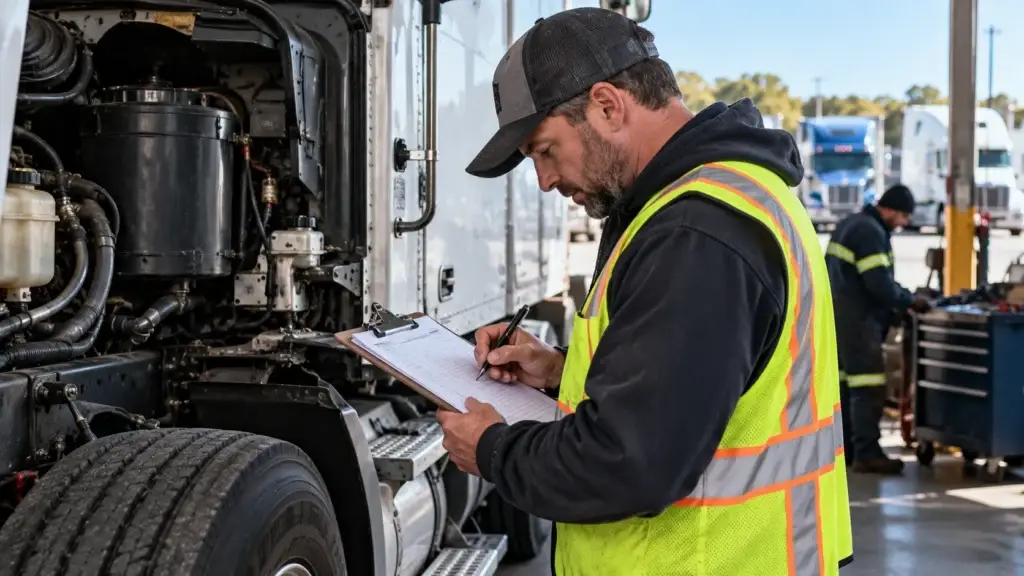
Commercial truck driver completing a digital vehicle inspection report on a tablet during a pre-trip safety inspection of a semi truck

Driver Vehicle Inspection Report (DVIR): A Complete Guide for Fleet Managers

Table of Contents
    Add a header to begin generating the table of contents

    By Michael Nielsen, Editor & Publisher | 15+ Years in Diesel Repair & Fleet Operations

    Last Updated: June 2026

    ⏱ Estimated reading time: 18 minutes

    A driver vehicle inspection report (DVIR) is a federally mandated document that creates a legally binding chain of accountability between the driver who identifies a defect, the carrier who repairs it, and the next driver who confirms the repair before operating the vehicle. Required under 49 CFR §396.11, DVIRs apply to commercial motor vehicles weighing 10,001 pounds or more, buses carrying nine or more passengers, and vehicles placarded for hazardous materials. For fleet managers, the DVIR is not a driver form — it is the backbone of your vehicle maintenance compliance program, the document FMCSA auditors examine in the vast majority of compliance reviews, and the record that protects your operation when a defect turns into an accident or a lawsuit. This guide covers everything you need to know: when a DVIR is legally required, what the report must contain, how the three-signature compliance chain works, what the March 2026 electronic DVIR rule changes for your fleet, the penalties for violations, and the management practices that separate compliant fleets from the 93% that accumulate citations.

    Key Takeaways

    • DVIRs are required under 49 CFR §396.11 for property-carrying CMVs when defects are found, and every operating day for passenger-carrying vehicles — but only 7% of motor carriers pass a focused compliance review without a single DVIR violation.
    • The three-signature chain is non-negotiable — driver reports defect, mechanic certifies repair, next driver acknowledges before operating. Breaking any link in this chain creates a direct violation.
    • Penalties are severe and compounding — fines range from $1,270 per missed report up to $15,420 for dispatching a vehicle with unrepaired safety defects, on top of CSA score damage.
    • The March 2026 eDVIR final rule explicitly authorizes electronic DVIRs in 49 CFR §396.11, removing all regulatory ambiguity and setting a clear technical standard for digital records.
    • Fleet managers, not just drivers, are accountable — carriers face separate violations for failing to repair certified defects, failing to retain records, and dispatching vehicles before the compliance chain is complete.

    What Is a Driver Vehicle Inspection Report?

    A driver vehicle inspection report is a formal written or electronic record confirming that a commercial motor vehicle driver has inspected the vehicle for defects or deficiencies that could affect safe operation or cause a mechanical breakdown. The DVIR documents the condition of specific vehicle components, captures any defects discovered, records the mechanic's certification that defects have been repaired, and confirms that the next driver reviewed the report before operating the vehicle.

    The regulation governing DVIRs, 49 CFR §396.11, defines the minimum vehicle systems to be covered, the documentation requirements, the chain of custody between driver and carrier, and the record retention obligations for motor carriers. A companion regulation, 49 CFR §396.13, governs the driver's pre-trip obligation to review the most recent DVIR and acknowledge that required repairs were completed before operating the vehicle.

    Think of the DVIR not as a form but as a communication chain. The driver identifies what needs attention. The shop fixes it and certifies the fix. The next operator confirms the vehicle is cleared before departure. Every link in that chain has a regulatory obligation and a corresponding signature. Miss one link, and the chain breaks — producing a violation that follows the carrier into every subsequent audit and CSA review.

    Who Is Required to Complete a DVIR?

    DVIR requirements under 49 CFR §396.11 apply to drivers of commercial motor vehicles that fall into any of these three categories: vehicles or vehicle combinations with a gross vehicle weight rating or gross combination weight rating exceeding 10,000 pounds, vehicles designed or used to transport nine or more passengers (including the driver) for compensation, and vehicles placarded for hazardous materials. The regulations cover both interstate and intrastate operations where federal rules apply.

    Three categories of carriers are exempt from DVIR requirements: private motor carriers of passengers operating on a nonbusiness basis, driveaway-towaway operations, and any motor carrier operating only one commercial motor vehicle. Note that single-vehicle owner-operators who qualify for this exemption are still required to perform pre-trip inspections under 49 CFR §392.7 and maintain general vehicle maintenance records — the DVIR exemption does not eliminate the inspection obligation, only the paperwork requirement.

    If a driver operates more than one vehicle during a single workday, a separate DVIR must be prepared for each vehicle operated where a defect or deficiency is discovered. The regulation explicitly addresses this — one inspection and one report per vehicle per tour of duty.

    When Is a DVIR Actually Required?

    This is the question that trips up even experienced fleet safety managers, because the answer differs based on vehicle type — and changed significantly with a 2014 regulatory amendment.

    Property-Carrying CMVs

    For trucks, tractors, and other property-carrying commercial motor vehicles, drivers are not required to prepare a written DVIR if no defect or deficiency is discovered by or reported to the driver during the day's work. This was a regulatory change FMCSA made in 2014 to reduce paperwork burden. Prior to that rule change, a report was required after every operating day regardless of defect status.

    However — and this is a critical operational distinction — many motor carriers require their drivers to complete a DVIR after every operating day as company policy, whether or not defects are found. The regulatory logic behind this practice is solid: consistent daily DVIRs create a documented inspection record that proves drivers are actually walking the equipment, not just rubber-stamping a clean sheet. During a DOT compliance review or litigation, the presence of daily no-defect DVIRs is significantly better protection than a gap in the record.

    Passenger-Carrying CMVs

    For buses and other passenger-carrying vehicles, the requirement is more stringent. A DVIR must be submitted for each vehicle operated every day, regardless of whether any defects are found. The 2014 no-defect exemption for property carriers explicitly does not apply to passenger-carrying vehicles.

    7%

    The share of motor carriers that pass a focused FMCSA compliance review without a single DVIR-related violation — meaning 93% of fleets accumulate citations that compound into fines, CSA score damage, and increased audit frequency.

    The 11 Required DVIR Inspection Components

    Under 49 CFR §396.11, every driver vehicle inspection report must cover at minimum the following eleven parts and accessories. This is a regulatory floor, not a ceiling — carriers can require inspection of additional components, and many do. Any defect "affecting safe operation or likely to cause breakdown" must be documented, even if the defective item is not on the mandatory list.

    Required Inspection ComponentWhat Drivers Are Checking
    Service brakes (including trailer brake connections)Brake pedal feel, air pressure, slack adjusters, brake lines, trailer glad-hands
    Parking brakeEngagement, holding ability on grade, release function
    Steering mechanismSteering wheel play, tie rod ends, drag link, power steering fluid
    Lighting devices and reflectorsHeadlights, taillights, brake lights, turn signals, clearance lights, conspicuity tape
    TiresTread depth, inflation, sidewall condition, valve stems, matching dual heights
    HornFunction test — audible and operational
    Windshield wipersBlade condition, wiper motor function, washer fluid
    Rear vision mirrorsAdjustment, mounting security, glass condition, visibility coverage
    Coupling devicesFifth wheel condition and locking, kingpin, pintle hooks, safety chains
    Wheels and rimsLug nuts, rim cracks, missing hardware, hub seals, proper seating
    Emergency equipmentFire extinguisher, warning triangles or flares, first aid kit where required

    These eleven components are harmonized with pre-trip inspection requirements under 49 CFR §392.7, which governs what drivers must check before operating. A defect found during the post-trip DVIR inspection flows directly into the pre-trip review obligation the next driver must complete before departure.

    Keep Your Fleet Running at Full Capacity

    Get HDJ's maintenance guides, compliance updates, and fleet management strategies delivered weekly — built for working diesel professionals.

    The Three-Signature DVIR Compliance Chain

    The DVIR compliance chain is a three-step custody process involving three separate parties — driver, mechanic or carrier official, and the next driver. Understanding this chain is the single most important thing a fleet manager can do to build a defensible DVIR program, because every FMCSA audit checks whether all three links are present and properly documented.

    Step 1: The Driver Report

    At the completion of each day's work, the driver inspects the vehicle against the 11 required component categories and documents any defects or deficiencies found. The report must identify the vehicle — license plate, VIN, fleet unit number, or other clear identifier — and list each defect with enough specificity that a mechanic can locate and address it. The driver then signs and dates the report.

    For property-carrying CMVs, if no defects are found, a written report is not legally required — but the driver must still certify that the inspection was performed. For property-carrying operations that require daily DVIRs by company policy, the driver marks the report as "no defects found" and signs it. For passenger-carrying operations, a full signed report is required every operating day regardless.

    Step 2: Carrier Repair and Certification

    Once the carrier or its agent receives the DVIR, any defect that would likely affect safe operation must be repaired before the vehicle is dispatched again. The regulation does not allow the fleet to simply acknowledge the defect and operate the vehicle anyway — safety-affecting defects must be corrected or certified as not requiring repair before the vehicle moves again.

    The mechanic or carrier official then certifies on the original DVIR that the defect has been repaired, or that repair is unnecessary because the item does not affect safe operation. This certification must appear on the original report — not a separate document. The certification links directly to the defect listed, closes the loop between the driver's report and the maintenance response, and creates the audit record that FMCSA reviewers are looking for.

    Step 3: Next-Driver Acknowledgment

    Before operating the vehicle, the next driver must review the most recent DVIR, confirm that any defects listed have been repaired or certified as unnecessary to repair, and sign the report acknowledging that review. This is governed by 49 CFR §396.13 — a separate regulatory requirement that carries its own compliance obligations distinct from §396.11.

    If no DVIR was filed because no defects were found on the previous trip, the next driver still performs a pre-trip inspection and must be satisfied that the vehicle is in safe operating condition before departure. The absence of a DVIR does not eliminate the pre-trip obligation — it simply means there is no prior report to review.

    Key Recommendation

    Never dispatch a vehicle until all three links in the DVIR chain are documented. A common audit trap is a vehicle with a defect on the DVIR, a repair note from the shop, but no next-driver acknowledgment signature before departure. That gap is a violation regardless of whether the repair was completed correctly.

    DVIR Record Retention: What Carriers Must Keep

    Under 49 CFR §396.11, every motor carrier must retain the driver vehicle inspection report, the certification of repairs, and the certification of the driver's review for a minimum of three months (90 days) from the date the written report was prepared. All three documents — the original report, the repair certification, and the next-driver acknowledgment — must be maintained together and be available on demand to authorized federal, state, and local officials.

    The 90-day minimum is a regulatory floor, and many compliance professionals recommend retaining DVIRs for at least 12 months. The reason is practical: CSA violation history goes back 24 months in the Safety Measurement System, and DVIR records from well-documented inspections can be used to challenge roadside violations that appear in your CSA data. Retaining records longer costs nothing when records are stored digitally, and the litigation protection value of a complete DVIR archive can be substantial if an accident occurs.

    For roadside inspection reports that result in out-of-service violations, retention requirements extend to 12 months. Annual inspection reports must be retained for 14 months from the date of inspection. A well-organized fleet maintains all of these records in a unified system rather than managing separate retention schedules for each record type.

    DVIR Violations and Penalties: What Fleet Managers Face

    FMCSA civil penalty amounts are updated periodically to reflect inflation, and the current schedule makes DVIR non-compliance expensive enough to demand systematic management. What begins as a single missed report can cascade into compounding violations across an entire fleet during a focused compliance review.

    Violation TypePer-Occurrence Penalty
    Driver fails to complete or sign a required DVIRUp to $1,270
    Falsifying inspection records (marking items as pass without inspecting)Up to $12,700
    Carrier fails to repair certified defects before dispatchUp to $15,420
    Operating vehicle placed out-of-serviceUp to $19,277

    Each missing or incomplete DVIR constitutes a separate violation. For a fleet of 50 trucks with systematic DVIR failures, a single focused compliance audit could expose the carrier to $63,500 or more in fines before any CSA score consequences are calculated. Beyond the direct financial penalties, DVIR violations accumulate in the Vehicle Maintenance and Driver Observed BASIC categories of the FMCSA Safety Measurement System, triggering increased audit frequency, higher insurance premiums, and in serious cases, suspension of operating authority.

    The 2026 CSA overhaul created a new "Driver Observed" sub-category within Vehicle Maintenance that specifically tracks roadside violations for defects drivers should have caught during their pre-trip or post-trip walk-around — burned-out headlights, cracked mirrors, visible tire damage, lighting failures. A fleet with consistent DVIR records showing drivers are catching these items before roadside inspectors do earns measurable CSA score protection. A fleet without DVIR documentation has no such defense.

    The HDJ Perspective

    After 15-plus years working around fleets and diesel operations, the pattern I see most consistently is this: the carriers who struggle with DVIR compliance aren't the ones who don't care — they're the ones who treat the DVIR as a driver responsibility instead of a systems responsibility. When drivers know that defect reports disappear into a black hole and nothing gets fixed, they stop writing thorough reports. When mechanics know that no one checks whether the certification made it back to the driver file, the chain breaks silently. The DVIR only works when the fleet manager builds the feedback loop — driver reports, shop response, and dispatch hold form a complete circuit. If dispatch can release a truck without confirming the prior DVIR was closed, your system has a gap that will show up in an audit. Summer heat right now is accelerating tire pressure changes and coupling wear faster than usual — this is exactly when thorough daily walk-arounds catch the conditions that become out-of-service orders in August.

    The 2026 Electronic DVIR Rule: What Changed and What It Means for Fleets

    On February 19, 2026, FMCSA published a final rule in Federal Register Vol. 91, No. 33 (Docket FMCSA-2025-0115) explicitly authorizing electronic Driver Vehicle Inspection Reports. The rule took effect on March 23, 2026, and added eDVIR language directly into 49 CFR §396.11 and §396.13 — the specific sections governing inspection reports.

    Electronic DVIRs were technically permissible since 2018 under 49 CFR §390.32, which governs electronic recordkeeping for motor carriers. However, the prior framework left enough regulatory ambiguity that some carriers, safety auditors, and attorneys interpreted the standards differently. The 2026 final rule eliminates that grey area by putting eDVIR authorization directly into the inspection-specific regulations rather than relying on cross-reference to the general electronic records rule.

    What the Rule Explicitly Authorizes

    Under the finalized rule, carriers may create, maintain, and transmit DVIRs in electronic format. All three signatures in the compliance chain — driver, mechanic or carrier official, and next driver — can be captured electronically with timestamps. Records may be stored digitally and produced digitally during audits with no wet ink signature required. Electronic systems must meet the technical standards for electronic records established in 49 CFR §390.32, including data integrity requirements and authenticated user access controls.

    What the Rule Does Not Change

    Paper DVIRs remain legally acceptable. The rule does not mandate electronic DVIRs — it authorizes them. FMCSA did not reinstate the requirement for no-defect DVIRs on property-carrying CMVs, despite requests during the rulemaking comment period, noting that eDVIRs make daily completion significantly faster and easier. The inspection content requirements, the 11 mandatory component categories, the three-signature chain, and the 90-day retention minimum are unchanged.

    The American Trucking Associations, the Owner-Operator Independent Drivers Association, and the National Tank Truck Carriers all supported the rulemaking during the comment period, citing operational efficiency gains and audit-record quality improvements as primary benefits.

    CapabilityPaper DVIRElectronic DVIR
    Defect notification to shopDriver delivers or mails form — delay of hours to daysInstant notification at submission
    Three-signature chain enforcementManual tracking — gaps possibleSystem can block dispatch until chain is complete
    Audit record retrievalManual file search — hours to daysInstant retrieval by date, unit, driver
    Defect photo documentationNot available on standard formGeotagged, timestamped photos at point of discovery
    Record retention complianceManual filing system — loss riskAutomated, indefinite retention at minimal cost
    Technology costNo technology cost requiredPlatform licensing — typically per-unit per-month

    What Qualifies as a DVIR Violation: Common Fleet Mistakes

    Understanding which specific failures generate violations helps fleet managers build DVIR programs that target the right failure points. These are the most common compliance gaps FMCSA auditors find in carrier records:

    Pencil Whipping

    Pencil whipping is the industry term for drivers checking inspection boxes without actually performing the inspection — marking every component as satisfactory on a daily basis regardless of actual condition. This is one of the most dangerous failure modes in any DVIR program because it looks like compliance from the outside while eliminating the safety function the report exists to serve.

    Pencil whipping on paper forms is structurally easy because there is no enforcement mechanism preventing a driver from signing a clean form from the cab. Electronic DVIRs with photo-required fields, guided walk-around workflows, and GPS-location validation at submission significantly reduce pencil whipping because the system requires proof that the driver was at the vehicle. When a roadside inspector later finds a defect that a consistent pattern of clean DVIRs should have identified, the discrepancy becomes direct evidence of falsification — an offense that carries up to $12,700 per occurrence.

    Missing Mechanic Certification

    A defect is noted on the DVIR. The shop fixes it. The vehicle goes back out. But the mechanic's certification on the original DVIR was never completed, or was written on a separate work order that never made it into the DVIR file. From a compliance standpoint, this is identical to the defect never being repaired — the legally required certification on the original document is absent, and the chain is broken.

    Next-Driver Signature Gap

    The prior DVIR shows a defect. The repair certification is present. But the next driver departed without signing the acknowledgment that they reviewed the repair status. This is a violation of 49 CFR §396.13 and appears during audits as a broken chain — even when the physical repair was completed correctly. Dispatch protocols that require the next-driver signature confirmation before releasing a vehicle for operation are the most effective control for this gap.

    Vague Defect Documentation

    A DVIR that notes "brakes — issue" does not provide a mechanic with actionable information, and it does not create a defensible audit record. Defect documentation must be specific enough to identify the nature of the problem, the component, and ideally the location on the vehicle. "Right rear service brake chamber leaking air at glad-hand connection" is a compliant defect notation. "Brake issue" is not.

    Record Retention Failures

    DVIRs that are purged before the 90-day minimum, stored in vehicles rather than at the carrier's principal place of business, or not retrievable on demand during an audit constitute violations even if the underlying inspections were conducted properly. The regulation requires that the carrier maintain the records — not that they exist somewhere — and retrievability on demand is part of the compliance standard.

    Building an Effective Fleet DVIR Program

    A functional DVIR program is not a driver training initiative — it is a systems design problem. The program must make compliance the path of least resistance at every step of the chain, from driver inspection through shop response to dispatch clearance.

    Establish a Daily DVIR Policy for All Vehicles

    Even where the regulations allow property-carrying CMVs to skip a report when no defects are found, most fleet compliance professionals recommend requiring daily DVIRs for all vehicles. The documentation value of consistent daily records — particularly for audit defense and CSA score protection in the new Driver Observed category — outweighs the minor additional time. With electronic systems, a no-defect daily DVIR takes under two minutes.

    Integrate DVIR into the Dispatch Hold Process

    Dispatch should not be able to release a vehicle when an open DVIR defect has not been certified as repaired, or when the next-driver acknowledgment signature is missing. This requires a documented dispatch checklist or a system integration that surfaces DVIR status before a unit is assigned to a load. The protocol does not need to be complex — it needs to be enforced consistently. A simple rule — "no open DVIR without a closed repair certification means no dispatch" — eliminates the most common compliance chain breaks.

    Create a Defect-to-Work-Order Workflow

    Every defect reported on a DVIR should automatically generate a work order or corrective action assignment that flows to the maintenance department. In paper-based operations, this typically means a designated maintenance review of all incoming DVIRs at the start of each shift. In electronic operations, this can be automated so that any defect notation triggers a work order and assigns it to a technician, with repair certification feeding back directly into the DVIR record.

    Conduct Periodic DVIR Audits

    Internal DVIR audits — reviewing a sample of DVIRs monthly or quarterly — catch systematic problems before FMCSA does. Review the sample for complete three-signature chains, defect documentation quality, timely repair certifications, and record completeness. Cross-reference DVIR defect history against roadside inspection violations in your CSA data. If roadside inspectors are consistently finding defects on equipment that your DVIRs show as clean, you have a pencil-whipping problem that requires driver retraining and potentially a system change.

    The Commercial Vehicle Safety Alliance publishes inspection standards that align closely with DVIR component categories — reviewing CVSA's inspection procedures and out-of-service criteria gives fleet managers a roadside inspector's perspective on what constitutes a documented-but-overlooked defect in DVIR records.

    Free Professional Fleet Tools

    Cost calculators, fault code lookup, maintenance planners, and more — built for owner-operators, fleet managers, and diesel techs. No signup required.

    Explore Free Tools →

    DVIR and the Annual DOT Inspection Relationship

    The DVIR program and the annual DOT inspection are separate regulatory obligations that work together to maintain fleet safety. The annual inspection under 49 CFR §396.17 requires a qualified inspector to examine each CMV against a comprehensive set of criteria. The DVIR is the daily driver-level check between annual inspections — the system that catches developing defects before they fail the vehicle at a roadside check or cause an accident between inspection cycles.

    Annual inspection records must be retained for 14 months and either displayed on the vehicle or made available to enforcement officials on demand. A fleet manager who maintains thorough DVIR records alongside annual inspection documentation builds a maintenance history that demonstrates systematic compliance — the kind of record that drives favorable audit outcomes and supports insurance coverage positions.

    The TMC Transportation Maintenance Council, a division of the American Trucking Associations, publishes recommended practices for vehicle inspection and maintenance that many fleet managers use as the operational standards underlying both their DVIR programs and preventive maintenance intervals. TMC's Recommended Practices library covers inspection intervals, component service life standards, and documentation requirements that complement the regulatory framework.

    DVIR for Owner-Operators: Specific Considerations

    Owner-operators operating as single-vehicle carriers are exempt from the written DVIR requirement under 49 CFR §396.11(a)(5). However, this exemption only removes the written report requirement — it does not exempt owner-operators from conducting pre-trip inspections under 49 CFR §392.7, maintaining vehicle maintenance records under 49 CFR §396.3, or meeting annual inspection requirements. The exemption is narrower than many single-truck operators assume.

    Owner-operators who lease their authority to a motor carrier operate under the carrier's DVIR program and are subject to the carrier's requirements — which may exceed the regulatory minimum. The lease agreement between an owner-operator and a carrier governs which party is responsible for maintaining DVIR records, and that responsibility should be explicit in any lease arrangement.

    Owner-operators operating under their own authority with more than one vehicle lose the single-vehicle exemption and must comply with the full DVIR program requirements for all vehicles in their fleet. The exemption applies to carriers operating exactly one CMV — not to the driver or the individual vehicle.

    Evaluating eDVIR Platforms: What Fleet Managers Should Require

    With the March 2026 final rule removing regulatory ambiguity, more fleets are evaluating electronic DVIR platforms. The eDVIR market includes standalone inspection apps, modules within fleet management systems, and integrations within ELD platforms. Not all eDVIR tools enforce the full compliance chain, and the capabilities that separate adequate tools from genuinely protective tools are specific and worth verifying before committing to a platform.

    Non-Negotiable Platform Capabilities

    Any eDVIR platform under evaluation must enforce the complete three-signature chain digitally — driver report, mechanic certification, and next-driver acknowledgment — with timestamps for each action. A platform that captures the driver's report but not the mechanic certification or next-driver sign-off produces the same compliance chain gaps as paper. Verify that the system can block dispatch or generate a compliance hold when the chain is incomplete.

    Look for compliance with 49 CFR §390.32 for electronic record integrity — this means authenticated user access, tamper-evident records, and the ability to produce complete records in a retrievable format during audits. Evaluate photo attachment capability with geolocation and timestamp metadata, which creates defect documentation that is significantly more defensible in both DOT audits and litigation than a text notation.

    Automatic retention exceeding the 90-day regulatory minimum should be standard in any credible platform. Digital storage costs are low enough that there is no operational reason to purge records at the regulatory minimum, and extended retention substantially improves audit and litigation defense.

    Conclusion

    The driver vehicle inspection report is a compliance requirement, a safety tool, and an audit record simultaneously. Fleets that treat it as a driver form — something that happens at the end of the day and gets filed somewhere — will continue to populate the 93% that accumulate DVIR violations in every focused compliance review. Fleets that treat it as a management system — with documented dispatch holds, defect-to-work-order workflows, and systematic internal audits — protect their CSA scores, reduce roadside violations, and build the kind of maintenance record that survives both audits and litigation.

    The March 2026 eDVIR final rule makes the transition to electronic DVIRs unambiguous for carriers who have been waiting for full regulatory clarity. Whether your fleet runs paper or electronic, the underlying requirements are the same: the three-signature chain must be complete, defects must be repaired before dispatch, and records must be retained and retrievable. The technology changes the friction involved in meeting those requirements — it does not change the requirements themselves.

    For fleet managers building or rebuilding a DVIR program, start with the workflow: driver inspection to defect report, defect report to work order, repair completion to certification, certification to next-driver review, next-driver review to dispatch clearance. Every step has a regulatory obligation. Every step needs a documented, verifiable record. Close all five links in that chain, and the DVIR becomes exactly what the regulation intends — a daily safety system that keeps defective equipment off the road before it becomes a violation, a breakdown, or something worse.

    Frequently Asked Questions

    Is a DVIR required when no defects are found?

    For property-carrying commercial motor vehicles, drivers are not required to prepare a written DVIR if no defect or deficiency is discovered by or reported to the driver. This was established in a 2014 regulatory amendment to 49 CFR §396.11. For passenger-carrying vehicles, a DVIR is required every operating day regardless of defect status. Many carriers require daily DVIRs for all vehicles as company policy regardless of the regulatory minimum, because consistent records provide audit protection and demonstrate active inspection compliance.

    How long must a carrier keep DVIR records?

    Under 49 CFR §396.11, carriers must maintain the driver vehicle inspection report, the certification of repairs, and the certification of the driver's review for a minimum of three months (90 days) from the date the report was prepared. Out-of-service inspection reports require 12-month retention. Annual inspection reports must be retained for 14 months. Most compliance professionals recommend retaining DVIRs for at least 12 months given the 24-month CSA violation history window, and digital storage makes extended retention essentially cost-free.

    Can a DVIR be completed electronically?

    Yes. FMCSA published a final rule on February 19, 2026 (effective March 23, 2026) explicitly authorizing electronic DVIRs in 49 CFR §396.11 and §396.13. Electronic DVIRs were permissible under 49 CFR §390.32 since 2018, but the 2026 rule adds explicit eDVIR authorization to the inspection-specific regulations, removing all ambiguity. Electronic creation, maintenance, and digital signatures for all three required signatories are fully compliant. Paper DVIRs remain acceptable — the rule authorizes eDVIRs but does not mandate them.

    What happens if a vehicle is dispatched with an unrepaired DVIR defect?

    Dispatching a vehicle with a documented defect that affects safe operation before it has been repaired and certified is a federal violation. The carrier faces civil penalties up to $15,420 per occurrence under current FMCSA penalty schedules. If the vehicle is subsequently found with that defect during a roadside inspection, an out-of-service order can be issued and the penalty exposure increases to up to $19,277 for operating a vehicle placed out of service. Beyond direct fines, the violation accumulates in the carrier's CSA Vehicle Maintenance BASIC category.

    Does the DVIR requirement apply to owner-operators?

    Owner-operators operating as single-vehicle carriers are exempt from the written DVIR requirement under 49 CFR §396.11(a)(5). This exemption covers only the written report obligation — not pre-trip inspection, vehicle maintenance records, or annual inspection requirements. Owner-operators with more than one vehicle in their fleet lose the single-vehicle exemption and must comply with full DVIR requirements for all vehicles. Owner-operators leased to a motor carrier operate under the carrier's DVIR program.

    What is the difference between a DVIR and a DOT roadside inspection?

    A DVIR is a driver-performed inspection documented by the carrier — it is a daily internal compliance document. A DOT roadside inspection is a formal inspection conducted by a certified enforcement officer using standardized CVSA criteria. DVIRs help prevent failures at roadside inspections by catching defects during daily walk-arounds before they are found by enforcement. A vehicle with consistent, thorough DVIR records that align with roadside inspection results demonstrates a functioning inspection program. A vehicle with clean DVIRs and repeated roadside violations creates a discrepancy that auditors specifically look for as evidence of falsification.

    What is "pencil whipping" and why does it matter for DVIR compliance?

    Pencil whipping refers to the practice of completing inspection report checkboxes without actually performing the physical inspection — marking all components as satisfactory regardless of actual vehicle condition. It is the most common quality failure in DVIR programs and one of the most dangerous, because it creates the appearance of compliance while eliminating the safety function the report exists to serve. When a roadside inspector finds a defect that a pattern of consistent clean DVIRs should have identified, the discrepancy becomes evidence of falsification, which carries civil penalties up to $12,700 per occurrence. Electronic DVIR systems with photo documentation requirements and location-validated submission significantly reduce pencil whipping by requiring physical evidence at the point of inspection.

    Share This With Your Safety Manager or Fleet Director

    If you're a driver or dispatcher, the compliance manager in your operation needs to see the section on the three-signature chain and the March 2026 eDVIR rule — it's the kind of regulatory update that affects dispatch protocols and record retention systems directly.

    Leave a Comment

    Your email address will not be published. Required fields are marked *

    Free Guide

    The Working Tech's
    Tool Guide

    Shop-Tested. Field-Approved. Zero Fluff.

    9 Categories Covered:

    🔧 Shop & Bay 🔍 Diagnostic ⚙️ Engine 🔩 Drivetrain 💨 Air & Brake 🚛 Service Truck 🏗️ Heavy Equipment 🦺 PPE & Safety 🛞 Tire Repair
    Vetted Tools Only gear a diesel pro would actually buy
    All Disciplines From shop bay basics to heavy equipment
    Always Free No login. No paywall. Just the guide.
    Browse the Tool Guide →

    Expert Diesel Knowledge. Always Free.