By Michael Nielsen, Publisher | 15+ Years in Diesel Repair
Last Updated: October 2026
⏱ Estimated reading time: 14 minutes
A heavy equipment maintenance checklist covers seven systems on every machine: hydraulics, engine, electrical, undercarriage or tires, attachments, operator controls and safety devices. Checking them daily, weekly and by operating hour catches small faults before they turn into breakdowns that idle crews and push project dates.
Heavy Duty Journal (HDJ), written by publisher Michael Nielsen, rebuilt this guide in October 2026. Rules are checked against primary text from the Occupational Safety and Health Administration (OSHA) and the National Institute of Standards and Technology (NIST), and HDJ's practical judgment is labeled as judgment.
The guide covers why the checklist pays, how to structure daily and hour-based checks, one section for each system, then records, weather adjustments and the numbers that show whether the program works. Intervals vary by machine, so the manufacturer's manual overrides any number printed here.
Key Takeaways
- ✓Seven systems, one routine. Hydraulics, engine, electrical, undercarriage or tires, attachments, operator controls and safety devices each get their own checks, so nothing depends on memory.
- ✓Hours beat dates. Hour meters track real wear, so build service intervals on machine hours and treat the manufacturer's manual as the authority.
- ✓Inspection is in the rules. OSHA's construction safety-program rule calls for frequent and regular inspection of equipment by competent persons and for tagging or removing unsafe machines.
- ✓Waiting for failure costs uptime. A NIST survey of U.S. manufacturers found the most reactive establishments had 3.3 times more downtime than the least reactive.
- ✓Records make the checklist count. Dated, hour-stamped records support warranty claims and resale, and they show which machines keep failing.
In This Guide
- Why a Heavy Equipment Maintenance Checklist Pays Off
- How to Structure Daily, Weekly and Hour-Based Checks
- System 1: Hydraulics
- System 2: Engine and Cooling
- System 3: Electrical and Batteries
- System 4: Undercarriage and Tires
- System 5: Attachments and Wear Parts
- Systems 6 and 7: Operator Controls and Safety Devices
- Documenting and Tracking Maintenance
- Adjusting the Checklist for Heat, Cold, Dust and Moisture
- Measuring Whether the Program Works
- Frequently Asked Questions
- The Bottom Line
Why a Heavy Equipment Maintenance Checklist Pays Off
A heavy equipment maintenance checklist pays off because a breakdown costs more than the repair. When a production machine stops, the contractor still pays for the idle crew, a rental or substitute machine, the service call and any schedule penalty.
To see the effect, run your own numbers. A machine that bills $120 an hour and sits idle for 40 hours loses $4,800 in billings before parts, labor, rental or crew time. That is a hypothetical example, so substitute your own figures. HDJ's guide to fleet total cost of ownership shows how to carry those losses into the full cost picture.
As of October 2026, the clearest public data on maintenance and downtime comes from manufacturing, not construction. The NIST study of U.S. discrete manufacturers, using 2016 costs, found that 45.7 percent of machinery maintenance was reactive on average. The quarter of establishments most reliant on reactive maintenance had 3.3 times more downtime than the quarter least reliant.
A factory machine is not an excavator, but the logic carries over. Inspection is also part of the rules. Under Title 29 of the Code of Federal Regulations (CFR), 29 CFR 1926.20 requires employer safety programs to provide for frequent and regular inspections of job sites, materials and equipment by competent persons the employer designates.
The table summarizes all seven systems, and the sections after it explain each row.
| System | Daily walkaround | Periodic check (interval per manual) | Fault caught early |
|---|---|---|---|
| 1. Hydraulics | Fluid level, leaks, hoses, cylinder rods | Fluid sample, filter change, pressure test | Contamination, pump wear, hose failure |
| 2. Engine | Oil and coolant level, air filter indicator, belts, leaks | Oil analysis, coolant test, fuel filters | Overheating, dust wear, fuel problems |
| 3. Electrical | Gauges, warning lights, battery terminals | Battery load test, harness and connector inspection | No-start, charging faults, shorts |
| 4. Undercarriage or tires | Track tension, loose hardware, tire pressure and cuts | Wear measurement, rollers and idlers, wheel nuts | Early wear, derailed tracks, tire failure |
| 5. Attachments | Pins, bushings, cutting edges, coupler lock | Wear measurement, grease points, crack check | Pin wear, dropped attachment, cracking |
| 6. Operator controls | Joysticks, pedals, steering, brakes | Linkage play, calibration, brake test | Drift, lag, loss of control |
| 7. Safety devices | Seat belt, lights, horn, reverse alarm, guards | Cab structure, glass, extinguisher tag | Missing or disabled protection |
How to Structure Daily, Weekly and Hour-Based Checks
Build the heavy equipment maintenance checklist in three layers. Daily checks are a short walkaround before the machine works, weekly checks go deeper into leaks, wear and electrical condition, and hour-based service follows the manufacturer's schedule for fluids, filters and inspections.
Hour meters, not calendar dates, should drive the service layer, because a machine working 2,000 hours a year wears differently from one working 500. The original equipment manufacturer (OEM) manual sets the baseline intervals. HDJ's guide to preventive maintenance scheduling explains how to adjust them for your duty cycle.
Severe duty changes the numbers. Demolition, quarry work, sand, mud and continuous production wear a machine faster than the manual's moderate-duty assumption, so shorten intervals there. Stretch them only when fluid analysis and inspection results support it.
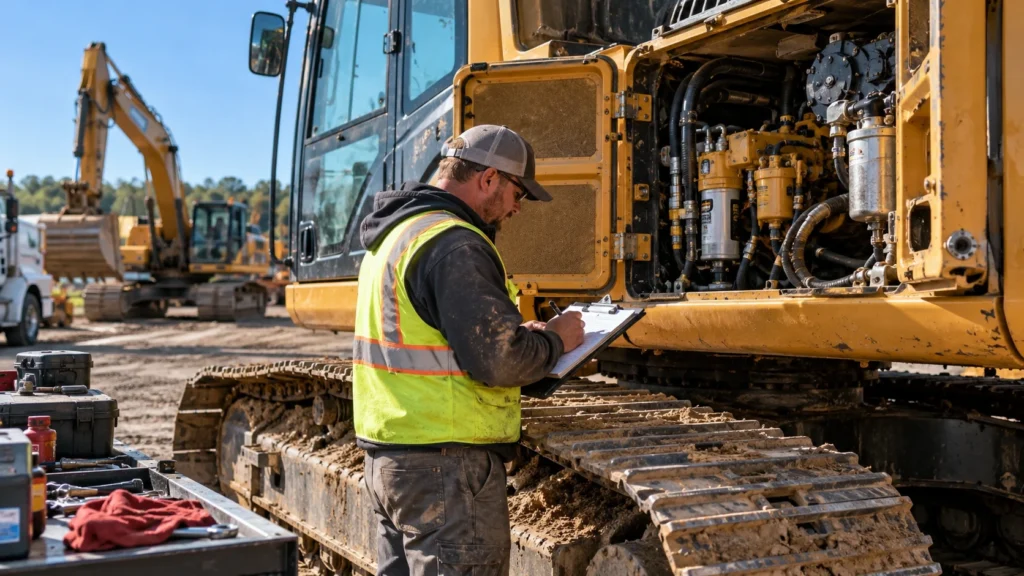
A good daily check takes minutes. Walk around the machine, look for fresh leaks, damage and loose hardware, check fluid levels, test lights, horn and alarms, and run each control through its range before loading. Write down anything abnormal, and keep a faulty machine parked until a competent person clears it.
Section 1926.20 also bars using equipment that does not meet applicable requirements. Such equipment must be identified as unsafe by tagging or locking its controls, or be removed from the work area. Make that a written step: a failed item means a tag and a call to the shop, not a note for later.
Digital forms on a phone or tablet prompt every item in order and stamp the date, time and hour-meter reading. Add photos of damage and a required operator sign-off, since a skipped field on a form shows up where a skipped line on paper does not.
System 1: Hydraulics
Hydraulics move the boom, stick, bucket and blade, and often the tracks, so a hydraulic fault stops the machine and can damage expensive parts. The usual cause is not the pump itself but fluid that is dirty, overheated or low. That is why this part of the heavy equipment maintenance checklist is mostly about fluid and leaks. HDJ's heavy equipment hydraulic maintenance guide goes deeper.
Daily, check the reservoir level against the sight glass or dipstick, and look under and around the machine for fresh fluid. Inspect hoses for cracks, bulges, chafing and weeping fittings, and look at cylinder rods for scoring or pitting. A level that keeps dropping means a leak somewhere, and it should be found before the next shift.
⚠️ Safety Warning
Hydraulic systems can bleed down, so never work under a boom, bucket, blade or attachment that is held up only by hydraulic pressure. Lower it to the ground or block it first. OSHA's 29 CFR 1926.600 requires machinery held aloft by slings, hoists or jacks to be substantially blocked or cribbed, and blades, buckets and dump bodies to be fully lowered or blocked during repair.
Periodically, sample the fluid and change filters on the OEM schedule. A laboratory report gives particle counts, often as an International Organization for Standardization (ISO) 4406 cleanliness code, plus water and wear metals that color alone cannot show. HDJ's guide to hydraulic oil analysis explains how to read one.
Filter bypass indicators and differential-pressure gauges show when a filter is loaded. Do not run past a bypass warning, because unfiltered oil then circulates through the pump and valves. Replace a damaged hose with one of the correct rating, routing and clamping.
Watch for slow cycle times, jerky movement, heat and a whining pump. These point to internal wear or restriction before a complete failure.
System 2: Engine and Cooling
The diesel engine is the most expensive single system, and most engine failures start with air, oil, coolant or fuel that was not clean or not there. Daily checks cover those four, plus belts and leaks.
Check oil and coolant levels with the engine cold, look for oil, coolant or fuel on and under the engine, and read the air filter restriction indicator. In dust, check the filter more often than the manual's moderate-duty schedule suggests, and empty any pre-cleaner or dust ejector. Dust that gets past a damaged filter or loose clamp wears an engine from the inside.
Oil analysis at each oil change gives a trend: wear metals, fuel dilution, coolant, soot and remaining additive. A single reading is a snapshot, while a series shows a bearing or ring problem developing.
Cooling systems fail quietly. Check coolant level and condition, inspect hoses, clamps and the radiator for leaks and debris, and test the coolant for freeze protection and corrosion inhibitor on the OEM schedule. Overheating can warp cylinder heads and damage an engine permanently, and HDJ's diesel engine overheating guide walks through causes and diagnosis.
Newer machines add exhaust aftertreatment to the engine checklist. Watch warning lights and fault messages, keep diesel exhaust fluid topped up with clean fluid, and never ignore a derate, because the machine is protecting itself.
System 3: Electrical and Batteries
Electrical faults cause no-starts, dead gauges and intermittent shutdowns, and loose or corroded connections are the usual culprit. The daily check is quick: gauges and warning lights at startup, working lights, and no cracked insulation, chafed wiring or corroded battery terminals.
Check battery terminals weekly for corrosion and tightness, and load test batteries on a schedule instead of waiting for a slow crank. Cold reduces cranking power and heat shortens battery life, so test before winter and after summer. OSHA's 1926.600 also ties battery handling on equipment to its subpart K, so follow the charging procedures in that subpart.
Inspect harnesses where they flex or rub, such as hinge points and routing past hot parts. Use a meter or battery tester instead of guessing at the cause.
Fault codes from the engine control module (ECM) and other controllers often show a failing sensor or connector before the machine stops. Record codes when they appear, and read them with a scan tool at the weekly check. HDJ's fleet electrical maintenance guide sets out inspection schedules that carry over to heavy equipment.
System 4: Undercarriage and Tires
On tracked machines the undercarriage is one of the largest wear costs. The daily check is simple: look at track tension, missing or loose bolts, and fresh leaks at rollers and idlers. A track that is too loose can derail and wear sprockets faster, while one that is too tight loads pins, bushings and final drives.
Weekly, inspect rollers, idlers and sprockets for leaks, flat spots and uneven wear, and check shoes and grousers for damage. Measure wear against the manufacturer's limits at the interval your duty cycle calls for. HDJ's bulldozer track maintenance guide covers tensioning, wear measurement and replacement timing.
Keep the undercarriage clean in packing mud and clay, where debris speeds wear. HDJ's guidance is to replace parts in the sequence the manufacturer recommends, because new components paired with badly worn ones usually wear faster.
Wheeled machines swap undercarriage checks for tire and wheel checks: pressure, cuts and bulges, wheel nut torque and valve caps. Use a restraining device or cage when inflating or mounting tires on split or locking-ring rims. As of October 2026, OSHA's 1926.600 requires a safety tire rack, cage or equivalent protection for that work.
System 5: Attachments and Wear Parts
Attachments are the system most often missing from a checklist. Inspect buckets, blades, forks, breakers and couplers for cracks, worn cutting edges and teeth, loose or worn pins and bushings, and damaged hoses on powered attachments.
Check the quick coupler's locking mechanism every time the attachment changes, and confirm it is fully engaged before lifting or digging. A coupler that is not locked can release an attachment, so HDJ treats this as a stop item, not a note on the form.
Grease pins and bushings on the OEM schedule, and measure wear on pins, bushings and cutting edges so you replace them before the bucket or stick itself is damaged. Matching the attachment to the work also affects wear.
Blade machines follow the same logic. Check cutting edges, end bits and the moldboard, and rotate or replace edges before they wear into the blade.
Systems 6 and 7: Operator Controls and Safety Devices
Operator controls and safety devices decide whether a problem becomes an incident. Test joysticks, pedals, steering and brakes through their full range every shift, and feel for lag, drift, sticking or play in linkages. A machine that does not respond as the operator expects is not ready to work.
Safety devices come next: seat belt and buckle, horn, lights, reverse alarm, mirrors and cameras, guards, fire extinguisher and the cab's protective structure. As of October 2026, OSHA's earthmoving rule, 29 CFR 1926.602, requires seat belts on covered equipment. It also bars earthmoving or compacting equipment with an obstructed rear view unless it has a reverse signal alarm distinguishable from the surrounding noise level, or a signaler is used.
Rollover protective structures (ROPS) are a separate matter, and coverage depends on the machine type. Check that the structure is undamaged and its certification label is legible. As HDJ's rule of thumb, not a quoted requirement, do not drill, weld or modify it without OEM approval.
Trucks working on the same site follow a different rule. OSHA's section 1926.601 covers motor vehicles on off-highway jobsites and lists a start-of-shift check of brakes, tires, horn, steering, coupling devices, seat belts, operating controls and safety devices, with defects corrected before the vehicle is placed in service. It does not apply to equipment covered by 1926.602.
Trained operators report problems earlier. Section 1926.20 allows only employees qualified by training or experience to operate equipment and machinery. Teach operators to recognize abnormal sounds, vibration, heat and response, to grease the points they are allowed to service, and to report a defect before the next shift. HDJ's operator certification guide covers qualification paths.
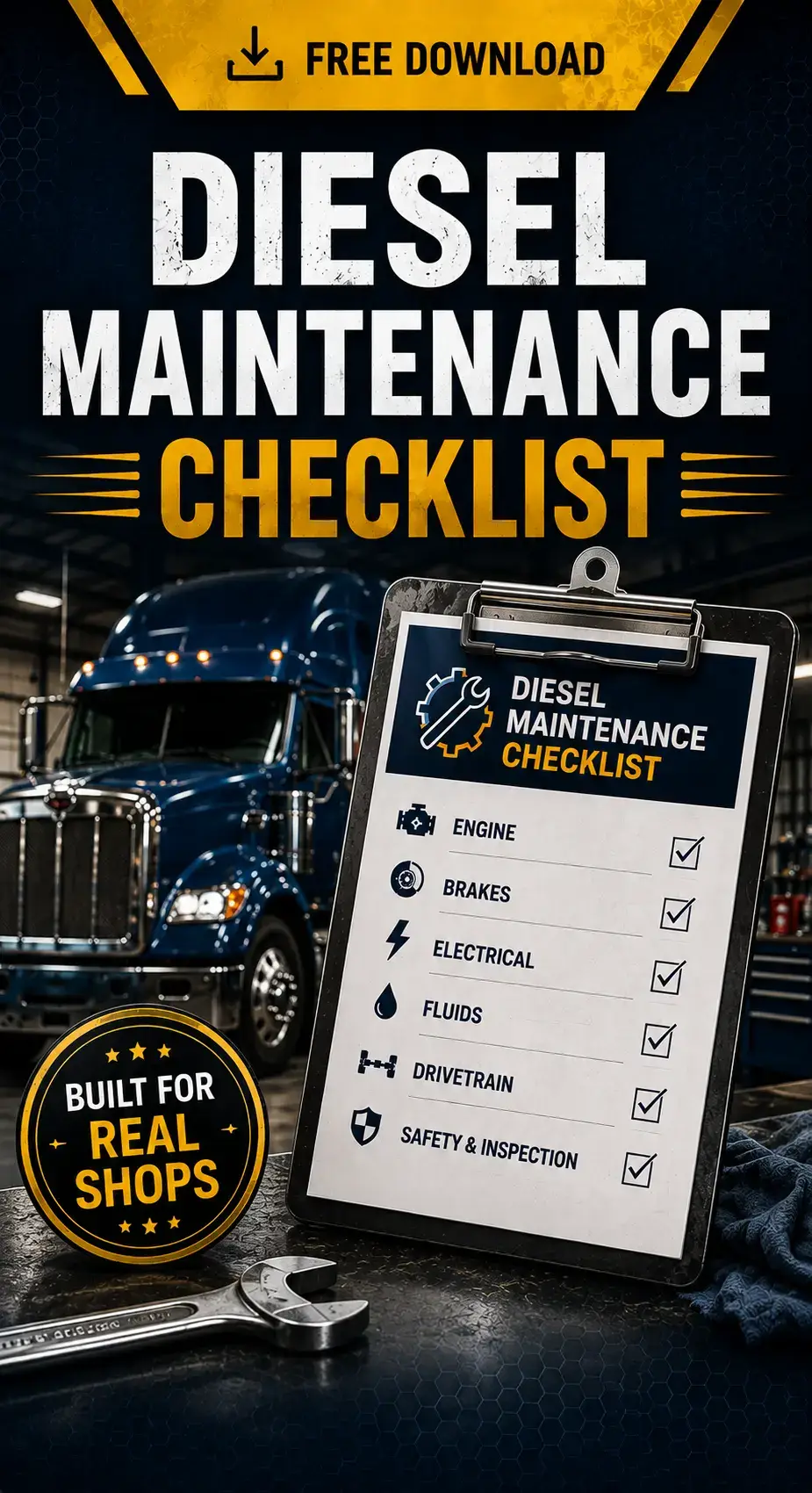
Free Diesel Maintenance Checklist
Get HDJ's free, field-tested diesel maintenance checklist delivered instantly to your inbox — print it, laminate it, keep it in the shop.
Instant PDF • 100% Free • No Spam
Documenting and Tracking Maintenance
A heavy equipment maintenance checklist only helps if the results are kept. Record the date, hour-meter reading, machine ID, operator, what was checked, what was found and what was done. Records support warranty claims, show a buyer the machine was cared for, and reveal the machine that keeps failing in the same place. HDJ's used equipment red flags guide shows what buyers look for in a service file.
A computerized maintenance management system (CMMS) centralizes records and creates work orders from hour-meter readings or calendar intervals, so scheduled service is not forgotten. Look for mobile access for technicians, photo attachments and history by serial number. HDJ's preventive maintenance software comparison reviews the options.
Telematics adds machine hours, fault codes, idle time and location straight from the machine. Used well, it moves part of the program from fixed intervals to condition-based decisions, but it supplements the walkaround and does not replace it. HDJ's telematics predictive maintenance guide covers the data worth acting on.
Key Recommendation
Make the pre-shift check a condition of starting the machine. No completed check means no work, and any failed item gets a tag and a repair order the same day.
Adjusting the Checklist for Heat, Cold, Dust and Moisture
Cold lengthens warm-up and strains starting. Check batteries and block heaters, use fuel and fluids rated for the temperature, let hydraulic oil warm before working the machine hard, and watch for fuel filter plugging from gelled fuel. HDJ's winter fleet maintenance guide covers cold-weather planning.
Heat shortens fluid life and loads the cooling system. Clean radiator and cooler fins more often, check coolant level and fan belts, and watch engine and hydraulic oil temperatures during long cycles.
Dust is the hardest condition on air filters, breathers and undercarriage. Inspect the intake and clamps for leaks, service the air filter when the restriction indicator says so, check hydraulic breathers, and wash coolers before debris packs them.
Moisture and salt attack connectors, bare metal and fuel. Drain water separators, inspect electrical connections and treat them as the manual allows, and wash salt off promptly.
Measuring Whether the Program Works
Track availability: scheduled hours minus unplanned downtime hours, divided by scheduled hours. Compare machines of the same type and watch the trend. A falling number means the heavy equipment maintenance checklist is missing something.
Track the share of maintenance spending that goes to emergency repairs. If it is growing, the program is catching too little, too late. Compare maintenance cost per operating hour by machine and against its replacement cost, using your own fleet as the benchmark, because HDJ could not verify a reliable industry figure.
Mean time between failures (MTBF) is the average operating hours between unplanned repairs for a machine type. A rising MTBF means the program is working. A falling one calls for root-cause work, such as a bad batch of filters, a skipped procedure or an operator habit.
To test what a change in downtime or maintenance spending does to ownership cost, Heavy Duty Journal's free Fleet Management Calculators let you compare scenarios before you commit.
Frequently Asked Questions
What should a heavy equipment maintenance checklist include?
A heavy equipment maintenance checklist should cover seven systems: hydraulics, engine, electrical, undercarriage or tires, attachments, operator controls and safety devices. Check fluids, leaks, wear, lights, alarms and controls daily, then add fluid sampling, filter changes and wear measurements on the manufacturer's schedule.
How often should heavy equipment be inspected?
Walk around the machine before every shift, do a deeper weekly check, and service by operating hours using the manual. OSHA's 29 CFR 1926.20 requires frequent and regular inspections of equipment by competent persons, and heavier duty usually means shorter intervals.
Should equipment maintenance follow hours or calendar dates?
Follow hours first, because hour meters track actual wear, and add a calendar limit for items that age without use, such as coolant, hoses and batteries. Whichever comes first sets the service date, and the manufacturer's manual supplies the numbers.
What does OSHA require for inspecting construction equipment?
OSHA's 29 CFR 1926.20 calls for frequent and regular inspections by competent persons and requires unsafe equipment to be tagged, locked out of use or removed. Section 1926.602 adds seat belts and reverse alarms on earthmoving equipment, and the OEM manual covers the rest.
Why does hydraulic fluid cleanliness matter?
Dirty, wet or overheated hydraulic fluid wears pumps, valves and cylinders, and contamination is widely regarded as a leading cause of hydraulic failure. Check level and leaks daily, sample the fluid on a schedule, and change filters on the indicator or the interval.
What maintenance records should I keep?
Record the date, machine ID, hour-meter reading, operator, what was checked, what was found and what was done, with photos of damage. Records support warranty claims, show a buyer the machine was cared for, and reveal which machines keep failing in the same place.
The Bottom Line
A heavy equipment maintenance checklist works when it is short enough to use every shift, complete enough to cover all seven systems, and tied to a rule that a failed item stops the machine. Daily checks catch leaks, damage and warning signs, and hour-based service handles wear that a walkaround cannot see.
Michael Nielsen and the Heavy Duty Journal team publish more equipment maintenance guides at heavydutyjournal.com. Confirm intervals in your manufacturer's manual and current OSHA requirements before relying on any rule summarized here, because regulations change.
Share This With Your Equipment Team
If someone on your crew runs machines or schedules service, pass this heavydutyjournal.com guide along so every system gets checked.