By Michael Nielsen, Editor & Publisher | 15+ Years in Diesel Repair
Last Updated: January 2026
📖 Estimated reading time: 20 minutes
Truck downtime costs fleet operators between $448 and $760 per day according to industry data, with some estimates reaching $2,500 for larger operations—expenses that compound quickly when diagnostic capabilities fall short. Professional diesel diagnostic tools transform hours of troubleshooting into precise, data-driven repairs that get commercial vehicles back in service fast.
Modern diesel engines integrate sophisticated electronic control systems managing fuel injection timing, variable geometry turbochargers, selective catalytic reduction (SCR), and diesel particulate filters (DPF). Basic code readers lack the communication protocols and depth required for these complex systems. Professional repair facilities need diagnostic platforms that communicate with multiple electronic control units (ECUs), perform bi-directional testing, access manufacturer-specific parameters, and execute critical maintenance procedures.
Key Takeaways
- ROI Timeline: Professional diesel diagnostic tools deliver 3-6 month ROI through faster repairs, reduced comebacks, and access to premium fleet contracts.
- Multi-Brand Coverage: Single platforms like Jaltest CV and Autel MaxiSYS 909CV eliminate multiple tool investments while handling 95% of commercial trucks.
- Protocol Compatibility: Tools supporting J1708/J1587 through CAN FD ensure compatibility with legacy and modern vehicles spanning three decades.
- Software Integration: Pairing hardware with platforms like JPRO Professional or manufacturer-specific software enables dealer-level diagnostic capabilities.
- Investment Strategy: Entry-level tools ($2,500-$4,000) suit mobile technicians while multi-bay facilities benefit from premium platforms ($7,000+).

Why Modern Shops Need Advanced Diesel Diagnostic Tools
Commercial trucks operate as mobile data centers. Electronic Control Modules (ECMs) continuously monitor and adjust hundreds of parameters—fuel injection pressure, turbocharger boost levels, exhaust gas temperatures, and aftertreatment system performance. When faults occur, generic code readers provide only surface-level information that leads to parts-swapping and extended downtime.
Professional diesel diagnostic tools access manufacturer-specific data streams, read enhanced diagnostic trouble codes (DTCs), and perform active tests that isolate failing components. This capability reduces diagnostic time from hours to minutes while increasing first-time fix rates significantly. According to the American Transportation Research Institute (ATRI), repair and maintenance costs averaged $0.198 per mile in 2024, making diagnostic efficiency critical to profitability.
75% Reduction in Diagnostic Time
Average improvement with professional diagnostic tools vs. basic scanners
Shops equipped with advanced diagnostic systems prevent just 2-3 emergency breakdowns to recover their tool investment. Fleet operators increasingly select service providers based on diagnostic capabilities, making proper equipment essential for competitive positioning. The business case remains compelling: professional diagnostic tool investments of $3,000-8,000 typically achieve ROI within 3-6 months through faster diagnostics, improved first-time fix rates, and expanded service capabilities.
Emissions Systems Drive Diagnostic Complexity
Modern emissions systems add complexity requiring specialized diagnostic approaches. The EPA’s Phase 3 greenhouse gas standards for model year 2027 and beyond mandate stricter emissions controls, pushing diagnostic requirements even higher.
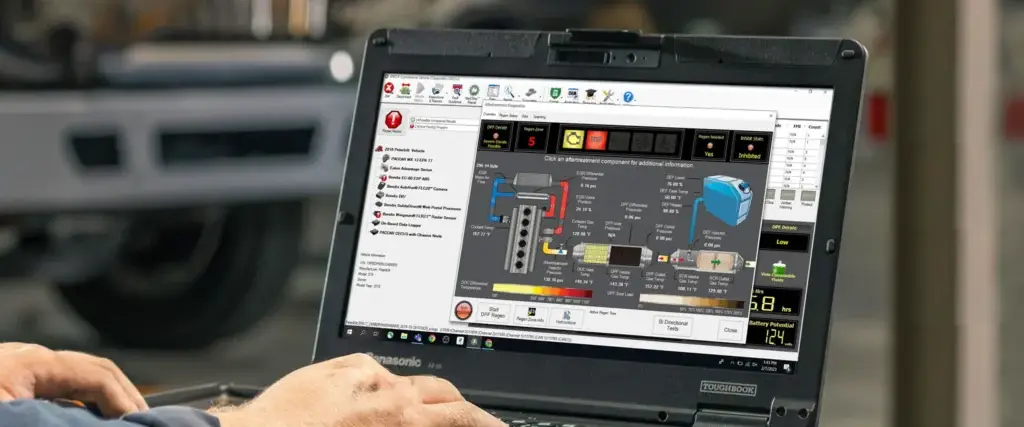
Diesel particulate filters demand forced regeneration capabilities. Selective catalytic reduction systems need DEF quality testing and dosing valve diagnostics. Variable geometry turbochargers require actuator testing and calibration. Professional tools handle these functions that basic scanners cannot address. As EPA standards require heavy-duty vehicles to limit NOx emissions to 0.035 grams per horsepower-hour, diagnostic precision becomes non-negotiable for compliance verification.
Jaltest CV: Multi-Brand Coverage Champion
Jaltest CV dominates the multi-brand commercial vehicle diagnostic market through comprehensive manufacturer coverage. This Spanish-engineered platform communicates with virtually every commercial truck brand operating in North America—Freightliner, Peterbilt, Kenworth, Volvo, Mack, International, and Western Star.
Independent shops replace multiple brand-specific scanners with this single integrated solution. The system provides dealer-level access to proprietary systems across manufacturers. Technicians perform forced DPF regenerations, injector coding after replacement, ECU programming, and parameter adjustments without dealer visits. This capability keeps revenue in-house while reducing vehicle turnaround time.
Core Diagnostic Capabilities
Jaltest delivers comprehensive functionality across commercial vehicle systems including multi-brand DPF regeneration with real-time monitoring, fuel injector coding and flow rate calibration, Wi-Fi connectivity enabling wireless diagnostics throughout the facility, and guided troubleshooting with technical service bulletins (TSBs). Regular software updates cover new model releases, while bi-directional control testing enables component verification.
The DPF regeneration functionality saves significant shop time. The system monitors exhaust temperatures, calculates soot load, and controls regeneration cycles across different engine platforms. This feature alone justifies the investment for shops handling multiple forced regenerations monthly. Injector coding represents another critical capability—after replacing fuel injectors, the system programs individual injector characteristics into the ECM, ensuring proper fuel delivery and emissions compliance.
At $6,000-8,000 depending on coverage options, Jaltest CV handles approximately 95% of commercial trucks. The investment eliminates multiple tool purchases while providing consistent diagnostic procedures across brands.
Autel MaxiSYS 909CV: OEM-Level Power
The MaxiSYS 909CV delivers original equipment manufacturer (OEM) diagnostic depth at independent shop pricing. This tablet-based platform provides ECU access typically reserved for franchise dealership service centers. Technicians execute module coding, parameter configuration, and software updates across multiple commercial vehicle platforms.
Live data graphing displays multiple parameters simultaneously, enabling pattern recognition that identifies intermittent faults. The topology mapping function identifies all electronic modules on the vehicle network, displaying communication status for each component. This capability quickly isolates network communication faults that cause multiple fault codes across systems.
Active testing enables component verification before parts replacement. Technicians command fuel injectors to fire, cycle EGR valves, or activate cooling fans while monitoring system response. This functionality confirms suspected failures before ordering expensive components. Whether diagnosing Cummins ISX engines, Detroit DD15 powertrains, or PACCAR MX-13 systems, this single tool provides comprehensive diagnostic access.
Integrated repair procedures guide technicians through complex tasks, reducing callbacks from incomplete repairs. Priced between $5,500-7,000, the MaxiSYS 909CV offers exceptional value for multi-bay commercial repair facilities.

NexIQ USB-Link 3: Future-Proof Communication
The USB-Link 3 adapter distinguishes itself through comprehensive communication protocol support. This interface handles everything from legacy J1708/J1587 protocols through current CAN FD standards, ensuring compatibility with vehicles spanning three decades. Data transfer speeds reach 8 times faster than traditional CAN networks—critical for modern vehicles generating massive diagnostic data volumes.
Shops servicing mixed-age fleets need tools communicating with older mechanical injection systems and current electronic common-rail platforms. The USB-Link 3 provides this versatility without requiring multiple adapters or interfaces.
Protocol Compatibility Overview
| Protocol Standard | Data Speed | Vehicle Application |
|---|---|---|
| J1708/J1587 | 9.6 kbps | Pre-2000 trucks, legacy systems |
| J1939 | 250-500 kbps | 2000-2015 models, full diagnostics |
| CAN FD | 2 Mbps | 2016+ vehicles, advanced features |
| J2534 | Variable | Pass-through programming, reflashing |
The device integrates seamlessly with OEM diagnostic software including Cummins INSITE, Detroit DiagnosticLink, Caterpillar Electronic Technician (ET), and PACCAR DAVIE4. This compatibility provides dealer-level ECU programming, calibration updates, and parameter adjustments. JPRO Professional, Noregon’s leading multi-brand platform, optimizes functionality when paired with NexIQ hardware.
At $3,000-4,000, the USB-Link 3 represents the most affordable entry point to professional commercial vehicle diagnostics. Shops purchasing this adapter gain immediate access to manufacturer software suites and third-party platforms, building diagnostic capability progressively as needs evolve.
Stay Current on Diagnostic Technology
Get the latest diagnostic tool reviews, protocol updates, and shop efficiency strategies delivered to your inbox weekly.
Texa Axone Nemo Plus: Heavy-Duty Specialist
Texa’s Axone Nemo Plus targets facilities specializing in Class 7 and Class 8 commercial vehicles. The included IDC6 software covers 99.9% of commercial vehicles from light-duty pickups through severe-service vocational trucks. This Italian-engineered platform provides exceptional diagnostic depth for heavy-duty applications.
The system excels at complex diagnostics requiring component-level troubleshooting. Extensive wiring diagrams include connector pinouts, wire colors, and circuit descriptions. Technicians trace electrical faults systematically rather than replacing components speculatively. Professional-grade capabilities include SCR system diagnostics with DEF quality testing, off-highway equipment coverage for construction and agricultural machinery, hydraulic system diagnostics for vocational applications, and comprehensive transmission diagnostics for Allison, Eaton, and ZF units.
Texa includes unlimited access to its Diesel Repair technical database without recurring subscription fees. This resource provides technical service bulletins, common fault patterns, and verified repair procedures. Over 50 certified technicians provide direct support, assisting with complex diagnostic challenges. The platform adheres to SAE J1939 protocol standards, ensuring compatibility with all modern heavy-duty vehicles.
Priced between $7,000-9,000, the Axone Nemo Plus represents a significant investment justified by comprehensive capabilities and exceptional support resources. Shops specializing in heavy-duty repairs recoup costs quickly through increased diagnostic efficiency and expanded service offerings.
DrewLinQ: The Mixed Fleet Solution
Facilities servicing both passenger vehicles and commercial trucks require versatile diagnostic platforms. DrewLinQ addresses this need through its CarDAQ-Plus 3 interface supporting light-duty through heavy-duty applications. Four simultaneous communication channels enable multi-system diagnostics without connection delays.
Vehicle Spy software transforms complex diagnostic data into actionable information. From active component testing to maintenance service resets, this platform handles critical diagnostic procedures efficiently. J2534 pass-through functionality supports factory programming on both automotive and commercial vehicle platforms. ECU reflashing, calibration updates, and software installations execute through this single tool.
Four simultaneous channels provide unique diagnostic advantages. Technicians monitor multiple vehicle networks concurrently, identifying intermittent faults and communication issues invisible to single-channel tools. At $2,500-3,500, DrewLinQ offers exceptional value for mixed-fleet repair facilities, eliminating the cost and complexity of maintaining separate automotive and commercial diagnostic platforms.

Essential Diagnostic Software Platforms
Diagnostic hardware provides vehicle access—software delivers functionality. Professional software platforms unlock full diagnostic capabilities, transforming basic scanners into comprehensive repair systems. Shops maximize tool investment by pairing quality hardware with appropriate software solutions. The right software combination provides dealer-level diagnostic depth at independent shop pricing.
Multi-Brand Diagnostic Platforms
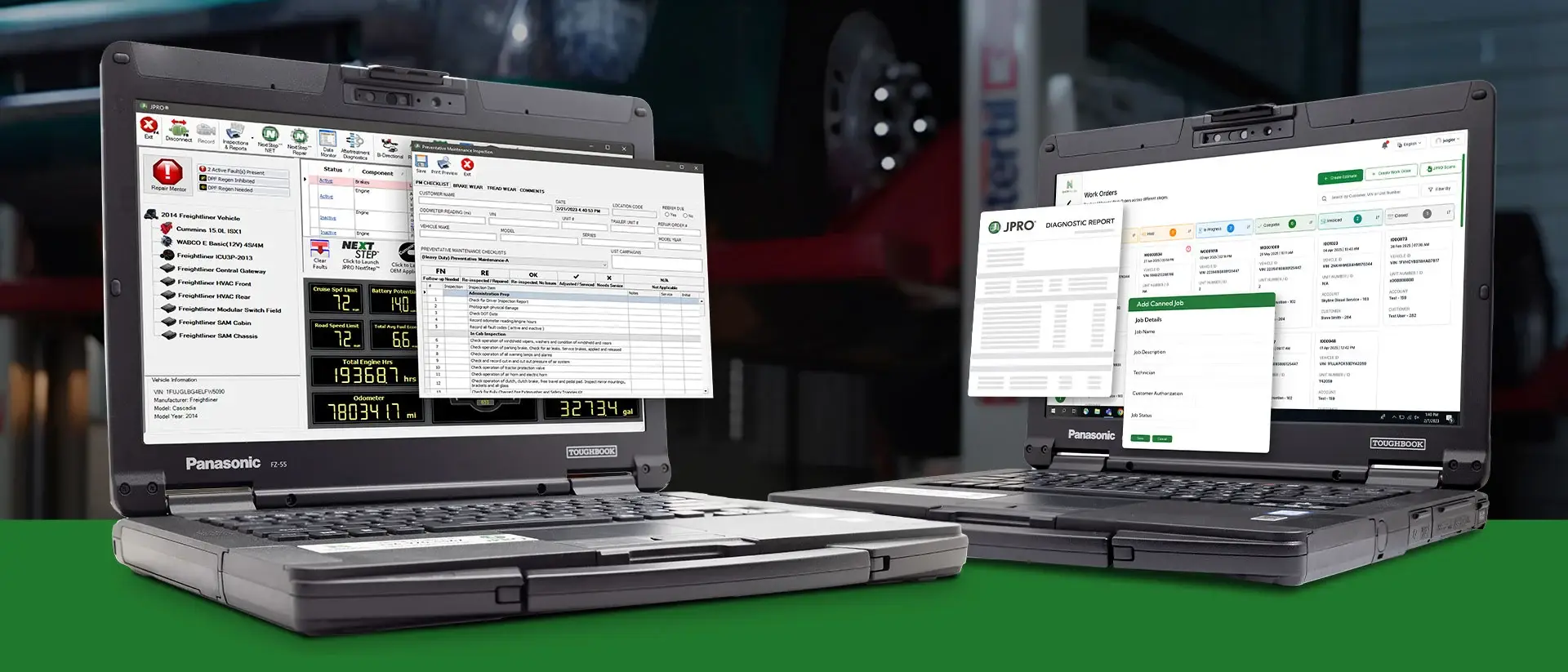
JPRO Professional leads multi-brand commercial vehicle diagnostics through comprehensive manufacturer coverage and intelligent diagnostic support. The platform connects to vehicles in approximately 60 seconds, significantly faster than competing solutions. This speed advantage compounds over multiple daily diagnostics, adding hours of productive time weekly.
Fault Guidance technology represents JPRO’s key differentiator. The system analyzes diagnostic trouble codes and provides step-by-step troubleshooting procedures ranked by probability. Technicians follow data-driven diagnostic paths rather than relying solely on experience or guesswork, reducing diagnostic time while improving first-time fix rates. Preventative maintenance scheduling functionality identifies impending failures before they cause breakdowns by analyzing sensor data trends and flagging components operating outside normal parameters.
NextStep Repair provides interactive repair procedures with video demonstrations and technical illustrations, particularly valuable for less experienced technicians or unfamiliar repair scenarios. The visual guidance reduces errors and callbacks while building technician confidence across the team.
Manufacturer-Specific Solutions
Manufacturer-specific software provides deepest diagnostic access for particular engine brands. Cummins INSITE enables complete engine parameter programming, fuel system calibration, and aftertreatment management—capabilities that multi-brand platforms cannot match. Detroit DiagnosticLink offers similar depth for Detroit Diesel powertrains, including ECU programming and advanced emission system diagnostics.
PACCAR DAVIE4 handles Kenworth and Peterbilt diagnostics with full parameter access and programming capabilities. Caterpillar Electronic Technician (ET) provides comprehensive diagnostics for Cat engines in both on-highway and off-highway applications. International ServiceMaxx covers Navistar vehicle diagnostics including engine, transmission, and chassis systems.
Software subscription costs vary significantly—JPRO Professional requires annual licensing fees around $1,500-2,000 depending on coverage level, while manufacturer software typically ranges from $500-1,500 annually per engine brand. These recurring costs factor into total diagnostic tool investment calculations. Shops should evaluate long-term subscription expenses alongside initial hardware purchases when building their diagnostic capability roadmap.
The HDJ Perspective
The diagnostic tool market has matured significantly over the past five years, with multi-brand platforms now matching dealer-level capabilities at a fraction of the cost. What we’re seeing in the field is a clear bifurcation: shops that invest in professional diagnostic equipment are winning fleet contracts and commanding premium labor rates, while those relying on basic scanners are losing ground. The real differentiator isn’t just the hardware—it’s the software subscriptions and ongoing training that determine whether a shop can tackle tomorrow’s vehicles. Smart operators are budgeting 15-20% of their initial tool investment annually for software updates and technician education.
Understanding Communication Protocols
Communication protocols determine diagnostic tool capability and longevity. Commercial vehicles use multiple protocol standards depending on model year and manufacturer. Tools supporting comprehensive protocol ranges handle diverse vehicle populations without requiring multiple adapters—understanding these standards helps shops make informed equipment purchases.
Legacy Protocol Standards
J1708/J1587 represents the original heavy-duty diagnostic standard, used extensively from the early 1990s through the mid-2000s. Trucks built before 2001 primarily use the 6-pin J1708 connector, and many of these older vehicles remain in active service requiring specialized diagnostic support. These serial communication protocols operate at 9.6 kilobits per second (kbps), adequate for early electronic control systems but insufficient for modern vehicle complexity.
J1939 became the dominant heavy-duty standard beginning in 2000. This Controller Area Network (CAN) protocol operates at 250 kbps for standard applications and 500 kbps for high-speed systems, supporting up to 30 electronic control units on a single network. J1939 handles multiple ECUs communicating simultaneously through standardized Parameter Group Numbers (PGNs)—structured identifiers that enable diagnostic tools to access engine RPM, fuel economy, exhaust temperatures, and hundreds of other vehicle parameters.
This standardization allows multi-brand diagnostic platforms to work across different manufacturers without proprietary protocols. The protocol enables bi-directional testing, live data streaming, and comprehensive diagnostics through broadcast messaging where all ECUs share data simultaneously.
Modern Protocol Evolution
CAN FD (Flexible Data-rate) represents current protocol evolution. Operating at up to 2 megabits per second, this standard supports modern vehicle complexity with significantly increased data payload capacity. Advanced driver assistance systems (ADAS), complex aftertreatment, and integrated vehicle systems generate data volumes requiring high-speed communication. The J1939-17 standard incorporates CAN FD capabilities into heavy-duty vehicle networks, providing the bandwidth needed for next-generation diagnostics and vehicle control systems.
J2534 pass-through capability enables ECU programming and reflashing. This standard allows diagnostic tools to connect vehicles with manufacturer software for calibration updates and parameter changes. J2534 compliance proves essential for shops performing ECU replacements or software updates without dealer involvement. Diagnostic tools supporting multiple protocols simultaneously provide maximum flexibility—mixed-age fleets containing vehicles from the 1990s through current models require this comprehensive compatibility.
Smart Investment Strategies
Selecting diesel diagnostic tools requires balancing capability with budget constraints while anticipating future needs. Strategic purchasing decisions position shops for growth while avoiding overspending on unused functionality.
| Investment Level | Price Range | Best Applications |
|---|---|---|
| Entry Level | $2,500-4,000 | Small shops, mobile technicians, mixed fleets |
| Professional | $5,000-7,000 | Multi-bay facilities, fleet contractors |
| Premium | $7,000-9,000+ | Heavy-duty specialists, off-highway service |
Entry-level tools suit shops establishing commercial vehicle service capabilities. These platforms provide essential diagnostics, code reading, and basic programming at accessible price points. Professional-tier tools deliver comprehensive capabilities for established commercial repair facilities—multi-brand coverage eliminates the need for multiple diagnostic platforms while handling forced regenerations, injector coding, and module programming across manufacturers.
Consider total ownership costs beyond initial purchase price. Annual software subscription fees, update costs, and training expenses factor into long-term investment analysis. Industry certifications such as ASE Medium/Heavy Truck certification help technicians maximize diagnostic tool capabilities through structured training in diesel engines, electrical systems, and computerized engine controls.
Following TMC Recommended Practices from the Technology & Maintenance Council provides industry-validated diagnostic procedures that complement technician training and ensure consistent, high-quality repairs across the shop.
Free Professional Fleet Tools
Cost calculators, fault code lookup, maintenance planners, and more—built for owner-operators, fleet managers, and diesel techs. No signup required.
Maximizing Return on Investment
Professional diesel diagnostic tools typically generate positive return on investment within 3-6 months through multiple revenue enhancement and efficiency improvement mechanisms. Understanding specific ROI drivers helps shops implement diagnostic systems effectively and accelerate payback periods.
Revenue Enhancement Strategies
Faster diagnostic speed directly improves shop productivity—professional tools reduce troubleshooting time by approximately 40% compared to basic scanners, allowing shops to complete 25% more jobs daily without adding technicians or service bays. This speed advantage compounds over multiple daily diagnostics, creating substantial revenue increases over baseline operations.
Accurate first-time diagnosis prevents costly comebacks. Professional diagnostic tools achieve 90% first-time fix rates compared to 60-70% for shops using basic equipment. Eliminating repeat repairs preserves shop reputation while reducing warranty work consuming profitable time. ATRI data shows that average miles between breakdowns increased to 38,249 miles in 2024, demonstrating the effectiveness of preventive maintenance and accurate diagnostics.
Fleet maintenance contracts represent significant revenue opportunities. Companies operating 10+ commercial vehicles seek reliable service providers with advanced diagnostic capabilities. Monthly fleet contracts worth $3,000-10,000 justify diagnostic tool investments rapidly. Dealer-level service capabilities keep work in-house—shops previously referring customers to franchises for programming, coding, or complex diagnostics now complete these procedures internally.
Services like forced DPF regenerations generate $250-400 per procedure while requiring only 30-45 minutes technician time. Injector coding ranges $150-300, and ECU programming bills at $200-500. These high-margin services become accessible only with professional diagnostic equipment.
Implementation Best Practices
Market advanced diagnostic capabilities prominently through signage, website content, and fleet operator outreach. Many potential customers don’t know independent shops offer dealer-level services—proactive marketing captures this overlooked revenue. Provide detailed diagnostic reports with visual data, fault code explanations, and recommended repairs to build customer trust. Professional reports justify premium service pricing while improving repair authorization rates.
Offer preventive scanning services during routine maintenance visits to identify developing issues before failures occur. By detecting problems early, shops schedule repairs during planned downtime rather than emergency breakdowns. This proactive approach builds customer loyalty while generating consistent repair revenue.
Training and Technician Development
Diagnostic tool capability means nothing without proper technician training. Comprehensive implementation programs ensure staff maximize equipment investment through confident, efficient operation. Manufacturer training programs from Jaltest, Autel, and Texa offer online courses, regional workshops, and certification programs that accelerate proficiency and reduce costly mistakes during initial deployment.
Hands-on practice builds confidence faster than theoretical instruction alone. Dedicate shop time for technicians to explore diagnostic tool functions on various vehicles—practice sessions identifying sensor locations, performing active tests, and interpreting live data develop practical skills that translate directly to billable efficiency. Software navigation efficiency develops through repetition, with initial diagnostic procedures requiring 20-30 minutes dropping to 5-10 minutes with experience.
Technical support utilization maximizes diagnostic success. Quality tool manufacturers provide phone support, remote assistance, and online resources. Technicians should feel comfortable contacting support when encountering unfamiliar situations rather than struggling independently. Documentation review prevents common operational errors—understanding proper connection procedures, software navigation, and safety protocols reduces equipment damage risk and diagnostic mistakes.
Frequently Asked Questions
What is the best diesel diagnostic tool for independent repair shops?
For most independent repair shops servicing multiple truck brands, the Jaltest CV or Autel MaxiSYS 909CV provide the best balance of comprehensive coverage and value. Jaltest CV excels with its multi-brand DPF regeneration and injector coding capabilities, while the MaxiSYS 909CV offers exceptional OEM-level diagnostic depth with guided troubleshooting. Shops should evaluate their specific customer mix—those handling primarily heavy-duty Class 8 trucks may benefit from Texa’s deeper heavy-duty focus, while mixed-fleet facilities often prefer DrewLinQ’s cross-platform versatility.
How long does it take to see ROI on professional diesel diagnostic equipment?
Most shops achieve full return on investment within 3-6 months of implementing professional diagnostic tools. The primary ROI drivers include 40% reduction in diagnostic time (enabling 25% more jobs daily), elimination of costly diagnostic referrals to dealers, and access to premium fleet maintenance contracts. A single prevented emergency breakdown or avoided parts-swapping incident can recover $500-1,500, meaning shops preventing just 2-3 such situations monthly recoup tool investments rapidly.
What communication protocols should commercial diesel diagnostic tools support?
Professional diagnostic tools should support the complete protocol range from J1708/J1587 (pre-2000 vehicles operating at 9.6 kbps) through J1939 (2000-2015 at 250-500 kbps) to current CAN FD standards (2 Mbps). J2534 pass-through capability is essential for ECU programming and reflashing without dealer involvement. Mixed-age fleets require this comprehensive protocol support—tools limited to newer protocols cannot diagnose the substantial population of older trucks still in active commercial service.
Do I need manufacturer-specific software in addition to multi-brand diagnostic tools?
While multi-brand platforms like JPRO Professional handle 85-90% of diagnostic needs, manufacturer-specific software provides the deepest access for complex programming and calibration tasks. Cummins INSITE, Detroit DiagnosticLink, and PACCAR DAVIE4 enable parameter changes and ECU updates that multi-brand tools cannot perform. Shops should evaluate their customer concentration—if 40% or more of work involves a specific engine brand, investing in that manufacturer’s software typically pays for itself through expanded in-house capabilities.
What ongoing costs should I budget for diesel diagnostic tools?
Beyond initial hardware purchase, plan for annual software subscription fees ranging from $1,500-2,500 for multi-brand platforms and $500-1,500 per manufacturer-specific software. Factor in technician training costs of $500-2,000 annually for workshops and certification programs. Extended warranties ($200-500 annually) protect expensive diagnostic hardware. Total ongoing costs typically run 15-20% of initial tool investment annually, but these expenses are recovered through expanded service capabilities and improved diagnostic efficiency.
How do I choose between wireless and wired diagnostic adapters?
Wireless adapters (typically using Wi-Fi or Bluetooth) offer convenience for technicians working around vehicles without cable management concerns. However, wired connections via USB provide more reliable data transmission, faster speeds, and no battery concerns during extended diagnostic sessions. For critical procedures like ECU programming or reflashing, wired connections are strongly recommended due to their stability. Most shops benefit from having both options—wireless for routine code reading and live data, wired for programming and complex diagnostics.
Building Your Diagnostic Capability
Investing in professional diesel diagnostic tools transforms shop capabilities, operational efficiency, and profitability. The five leading platforms—Jaltest CV, Autel MaxiSYS 909CV, NexIQ USB-Link 3, Texa Axone Nemo Plus, and DrewLinQ—each deliver exceptional value while targeting specific operational needs. Multi-brand repair facilities benefit most from Jaltest CV or Autel MaxiSYS platforms offering comprehensive manufacturer coverage. Heavy-duty specialists handling predominantly Class 8 trucks justify Texa systems through exceptional diagnostic depth and technical support.
Return on investment typically occurs within 3-6 months through faster diagnostics, improved first-time fix rates, and expanded service capabilities. As commercial vehicles grow increasingly complex and EPA emissions standards continue tightening, independent repair facilities must maintain technological parity with franchise dealers. Professional diagnostic platforms provide this capability while delivering superior customer service and competitive pricing—positioning repair facilities as industry experts capable of handling the most complex commercial vehicle challenges.
Help Fellow Technicians Make Smarter Investments
Share this diagnostic tool comparison with your network to help other shops make informed equipment decisions.