By Michael Nielsen, Publisher | 15+ Years in Diesel Repair
Last Updated: October 2026
⏱ Estimated reading time: 13 minutes
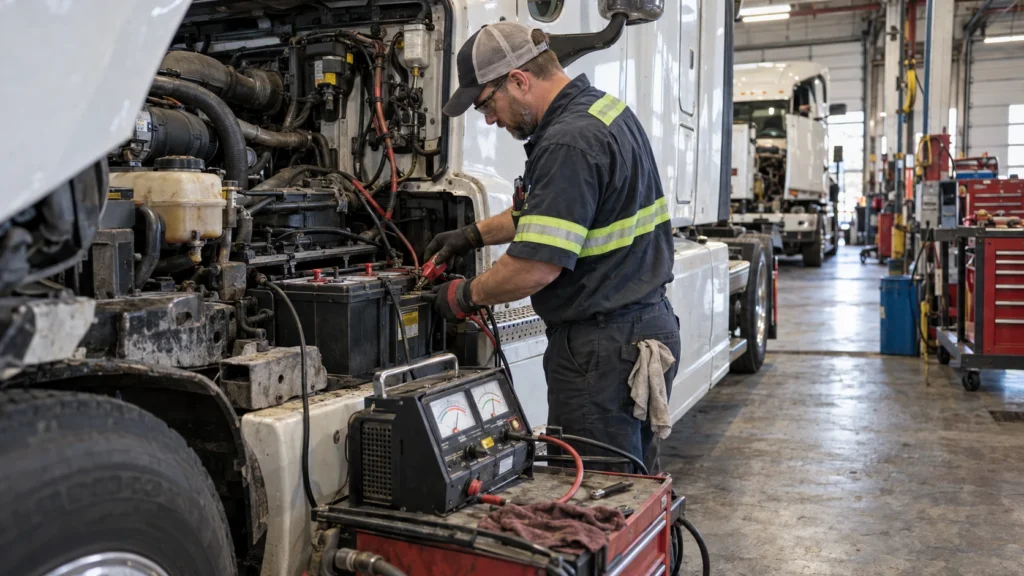
A heavy duty battery load tester checks whether a truck battery can hold its voltage under a cranking-sized demand, and fleet shops are usually best served by two kinds: a carbon pile tester to prove a battery under real load and a conductance analyzer to screen many batteries quickly. High-voltage pack tools and stationary battery analyzers are separate equipment for separate jobs.
Heavy Duty Journal's editorial team, led by publisher Michael Nielsen, rebuilt this guide for fleet managers, shop owners, and technicians. HDJ checked manufacturer specification pages, retailer listings, and the Code of Federal Regulations (CFR) as of October 2026, and it kept only the figures it could verify.
According to Heavy Duty Journal's October 2026 review, the first question is not which brand to buy but which job the tester must do. The Fluke BT521, for example, is designed for stationary battery banks, while the Midtronics GRX-5100 services electric vehicle (EV) packs, so neither replaces a tester built for starting batteries.
Key Takeaways
- ✓Two testers, two jobs. A carbon pile tester proves a battery under load, and a conductance analyzer screens quickly without discharging it.
- ✓Match the tool to the job. Starting-battery testers, stationary analyzers, and EV pack tools are separate categories, and a model built for one cannot stand in for another.
- ✓Know the numbers. One battery maker publishes a load test at half the battery's cold cranking amps (CCA) rating for 15 seconds, with voltage holding above 9.6 volts.
- ✓Seven models compared. The AutoMeter BVA-36/2, Midtronics MDX-700 HD and DSS-5000 HD, Foxwell BT715, Fluke BT521, Midtronics GRX-5100, and Launch X431 EVP711 are compared by published specifications.
- ✓Safety is part of the test. The Occupational Safety and Health Administration (OSHA) says flammable hydrogen gas is always present during battery recharging.
- ✓Check prices with dealers. Fluke lists the BT521 at $5,809.19 as of October 2026, while most other prices vary by dealer and region.
In This Guide
- How a Heavy Duty Battery Load Tester Works
- Carbon Pile and Conductance Testers Compared
- How to Run a Load Test on a Truck Battery Bank
- Heavy Duty Battery Load Tester Models Compared
- Safety for High-Voltage and Stationary Battery Work
- Building a Battery Testing Routine for Your Fleet
- Frequently Asked Questions
- The Bottom Line
How a Heavy Duty Battery Load Tester Works
A load test asks a battery to deliver a large current for a short time and records how far the voltage falls. A battery that holds its voltage can crank an engine, while one that collapses cannot, even if its resting voltage looked fine.
Battery ratings use cold cranking amps (CCA), and a load test applies a fraction of that rating to the battery on the bench. The rating itself has a precise definition, and it is worth knowing before you read any tester's display.
0°F · 30 s · 7.2 V
The CCA rating: the current a new, fully charged 12-volt battery can deliver for 30 seconds at 0°F while holding at least 7.2 volts, according to the Battery Council International rating that makers such as OPTIMA Batteries describe.
A carbon pile tester applies a real, adjustable resistive load. A conductance analyzer instead sends a small signal and calculates battery condition without discharging the battery. Midtronics describes the conductance technology in its MDX-700 HD as returning results in seconds, which is why shops use it for screening.
Voltage coverage matters on heavy-duty vehicles. Midtronics lists the MDX-700 HD as compatible with 6-volt and 12-volt batteries in 12-volt to 24-volt systems, so confirm what your tester covers and follow its instructions for batteries wired in series or parallel banks.
Cost pressure adds urgency. As of July 2026, the American Transportation Research Institute (ATRI) reported in its 2026 operational costs update that repair and maintenance costs rose 8.6 percent in 2025, the second-largest percentage gain behind tolls. A weak battery found on the bench is a repair you schedule instead of one a driver reports from the roadside.

Carbon Pile and Conductance Testers Compared
Each tester type answers a different question, so the table below compares what each does well, where it stops, and where it fits. The two starting-battery methods are the core of any shop program.
| Tester type | Strength | Limit | Best use |
|---|---|---|---|
| Carbon pile | Applies a real, adjustable load to prove cranking capacity | Heavy, and the load element gets hot | Confirming borderline batteries |
| Conductance analyzer | Results in seconds without discharging the battery | Estimates condition instead of applying a full load | Screening many batteries during preventive maintenance |
| Stationary analyzer | Resistance trends across battery strings | Built for backup banks, not starting batteries | Telecom and backup power |
| EV pack tool | Controlled discharge, charge, and balancing of high-voltage packs | Not a starting-battery tester | EV and hybrid pack service |
The first two rows are the core of a truck shop program, and the last two are specialist tools. A heavy duty battery load tester is a different tool from a stationary analyzer or an EV pack tool, and the four are not interchangeable, which is why this guide separates them before it compares models.
Many shops screen with a conductance analyzer and load test only the batteries that come back borderline. That is a shop practice rather than a regulatory rule, but it keeps the heavy, hot carbon pile tester for the batteries that need it.
Where you test matters too. Midtronics lists the DSS-5000 HD for testing a battery pack while it is still assembled in the vehicle and the MDX-700 HD with a 15-foot standard cable. AutoMeter describes the BVA-36/2 as built for stationary use or an optional cart, so a bench carbon pile tester works best when the battery comes to it.
Chemistry coverage is the next screen. Foxwell lists flooded, absorbent glass mat (AGM), enhanced flooded battery (EFB), and gel batteries, and Midtronics lists flooded, AGM spiral, gel, EFB, and NorthStar and Odyssey pure lead for the DSS-5000 HD. A tester that does not list your battery type is not a safe choice for it.
A pass tells you the battery can crank today, while a borderline reading calls for a recharge and a retest. Compare each result with the same battery's last result, because a number that keeps falling matters even when it still passes.
A tester only reports what the battery is today. HDJ's heavy duty truck battery maintenance guide covers the cleaning, charging, and inspection routine that keeps a good battery good between tests.
How to Run a Load Test on a Truck Battery Bank
Follow the battery maker's procedure first. The sequence below reflects the procedure Discover Battery publishes, which HDJ used as a reference as of October 2026, and it works with a carbon pile tester or with a conductance analyzer that offers a load mode.
- Inspect the battery, case, and terminals, and clean any corrosion so the clamps seat on bare metal.
- Check state of charge and recharge first if it is below 75 percent, because a discharged battery fails a load test it would pass when charged.
- Isolate the battery as the tester maker instructs, especially in banks wired in series or parallel.
- Apply a load equal to half the battery's CCA rating for 15 seconds.
- Read the voltage at the end of the 15 seconds. It should hold above 9.6 volts.
- If it fails, recharge and retest. A second failure indicates the battery needs replacement.
Discover Battery also publishes a tougher test that applies the full CCA rating for 30 seconds and expects voltage to stay above 7.2 volts. Use whichever procedure your battery maker specifies, and never mix one maker's load with another maker's pass voltage.
Some batteries pass the load test and still leave a truck slow to crank, because cables and grounds add resistance of their own. Follow a passing result with a voltage drop test, which HDJ's voltage drop testing guide walks through.
⚠️ Safety Warning
OSHA's guidance for electric forklift batteries says flammable hydrogen gas is always present during battery recharging and can be explosive if it accumulates in a closed area, so ventilate the bay and keep sparks, arcs, and open flames away. Wear chemical splash goggles or a face shield and acid-proof gloves. 29 CFR 1910.151(c) requires suitable drenching or flushing facilities where corrosive materials can reach the eyes or body, and a carbon pile load element gets hot, so keep clear of it during and after a test.
Heavy Duty Battery Load Tester Models Compared
Specifications below come from manufacturer pages for the AutoMeter, Midtronics, and Fluke products, and from retailer listings for the Foxwell and Launch, as of October 2026. HDJ did not test these units, so confirm every figure with the dealer before you order. Voltage figures use direct current (DC) and alternating current (AC), and VDC and Vdc both mean volts of direct current.
| Model | Type | Voltage and range | Best fit |
|---|---|---|---|
| AutoMeter BVA-36/2 | Carbon pile, 800 amps | 12-volt models listed | Bench or cart load testing |
| Midtronics MDX-700 HD | Conductance analyzer | 0.9–30 Vdc; up to 2,000 CCA | Fleet battery screening |
| Midtronics DSS-5000 HD | Conductance system tester | 12- and 24-volt packs, starter, alternator | Pack, cable, and charging tests |
| Foxwell BT715 | Conductance system tester | 12- and 24-volt; 100–2,000 CCA | Entry-level screening |
| Fluke BT521 | Stationary battery analyzer | DC to 1,000 V; AC to 600 V | Backup banks |
| Midtronics GRX-5100 | EV pack service station | 0–384 VDC | Pack discharge, charge, balancing |
| Launch X431 EVP711 | EV pack charge and discharge | DC 2–400 V | High-power pack cycling |
Starting-Battery Testers for Heavy-Duty Shops
AutoMeter's carbon pile guide lists models rated at 500 and 800 amps. It describes the BVA-36/2 as suited to high-volume repair shops and fleet service centers, built for stationary use or an optional cart, while the portable BVA-34 and the SB-5/2 also carry 800-amp ratings. The 500-amp SB-3 is aimed at light and standard-duty vehicles.
The guide lists no 24-volt coverage for these models, so confirm voltage before buying for a 24-volt system. A carbon pile tester gives you a real load result, but it is heavy and hot, which is why many shops pair it with a conductance analyzer for screening.
Midtronics lists the MDX-700 HD for the heavy-duty fleet market. It covers 0.9 to 30 Vdc and up to 2,000 CCA, handles Group 31, commercial 4D and 8D, and automotive batteries, and ships with a 15-foot cable. The MDX-700P HD adds an integrated printer for shops that want a printed result.
The Midtronics DSS-5000 HD goes beyond the battery. It is designed for heavy-duty commercial truck and fleet work, with 12- and 24-volt battery pack, starter, and alternator diagnostics, plus battery, cable, and live starting and charging circuit tests. It can test a pack while installed and email or print results. Midtronics says it serves both preventive maintenance and battery warranty management, and it lists a DSS-5000P HD with an integrated printer.
The Foxwell BT715 is the budget option. Listings show 12- and 24-volt starting and charging tests, a 100–2,000 CCA range, support for flooded, AGM, EFB, and gel batteries, and a UK retail price of £85. HDJ reads that as a screening aid for a small shop, not a replacement for a load test on a borderline battery.
Stationary Battery Analyzer
Fluke describes its 500 series as designed for maintenance, troubleshooting, and performance testing of individual stationary batteries and battery banks in critical backup applications. The BT521 lists resistance resolution as fine as 0.001 milliohm, DC voltage to 1,000 V, AC voltage to 600 V, ripple measurement, and profiles that each store up to 450 batteries.
The BT521 adds an infrared temperature sensor in its BTL21 probe and a mobile app, and Fluke lists it at $5,809.19 as of October 2026. Fluke says the series does not cover lithium batteries with management systems. It belongs in a telecom or backup power program rather than a truck bay.
Fluke also lists trend analysis through its FlukeView Battery Management Software and a three-year warranty. Trending is a main use of this class of tool, since resistance readings on a string are most useful when compared with earlier readings of the same cells.
EV Pack Service Tools
Midtronics lists the GRX-5100 at 0–384 VDC, with 0–7.5 amp discharge and 0–5.0 amp charge, leakage monitoring that ends a session on excessive leakage, two independent controller area network (CAN) buses, vehicle identification number (VIN) capture, and a battery pack status report. It runs on 100–240 VAC at up to 12 amps.
A retailer listing for the Launch X431 EVP711 shows up to 7.2 kilowatts of discharge and 4.4 kilowatts of charge across 2–400 volts DC, with an AC 220-volt input and a €4,199 price. Check input power against your bay circuits and confirm adapter coverage for your vehicles in writing before ordering.
Questions to Put in Writing
Before you accept a quote for any battery tester, ask the dealer to confirm these items in writing so the figures on the sheet become commitments:
- Voltage systems covered, and how to test batteries wired in series or parallel
- Battery chemistries and the CCA range the unit supports
- Cable length, clamp type, and replacement parts
- Printer, email, or software options for recording results
- Input power requirements, for any EV pack tool
- Warranty terms, training, and service support for the model
Safety for High-Voltage and Stationary Battery Work
High-voltage pack work and stationary banks carry hazards that a starting-battery test does not. 29 CFR 1910.137, OSHA's electrical protective equipment standard, requires insulating equipment to be inspected for damage before each day's use, protector gloves to be worn over insulating gloves with limited exceptions, and periodic electrical testing, with a six-month interval for gloves.
Before assigning anyone to a pack, 29 CFR 1910.132 requires the employer to assess the workplace for hazards that call for protective equipment and to train each employee who must use it. HDJ's diesel mechanic personal protective equipment guide covers the protective gear a shop should have on hand.
Training is a separate step from buying the tool. A GRX-5100 or EVP711 is only as safe as the technician and procedure behind it, so make sure the people assigned to pack work have been trained on the specific unit and the manufacturer's service procedure.
Building a Battery Testing Routine for Your Fleet
HDJ did not find a federal interval for load testing a commercial vehicle battery, so set the schedule from the battery maker's guidance and your preventive maintenance program. Record the date, battery, method, reading, and result each time, so you can see a battery weakening before it strands a truck.
Records are what turn single tests into a program. The MDX-700P HD and DSS-5000P HD print results, the DSS-5000 HD can email them, and the Fluke BT521 logs to its software, so choose a tester whose output your shop will actually file.
Cold exposes weak batteries first, so many shops test ahead of winter. HDJ's winter fleet maintenance strategies guide covers the wider preparation that cold-weather reliability depends on.
A battery that keeps failing may not be the problem. HDJ's parasitic battery drain guide explains how to find a draw that empties batteries while a truck sits, before you replace another one.
The charging side deserves its own test. A good battery will not stay good behind a weak alternator, and HDJ's alternator testing guide covers the checks that separate a battery fault from a charging fault.
While the battery is out of its box, inspect the compartment. 49 CFR 393.30 requires a battery to be covered by a fixed part of the vehicle or a removable cover or enclosure, which must be securely latched, with an acid-resistant coating and openings for ventilation and drainage.
A jump starter supplies current; it does not diagnose. Confirm the system voltage in the vehicle's service documentation before connecting any booster, and load test the battery after the jump so you know whether it can be trusted for the next start. HDJ's electrical guides at heavydutyjournal.com cover the charging and cranking checks that follow.
Free Diesel Maintenance Checklist
Get HDJ's free, field-tested diesel maintenance checklist delivered instantly to your inbox — print it, laminate it, keep it in the shop.
Instant PDF • 100% Free • No Spam
Frequently Asked Questions
What is the difference between a carbon pile and a conductance tester?
A carbon pile tester applies a real, adjustable load to prove a battery can crank. A conductance analyzer sends a small signal and calculates condition in seconds without discharging the battery, which suits screening. Many shops screen first and load test borderline batteries.
How do you load test a heavy-duty truck battery?
Charge the battery to at least 75 percent, apply a load equal to half its CCA rating for 15 seconds, and read the voltage. One maker publishes 9.6 volts as the pass threshold. A second failure after recharging means replacement, so follow your battery maker's figures.
Do I need a different tester for a 24-volt system?
Not necessarily, but check coverage. Midtronics lists the MDX-700 HD for 6-volt and 12-volt batteries in 12-volt to 24-volt systems, and the DSS-5000 HD for 12- and 24-volt diagnostics. AutoMeter's guide lists no 24-volt models, so verify voltage before buying.
Can an EV pack tester check truck starting batteries?
No. The Midtronics GRX-5100 lists 0–384 VDC and the Launch X431 EVP711 lists DC 2–400 V, and both are built to discharge, charge, and balance high-voltage packs. Starting batteries need a carbon pile tester or a conductance analyzer designed for them.
How much does a heavy duty battery load tester cost?
Prices vary widely. Fluke lists the BT521 stationary analyzer at $5,809.19 as of October 2026, and a UK retailer lists the Foxwell BT715 at £85. Most other models have no published price, so request written dealer quotes that include cables, printers, and adapters.
The Bottom Line
A heavy duty battery load tester earns its place when it matches the batteries your trucks actually carry. Buy a carbon pile tester and a heavy-duty conductance analyzer for starting batteries, and add stationary or EV pack tools only if your shop services those systems.
Heavy Duty Journal's guidance at heavydutyjournal.com, from publisher Michael Nielsen and the HDJ editorial team, is to follow the battery maker's procedure, record every test, and confirm each tester's voltage coverage in writing before you buy.
Share This Guide With Your Team
If a technician or fleet manager on your team is choosing battery testing equipment, pass this guide along so they can compare tester types and verified specifications before they request quotes.