brake lathe machine

Best Brake Lathe Equipment for Heavy Duty Shops: 2025 Guide

Table of Contents
    Add a header to begin generating the table of contents

    By Michael Nielsen, Editor & Publisher | 15+ Years in Diesel Repair

    Last Updated: January 2026

    📖 Estimated reading time: 22 minutes

    Professional automotive shops need reliable brake lathe equipment to maintain high service standards and maximize profitability. The right machine transforms your operation by delivering precision rotor and drum work that keeps customers coming back while generating substantial profit margins on every brake job. For heavy duty shops handling commercial fleets, owner-operator trucks, and high-volume passenger vehicle work, investing in quality resurfacing equipment has become essential for competitive positioning.

    Modern brake lathe technology has advanced significantly, offering features that boost technician productivity while ensuring consistent quality across thousands of service cycles. Whether you’re upgrading existing equipment or outfitting a new facility, understanding what separates professional-grade machines from consumer alternatives helps you make purchasing decisions that support long-term shop growth.

    This comprehensive guide examines six leading brake lathe models specifically designed for demanding heavy duty environments. We’ll explore how each option addresses critical factors like operational efficiency, long-term reliability, and return on investment for fleet maintenance operations.

    Key Takeaways

    • Professional brake lathe equipment ranges from $8,000 to $35,000 depending on configuration, with most shops achieving payback within 18-36 months
    • Bench-mount systems excel at high-volume batch processing, while on-car systems eliminate rotor removal and correct hub runout issues
    • Heavy duty operations need 20-24 inch rotor capacity and 1.5+ horsepower motors to handle commercial vehicle brake components
    • Six professional-grade models reviewed: Ammco 4000E, Ranger RL-8500XLT, RELS RB200, Accu-Turn 8922, Hofmann Megaplan BL200, and Pro-Cut PFM 9.2
    • Resurfacing services deliver 70-85% profit margins compared to 30-40% for parts replacement, significantly improving shop profitability

    Why Heavy Duty Shops Need Professional Brake Lathe Equipment

    Investing in professional-grade brake lathe equipment transforms how heavy duty shops approach brake service efficiency and profitability. The ability to perform precision machining in-house separates successful operations from those that depend on external services or simply replace components. This capability directly impacts both customer satisfaction and your bottom line through faster turnaround times and higher profit margins per job.

    Surface flaws cause nearly every brake-related customer complaint. Federal regulations under 49 CFR Part 393 Subpart C establish minimum brake performance standards for commercial vehicles, and when drivers experience pulsation, vibration, or squealing during braking, the root cause typically stems from surface variations on rotors, drums, or flywheels. These imperfections create inconsistent contact between brake pads and rotor surfaces, leading to performance issues that customers notice immediately behind the wheel. Commercial vehicles must maintain brakes that meet 49 CFR Part 393 Subpart C requirements—and proper brake surface finish is essential for compliance.

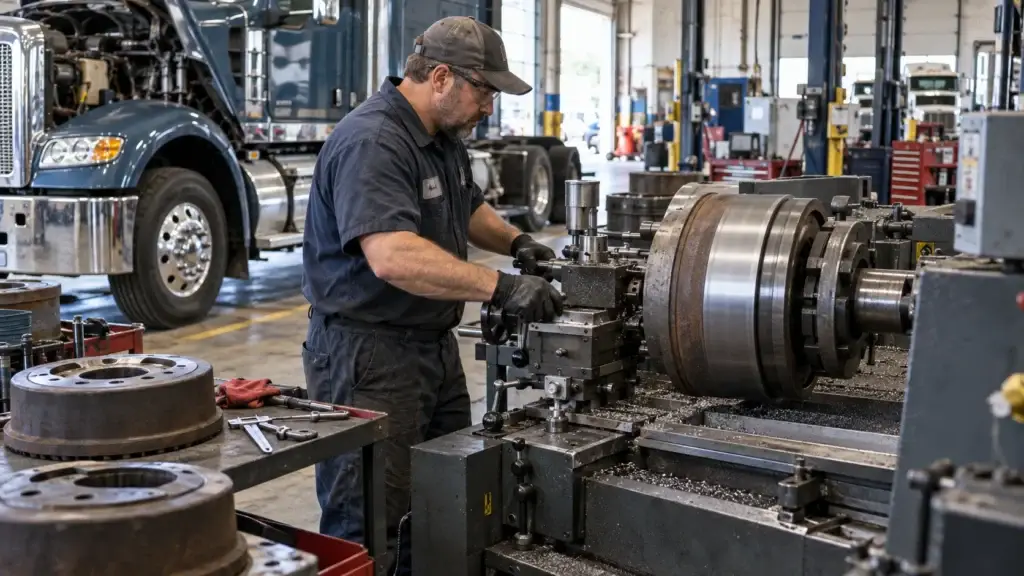
    Diesel technician operating brake lathe equipment in professional heavy duty shop setting

    A quality rotor resurfacing machine corrects these surface variations by machining down the entire surface to eliminate high spots and create a smooth, uniform finish. This process restores components to proper specifications without the expense of replacement. The precision achieved through professional brake service equipment ensures brake surfaces meet manufacturer tolerances and deliver the performance fleet managers expect from their vehicles.

    Rotor resurfacing typically costs less and proves more efficient than complete rotor replacement. This cost advantage benefits both your shop and your customers. You maintain higher profit margins—typically 70-85% on resurfacing services compared to 30-40% on parts markup—while offering competitive pricing that builds long-term customer relationships.

    70-85%

    Typical profit margin on rotor resurfacing services, compared to 30-40% on parts replacement

    The competitive advantages of owning professional brake service equipment extend beyond basic cost savings. Heavy duty shops with in-house machining capabilities gain faster turnaround times by completing brake jobs without waiting for external machine shops. You keep machining fees in-house rather than paying markup to third-party services. Marketing your shop as a complete brake service provider with full capabilities attracts customers seeking comprehensive solutions.

    Rush job capability becomes possible when you handle emergency repairs and fleet maintenance without scheduling delays. Direct oversight of machining precision and surface finish standards eliminates quality concerns that arise when outsourcing critical work. For high-volume operations, brake lathe equipment pays for itself through increased revenue opportunities that compound with every rotor or drum you resurface instead of replace.

    Professional brake service capabilities also position your shop as the preferred choice for fleet accounts and commercial vehicles. The Commercial Vehicle Safety Alliance’s brake inspection standards require a minimum braking efficiency of 43.5 percent—vehicles falling below this threshold face out-of-service orders. Fleet managers need reliable partners who can handle all aspects of brake maintenance efficiently. When you resurface heavy duty rotors and drums on-site, you become indispensable to fleet managers who prioritize vehicle uptime and predictable maintenance costs.

    What to Look for in Professional Brake Lathe Equipment

    Understanding essential brake lathe features separates successful equipment investments from costly mistakes in professional automotive environments. Heavy duty shops need equipment that delivers consistent performance across diverse vehicle types while maintaining exceptional accuracy standards. The right machine combines adequate power, versatile capabilities, robust construction, and precision engineering to handle demanding workloads year after year.

    Close-up of brake lathe control panel showing digital readouts and adjustment mechanisms

    Motor Power and Cutting Capacity

    The motor represents the heart of any brake lathe system, particularly for on-car applications where the unit must overcome substantial drivetrain friction. Greater horsepower enables technicians to service a wider range of vehicles without struggling against resistance from transmission components and wheel bearings. Professional-grade machines typically feature motors ranging from 1 to 2 horsepower for bench-mount systems and up to 3 horsepower for on-car configurations.

    Cutting capacity defines the physical size range of rotors and drums the machine can accommodate. Maximum rotor diameter specifications typically range from 18 to 24 inches for heavy duty models. This measurement determines whether the lathe can handle large truck rotors, performance vehicle components, and oversized brake systems common in commercial fleets.

    Material thickness capabilities matter equally when evaluating cutting capacity. Machines must maintain consistent performance across both thin passenger car rotors and thick commercial vehicle components. The ability to machine rotors from 0.5 inches to over 2 inches thick without compromising surface quality distinguishes professional equipment from consumer-grade alternatives.

    Versatility and Adapter Compatibility

    Comprehensive adapter packages dramatically expand the vehicle coverage any brake lathe can provide. High-quality adapters accommodate domestic, foreign, hub-less, and composite rotors with various center-hole dimensions. Shops serving diverse customer bases require extensive adapter collections to avoid turning away profitable work due to equipment limitations.

    Adapter quality directly influences the surface finish technicians achieve. Premium adapters absorb vibrations during the cutting process, preventing chatter marks and ensuring mirror-smooth rotor surfaces. Inferior adapters transmit vibrations to the rotor, creating microscopic irregularities that cause brake pulsation and customer comebacks.

    Evaluate adapter mounting systems carefully during equipment selection. Quick-change systems reduce setup time between jobs, improving throughput in high-volume environments. Universal mounting patterns provide flexibility when expanding adapter collections or replacing worn components. Look for tool-free adapter changes, precision centering mechanisms, corrosion-resistant materials, compatibility with aftermarket options, and clear labeling systems for quick identification.

    Build Quality and Durability Standards

    Substantial mass and sturdy construction prevent the vibrations and chatter that compromise machining precision. Heavy brake lathes absorb cutting forces more effectively than lightweight alternatives, producing superior surface finishes with fewer operational challenges. Professional machines typically weigh 200 to 600 pounds depending on configuration, with this mass providing stability during aggressive cutting operations.

    Manufacturers sometimes reduce mass to lower production costs and shipping expenses. However, this compromise introduces more vibration potential that affects surface quality. Heavy duty shops should prioritize machines with robust castings, reinforced frames, and solid component mounting that maintain rigidity under demanding conditions.

    Critical components like bearings and drive systems determine long-term reliability in high-volume environments. Sealed precision bearings resist contamination from brake dust and metal shavings. Hardened steel drive components withstand continuous use without excessive wear. Construction quality affects whether machines deliver consistent performance after years of heavy use or require frequent repairs and adjustments.

    Precision Tolerances and Accuracy

    Digital readouts simplify depth-of-cut adjustments while reducing technician errors that waste rotors and labor time. Modern digital displays provide measurements in thousandths of an inch, enabling precise material removal that maximizes rotor life. These systems eliminate the interpretation errors common with analog measurement tools, particularly for less experienced technicians.

    Adjustable speed settings prevent rotor “singing” or “chatter” at problematic frequencies that ruin surface finish. Different rotor compositions and thicknesses respond optimally to specific cutting speeds. Machines offering variable speed control from 60 to 200 RPM allow technicians to fine-tune operations for each specific rotor, achieving consistently smooth finishes across diverse applications.

    Machining precision capabilities ultimately determine whether equipment delivers the mirror-smooth surfaces that eliminate brake pulsation. Professional brake lathe specifications should guarantee tolerances within 0.0005 inches or better. This precision level ensures rotors run true without thickness variation that causes pedal pulsation, vibration, and premature pad wear.

    Stay Current on Shop Equipment Technology

    Get expert guidance on brake service equipment, diagnostic tools, and shop efficiency delivered to your inbox. Join fleet managers and diesel technicians who rely on Heavy Duty Journal.

    Ammco 4000E Heavy Duty Brake Lathe

    Professional technicians recognize the Ammco 4000E as a benchmark heavy duty lathe that combines robust construction with operational precision. This machine has earned its reputation through decades of reliable service in demanding shop environments. Heavy duty operations across the United States depend on this equipment to maintain consistent quality standards for both passenger vehicles and light truck applications.

    Ammco 4000E bench-mount brake lathe with rotor mounted and cutting tool engaged

    Technical Specifications and Market Position

    The Ammco 4000E occupies a distinctive position as a workhorse solution for established automotive service facilities. This bench mount brake lathe handles both passenger vehicle and light truck applications with equal competence. The machine’s design reflects input from professional technicians who work with brake components daily.

    Rotor capacities extend from 7 inches to 18 inches in diameter, accommodating the vast majority of vehicles serviced in typical heavy duty shops. Drum cutting capabilities range from 7 inches to 16.5 inches, providing comprehensive coverage for brake service needs. The equipment maintains precision tolerances within 0.002 inches across its entire cutting range.

    The motor system delivers 1.5 horsepower of continuous cutting power, enabling efficient material removal without overheating during extended operation. Variable spindle speeds from 85 to 170 RPM allow operators to optimize cutting parameters for different materials and finish requirements. This flexibility proves essential when working with modern composite rotors and harder metallurgy drums.

    Advantages for Heavy Duty Operations

    Construction quality stands out immediately with this Ammco brake lathe, featuring cast iron components and precision-ground surfaces that resist deflection under cutting loads. This structural integrity translates directly to consistent results across thousands of service cycles. Adapter compatibility represents a significant operational benefit, as the machine works with Ammco’s extensive catalog of mounting adapters including specialized options for European and Asian vehicle applications.

    Support network accessibility provides peace of mind for shop owners. Parts availability remains excellent even for older 4000E units, minimizing downtime when maintenance becomes necessary. Technical support resources include detailed service documentation and experienced technicians familiar with the platform. The learning curve proves manageable for technicians with basic brake lathe experience, with control placement following logical patterns that become intuitive with practice.

    Considerations Before Purchase

    Initial investment costs position this unit in the mid-to-upper price range for bench mount brake lathe equipment. Floor space requirements exceed those of more compact units, demanding approximately 48 inches of bench length and 24 inches of depth plus clearance for operator positioning. The manual control system lacks some automated features found on newer digital models, requiring operators to develop skill in judging appropriate feed rates and cutting depths through experience.

    Ranger RL-8500XLT Professional Brake Lathe

    Addressing the persistent vibration challenges that plague gear-driven brake lathes, the Ranger RL-8500XLT delivers a modern solution through advanced DC servo motor technology. This professional-grade machine represents a fundamental shift in brake lathe engineering by eliminating the mechanical transmissions and variable-speed gearboxes that have compromised cutting quality for decades.

    Ranger RL-8500XLT professional brake lathe showing servo motor drives and workbench setup

    Technical Innovation and Design Philosophy

    The RL-8500XLT distinguishes itself by replacing antiquated transmission systems with independent DC servo motors controlling both cross feed and spindle feed drives. This engineering approach eliminates the vibrations and chatter inherent in gear-based mechanical drive components. Traditional brake lathes transmit unwanted oscillations through bearings, gears, and linkages, creating surface imperfections that require additional finishing work.

    By removing these mechanical weaknesses, this Ranger brake lathe achieves dramatically smoother cutting action. The servo-controlled system provides precise speed regulation without the backlash and wear characteristics of gear trains. This translates directly to superior rotor surface quality and extended cutting tool life. Shops using DC servo motor brake lathe technology experience substantially reduced repair and service costs throughout the machine’s operational lifespan.

    Advantages of Servo-Driven Technology

    Complete vibration elimination through servo motors provides smooth, chatter-free cutting that produces consistently superior surface finishes. Eliminating gear boxes and mechanical transmissions drastically cuts maintenance expenses and repair frequency over the machine’s lifespan. Every unit includes a heavy-duty workbench, complete adapter set, dual work lamps, safety shield, and chip collection funnel without additional purchase requirements.

    The Quick-Change Adapter Plus system eliminates conventional bell clamps and cones, streamlining rotor installation and reducing setup time. Extensive tooling fits hub-less drums, domestic and foreign rotors with center holes from 2-5/32 inches to 6.25 inches, plus composite rotors requiring specialized handling. Ergonomic control layout minimizes operator movement and fatigue during extended resurfacing sessions.

    Considerations for Purchase Planning

    Higher initial investment positions servo motor technology above conventional gear-driven models, though long-term cost savings typically offset this difference. Operators familiar exclusively with mechanical brake lathes may need orientation to servo-controlled systems and digital interface elements. DC servo motors require stable power supply and appropriate circuit protection. The included heavy-duty workbench increases the total footprint compared to standalone lathe units.

    RELS RB200 Heavy Duty On-Car Brake Lathe

    When precision and workflow efficiency matter most, on-vehicle brake service equipment delivers distinct advantages over traditional bench systems. The RELS RB200 represents a professional-grade solution designed specifically for heavy duty shops that demand consistent quality and reduced turnaround times. This system mounts directly to the vehicle’s hub assembly, utilizing the factory bearing system as a reference point for machining operations.

    RELS RB200 on-car brake lathe system attached to vehicle wheel hub during rotor resurfacing

    Understanding the On-Car Advantage

    The on-car brake lathe concept addresses a fundamental challenge in brake service. When rotors are removed for bench machining, they lose their relationship to the vehicle’s bearing assembly. Even minor variations in mounting can create runout when components are reinstalled, leading to the very brake pulsation the service intended to correct.

    This RELS brake lathe mounts securely to the vehicle’s hub, creating a machining reference that matches the rotor’s actual operating position. This eliminates the possibility of installation-related runout. The cutting operation occurs while the rotor maintains its factory relationship to the wheel bearing assembly, compensating for any hub face irregularities or bearing play.

    On-vehicle brake service requires equipment powerful enough to overcome drivetrain resistance. The RB200 addresses this challenge with engineering designed for real-world shop conditions. Its motor provides sufficient torque to turn rotors through transmissions, differentials, and other drivetrain components without strain.

    Operational Advantages

    Powerful motor design overcomes drivetrain friction across various vehicle configurations without bogging down during cutting operations. Reverse operation capability allows technicians to service vehicles with directional friction characteristics by rotating in either direction. Variable speed adjustment prevents differential lock-up issues that would otherwise require driveshaft removal, saving significant labor time.

    Ergonomic design enables comfortable operation on both sides of the vehicle without requiring technicians to work in inverted positions. Robust internal drivetrain withstands impacts from rotor hats and obstacles without expensive repairs or downtime. Expandable capacity accommodates oversized rotors found on heavy duty trucks and specialty vehicles through adapter systems.

    Practical Considerations

    Per-job time investment may exceed bench lathe processing when servicing multiple rotors in sequence. Initial purchase cost typically runs higher than comparable bench-mount systems. Storage requirements demand dedicated space for the unit and its adapter collection. Vehicle access limitations may prevent use when suspension components or body panels restrict mounting.

    The HDJ Perspective

    The brake lathe decision ultimately comes down to understanding your shop’s service mix and growth trajectory. High-volume general repair shops typically see fastest ROI with quality bench-mount systems that enable batch processing. Fleet-focused operations benefit more from on-car capabilities that minimize vehicle downtime. The smartest operators we’ve encountered often start with a proven bench unit, then add on-car capability as fleet business grows—giving them maximum flexibility to capture every profitable brake service opportunity regardless of vehicle type or customer urgency.

    Accu-Turn 8922 Combination Brake Lathe

    When a heavy duty shop needs to handle both disc rotors and drum brakes without switching machines, the Accu-Turn 8922 delivers that capability. This versatile brake lathe combines two essential functions in a single platform, eliminating the need for separate equipment or time-consuming reconfiguration. Shops that service diverse vehicle fleets appreciate the efficiency this combination design provides.

    Accu-Turn 8922 combination brake lathe configured for disc rotor machining

    Combination Design Benefits

    This Accu-Turn brake lathe occupies a strong market position among shops requiring maximum operational flexibility. The combination brake lathe handles disc rotor machining and drum brake service within the same footprint, streamlining workflow for technicians who regularly encounter both brake system types. The design philosophy centers on rapid conversion capability rather than compromise.

    Built on a heavy cast iron base, the machine maintains stability during both disc and drum operations. The conversion process between modes takes minutes rather than hours. Technicians can switch configurations without specialized tools or extensive training. The integrated rotor thickness gauge allows technicians to verify minimum specifications before beginning cuts, protecting against machining rotors beyond safe operational limits.

    Operational Advantages

    Rapid drum-to-disc conversion capability enables shops to transition between brake types in approximately five minutes, maintaining productivity during busy service periods. The integrated measurement system reduces risk of cutting beyond minimum thickness specifications. Independent feed rate adjustment provides versatility across different rotor materials. Comprehensive adapter compatibility covers domestic and import vehicles from multiple decades while achieving space efficiency by consolidating two machine types into approximately 48 inches of floor space.

    Technical Specifications

    The motor delivers 1.5 horsepower with sufficient torque for both light automotive and medium-duty commercial applications. Spindle speed ranges from 80 to 180 RPM, providing optimal cutting speeds for various materials. Maximum disc capacity reaches 18 inches diameter with 0.100 inches maximum depth per pass. Drum capacity extends to 16 inches diameter. Digital readouts display cutting depth and cross-feed position with 0.0001-inch resolution.

    The drum-to-disc conversion mechanism uses a quick-change arbor system that technicians can operate without removing primary drive components. Construction quality centers on a cast iron base weighing approximately 450 pounds. Sealed bearings throughout the drive system reduce maintenance requirements while extending component longevity.

    Free Professional Fleet Tools

    Cost calculators, fault code lookup, maintenance planners, and more—built for owner-operators, fleet managers, and diesel techs. No signup required.

    Explore Free Tools →

    Hofmann Megaplan BL200 Professional Brake Lathe

    When heavy duty shops require uncompromising accuracy and long-term reliability, the Hofmann Megaplan BL200 delivers European-grade performance. This professional brake lathe system combines decades of German engineering expertise with the practical demands of North American automotive service operations. The machine represents a premium investment for shops that prioritize precision, durability, and consistent results over decades of service.

    Hofmann Megaplan BL200 brake lathe showing precision controls and cutting assembly

    European Engineering Standards

    This Hofmann brake lathe enters the market with distinct advantages that appeal to professional operations. The system targets high-volume environments where consistency matters as much as initial precision. Heavy duty shops processing dozens of brake jobs weekly benefit from the BL200’s engineering approach that maintains tight tolerances even after years of continuous operation.

    Exceptional build quality features robust construction engineered for decades of service life in demanding shop environments. Heavy castings and precision-ground components resist wear and maintain alignment. Superior precision tolerances consistently deliver surface finishes that meet or exceed OEM specifications. Intuitive digital readout systems minimize operator errors and streamline workflow efficiency.

    Technical Capabilities

    Motor power comes from a 1.5 HP industrial-grade motor with variable speed control that handles hardened rotors and continuous operation without overheating. Maximum rotor capacity reaches up to 20-inch diameter and 4-inch thickness, covering passenger vehicles through heavy-duty trucks. The precision tapered roller bearing spindle system with sealed lubrication maintains accuracy over years of service with minimal maintenance. LCD display with 0.0001-inch resolution eliminates measurement errors and speeds quality verification. Machine weight of 850 pounds with cast iron base construction provides superior vibration dampening for smooth finishes.

    Support and Considerations

    Comprehensive manufacturer support through established Hofmann service networks across North America provides reliable field representatives who understand heavy duty shop requirements. Premium price positioning exceeds many domestic alternatives, requiring shops to weigh upfront costs against long-term value. Some areas may have limited access to factory-trained technicians compared to more established domestic brands. Replacement components may require longer delivery periods than domestic equipment.

    Pro-Cut PFM 9.2 On-Vehicle Brake Lathe System

    On-vehicle brake machining technology reaches peak performance with the Pro-Cut PFM 9.2 system. This advanced equipment eliminates the need to remove rotors from vehicles entirely. The system machines brake components while they remain mounted on the vehicle, addressing fundamental accuracy issues that traditional bench lathes cannot solve.

    Off-car machining introduces potential errors through hub runout and improper mounting procedures. Even perfectly machined rotors can develop vibration problems when reinstalled. The PFM 9.2 solves these challenges by cutting rotors in their actual operating position, ensuring perfect alignment with the wheel hub and bearing assembly.

    Professional-Grade On-Vehicle Technology

    Pro-Cut has specialized in on-vehicle brake lathe technology for decades, refining their systems through continuous engineering improvements. The PFM 9.2 represents the culmination of this focused expertise, delivering professional-grade results that eliminate common brake service comebacks related to vibration and pulsation.

    The system mounts directly to the wheel hub using vehicle-specific adapters. This approach maintains the exact relationship between the rotor and bearing assembly. Cutting operations occur with the rotor in its true running position, compensating for any hub runout or bearing play that exists in the vehicle. Shops performing portable brake lathe services find this system particularly valuable for on-site fleet maintenance.

    Operational Advantages

    Motor power specifications exceed requirements for overcoming drivetrain friction across all vehicle types. Turning rotors on the car requires significantly more power than bench-mount operations because the motor must rotate the entire drivetrain assembly. Bidirectional operation capability provides critical flexibility—some vehicles exhibit less drivetrain friction when rotating in one direction versus the other.

    Expandability accommodates large rotors on heavy duty trucks and commercial vehicles through comprehensive expansion kits that increase rotor diameter and thickness capacity. On-vehicle brake service eliminates mounting errors entirely since the rotor never leaves its hub during machining. Setup time decreases substantially compared to removing, machining, and reinstalling rotors. Surface finish quality rivals or exceeds bench lathe results through precision cutting tool technology.

    Investment Considerations

    Investment costs for premium on-vehicle systems exceed traditional bench lathe pricing. Storage and transport requirements present practical considerations, with the system including multiple components, adapters, and accessories requiring dedicated space. Training requirements exceed those for bench-mount equipment, with technicians needing comprehensive instruction on adapter selection, mounting procedures, and cutting techniques.

    Brake Lathe Comparison: Bench-Mount vs. On-Car Systems

    The brake lathe types available to professional shops each offer distinct advantages suited to different business models and service approaches. Understanding these fundamental differences enables informed shop equipment selection that aligns with your specific customer base and workflow requirements.

    ModelTypeBest ForInvestment Range
    Ammco 4000EBench-mountEstablished shops, proven reliability$8,000-$12,000
    Ranger RL-8500XLTBench-mount (servo)Vibration-free precision, low maintenance$12,000-$18,000
    RELS RB200On-carFleet operations, hub runout correction$15,000-$22,000
    Accu-Turn 8922CombinationMixed fleet, disc/drum versatility$10,000-$15,000
    Hofmann BL200Bench-mountPremium precision, European vehicles$14,000-$20,000
    Pro-Cut PFM 9.2On-carMobile service, commercial fleets$18,000-$35,000

    High-Volume Production Advantages

    Bench brake lathe systems deliver unmatched efficiency when processing multiple rotors throughout the workday. These systems allow technicians to batch similar jobs together, creating streamlined workflow patterns that maximize productivity. Shops handling twenty or more rotors daily find this approach significantly reduces per-job processing time.

    Bench-mount systems provide superior stability and mass that virtually eliminates vibration issues during cutting operations. The dedicated workstation design positions equipment at ergonomic heights that reduce technician fatigue. This controlled environment enables the highest precision tolerances achievable in rotor machining. Training new technicians becomes simpler with stationary equipment, and cost efficiency proves superior in high-volume operations due to optimal cutting conditions and reduced bit consumption.

    Fleet Operations and Mobile Service Solutions

    On-vehicle brake lathe systems eliminate the time-consuming process of rotor removal and reinstallation. This advantage becomes critical when servicing large commercial vehicles where rotor access requires significant disassembly. Fleet maintenance operations save substantial labor hours by machining rotors in place.

    These systems address hub runout and bearing problems that bench machining cannot correct. When rotors are machined on the vehicle, the cutting process compensates for hub face irregularities and bearing play. This approach delivers superior results for vehicles experiencing pulsation issues caused by assembly stack-up tolerances. Mobile brake service businesses find on-car systems essential for their operational model, enabling complete brake service at customer locations.

    Versatile Dual-System Strategies

    Progressive shops increasingly adopt combination approaches that leverage both bench and on-car capabilities. This strategy positions the operation to handle any brake service scenario while optimizing technician productivity. Workflow optimization becomes possible when shops can assign jobs to the most appropriate system—quick rotor refinishing jobs go to the bench unit while vehicles with pulsation problems or difficult rotor access receive on-car service.

    Essential Maintenance for Brake Lathe Longevity

    Proper equipment care transforms brake lathe machines from costly capital expenditures into reliable profit centers that serve shops for decades. The Technology & Maintenance Council’s recommended practices emphasize that systematic maintenance programs significantly extend equipment service life and improve operational reliability. The difference between equipment that delivers consistent quality for ten years versus twenty years depends entirely on systematic brake lathe maintenance protocols.

    Daily Cleaning and Lubrication Procedures

    Metal shavings and brake dust accumulate rapidly during machining operations and create multiple problems if not removed daily. These contaminants interfere with adapter mounting surfaces, contaminate bearings, and compromise the precision of finished brake rotors. Establishing disciplined cleaning routines among all technicians prevents 80% of common brake lathe problems.

    The spindle assembly requires particular attention during daily equipment care procedures. Clean all mounting surfaces with a soft brush to remove metal particles. Inspect spindle faces for scoring or damage that might affect adapter seating. Wipe down rails and slideways before applying fresh lubricant to prevent grinding particles into critical surfaces. Apply appropriate lubricant to carriage slides, cross-feed mechanisms, and adjustment screws according to manufacturer specifications.

    Cutting Tool Care and Replacement

    The condition of cutting tools directly determines surface finish quality and dimensional accuracy on every brake job. Worn or damaged tools create chatter marks, poor surface finish, and inconsistent cutting depths. Tool inspection should occur before starting each brake lathe operation—examine cutting edges under good lighting for chips, cracks, or excessive wear.

    Premium carbide tools cost more initially but deliver superior performance and longer service intervals. Attempting to extend tool life beyond optimal replacement points compromises machining quality and increases cycle times. Calculate tool costs per brake job rather than per tool to understand true operating expenses.

    Regular Calibration and Accuracy Verification

    Brake lathe calibration procedures maintain the precision tolerances that distinguish professional equipment from budget alternatives. Spindle runout, tool alignment, and measurement system accuracy all drift gradually over time. High-volume shops should perform spindle runout checks monthly, while moderate-use facilities can extend calibration intervals to quarterly.

    Spindle runout exceeding 0.002 inches requires immediate attention from qualified service technicians. Digital readout systems need periodic verification against precision standards at regular intervals. Document calibration results to track equipment performance trends over time—this documentation proves valuable for warranty claims and helps identify developing problems before they cause quality issues.

    ⚠️ Safety Warning

    Always disconnect power before performing any brake lathe maintenance or calibration procedures. Per OSHA machine guarding requirements (29 CFR 1910.212), rotating equipment must be properly safeguarded during operation. Metal shavings can be sharp—wear appropriate cut-resistant gloves when cleaning equipment. Ensure proper eye protection is worn during all machining operations.

    Investment Analysis and ROI for Heavy Duty Operations

    The decision to invest in brake lathe equipment extends far beyond the initial price tag, encompassing installation costs, operational returns, and long-term support considerations. Smart shop owners approach this equipment investment with comprehensive financial analysis that accounts for all expenses and revenue opportunities.

    Complete Capital Requirements Beyond Equipment Price

    The brake lathe cost represents just one component of total implementation expenses. Professional-grade bench-mount systems typically range from $8,000 to $18,000 depending on capabilities and manufacturer. Premium on-car systems command higher prices, often between $15,000 and $35,000 for complete configurations.

    Installation requirements add significant expenses to base equipment pricing. Electrical service upgrades may be necessary to accommodate high-powered motors, particularly for heavy duty models requiring 220-volt circuits. Workspace preparation including proper ventilation, adequate lighting, and appropriate flooring represents additional capital expenditure. Essential accessories not included with base equipment packages—adapter sets ($1,500-$4,000), measuring tools, safety equipment, and initial cutting tool inventory ($800-$2,000)—require separate budgeting. Technician training ($500-$1,500 per technician) ensures proper operation from day one. The FMCSA’s Part 396 regulations require motor carriers to maintain evidence of brake inspector qualifications, making documented training an operational necessity for shops serving commercial fleet accounts.

    Projecting Payback Periods and Profit Enhancement

    Calculating equipment ROI requires realistic projections based on service volume and pricing structures specific to your market. According to the American Transportation Research Institute’s operational costs analysis, repair and maintenance expenses average approximately 20 cents per mile for commercial fleets—costs that brake resurfacing services help control. Brake resurfacing services typically command $25 to $60 per rotor depending on vehicle type and regional pricing. Heavy duty applications often justify premium pricing given the specialized equipment and expertise required.

    Shops processing just 15 brake jobs weekly that include resurfacing generate substantial annual revenue from this capability. At an average of $80 per job for dual-rotor machining, annual revenue reaches $62,400. Material costs remain minimal, primarily consisting of cutting tool wear and nominal electricity consumption. Most heavy duty operations achieve equipment payback within 18 to 36 months depending on service volume and pricing strategy.

    Manufacturer Support Impact on Long-Term Value

    The brake lathe warranty reveals manufacturer confidence in equipment quality and durability standards. Standard warranty coverage typically spans one to three years on major components, with premium manufacturers offering extended protection on critical elements. Technical support accessibility proves invaluable when operational questions arise during production hours. Parts availability throughout equipment lifetime significantly influences total cost of ownership—established manufacturers maintain comprehensive parts inventories with reasonable pricing structures, ensuring equipment remains operational for decades.

    Frequently Asked Questions

    What is the difference between bench-mount and on-car brake lathes?

    Bench-mount brake lathes remove rotors from vehicles for machining in a fixed workstation, delivering maximum throughput for high-volume shops processing numerous rotors daily. On-car brake lathes machine rotors while still mounted on the vehicle hub, eliminating concentricity errors that can occur when components are removed and reinstalled. Bench systems excel at batch processing efficiency, while on-car systems provide superior results for vehicles with hub runout issues and significantly reduce labor time by eliminating rotor removal steps entirely.

    How much does professional brake lathe equipment cost?

    Professional brake lathe equipment ranges from $3,500 to $35,000 depending on configuration and capabilities. Bench-mount systems typically cost $8,000 to $18,000, while premium on-car systems range from $15,000 to $35,000 for complete configurations. Additional costs include installation ($1,200-$3,500), adapter packages ($2,300-$6,000), and technician training ($500-$1,500 per technician). Most heavy duty operations achieve equipment payback within 18 to 36 months through increased service revenue and higher profit margins on brake jobs.

    What rotor capacity do heavy duty shops need?

    Heavy duty shops servicing commercial vehicles and trucks typically need brake lathes capable of handling rotors from 7 to 24 inches in diameter and up to 2 inches thick. Standard passenger vehicle work requires 18-inch maximum capacity, while shops serving Class 6-8 trucks need 20-24 inch capacity with heavy-duty adapters. Drum cutting capability from 7 to 16.5 inches covers most brake drum applications encountered in fleet maintenance operations across both light and medium-duty vehicle segments.

    How often should brake lathe equipment be calibrated?

    High-volume shops processing more than 20 rotors weekly should perform spindle runout checks monthly, while moderate-use facilities can extend calibration intervals to quarterly. Spindle runout exceeding 0.002 inches requires immediate attention from qualified service technicians to prevent quality problems. Digital readout systems need periodic verification against precision standards. Document all calibration results to track equipment performance trends over time and support warranty claims when maintenance becomes necessary.

    Is resurfacing rotors better than replacing them?

    Rotor resurfacing typically costs less than replacement while restoring proper surface finish and eliminating brake pulsation complaints. Resurfacing makes sense when rotors have sufficient thickness remaining above minimum specifications and show no cracks, heat damage, or excessive scoring. Replacement becomes necessary when rotors fall below minimum thickness, show heat checking or cracks, or have already been resurfaced to their limit. Professional resurfacing delivers 70-85% profit margins compared to 30-40% for parts replacement, significantly improving shop profitability on every brake job.

    Making the Right Brake Lathe Investment

    Choosing the right brake lathe equipment for your heavy duty shop requires careful evaluation of your specific operational needs, service volume, and customer base. The six models examined—Ammco 4000E, Ranger RL-8500XLT, RELS RB200, Accu-Turn 8922, Hofmann Megaplan BL200, and Pro-Cut PFM 9.2—each deliver distinct advantages for different shop requirements and business models.

    Your brake lathe selection should align with service volume projections, vehicle specialization, available workspace, and budget constraints. Bench-mount systems excel in high-volume environments requiring batch processing efficiency. On-car systems provide flexibility for fleet operations and mobile service businesses. Combination units offer maximum versatility for diverse applications serving varied customer needs.

    Focus on critical evaluation criteria when comparing professional brake equipment: motor power determines cutting capability across vehicle types, adapter compatibility expands your service range, build quality ensures longevity under demanding conditions, and precision tolerances maintain the accuracy standards professional shops demand. Base your decision on long-term value rather than initial price alone—evaluate warranty coverage, technical support availability, and parts accessibility before making your final selection.

    Share This Guide With Your Team

    Help other fleet managers and shop owners make informed brake lathe decisions. Share this comprehensive comparison with colleagues in the industry.

    Leave a Comment

    Your email address will not be published. Required fields are marked *

    Sponsored

    Emergency Breakdown?

    Find Certified Repair Shops Near You

    24/7 Mobile Service
    Verified Facilities
    Nationwide Coverage
    Find Repair Shops Now →

    Trusted by thousands of fleet operators