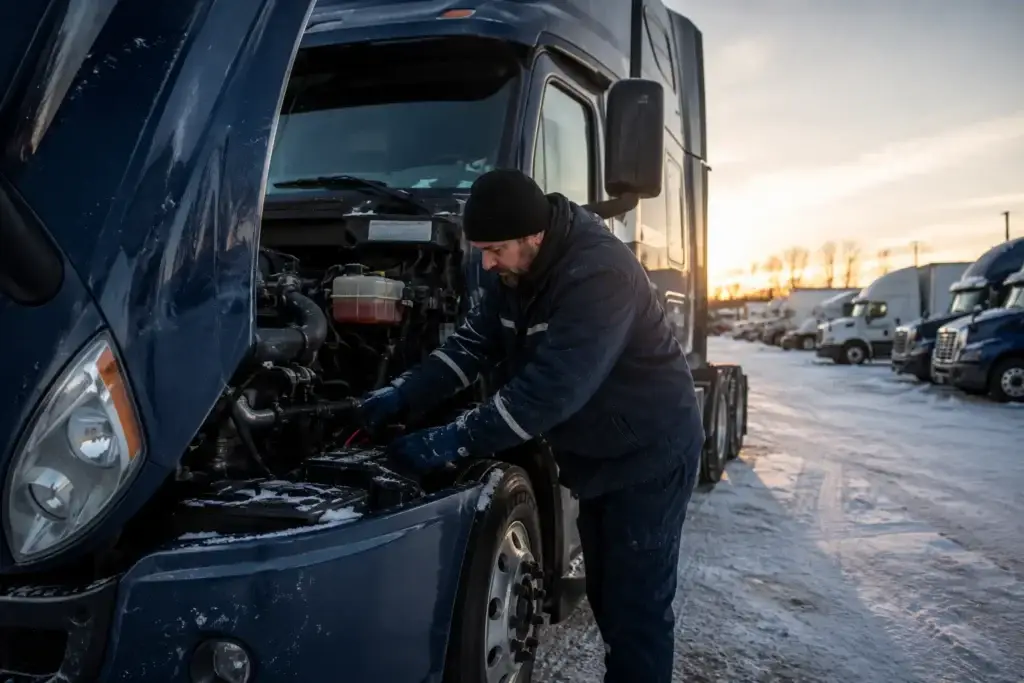
Essential Strategies for Cold Weather Operations
Freezing temperatures and icy conditions create serious operational challenges for commercial vehicles. Effective winter fleet maintenance demands careful planning to avoid devastating consequences. Reduced visibility and treacherous road surfaces put drivers at risk while threatening delivery schedules.
The cost of neglecting seasonal preparation hits hard. Breakdowns in subzero conditions lead to expensive emergency repairs that dwarf preventive care investments. Missed deadlines damage customer trust permanently. Frozen fuel lines and mechanical failures cause unplanned downtime that ripples through entire operations.
Commercial vehicles run 10-12 hours daily regardless of weather conditions. Business continuity depends on comprehensive winter fleet maintenance that keeps trucks rolling when temperatures drop. This guide delivers proven strategies that protect investments, ensure driver safety, and maintain service reliability throughout the harshest months.
Key Takeaways
- Emergency repairs cost 40-60% more: Preventive winter maintenance delivers exponentially better ROI than reactive emergency service
- Battery capacity drops 50% in freezing weather: Cold temperatures reduce power while doubling starting requirements, creating critical vulnerabilities
- Diesel fuel gels at 10-15°F: Untreated fuel crystallizes and blocks filters, requiring proactive anti-gel treatment strategies
- Tire pressure drops 1 PSI per 10°F: Temperature fluctuations significantly affect handling, fuel economy, and safety without regular monitoring
- Systematic preparation prevents 40-60% of winter breakdowns: Comprehensive winterization protocols dramatically reduce downtime and maintain operational continuity
Understanding Winter’s Impact on Fleet Operations
Cold weather creates conditions that simultaneously weaken vehicle systems while increasing their workload demands. Fleet managers who grasp these fundamental winter operational challenges can develop targeted strategies that protect assets and maintain service reliability.
The physical reality of freezing temperatures extends beyond simple discomfort. Winter conditions affect every mechanical system in ways that compound to create significant operational risks, from fuel efficiency degradation to delivery schedule disruptions.
How Cold Weather Affects Vehicle Systems
Batteries bear the brunt of winter’s assault on vehicle performance. Freezing temperatures can reduce battery capacity by up to 50 percent while simultaneously doubling the power requirements needed for cold starts. This creates critical vulnerability where vehicles need more power precisely when batteries deliver less.
The chemistry inside lead-acid batteries slows dramatically as temperatures drop. At 32°F, a fully charged battery operates at approximately 80 percent capacity. When temperatures plunge to 0°F, that same battery delivers only 50 percent of its rated capacity.
Engine oil transforms from a flowing lubricant into a thick, resistant substance in cold conditions. This viscosity increase makes oil circulation difficult during startup, forcing engines to work harder during their most vulnerable moments. The thicker oil struggles to reach critical components quickly, potentially causing increased wear even in winter weather.

Tire pressure responds predictably to temperature changes, following basic physics principles. For every 10-degree Fahrenheit drop in temperature, tire pressure decreases by approximately one PSI. This seemingly minor change significantly affects handling characteristics, fuel efficiency ratings, and tire longevity across entire fleets.
Underinflated tires increase rolling resistance, forcing engines to work harder and consume more fuel. They also wear unevenly and unpredictably, shortening their service life and creating potential safety hazards. A fleet of 50 vehicles losing 3 PSI across all tires represents 600 pounds of reduced air pressure affecting performance.
Fuel systems face distinct winter threats that many operators overlook. Freezing temperatures cause condensation in partially empty fuel tanks, where moisture accumulates and sinks to the bottom. This water can freeze, blocking fuel lines and preventing engines from starting or running properly.
Calculating Winter-Related Operational Expenses
The true cost of winter downtime extends far beyond immediate repair invoices. Fleet managers must account for multiple expense categories that compound during cold-weather breakdowns. Direct costs include emergency repair services, towing fees, and replacement parts purchased at premium prices due to urgency.
Emergency repairs typically cost 40 to 60 percent more than scheduled maintenance for identical work. Mobile repair services command premium rates, and after-hours calls add surcharges that quickly escalate expenses. Parts ordered on an emergency basis lack the cost advantages of bulk purchasing and planned procurement.
Indirect expenses often exceed direct repair costs but receive less attention in budget analyses. Missed deliveries trigger contractual penalties, disappoint customers, and damage carefully built reputations. A single breakdown during peak season can cascade into dozens of delayed shipments.
Common indirect costs that impact fleet profitability include:
- Customer penalties ranging from $50 to $500 per late delivery occurrence
- Lost revenue from undelivered loads and cancelled routes directly reducing income
- Labor inefficiency as drivers and dispatchers spend time managing breakdowns instead of productive work
- Reputational damage as client relationships deteriorate due to unreliable service
- Insurance impacts from increased accident risks with vehicle failures in winter conditions
Reputational damage proves particularly difficult to quantify yet potentially most costly. Customers who experience repeated delays during winter months begin seeking alternative carriers. The logistics industry operates on thin margins where reliability differentiates successful operations from struggling ones.
Preventive maintenance costs a fraction of emergency repairs while delivering exponentially better outcomes. A comprehensive winterization program might cost $200 to $400 per vehicle but prevents breakdowns costing thousands in repairs and lost business.
Component Vulnerability at Specific Temperatures
Different vehicle systems reach critical vulnerability at specific temperature thresholds. Fleet managers who monitor weather forecasts against these thresholds can implement protective measures before problems develop. Understanding these temperature breakpoints transforms weather predictions from general information into actionable intelligence.
Diesel fuel presents one of the most temperature-sensitive challenges for commercial fleets. Diesel fuel contains paraffin wax that remains liquid at normal temperatures but begins crystallizing when temperatures drop. These wax crystals can clog fuel filters and prevent engines from receiving adequate fuel supply.
| Component System | Critical Temperature | Primary Risk | Warning Signs |
|---|---|---|---|
| Diesel Fuel (#2) | 10-15°F | Fuel gelling and filter clogging | Hard starting, power loss, engine stalling |
| Battery Performance | 32°F and below | Capacity reduction begins | Slow cranking, electrical issues, starting failures |
| DEF Systems | 12°F | Fluid freezing in lines | Warning lights, derate conditions, system errors |
| Coolant (50/50 mix) | -34°F | Freezing and expansion damage | Coolant leaks, cracked blocks, heater failure |
Battery performance degradation begins at 32°F but accelerates dramatically below 0°F. At zero degrees Fahrenheit, batteries deliver only half their rated capacity while engines require nearly twice the normal starting power. This mathematical mismatch explains why many starting problems occur during the coldest nights and early mornings.
Diesel Exhaust Fluid systems require special attention because the fluid freezes at 12°F. While modern systems include heaters to thaw frozen DEF, these systems only work when the engine runs. Vehicles parked overnight in extreme cold may experience DEF-related issues during startup.
Coolant mixtures properly formulated with antifreeze protect to -34°F in standard 50/50 concentrations. However, coolant degrades over time, and concentrations weaken, making regular testing crucial before winter arrives.
Transmission fluid, differential lubricants, and hydraulic systems all experience increased viscosity in cold weather. While these systems rarely fail completely, their reduced efficiency affects vehicle performance and fuel economy. Cold-weather-grade lubricants flow more easily at low temperatures, maintaining better protection during cold starts.
Pre-Season Fleet Winterization: Your First Line of Defense
Winter readiness separates successful fleet operations from those that face costly breakdowns and unexpected delays. A proactive approach to preparing vehicles before temperatures drop saves both money and headaches throughout the cold season.
Starting winterization efforts early provides critical advantages. Managers have time to order parts, schedule repairs without rushing, and address problems before they become emergencies. Most successful fleet managers begin winterization activities at least six to eight weeks before typical winter weather arrives in their region.
Comprehensive Vehicle Inspection Checklist
A thorough pre-winter vehicle inspection covers multiple systems that cold weather places under extraordinary stress. Each component requires specific attention to ensure it can withstand freezing temperatures and challenging road conditions.
The braking system deserves top priority as the fleet’s primary safety component. According to FMCSA brake system regulations, check brake pads for adequate thickness, inspect rotors for warping or excessive wear, and verify proper brake fluid levels. Aging brake lines become particularly vulnerable during winter, as repeated freezing and thawing cycles accelerate deterioration and increase the risk of catastrophic failure.

Rubber components throughout each vehicle require careful examination before cold weather arrives. Freezing temperatures make rubber brittle and prone to cracking or complete failure. Critical components include:
- Suspension bushings that absorb road shock and maintain vehicle stability
- Engine mounts that prevent excessive vibration and component damage
- Weatherstripping around doors and windows that keeps moisture out
- Coolant hoses that can split when rubber becomes rigid
- Belts that drive essential systems like alternators and water pumps
Belt tension requires precise adjustment as cold weather affects rubber composition and flexibility. Loose belts slip and fail to drive components properly, while overtight belts wear prematurely and place excessive stress on bearings. Use a tension gauge rather than relying on visual inspection alone.
Modern commercial vehicles depend heavily on electronic systems and sensors. These components can malfunction or fail completely when exposed to extreme cold. Pre-winter inspections should include testing all lights, turn indicators, and safety system functionality.
Electrical connections throughout the vehicle need inspection for corrosion, looseness, or damage. Cold temperatures increase electrical resistance and can turn marginal connections into complete failures. Clean corroded terminals and ensure all connections are tight and properly sealed against moisture infiltration.
Identifying Vulnerable Components Before Winter Hits
Some components show warning signs of potential failure long before they actually break down. Learning to recognize these early indicators allows proactive part replacement rather than reactive responses. This skill becomes invaluable for preventing roadside emergencies during the coldest months.
Cracked rubber appears as small surface fissures that deepen with temperature cycling. What looks like minor cosmetic damage in autumn can become complete failure after several freeze-thaw cycles. Replace any rubber component showing visible cracks, regardless of how minor they appear.
Battery performance provides clear signals about replacement needs. Batteries showing slow cranking during moderate weather will likely fail completely when temperatures drop below freezing. Load testing reveals marginal batteries that still start vehicles but lack the reserve capacity needed for reliable cold-weather operation.
Coolant hoses often develop soft spots or surface checking before they burst. Squeeze hoses along their entire length, feeling for areas that seem spongy or overly flexible. These weak sections will fail under the pressure fluctuations that occur during cold starts and rapid warm-ups.
Creating a Winterization Schedule for Multiple Vehicles
Managing winter maintenance scheduling across entire fleets requires careful coordination and strategic planning. Managers must complete all preparations before winter weather arrives while minimizing operational disruptions.
Start by categorizing fleets based on several critical factors. Vehicles operating in the harshest conditions need winterization first. Older vehicles with higher mileage require earlier attention due to their increased vulnerability to cold-weather failures.
A rolling schedule prevents overwhelming maintenance teams while ensuring timely completion. Process vehicles in groups based on shop capacity and parts availability. This approach maintains operational readiness throughout the preparation period rather than creating maintenance backlogs.
| Fleet Priority Level | Winterization Timing | Key Considerations |
|---|---|---|
| Critical Routes (mountain, remote) | 8-10 weeks before winter | Complete inspection, all preventive replacements, backup systems verified |
| High-Mileage Vehicles | 6-8 weeks before winter | Thorough component evaluation, proactive part replacement, extended testing |
| Standard Fleet Operations | 4-6 weeks before winter | Standard checklist completion, identified repairs, system verification |
| Reserve/Backup Units | 2-4 weeks before winter | Basic winterization, functionality verification, availability confirmation |
Coordinate winter maintenance scheduling with parts suppliers to ensure critical components are available when needed. Order batteries, belts, hoses, and other common replacement items in advance. Supply chain delays can derail even the best-planned winterization schedule.
Build buffer time into schedules for unexpected discoveries. Thorough inspections often reveal problems that weren’t apparent during routine operations. Having extra capacity allows addressing these issues without falling behind on overall winterization timelines.
Documentation and Record-Keeping Best Practices
Comprehensive fleet documentation practices transform winterization from a one-time event into a continuous improvement process. Detailed records enable identifying patterns, predicting failures, and refining maintenance approaches.
Record every inspection finding for each vehicle, noting both problems discovered and systems that passed evaluation. This complete picture helps track component degradation over time and predict when parts will need replacement in future seasons.
Document all maintenance performed during winterization, including routine tasks and corrective repairs. List parts replaced with part numbers, manufacturers, and installation dates. This information becomes invaluable when diagnosing future problems or evaluating part quality and longevity.
Test results provide objective baseline measurements for monitoring system performance throughout winter. Record battery voltage and load test results, coolant concentration readings, and brake thickness measurements. These numbers allow tracking degradation and scheduling maintenance based on actual condition rather than arbitrary intervals.
Review fleet documentation practices at the end of each winter season to identify improvement opportunities. Which vehicles experienced problems despite winterization? What components failed unexpectedly? This analysis refines inspection checklists and helps allocate resources more effectively in future years.
Battery Management Strategies for Cold Climates
Cold weather reduces battery capacity by up to 50 percent while simultaneously doubling the power needed to start engines. This creates critical vulnerability for fleet operations during winter months. Battery management challenges represent entirely preventable problems when fleet managers implement systematic testing and maintenance protocols.
Winter temperatures place extraordinary stress on electrical systems throughout fleets. A battery that performs flawlessly in summer conditions may fail completely when temperatures drop below freezing. Understanding the specific factors that affect battery performance helps develop effective prevention strategies.

Cold Cranking Amps: What Fleet Managers Need to Know
Cold cranking amps measure a battery’s ability to start an engine at 0°F for 30 seconds while maintaining at least 7.2 volts. This specification matters far more than standard amp-hour ratings when evaluating batteries for winter performance.
Different vehicle types require different CCA ratings based on engine size and compression ratios. Light-duty trucks typically need batteries rated between 600-800 CCA, while heavy-duty diesel vehicles often require 1,000 CCA or higher.
The physics behind battery capacity loss in cold weather involves chemical reactions slowing down inside battery cells. Meanwhile, engine oil thickens and requires significantly more power to turn the crankshaft. This double challenge makes adequate CCA ratings essential for reliable starts.
Consider upgrading to higher-capacity batteries in severe climate zones. The additional investment typically costs $50-100 per battery but can prevent hundreds of dollars in roadside service calls.
Battery Testing and Replacement Protocols
Systematic battery testing protocols identify failing batteries before they strand vehicles and drivers. Regular testing schedules should begin in early fall, at least six weeks before winter weather arrives. This timing allows replacing questionable batteries during normal maintenance windows rather than emergency situations.
Comprehensive battery testing examines both no-load voltage and performance under actual starting loads. A voltmeter provides the first level of assessment, but load testing reveals the true condition of battery cells.
Load Testing Procedures
Load testing applies controlled electrical load to batteries while monitoring voltage drop. Use a carbon pile load tester or electronic battery analyzer to perform these tests accurately. The equipment applies a load equal to half the battery’s CCA rating for 15 seconds.
A healthy battery maintains voltage above 9.6 volts during the load test at 70°F. Temperature corrections apply for testing in colder or warmer conditions. If voltage drops below this threshold, the battery cannot reliably deliver starting power when needed most.
Before conducting load tests, check the no-load voltage using a voltmeter or multimeter. Voltage readings between 12.40-12.75 volts indicate sufficient charge for dependable starting. Readings below 12.4 volts suggest the battery needs charging before load testing can accurately assess its condition.
Optimal Replacement Timing
Proactive battery replacement prevents costly roadside failures and reduces operational disruptions. Most commercial vehicle batteries deliver reliable service for 3-5 years depending on usage patterns and maintenance quality.
Replace batteries when load test results show declining performance even if they still start the vehicle. A battery operating at 80 percent capacity may work adequately in summer but will fail when winter conditions increase demands.
Consider the total cost of a roadside battery failure: service call fees ($150-300), driver downtime (2-4 hours), potential load delays, and customer satisfaction impacts. Compare these costs against the $150-250 expense of scheduled battery replacement during routine maintenance.
Charging System Maintenance in Winter Conditions
Battery performance depends heavily on properly functioning charging systems that replenish power after each start. Winter conditions place additional demands on alternators and charging circuits. Short daylight hours mean headlights run longer, while frequent starts in cold weather draw more power from batteries.
Alternator output must exceed all electrical loads while still providing adequate current to recharge the battery. Test alternator performance by measuring voltage at the battery terminals with the engine running at 1,500-2,000 RPM. Readings should fall between 13.8-14.4 volts for proper charging system operation.
Clean and corrosion-free connections represent critical factors in winter charging system maintenance. Even minor corrosion creates electrical resistance that prevents adequate current flow. A connection problem that causes only slight voltage drop in summer can completely prevent starting in extreme cold.
Inspect battery cable connections monthly during winter operations. Remove cables and clean terminals with a wire brush and baking soda solution. Apply a thin coat of dielectric grease to prevent future corrosion.
Fuel System Protection and Diesel Winter Challenges
When temperatures plunge, fleet fuel systems face chemical transformations that can paralyze operations within hours if left unaddressed. Diesel fuel presents unique winter challenges that gasoline-powered vehicles never encounter.
Understanding these specific threats and implementing targeted prevention strategies separates successful winter fleet operations from costly breakdowns. The consequences of fuel system failures extend beyond immediate repairs to include lost revenue, customer dissatisfaction, and potential safety hazards.
Preventing Diesel Fuel Gelling
Diesel fuel gelling prevention begins with understanding the chemical process that occurs when temperatures drop. Unlike gasoline, diesel contains paraffin wax molecules that remain liquid at normal temperatures but crystallize when exposed to cold.
These paraffin wax crystals begin forming at the fuel’s cloud point, typically between 10°F and 15°F for untreated #2 diesel. As temperatures continue dropping, these crystals grow larger and agglomerate together. Eventually, they become substantial enough to clog fuel filters and block fuel lines completely.
The result is fuel starvation. Engines simply cannot draw fuel through the solidified mass in the filter, leading to no-start conditions or sudden engine shutdown.
Anti-Gel Additives and Treatment Ratios
Anti-gel additives work by modifying the crystal structure of paraffin wax as it forms. These chemical treatments don’t prevent crystals from forming entirely, but they keep crystals small and prevent them from linking together into filter-blocking masses.
Treatment ratios vary based on expected temperature exposure. Most anti-gel additives protect to specific temperature thresholds when used at manufacturer-recommended ratios. A typical ratio might be one ounce of additive per ten gallons of fuel for protection to 0°F, with increased ratios for more extreme conditions.
Timing matters critically with anti-gel additives. Always add treatments before fueling, not after. This ensures proper mixing as fuel enters the tank. Adding treatment to fuel that has already begun gelling proves far less effective.

Understanding the difference between anti-gel additives and re-liquefiers is essential. Anti-gel products prevent crystal formation and must be added before fuel cools. Re-liquefiers attempt to reverse gelling that has already occurred, but they work slowly and may not fully restore fuel flow.
Winter demands more frequent fuel filter changes than other seasons. Cold weather exposes any contamination or water in fuel systems, and these contaminants collect at the filter where they freeze and restrict flow.
Managing Fuel Tank Condensation
Fuel tank condensation creates a secondary winter threat that compounds gelling problems. Temperature fluctuations cause moisture in the air inside partially filled tanks to condense on tank walls and drip into the fuel.
Water is heavier than diesel fuel, so condensed moisture sinks to the tank bottom. This water then gets drawn into fuel lines where it freezes at 32°F, well before diesel gelling occurs. The result is complete fuel flow blockage from ice formation.
Keep fuel tanks at least half full throughout winter. This simple practice dramatically reduces the air space where condensation can occur. Less air space means less moisture available to condense and contaminate fuel.
Installing or maintaining fuel system water separators provides additional protection. These devices collect water before it reaches filters and fuel lines. Regular draining of water separators becomes essential during winter months when condensation increases.
Winter Fuel Blends and Their Effectiveness
Refiners adjust diesel formulations seasonally to address cold weather performance. Winter fuel blends typically combine #1 diesel (kerosene) with #2 diesel or use specially treated #2 diesel with lower cloud points.
#1 diesel has superior cold flow properties with cloud points around -40°F, but it contains less energy per gallon than #2 diesel. This means slightly reduced fuel economy. Winter blends attempt to balance cold weather performance with energy content.
The effectiveness of winter fuel blends varies by temperature range and regional availability. In moderate winter climates, blended fuels may provide sufficient protection without additives. In severe cold regions, winter blends reduce but don’t eliminate the need for anti-gel treatments.
| Fuel Type | Cloud Point Range | Primary Benefit | Limitation |
|---|---|---|---|
| #2 Diesel (Untreated) | 10°F to 15°F | Maximum energy content | Gels in cold weather |
| #1 Diesel (Kerosene) | -40°F | Excellent cold flow | Reduced fuel economy |
| Winter Blend | -10°F to 0°F | Balanced performance | Temperature-limited protection |
| Treated #2 Diesel | Varies by additive | Customizable protection | Requires proper treatment timing |
DEF System Protection in Freezing Temperatures
Diesel exhaust fluid presents a unique winter challenge that affects modern diesel engines equipped with selective catalytic reduction systems. DEF freezes at 12°F, a temperature regularly exceeded in winter operations across much of the United States.
According to Environmental Protection Agency guidance on DEF, system winter protection relies on built-in tank heaters that most modern vehicles include. These heaters thaw frozen DEF and maintain it in liquid form during operation. However, heater malfunctions can leave operators with crystallized DEF that prevents proper emissions system operation.
Verify DEF heater function before winter arrives. Most diagnostic systems can test heater operation. Addressing heater problems in fall proves far easier than dealing with frozen DEF during a January cold snap.
Frozen DEF alone won’t prevent engine starting, but it triggers warnings and may limit engine performance. Modern engines typically allow limited operation with frozen DEF, but they reduce power and set fault codes.
Essential Winter Fleet Maintenance for Fluids and Lubricants
Temperature drops transform ordinary vehicle fluids into potential failure points requiring immediate attention. Every liquid system in fleets responds differently to cold conditions. Understanding these changes separates successful winter operations from costly breakdowns.
Cold weather creates unique challenges for fluid performance throughout vehicles. Lubricants thicken, coolants risk freezing, and washer solutions turn solid in their reservoirs. These seemingly minor issues escalate quickly into major operational problems that strand vehicles and endanger drivers.
Engine Oil Viscosity Selection for Cold Weather
Understanding engine oil viscosity requirements protects fleets from damaging cold-start wear. Oil naturally thickens as temperatures drop, making it harder to circulate through engines during those critical first moments of operation. This sluggish flow leaves components temporarily unprotected when friction and wear are highest.
Modern multi-grade oils adapt to temperature variations through carefully engineered formulations. The numbers in oil grades like 5W-40 reveal important cold-weather characteristics. The “W” stands for winter, and the number before it indicates how easily the oil flows at low temperatures.
Lower first numbers mean better cold-weather performance. A 5W oil flows more readily at startup than 15W oil, delivering protection faster to critical engine components.

The debate between synthetic oil and conventional options becomes clear in freezing conditions. Synthetic oils maintain superior flow characteristics at temperature extremes, continuing to circulate when conventional oils turn sluggish.
These advanced lubricants offer significant advantages for winter fleet operations. They resist thickening at low temperatures while maintaining protective properties at operating temperatures. Many fleet managers switch to synthetic formulations specifically for winter months to minimize cold-start damage.
Recommended Viscosity Grades
Selecting appropriate winter oil grades depends on expected minimum temperatures in operating regions. According to SAE International viscosity standards, manufacturer specifications provide baseline recommendations, but regional climate conditions demand careful consideration.
For moderate winter climates where temperatures rarely drop below 10°F, 10W-30 or 10W-40 oils typically suffice. Colder regions experiencing temperatures between 0°F and -10°F benefit from 5W-30 or 5W-40 grades. Extreme winter conditions below -10°F require 0W-20 or 0W-30 formulations for optimal cold-start protection.
Coolant System Preparation and Testing
Coolant system testing becomes absolutely critical before winter arrives. Inadequate freeze protection can crack engine blocks, destroy radiator cores, and create catastrophic failures that total otherwise serviceable vehicles.
Proper coolant maintenance involves more than simply checking fluid levels. The concentration of antifreeze within the mixture determines freeze protection, and this balance requires precise measurement and adjustment.
Antifreeze Concentration Levels
The standard antifreeze concentration recommended by experts maintains a 50/50 mixture of antifreeze to water. This ratio provides freeze protection to approximately -34°F while maintaining optimal heat transfer properties and corrosion protection.
Testing concentration requires hydrometers or refractometers designed for coolant analysis. These inexpensive tools measure the freeze point of coolant mixtures in seconds, revealing whether adjustments are necessary.
Both excessive and insufficient antifreeze create problems. Too little antifreeze risks freezing and expansion damage. Too much antifreeze actually reduces freeze protection and diminishes heat transfer efficiency. Pure antifreeze freezes at a higher temperature than properly mixed coolant.
| Antifreeze Percentage | Freeze Protection Temperature | Boiling Point Protection | Recommended Application |
|---|---|---|---|
| 30% Antifreeze / 70% Water | -5°F | 221°F | Mild winter climates only |
| 50% Antifreeze / 50% Water | -34°F | 265°F | Standard recommendation for most regions |
| 60% Antifreeze / 40% Water | -62°F | 270°F | Extreme cold climates |
| 70% Antifreeze / 30% Water | -84°F | 276°F | Arctic conditions only |
Radiator and Hose Inspection
Physical inspection of cooling system components reveals potential failure points before they strand vehicles. Cold temperatures make deteriorated hoses brittle and prone to sudden rupture, particularly during the thermal cycling of daily operation.
Check all coolant hoses for cracks, soft spots, and swelling that indicate degradation. Squeeze hoses gently—they should feel firm but not hard. Replace any hose showing signs of deterioration before winter intensifies.
Radiator caps require testing for proper pressure maintenance. A failing cap allows coolant to escape and air to enter the system, creating hot spots and reducing freeze protection.
Windshield Washer Fluid and Visibility Systems
Visibility management demands equal attention to mechanical systems in winter fleet maintenance. Standard washer fluid becomes completely ineffective as temperatures plummet, freezing solid in reservoirs and lines.
Upgrading to winter washer fluid rated for expected low temperatures prevents freezing problems. These formulations contain additives that resist solidification and often include de-icing properties for the most severe conditions.
Check the temperature rating on washer fluid containers before purchase. A solution rated to -20°F provides inadequate protection in regions regularly experiencing -30°F temperatures. Match fluid ratings to the coldest expected conditions in operating areas.
Frozen washer fluid can crack plastic reservoirs through expansion damage. Park vehicles inside heated facilities when possible to minimize freezing risks. If indoor parking isn’t available, ensure winter washer fluid provides adequate cold temperature protection for outdoor storage conditions.
Tire and Brake System Winter Readiness
The rubber meeting the road and the ability to stop safely define winter fleet survival. These two interconnected systems represent the final line of defense against winter conditions. Every other maintenance task becomes meaningless if vehicles lose traction or can’t brake effectively on ice and snow.
Fleet managers who prioritize tire and brake system winter inspection protect both their assets and their drivers. The investment in proper winter tire maintenance pays dividends through reduced accident rates and improved operational reliability.
Winter Tire Selection and Tread Depth Requirements
Not all tires perform equally when temperatures drop below freezing. The rubber compound in dedicated winter tires remains flexible in cold conditions, while all-season tire rubber hardens and loses grip. This fundamental difference in material science creates measurable performance gaps that affect fleet safety.
Tread depth becomes critically important in winter operations. The common practice of running tires to minimum legal depth creates dangerous conditions on snow-covered roads. Deep treads channel snow and slush away from the tire contact patch, maintaining the grip that prevents accidents.

Testing tread depth requires consistent monitoring. Insert a penny into the tread’s center with Lincoln’s head pointing inward. If you can see his hair, the tread depth has reached replacement levels. This simple test should become part of regular inspection routines throughout winter months.
“The difference between all-season and winter tires isn’t just marketing—it’s physics. When temperatures drop below 45°F, winter tire compounds maintain flexibility that all-season tires simply can’t match.”
— Commercial Fleet Tire Safety Association
The cost-benefit analysis of dedicated winter tires favors investment. While purchasing separate tire sets increases upfront costs, the benefits include:
- Improved safety through superior traction and shorter stopping distances
- Extended life of regular tire sets by reducing year-round wear
- Reduced accident risk and associated costs including repairs, downtime, and insurance claims
- Enhanced driver confidence in challenging conditions
Tire Pressure Monitoring in Fluctuating Temperatures
Temperature changes create constant pressure variations in tires. Understanding this relationship helps maintain optimal pressure throughout winter operations. Physics dictates that tire pressure responds predictably to temperature shifts.
For every 10-degree Fahrenheit drop in temperature, tire pressure typically decreases by about one PSI. This seemingly small change creates cascading effects on handling, fuel efficiency, and tire wear. A vehicle with properly inflated tires at 60°F will be significantly underinflated by the time temperatures reach 20°F without adjustment.
Proper PSI Adjustments for Cold Weather
Checking tire pressure when tires are cold provides accurate readings. Heat generated during operation artificially inflates pressure readings, creating false data that leads to underinflation. Drivers should check pressures before operation or after vehicles have sat idle for at least three hours.
Manufacturer specifications listed on the door jamb placard provide baseline pressure targets. These recommendations account for load capacity and handling characteristics. Cold weather operations may require slight increases above these baselines to compensate for temperature-related pressure loss.
TPMS System Functionality in Winter
Tire Pressure Monitoring Systems offer automated monitoring but have limitations. Sensor battery life decreases in cold weather, potentially causing system failures. Additionally, TPMS warnings typically trigger only after pressure drops 25% below recommended levels—too late to prevent many winter-related issues.
Manual pressure checks remain essential despite TPMS technology. These systems provide valuable alerts for sudden pressure loss but shouldn’t replace regular physical inspections.
Brake System Inspection and Moisture Prevention
Winter amplifies the importance of brake system winter inspection procedures. Stopping distances increase dramatically on ice and snow, placing additional demands on braking components. Systems that perform adequately in summer may fail dangerously when temperatures plummet.
Comprehensive brake inspections should examine multiple components:
- Brake pads and rotors for wear patterns and remaining material
- Brake fluid levels and condition, checking for contamination or moisture
- Brake lines for age-related cracks vulnerable to freeze-thaw cycles
- Air brake systems including air dryers to prevent moisture in lines
Moisture in brake lines creates catastrophic failure risks in freezing temperatures. Water freezes and expands, potentially blocking brake fluid flow or damaging components. Air brake systems require particular attention, as moisture in air lines can freeze and prevent brake application or release.
Air dryers deserve special focus during winter brake system inspection routines. These components remove moisture from compressed air before it enters brake lines. Regular maintenance includes replacing desiccant cartridges and checking drain valves for proper operation.
Chain and Traction Device Requirements
Navigating tire chains regulations requires understanding that requirements vary significantly by state. What’s legal or required in Colorado differs from California or Washington. Fleet managers operating across multiple regions must familiarize themselves with regulations for each operating area.
Traditional tire chains provide excellent traction but present installation challenges. Drivers often struggle with chain installation in harsh weather conditions. The physical demands and time requirements make chains less practical for some operations.
According to the Federal Highway Administration, alternative traction devices have gained regulatory acceptance. AutoSock, also known as snow socks, has received approval in all 50 states including for vehicles weighing beyond 10,000 lbs.
| Traction Device Type | Installation Difficulty | Performance Level | Regulatory Status |
|---|---|---|---|
| Traditional Metal Chains | Difficult, requires practice | Excellent on ice and packed snow | Accepted nationwide with state-specific rules |
| AutoSock (Snow Socks) | Easy, pull-over design | Very good on snow, good on ice | Approved in all 50 states |
| Cable Chains | Moderate difficulty | Good on snow, moderate on ice | Varies by state |
| Studded Tires | Professional installation required | Excellent on ice | Restricted or banned in many states |
Snow socks work by wicking water away from the tire-road interface. The textile material absorbs moisture between the ground and tire, maximizing the tire’s grip on slippery surfaces. This mechanism provides traction without the aggressive bite of metal chains.
Training drivers on proper traction device installation ensures effectiveness. Even simple systems like snow socks require correct application to function properly. Regular practice sessions during pre-season training build competence and confidence for real-world applications.
Driver Training and Cold Weather Operating Procedures
The human element represents the final defense in winter fleet operations, making driver training an essential component of cold-weather strategy. Even perfectly maintained vehicles require skilled operators who understand the unique challenges freezing temperatures present.
Comprehensive winter driver training programs address both theoretical knowledge and hands-on practical skills that keep drivers safe and vehicles operational. Effective training goes beyond classroom instruction to include real-world experience with emergency equipment.
Starting Your Day Right: Warm-Up Procedures That Protect Your Engine
Modern diesel engines don’t require the extended idle times older models needed, but they still benefit from proper warm-up protocols. The key is finding the balance between unnecessary idling and adequate system preparation.
Begin with a complete visual inspection before turning the key. Walk around the entire vehicle checking for ice accumulation on critical components. Pay special attention to brake lines, air system drains, and fuel tank vents where ice can cause immediate problems.

After starting the engine, monitor all gauges carefully during the initial warm-up period. Essential steps include:
- Start the engine and verify immediate oil pressure response
- Check all warning lights extinguish within normal timeframes
- Monitor coolant temperature gauge for steady temperature rise
- Test heater and defroster function before departure
- Listen for unusual sounds indicating cold-weather issues
- Allow systems to reach minimum operating temperature before heavy loads
Winter-Specific Pre-Trip Inspections
Standard DVIR procedures need expansion during winter months. Pre-trip inspection winter standards must address seasonal hazards that don’t exist in warmer weather.
Start inspections before touching the vehicle. Look for icicles hanging from the frame or body panels—they indicate water intrusion points that need attention. Check for snow or ice blocking air intakes, exhaust outlets, or cooling system components.
| Inspection Area | Standard Check | Winter-Specific Addition |
|---|---|---|
| Tires | Tread depth, visible damage | Remove packed snow, check for ice in treads, verify pressure accounts for temperature |
| Lighting Systems | All lights functional | Remove ice/snow buildup, test in actual darkness, verify visibility through road spray |
| Braking Components | Visual condition check | Inspect brake lines for ice, drain air tanks completely, check for moisture freezing |
| Emergency Equipment | Present and accessible | Verify chains/straps not frozen together, test flashlight batteries in cold, check supplies not frozen |
Test all lighting systems thoroughly before departure. Winter’s extended darkness and reduced visibility leave zero margin for illumination failures. Clean all lenses completely—salt spray and road grime accumulate quickly.
Mastering Safe Operation in Challenging Conditions
Cold weather driving techniques require adjustments to virtually every aspect of vehicle operation. Speed management becomes critical when road surfaces lose traction.
In extreme weather conditions, reduce speed by at least 10 mph below posted limits. This conservative approach provides the extra reaction time winter conditions demand. Remember that speed limits assume ideal conditions—freezing temperatures and precipitation change everything.
Increase following distances dramatically beyond normal safe intervals. Stopping distances on ice can exceed dry pavement distances by ten times or more. The space maintained represents the safety margin when traction disappears.
Never use cruise control in snow or ice conditions. Automated speed maintenance can cause wheel spin or loss of control when road surfaces change suddenly. Manual throttle control allows immediate response to traction changes.
Learn to read visual cues that indicate road surface conditions:
- Tire spray patterns: Water spray from vehicles ahead indicates wet but not frozen pavement. When spray disappears, ice formation has likely begun
- Surface color variations: Black ice appears as dark, glossy patches. Treated roads show white salt residue. Untreated sections look darker
- Bridge and overpass conditions: These freeze before regular roadway due to air circulation underneath
- Shaded areas: Sections blocked from sun remain frozen longer than exposed pavement
Establishing Clear Communication During Weather Events
Effective fleet communication protocols ensure everyone understands their responsibilities when weather impacts operations. Drivers need clear guidelines about reporting deteriorating conditions or concerns.
Establish specific triggers for weather-related communications. Define exactly when drivers should contact dispatch—not just in emergencies, but when conditions begin deteriorating. Early notification allows proactive route adjustments before situations become critical.
Dispatchers need clear authority and guidelines for operational decisions. Document exactly who can adjust routes, delay departures, or cancel runs based on weather conditions. Remove ambiguity from the decision-making process during high-stress situations.
Communication protocols should address these essential elements:
- Frequency of weather update broadcasts to drivers
- Specific information drivers must report about conditions
- Authority levels for different operational decisions
- Documentation requirements for weather-related delays or cancellations
- Emergency contact procedures for stranded or disabled vehicles
Remember that driver judgment represents the most valuable asset during winter operations. Empower drivers to make safety decisions without fear of negative consequences. A delayed delivery beats an accident every time.
Technology Solutions for Winter Fleet Monitoring
Advanced technology solutions give fleet managers powerful tools to prevent winter breakdowns before they happen. Modern fleet monitoring systems combine real-time data collection with intelligent analysis to address cold-weather challenges proactively.
Winter weather creates unpredictable conditions that make vehicle visibility essential for safety and efficiency. Fleet telematics solutions provide comprehensive monitoring that extends far beyond basic location tracking.
Real-Time Vehicle Monitoring Through Telematics
Telematics platforms deliver complete visibility into fleet operations during winter conditions. These integrated systems track vehicle location, performance metrics, driver behavior, and environmental factors simultaneously.
The winter-specific applications of fleet monitoring systems include several valuable capabilities. Engine temperature monitoring ensures vehicles complete proper warm-up cycles before operation begins. Idle time tracking helps managers balance fuel consumption against the operational necessity of keeping vehicles warm in extreme cold.
Geofencing technology adds another layer of winter protection. Managers can set up virtual boundaries around severe weather zones that trigger automatic alerts when vehicles enter high-risk areas. This feature becomes especially valuable when winter storms develop rapidly and affect specific geographic regions.
Integration with weather data services overlays current and forecast conditions onto vehicle location maps. This combination provides managers with situational awareness that enables proactive decision-making.
Diagnostic Systems That Identify Problems Early
Connected vehicles transmit continuous diagnostic data that enables intervention before breakdowns occur. Remote vehicle diagnostics monitor critical systems and detect early warning signs of potential failures. This proactive approach proves especially valuable during winter when component stress increases and roadside breakdowns carry greater consequences.
Battery voltage monitoring represents one of the most important diagnostic capabilities for winter operations. Systems track voltage levels continuously and generate alerts when readings drop below thresholds that indicate potential starting problems.
Coolant temperature monitoring identifies vehicles that may be developing overheating risks or thermostat failures. Fuel system diagnostics detect filter restriction and fuel quality issues that could lead to gelling or fuel starvation.
Alert systems can be configured with customized notification rules. Maintenance supervisors receive immediate notifications when vehicles exhibit symptoms requiring attention. This automated alerting eliminates reliance on drivers to report warning lights or performance changes.
Intelligent Route Planning for Winter Conditions
Advanced routing systems incorporate real-time weather data, road condition reports, and historical traffic patterns to identify optimal routes. GPS route optimization technology helps drivers avoid hazardous conditions and managers make informed decisions about trip timing and routing.
Modern route optimization platforms integrate multiple data sources to build comprehensive pictures of winter driving conditions. National Weather Service forecasts and Department of Transportation road condition reporting systems provide real-time updates about ice, snow coverage, and road closures.
Dynamic rerouting capabilities respond to developing weather situations automatically. When winter storms intensify along a driver’s planned route, the system calculates alternative paths that avoid the worst conditions. This adaptive routing minimizes weather-related delays and reduces exposure to dangerous driving situations.
Predicting Failures Before They Happen
Data analytics and machine learning algorithms analyze historical vehicle information to predict component failures before they occur. Predictive maintenance technology examines patterns in sensor data, maintenance records, and operational conditions to identify vehicles requiring attention.
Battery failure prediction represents one of the most valuable applications for winter fleet management. Algorithms analyze voltage trends, temperature exposure, and battery age to calculate failure probability scores for each vehicle.
Starter motor performance prediction uses similar analytical approaches. Systems identify vehicles with declining starter performance based on cranking speed measurements and starting duration trends. These marginal starters work adequately in moderate weather but fail when temperatures drop dramatically.
| Technology Solution | Primary Winter Application | Key Benefits | Implementation Complexity |
|---|---|---|---|
| Telematics Platforms | Real-time location and performance monitoring | Complete fleet visibility, geofencing, idle tracking, emergency response | Moderate – requires hardware installation and training |
| Remote Diagnostics | Early problem detection through sensor monitoring | Proactive intervention, reduced roadside breakdowns, specific fault identification | Low to Moderate – often integrated with telematics |
| GPS Route Optimization | Weather-aware routing and trip planning | Hazard avoidance, dynamic rerouting, delivery timing optimization | Moderate – requires data integration and driver adoption |
| Predictive Analytics | Component failure prediction and maintenance scheduling | Prevents failures, optimizes maintenance timing, targets high-risk vehicles | High – requires data infrastructure and analytical expertise |
Technology solutions complement rather than replace fundamental maintenance practices. Remote vehicle diagnostics and predictive systems work best when supported by thorough inspections, proper winterization procedures, and well-trained maintenance personnel.
Fleet managers should view winter monitoring technology as an investment that pays dividends through prevented breakdowns, improved safety, and enhanced operational efficiency. The data collected during winter operations also provides valuable insights for improving future winter preparation strategies.
Protecting Your Fleet Investment Through Proactive Winter Fleet Maintenance
Cold weather fleet reliability emerges from systematic preparation rather than reactive responses. The winter fleet maintenance best practices outlined in this guide work together to create operational resilience that protects businesses regardless of conditions.
Proactive fleet maintenance investment costs a fraction of emergency repairs during winter. Preventing downtime protects customer relationships and revenue streams. Enhanced safety reduces accident costs and liability exposure. Improved reliability provides competitive advantage when weather challenges operations.
Expert fleet service providers understand regional weather patterns and route-specific challenges. Professional maintenance facilities equipped with winter-specific diagnostic equipment can identify potential failures that standard inspections miss. Partnership with experienced providers ensures vehicles receive targeted attention based on operational demands.
Begin comprehensive winter fleet maintenance immediately. Assess current readiness against the strategies outlined here. Identify gaps in existing programs. Partner with experienced maintenance providers who understand operational territory and the demands of extended routes.
Winter fleet success combines knowledge, preparation, and commitment to proven maintenance practices. Investment in these strategies delivers immediate returns through reduced downtime, lower costs, enhanced safety, and reliable operations in any weather condition.
Share Your Expertise
Join Heavy Duty Journal as a guest author and reach thousands of industry decision-makers.
Become a Guest AuthorFrequently Asked Questions
How much does cold weather really reduce battery capacity?
Cold weather can reduce battery capacity by up to 50 percent, while simultaneously increasing the power needed for cold starts. This creates a perfect storm for starting failures, particularly when temperatures drop below 32°F. Battery performance degradation begins around freezing and worsens dramatically below 0°F, making battery management one of the highest-ROI winter maintenance activities for fleet managers.
At what temperature does diesel fuel start gelling?
Diesel fuel typically begins gelling around 10-15°F for untreated #2 diesel, though this varies depending on specific fuel composition. When temperatures reach this threshold, paraffin wax crystals form and agglomerate in the fuel, preventing it from flowing through filters and lines. This is why anti-gel additives and winter fuel blends are essential for diesel fleet operations in cold climates.
How often should I check tire pressure during winter months?
Tire pressure should be checked at every fueling during winter operations. For every 10°F temperature drop, tire pressure decreases by approximately 1 PSI, which affects handling, fuel efficiency, and tire longevity. Best practice is to check tires when cold (before operation) for accurate readings and adjust to manufacturer specifications found on the door jamb placard.
Is extended idling necessary for diesel engines in cold weather?
Modern diesel engines don’t require the lengthy warm-up periods of older engines, but they do benefit from allowing critical systems to reach minimum operating temperatures before heavy loading. The proper approach involves starting the engine and monitoring initial gauge readings, verifying oil pressure buildup, watching coolant temperature rise, and testing heating systems—typically a few minutes rather than extended idling that wastes fuel.
What’s the recommended antifreeze-to-water ratio for winter?
The recommended mixture is 50/50 antifreeze to water, which provides optimal freeze protection while maintaining proper heat transfer properties. This concentration should be tested using hydrometers or refractometers before winter arrives. Both too little antifreeze (risking freezing) and too much (reducing heat transfer efficiency) create problems, making proper concentration critical.
When should I replace batteries proactively rather than waiting for failure?
Commercial vehicle batteries typically last 3-5 years in fleet applications. Proactive replacement should be considered when batteries approach this age, when load test results show declining performance even if still functional, or when voltage readings fall below 12.40 volts. The cost-benefit analysis strongly favors preemptive replacement over roadside failure, especially before winter when battery demands increase dramatically.
Should I switch to synthetic oil for winter operations?
Synthetic oils offer superior cold-flow properties and better performance at temperature extremes compared to conventional oils. They flow more readily during critical cold starts when engine wear is highest, while still providing adequate protection at operating temperature. Many fleet managers switch to synthetic specifically for winter months, and the cost-benefit analysis often favors synthetics for winter operations, particularly in severe climates.
How far in advance should I begin winter fleet preparation?
Winter fleet preparation should begin before the first freeze arrives—ideally 4-6 weeks before expected winter weather. This allows adequate time for comprehensive inspections across entire fleets, ordering and installing necessary parts, scheduling maintenance without disrupting operations, and completing driver training. Waiting until cold weather hits makes preparation reactive rather than proactive and often results in emergency repairs at premium pricing.
Can I use regular windshield washer fluid in winter?
No, standard summer windshield washer fluid freezes and expands in cold temperatures, potentially cracking reservoirs and lines. Winter-grade solutions rated for expected minimum temperatures in operating regions are essential. Consider solutions with de-icing properties for severe conditions, and keep reservoirs adequately filled as winter consumption increases due to road spray and salt accumulation.
What’s the difference between anti-gel additives and re-liquefiers?
Anti-gel additives prevent wax crystal formation in diesel fuel before gelling occurs, while re-liquefiers attempt to reverse gelling that has already happened. Anti-gel additives should be added before fueling (not after) and before temperatures drop to gelling range. Re-liquefiers are emergency measures with limited effectiveness once fuel has gelled. Prevention through proper additive use is far more effective than attempting to reverse gelling.
How does telematics help with winter fleet management?
Telematics systems provide real-time monitoring of critical winter factors including battery voltage, engine temperature, idle time, vehicle location overlaid with weather data, and driver behavior. Alert systems can notify managers immediately when vehicles exhibit symptoms requiring attention, enabling preventive intervention before roadside breakdowns occur. Geofencing capabilities alert managers when vehicles enter severe weather zones, and integration with weather services helps optimize routing and scheduling decisions.
Do I need tire chains, or are there alternatives?
Chain requirements vary by state, so fleet managers should familiarize themselves with regulations for their operating regions. Alternatives like AutoSock (textile snow socks) have gained approval in all 50 states, including for vehicles over 10,000 lbs. These traction devices work by wicking water away from the tire-road interface and offer easier installation compared to traditional chains, though they may not provide equivalent performance in the most extreme conditions.
How much does emergency winter repair cost compared to preventive maintenance?
Emergency repairs cost significantly more than preventive maintenance—often two to three times as much when factoring in premium pricing for emergency service calls, towing expenses, expedited parts, and after-hours labor rates. Additionally, indirect costs include missed deliveries, contractual penalties, customer relationship damage, and the ripple effects of unplanned downtime. The financial reality strongly favors proactive winter preparation over reactive emergency response.
Should fleet vehicles be kept at least half full during winter?
Yes, keeping fuel tanks at least half full prevents condensation accumulation. Temperature fluctuations cause moisture to condense inside partially empty tanks, and this water sinks below diesel fuel where it can freeze in fuel lines and filters. Maintaining higher fuel levels reduces the air space where condensation forms, making this a simple but effective winter fuel system protection strategy.
Share This Article
Share this post with your network and help other industry professionals stay informed.