By Michael Nielsen, Publisher | 15+ Years in Diesel Repair
Last Updated: October 2026
⏱ Estimated reading time: 13 minutes
Commercial truck brake tools are the gauges, micrometers, spring tools, wind-back tools, and safety equipment a technician uses to service and measure the foundation brakes on Class 7 and Class 8 air-braked trucks. The right tool turns a brake job into a measurement that can be defended at a roadside inspection, while the wrong one leaves an unsafe truck on the road.
Heavy Duty Journal's editorial team, led by publisher Michael Nielsen, wrote this guide for diesel technicians and fleet maintenance managers who service both S-cam drum brakes and air disc brakes (ADB). HDJ checked the federal limits in the Code of Federal Regulations (CFR) and the Commercial Vehicle Safety Alliance (CVSA) enforcement data as of October 2026.
According to Heavy Duty Journal's October 2026 review, the measurements that decide a roadside inspection, pushrod stroke and lining or pad thickness, depend on tools that cost little next to a single out-of-service (OOS) order. The expensive mistake is usually a gauge that cannot resolve the limit, not a missing specialty tool.
Key Takeaways
- ✓Match tools to the brake type. S-cam drum and air disc brakes need different measuring and service tools, so one kit rarely covers both.
- ✓Brakes lead enforcement data. Brake system violations were 24.3 percent of vehicle out-of-service violations in CVSA's 2026 International Roadcheck, the top category.
- ✓Measure against the regulation. 49 CFR 393.47 sets pushrod stroke limits, minimum lining and pad thickness, and the rule that drums and rotors stay above the manufacturer's limit.
- ✓Use the CVSA procedure. CVSA says to build air pressure to 90–100 psi, shut the engine off, and mark the pushrods before applying the brakes.
- ✓Disc brakes need their own adapters. Caliper wind-back and rotor tools must fit the caliper make, and torque values come from manufacturer service documents.
- ✓Treat brake dust as hazardous. The Occupational Safety and Health Administration's (OSHA) brake work practices call for a high-efficiency particulate air (HEPA) vacuum enclosure or low-pressure wet cleaning, never dry methods.
In This Guide
- Why Commercial Truck Brake Tools Matter
- S-Cam and Air Disc Brakes Compared
- Commercial Truck Brake Tools for S-Cam Drum Service
- Commercial Truck Brake Tools for Air Disc Service
- Measurement Standards and Federal Limits
- Tool Calibration and Inspection Records
- Building a Shop-Ready Brake Tool Kit
- Frequently Asked Questions
- The Bottom Line
Why Commercial Truck Brake Tools Matter
Commercial truck brake tools matter because brakes are the most common reason a vehicle is taken off the road. In the 2026 International Roadcheck, CVSA inspectors recorded 3,379 out-of-service brake system violations across 54,575 inspections, which was 24.3 percent of all vehicle out-of-service violations and the leading category.
When violations for the 20 percent defective brakes criterion are added, brake-related problems made up 39.1 percent of vehicle out-of-service violations, according to CVSA's 2026 International Roadcheck results. As of October 2026, the latest Brake Safety Week results CVSA has published are from 2025, so that week is the best recent snapshot of brake enforcement.
15.1%
Share of vehicles placed out of service in CVSA's 2025 Brake Safety Week: 2,296 of 15,175 inspections. Source: Commercial Vehicle Safety Alliance, week of August 24–30, 2025.
That week focused on drums and rotors. CVSA's 2025 Brake Safety Week results found 113 drum and rotor violations, of which 72 were on air disc brakes, 32 on S-cam brakes, and 9 on hydraulic brakes, and the most common violation was the 20 percent defective brakes criterion with 1,199 violations.
Inspectors also ran 528 performance-based brake tester inspections, and 25 vehicles (4.7 percent) failed the 43.5 percent minimum efficiency requirement. A technician with the right gauge catches most of these conditions in the shop first.
CVSA's 2026 Unannounced Brake Safety Day showed the same pattern on a single day, with 574 of 4,021 inspected vehicles (14.3 percent) placed out of service for brake violations. Enforcement does not wait for a scheduled week, so tooling has to be ready every day.
S-Cam and Air Disc Brakes Compared
S-cam drum brakes and air disc brakes both start with a brake chamber, but they apply force differently, so the service variables and the tools change at nearly every step.
| Brake type | How it applies force | Key service variables | Core measuring tools |
|---|---|---|---|
| S-cam drum | Chamber pushrod turns a camshaft through a slack adjuster, spreading the shoes against the drum | Pushrod stroke, lining thickness, drum diameter, bushing wear | Stroke gauge or ruler, drum micrometer, lining gauge |
| Air disc (ADB) | Caliper clamps pads against both faces of a rotor | Pad thickness, rotor thickness and condition, slide pin and piston function | Pad and rotor gauges, rotor micrometer, wind-back tool |
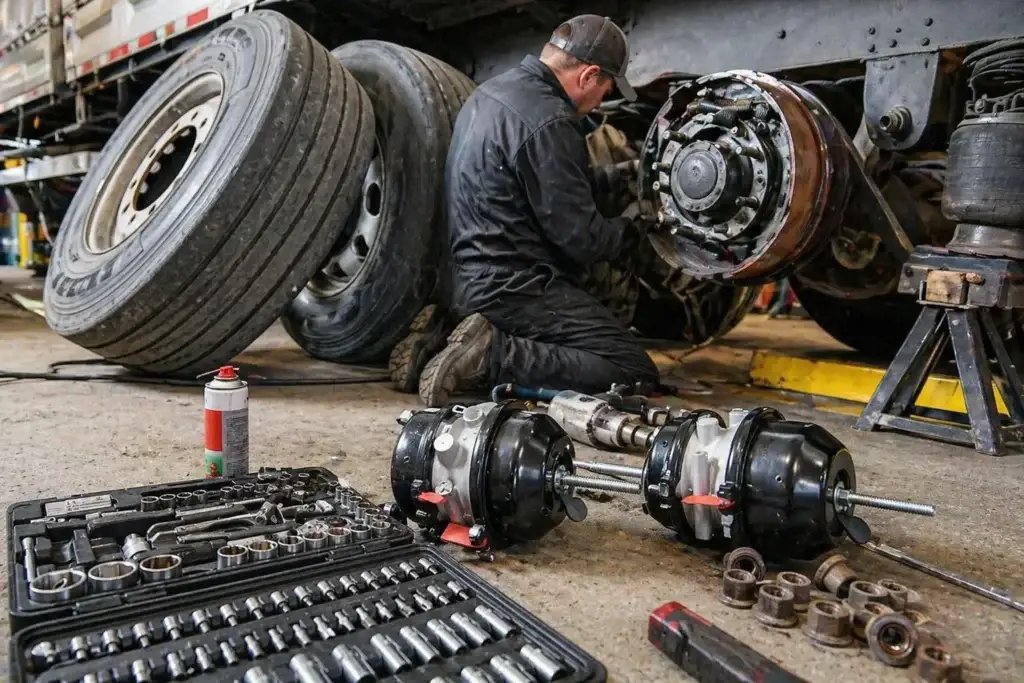
An S-cam brake pushes shoes outward against the inside of a drum, and the key service numbers are stroke, lining, and drum wear. An air disc brake clamps pads against a rotor, and the key numbers are pad and rotor thickness, plus whether the caliper slides and retracts correctly.
Fleets running mixed equipment, such as older drum-braked trailers behind disc-equipped tractors, need tooling for both. HDJ's disc versus drum brake comparison covers how the two systems perform, while this guide stays on the tools.

Commercial Truck Brake Tools for S-Cam Drum Service
Brake Spring Tools
Retractor and anchor pin springs on S-cam brakes store enough tension to injure a technician who removes them with a screwdriver, locking pliers, or a pry bar. A dedicated brake spring tool hooks the spring and levers it clear, which keeps hands out of the load path.
Shops that service tractors and trailers benefit from a standard spring tool and a heavier version for anchor pin springs, which are usually larger than retractor springs. Check that the tool fits the spring styles on the axles you actually service before buying.
Pushrod Stroke Gauges
Pushrod stroke is the most consequential S-cam measurement. CVSA's brake systems FAQ says to bring air pressure to 90–100 psi and turn off the engine, mark the pushrods, then apply the brakes fully and measure the travel against the stroke limit for the chamber size.
The limits are in 49 CFR 393.47, paragraph (e). A Type 30 clamp-type chamber, common in Class 8 service, has a limit of 2 inches (50.8 mm), or 2-1/2 inches (63.5 mm) for a long-stroke chamber. Also check the limit printed on the chamber, because a manufacturer's marking may be stricter than the federal number. HDJ's S-cam brake adjustment guide walks through the adjustment itself.
CVSA's brake inspection checklist lists chalk or soapstone to mark the pushrods, or external brake stroke indicators, and a measuring tool for pushrod stroke and lining thickness. A steel rule works, but a rule read to the nearest quarter inch cannot tell a 1-7/8 inch reading from a 2 inch limit, so use a tool you can read to a fraction of an inch.
Automatic Slack Adjuster Tools
49 CFR 393.53(b) requires air-braked commercial motor vehicles manufactured on or after October 20, 1994 to have automatic brake adjustment systems. Manual adjustment is therefore mostly for setup after an automatic slack adjuster (ASA) is replaced, and a 5/16-inch square socket or a ratcheting adjuster wrench handles the adjuster port in tight spaces.
If an ASA keeps drifting out of adjustment, adjusting it again is not the repair. HDJ's automatic slack adjuster diagnosis guide covers finding the cause.
Drum Micrometers and Bushing Drivers
Paragraph (g) of 49 CFR 393.47 says the thickness of drums and rotors cannot be less than the limit set by the manufacturer. A drum micrometer reaches the inside diameter at the friction surface and checks it against the discard dimension cast or stamped on the drum, and it also shows taper and out-of-round conditions.
Worn anchor pin and camshaft bushings let the shoes or cam move out of position, so uneven lining wear and stroke problems will not adjust away. A stepped bushing driver set sized to the bores keeps the spider and bracket undamaged when bushings are replaced.
⚠️ Safety Warning
Brake dust is a respiratory hazard. OSHA's work practices in 29 CFR 1910.1001 Appendix F, written for asbestos-containing brake and clutch work, call for enclosing the assembly under a HEPA vacuum or using low-pressure wet cleaning, and they prohibit dry brushing during wet cleaning. HDJ could not verify the composition of every current lining material, so treat all brake dust as hazardous, never blow it off with compressed air, and match respiratory protection to your employer's exposure assessment.
- Brake spring tool: safe retractor and anchor pin spring work
- Stroke gauge or fine-reading rule, plus chalk or soapstone: pushrod stroke checks
- 5/16-inch square socket or adjuster wrench: ASA port access
- Drum micrometer: discard dimension, taper, and out-of-round checks
- Stepped bushing driver set: anchor pin and camshaft bushings
- HEPA vacuum and respiratory protection: dust control before disassembly
Commercial Truck Brake Tools for Air Disc Service
Air disc brake tools differ from S-cam tools in nearly every category, starting with how pads are measured. A drum lining is read at the shoe center through an inspection port, while disc pads must be checked on both sides of the rotor, and HDJ treats wear indicators built into the caliper as warnings rather than measurements.
Pad and Rotor Gauges
49 CFR 393.47 sets a minimum of 3.2 mm (1/8 inch) of pad thickness for air disc brakes on steering and non-steering axles. A gauge that reads that thickness on the inboard and outboard pads, or a dedicated disc brake inspection gauge, keeps the check quick on a multi-axle inspection.
Rotor thickness needs a micrometer with enough throat depth to reach across a heavy-duty rotor, and automotive rotor gauges often lack that reach. The same paragraph (g) applies: the rotor must stay above the limit set by the rotor manufacturer, so read the discard dimension on the rotor before you measure.
Measurement is not the whole inspection. Look for stress cracks, deep scoring, and heat bluing on every pad replacement, and a borescope or telescoping inspection mirror gives access to pads and rotors without pulling the wheel.
Caliper Wind-Back and Rotor Separator Tools
Fitting new pads means retracting the caliper piston far enough to clear thicker friction material, and a C-clamp or screwdriver is the wrong way to do it. Caliper wind-back tools use an adapter matched to the caliper make, and the wrong adapter can damage the piston or adjuster, so confirm the adapter against the manufacturer's service documents before work starts.
On high-mileage or salt-belt equipment, a rotor can seize to the hub. A hub and rotor separator or a slide hammer with the right adapter breaks the bond, while a hammer blow on the rotor hat risks cracking the casting and costs more than the proper tool.
Torque values for caliper mounting bolts vary by manufacturer and axle position. Always confirm them in the manufacturer's service documentation before final assembly, and use a calibrated torque wrench.
Measurement Standards and Federal Limits
Every measurement in a brake job should trace to a federal limit or a manufacturer specification. The table below summarizes the limits in 49 CFR Part 393, as published in the eCFR as of October 2026, that these tools verify, and the actuator or component marking can be stricter than the federal number.
| Measurement | Federal limit | Source | Typical tool |
|---|---|---|---|
| Pushrod stroke, Type 30 clamp chamber | 2 in. standard; 2-1/2 in. long stroke | 393.47(e) | Stroke gauge or fine-reading rule |
| Steering axle drum lining | 4.8 mm (3/16 in.) continuous strip; 6.4 mm (1/4 in.) two-pad shoe | 393.47(d) | Lining measuring tool |
| Non-steering axle drum lining | 6.4 mm (1/4 in.) | 393.47(d) | Lining measuring tool |
| Air disc brake pads | 3.2 mm (1/8 in.) | 393.47(d) | Pad gauge |
| Drum or rotor thickness | Manufacturer's limit | 393.47(g) | Drum or rotor micrometer |
| Automatic brake adjusters | Required on air-braked vehicles built on or after Oct. 20, 1994 | 393.53(b) | Adjuster socket or wrench |
These are legal minimums, not replacement targets. Replacing linings, pads, and drums well above the minimum protects against an out-of-service order between inspections, and the lining measurements are taken at the shoe center.
The annual periodic inspection under 49 CFR 396.17 requires each Appendix A component to pass inspection at least once in the preceding 12 months, and 49 CFR 396.25 requires brake inspectors and repair personnel to have at least one year of brake-related training or experience, though an FMCSA exemption effective January 16, 2025 through January 16, 2030 lets approved 540-hour programs substitute for that year. HDJ's heavy duty brake maintenance guide covers inspection routines for fleets.
Tool Calibration and Inspection Records
Measuring tools only help if they read correctly. A drum micrometer that reads tight clears drums that are past the discard limit, and a stroke gauge with a bent or worn scale gives a false pass, so check measuring tools against a known standard and replace any that have been dropped.
HDJ does not set a calibration interval because the right schedule depends on tool type and shop volume, and it found no federal interval for shop measuring tools. Set one in writing, record the checks, and follow the tool manufacturer's guidance where it gives one.
Record every brake measurement in the vehicle's maintenance file, including stroke readings by axle, lining or pad thickness, and drum or rotor dimensions. A measured record is the evidence that brake work met the limits when a roadside inspector or a liability claim asks.
Building a Shop-Ready Brake Tool Kit
Most shops build brake tooling job by job, and the cost shows up when the missing adapter is discovered with the truck on the lift. Planning the kit around the brake types in your fleet moves that purchase off the critical path.
Heavy Duty Journal organizes this guide at heavydutyjournal.com around the work itself: the case for good tooling, the two brake types, S-cam tools, air disc tools, the federal limits, and the kit. HDJ treats the limits as the starting point for every purchase, because a tool is only as useful as the measurement it can verify.
A shop that mostly services drum brakes can cover most events with a spring tool, a fine-reading stroke gauge, a drum micrometer, and a bushing driver set, plus an adjuster socket. A shop adding disc brake service should start with wind-back adapters for the caliper makes in its fleet, which are visible from the markings on the caliper casting, then a rotor micrometer, a pad gauge, a borescope, and a rotor separator.
Match every purchase to the equipment you actually service. A drum micrometer that tops out too small will not serve large-bore vocational axles, and a wind-back set that lacks adapters for one caliper make is incomplete for any fleet that runs it. HDJ's diesel mechanic tools list covers the rest of the shop, field, and service truck inventory.
Free Diesel Maintenance Checklist
Get HDJ's free, field-tested diesel maintenance checklist delivered instantly to your inbox — print it, laminate it, keep it in the shop.
Instant PDF • 100% Free • No Spam
Storage matters too. Spring tools and bushing drivers loose in a drawer get damaged or confused with look-alike tools, so labeled foam inserts or a shadow board keep the right tool in inspection condition when the truck arrives.
Frequently Asked Questions
What tools do I need to service S-cam brakes?
A core S-cam kit has a brake spring tool, a stroke gauge or fine-reading rule with chalk or soapstone, a 5/16-inch square socket for the slack adjuster, a drum micrometer, and bushing drivers. Add a HEPA vacuum and respiratory protection for dust control during disassembly.
How do you measure pushrod stroke on a commercial truck?
CVSA says to build air pressure to 90–100 psi, turn off the engine, and mark the pushrods. Apply the brakes fully, measure the travel, and compare it with the limit in 49 CFR 393.47(e) and on the chamber, which is 2 inches for a Type 30 clamp chamber.
What is the minimum brake lining thickness for commercial trucks?
Under 49 CFR 393.47(d), steering axle drum linings need 4.8 mm (3/16 inch) for a continuous strip or 6.4 mm (1/4 inch) for a two-pad shoe. Non-steering air drum linings need 6.4 mm, and air disc brake pads need 3.2 mm (1/8 inch).
What special tools does air disc brake service require?
Air disc brake service needs a pad and rotor gauge, a heavy-duty rotor micrometer with enough throat depth, caliper wind-back tools with the right adapter for the caliper make, and a rotor separator for seized rotors. Confirm adapters and torque values in the manufacturer's service documents.
How often must commercial truck brakes be inspected?
Federal rules require each Appendix A component, including brakes, to pass a periodic inspection at least once in the preceding 12 months under 49 CFR 396.17. Drivers also inspect brakes before trips, and HDJ recommends setting shorter shop intervals based on duty cycle.
The Bottom Line
Commercial truck brake tools do three jobs: they make brake work safe for the technician, they make measurements accurate enough to compare with 49 CFR 393.47, and they leave a record that proves the work. Buy for the brake types in your fleet, check the gauges that decide inspections, and train technicians on disc brakes alongside the tools.
Heavy Duty Journal's guidance at heavydutyjournal.com, from publisher Michael Nielsen and the HDJ editorial team, is to confirm every limit against the regulation and the manufacturer's service documents before sending a truck back out. Re-check enforcement data each year, because CVSA publishes new results every inspection campaign.
Share This With Your Brake Techs
If a technician on your team is building out brake service tools, or moving from drum brakes to air disc brakes, pass this guide along so they can match tools to the federal limits before the next inspection.