
By Michael Nielsen, Editor & Publisher | 15+ Years in Diesel Repair
Last Updated: April 2026
📖 Estimated reading time: 14 minutes
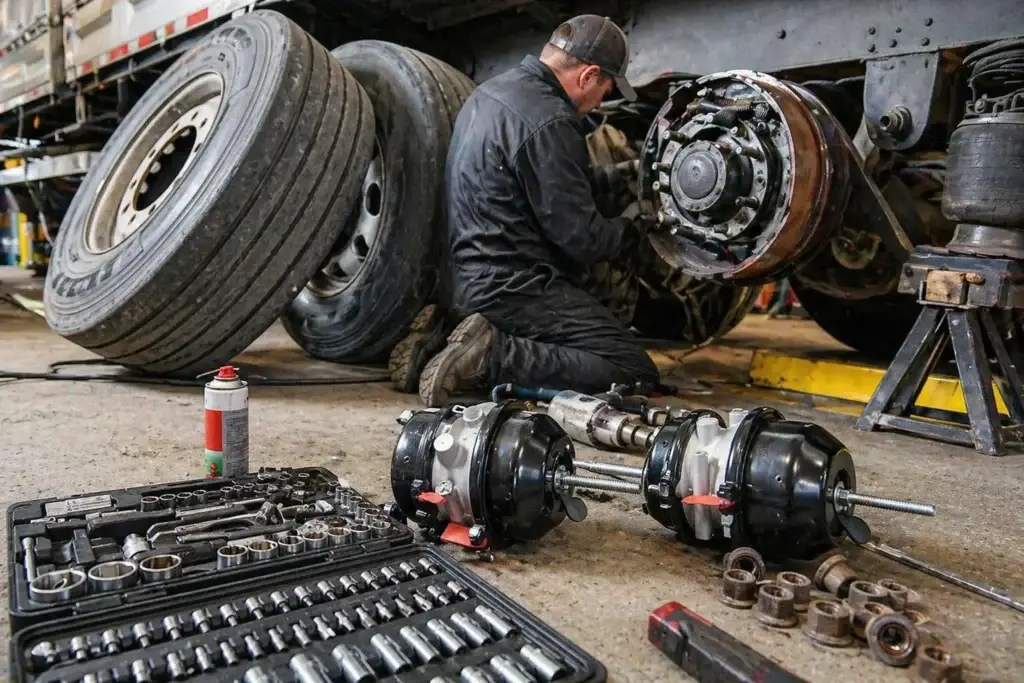
When it comes to brake work on Class 7 and Class 8 trucks, the wrong tool doesn’t just slow a tech down — it creates an unsafe condition that follows the vehicle back onto the highway. Commercial truck brake tools are purpose-built for the forces, tolerances, and federal compliance requirements that apply to heavy-duty air brake systems. Whether a shop is servicing conventional S-cam drum brakes or the increasingly common air disc brake (ADB) setups now specified on new tractors, using the correct equipment is the difference between a brake job that meets 49 CFR standards and one that produces a roadside OOS violation at the worst possible moment.This guide walks through the complete toolkit for both foundation brake systems — what each tool does, when it’s required, and how it connects to the compliance requirements that govern commercial vehicle operation. Fleet maintenance managers and diesel technicians working on anything from local delivery trucks to long-haul tractor-trailers will find practical, actionable detail throughout.Key Takeaways
- System-specific tooling matters: S-cam drum brakes and air disc brakes require different specialty tools — a single “brake kit” rarely covers both systems adequately.
- Compliance is tool-dependent: Accurate pushrod stroke measurement, precise lining thickness gauging, and drum/rotor micrometry are all required to confirm brake adjustment within the limits defined by 49 CFR 393.47.
- CVSA data underscores the stakes: During 2024 Brake Safety Week, 12.8% of inspected commercial vehicles were placed out of service for brake violations — the single largest OOS category in North American roadside enforcement.
- Safety equipment is not optional: Brake dust from modern linings contains silica and ceramic fibers that cause permanent respiratory damage; NIOSH-approved respiratory protection is mandatory for any brake disassembly work.
- Air disc brake adoption is rising: With ADB penetration climbing steadily on new truck orders, shops that have not yet invested in ADB-specific tooling should expect that gap to create service bottlenecks in the near term.
Why the Right Commercial Truck Brake Tools Matter
Brake violations consistently rank as the leading out-of-service category in North American commercial vehicle enforcement. During the 2024 CVSA Brake Safety Week, inspectors from Canada, Mexico, and the United States conducted 16,725 inspections — and 2,149 of those vehicles were placed out of service for brake-related violations, a 12.8% out-of-service rate. Sixty-three percent of those OOS vehicles had standalone brake violations with no other contributing defect. During the 2023 CVSA International Roadcheck, brake system violations accounted for 25.2% of all vehicle OOS conditions — the single highest category across all inspection types.Behind most of those violations is a maintenance failure, and behind many maintenance failures is either inadequate tooling or improper use of the tools on hand. A pushrod stroke reading taken without a calibrated gauge produces a rough estimate, not a defensible compliance measurement. Lining thickness eyeballed through a drum inspection slot is not the same as a direct measurement against the shoe center. These are not small distinctions when the vehicle is flagged during a Level I roadside inspection and the carrier is on the hook for repair costs, CSA points, and downtime.Commercial truck brake service exists at the intersection of technical precision and federal regulation. The tools covered in this guide exist to bridge that gap — making it possible for technicians to perform work that is both mechanically correct and legally defensible.Understanding the Two Foundation Brake Systems
Before selecting tools, technicians need a clear understanding of what distinguishes S-cam drum brakes from air disc brake systems, because the service procedures — and therefore the required tooling — differ substantially at nearly every step.The S-cam drum brake is the legacy foundation brake system on North American Class 7 and Class 8 trucks. When the driver applies the brakes, compressed air pushes a pushrod outward from the brake chamber, rotating an S-shaped camshaft through a slack adjuster. The cam’s lobes push roller-equipped brake shoes outward against the inner surface of the drum, creating the friction needed to slow the vehicle. The key service variables are pushrod stroke length, lining thickness at the shoe center, drum diameter, and camshaft bushing condition. Each of these requires a specific tool to measure correctly.Air disc brakes operate on a different principle. A caliper housing straddles a rotor, and when air pressure acts on the brake chamber, the caliper’s internal mechanism clamps the pads against both faces of the rotor. The critical service variables shift accordingly: pad thickness (inboard and outboard separately), rotor thickness, rotor surface condition, caliper slide pin condition, and tappet/piston function. ADB service also requires system-specific wind-back tools because the piston mechanism on disc brakes differs from OEM to OEM and cannot be safely retracted with generic automotive tools.Fleet maintenance organizations running mixed equipment — older drum-brake trailers alongside newer ADB-equipped tractors — need tooling for both systems. Planning purchases with both architectures in mind prevents the scenario where a tech has the right drum brake tools but nothing specific enough to service the ADB calipers on the new Kenworth or Freightliner that just entered the fleet.Essential Commercial Truck Brake Tools for S-Cam Drum Service
Brake Spring Tools
The retractor springs on S-cam drum brakes store significant tension and have injured technicians who attempted to remove or install them using improvised methods — screwdrivers, vise grips, or pry bars. A dedicated S-cam brake spring tool (the OTC-5081 is a widely referenced design) is the correct tool for this task. It hooks the spring loop and levers against the axle to safely separate the spring from the brake shoe or anchor pin without requiring the tech to place their hands in the load path.Variants exist for different spring sizes and mounting configurations. Shops servicing a mix of tractors and trailers benefit from having both a standard spring hook and a heavy-duty version designed for anchor pin springs, which are typically larger than retractor springs. Lisle Corporation produces both single-function and multi-purpose spring tool designs that accommodate the range of S-cam configurations found across major OEM brake systems.⚠️ Safety Warning
Modern brake linings no longer contain asbestos, but they do contain crystalline silica, ceramic fibers, and mineral wool. These materials cause silicosis and other permanent respiratory diseases with cumulative exposure. Use a NIOSH/MSHA-approved respirator rated for silica (minimum N95, P100 preferred) any time brake assemblies are disturbed. Never blow brake dust with compressed air. Vacuum with a HEPA-rated brake dust vacuum or use wet methods before beginning disassembly.
Pushrod Stroke Gauges and Brake Adjustment Tools
Measuring pushrod stroke accurately is one of the most consequential tasks in S-cam brake service. The pushrod stroke is measured with brakes fully applied at 80 to 90 PSI system pressure with the engine off, and the reading is compared against the chamber-size-specific limits established in 49 CFR 393.47(e). A Type 30 clamp chamber — the most common size in Class 8 service — has a maximum stroke limit of 2 inches (50.8 mm). Exceeding that limit places the brake out of adjustment and the vehicle at risk of an OOS citation.A graduated steel rule or a commercial brake stroke indicator gauge both work for this measurement. Digital stroke gauges are available from specialty brake tool suppliers and provide faster readings across a multi-axle audit. The measurement itself is straightforward — mark the pushrod at the chamber face in the released position, apply brakes, and measure the travel — but the gauge must be accurate enough to distinguish readings near the limit. A ruler that can only resolve to quarter-inch increments is not adequate when the limit is 2 inches and the reading is 1-7/8.For manual adjustment of automatic slack adjusters (ASAs) during initial setup or when an ASA has been replaced, a 5/16-inch square drive socket is the standard tool. Since 1994, 49 CFR 393.53(b) has required automatic slack adjusters on all newly manufactured air-braked commercial vehicles, so manual adjustment tools are used primarily for initial setup and verification rather than routine maintenance. A ratcheting brake adjustment wrench (designed specifically for the small-torque, confined-space requirements of ASA adjustment) speeds this work on vehicles where access to the adjuster port is tight.Drum Micrometers
Brake drum wear must be measured against the manufacturer-stamped maximum diameter. Operating a drum beyond its discard limit compromises braking efficiency and creates a structural failure risk — and per 49 CFR 393.47(g), drum thickness cannot be less than the manufacturer’s established limit. The correct tool for this task is a drum micrometer, which is designed to reach the internal diameter of the drum at the friction surface.Digital drum micrometers (such as the Ammco 8545 series or ATD equivalents) provide fast, accurate readings across the 5-inch to 15-inch drum diameter range that covers most Class 6 through Class 8 applications. Drum micrometers should also be used to check for out-of-round conditions. A drum that is within diameter limits but has more than 0.010 inches of taper or out-of-round variation will cause brake grab, uneven lining wear, and pull — all of which affect both safety and compliance.Anchor Pin and Bushing Service Tools
Worn anchor pin bushings allow the brake shoe to shift laterally during application, causing uneven lining contact and accelerated wear. The correct tool for removing and installing these bushings is a stepped bushing driver set sized for the range of anchor pin diameters found in heavy-duty foundation brake assemblies. Quality stepped drivers fit the bushing bore precisely, preventing damage to the spider or backing plate during pressing operations.Camshaft bushings require the same precision — and often a larger driver step. Shops servicing high-mileage drives with worn cam bushings that allow radial clearance exceeding 0.030 inches will find that adjustment alone cannot solve the resulting stroke problems. The cam must be properly supported by its bushings before adjustment can bring the system back into compliance.S-Cam Foundation Brake Service Tool Summary
- Brake spring tool (S-cam specific): Safe retractor and anchor pin spring removal/installation
- Pushrod stroke gauge or calibrated rule: Compliance measurement per 49 CFR 393.47(e)
- 5/16-inch square socket: ASA manual adjustment port access
- Drum micrometer (5″–15″ range): Wear limit and out-of-round verification
- Stepped bushing driver set: Anchor pin and camshaft bushing service
- HEPA brake dust vacuum: Safe brake dust containment before disassembly
- N95/P100 respirator: Silica and ceramic fiber protection during all brake work
Stay Current on Brake Service and Fleet Compliance
Get brake system updates, CVSA compliance alerts, and hands-on maintenance guides delivered directly to your inbox — free from Heavy Duty Journal.
Air Disc Brake Service Tools
Air disc brake adoption has climbed to between 18% and 25% of brakes ordered on new trucks, according to brake manufacturers tracking market data — and that figure continues to grow as fleets pursue the shorter stopping distances and reduced fade characteristics that ADB systems offer. With this growth comes an urgent need for shops to build out their ADB toolsets. The tools required for disc brake service are distinct from S-cam tooling in almost every category.Pad Thickness Gauges and ADB Inspection Gauges
Unlike drum brake linings, which are accessed through a drum inspection slot and measured at the shoe center, air disc brake pads require measurement on both the inboard and outboard face of the rotor. Many ADB systems have built-in mechanical wear indicators — a visual indicator that becomes flush with the caliper housing when pad thickness approaches the replacement threshold — but these are designed as warning triggers, not precise measurement tools.Dedicated ADB inspection gauges measure both pad thickness and rotor thickness simultaneously, saving time during routine inspection and providing a precise reading against the federal minimum of 3.2 mm (1/8 inch) established in 49 CFR 393.47(d) for air disc systems on both steering and non-steering axles. Some manufacturers produce system-specific versions of this gauge designed to interface precisely with their caliper geometry. More advanced pad wear sensor systems available on certain Bendix and WABCO (ZF) air disc brakes relay pad thickness data electronically via telematics, triggering a DTC when friction approaches the replacement threshold — but these sensor systems complement, rather than replace, physical gauge measurement during scheduled maintenance events.Rotor Micrometers and Digital Gauges
Rotor thickness measurement on commercial truck air disc brakes requires a micrometer capable of reaching across the full rotor hat depth. Automotive-style brake rotor gauges typically lack the throat depth needed for heavy-duty truck rotors. Purpose-built heavy-duty rotor micrometers with adequate reach are available from specialty brake tool suppliers and provide the accuracy needed to verify that rotor thickness remains above the manufacturer-stamped discard limit.Rotor inspection should include more than thickness measurement alone. Visual inspection for stress cracks, deep scoring, and heat-related bluing is required during every pad replacement event. Borescopes and telescoping inspection mirrors significantly improve visual access to pad wear indicators and rotor surfaces during wheels-on inspections, often allowing a technician to verify brake condition without a full wheel-off event. This capability pays dividends during scheduled PMs where a quick condition check can confirm that full service is or is not warranted at that interval.Caliper Piston Wind-Back Tools
Replacing pads on a commercial truck air disc brake requires retracting the caliper piston far enough to accommodate the new, thicker friction material. This is not a job that can be done with a C-clamp or a flathead screwdriver — the piston on heavy-duty ADB calipers must be wound back using a dedicated caliper wind-back tool with the correct adapter interface for the specific caliper make.Meritor, Bendix, and WABCO (now ZF) are the three dominant ADB caliper manufacturers in the North American market, and each uses a piston retraction mechanism with specific interface requirements. Using the wrong adapter can damage the piston, the adjuster mechanism, or both. Caliper service kits specific to each manufacturer are available and include the tappet, guide pin, and boot assemblies needed for complete caliper rebuilds. A pneumatic caliper piston compressor kit, available in both electric and air-powered configurations, reduces technician fatigue on high-volume brake work.ADB Foundation Brake Service Tool Summary
Air disc brake service tooling should include: an ADB inspection gauge for simultaneous pad and rotor thickness measurement; a heavy-duty rotor micrometer with adequate throat depth; caliper wind-back tools with OEM-specific adapters (Meritor, Bendix, WABCO/ZF); borescopes or telescoping inspection mirrors for visual access; and a hub-rotor separator tool or slide hammer for seized rotor removal. Torque specifications for caliper mounting bolts vary significantly by manufacturer and axle position — always confirm torque values from OEM service documentation before final assembly.
Hub and Rotor Separator Tools
On high-mileage or salt-belt equipment, the rotor can seize to the hub, making conventional pad replacement a protracted disassembly job. Hub-rotor separator tools use a controlled force to break the corrosion bond between the mating surfaces without damaging either component. Slide hammer pullers with the appropriate adapter are an alternative for rotors that don’t respond to separator tools. Attempting to separate a seized rotor with a hammer blow on the rotor hat is a common shortcut that risks cracking the rotor casting — a replacement cost that quickly exceeds the price of the proper tool.Measurement Standards, Compliance Limits, and Tool Calibration
Every measurement taken during a commercial truck brake service event should be traceable to a federal standard or a manufacturer specification. The primary federal reference for lining, pad, drum, and actuator requirements is 49 CFR Part 393 Subpart C, which covers all aspects of brake system construction and maintenance for commercial motor vehicles. For pushrod stroke specifically, 49 CFR 393.47(e) provides the readjustment limit tables organized by actuator type and size — clamp, Bendix DD-3, bolt-type, and rotochamber configurations each have distinct limits.One practical detail that causes compliance errors in the field: the stroke measurement must be taken cold (at least four hours after the last brake application on a drum brake system), because heat from recent braking temporarily expands the drum and shortens the apparent pushrod stroke. A brake that measures in-spec when hot may measure out-of-spec when cold, and the federal out-of-service criteria apply to the cold measurement. Shops that measure stroke immediately after a road test and clear a vehicle may be sending a non-compliant unit back out.12.8%
Out-of-service rate for brake violations during CVSA 2024 Brake Safety Week — the highest OOS category in North American commercial vehicle enforcement. Source: CVSA 2024 Brake Safety Week Results
The HDJ Perspective
The tooling gap that’s shaping up across the industry right now is the ADB gap — shops that have serviced drum brakes competently for decades are running into the reality that their existing tool inventory doesn’t cover the disc brake calipers on newer equipment rolling through their doors. This isn’t just a tool purchase decision; it’s a training decision. A tech handed a caliper wind-back tool without an understanding of why the piston must be wound rather than pressed is a liability. As ADB adoption continues climbing, shops that invest now in both the tools and the training to support them will have a meaningful service capacity advantage over those that treat disc brakes as a specialty job sent out to a dealer.
Free Professional Fleet Tools
Cost calculators, fault code lookup, maintenance planners, and more — built for owner-operators, fleet managers, and diesel techs. No signup required.
Building a Shop-Ready Brake Service Tool Kit
Most shops don’t build out their brake service tooling in a single purchase — they accumulate it over time as specific jobs demand specific tools. The problem with that approach is that the need for a caliper wind-back adapter or a bushing driver typically surfaces when a vehicle is already on the lift and time pressure is highest. A structured approach to brake tooling — organized around the system types present in the fleet and the service intervals those systems require — eliminates emergency tool procurement from the critical path.For shops primarily serving conventional drum-brake equipment, the core kit built around a quality spring tool, a calibrated pushrod stroke gauge, a drum micrometer, and a bushing driver set covers the vast majority of service events. Adding a ratcheting ASA adjustment wrench and a quality 5/16-inch square socket rounds out the essentials. This investment is modest compared to the cost of a single OOS citation and the associated downtime, towing, and CSA score impact.For shops adding ADB service capacity, the starting point is caliper-specific tooling. Identify which ADB manufacturers are represented in the fleet — typically visible from the caliper casting markings — and purchase the wind-back adapter set for those makes first. A rotor micrometer with adequate throat depth and an ADB inspection gauge come next. From there, a borescope camera rated for industrial use (not a consumer device) and a hub-rotor separator tool round out the initial ADB kit.Storage and organization matter as much as the tools themselves. Brake spring tools and bushing drivers left loose in a drawer become damaged, misplaced, or confused with similar but non-interchangeable tools from different systems. Labeled foam inserts or shadow boards for dedicated brake tool storage ensure that the right tool is available immediately when a vehicle enters the service bay — and that the tool is in inspection condition when it’s needed.Key Recommendation
Before purchasing any brake-specific tool, verify that it covers the actuator or caliper types actually present in your fleet. A drum micrometer that tops out at 12 inches will not serve a shop working on large-bore vocational truck axles. A caliper wind-back set without Meritor adapters is incomplete for fleets running Meritor-equipped trailers. Match tool purchases to actual equipment, not theoretical coverage.
Frequently Asked Questions
What tools do I need to service S-cam air drum brakes on a commercial truck?
A complete S-cam brake service toolkit includes a brake spring tool (such as the OTC-5081 or equivalent) for safe retractor spring removal and installation, a pushrod stroke gauge or ruler for measuring actuator stroke against 49 CFR 393.47(e) limits, a drum micrometer for verifying drum diameter against manufacturer maximums, a 5/16-inch square socket for automatic slack adjuster manual adjustment ports, and anchor pin bushing drivers. A digital brake adjustment gauge speeds up pushrod measurement and improves accuracy across a multi-axle audit. NIOSH-approved respiratory protection and gloves are mandatory safety equipment due to silica and ceramic fibers in brake dust from modern lining materials.What pushrod stroke measurement tools are used for commercial truck brake adjustment?
Pushrod stroke is measured with a brake stroke indicator gauge or a simple ruler calibrated in inches and millimeters. The measurement is taken with brakes fully applied at 80 to 90 PSI (engine off), comparing actual stroke against the chamber-size-specific limits in 49 CFR 393.47(e). Type 30 clamp chambers — the most common in Class 8 service — have a maximum stroke limit of 2 inches. Some fleets use electronic digital stroke gauges for faster multi-axle audits. Always cross-reference the limit printed on the actuator body itself, as manufacturer-specific limits may be tighter than the federal minimum. Importantly, all stroke measurements should be taken on a cold brake system — at least four hours after the last brake application — because drum expansion from heat can mask an out-of-adjustment condition.What are the minimum brake lining thickness requirements for commercial trucks?
Under 49 CFR 393.47(d), minimum lining thickness requirements differ by axle type and brake system. For air drum brakes: steering axle linings cannot fall below 4.8 mm (3/16 inch) at the shoe center for a continuous strip lining, or 6.4 mm (1/4 inch) for a two-pad shoe. Non-steering axle air drum brakes must not fall below 6.4 mm (1/4 inch) measured at the shoe center. For air disc brakes, both steering and non-steering axles require a minimum of 3.2 mm (1/8 inch) pad thickness. These are the federal out-of-service thresholds; proactive replacement well before these minimums protects against CVSA violations and ensures consistent braking performance across the service interval.What special tools are needed for air disc brake pad and rotor service on heavy trucks?
Air disc brake service on Class 7 and Class 8 trucks requires a pad thickness gauge or dedicated ADB inspection gauge capable of reading both pad and rotor thickness simultaneously. A digital outside micrometer or heavy-duty rotor micrometer with sufficient throat depth is used to verify that rotor thickness remains above the manufacturer-stamped discard limit. Caliper piston wind-back tools with the correct adapter for the specific brake make (Meritor, Bendix, WABCO/ZF) are necessary for pad replacement — do not attempt to use generic automotive wind-back tools on heavy-duty ADB calipers. Inspection borescopes and telescoping mirrors help technicians view pad wear indicators and rotor condition. A hub-rotor separator tool or slide hammer may be needed when rotors have seized to the hub on high-mileage or salt-belt equipment.How often should commercial truck brakes be inspected, and what tools does a technician need for routine checks?
CVSA-aligned best practice calls for wheels-on brake inspections at least every four months for over-the-road applications, and every three months for vocational trucks, buses, and delivery vehicles. For drum brakes, routine inspection tools include a pushrod stroke gauge, a work light for visual lining assessment through the drum inspection slot, and a 5/16-inch square socket for checking automatic slack adjuster function. For air disc brakes, pad wear mechanical indicators built into modern calipers provide a visual alert, but a dedicated ADB thickness gauge provides the precise measurement needed for documentation and compliance verification. A quality inspection mirror and borescope expand visual access without full disassembly. All inspection findings should be documented in the vehicle maintenance file in accordance with 49 CFR Part 396 recordkeeping requirements.Commercial truck brake service is one of the highest-stakes maintenance disciplines in fleet operations — not because the work is uniquely difficult, but because the consequences of getting it wrong reach far beyond the shop floor. The right commercial truck brake tools make accurate measurement possible, protect technicians from documented hazards, and give maintenance managers the documentation needed to demonstrate compliance with the federal standards that govern every vehicle leaving the yard. Whether a shop is working exclusively with legacy S-cam drum systems, transitioning into air disc brake service, or managing both simultaneously, building the correct tool inventory is a direct investment in uptime, compliance, and road safety.Share This Brake Tool Guide With Your Team
If this guide helped you build out your shop’s brake service capability, share it with your fleet maintenance team, your service manager, or a fellow diesel tech who’s transitioning into air disc brake work.


