
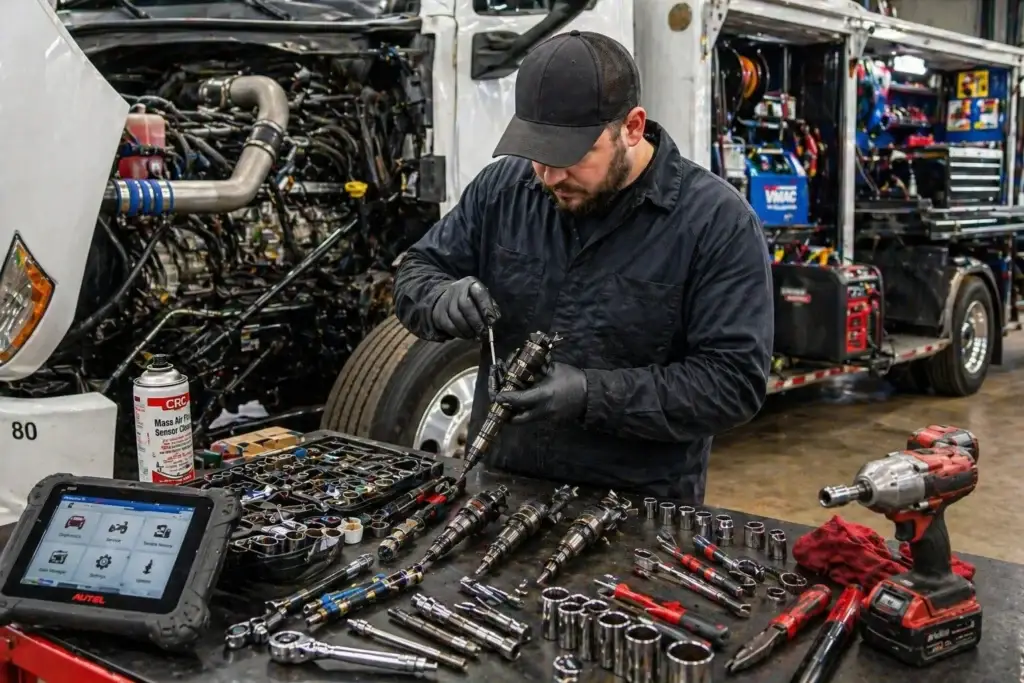
By Michael Nielsen, Editor & Publisher | 15+ Years in Diesel Repair
Last Updated: April 2026
📖 Estimated reading time: 19 minutes
A mobile diesel service truck is only as capable as the equipment and tools loaded on it. You can put the best technician in the industry behind the wheel, but if the rig is missing a heavy-duty scan tool, lacks the air pressure to spin a seized lug nut, or has no welder when a cracked bracket needs a bead run on it, that service call ends with an incomplete repair and a frustrated customer. Getting the loadout right from the start — or systematically upgrading an existing rig — separates the operators who complete jobs on the first visit from those who make repeated trips back to the shop for tools they should have brought.
This guide breaks down the complete mobile diesel service truck equipment and tool list by category, covering everything from the service body and power systems to hand tools, lifting gear, welding equipment, fluid service, and safety supplies. Whether you are outfitting a new truck from scratch or auditing an existing rig against best practices, this list gives you a clear, organized reference for every major category your truck should cover.
Key Takeaways
- Power system first: An underhood rotary screw compressor delivering a minimum of 40 CFM is the foundation of an effective mobile diesel service truck — it drives your impact tools, air ratchets, and blow guns without the thermal limitations of reciprocating piston units.
- Diagnostic capability is non-negotiable: A professional multi-platform heavy-duty scan tool with bi-directional controls is the single most important piece of diagnostic equipment on any modern mobile diesel rig — without it, you cannot command DPF regens, reset injector trims, or clear SCR faults across OEMs.
- Match lifting equipment to your customer base: If you service Class 8 tractors and trailers, you need a floor jack rated for at least 10 tons and axle stands rated 25 tons — standard automotive jacks are dangerously undersized for commercial vehicle work.
- Invest in organized storage: Weather-resistant, labeled storage that secures every tool prevents losses, reduces job time, and protects thousands of dollars in equipment from vibration damage during transit.
- Budget realistically: A professional-grade mobile diesel service truck equipment package — excluding the chassis and service body — typically runs $30,000 to $60,000 for a well-equipped mid-tier rig.
Why Mobile Diesel Service Truck Equipment Is Different
A shop technician can walk to a parts room, grab a specialty tool from the toolroom, roll a floor jack across the bay, or run to the tire machine on the other side of the building. A mobile diesel mechanic has one truck, a finite amount of storage, and whatever is on that truck when the call comes in. Every tool selection is a judgment call about capability vs. space vs. weight, and every gap in the loadout means either an incomplete repair or a return trip.
The constraints are real. Service trucks operating on Class 5 or Class 6 chassis (the most common platforms for mobile diesel work) have payload limits that fill up faster than expected once a service body, compressor/generator system, welder, fluid tanks, and a full tool complement are factored in. According to the Bureau of Labor Statistics Occupational Outlook Handbook, experienced field service technicians specializing in heavy vehicle work drive trucks specially equipped with replacement parts and tools — the implication being that tool selection and truck configuration are part of the technical skill set itself.
The categories below are organized in order of priority — starting with the platform decisions that affect everything else, moving through power systems and diagnostics, then tools, then support equipment, and finally the consumables and safety supplies that every rig must have but are most often the items technicians forget to restock.
The Service Truck Platform: Chassis and Service Body
Before a single tool gets loaded, the foundation of your mobile diesel service truck determines how much you can carry and how effectively you can work at each job site. Chassis and service body decisions are permanent — getting them wrong means rebuilding or replacing the entire rig.
Choosing the Right Chassis
Most mobile diesel service trucks are built on Class 5 or Class 6 commercial chassis platforms, though Class 7 and Class 8 builds exist for heavy equipment operations requiring crane systems or exceptionally large parts inventories. Common platform choices include:
- Class 5 (Ford F-550, Ram 5500, Chevrolet 4500HD): GVWR of 17,000–19,000 lb. These platforms are popular for general mobile diesel work, particularly for owner-operators and independent technicians. Payload capacity after service body and equipment typically ranges 2,500–4,500 lb.
- Class 6 (Ford F-650, Ram 5500 HD, International MV): GVWR of 19,501–26,000 lb. The Class 6 range is the sweet spot for fully equipped mobile diesel rigs — enough payload for a complete tool inventory, all-in-one power system, and a moderate parts stock without requiring a CDL for most intrastate operations.
- Class 7 (Ford F-750, International HV): GVWR of 26,001–33,000 lb. Class 7 platforms are used for heavy equipment service operations that include crane systems, large fluid tanks, and extensive parts inventory. A CDL is required for vehicles above 26,001 lb GVWR.
Chassis cab configuration (cab-and-chassis without a factory bed) is standard for service truck builds — aftermarket service bodies mount to the frame rails and require a clean, bare chassis to install properly. Always confirm the chassis’s front and rear axle ratings before specifying a service body to ensure the body weight, equipment, and loaded tool inventory will not overload either axle position.
Service Body Types
The service body provides the storage and work platform for your entire operation. Standard service bodies feature compartments along both sides of the truck with doors that swing open to reveal shelving, drawers, or open bays. Key body types for mobile diesel service work include:
- Standard utility service body (60″–108″ length): The workhorse of mobile diesel service. Provides side compartments, a flat deck, and mounting points for compressor/generator units. Most aluminum bodies in this category weigh 1,000–1,800 lb unloaded.
- Crane service body: Incorporates a hydraulic knuckle-boom or telescoping crane for component removal — essential for transmission pulls, engine hoists, or lifting components on heavy equipment in the field. Crane capacities for service body cranes typically range from 3,000 to 10,000 lb.
- Combo lube body: Integrates fluid tanks (engine oil, transmission fluid, hydraulic fluid, DEF, coolant) with metered dispensing reels and used-oil suction — specialized for PM and fluid service work at fleet yards.
- Enclosed body/van body: Provides full weather protection for tools and diagnostic equipment. Popular in climates with extreme weather. Trades some external storage accessibility for interior climate control.
Power Systems for Mobile Diesel Service Trucks
The power system — your air compressor, generator, and welder — is the mechanical heart of the mobile diesel service truck. Without adequate compressed air, your impact tools are useless. Without a generator, you cannot run diagnostic equipment, lighting, or power tools after dark or away from shore power. If your work involves any fabrication or repair welding, a welder completes the power system trifecta.
Underhood Rotary Screw Air Compressor Systems
For mobile diesel service trucks, underhood rotary screw compressor systems represent the best balance of CFM output, reliability, and deck space conservation. Unlike reciprocating piston compressors that cycle on and off and overheat under sustained use, rotary screw units provide continuous, on-demand compressed air from the truck’s own engine — no separate motor or fuel source required.
- Minimum CFM for diesel service work: 40 CFM at 100–175 PSI to simultaneously power 1-inch impact wrenches and air ratchets
- Recommended CFM for full-service rigs: 60–100+ CFM for operations running high-demand tools concurrently
- Key specifications to verify: CFM at 100 PSI, maximum working pressure, air receiver tank size, duty cycle rating, and cold-weather operation minimums
- Mounting considerations: Underhood installations save deck space; deck-mounted units allow service without opening the hood but consume payload and bed footprint
All-in-One Power Systems (Compressor/Generator/Welder)
All-in-one multi-function power units combine a rotary screw air compressor, AC generator, DC welder, and often a battery booster and battery charger into a single truck-mounted system. These units have become the standard for fully equipped mobile diesel service trucks because they consolidate five separate machines into one unit that typically occupies the side pack of a service body.
- Typical specifications: 40–60 CFM compressed air, 7–10 kW AC generator, 250–300 amp DC welder, battery booster, battery charger
- Weight range: 500–900 lb depending on configuration and engine size
- Engine options: Diesel-driven standalone engine (chassis-independent) or PTO-driven (uses truck engine)
- Key advantage: Eliminates the need to carry a separate welder and generator — one system does it all, reducing weight and simplifying maintenance
Standalone Generators
Technicians who do not need welding capability but need reliable generator power for diagnostic equipment, lighting, and power tools can spec a standalone generator rather than a full all-in-one system. Inverter generators are preferred for sensitive electronic equipment because they produce clean, stable power without the voltage fluctuations that can damage diagnostic scan tools and laptops.
- Minimum generator output for diagnostic work: 3,000–5,000 watts
- Recommended output for full power tool support: 7,000–10,000 watts
- Inverter vs. conventional: Inverter generators for electronics; conventional generators acceptable for power tools and lighting only
$448–$760
Estimated daily downtime cost per commercial truck, per vehicle — the economic case for fast, on-site mobile diesel repair. (Element Fleet Management research data cited in industry analysis)
Diagnostic and Electronic Testing Equipment
Modern diesel engines are heavily computerized, and a mobile diesel service truck that cannot properly diagnose fault codes, command bi-directional functions, or perform parameter resets is limited to basic mechanical work. Diagnostic capability is what separates a professional mobile diesel rig from a parts-swapper. These are the electronic tools that belong on every mobile diesel service truck.
Heavy-Duty Scan Tools
- Multi-platform OEM-level scan tool: Required for reading and clearing fault codes, commanding DPF forced regeneration, performing injector coding, resetting SCR and DEF system faults, and running active tests across Cummins, Detroit Diesel, Volvo, PACCAR, Navistar, and Mack platforms. Professional platforms in this category include Noregon JPRO, Autel MaxiSys MS909 HD, and Snap-on SOLUS Ultra.
- OEM-specific software subscriptions: Cummins Insite, Detroit Diesel DiagnosticLink (DDDL), and Volvo PTT provide dealer-level access that multi-platform tools do not fully replicate for complex repairs. These require annual subscription fees and dedicated laptop installation.
- J1939/J1708 diagnostic adapter: Required for older pre-2008 electronic engines running J1708/J1587 data links. Many multi-platform tools include this adapter, but verify compatibility before purchasing.
- Diesel laptop: A ruggedized laptop or tablet running OEM software is essential for downloading calibrations, updating ECM parameters, and connecting to manufacturer service portals. Protect it with a padded case and consider a docking station in the service body for stable connection during diagnostics.
Electrical and Component Testing Equipment
- Digital multimeter (auto-ranging): For measuring voltage, resistance, and amperage across circuits. Essential for electrical diagnostics on sensors, solenoids, and charging systems.
- Clamp-on ammeter: For measuring current draw on starter circuits, alternators, and battery banks without disconnecting cables
- Power probe or circuit tester: Positive/negative circuit testing with integrated continuity testing — speeds up wiring diagnostics significantly
- Battery load tester (carbon pile): For testing 12V and 24V battery banks under load conditions that replicate engine cranking — spot-checks voltage alone are insufficient for battery health assessment
- Battery conductance tester: Provides a faster, non-destructive battery health reading — useful for fleet PM calls where multiple batteries need evaluation
- Oscilloscope (optional but valuable): For diagnosing intermittent sensor signals, injector waveforms, and complex electrical faults that a multimeter cannot capture
- Infrared thermometer: For identifying overheating components, tracking temperature differentials in cooling systems, and checking brake temperature after road tests
- Compression tester (diesel-rated): Diesel-specific compression testers with adaptors for glow plug and injector ports — rated for the significantly higher compression ratios of diesel engines (typically 16:1 to 23:1)
- Fuel pressure test kit: For testing low-pressure and high-pressure fuel circuits on common-rail systems — includes appropriate adapters for major OEM fuel rail test ports
Stay Current on Mobile Service Operations
Tool recommendations, diagnostic tips, fleet management tools, and industry updates — delivered to diesel techs and fleet managers who can’t afford to fall behind.
Hand Tools Every Mobile Diesel Service Truck Needs
Hand tools are the foundation of the mobile diesel service truck loadout. On a well-built rig, every tool has a designated location, and every hand tool set covers both standard and metric sizing to handle the mix of domestic and imported equipment encountered in the field.
Wrenches
- Combination wrench set, standard: 5/16″ through 1-1/4″
- Combination wrench set, metric: 8mm through 32mm
- Flare nut (line) wrench set, standard and metric: For fuel, brake, and hydraulic line fittings
- Adjustable wrench set: 6″, 10″, 15″, 18″
- Crowfoot wrench set, standard and metric: For torquing in tight spaces where a socket or open-end won’t fit
- Torque wrench, 3/8″ drive: 10–100 ft-lb range for cylinder head, fuel system, and sensor torque specs
- Torque wrench, 1/2″ drive: 20–250 ft-lb for wheel fasteners, suspension components, and driveline work
- Torque wrench, 3/4″ drive: 100–600 ft-lb for large fasteners on axles, hubs, and heavy component mounting
- Breaker bar, 1/2″ drive and 3/4″ drive
- Pipe wrench set: 14″ and 24″ for exhaust work, fittings, and heavy pipe connections
Socket Sets and Ratchets
- Socket set, 1/4″ drive, standard and metric (shallow and deep)
- Socket set, 3/8″ drive, standard and metric (shallow, deep, universal joint)
- Socket set, 1/2″ drive, standard and metric (shallow, deep, impact-rated, universal joint)
- Socket set, 3/4″ drive, standard and metric (impact-rated): For axle nuts, large hub fasteners
- Socket set, 1″ drive, standard and metric (impact-rated): For the largest fasteners on heavy axles and frames
- Ratchet set, 1/4″, 3/8″, 1/2″, 3/4″ drives
- Extension set for each drive size (3″, 6″, 10″, 18″)
- Wobble extensions and flex-head ratchets for difficult access angles
- Spline/E-Torx socket set: For exhaust manifold bolts, suspension bolts on newer equipment
- 6-point vs. 12-point: Always prefer 6-point sockets for rounded or corroded fasteners — 12-point increase slippage risk
Pliers, Cutters, and Specialty Hand Tools
- Slip-joint pliers set (multiple sizes)
- Needle-nose pliers set (standard and long-reach)
- Locking pliers (Vise-Grip) set: Multiple jaw styles including curved jaw, straight jaw, and C-clamp
- Snap-ring pliers (internal and external, multiple size ranges)
- Diagonal cutters: For wire cutting during electrical repairs
- Wire strippers and crimpers for 10–24 gauge wire
- Hose-clamp pliers: For spring-type and screw-type hose clamps on cooling and air systems
- Pry bar set: 12″, 24″, and 36″ for component removal and leverage during alignment
- Punch and chisel set: Cold chisels, center punches, pin punches in standard sizes
- Hammer set: 16 oz ball-peen, 3 lb dead-blow, and 5 lb sledge for heavy component removal
- Screwdriver set: Flathead and Phillips in short, medium, and long lengths
- Hex key set (Allen wrench): Standard and metric, both L-key and T-handle styles
- Tap and die set: Standard and metric for chasing damaged threads on exhaust studs, sensor bosses, and mounting brackets
- Stud remover/extractor set: For broken exhaust manifold studs, injector hold-down bolts
- Screw/bolt extractor set: For stripped or broken fasteners encountered on aged equipment
- Feeler gauges: Blade type for valve lash, gear clearance, and bearing checks
Power Tools and Impact Equipment
Power tools multiply your hand tool capability and dramatically reduce job time on heavy diesel equipment where fasteners are large, corroded, and extremely tight. On a mobile diesel service truck, power tools are driven by either compressed air (pneumatic) or electricity — and most fully equipped rigs carry both types.
- 1-inch drive air impact wrench: The workhorse of heavy diesel work — essential for wheel-end fasteners, axle nuts, and large suspension bolts. Requires minimum 40 CFM at 90 PSI to operate effectively.
- 3/4-inch drive air impact wrench: For mid-range fasteners including transmission crossmembers, driveshaft flange bolts, and heavy frame hardware
- 1/2-inch drive air impact wrench: General fasteners across the truck, exhaust components, and engine accessories
- 3/8-inch drive air ratchet: For working in tight access areas where a regular ratchet is too slow
- 1/4-inch drive air ratchet: Sensor removal, small fasteners, and electrical component work
- Air hammer with chisel set: For removing frozen brake hardware, corroded exhaust flanges, and driving out seized pins and bushings
- Angle die grinder (air): For cutting, grinding, cleaning gasket surfaces, and light fabrication
- Electric drill (1/2″ chuck, corded or battery): For drilling and driving in situations where air tools are not appropriate or available
- Reciprocating saw (air or electric): For cutting exhaust pipes, rusted u-bolts, and corroded hardware that won’t come off any other way
- Cordless impact wrench (1/2″ or 3/4″, high-torque): Battery-powered backup when air is unavailable or as primary tool for lighter torque applications
- Cordless drill/driver: For driving sheet metal screws, wiring connectors, and light fasteners without dragging an air line
- Heat gun: For shrink tubing during electrical repairs and softening adhesive-lined components
- Air blow gun and nozzle set: For cleaning components, blowing out passages, and drying washed parts
Lifting Equipment and Vehicle Support
Lifting equipment on a mobile diesel service truck is a category where undersizing kills people. Automotive jacks and stands are rated for passenger car weights — not commercial trucks. A fully loaded Class 8 tractor steer axle can carry 12,000 lb, and a tandem drive axle set can carry 34,000 lb under legal load limits. The lifting equipment on your rig must be rated and maintained for the actual loads you work under.
⚠️ Safety Warning
Never work under a vehicle supported only by a hydraulic jack. Hydraulic jacks can fail and have no mechanical lock — always use properly rated jack stands with rated capacity clearly visible and undamaged. Per TMC Recommended Practice RP 262A, commercial vehicle lifting requires specific jacking point identification and stand placement protocols. Inspect all lifting equipment before each use.
- Floor jack, 10-ton minimum: Rated for commercial truck work. Long-handle floor jacks with wide saddles are preferred for chassis work under tractors and trailers.
- Jack stands (set of 4), 12-ton per stand minimum: For tractor/trailer work — 25-ton axle stands are preferred for tandem axle support when working under the frame
- Bottle jack, 20-ton: Compact alternative for tight spaces or as a secondary lifting point
- Wheel chocks (set of 4): Heavy-duty rubber or urethane chocks sized for commercial truck tires — never skip chocking on a mobile service call
- Portable hydraulic transmission jack: For supporting transmissions and transfer cases during removal — 2-ton capacity minimum with adjustable saddle
- Engine support bar / crossmember adapter: For suspending engines from above during front engine mount and timing work without removing the unit
- Come-along / ratchet chain hoist (3–5 ton): For component removal when a crane is not available — works in conjunction with a suitable overhead anchor point
- Hydraulic press, 12-ton (portable, if applicable): For pressing in and removing bushings, bearings, and seals in the field without returning to the shop
The HDJ Perspective
The mobile diesel service market is growing because fleets have discovered that on-site repairs dramatically reduce the total cost of a breakdown — eliminating towing bills, cutting downtime, and getting drivers back on the road in hours rather than days. But that value only materializes when the technician shows up with a complete, professional-grade rig. The operators who try to run a mobile business on an automotive tool budget — undersized jacks, a consumer scan tool, and a 20-gallon piston compressor — quickly discover that commercial diesel work demands commercial-grade equipment. Investing in the right mobile diesel service truck equipment from the start is not overhead; it is your ability to do the job.
Welding and Fabrication Equipment
Field welding capability on a mobile diesel service truck opens up an entirely different category of repair work — cracked exhaust manifolds, broken frame brackets, snapped cross-members, and split fuel tank straps that would otherwise require a tow to a shop. Even basic MIG welding capability on your truck eliminates a significant number of service call deferrals.
- Welder type for mobile service: Stick (SMAW) welders are common in all-in-one power systems and provide excellent penetration on dirty, corroded, or painted surfaces in field conditions — a realistic advantage over MIG when working on rusty exhaust and chassis components
- MIG welder (separate or integrated): Faster for sheet metal, thinner materials, and production welding — requires shielding gas (75/25 argon/CO2) which adds a cylinder to carry
- Welding helmet (auto-darkening): Auto-darkening helmets rated ANSI Z87.1 for arc-flash protection — required at every service call that involves welding
- Welding gloves: Heavy leather gauntlet style for stick welding; lighter MIG gloves for wire feed welding
- Welding wire and electrodes: Minimum stock of E6013 and E7018 stick electrodes for general structural and dirty-metal work; ER70S-6 MIG wire for cleaner base material
- Angle grinder with grinding and cutting discs: For weld prep, cutting thick steel, and grinding weld beads flush after repair
- Wire brush and chipping hammer: For post-weld cleanup and scale removal
- Welding clamps (C-clamps and locking pliers): For securing components in position before welding
- Fire extinguisher (dedicated welding area): ABC-rated, positioned within arm’s reach during all field welding operations
- Welding blankets: For protecting adjacent components, wiring harnesses, and fuel lines from weld spatter during chassis repairs
Plasma Cutter (Optional but Valuable)
A compact plasma cutter on the service truck dramatically speeds up the removal of severely corroded brackets, exhaust clamps, and rusted hardware that would otherwise require extended grinding and cutting. Plasma cutters require adequate generator output (check the specific unit’s amperage draw) and produce an extremely hot, narrow arc — proper shielding of adjacent components is essential during use.
Fluid Service Equipment
Preventive maintenance is one of the most reliable revenue streams for mobile diesel technicians, and fluid service capability — engine oil, transmission fluid, coolant, DEF, and hydraulic oil — is central to that work. The right fluid equipment lets you complete PM calls at fleet yards without the customer needing to bring equipment to a shop.
- Used-oil drain tank (minimum 30-gallon capacity): Sealed, spill-resistant tank for capturing drained engine oil and transmitting it to a recycling facility. Proper used oil handling is required under EPA used oil management standards.
- Oil transfer pump (air-operated or electric): For pumping fresh engine oil from drums or bulk tanks into engines — metered dispensers with hose reels provide accurate fill volumes
- Fluid reel (lube oil): A retractable hose reel mounted to the service body for clean, controlled fluid delivery during oil changes
- DEF transfer equipment: Dedicated DEF pump and hose (never shared with hydrocarbon lines — DEF contamination with oil destroys SCR catalyst function); DEF must be handled in accordance with ISO 22241 purity and handling standards
- Coolant transfer equipment: Separate from oil equipment — pumps and hoses for adding pre-mixed coolant during PM or after cooling system repairs
- Fluid suction gun: For extracting small amounts of fluid from reservoirs, differentials, and transmission fill plugs for sample collection and top-off
- Hydraulic oil equipment: For equipment with hydraulic systems — a dedicated pump and clean-handling hose to prevent contamination of hydraulic reservoirs
- Spill containment kit: Absorbent pads, absorbent socks, and a drip pan — required on any service call to comply with EPA field service spill prevention requirements and to maintain professional site conditions
- Oil analysis sample kits: Pre-labeled vacuum sample bottles for pulling oil analysis samples at PM intervals — a value-add service that helps fleet customers identify developing engine wear before a failure occurs
Brake and Air System Equipment
Air brake system work is core business for mobile diesel service technicians who respond to roadside calls. A technician who shows up without the tools to test, repair, and verify an air brake system will lose brake-related service calls to competitors who come prepared.
- Air brake test kit: Includes brake chamber gauges, supply pressure gauges, and signal line pressure gauges for testing system pressure and checking for pressure drop under application — essential for CVSA brake system out-of-service criteria compliance verification
- Air brake line inventory: Bulk coil of 3/8″ and 1/2″ air brake nylon tubing in standard colors (blue for service, red for emergency, black for auxiliary lines)
- Air brake fittings assortment: Push-to-connect and compression fittings in common sizes — an extensive fitting assortment is the most frequently praised item on field service trucks for preventing deferred repairs
- Air line crimper and cutting tools: For clean cuts and proper connection of air brake tubing in the field
- Brake shoe measurement tools: Go/no-go gauges for drum brake lining thickness and brake drum diameter measurement
- Slack adjuster tools: S-cam adjuster sockets and check tools for manual and automatic slack adjuster verification
- Air dryer service kit: Desiccant cartridges and o-rings for common air dryer platforms (Bendix AD-9, Wabco System Saver, etc.) — air dryer service is a high-frequency PM item
Quick Reference
- Minimum air system pressure: 90 PSI service line pressure for brake system testing
- Air brake line colors: Blue = service; Red = emergency; Black = auxiliary
- Air dryer service interval: Annually or per OEM recommendation — Bendix AD-9 desiccant recommended annually in most operating conditions
- CVSA OOS brake criteria: Brake adjustment, brake chamber, and lining/pad defects covered under CVSA North American Standard Out-of-Service Criteria
Free Professional Fleet Tools
Cost calculators, fault code lookup, maintenance planners, and more — built for owner-operators, fleet managers, and diesel techs. No signup required.
Safety Equipment and Consumables
Safety equipment on a mobile diesel service truck is not optional — it is a professional and regulatory requirement. Mobile technicians work in traffic, under loaded vehicles, near pressurized systems, and with flammable fluids. The safety equipment listed below addresses the primary hazard categories encountered during field diesel service work.
Personal Protective Equipment (PPE)
- Safety glasses, ANSI Z87.1+ rated (multiple pairs — they get lost and broken in the field)
- Chemical-resistant nitrile gloves (multiple box supply)
- Heavy leather gloves for exhaust, cutting, and welding work
- Steel-toe or composite-toe boots, ASTM F2413 rated
- High-visibility safety vest (Class 2 minimum for roadside work)
- Hearing protection — earplugs and earmuff styles
- Face shield for fluid work and grinding operations
- Welding helmet, auto-darkening, ANSI rated
- Fire-resistant coveralls or FR-rated shop shirt for welding operations
Vehicle and Site Safety Equipment
- Warning triangles (minimum 3, required by 49 CFR 393.95 for stopped commercial vehicles)
- LED flares or roadside safety flares (for roadside breakdown response)
- Wheel chocks (carried in the hand tools section — also a critical safety item)
- Fire extinguisher(s): Minimum 10 lb ABC-rated; a second unit near welding equipment
- First aid kit: ANSI Z308.1 compliant, maintained and restocked regularly
- Eye wash station (portable, saline-based): For chemical splash emergencies in the field
- Spill containment kit: Absorbent pads and socks for fluid spills — field environmental compliance
- Flashlights and LED work lights: Multiple high-lumen flashlights plus a portable magnetic work light for under-hood and under-vehicle illumination
- Portable drop light (LED): For illuminating engine bays, transmission tunnels, and under-body work areas
- Extension cord (heavy-duty, 50′ minimum, 12-gauge): For connecting shop equipment and diagnostic tools to the onboard generator
Parts and Consumables Inventory
The tools get the job started — but without the right parts and consumables on hand, many repairs still end in a return trip. A well-stocked mobile diesel service truck carries a rotating inventory of the consumable items most commonly needed on service calls, restocked after each job.
- Filters: Common oil, fuel, and air filter cross-references for the most frequent equipment in your service area
- Belts: Serpentine belts and fan belts for common engine platforms you service regularly
- Fuses and relays: Standard automotive and heavy-duty fuse assortment (blade and maxi fuses, common relay types)
- Electrical supplies: Wire (10–18 gauge in multiple colors), heat-shrink butt connectors, terminals, wire loom, electrical tape, dielectric grease
- Hose and fittings: Assorted radiator hose sections, heater hose, fuel hose, and push-to-connect air fittings in common sizes
- Hose clamps: Spring-type and worm-drive clamps in a range of sizes
- Gaskets and seals: Common gasket material, RTV silicone (OEM-approved formulations), and the highest-frequency replacement seals for the equipment you work on
- Lubricants: Multi-purpose grease (cartridges for grease gun), penetrating oil, anti-seize compound, thread locker (medium and high strength), brake cleaner, contact cleaner, and silicone spray
- Hardware assortment: Grade 8 bolts, hex head cap screws, lock nuts, flat washers, and metric equivalents across the most common sizes encountered on diesel equipment
- Coolant: Pre-mixed coolant or concentrate with distilled water for topping off cooling systems — use the correct coolant type for the equipment being serviced (NOAT, OAT, or conventional as specified by OEM)
- DEF: Sealed containers for topping off SCR systems — keep clean and separated from all hydrocarbon fluids
- Rags and shop towels: Both reusable shop rags and disposable shop towels
- Zip ties and wire loom: For securing repaired wiring harnesses and routing new wire runs cleanly
Service Truck Organization and Storage
The difference between a productive mobile diesel service truck and a frustrating one often comes down to storage organization. A technician who spends five minutes looking for a specific fitting or cannot find the right extension because it rolled to the back of a drawer is losing billable time on every job call. Strategic storage is not just convenience — it directly affects how many jobs you can complete in a day.
Key principles for mobile diesel service truck storage organization include compartment grouping by function (all electrical testing equipment together, all air brake tools together, all hand tools organized by drive size), the use of labeled drawers and bins so any technician can work from the truck efficiently, and tool foam inserts for the most frequently used and most valuable tools that need to return to a specific spot after each use.
- Slide-out service body drawers: Full-extension, heavy-duty steel drawer systems for hand tools and small parts — organize by category with labels visible when the drawer is closed
- Underbody compartments: For larger items (jack stands, floor jack, air hose reel) that are too heavy for overhead storage
- Tool bag organization: Dedicated bags for electrical tools, air brake tools, and specialty engine tools that can be pulled as a kit for specific job types
- Pegboard or magnetic panels: For frequently used wrenches and screwdrivers where visual confirmation of presence is more important than enclosed protection
- Bin and tray systems: Open-top bins for fluid supplies, consumables, and hardware that needs to be accessed quickly
- Reel systems: Retractable air hose reels, electrical extension reels, and fluid hose reels mounted to the service body to prevent hose damage and reduce setup/breakdown time
- Locking compartment security: Commercial-grade locking handles on all service body compartments — tool theft from service trucks is a significant loss exposure for mobile operators
Key Recommendation
Before finalizing your service body and equipment layout, conduct a weight distribution calculation. Load the heaviest items — power system, fluid tanks, lifting equipment — as low and as close to the cab as possible. A top-heavy or rear-heavy service truck handles poorly, fatigues the frame, and affects tire wear and stopping distance. Request a completed weight slip from your upfitter showing the front and rear axle weights at full load before accepting delivery of a new rig.
Frequently Asked Questions
What equipment is essential for a mobile diesel service truck?
A fully equipped mobile diesel service truck requires five core equipment categories: a power system (air compressor, generator, and ideally a welder), a professional-grade heavy-duty scan tool capable of bi-directional controls, a complete set of hand and power tools (impact wrenches, socket sets, ratchets), lifting equipment rated for commercial vehicle weights (minimum 10-ton floor jack, 12-ton jack stands), and fluid service equipment including an oil drain system and used-oil tank. Safety gear, spill containment, and an organized storage system round out the essential list. Every category works together — a mobile service truck that excels in diagnostics but lacks adequate lifting equipment will still be unable to complete many repairs.
How much does it cost to fully equip a mobile diesel service truck?
Equipping a mobile diesel service truck typically costs between $30,000 and $100,000 or more depending on the level of capability required. A basic starter setup focused on diagnostics, hand tools, and pneumatic equipment runs $15,000–$30,000. A mid-tier rig with a quality all-in-one power system, professional scan tools, and complete hand and power tool inventory runs $30,000–$60,000. A fully loaded operation with multi-function power systems, inverter welders, crane or liftgate, and a comprehensive parts inventory can exceed $80,000–$100,000. These figures are in addition to the cost of the truck chassis and service body itself, which for a Class 5–6 platform with a professional service body typically adds $50,000–$90,000 more.
What scan tool do mobile diesel mechanics use?
Mobile diesel mechanics typically use professional-grade multi-platform scan tools such as the Noregon JPRO, Autel MaxiSys MS909 HD, or Snap-on SOLUS Ultra. These platforms cover multiple OEMs including Cummins, Detroit Diesel, Volvo, PACCAR, Navistar, and others, and support bi-directional controls, DPF forced regen commands, injector coding, and parameter resets that basic code readers cannot perform. OEM-specific software tools such as Cummins Insite, Detroit Diesel DiagnosticLink, and Volvo PTT provide the deepest access to manufacturer systems and are commonly used alongside multi-platform tools. Most professional mobile technicians carry both a multi-platform scanner and at least one OEM-specific software subscription relevant to their primary customer base.
What size air compressor does a mobile diesel service truck need?
A mobile diesel service truck needs a minimum of 30–40 CFM at 100–175 PSI to effectively power 1-inch impact wrenches, air ratchets, and blow guns simultaneously. Underhood rotary screw compressor systems deliver continuous air supply without overheating — a significant advantage over reciprocating piston units under sustained field use. For trucks that will run high-demand tools like air hammers or tire changers alongside impact guns, target at least 60 CFM. All-in-one power systems combining a compressor with a generator and welder are common on fully equipped rigs and eliminate the need for separate generator equipment.
Does a mobile diesel service truck need a CDL?
A CDL is required when the mobile service truck has a GVWR exceeding 26,001 pounds, is used in combination with a trailer over 10,001 pounds GVWR, or is operated in interstate commerce and exceeds 10,001 pounds GVWR. Many fully equipped service trucks built on Class 5–6 chassis fall under 26,001 pounds GVWR and do not require a CDL for intrastate work, but may require one for interstate operations. The FMCSA’s CDL requirements guidance provides the definitive criteria — always verify your specific truck’s GVWR and operating jurisdiction’s requirements before assuming CDL exemption applies to your situation.
What lifting equipment should a mobile diesel service truck carry?
At minimum, a mobile diesel service truck should carry a 10-ton floor jack, a set of 12-ton jack stands (four stands), wheel chocks, and a bottle jack for tight-access situations. For technicians servicing tractors and trailers, axle stands rated 25+ tons are advisable to safely support loaded frame sections. TMC’s Recommended Practice RP 262A covers proper jacking procedures for commercial vehicles. Heavy equipment technicians working on off-road machinery may additionally carry a portable hydraulic crane or A-frame rated for major component removal. Always use stands rated well above the expected load, inspect all lifting equipment before each use, and never rely solely on a hydraulic jack to support a vehicle while personnel are working underneath.
Building the Right Rig for Your Service Area
The complete mobile diesel service truck equipment and tool list above covers every major category a professional field service operation needs, but not every rig needs every item from day one. The most effective approach is to start with the foundation — platform, power system, diagnostic tools, complete hand and power tool complement, and adequate lifting equipment — and add specialized categories as your customer base and service menu develop.
Technicians who do primarily preventive maintenance work at fleet yards benefit most from comprehensive fluid service equipment and organized parts inventory. Those responding to roadside breakdowns need diagnostic depth, air brake repair supplies, and welding capability to handle the widest range of calls. Heavy equipment operators working construction sites need crane-equipped service bodies and higher-capacity lifting gear. Match your equipment investment to the actual work you are doing, track the repairs you turn away due to missing equipment, and let real service call data guide your upgrades.
For more on the business setup decisions behind a mobile diesel service operation — including chassis selection, service body types, and operational workflow — see the Mobile Service Truck Setup guide and the Essential Mobile Diesel Mechanic Tools checklist on Heavy Duty Journal. Together with this equipment and tool list, those resources give you the complete picture for building a profitable mobile diesel service business grounded in professional-grade capability.
Share This Equipment List With Your Team
This complete mobile diesel service truck equipment and tool reference is free to bookmark and share. If it helped you audit your rig or plan a new build, pass it on to the fleet managers and technicians in your network who are building out their own mobile service operations.


