

By Michael Nielsen, Editor & Publisher | 15+ Years in Diesel Repair
Last Updated: January 2026
📖 Estimated reading time: 19 minutes
Field service technicians face challenges that shop-based mechanics never encounter. A comprehensive mobile diesel mechanic tools checklist balances portability with professional capability—every repair situation demands immediate access to the right equipment without the luxury of a fully-stocked garage nearby. The difference between completing a roadside repair efficiently and leaving a customer stranded often comes down to toolkit preparation.
Quality matters significantly when selecting diesel mechanic equipment for mobile operations. The right tools directly impact service efficiency, customer satisfaction, and workplace safety. Substandard equipment leads to extended repair times, potential component damage, and compromised professional reputation that affects long-term business viability.
Industry practice requires technicians to supply their own toolsets regardless of employer. According to the Technology & Maintenance Council’s recommended practices, technicians should maintain equipment aligned with industry standards for the platforms they service. This makes building a collection of professional diesel tools an essential career investment—your equipment represents your capability and separates competent professionals from amateur operators.
Key Takeaways
- Self-sufficiency is essential: Mobile diesel mechanics must carry comprehensive toolkits that match shop-based capabilities since there’s no supply room at remote job sites.
- Tool investment ranges widely: Professional mobile toolkits cost $15,000-$50,000, though entry-level technicians can start with $5,000-$8,000 in essentials and expand over time.
- Diagnostic capability differentiates professionals: Multi-platform scanners like Snap-on SOLUS Ultra or Autel MaxiSys MS909 enable dealer-level diagnostics across Cummins, Detroit, PACCAR, and other OEM systems.
- Safety equipment is non-negotiable: OSHA regulations require proper PPE including ANSI-rated eye protection, chemical-resistant gloves, and steel-toe boots for all technicians.
- Organized storage protects your investment: Weather-resistant truck storage systems and systematic tool management prevent losses that cost hundreds annually.
Understanding Mobile Diesel Mechanic Toolkit Requirements
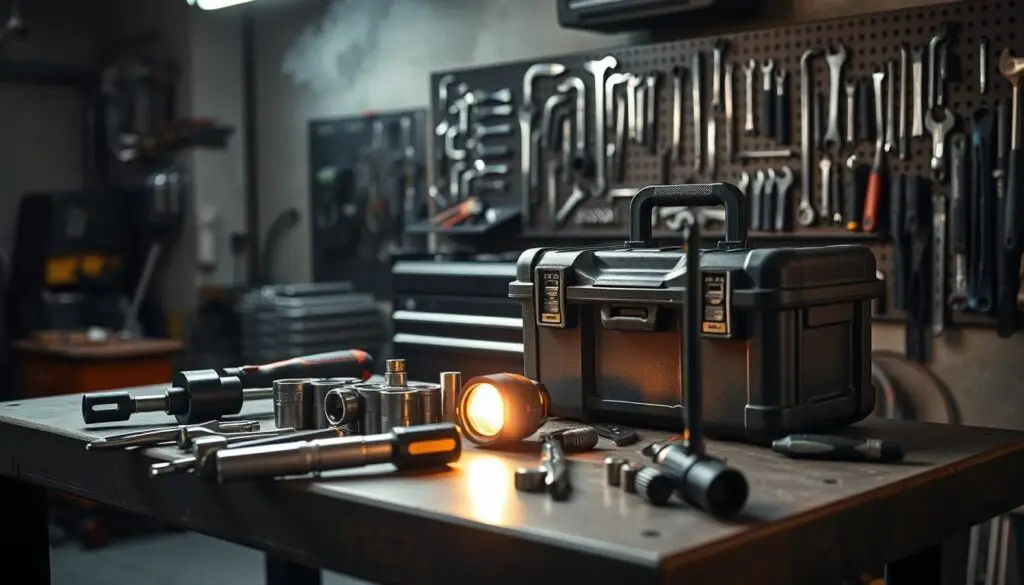
Working as a mobile diesel mechanic demands a specialized approach to tool selection and equipment management. Unlike shop-based technicians with unlimited access to stationary equipment, field service professionals must carefully curate their mobile repair tools to handle diverse scenarios while working from service trucks with finite storage capacity.
The unique demands of field service create specific challenges that directly impact toolkit composition. Every tool selection represents a calculated decision balancing capability against portability and storage constraints. Most fleets find that technicians who invest in comprehensive, quality tooling complete repairs faster and generate fewer callbacks—directly improving both customer satisfaction and shop profitability.
Field Service Environmental Challenges
On-site diesel repair presents environmental factors that shop-based mechanics rarely encounter. Weather conditions range from extreme heat to freezing temperatures, affecting both tool performance and work efficiency. Limited workspace around heavy-duty equipment often restricts movement and access to critical engine components—a 500-pound engine hoist might be standard in a shop but completely impractical for mobile operations.
Mobile mechanics must achieve complete self-sufficiency during field calls. Power sources may be unavailable or unreliable, making battery-operated equipment essential for consistent performance. The days of relying on customer facilities for compressed air or electrical power often end in delays that frustrate everyone involved.
Balancing Capability Against Portability
Shop-based facilities offer advantages that mobile mechanics cannot replicate in the field. Large diagnostic machines, overhead lifts, and extensive specialty equipment remain stationary by necessity. Mobile professionals compensate by selecting versatile, multi-functional portable diesel tools that address multiple repair scenarios without duplicating capability.
Diesel engines vary significantly across agricultural, construction, and transportation industries. The Cummins ISX that dominates over-the-road trucking requires different specialty tools than the Caterpillar C13 common in vocational applications. Mobile mechanics need equipment that adapts to different engine types without maintaining separate tooling for each manufacturer or displacement.
92%
of TMC member fleets report less than a quarter of their technicians hold ASE certification—highlighting the competitive advantage certification provides in the job market.
Foundational Hand Tools for Diesel Engine Work
Reliable hand tools represent the difference between completing a repair on-site and facing costly delays. These fundamental instruments form the core of any professional diesel tool kit and must withstand extreme conditions while delivering consistent performance. Experienced technicians typically spend 40-60% of their initial tool budget on quality hand tools, recognizing that these are the items they’ll reach for hundreds of times daily.
Complete Socket and Wrench Collections
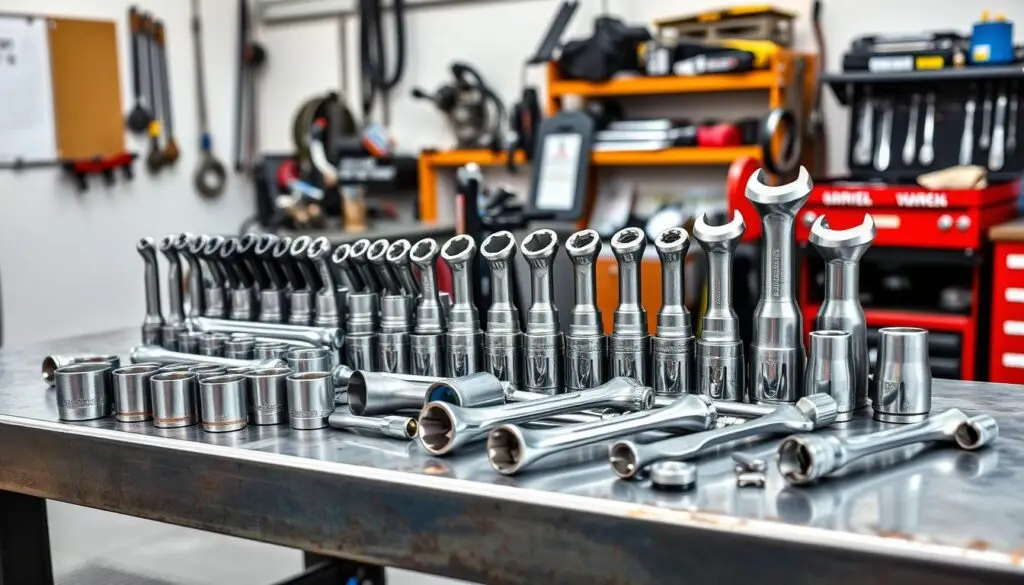
Socket and wrench sets represent the most frequently used components in any diesel mechanic’s arsenal. Diesel engines feature fasteners ranging from small sensor bolts to massive flywheel components, requiring extensive coverage in both SAE and metric measurement systems. Your socket collection must include three primary drive sizes to address different torque requirements and accessibility challenges.
Quarter-Inch Drive Sockets
A complete ¼-inch drive collection covers 3/16″ to ⅝” in SAE and 5mm to 15mm in metric, both in shallow and deep configurations. These smaller drive sockets handle delicate sensors, electrical connections, and tight access points common in modern diesel engines where larger tools simply won’t fit.
Three-Eighths-Inch Drive Sockets
The ⅜-inch drive collection forms the workhorse category, spanning 5/16″ to 1″ SAE and 7mm to 20mm metric in shallow, deep, and impact-rated versions. Most diesel engine work falls within this range, making these sockets your most essential investment—this is where skimping on quality costs the most in the long run.
Half-Inch Drive Sockets
The ½-inch drive collection addresses heavy-duty applications with sizes from ⅜” to 1¼” SAE and 10mm to 27mm metric. These robust sockets handle high-torque applications like suspension components, drivetrain fasteners, and structural bolts on commercial equipment where failure isn’t an option.
Combination wrenches provide crucial accessibility where sockets cannot reach. Your collection should include SAE sizes from 5/16″ to 1¼” and metric sizes from 8mm to 22mm. Adjustable wrenches complement fixed-size options—carry at least a 1″ to 8″ adjustable for general work and a 1″ to 12″ adjustable for larger applications common on hydraulic systems.
Specialized Pliers and Cutting Tools
Beyond turning fasteners, mobile diesel mechanics need specialized gripping and cutting implements for electrical repairs, hose removal, and component manipulation. Your pliers collection should include standard slip-joint, needle-nose, adjustable joint, and snap ring pliers—each type serves specific functions from removing retaining rings to gripping irregularly shaped components.
Locking pliers provide adjustable clamping force essential for seized fasteners and makeshift holding applications. Channel lock pliers offer adjustable jaw opening for filter removal and gripping large diameter components. Electrical system repairs demand proper cutting tools—side cutters, wire strippers, and cable cutters prevent the frayed connections and improper strips that cause electrical problems.
Screwdriver Sets and Pry Bars
Comprehensive screwdriver collections include Phillips drivers in short, medium, and long lengths plus flathead sizes from 1″ #2 through 12″ #3. Modern diesel engines also require Torx bit drivers from T10 through T45 for European equipment and newer domestic platforms.
Pry bars serve multiple functions beyond separating components. A three-piece set with 12-inch, 24-inch, and 36-inch bars provides leverage for aligning drivetrain components, removing stubborn seals, and general persuasion work. These must feature hardened steel construction to prevent bending during high-stress applications where lesser tools simply fail.
Power Tools and Air Tool Equipment
The right combination of battery-powered and pneumatic equipment enables mobile diesel technicians to handle everything from routine maintenance to emergency breakdowns. Diesel power tools deliver the muscle needed to loosen rusted fasteners, cut through damaged components, and complete repairs efficiently at remote locations.
Most mobile mechanics invest in their own power tool collections through financing programs offered by major suppliers. Companies like MATCO, Mac Tools, Snap-On, and Cornwell Tools provide payment plans that make premium equipment accessible. While some employers provide specialty items like torque wrenches and anything over a half-inch drive, technicians typically build their core power tool inventory independently.
High-Torque Impact Wrenches
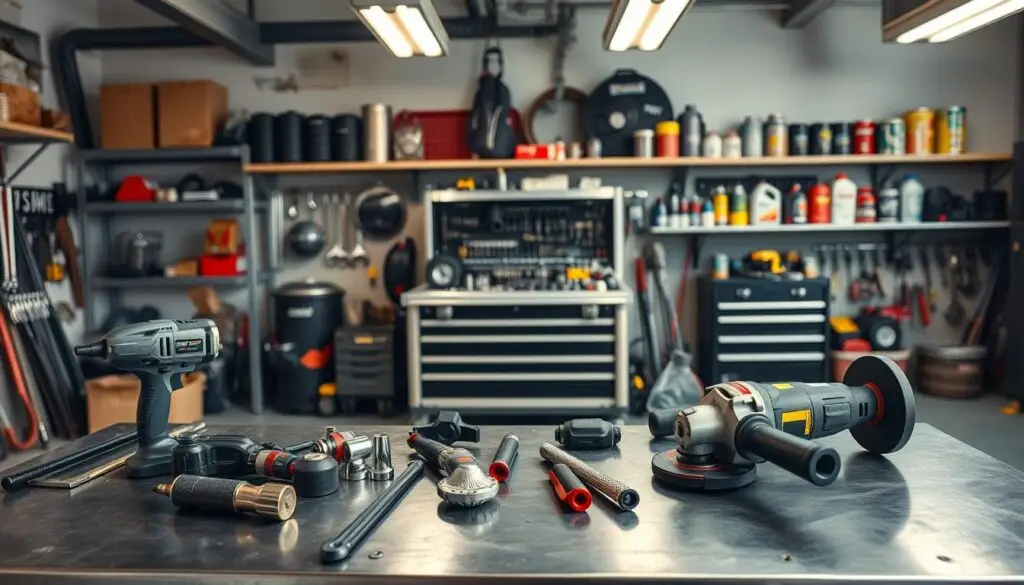
Impact wrenches represent the cornerstone of any mobile diesel mechanic’s power tool arsenal. These tools deliver the high torque output necessary to remove stubborn lug nuts, suspension components, and engine fasteners that resist conventional methods.
The Milwaukee M18 FUEL series has become the benchmark for battery-powered impact wrenches in mobile diesel service, delivering up to 1,400 foot-pounds of fastening torque and 1,000 foot-pounds of nut-busting torque. The brushless motor technology provides extended runtime and durability that withstands daily field use. Battery-powered impacts eliminate the need for air compressors at every job site—a significant advantage when responding to roadside calls.
When maximum torque is required and compressed air is available, pneumatic options like the Ingersoll Rand 2235TiMAX deliver 1,350 foot-pounds of breakaway torque. The titanium hammer case reduces weight without sacrificing durability. Many mobile mechanics carry both battery-powered and air-powered impacts to maximize capabilities across different service scenarios.
Cutting and Grinding Tools
A quality 4.5-inch angle grinder cuts through rusted bolts that no impact wrench can remove. Reciprocating saws make quick work of exhaust pipe sections and damaged brackets. These tools handle situations where traditional removal methods fail—and mobile technicians encounter severely corroded components far more often than shop-based mechanics working on well-maintained fleet vehicles.
Portable Air Compressor Selection
A reliable portable air compressor enables pneumatic tool use and provides tire inflation services at job sites. The ideal unit balances CFM output, tank capacity, and portability for mobile operations. Most mobile diesel technicians select compressors with minimum 5.0 CFM at 90 PSI to power impact wrenches and air ratchets effectively.
Compressors with 20-30 gallon tanks provide adequate air storage while remaining transportable on service trucks. Features like oil-free pumps reduce maintenance requirements, while cast-iron construction ensures longevity under demanding field conditions.
Diagnostic and Electronic Testing Equipment
Modern diesel engines demand investment in professional-grade diagnostic and electronic testing equipment. Computer-controlled systems regulate everything from fuel injection timing to emissions management, and mobile mechanics need diagnostic equipment that delivers accurate readings in field conditions where dealer support isn’t available.
Modern diesel engines feature sophisticated electronic control units that communicate through digital protocols. Unlike older mechanical systems, these engines require specialized tools for proper diagnosis. The ASE L2 Electronic Diesel Engine Diagnosis Specialist certification validates technician competency in these advanced diagnostic procedures—and requires passing both diesel engines and electrical/electronic systems certifications first.
Professional Diesel Diagnostic Scanners
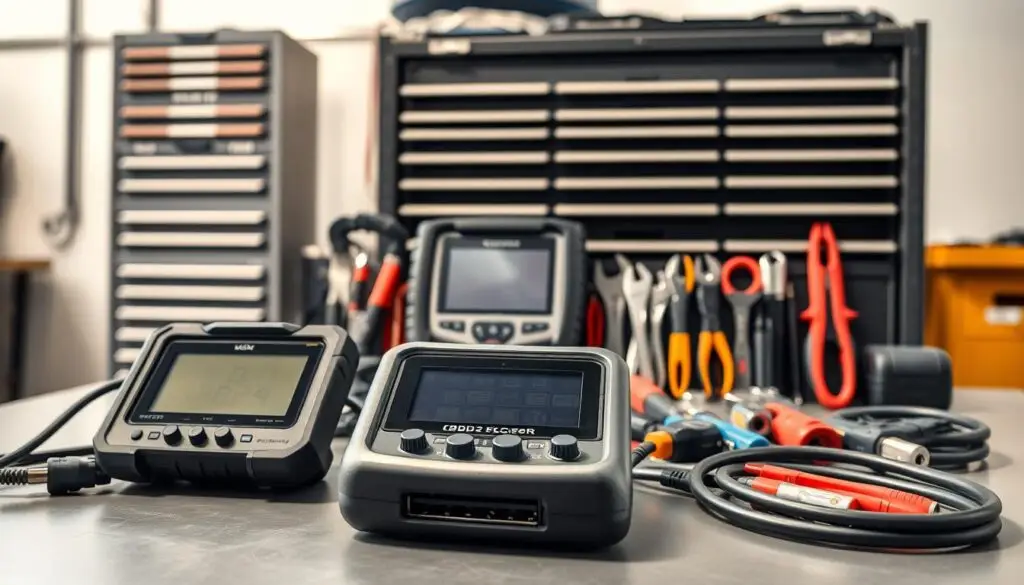
High-quality diagnostic scanners represent a significant investment but deliver essential capabilities for modern diesel repair work. Professional-grade scanners access all vehicle systems, read fault codes, and perform bi-directional testing that identifies problems conclusively.
The Snap-on SOLUS Ultra provides comprehensive coverage for heavy-duty vehicles and diesel systems with extensive manufacturer coverage across commercial trucks and equipment. Its rugged design withstands demanding field conditions. Features include DPF regeneration commands, injector coding capabilities, and ECU programming functions.
The Autel MaxiSys MS909 delivers advanced diagnostics specifically designed for diesel applications, excelling at bi-directional controls and active testing procedures. The Android-based platform receives regular software updates to maintain vehicle coverage. Both platforms handle specialized diesel functions that generic OBD-II scanners simply cannot access.
Digital Multimeters and Circuit Testers
Electrical diagnostics form a critical component of diesel engine repair. A quality multimeter identifies voltage issues, tests sensors, and verifies circuit integrity. The Fluke 88V represents the gold standard for automotive electrical testing, featuring auto-ranging capabilities and high accuracy across 9-volt, 12-volt, and 24-volt systems common in diesel vehicles.
Built-in frequency measurement assists with sensor testing and waveform analysis. The peak capture function identifies intermittent electrical faults that standard meters miss—critical for diagnosing those frustrating problems that don’t appear during static testing.
Compression and Fuel System Testing
Diesel engines operate at significantly higher compression ratios than gasoline engines. Specialized compression testing equipment handles these extreme pressures while providing accurate cylinder analysis—diesel compression testers must feature heavy-duty gauges rated for pressures exceeding 600 PSI.
Modern common rail diesel injection systems operate at extraordinarily high pressures exceeding 30,000 PSI. Fuel pressure testing equipment designed for diesel applications differs substantially from gasoline testing tools. Professional fuel pressure test kits include multiple adapters for different injection system types with high-pressure lines and fittings that withstand extreme forces without leaking.
| Equipment Type | Key Features | Investment Range | Primary Applications |
|---|---|---|---|
| Snap-on SOLUS Ultra | Heavy-duty coverage, DPF regen, injector coding | $3,500-$4,500 | Complete system diagnostics |
| Autel MaxiSys MS909 | Bi-directional controls, cloud updates | $3,200-$4,000 | Advanced diesel functions |
| Fluke 88V Multimeter | Auto-ranging, peak capture, 24V systems | $400-$500 | Electrical diagnostics |
| Compression Tester | 600+ PSI rating, multiple adapters | $200-$400 | Cylinder analysis |
Diesel Engine Specialty Tools and Injector Equipment
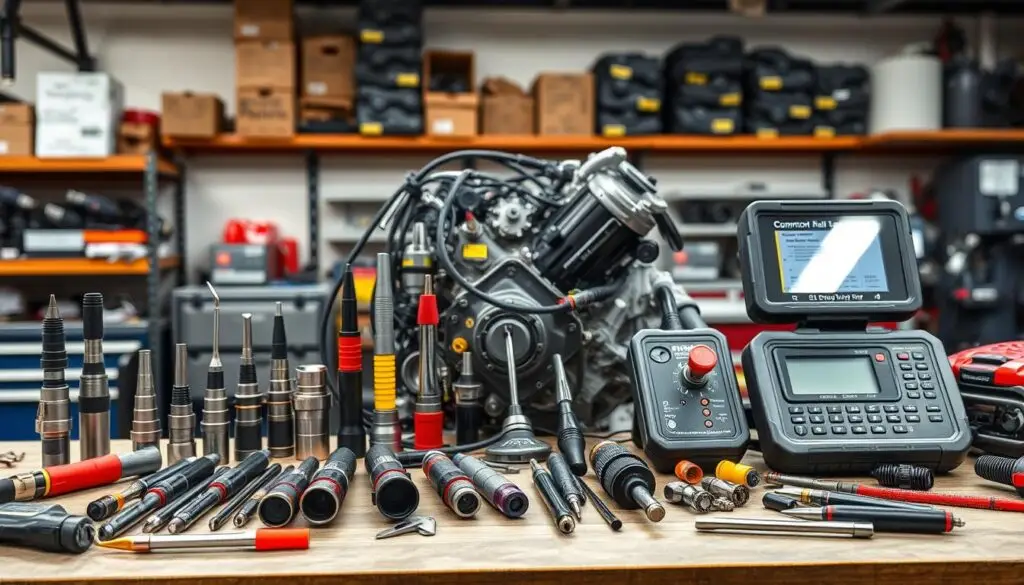
Diesel engine specialty tools represent a significant investment, but they’re essential for professional mobile mechanics. These tools are engineered specifically for the extreme pressures, higher torque specifications, and unique component designs found in modern diesel powertrains. Standard automotive equipment often cannot handle components operating under pressures exceeding 30,000 PSI in common rail systems.
Fuel Injection Service Tools
Modern diesel fuel systems require dedicated equipment designed for safe and effective maintenance. Injector pullers are essential for safely extracting stuck or seized fuel injectors without damaging cylinder heads—these slide hammer-style tools grip the injector body and apply controlled extraction force. Quality puller sets include adapters for multiple injector designs including Bosch, Delphi, and Denso systems.
High-pressure fuel line tools include specialized flare nut wrenches and disconnect tools for quick-connect fittings. Crowfoot-style wrenches allow access to confined spaces where standard wrenches cannot fit. Dedicated fuel line disconnect tools for common rail systems are mandatory safety equipment—attempting to disconnect high-pressure lines without proper tools risks injury from fuel spray.
⚠️ Safety Warning
Common rail fuel systems operate at pressures exceeding 30,000 PSI. Never attempt to loosen fuel lines while the engine is running or immediately after shutdown. Allow adequate time for pressure to dissipate and use proper tools designed for high-pressure fuel system service.
Glow Plug and Turbocharger Tools
Glow plug service requires specialized sockets with deep-wall construction to protect fragile electrical connections. Extraction tools for broken glow plugs remove seized components that break during removal attempts—reamer sets clean carbon buildup from glow plug holes, ensuring proper seating and preventing compression leaks.
Turbocharger service equipment includes specialized wrenches designed for restricted access around turbo mounting locations. Long-reach flex-head wrenches and specialized sockets reach recessed fasteners without requiring complete component disassembly. Actuator adjustment tools calibrate variable geometry turbochargers to manufacturer specifications available through OEM portals like Cummins QuickServe.
Engine Timing Tools
Engine timing tools are manufacturer-specific and critical for valve timing procedures. These tools lock crankshafts and camshafts in precise positions during timing component replacement. Using incorrect timing tools or attempting timing work without proper equipment results in catastrophic engine damage.
Cummins timing equipment includes specific barring tools, camshaft locking pins, and injection pump timing indicators for ISX, ISB, ISC, and other series engines. Duramax engines from LB7 through L5P generations each require generation-specific camshaft locking tools and crankshaft holding fixtures. Power Stroke timing tools differ significantly between 6.0L, 6.4L, 6.7L, and 7.3L platforms. Mobile mechanics serving multiple diesel platforms must maintain complete timing tool sets for each engine family they service.
| Engine Platform | Essential Timing Tools | Investment Range |
|---|---|---|
| Cummins ISX/ISB | Barring tool, camshaft pins, injection pump indicator | $450-$800 |
| Duramax LML/L5P | Camshaft locking plate, crankshaft holder, balancer tool | $350-$650 |
| Power Stroke 6.7L | Camshaft alignment bar, crankshaft TDC tool, special sockets | $400-$750 |
| Detroit DD13/DD15 | Crankshaft positioning tool, gear train locks, overhead alignment | $500-$900 |
The HDJ Perspective
The investment in quality specialty tools separates technicians who handle complex repairs confidently from those who must decline work or subcontract to dealers. In practice, most fleets find that technicians with comprehensive timing tool sets command higher hourly rates and generate fewer warranty callbacks. The $500-$900 investment in a complete timing tool set for a single engine platform pays for itself after just a few timing chain or overhead adjustments—work that would otherwise require expensive dealer involvement or risky improvisation.
Safety and Personal Protective Equipment
Comprehensive safety equipment isn’t just about compliance—it’s about returning home uninjured after every job. Field environments present unpredictable hazards that stationary shops rarely encounter, from unstable ground conditions to extreme weather exposure. OSHA’s PPE requirements under 29 CFR 1910.132 mandate that employers assess workplace hazards and provide appropriate protective equipment.

Personal Protective Equipment Requirements
ANSI Z87.1-rated safety glasses form the foundation of eye protection for every repair task. Flying metal particles from grinding operations can cause permanent vision damage in milliseconds. Face shields provide additional coverage when working with pressurized fuel systems or battery acid.
Chemical-resistant nitrile gloves provide excellent resistance to petroleum products while maintaining tactile sensitivity. Cut-resistant gloves with reinforced palms protect hands when handling sharp metal edges. ASTM F2413-certified steel-toe boots safeguard feet from crushing injuries when handling heavy diesel components.
Impact wrenches, air compressors, and angle grinders generate noise levels that cause permanent hearing damage over time. OSHA enforces a permissible exposure limit of 90 decibels over an eight-hour workday. Foam earplugs providing 29-33 dB noise reduction offer protection for extended wear, while earmuff-style options work well for intermittent high-noise tasks.
Fire Safety and Environmental Compliance
ABC-rated fire extinguishers handle the multiple fire classifications present in diesel repair environments. Mount a 10-pound extinguisher in an easily accessible location on your service vehicle. Diesel fuel ignites at lower temperatures than gasoline, creating flash fire risks during fuel system repairs.
Spill containment kits with absorbent pads manage fuel and hydraulic fluid leaks while meeting environmental compliance standards. Include disposal bags for contaminated materials and non-water absorbents specifically designed for petroleum products. Proper spill response prevents environmental violations that result in substantial fines.
Lighting for Field Operations
High-quality LED work lights eliminate shadows in engine compartments where poor visibility leads to mistakes and injuries. Non-metallic construction prevents electrical shorts when lights contact battery terminals. Rechargeable units with magnetic bases provide hands-free illumination—adequate lighting improves repair quality while reducing eye strain during extended diagnostic procedures.
Hydraulic Lifting and Support Equipment
The right hydraulic lifting and support equipment separates safe, efficient field service from dangerous attempts at mobile diesel repair. Working with diesel trucks and heavy equipment requires lifting tools with capacities far exceeding standard automotive specifications. Standard automotive jacks simply cannot handle the weight and stress of commercial diesel vehicles.
Heavy-Duty Floor Jacks and Jack Stands
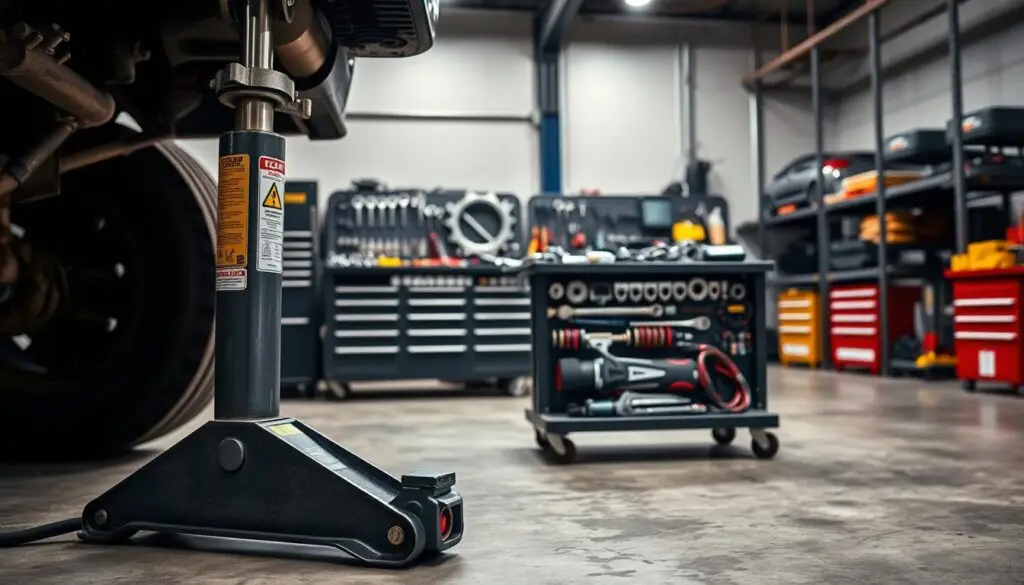
Professional mobile diesel mechanics need floor jacks with capacity ratings between 3 and 10 tons to safely lift heavy-duty trucks and equipment. Low-profile designs prove essential when working with heavily-loaded vehicles or equipment with minimal ground clearance. The Sunex 6602LP combines a low-profile design with substantial lifting capacity, with large wheels that provide excellent maneuverability on uneven surfaces.
Never work under a vehicle supported only by jacks—this represents one of the most dangerous practices in diesel repair. Commercial-grade jack stands with capacity ratings of 6 tons or higher per pair provide the necessary safety margin. Heavy-duty wheel chocks prevent vehicle movement during service work on vehicles weighing several tons.
Bottle Jacks and Portable Hoists
Portable bottle jacks with capacities ranging from 20 to 50 tons handle situations where standard floor jacks cannot provide adequate capacity. Mobile diesel mechanics working on heavy equipment, agricultural machinery, or industrial vehicles rely on these compact yet powerful lifting options.
Collapsible engine hoists and transmission jacks designed for field deployment enable complete engine removal and transmission service at customer locations. Portable engine hoists with 1 to 2-ton capacities fold for transport and assemble quickly at job sites.
Free Professional Fleet Tools
Cost calculators, fault code lookup, maintenance planners, and more—built for owner-operators, fleet managers, and diesel techs. No signup required.
Mobile Tool Storage and Organization Systems
A well-designed storage system protects your investment while maximizing productivity on every job site. Mobile diesel mechanics transport thousands of dollars in equipment between locations daily—effective mechanic tool storage ensures tools remain accessible, protected, and organized despite constant movement and varying work conditions.
Service Truck Storage Configurations
Service trucks require specialized mounting systems that withstand constant vibration and road conditions. Weather Guard aluminum crossover toolboxes represent the industry standard for truck-mounted storage, mounting across the truck bed behind the cab with weather-tight protection and robust locking mechanisms. The compartmentalized interior separates hand tools from power equipment and diagnostic scanners.
Decked truck bed storage systems transform standard truck beds into organized storage platforms. Each drawer extends fully on heavy-duty ball-bearing slides, supporting up to 200 pounds of equipment. The deck surface holds up to 2,000 pounds, accommodating generators, air compressors, and parts containers while keeping tools organized below.
Portable Rolling Solutions
Portable rolling chests bring shop-level organization directly to job sites. Quality carts feature ball-bearing drawer slides that operate smoothly even when fully loaded. Look for models with work surface tops that provide clean assembly areas for injectors and electronic components. Power tool storage compartments keep cordless drills and impact wrenches charged and ready.
Tool Inventory Management
Systematic inventory management prevents costly tool loss and ensures nothing gets left behind at job sites. Shadow board systems with foam cutouts visually identify missing tools instantly. Custom foam inserts fit drawer dimensions precisely, creating designated spots for each piece of equipment.
Effective tool organization includes color-coded drawer systems for faster location, pre-job checklists to verify critical tools, post-job inspections before departing job sites, and regular cleaning protocols to prevent rust. Clean your tools regularly after use to remove grease and debris, and store them in dry, organized locations to prevent damage that shortens tool life.
Maintenance Supplies and Consumable Materials
Keeping comprehensive maintenance supplies enables mobile mechanics to handle unexpected repairs and complete services in a single visit. Beyond specialized tools, professional mobile operations require consumable materials that prevent unnecessary return trips.
Fluids and Lubricants
Carry multiple viscosity grades of diesel engine oil including 15W-40 and 5W-40 for different climate conditions. Diesel Exhaust Fluid (DEF) is essential for modern emissions systems and should be stored in sealed containers to prevent contamination. Heavy-duty cleaning products form the foundation of professional repair work—brake cleaner removes contaminants quickly, while penetrating oils loosen rusted fasteners.
Common Replacement Components
Stock frequently used fuel filters, oil filters, and air filters for popular diesel engine models. Include common belts, hoses, and clamps to address unexpected failures during service calls. Comprehensive O-ring assortments in various sizes prove invaluable during field repairs—include common gaskets, oil drain plug washers, and seal collections to replace damaged components discovered during service.
Frequently Asked Questions
What tools do mobile diesel mechanics need to supply themselves?
Mobile diesel mechanics typically supply their own hand tools, sockets, wrenches, basic power tools, and personal diagnostic equipment. Most employers provide specialty items like torque wrenches, anything over half-inch drive, and major diagnostic systems. Tool financing through companies like Snap-On, Mac Tools, MATCO, and Cornwell makes building a professional toolkit manageable through weekly payment plans that spread costs over several years.
How much does a complete mobile diesel mechanic toolkit cost?
A professional mobile diesel mechanic toolkit ranges from $15,000 to $50,000 depending on quality and completeness. Entry-level technicians can start with $5,000-$8,000 in essential tools, expanding over time as income allows. Quality hand tools from major brands cost $3,000-$8,000, diagnostic equipment runs $3,000-$6,000, and power tools add another $2,000-$5,000. Service truck storage systems represent an additional $2,000-$10,000 investment that protects your overall tool investment.
What diagnostic scanner works best for mobile diesel service?
Professional mobile diesel mechanics favor multi-platform scanners like the Snap-on SOLUS Ultra or Autel MaxiSys MS909 for comprehensive heavy-duty coverage. These scanners provide dealer-level diagnostics, bi-directional controls, DPF regeneration commands, and injector coding capabilities across multiple OEMs. Software like Noregon JPRO offers guided diagnostics specifically designed for commercial vehicle applications.
What safety equipment is required for mobile diesel mechanics?
OSHA requires employers to provide appropriate PPE based on workplace hazard assessments. Essential safety equipment includes ANSI Z87.1-rated safety glasses, chemical-resistant nitrile gloves, ASTM F2413-certified steel-toe boots, hearing protection rated for 85+ dB environments, and ABC-rated fire extinguishers. Mobile technicians should also carry spill containment kits for environmental compliance during field service operations.
What lifting equipment do mobile diesel mechanics need?
Mobile diesel mechanics need heavy-duty floor jacks rated 3-10 tons, commercial-grade jack stands rated 6+ tons per pair, and portable bottle jacks ranging 20-50 tons for heavy equipment applications. Following TMC RP 262A guidelines for jacking and lifting tractors and trailers ensures proper procedures. Never work under vehicles supported only by jacks—always use properly rated jack stands and wheel chocks.
How should mobile diesel mechanics organize their service truck?
Effective service truck organization combines weather-resistant crossover toolboxes mounted behind the cab with drawer-based bed storage systems like Decked. Weather Guard aluminum toolboxes provide secure, weatherproof storage for hand tools and diagnostics. Portable rolling tool carts allow technicians to position tools at the work area. Shadow board systems with foam cutouts enable instant visual identification of missing tools after each job site.
Building Your Mobile Diesel Toolkit for Career Success
Assembling a complete mobile diesel mechanic toolkit represents a significant investment in your career. The equipment covered throughout this guide forms the foundation for success in heavy-duty vehicle field service—and most diesel technicians provide their own tools regardless of workplace.
Several practical strategies make acquiring professional tools more manageable. Tool financing programs through major suppliers spread costs over time, while purchasing quality used toolkits through marketplace platforms offers cost-effective alternatives. Students enrolled in diesel technology programs often access discounted tool programs that help build collections before entering the workforce.
Proper equipment demonstrates professionalism and technical knowledge. Clients trust mechanics who arrive prepared with appropriate tools for diverse repair scenarios. Your complete mobile diesel toolkit becomes your competitive advantage in the field service market—and the investment pays dividends through efficient service delivery, expanded capabilities, and sustained business growth throughout your career.
Share This Resource
Know a technician building their mobile toolkit or a fleet manager equipping field service trucks? Share this comprehensive guide to help them invest wisely.