

By Michael Nielsen, Editor & Publisher
Last Updated: January 2026
Reading Time: 18 minutes
Setting profitable rates for mobile diesel repair services requires balancing market expectations against the real costs of bringing professional service directly to breakdown sites. With heavy-duty repair labor rates reaching a median of $134 per hour by late 2024 according to Fullbay’s State of Heavy-Duty Repair report, mobile operators need clear pricing frameworks that account for travel time, specialized equipment investments, and the premium value of on-site service delivery.
This guide provides fleet managers, owner-operators launching mobile services, and established technicians refining their pricing with complete rate structures backed by current market data. You’ll find labor rate calculations, regional benchmarks, service-specific pricing guidelines, and a downloadable rate sheet template—everything needed to establish rates that satisfy customers while sustaining profitable operations.
Whether you’re bidding on fleet maintenance contracts or quoting emergency roadside repairs, transparent pricing builds the trust that converts first-time callers into long-term accounts. The numbers matter, but how you communicate them matters just as much.
KEY TAKEAWAYS
- Current market rates: Mobile diesel repair labor ranges from $95-$175 per hour, with mobile services commanding 15-25% premiums over shop-based competitors.
- Labor rate calculation: Add direct labor costs ($45+ per hour), overhead allocation ($26-50 per hour), and target profit margin (15-25%) to determine your minimum sustainable rate.
- Travel charge structures: Zone-based pricing or mileage fees ($2.50-$4.50 per mile) protect profitability on extended service calls.
- Parts markup targets: Aim for 35-45% blended margin across maintenance items (30-50% markup) and specialty components (25-40% markup).
- Regional variations: Metropolitan rates run $30-50 higher per hour than rural markets due to elevated operating costs and technician wages.
- Rate review frequency: Assess pricing quarterly; implement annual increases of 3-7% with 30-60 day customer notice.
Understanding the Mobile Diesel Repair Market
Mobile diesel services have expanded rapidly as fleet operators recognize the financial advantage of bringing qualified technicians to disabled vehicles rather than arranging costly towing. Every hour a commercial truck sits out of service costs operators an average of $150-$300 in lost productivity—a reality that creates strong demand for rapid mobile response and justifies premium pricing.
The customer base spans long-haul trucking companies, construction equipment operators, agricultural businesses, municipal fleets, and bus companies. Each segment brings distinct service requirements and budgetary constraints that shape pricing expectations. Understanding these dynamics helps position your rates competitively within specific market niches.

Current Industry Rate Benchmarks
Labor rates for mobile diesel repair currently range from $85 to $175 per hour depending on geographic location and service complexity. TMC’s reporting on Fullbay’s 2025 data shows the industry experienced a $9 per hour increase from 2023 through late 2024, reflecting rising technician wages and operational costs that mobile operators must recover through appropriate pricing.
Technician certification directly impacts pricing power. ASE-certified technicians with manufacturer-specific training justify rates 15-25% higher than non-certified competitors. The complexity of post-2010 diesel engines with advanced emissions systems demands specialized diagnostic equipment and training that fewer technicians possess—creating legitimate differentiation for credentialed providers.
| Service Level | Hourly Rate | Response Time | Technician Credentials |
|---|---|---|---|
| Entry-Level Service | $85-$110 | 4-6 hours | Basic experience |
| Professional Service | $115-$145 | 2-4 hours | ASE-certified |
| Premium Service | $150-$175 | 1-2 hours | ASE Master + OEM certified |
What Fleet Managers Expect from Pricing
Fleet managers prioritize transparent pricing above nearly all other factors when selecting mobile diesel providers. They expect detailed written estimates before work begins, itemized invoices separating labor from parts costs, and explanations for any deviations from initial quotes. Hidden fees or surprise charges damage relationships and generate negative referrals that hurt long-term business development.
Technical competency ranks alongside pricing transparency in fleet manager priorities. Modern diesel engines incorporate complex electronic controls, emissions systems, and computerized diagnostics requiring current training and equipment. Fleet managers expect technicians arriving with comprehensive diagnostic tools compatible with their specific vehicle makes—particularly trucks manufactured since 2010 with selective catalytic reduction (SCR) and diesel particulate filter (DPF) systems.
Documentation quality has become increasingly important as fleet operators implement sophisticated maintenance tracking systems. Professional mobile services deliver comprehensive digital reports including diagnostic trouble codes, parts replaced with serial numbers, fluid analysis results, and preventive maintenance recommendations. This documentation provides value beyond immediate repairs and justifies premium positioning.
Calculating Your Base Hourly Labor Rate
Every sustainable mobile diesel repair business starts with one critical number: the base hourly labor rate that covers costs and generates profit. This figure represents your complete business model—from technician compensation to equipment costs to growth investment. Getting this calculation wrong means either leaving revenue on the table or pricing yourself out of competitive bidding.
Direct Labor Cost Calculations
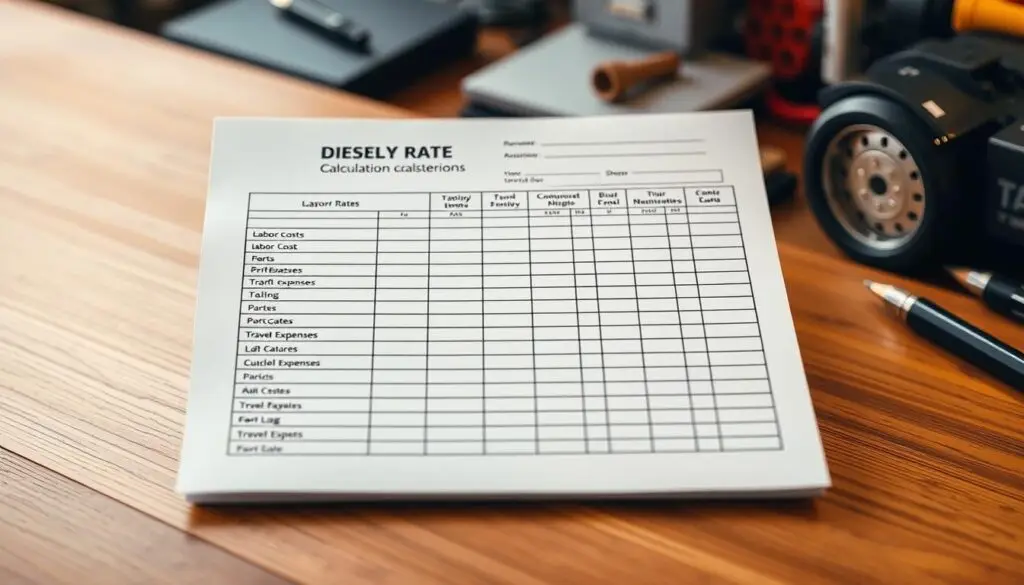
Start with the gross annual compensation package for your technician. A skilled diesel technician earning $65,000 annually represents just the starting point. Mandatory payroll taxes consume 10-15% of the base wage, and the benefits burden—health insurance, retirement contributions, paid time off, workers’ compensation—typically adds 25-35% more.
A technician with $65,000 base salary plus 25% benefits burden costs your business $81,250 annually. But you cannot simply divide by 2,080 hours (52 weeks × 40 hours) to determine hourly cost. Not all hours are billable. Account for non-productive time including vehicle maintenance, administrative tasks, training, and travel between service calls. Most mobile operations achieve 1,800-2,000 billable hours annually per technician.
Using 1,800 billable hours, that $81,250 total compensation yields a direct labor cost of approximately $45 per hour. This represents your baseline—the absolute minimum to recover before considering other business expenses.
Overhead Expense Allocation
Overhead expenses include everything required to operate beyond direct technician compensation. These costs must be allocated across billable hours to ensure full recovery.
Fixed monthly overhead typically includes: mobile service vehicle payments and maintenance ($1,200-$2,000), commercial insurance premiums ($800-$1,500), business licensing and permits ($200-$400), and administrative software ($150-$300). Variable monthly overhead fluctuates with activity: fuel costs ($600-$1,200), tool replacement and equipment depreciation ($300-$600), marketing expenses ($400-$800), and professional services ($300-$600).
A typical mobile diesel operation incurs $4,000-$7,500 in monthly overhead, totaling $48,000-$90,000 annually. Divided across 1,800 billable hours, this adds $26.67-$50.00 to your hourly rate calculation. Combined with direct labor, you now need $71.81-$95.14 per hour just to break even—covering expenses but generating zero profit.
Target Profit Margin Integration
Profit enables business sustainability, equipment reinvestment, and owner compensation. The industry recommends a 55-65% margin on labor rates to cover shop costs and generate profit after technician wages and management overhead.
To integrate a 20% net profit margin, multiply your break-even rate by 1.25. Using previous calculations: lower break-even of $71.81 × 1.25 = $89.76 minimum, while higher break-even of $95.14 × 1.25 = $118.93 minimum. This percentage-based approach ensures profit margins remain consistent as costs fluctuate with fuel prices, insurance premiums, or other variable expenses.
$9/hour increase
Heavy-duty repair labor rate increase from 2023 to late 2024 — Fullbay State of Heavy-Duty Repair 2025
Travel and Trip Charge Structures
Travel charges compensate mobile operators for non-billable time spent reaching breakdown sites. Unlike shop-based businesses, mobile technicians sacrifice productive repair hours driving to customer locations. Your pricing structure must account for fuel costs, vehicle wear, and the opportunity cost of travel time.
Mileage-Based Charges
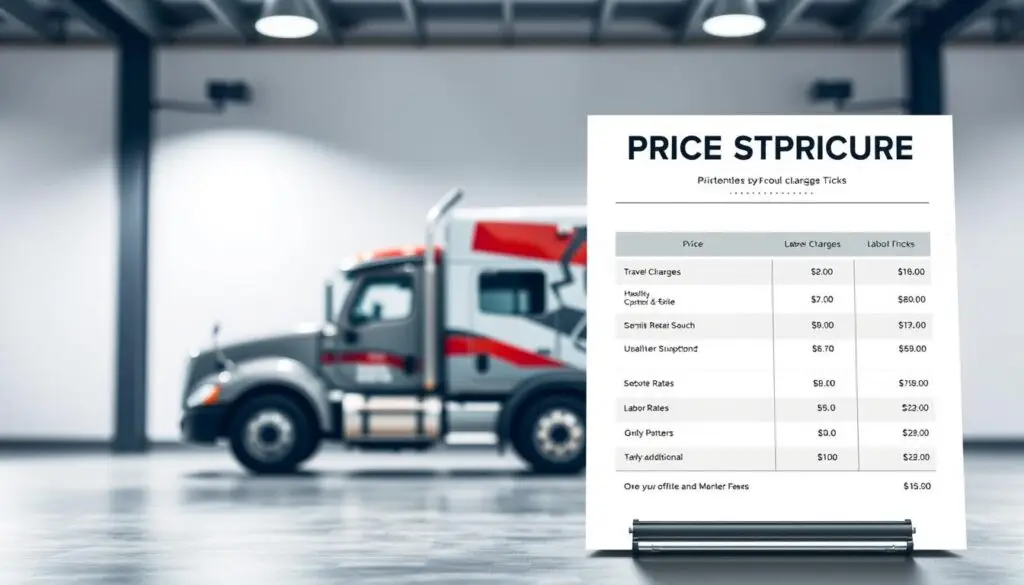
Mileage fees provide straightforward travel cost recovery. This method charges customers based on actual distance traveled from your base location, typically ranging from $2.50 to $4.50 per mile. Many operators use a multiplier approach—taking the current IRS standard mileage rate (67 cents per mile for 2024 business use) and multiplying by 3-5 to account for revenue opportunity cost during travel.
Most mobile diesel services establish a no-charge radius around their base location. The first 15-25 miles typically fall within standard labor rates. Beyond this threshold, mileage fees compensate for extended travel. Clearly specify whether you calculate one-way or round-trip mileage—this transparency prevents disputes and builds customer trust.
Zone-Based Pricing Systems
Service radius pricing tiers create predictable flat charges based on distance zones, simplifying quoting and reducing administrative time calculating exact mileage for every call. A typical structure includes four tiers: Zone 1 (0-15 miles) carries no separate trip charge, Zone 2 (16-30 miles) adds $75-$125, Zone 3 (31-50 miles) adds $150-$250, and Zone 4 (beyond 50 miles) adds $275-$400 plus additional mileage fees.
Display your service zones on a map included with rate sheets. Visual representations help customers instantly understand which pricing tier applies to their location, reducing phone inquiries and streamlining booking.
Emergency Response and After-Hours Fees
Emergency surcharges compensate technicians for availability outside standard business hours. Standard emergency pricing applies time-and-a-half or double-time multipliers to regular labor rates. A technician earning $125 per hour during normal business hours would charge $187.50 (1.5x) for evening calls or $250 (2x) for weekend emergencies.
Same-day urgent service requests often carry additional surcharges of $150-$350 when they force rescheduling pre-planned appointments. Specify exact after-hours definitions in your rate sheet—clear parameters prevent misunderstandings about when premium rates apply.
Minimum Service Charges
A service call minimum protects your business from unprofitable short-duration calls. Most mobile diesel operations set minimums between $150 and $300—enough to cover at least one hour of labor plus trip charges for your closest service zone. This baseline ensures every dispatch generates adequate revenue to justify mobilizing your service vehicle and technician.
Mobile Diesel Repair Pricing Models
Choosing the right pricing model affects profitability, customer satisfaction, and competitive positioning. Most successful mobile diesel operations utilize one of four primary billing frameworks, with many combining elements for maximum flexibility.
Flat Rate Pricing
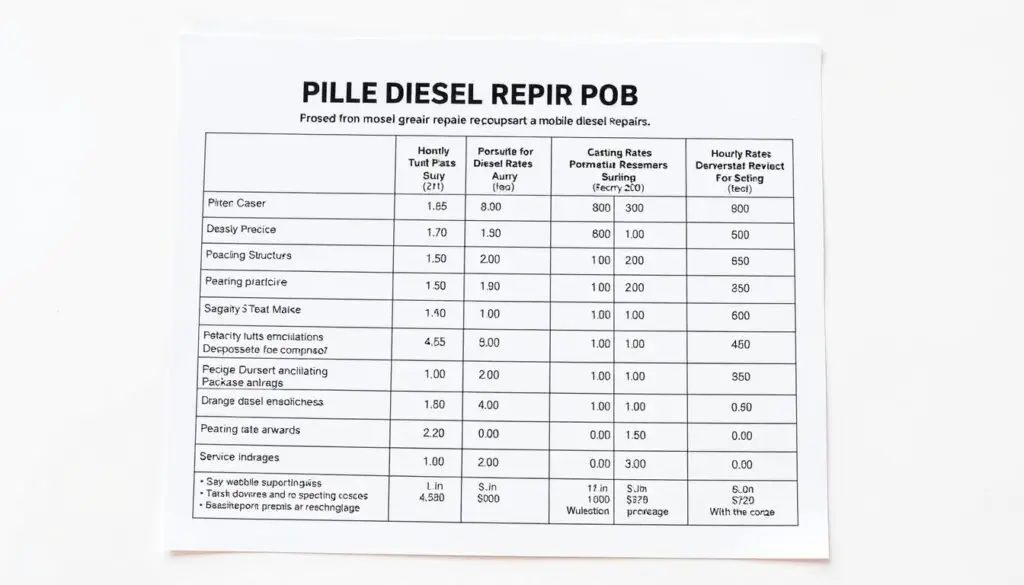
Flat rate pricing uses standardized labor times from industry guides like Motor or Mitchell1 multiplied by your established shop labor rate. This approach provides customers with predictable costs regardless of actual repair duration. A brake replacement listed at 3.5 hours in the guide costs the same whether your technician completes it in two hours or four.
This model works exceptionally well for common services where experienced technicians consistently meet or beat book times—clutch replacements, turbocharger installations, cooling system overhauls. Fleet managers appreciate knowing exact costs before work begins, which eliminates billing surprises and simplifies their budgeting.
Hourly Rate Billing
Hourly billing charges customers for actual time spent diagnosing and completing repairs. This transparent approach documents real labor investment and provides fairness for complex or unpredictable work. The model excels when dealing with custom fabrication, extensive electrical diagnostics, or older equipment where standard labor times don’t exist.
Independent owner-operators often prefer hourly billing because they perceive it as more transparent and equitable for major repairs with uncertain scope. Complex transmission rebuilds, custom exhaust fabrication, and troubleshooting intermittent electrical faults all justify this approach.
Diagnostic Fee Plus Repair
This model separates initial assessment from subsequent repair work. Comprehensive diesel diagnostics typically cost $125-$250 depending on system complexity and equipment requirements. After identifying problems, you present repair options with associated costs for customer approval.
The diagnostic fee ensures compensation for your expertise regardless of whether customers authorize repairs—protecting against customers seeking free troubleshooting before taking work elsewhere. Many mobile operations apply diagnostic fees toward repair costs if customers approve work immediately, encouraging commitment while maintaining professional boundaries.
Hybrid Pricing Systems
Successful mobile diesel businesses often combine elements of multiple approaches. A hybrid system might use flat rate pricing for preventive maintenance packages while applying hourly rates for custom work or complex diagnostics. Many operations implement tiered structures: routine maintenance follows predetermined flat rates, standard repairs use book time multiplied by labor rates, and unusual jobs bill hourly with customer pre-approval at specific cost thresholds.
| Pricing Model | Best Applications | Rate Range |
|---|---|---|
| Flat Rate | Common repairs, PM services, brake jobs | Book time × $100-$150/hr |
| Hourly Billing | Complex diagnostics, custom fabrication | $95-$175 per hour |
| Diagnostic Fee | Troubleshooting, electrical problems | $125-$250 initial fee |
| Hybrid System | Full-service operations, diverse repairs | Variable by service category |
Parts Markup and Material Cost Strategies
Profit margins on diesel parts create a separate revenue stream covering inventory expenses and protecting against market fluctuations. While labor rates generate steady income, your parts pricing approach significantly impacts overall profitability.
Standard Markup Percentages
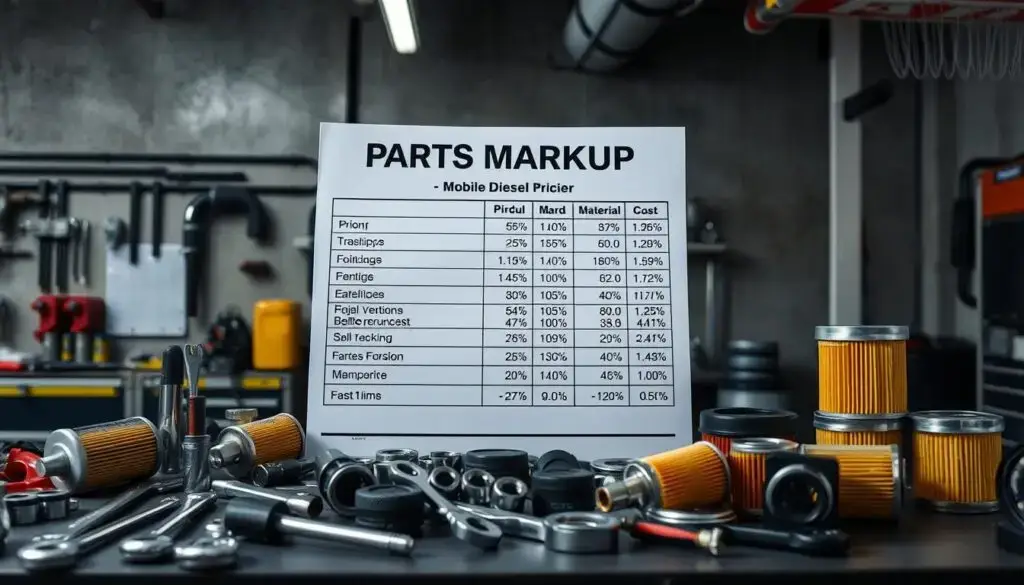
Most successful mobile diesel operations apply markup percentages between 30% and 50% above wholesale cost for commonly stocked items—filters, belts, hoses, and fluids that turn over quickly. Specialty components including turbochargers, fuel injectors, electronic control modules, and transmission parts typically carry 25-40% markups due to higher unit costs and online price transparency.
The goal is achieving a blended parts margin of 35-45% across all sales. This balanced approach covers inventory carrying costs, obsolescence risk, warranty exposure, procurement time, and working capital tied up in stock.
Wholesale Supplier Relationships
Strong supplier relationships form the foundation of competitive material costs. Successful mobile operations maintain accounts with multiple diesel parts suppliers across different categories—national distributors like NAPA and O’Reilly Commercial for common maintenance items, diesel specialists like Diesel Parts Direct for heavy-duty components, and manufacturer dealers like Cummins QuickServe for OEM parts with full warranty support.
Volume discounts become available as purchasing grows. Many wholesale agreements offer 10-20% deeper discounts for businesses committing to monthly minimums or annual volume targets. These savings drop directly to your bottom line when maintained against customer pricing.
Customer-Supplied Parts Policies
Handling customer-supplied parts requires careful policy development. Accept these only with written acknowledgment stating you provide no warranty on parts quality, compatibility, or performance. Charging a premium labor rate of 10-20% higher offsets lost parts revenue and increased liability.
When you supply components, the parts markup margin compensates for warranty risk and procurement effort. Customer-supplied parts eliminate this revenue while increasing exposure—if parts fail or prove incompatible, you’ve invested labor without protective margin covering such problems.
The HDJ Perspective
The mobile diesel repair market has matured significantly over the past five years. Operators who treated pricing as an afterthought—copying competitor rates without calculating their own costs—are increasingly struggling as expenses rise faster than casual rate adjustments accommodate. The businesses thriving today approach pricing as a strategic discipline: they know their numbers, communicate value clearly, and review rates quarterly even if adjusting only annually. Fleet managers respect this professionalism and increasingly prefer it over the uncertainty of working with operators who seem to be guessing at their pricing. The era of competing primarily on low price is ending; the operators winning fleet contracts today compete on reliability, transparency, and demonstrated expertise.
Service-Specific Pricing Guidelines
Clear pricing guidelines for common repair services enable consistent quoting and predictable profitability. Your pricing structure should reflect both technical complexity and the added value of bringing professional service directly to customer locations.
Preventive Maintenance Services
Routine maintenance represents bread-and-butter revenue for most mobile operations. These services follow predictable timeframes and parts requirements, making them ideal for flat-rate pricing.
Complete oil change service for Class 8 trucks ranges from $350 to $550, including 10-13 gallons of premium diesel engine oil, heavy-duty filters, and approximately 45 minutes of labor. Mobile providers should position at the higher end, adding $75-$100 for on-site convenience. Coolant system flushes typically run $225-$350, transmission fluid services $400-$650, and differential fluid changes $175-$275 per axle.
DOT annual inspections represent mandatory compliance work ranging from $100-$175. Mobile operators should price at the premium end since on-site service eliminates vehicle transport to inspection facilities. Include complete documentation with official forms and stickers.
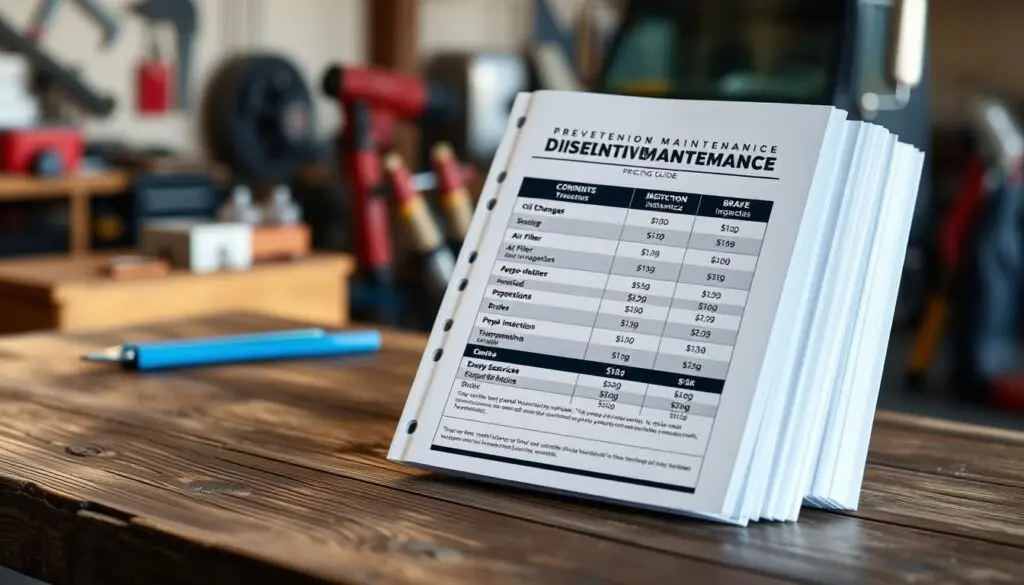
Engine Diagnostics and Repairs
Advanced engine work commands premium rates reflecting specialized knowledge and sophisticated diagnostic equipment. Charge separately for diagnostic time to ensure compensation regardless of whether customers approve recommended repairs.
Turbocharger diagnostic testing ranges from $150-$250 including boost pressure testing and visual inspection. Complete turbocharger replacement involves 4-8 hours of labor, with units costing $1,200-$4,500 depending on application. Total service pricing typically falls between $2,200 and $6,500.
Fuel system diagnostics including smoke testing and electronic injector balance testing run $175-$300. Individual injector replacement prices at $450-$750 per cylinder including parts, labor, and programming. Complete fuel pump replacement commands $1,800-$3,500.
Emissions System Repairs
DEF systems in post-2010 engines create regular repair opportunities. DEF pump replacement services range from $800-$1,400, NOx sensor replacement prices between $400-$650 per sensor, and DPF services span $500 for professional cleaning to $3,500 for complete replacement. Understanding these systems and maintaining proper diagnostic equipment justifies premium positioning in this growing service category.
⚠️ Safety Warning
Aftertreatment system components reach extreme temperatures during regeneration cycles. Always verify DPF regeneration status before handling exhaust system components—surface temperatures can exceed 1,000°F and cause severe burns. Follow lockout/tagout procedures when working on running engines.
Transmission and Drivetrain Work
Heavy-duty transmission and drivetrain repairs represent labor-intensive, high-revenue services. Mobile drivetrain work commands 20-30% premiums above shop-based pricing due to challenging field conditions.
Basic clutch adjustment services price from $150-$250. Complete clutch replacement represents major revenue at $2,500-$4,500, including disc, pressure plate, release bearing, and 6-10 hours labor. Axle seal replacement runs $350-$650 per seal, wheel bearing replacement $800-$1,500, and complete differential overhaul services $2,200-$4,000 based on axle configuration.
| Service Category | Typical Service | Price Range | Labor Time |
|---|---|---|---|
| Preventive Maintenance | Complete Oil Change (Class 8) | $350-$550 | 30-45 minutes |
| DOT Compliance | Annual Inspection | $100-$175 | 45-60 minutes |
| Engine Repairs | Turbocharger Replacement | $2,200-$6,500 | 4-8 hours |
| Fuel System | Injector Replacement (per cylinder) | $450-$750 | 1-2 hours |
| Transmission | Complete Clutch Replacement | $2,500-$4,500 | 6-10 hours |
Regional Pricing Variations
Geographic location creates substantial rate disparities that mobile operators must navigate carefully. Understanding regional differences helps establish competitive rates reflecting local market realities.
Urban vs. Rural Market Differences
Major metropolitan areas support labor rates $20-$40 higher per hour than rural markets. Cities like New York, Los Angeles, Chicago, and San Francisco typically command $140-$175 per hour for mobile diesel services. Urban operators face higher costs—commercial insurance in cities costs significantly more than rural policies, qualified technicians demand salaries $15,000-$25,000 above rural counterparts, and fuel costs plus traffic congestion increase service delivery expenses.
Rural markets in agricultural regions operate on different economics. States like Iowa, Nebraska, Montana, and Oklahoma typically support rates between $85 and $115 per hour. These lower rates remain profitable given reduced expense structures. Agricultural markets also experience seasonal demand fluctuations—during planting and harvest seasons, emergency repair demand spikes dramatically, creating opportunities for temporary rate increases of 15-25%.
Coastal vs. Inland Markets
Coastal markets generally command premium rates compared to inland cities of similar size due to port activity and concentrated populations. Gulf Coast markets including Houston and New Orleans support elevated rates from petrochemical industry demand. East Coast ports like Baltimore and Norfolk generate consistent demand from container chassis and drayage operations. These coastal markets typically support rates $15-$35 higher than comparable inland cities.

Competitive Analysis in Your Market
Systematic competitive research ensures rates remain appropriately positioned. Gather intelligence through multiple channels: request rate sheets from 5-10 direct mobile diesel competitors, review competitor websites for published pricing, and conduct mystery shopping by requesting quotes for standard services.
A healthy quote-to-work conversion rate typically falls between 40% and 60%. Winning more than 75% of quotes suggests underpricing, while rates below 30% indicate either overpricing or insufficient differentiation to justify premium positioning.
Free Professional Fleet Tools
Cost calculators, fault code lookup, maintenance planners, and more—built for owner-operators, fleet managers, and diesel techs. No signup required.
Building Your Professional Rate Sheet
Your rate sheet functions as both operational reference and sales tool. A well-designed document communicates expertise, establishes expectations, and differentiates your service from competitors before you turn a wrench.
Essential Components
Professional rate sheets begin with business identity elements establishing credibility—company name, logo, complete contact information, and relevant licensing numbers. Include your service area definition with zone-based trip charges, and prominently display the effective date. Update this whenever adjusting pricing.
Professional formatting conveys competence and attention to detail. Use clean layouts with consistent fonts, adequate white space, and organized sections guiding readers through information naturally. Provide both PDF format for email distribution and printed versions for in-person presentations.
Labor Rate Classifications
Establish tiered pricing reflecting expertise levels within your operation. Standard classifications include: Apprentice/Entry Level ($75-$95 per hour) for basic maintenance tasks, Journeyman Technician ($95-$135 per hour) for standard diagnostics and most repairs requiring ASE certification, Master Technician ($125-$175 per hour) for complex diagnostics and specialized systems, and Emergency/After-Hours rates at 1.5x to 2x standard.
Specify which technician level dispatches for different service types. This transparency builds confidence that customers receive appropriate expertise for their specific needs.
Payment Terms and Warranty Provisions
Clear payment terms prevent collection issues. List all accepted payment methods, specify timing requirements (payment upon completion for one-time customers, NET 15 or NET 30 for established fleet accounts), and document deposit requirements for major repairs—typically 50% for work exceeding $2,500.
Standard mobile diesel repair warranties cover labor for 90 days or 10,000 miles, whichever comes first. Parts warranties typically pass through manufacturer coverage. Clearly specify coverage limits and exclusions in writing to prevent disputes.
Implementing and Adjusting Your Pricing
A well-crafted pricing strategy doesn’t remain static. Successful mobile diesel repair businesses continuously evaluate and refine rates based on market response and operational data.
Testing Initial Pricing
Your soft launch period should span 60-90 days while carefully monitoring customer response to quoted rates. Track every quote provided and document conversion to actual work. Pay attention to customer objections during quoting—note which line items generate pushback and which services customers accept without hesitation. This intelligence guides targeted adjustments rather than across-the-board rate changes.
When and How to Raise Rates
Implement general rate increases annually, typically on January 1st, with 30-60 day advance notice to existing customers. Keep annual increases modest—generally 3-7%—to match inflation and cost increases without shocking customers. Document reasons for increases in customer communications: rising insurance costs, increased technician wages, new equipment investments, and fuel price changes all provide legitimate justification that customers understand.
Consider enhancing service offerings simultaneously with rate increases. Adding new diagnostic capabilities or improving guaranteed response times when raising rates softens resistance by demonstrating increased value.
Rate Management Tools
Modern shop management software like Fullbay or Mitchell 1 Manager SE streamlines pricing consistency and profitability tracking. These platforms maintain current labor rate matrices adjusting automatically when you update base rates, track actual time versus estimated time for every job, and generate professional estimates with consistent formatting. Investing $100-$300 monthly delivers substantial returns through improved estimating accuracy and data-driven insights.
Frequently Asked Questions
What is the average hourly rate for mobile diesel repair in 2025?
Mobile diesel repair labor rates in 2025 typically range from $95 to $175 per hour, depending on geographic location, technician certification level, and service complexity. Metropolitan areas command rates at the higher end ($140-$175), while rural markets average $85-$120 per hour. The national median for heavy-duty repair shops reached $134 per hour by late 2024, with mobile services commanding 15-25% premiums over shop-based rates due to the convenience factor and eliminated towing costs.
How do I calculate my mobile diesel repair labor rate?
Calculate your labor rate by determining your fully-loaded technician cost (wages plus 25-35% benefits burden), dividing by billable hours (typically 1,800-2,000 annually), then adding overhead allocation ($26-50 per hour for typical mobile operations) and profit margin (15-25%). Industry standards recommend achieving a 55-65% margin on labor rates to cover costs and generate profit. A technician earning $65,000 annually with benefits costs approximately $45 per hour in direct labor before overhead and profit markup.
Should I charge travel fees for mobile diesel service calls?
Yes, travel charges are standard practice for mobile diesel services. Most operators include the first 15-25 miles in their base rate, then charge $2.50-$4.50 per mile beyond that threshold. Zone-based pricing is equally common: Zone 1 (0-15 miles) includes no separate fee, Zone 2 (16-30 miles) adds $75-$125, Zone 3 (31-50 miles) adds $150-$250, and Zone 4 (50+ miles) adds $275-$400 plus additional mileage. Transparent travel fee structures prevent customer disputes and ensure profitability on extended service calls.
What parts markup percentage should mobile diesel services charge?
Mobile diesel operations typically apply 30-50% markup on common maintenance parts (filters, belts, fluids) and 25-40% on specialty components (turbochargers, injectors, ECMs). The goal is achieving a blended parts margin of 35-45% across all sales. Higher markups on low-cost items offset competitive pressure on expensive parts where customers easily compare prices online. Many successful operators maintain relationships with multiple suppliers to secure volume discounts while preserving healthy retail margins.
How often should I raise my mobile diesel repair rates?
Review pricing quarterly but implement annual rate increases of 3-7% on January 1st with 30-60 day advance notice to customers. Fullbay’s 2025 State of Heavy-Duty Repair report found that 45% of shops assess rates annually, though the industry saw a $9 per hour increase between 2023 and late 2024. More frequent reviews help align rates with rising costs, but dramatic jumps create customer friction. Consider enhancing service offerings when raising rates to demonstrate increased value.
Building Profitable Mobile Diesel Pricing
Your mobile diesel repair pricing strategy determines whether you build a thriving operation or struggle with thin margins. The rate calculations, regional benchmarks, and service-specific guidelines throughout this guide provide the foundation for pricing that covers costs and generates sustainable profit.
Start by implementing your calculated labor rate immediately. Test rates with current customers, track job profitability carefully, and let data reveal which services deliver strongest margins. Review pricing quarterly, communicate changes transparently, and position your mobile service as the reliable, professional choice that fleet managers trust—even when you’re not the cheapest option available.
The commercial vehicle service industry rewards businesses delivering consistent value. Your rate sheet communicates professionalism and transparency while positioning services appropriately within your regional market. Focus on building relationships with fleet operators who appreciate quality work and understand that lowest price rarely delivers best long-term value.
Share This Pricing Guide
Know a diesel tech starting their mobile business or a fleet manager negotiating service contracts? Share these rate benchmarks and calculations.