By Michael Nielsen, Publisher | 15+ Years in Diesel Repair
Last Updated: September 2026
⏱ Estimated reading time: 15+ minutes
Heavy duty brake maintenance involves systematic inspection, adjustment, and servicing of commercial vehicle braking systems to ensure safe stopping performance under extreme operating conditions. For fleet operators managing Class 7 and Class 8 trucks, a disciplined brake program prevents catastrophic failures, reduces unscheduled downtime, and keeps carriers compliant with FMCSA regulations — but the real payoff comes from treating brake maintenance as a fleet-wide program, not a series of one-off repairs.
Michael Nielsen and Heavy Duty Journal's editorial team built this guide around that fleet-level view: how to structure a brake program, staff and train for it, budget for it honestly, and use the technology now available to catch problems before they become roadside failures. For the hands-on procedural side — exact measurement techniques, component-by-component service steps — HDJ's air brake maintenance guide covers that in full technical depth; this guide is the program-level companion to it.
Commercial fleet brake systems face demands passenger vehicles never encounter. Trucks carrying 80,000-pound loads through constant stop-and-go traffic put extreme, repeated stress on components that have to perform flawlessly every single day — a fully loaded tractor-trailer braking hard from highway speed can push brake drum temperatures well past 600°F in a single stop.
Key Takeaways
- ✓System complexity: Commercial air brake systems require specialized knowledge beyond passenger-vehicle experience — compressed air technology and fail-safe spring brakes work fundamentally differently from hydraulic systems.
- ✓Cost impact: Proactive maintenance meaningfully reduces total operating cost versus reactive repair — through extended component life and fewer emergency calls — but the exact percentage is fleet-specific, not a fixed industry number.
- ✓Inspection layers: Effective programs combine daily driver checks, monthly technician evaluations, and annual DOT inspections to catch problems at multiple intervention points.
- ✓Compliance stakes: CVSA out-of-service criteria ground vehicles immediately for out-of-adjustment brakes — brake defects are consistently the single largest category of vehicle out-of-service violations nationwide.
- ✓Technology advantage: Telematics and electronic wear sensors give fleets earlier warning of developing brake problems than fixed-interval inspection alone can provide.
In This Guide
- Understanding Heavy-Duty Brake Systems in Commercial Vehicles
- Pre-Inspection Safety Protocols and Equipment Setup
- Systematic Brake Component Inspection Procedures
- Heavy Duty Brake Maintenance Service and Adjustment Guidelines
- Diagnosing Common Heavy-Duty Brake Problems
- Establishing Preventive Maintenance Schedules
- Documentation Requirements and Federal Compliance
- Optimizing Fleet Brake Performance and Longevity
- Frequently Asked Questions
Understanding Heavy-Duty Brake Systems in Commercial Vehicles
Heavy-duty commercial vehicles rely on specialized brake systems engineered to handle extreme stopping requirements, consistently bringing loads of 80,000 pounds or more to a safe stop from highway speeds. The technology differs significantly from passenger vehicle designs because of the forces involved and the critical safety demands of transporting goods across thousands of miles.
The two primary brake system types in commercial applications are compressed air systems for heavy-duty trucks and hydraulic systems for medium-duty vehicles, each with distinct components, operational characteristics, and maintenance requirements.
Air Brake System Components and Operation
Commercial vehicle brakes in Class 7 and Class 8 trucks use compressed air technology rather than hydraulic fluid — a design choice that provides greater reliability and fail-safe operation for vehicles that can weigh up to 80,000 pounds when fully loaded. The compressed air system stores energy in tanks and can continue functioning even with minor leaks in the system. Federal regulations mandate specific performance standards for these critical safety systems.
The air compressor mounts directly on the engine and generates pressurized air between 100 and 120 PSI, running continuously while the engine operates to maintain system pressure for immediate brake response. An air dryer removes moisture, oil, and contaminants from the compressed air before it enters storage tanks — this filtration prevents water from freezing in brake lines during cold weather and stops corrosion from forming inside system components.
The system stores pressurized air in multiple compressed air tanks that serve as energy reserves. Commercial trucks typically have primary and secondary air tanks providing backup capacity — if the compressor fails, these reserves give the driver enough brake applications to safely stop the vehicle.
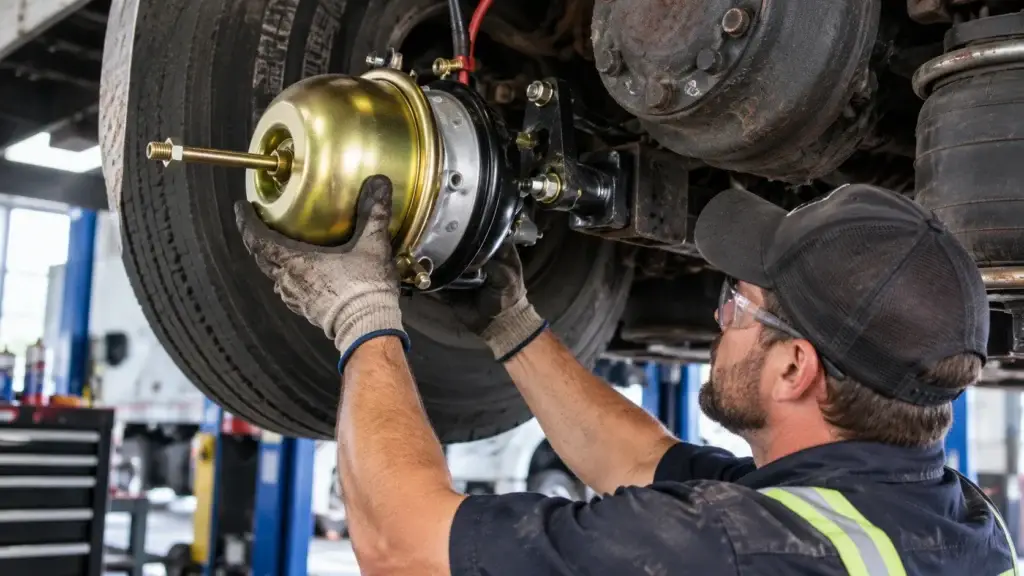
When a driver applies the brake pedal, air flows from the tanks into service chambers mounted at each wheel. The pressurized air pushes against a flexible diaphragm inside the chamber, extending a pushrod that connects to the slack adjuster mechanism.
The pushrod activates the slack adjuster, which functions as a lever arm — modern trucks use automatic slack adjusters that maintain proper clearance between brake shoes and drums. The slack adjuster rotates the S-cam shaft, whose rounded lobes push the brake shoes outward against the inner surface of the brake drum, creating the friction that generates stopping force.
Hydraulic Brake Systems in Medium-Duty Applications
Medium-duty commercial trucks and vans with gross vehicle weights under 26,000 pounds typically use hydraulic brake systems, which operate on different principles but provide adequate stopping power for lighter commercial applications. Hydraulic systems transmit brake pedal force through incompressible brake fluid rather than compressed air — when the driver presses the brake pedal, a master cylinder creates hydraulic pressure that travels through steel brake lines to wheel cylinders or calipers.
This direct fluid connection provides immediate brake response without the slight delay present in air brake systems. These systems use either drum brakes or disc brakes at the wheels — disc systems feature calipers that squeeze brake pads against rotating discs, while drum systems use wheel cylinders to push brake shoes outward against drums, similar to air brake mechanical action but activated hydraulically instead of pneumatically.
Hydraulic systems require less maintenance space and weigh significantly less than air brake systems. However, they cannot store energy the way compressed air tanks can — a brake fluid leak can result in complete brake failure, whereas an air brake system maintains some braking capability even with minor air leaks, thanks to its multiple tank reserves.
| System Feature | Air Brake Systems | Hydraulic Brake Systems |
|---|---|---|
| Typical Application | Heavy-duty trucks over 26,000 lbs GVWR | Medium-duty vehicles under 26,000 lbs GVWR |
| Operating Medium | Compressed air at 100–120 PSI | Hydraulic brake fluid under pressure |
| Energy Storage | Multiple air tanks provide backup reserves | No energy storage; relies on continuous fluid pressure |
| Response Time | Slight delay due to air compression and travel | Immediate response through incompressible fluid |
Critical Brake System Functions for Fleet Safety
Brake system reliability directly determines whether commercial vehicles can stop safely under all operating conditions — a loaded commercial truck requires exponentially more braking force than a passenger car to cover comparable ground. Under FMVSS 121, most loaded heavy truck tractors must stop from 60 mph within 250 feet, with a 310-foot allowance for the heaviest configurations — a standard tightened considerably from the older 355-foot requirement that fully phased out by 2013.
Commercial vehicle brakes must dissipate enormous amounts of thermal energy — when brake shoes or pads contact drums or rotors, kinetic energy converts to heat. A single emergency stop from highway speed can generate temperatures exceeding 600°F at the brake drums, and repeated hard braking on mountain grades can push temperatures considerably higher still. Overheated brakes experience fade, where friction materials lose their ability to grip effectively — a documented contributor to commercial vehicle accidents, particularly on steep downgrades where drivers ride the brakes continuously instead of using engine braking.
The compressed air brake design provides an inherent safety advantage for heavy loads: if air pressure drops below safe levels, spring brakes automatically engage to stop the vehicle. This fail-safe mechanism, which hydraulic systems lack, prevents runaway trucks when brake system pressure is lost — and it's the core reason regulators and fleets alike treat air brake system integrity as non-negotiable rather than a routine maintenance line item.
Pre-Inspection Safety Protocols and Equipment Setup
Before touching any brake component, technicians must establish a safe working environment through systematic preparation. Commercial vehicle brake systems operate under extreme forces and high temperatures — the risks of improper inspection procedures include injury from pressurized air systems, exposure to brake dust, and accidents from unsecured vehicles.
Protective Gear Standards for Brake Work
OSHA's PPE standards apply to commercial vehicle technicians working with brake systems, because brake work exposes technicians to multiple hazards simultaneously. Safety glasses with side shields — meeting ANSI Z87.1 impact resistance standards — protect eyes from brake dust, metal particles, and chemical splashes; standard prescription glasses don't provide adequate protection on their own.
Heavy-duty, nitrile-coated work gloves protect hands from sharp edges, hot components (brake drums and rotors retain heat long after operation ceases), and chemical exposure while maintaining dexterity for detailed work. Steel-toed boots meeting ASTM F2413 standards, with slip-resistant soles, prevent crush injuries from falling brake drums, which can weigh 80 pounds or more.
Respiratory protection matters when working with older brake components — modern friction materials no longer contain asbestos, but brake dust still carries harmful particulates. N95 respirators or higher-rated masks filter these contaminants effectively.
| PPE Item | Protection Against | Required Standard |
|---|---|---|
| Safety Glasses | Flying debris, brake dust, chemicals | ANSI Z87.1 |
| Work Gloves | Heat, cuts, chemical exposure | Cut-resistant, minimum Level A2 |
| Steel-Toed Boots | Crushing injuries, punctures | ASTM F2413 |
| Respirator | Brake dust, particulates | N95 or P100 |
Securing Vehicles and Energy Isolation
Vehicle securing prevents catastrophic accidents during brake maintenance — a commercial vehicle that moves unexpectedly during brake work can cause fatal injuries. Wheel chocking is the first physical barrier: place heavy-duty chocks, rated for the vehicle's weight, on both sides of wheels diagonal to those being serviced.
Apply the parking brake fully before beginning any work. For air brake systems, allow the system to build to full pressure, then apply the park brake to mechanically lock the wheels — redundant securing beyond the chocks alone. Air system depressurization must occur before disconnecting any brake components: drain all air tanks completely, and verify zero pressure using the vehicle's gauges before loosening any fittings.
Lockout-tagout procedures require physically disabling the vehicle's starting system — remove the ignition key, and attach a warning tag to the steering wheel identifying the technician and stating brake maintenance is in progress. Disconnecting the negative battery cable adds further protection against accidental system pressurization during maintenance.
Measurement and Diagnostic Equipment
Accurate inspection tools provide the objective data that determines whether a component meets safety standards or requires replacement. Brake pad thickness gauges measure remaining friction material with precision; digital calipers offer even greater accuracy for critical measurements. Dial indicators assess rotor and drum runout, which affects both brake performance and pad wear.
Torque wrenches calibrated to manufacturer specifications ensure proper fastener tension — under-torqued wheel fasteners risk wheel separation, while over-torquing damages threads and studs. Air pressure gauges reading in 1 PSI increments verify system pressure at various points, helping diagnose leaks, compressor problems, and valve malfunctions.
These tools need regular calibration to maintain accuracy — establish a schedule following manufacturer recommendations (typically annual for precision measuring instruments), and record calibration dates and results in maintenance documentation to demonstrate compliance.
Systematic Brake Component Inspection Procedures
Thorough inspection demands methodical procedures technicians can replicate consistently across an entire fleet — a complete evaluation goes far beyond checking pad thickness. It requires examining every critical element that contributes to stopping power and system reliability, following a standardized sequence at each wheel position so nothing gets overlooked.
Assessing Drum and Rotor Condition
Brake drum inspection starts with precise diameter measurements using inside micrometers, taken at multiple points around the friction surface to identify uneven wear. Compare against the maximum service diameter stamped on the drum exterior. Heat damage appears as distinctive discoloration — blue or purple spots indicate temperatures that exceeded safe operating limits, while dark brown patches suggest sustained overheating that may have compromised metal integrity.
Rotor condition assessment requires careful visual examination under proper lighting for deep grooves exceeding manufacturer specifications, and surface scoring that creates noise and reduces friction material contact area. Crack detection demands thorough inspection of high-stress areas — the friction surface, cooling vanes, and mounting surfaces. Dye penetrant testing can reveal hairline cracks invisible to the naked eye.
Measuring Pad and Shoe Thickness
Position the thickness gauge perpendicular to the friction material at the thinnest visible point — never at rivet heads or backing plate areas, which give false readings. Most commercial brake pads require replacement at 4–6mm remaining thickness, though manufacturer specifications vary and some high-performance applications call for earlier replacement.
Uneven wear patterns reveal underlying mechanical problems that a simple thickness measurement alone won't catch. Tapered wear indicates caliper slide pin binding or uneven pressure distribution; inner pad wear faster than outer pad suggests seized caliper pistons. Document every measurement with wheel position identification — this data tracks wear rates across the fleet and identifies vehicles with accelerated brake consumption, pointing toward either driver behavior patterns or mechanical deficiencies.
Chamber and Actuator Function Testing
Brake chamber testing evaluates the air-powered components that apply foundation brakes. Measure pushrod travel distance from fully released to fully applied positions — excessive travel indicates adjustment problems or component wear, and travel beyond specification places the vehicle out of service under CVSA criteria. Diaphragm integrity testing requires examining for cracks, tears, or deterioration; apply air pressure while listening for leaks around the chamber body, since any audible air loss indicates diaphragm failure requiring immediate replacement.
| Component | Measurement Point | Acceptable Range | Out-of-Service Limit |
|---|---|---|---|
| Type 30 Chamber | Pushrod Travel | 1.0–1.5 inches | 2.0 inches |
| Type 24 Chamber | Pushrod Travel | 1.0–1.5 inches | 1.75 inches |
| Brake Pad | Friction Material | 6mm–15mm | 4mm |
| Brake Shoe | Lining Thickness | 8mm–20mm | 6mm |
Air System Line and Connection Checks
Comprehensive air line inspection begins at the supply tanks and follows every connection to the brake chambers. Visual examination identifies cuts, abrasion, or impact damage — pay special attention to areas where lines route near heat sources or moving components. Flexible brake hoses need inspection for age-related deterioration: surface cracking in the rubber compound indicates UV or chemical damage, and bulging suggests internal reinforcement failure that precedes catastrophic hose rupture.
Connection integrity testing uses soap solution applied to all fittings under system pressure — even small leaks create visible bubbles that pinpoint the exact leak location. Testing should include a full brake application while inspecting all connections under maximum pressure, since this dynamic testing reveals leaks that static inspection can miss. Document any air loss exceeding manufacturer specification for future trending.
Stay Ahead of Industry Trends
Get expert insights, equipment reviews, and operational strategies delivered to your inbox weekly.
Heavy Duty Brake Maintenance Service and Adjustment Guidelines
Effective brake maintenance goes beyond inspection to include precise adjustments and strategic component replacement. Proper documentation of all service work creates an accountability trail that supports both fleet management and regulatory compliance.
Inspecting Automatic Slack Adjusters and Making Manual Corrections
Automatic slack adjusters maintain proper brake stroke without manual intervention under normal operating conditions, compensating for lining wear throughout the friction material's service life. When slack adjuster maintenance becomes necessary, first determine whether the unit needs adjustment or replacement — measuring pushrod travel distance gives the most accurate assessment.
Applied brake stroke should not exceed 1.5 inches for Type 20 chambers or 1.75 inches for Type 30 chambers. Excessive travel indicates improper adjustment or internal slack adjuster failure requiring immediate attention.
Manual adjustment of automatic slack adjusters should be rare and temporary — frequent adjustment needs signal underlying problems such as contaminated S-cam bushings, worn brake linings, or internal slack adjuster damage. Replace any automatic slack adjuster that repeatedly loses adjustment within days of servicing, and always verify that a replacement unit matches the brake chamber type and mounting configuration of the original.
Essential Lubrication Points and Recommended Products
Strategic lubrication prevents premature component wear. Critical lubrication points require high-temperature grease formulations that maintain viscosity under extreme heat — standard automotive grease breaks down rapidly in a brake system environment and should never be used. The S-cam bushing is the most critical lubrication point in drum brake systems, given the rotational forces it experiences during every application. Apply high-temperature moly-based grease through the fitting until fresh grease appears at both ends of the bushing, ensuring complete distribution and purging contaminated lubricant.
| Lubrication Point | Recommended Product | Service Interval |
|---|---|---|
| S-cam Bushings | Moly-based high-temp grease | Every 25,000 miles |
| Slack Adjuster Splines | Anti-seize compound | Every brake service |
| Clevis and Anchor Pins | High-temp synthetic grease | Every 50,000 miles |
| Brake Chamber Pushrod | Dry graphite lubricant | Annual inspection |
When to Replace Components and Proper Fastener Torque
Clear replacement criteria eliminate guesswork. Brake drums require replacement when internal diameter exceeds the discard specification cast into the drum — typically allowing about 0.120 inches of wear beyond the original diameter. Drums showing heat cracks deeper than 0.060 inches must be replaced regardless of diameter measurement, and surface scoring deeper than 0.015 inches also mandates replacement. Replace brake shoes when lining thickness measures less than 1/4 inch at the thinnest point; for disc pads, 1/8 inch remaining thickness is the typical replacement trigger.
Proper torque on safety-critical fasteners matters as much as component condition — wheel lug nuts, brake chamber mounting hardware, and slack adjuster clamps each have manufacturer-specified values that should be verified with a calibrated torque wrench and applied in the correct sequence (typically a star pattern for wheel fasteners). Under-torqued fasteners cause vibration and loosening; over-torqued fasteners strip threads and can crack components.
Testing Brake Performance After Service Completion
Post-service testing validates that maintenance work meets performance standards before the vehicle returns to operation. Begin with a static air system pressure test — with the engine running, air pressure should build from 85 to 100 PSI within about 45 seconds; extended build times indicate a weak compressor or system leakage requiring investigation. With the engine off and air system at full pressure, apply and release brakes several times while monitoring pressure drop against manufacturer specification.
Road testing is the final verification. Select a safe location with adequate stopping distance and test brake application at various speeds, evaluating for balanced braking without vehicle pull, unusual noise, or vibration during stops.
Diagnosing Common Heavy-Duty Brake Problems
Effective troubleshooting requires recognizing symptoms, tracing root causes, and implementing lasting solutions rather than just replacing the most obvious part. Commercial vehicle brake systems exhibit specific failure patterns that provide real diagnostic clues when properly interpreted, and drivers often report performance changes before complete failure occurs.
Thermal Damage and Performance Degradation
Brake fade begins with understanding how excessive heat affects friction material performance — when components reach temperatures beyond their designed operating range, the friction coefficient drops dramatically, reducing stopping power precisely when drivers need it most. This typically occurs during prolonged braking on long downhill grades or repeated heavy stops. Glazing creates a smooth, shiny surface on brake shoes and drums that significantly reduces friction, as overheating causes binding resins in the friction material to migrate to the surface and form a hardened layer.
Proper gear selection and disciplined engine braking on grades meaningfully reduce service brake usage — the exact reduction depends on grade, load, and driver technique, but the underlying mechanism is straightforward: less service brake use means lower average brake temperature and longer component life. HDJ's technician shortage guide covers why this kind of driver technique matters even more now, given how much harder qualified brake technicians are to find and retain.
Identifying heat damage extends beyond friction surfaces. Brake drums showing blue discoloration have experienced extreme temperatures that alter metal properties; cracks radiating from mounting holes or friction surfaces indicate thermal stress. Components with visible heat damage require replacement rather than resurfacing.
Pneumatic System Failure Points
Air system leaks are the most common brake troubleshooting challenge in commercial fleets — they waste compressor capacity, extend brake application times, and create potential safety violations. Systematic diagnosis begins with static leak testing on a fully pressurized system with the engine off; FMCSA standards specify maximum allowable air loss rates for both single vehicles and combinations, with tighter limits when brakes are released than when applied.
Locating leaks requires both audible detection and soap solution application. Listen for the telltale hiss of escaping air at common failure points: pushrod seals at each brake chamber, compression fittings at valves and connections, rubber air lines showing weather cracking, tank drain valves and petcocks, and relay valve or quick release valve seats.
Reading Component Wear Indicators
Wear patterns function as diagnostic maps that reveal underlying mechanical problems. Technicians who understand these patterns identify root causes rather than simply replacing worn components — an approach that prevents recurring failures and reduces long-term maintenance cost.
| Wear Pattern | Primary Cause | Corrective Action |
|---|---|---|
| Tapered pad wear | Caliper slider restriction | Clean and lubricate sliders, replace worn bushings |
| Inside shoe wear | S-cam bushing wear | Replace cam bushings, verify anchor pin condition |
| Scoring on drums | Contamination or embedded debris | Identify contamination source, resurface or replace drum |
| Circumferential grooving | Excessive out-of-round condition | Check bearing adjustment, resurface drum within limits |
Wheel End Assembly Complications
Wheel bearing problems directly impact brake performance even though bearings aren't brake components themselves. Improper bearing adjustment creates wheel end play that allows rotors to move laterally, causing uneven pad contact and reduced stopping power. Excessive looseness causes rotor runout that creates brake pulsation and uneven wear; over-tightening generates heat that damages bearings and seals — following manufacturer torque and adjustment procedures ensures optimal preload.
Hub seal leaks contaminate brake friction surfaces with gear oil, dramatically reducing friction coefficient — even small amounts of oil contamination destroy brake performance. Inspect for oil residue on the inboard side of brake rotors and drums during routine inspections.
Establishing Preventive Maintenance Schedules
Systematic maintenance schedules transform brake care from reactive repairs to proactive fleet management. A comprehensive schedule can't rely on mileage alone, since usage patterns vary dramatically across a commercial fleet — the most effective programs combine driver-performed inspections with technician-conducted evaluations at strategic intervals, creating multiple safety checkpoints that catch developing problems before they escalate into violations or failures.
Driver-Performed Pre-Trip Inspections
Daily brake checks are the first line of defense. Before every trip, drivers should test the low air pressure warning system — build air pressure above 100 PSI, shut off the engine, then press the brake pedal to reduce pressure; the warning light or buzzer must activate before pressure drops below 60 PSI.
Next, verify the air pressure build-up rate meets manufacturer specification: from roughly 85 PSI, the system should build to governor cut-out pressure within the specified time, typically 45 seconds for single vehicles. Slow build-up indicates compressor problems or system leaks needing immediate attention. Drivers should also conduct visual inspections for obvious damage, missing components, or fluid leaks, and check brake adjustment by observing pushrod stroke during brake application.
Technician-Conducted Monthly Evaluations
Monthly inspections provide comprehensive evaluations that exceed daily driver checks. Qualified technicians measure brake lining thickness, drum and rotor condition, and pushrod stroke under static and applied conditions — every measurement documented with specific values, not a simple pass-fail notation. Functional testing validates slack adjuster operation, chamber mounting security, air line condition, and foundation brake component function, catching developing problems before they cause failures or violations.
Federal Annual Performance Requirements
Annual DOT inspections establish the minimum acceptable brake function for commercial vehicles. CVSA criteria define specific out-of-service thresholds for brake adjustment, lining thickness, and air system performance — a vehicle failing these criteria receives an out-of-service order prohibiting operation until repairs are completed. HDJ's CSA score improvement guide covers how these inspection outcomes compound into a carrier's Vehicle Maintenance BASIC score over time.
Component-Specific Service Intervals
Mileage-based intervals provide a structured replacement schedule, though operating conditions significantly affect actual component life — severe service applications need shorter intervals than linehaul operations covering similar mileage.
| Component | Normal Service Interval | Severe Service Interval |
|---|---|---|
| Brake Shoes and Pads | 150,000–200,000 miles | 75,000–100,000 miles |
| Air Dryer Cartridge | 100,000 miles | 75,000 miles |
| Brake Chambers | 500,000+ miles | As condition requires |
| Wheel End Bearings | Annually or at brake service | Every brake service |
Documentation Requirements and Federal Compliance
Federal regulations mandate specific brake inspection records and performance standards that every commercial fleet must maintain. Compliance protects fleet operations from penalties, roadside out-of-service orders, and liability exposure.
Commercial Vehicle Safety Alliance Inspection Standards
CVSA establishes the brake inspection criteria enforcement officers use during roadside inspections nationwide. Pushrod stroke exceeding the allowable range for its chamber type constitutes a critical threshold for air brake systems — when brake stroke is out of adjustment on enough axles, the vehicle fails inspection. Brake pad thickness below specification on steering or other axles, cracked or broken brake drums, missing brake components, and audible air leaks also trigger immediate out-of-service orders.
Federal Recordkeeping and Maintenance Requirements
The FMCSA regulations under 49 CFR 396 establish comprehensive maintenance recordkeeping obligations for every motor carrier and intermodal equipment provider. Maintenance records must document the date of inspection or repair, vehicle identification, description of work performed, and signature of the person completing the work. Inspection reports and maintenance records must be retained for one year from the date of inspection; repair records must be maintained for one year following completion.
Technology-Driven Compliance Management
Modern fleet management systems change how carriers track brake compliance documentation — digital platforms automate inspection scheduling, record maintenance activities, and generate compliance reports, reducing administrative burden while improving record accessibility. Telematics technology provides real-time monitoring of brake system performance and driver behavior; electronic sensors can track brake wear rates, air pressure fluctuations, and hard braking events continuously, rather than only at the moment of a scheduled inspection.
Optimizing Fleet Brake Performance and Longevity
Strategic brake management delivers real cost savings alongside improved safety and equipment reliability. Optimization goes beyond basic maintenance to incorporate technology, training, and intelligent component selection — turning brake maintenance from a necessary expense into a genuine competitive advantage.
Harnessing Technology for Proactive Maintenance
Predictive maintenance represents a real shift from time-based or reactive approaches, using data analytics, electronic monitoring, and historical patterns to forecast component failures before they occur.
Electronic brake wear sensors provide continuous monitoring of pad and shoe thickness, illuminating dashboard warnings when components reach predetermined replacement thresholds — a meaningful improvement over manual inspection at fixed intervals alone, since it catches accelerated wear that might otherwise go undetected between scheduled services. HDJ's shop management software comparison covers the platforms that turn this kind of sensor data into an actual scheduled work order rather than just a dashboard light.
Empowering Drivers as Frontline Inspectors
Drivers occupy a unique position in brake system monitoring that no technology fully replicates — they experience subtle changes in brake performance that electronic sensors might miss. A slight increase in pedal travel, minor pulsation during braking, or decreased stopping power can signal developing problems long before they become critical failures.
Comprehensive driver training teaches operators to recognize the symptoms of brake system deterioration — what normal brake performance feels like, so deviations register immediately — covering warning signs including unusual noises, vibration, pulling to one side, and changes in pedal pressure or travel.
Fleets that invest genuinely in this kind of training tend to see real reductions in both brake-related maintenance cost and roadside inspection violations, though the size of that gain depends heavily on the fleet's starting point and how consistently the training gets reinforced, not a fixed percentage any article can promise.
Strategic Component Procurement and Supplier Qualification
Brake component selection is a strategic decision affecting both cost and legal liability — opting for the cheapest available brake pad is a costly mistake in most long-term analyses. Quality components engineered specifically for fleet applications, using advanced friction materials that withstand high temperatures and resist wear under heavy loads, deliver superior longevity that generally outweighs the higher initial cost through fewer replacements, reduced labor, less downtime, and lower total cost of ownership.
Financial Impact: Reactive Versus Preventive Approaches
Reactive maintenance appears less expensive on paper, but comprehensive cost accounting tells a different story once every factor is included, not just parts pricing. A premium brake pad costing more upfront becomes economical if it lasts meaningfully longer than a cheaper alternative — labor cost for installation stays roughly the same regardless of component quality, so a longer service interval reduces how often that cost gets paid. Most importantly, fewer replacements mean less downtime, which preserves revenue-generating capacity.
Editorial note: An earlier version of this guide included a specific reactive-versus-preventive cost comparison table (with a precise dollar total and percentage savings figure) and a quote attributed generically to "Technology & Maintenance Council Recommended Practice." HDJ could not verify a traceable source for either and has removed them. Build your own reactive-versus-preventive comparison from your fleet's actual parts, labor, and downtime records — a real number specific to your operation is worth more than any industry-wide figure, verified or not.
Editorial Insight
The HDJ Perspective
HDJ's editorial team has seen the same pattern across fleets of every size: the ones that treat brake maintenance as a program — layered inspection checkpoints, trained drivers who know what to report, technology that catches what a fixed schedule misses, and honest cost accounting — consistently outperform fleets running the same procedures reactively, one repair at a time. Brake system reliability isn't a line item to optimize down; it's the foundation everything else in a fleet operation depends on staying intact.
Frequently Asked Questions
What is the most important difference between commercial vehicle brakes and passenger vehicle brakes?
Commercial systems are engineered for extreme loads and constant use far beyond passenger vehicle requirements. Heavy-duty trucks use air brake systems designed to stop loads exceeding 80,000 pounds repeatedly throughout the day, with a fail-safe spring brake mechanism hydraulic systems don't have — commercial brakes must withstand higher temperatures and maintain reliability across hundreds of thousands of miles.
How often should commercial fleet brake inspections be performed?
On multiple layered intervals: daily pre-trip inspections by drivers before every dispatch, monthly comprehensive inspections by qualified technicians, annual DOT inspections verifying FMCSA compliance, and component-specific intervals based on mileage and operating severity. This layered approach shifts operations from reactive failure response toward proactive prevention.
What personal protective equipment is required for brake system maintenance?
Safety glasses with side shields, heavy-duty gloves, steel-toed boots rated for the weight of a brake drum or rotor, and NIOSH-approved respiratory protection when working with friction material dust. OSHA's PPE standards for commercial vehicle maintenance facilities cover this equipment directly.
What are automatic slack adjusters and do they need manual adjustment?
They're mechanical devices that automatically compensate for brake lining wear by maintaining proper pushrod travel as friction material thins. They should rarely need manual adjustment — frequent adjustment needs indicate an underlying problem (worn linings, a foundation brake issue, or adjuster malfunction) that needs diagnosis, not repeated manual correction.
What brake stroke measurement constitutes a CVSA out-of-service violation?
Pushrod stroke exceeding the maximum for its chamber type — roughly 2.0 inches for standard Type 20/24 chambers, 2.5 inches for long-stroke Type 24/30 chambers — is a critical violation. Out-of-service criteria also include brake lining thickness below specification, missing or broken components, and audible air leaks at brake chambers.
How does brake fade occur and what are the warning signs?
Brake fade results from excessive heat buildup during prolonged or repeated braking, which degrades friction material performance and requires increased pedal pressure for the same stopping force. Warning signs include a burning smell, increased pedal travel, visible smoke from wheel ends, and discolored brake drums. Extended downhill operation without engine braking is the most common cause.
What documentation must motor carriers maintain for brake system maintenance?
Per 49 CFR 396, records must include vehicle identification, service date, a description of work performed, components replaced, and technician identification. Records must be retained for one year and remain accessible at the carrier's principal place of business or with the vehicle.
Conclusion
A systematic approach to commercial brake reliability is not simply an operating expense — it's a strategic investment in your fleet's future. Comprehensive brake optimization protects drivers, safeguards public safety, and strengthens your company's financial position.
Building a program on regular inspections, skilled technician oversight, and quality components reduces costly breakdowns and keeps vehicles operating when it matters most. The practices in this guide — daily driver checks, scheduled maintenance intervals, proper documentation, and component quality standards — work together as an interconnected system, the same standard Michael Nielsen and Heavy Duty Journal's editorial team hold every guide on heavydutyjournal.com to.
Share This Article
Share this post with your network and help other industry professionals stay informed.