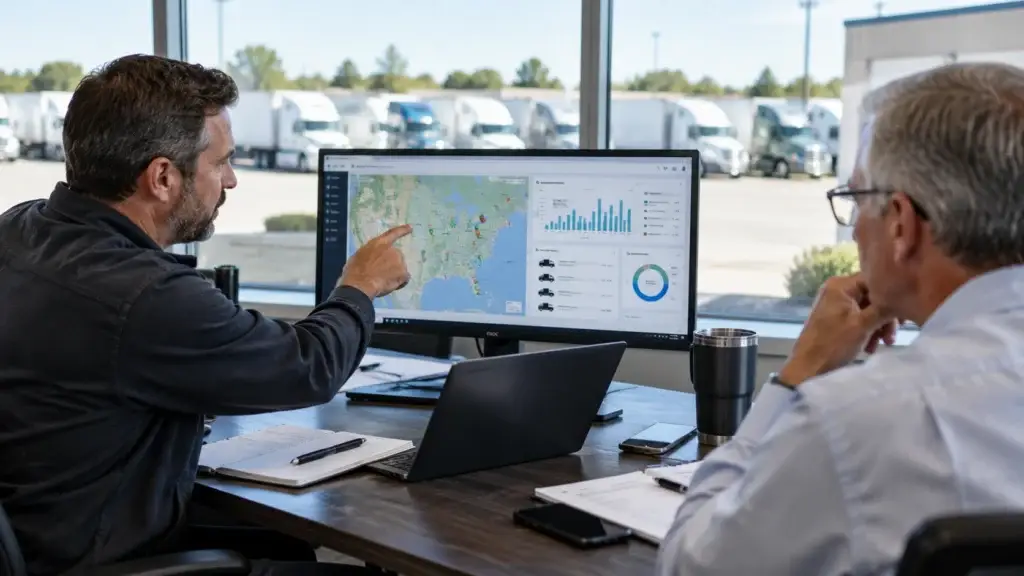
fleet telematics ROI

How to Calculate and Justify Fleet Telematics ROI

Table of Contents
    Add a header to begin generating the table of contents

    Asking executives for a $50,000+ capital expenditure on vehicle tracking systems can feel daunting. Many fleet managers struggle to articulate why GPS technology deserves priority funding. Yet the numbers tell a compelling story that leadership cannot ignore.

    Unplanned downtime costs companies approximately $25,000 per hour on average. Asset-intensive industries face even steeper losses. Transportation and logistics organizations lose up to $50 billion annually due to equipment failures and operational inefficiencies. These hidden expenses far exceed implementation costs for modern tracking solutions.

    The old “fix it when it breaks” approach no longer works in competitive markets. Data-driven fleet management has become a strategic necessity, not an optional upgrade. Companies without vehicle monitoring systems hemorrhage money through excessive fuel consumption, accelerated depreciation, and inefficient routing.

    Last Updated: November 2025

    Key Takeaways

    • Unplanned downtime costs: Businesses lose $25,000 per hour from vehicle failures, making prevention systems financially critical
    • Industry-wide inefficiencies: Transportation sectors lose $50 billion yearly to operational waste that tracking technology prevents
    • Hidden expense categories: Fuel waste, routing inefficiency, and accelerated depreciation exceed implementation costs
    • Competitive necessity: Modern vehicle tracking has shifted from optional technology to operational requirement
    • Concrete metrics required: Successful investment justification demands specific data, not vague efficiency promises
    • Data-driven presentations: Evidence-based proposals transform executive skepticism into capital expenditure approval
    detailed breakdown of fleet telematics implementation costs showing hardware and subscription fees

    Understanding the complete cost structure—from hardware to ongoing subscriptions—builds credibility with financial decision-makers.

    Understanding the True Cost of Fleet Telematics Investment

    Successfully justifying telematics implementation costs to leadership requires complete transparency about the financial commitment involved. Many fleet managers underestimate the total investment by focusing solely on hardware expenses while overlooking subscription fees, training programs, and ongoing support requirements.

    A comprehensive fleet management business case must account for both one-time capital expenditures and recurring operational costs to establish credibility with financial decision-makers. The difference between a rejected proposal and an approved budget often comes down to how thoroughly you present the complete cost picture.

    CFOs appreciate detailed breakdowns that demonstrate you’ve anticipated every expense category. This approach builds trust and prevents budget overruns that could undermine your credibility later in the implementation process.

    “The biggest mistake I see is fleet managers presenting only the hardware costs and getting blindsided by subscription fees during budget reviews. Show everything upfront, and your executives will respect your thoroughness.”

    — Fleet management consultant at a Fortune 500 logistics company

    Upfront Implementation Costs

    The initial investment in fleet telematics extends far beyond simply purchasing GPS devices. Organizations must prepare for a multi-layered financial commitment that includes equipment, software access, and professional installation services.

    Understanding these upfront expenses helps you create realistic budget projections that won’t shock leadership during approval processes. Each cost category plays a distinct role in the overall implementation strategy.

    Hardware and GPS Device Expenses

    GPS device costs vary significantly based on functionality and feature sets. Basic tracking units typically range from $150 to $250 per vehicle, while advanced devices with accelerometer sensors, driver identification, and extended diagnostics cost between $300 and $400 per unit.

    For a 100-vehicle fleet, hardware expenses alone represent a $15,000 to $40,000 investment. Larger organizations with 500+ vehicles should budget $75,000 to $200,000 for complete hardware deployment.

    The equipment choice depends on your specific tracking needs. Standard GPS units provide location and mileage data, while premium devices offer driver behavior monitoring, engine diagnostics, and integration with electronic logging devices for DOT compliance.

    Software Licensing and Subscription Fees

    Software licensing represents an ongoing cost that many organizations overlook during initial budgeting. Most telematics providers charge monthly subscription fees ranging from $20 to $60 per vehicle depending on the platform’s capabilities and data storage requirements.

    Entry-level platforms at $20-$30 per vehicle monthly provide basic GPS tracking and geofencing. Mid-tier solutions at $35-$45 monthly add driver behavior scoring, maintenance alerts, and reporting dashboards.

    Enterprise platforms at $50-$60 monthly include predictive analytics, API integrations, and dedicated account management. Annual software costs for a 100-vehicle fleet range from $24,000 to $72,000.

    This recurring expense must be factored into your five-year total cost of ownership calculations.

    Professional Installation and Vehicle Downtime

    Professional installation ensures proper device placement and system functionality. Installation fees typically range from $50 to $150 per vehicle depending on vehicle type and installation complexity.

    The often-overlooked cost is vehicle downtime during installation. Each vehicle requires 30-90 minutes out of service, which translates to lost revenue for commercial operations.

    For a delivery fleet generating $200 per vehicle daily, removing 100 vehicles for installation represents approximately $10,000 in opportunity costs. Some organizations stagger installations to minimize operational disruption.

    Others schedule installations during off-peak seasons or weekends to reduce the financial impact of vehicle unavailability.

    Ongoing Operational Expenses

    The relationship between upfront costs and ongoing expenses is critical to understanding total ownership economics. While hardware represents a one-time investment, operational expenses continue throughout the system’s lifecycle.

    These recurring costs include platform fees, training programs, and technical support that ensure your telematics investment delivers sustained value.

    Monthly Platform and Data Management Fees

    Cloud hosting and data management fees are embedded in most subscription models. These costs cover data storage, processing, real-time updates, and platform infrastructure that keeps your system operational 24/7.

    Premium platforms with advanced analytics and custom reporting capabilities command higher monthly fees. Organizations processing large data volumes from extensive fleets may face additional charges for data overage or expanded storage capacity.

    Budget for annual increases of 3-5% as telematics providers add new features and capabilities. Most contracts include these escalation clauses, so factor them into long-term financial projections.

    Employee Training and Change Management Programs

    Successful adoption requires comprehensive employee training programs for dispatchers, fleet managers, and drivers. Initial training typically costs $2,000 to $10,000 depending on organization size and training delivery method.

    Change management initiatives help overcome resistance from drivers who view telematics as surveillance. These programs include communication campaigns, driver incentive structures, and ongoing coaching that can add $5,000 to $25,000 to first-year expenses.

    Organizations that skimp on training face poor adoption rates and reduced ROI. Investing in proper change management ensures your team actually uses the system’s capabilities instead of viewing it as a compliance burden.

    Technical Support and System Maintenance

    Technical support contracts ensure rapid response when issues arise. Most providers include basic support in subscription fees, but dedicated account management and priority troubleshooting require premium support packages costing an additional $5,000 to $15,000 annually.

    System maintenance includes software updates, security patches, and hardware replacements for failed devices. Budget 5-10% of your hardware investment annually for device replacements due to damage, malfunction, or technological obsolescence.

    For organizations with internal IT resources, some maintenance tasks can be handled in-house. However, specialized technical issues still require vendor support to resolve complex integration problems or system malfunctions.

    Cost CategoryOne-Time InvestmentAnnual Recurring Cost100-Vehicle Fleet Example
    Hardware and GPS Devices$150-$400 per vehicle5-10% replacement budget$15,000-$40,000 initial
    Software LicensingSetup fees vary$20-$60 per vehicle monthly$24,000-$72,000 annually
    Professional Installation$50-$150 per vehicleN/A$5,000-$15,000 one-time
    Training and Change Management$2,000-$10,000$1,000-$3,000 ongoing$3,000-$13,000 first year
    Technical SupportIncluded in subscriptions$5,000-$15,000 premium$5,000-$15,000 annually

    This comprehensive cost breakdown demonstrates the financial commitment required for successful telematics deployment. By presenting complete expense projections to leadership, you establish credibility and set realistic expectations for the investment timeline.

    The next sections will demonstrate how these costs are quickly offset by measurable savings and efficiency gains that deliver substantial returns within 12-18 months.

    Key ROI Drivers and Measurable Benefits

    Telematics cost savings materialize through direct financial impacts, operational improvements, risk reduction, and strategic competitive positioning that together create sustainable value. Organizations that view fleet tracking purely as an expense management tool miss significant opportunities for revenue enhancement and market differentiation.

    The comprehensive value framework outlined below demonstrates why successful implementations consistently generate returns exceeding 200% within the first 24 months. Fleet management ROI extends across four interconnected categories that address different stakeholder priorities.

    Financial executives focus on immediate cost reductions, operations managers value efficiency improvements, risk officers prioritize compliance protection, and sales leaders recognize competitive positioning advantages. This multi-dimensional approach ensures your business case resonates with diverse decision-makers.

    comprehensive fleet management ROI benefit categories including financial operational and strategic value

    ROI extends beyond simple cost reduction to include operational efficiency, risk mitigation, and competitive advantages.

    Immediate Financial Impact

    Direct cost reductions provide the most visible and easily quantifiable returns that leadership demands during investment evaluations. These hard-dollar savings appear directly on financial statements within weeks of implementation.

    Fuel expense optimization typically delivers the largest single cost reduction category. GPS fleet management benefits include reducing unnecessary mileage by 10-25% through route optimization and eliminating personal vehicle use.

    A fleet spending $500,000 annually on fuel can realize $50,000-$125,000 in immediate savings. Preventive maintenance enabled by telematics systems saves 12-18% in maintenance costs.

    Real-time diagnostics alert managers to emerging issues before they escalate into expensive repairs. Organizations implementing proactive asset management strategies report significant reductions in unplanned downtime and extended equipment lifespan improvements of up to 20%.

    Insurance premium negotiations become more favorable when carriers see documented proof of driver monitoring and safety programs. Most fleets secure 5-15% premium reductions immediately upon demonstrating telematics deployment.

    Additional savings accumulate as accident frequencies decline over subsequent policy periods. Labor cost accuracy improves through automated timesheet verification that eliminates manual entry errors and timesheet fraud.

    The average fleet recovers 30-60 minutes per driver weekly through precise time tracking. For a 50-driver operation, this represents $75,000-$150,000 in annual labor cost recovery.

    Operational Efficiency and Asset Optimization

    Indirect value creation generates substantial returns that traditional accounting methods often overlook. These benefits compound over time and create lasting competitive advantages.

    Vehicle utilization rates improve dramatically when managers gain visibility into actual asset deployment. Most fleets operate at 60-70% utilization before implementing telematics.

    GPS fleet management benefits push utilization rates to 85-90% on critical operations, effectively expanding capacity without purchasing additional vehicles. Extended vehicle lifespan delays capital replacement cycles that represent significant cash flow benefits.

    Proper maintenance scheduling and reduced aggressive driving behaviors extend useful vehicle life by 15-20%. A fleet replacing 20 vehicles annually at $45,000 each can defer $180,000 in capital expenditures by extending replacement cycles just one additional year.

    Customer satisfaction improvements translate directly to revenue retention and growth. Accurate arrival time estimates, faster response to service requests, and verifiable completion documentation differentiate your organization from competitors.

    Studies show that 92% of customers value real-time service visibility when selecting providers. Strategic decision-making improves when executives access comprehensive operational data.

    Route profitability analysis, customer service patterns, and capacity planning become data-driven rather than intuition-based. This operational intelligence enables expansion into new markets with confidence.

    Protection Against Risk and Regulatory Exposure

    Risk mitigation benefits protect existing revenue streams and prevent catastrophic losses that could threaten business viability. These protective measures justify telematics investments even without considering other benefits.

    Liability defense capabilities provide documented evidence during accident investigations and legal proceedings. Video telematics and GPS tracking data have exonerated drivers in disputed claims, preventing settlements averaging $50,000-$200,000 per incident.

    A single avoided lawsuit can justify entire annual telematics costs. Hours of Service compliance automation eliminates DOT violation risks that carry penalties reaching $16,000 per violation.

    Fleets subject to electronic logging device mandates require telematics systems regardless of other benefits. Automated compliance documentation reduces administrative burden by 8-12 hours weekly for compliance managers.

    Theft recovery and unauthorized use prevention protect valuable assets from loss. Real-time GPS alerts enable recovery of stolen vehicles within hours rather than days.

    The average commercial vehicle theft results in $15,000-$30,000 in losses when recovery fails. Maintenance audit trails satisfy regulatory requirements and protect against citations during inspections.

    Complete service histories demonstrate due diligence during liability investigations. This documentation proves invaluable during insurance claims and regulatory audits.

    Market Positioning and Service Excellence

    Competitive advantages transform fleet operations from cost centers into revenue generators that capture premium pricing and expand market access. These strategic benefits position organizations for long-term growth.

    Enterprise contract qualification becomes achievable when large customers require fleet tracking capabilities as mandatory vendor requirements. Many Fortune 500 companies and government agencies now mandate telematics visibility before awarding contracts.

    This technology investment unlocks entire market segments previously inaccessible. Faster quote turnaround improves win rates in competitive bidding situations.

    Accurate capacity data enables instant responses to quote requests rather than requiring 24-48 hour research periods. Sales teams report 15-20% higher conversion rates when providing immediate pricing with guaranteed service windows.

    Premium pricing justification becomes defensible when customers receive superior visibility and service reliability. Organizations offering real-time tracking and proactive communication command 8-12% price premiums compared to competitors lacking these capabilities.

    Customers willingly pay more for predictability and transparency. Brand reputation enhancement occurs when service excellence becomes consistently measurable and communicable.

    Marketing departments leverage on-time performance statistics, safety records, and sustainability metrics enabled by telematics data. These differentiators attract quality-conscious customers and top-tier driver talent.

    Understanding fleet management ROI requires examining these interconnected benefit categories as a comprehensive value system rather than isolated advantages.

    How to Calculate Fleet Telematics ROI

    Building a credible ROI calculation demands more than vendor promises—it requires rigorous baseline documentation and conservative financial projections. The difference between a rejected proposal and approved investment often comes down to the quality of your financial analysis and supporting data.

    Fleet managers who successfully justify telematics investments understand that CFOs and financial decision-makers require mathematical precision. They expect to see documented current costs, realistic improvement projections, and clear timelines for recouping the investment.

    fleet tracking ROI calculator dashboard displaying comprehensive cost benefit analysis

    Rigorous financial analysis with documented baselines transforms vendor promises into credible executive presentations.

    The Standard ROI Formula for Fleet Technology Investments

    The fundamental calculation for any fleet tracking ROI calculator follows a straightforward formula: ROI equals net benefits minus total investment, divided by total investment, multiplied by 100. This percentage tells leadership exactly how much return they can expect for every dollar invested.

    However, fleet telematics requires expanding this basic formula into specific operational categories. Net benefits must be broken down into measurable components that reflect real-world savings.

    Your calculation should include these distinct benefit categories: fuel savings from reduced idling, optimized routing, and eliminated unauthorized use; maintenance cost reductions through predictive scheduling and prevented breakdowns; insurance premium decreases negotiated with carriers based on telematics data; labor productivity gains from automated timekeeping and reduced administrative tasks; and avoided downtime costs from preventing vehicle failures and improving dispatch efficiency.

    The total investment side of the equation must account for both upfront and ongoing expenses. Include hardware costs, software licensing fees, installation expenses, training time, and three years of operational costs for an accurate projection.

    This comprehensive approach prevents the common mistake of comparing only hardware costs against total benefits. Such incomplete calculations create unrealistic expectations and damage credibility when actual performance falls short of initial projections.

    Establishing Your Current Baseline Metrics

    ROI claims without documented baseline data lack credibility and invite skepticism from financial decision-makers. Establishing accurate pre-implementation metrics is the foundation of every successful telematics business case.

    Organizations that skip this documentation phase often struggle to demonstrate actual improvements. Without knowing your starting point, you cannot prove that fleet efficiency improvements resulted from the telematics investment rather than external factors like fuel price changes or seasonal variations.

    The baseline documentation period should span at least 90 days to capture representative operational patterns. This timeframe accounts for weekly and monthly variations while providing sufficient data volume for statistical reliability.

    Documenting Current Fuel Consumption Rates

    Start by collecting comprehensive fuel purchase data across your entire fleet. Gather at least three months of fuel receipts, fleet card transactions, and mileage records to establish reliable consumption patterns.

    Calculate the average miles per gallon for each vehicle class in your fleet. Group similar vehicles together—light-duty trucks separate from heavy-duty equipment, for example—since different vehicle types have vastly different consumption profiles.

    Identify current idling hours and excessive consumption patterns through driver reports or existing GPS data. Document any known instances of unauthorized vehicle use or personal trips that increase fuel costs without business value.

    Record these specific data points: total gallons consumed per vehicle per month, average MPG by vehicle type and duty cycle, estimated idling hours if available through engine hour meters, known inefficiencies such as circuitous routing or repeated trips, and after-hours or weekend fuel purchases indicating potential unauthorized use.

    Recording Existing Maintenance Costs Per Vehicle

    Compile your total annual maintenance expenditure per vehicle from maintenance management systems or accounting records. This figure should include parts, labor, and any outsourced service costs.

    Separate emergency and breakdown repairs from scheduled preventive maintenance. This distinction is critical because telematics primarily reduces unplanned maintenance through early problem detection and predictive scheduling.

    Document the average vehicle downtime per maintenance incident. Downtime represents lost productivity and potentially missed service appointments, creating hidden costs beyond the repair bills themselves.

    Capture your current maintenance intervals for oil changes, tire rotations, brake inspections, and other scheduled services. Many fleets discover they’re performing maintenance too frequently based on calendar schedules rather than actual vehicle usage—an inefficiency that telematics can eliminate.

    Analyzing Insurance Premiums and Claims History

    Obtain your current annual insurance premium costs per vehicle from your carrier. Request a breakdown showing liability coverage, physical damage, and any additional coverages specific to commercial fleet operations.

    Document your claims history for the past three years, including claim frequency, average claim severity, and total claim costs. Insurance carriers use this history to set premiums, and demonstrating improvement through telematics data can yield significant reductions.

    Record your current accident frequency rate, typically expressed as incidents per million miles driven. This metric provides a baseline for measuring safety improvements after implementation.

    Identify any recent premium increases attributed to claims experience. These increases represent an opportunity for telematics to reverse unfavorable trends and restore lower premium rates.

    Projecting Post-Implementation Savings Accurately

    Conservative improvement targets based on industry benchmarks withstand CFO scrutiny better than optimistic vendor projections. Setting realistic expectations protects your credibility and ensures leadership won’t view the investment as a failure if it achieves 12% savings instead of the 20% promised by sales materials.

    Cost CategoryConservative TargetAggressive TargetIndustry Average
    Fuel consumption reduction10-12%15-20%13%
    Maintenance cost savings12-15%18-25%16%
    Insurance premium decrease5-8%10-15%7%
    Labor productivity gains8-10%12-18%11%

    Use the conservative targets for your primary financial projections. Present the aggressive targets as upside potential that may be realized with strong driver adoption and management engagement.

    Apply these percentages to your documented baseline costs to calculate projected annual savings. Multiply your current annual fuel spend by 10-12% to estimate fuel savings, for example, rather than using vendor case studies from operations that may differ significantly from yours.

    Factor in a ramp-up period where savings increase gradually. Most implementations achieve only 40-60% of potential savings in the first three months as drivers adjust to monitoring and managers learn to use the system effectively.

    Setting Realistic Timeframes for Break-Even Analysis

    Most fleet telematics implementations achieve break-even within 12-18 months when properly executed. This timeframe accounts for initial implementation costs, the learning curve period, and the gradual realization of operational improvements.

    Full ROI realization typically occurs over a three-year period, which aligns with standard capital equipment depreciation schedules. Presenting your analysis with this timeframe helps leadership understand that telematics is a medium-term investment rather than an immediate expense recovery.

    Create a month-by-month cash flow projection showing when specific savings begin to materialize. Fuel savings typically appear within the first 30-60 days as drivers modify behavior.

    Maintenance savings emerge more gradually over 6-12 months as the predictive scheduling prevents future failures. Include these milestones in your break-even timeline.

    Months 1-3 show initial fuel savings from reduced idling and unauthorized use, representing 30-50% of projected annual fuel savings. Months 4-6 demonstrate labor productivity improvements from automated timekeeping and route optimization.

    Months 7-12 reveal maintenance cost reductions as predictive scheduling prevents major failures. Month 12-18 brings insurance premium reductions negotiated at policy renewal based on demonstrated safety improvements.

    Years 2-3 continue cost avoidance and efficiency gains as the system becomes fully integrated into operations. This phased approach sets appropriate expectations with leadership.

    It demonstrates that you understand the implementation reality rather than promising immediate, dramatic results that rarely materialize in actual deployments.

    Fuel Cost Reduction and Efficiency Gains

    Fuel expenses represent the single largest controllable operating cost in most fleet operations, making fuel cost reduction the cornerstone of any telematics ROI calculation. Unlike maintenance schedules or insurance premiums that fluctuate based on various factors, fleet fuel savings deliver immediate, measurable results that appear directly on monthly fuel card statements.

    This visibility makes fuel reduction the most credible component when justifying your investment to financially-focused executives. Leadership can track consumption patterns before and after implementation without relying on estimates or projections.

    Every reduction in idling hours, every optimized route, and every unauthorized trip prevented translates directly into dollars saved. Most fleet managers discover that fuel waste occurs in three primary categories: excessive idling, inefficient routing, and unauthorized vehicle use.

    Addressing these areas systematically generates returns that often justify the entire vehicle tracking system ROI within the first 18-24 months.

    Eliminating Excessive Idling and Engine Runtime

    Excessive idling represents one of the most substantial yet overlooked sources of fuel waste in commercial fleets. Each hour of idling consumes between 0.6 and 1.0 gallons of fuel while generating zero productive miles.

    For service fleets with frequent stops, idle time commonly accounts for 20-40% of total engine hours. Telematics systems provide idle monitoring that identifies which drivers habitually leave engines running during lunch breaks, service calls, or administrative tasks.

    Real-time dashboards display idle duration for each vehicle, enabling managers to spot patterns immediately. Setting idle-time thresholds with automated alerts creates accountability without requiring constant supervision.

    Implementation of idle reduction coaching programs typically reduces idle time by 30-50% within 90 days. A fleet with 25 vehicles idling an average of 2 hours daily wastes approximately 37,500 gallons annually at baseline.

    Reducing idle time by just 40% saves 15,000 gallons, translating to $52,500 in annual fuel cost reduction at $3.50 per gallon.

    fleet fuel savings dashboard showing idle time reduction and route optimization metrics

    Real-time fuel consumption monitoring reveals waste patterns invisible to manual tracking methods.

    Optimizing Route Planning and Dispatch Operations

    GPS tracking combined with historical route data enables dispatchers to reduce total miles driven by 10-20% through intelligent routing algorithms. Traditional paper-based or memory-based routing creates inefficiencies that compound daily across your entire fleet.

    Telematics platforms analyze thousands of completed routes to identify optimization opportunities. Dynamic rerouting based on real-time traffic conditions prevents drivers from sitting in congestion burning fuel unnecessarily.

    When accidents or road closures occur, the system automatically calculates alternative routes and pushes notifications to driver devices. This capability alone saves 5-8% of fuel costs in urban operating environments.

    Territory planning improvements cluster service stops geographically, eliminating backtracking and zigzag patterns. A technician visiting 12 locations daily might drive 140 miles with poor routing versus 105 miles with optimized sequencing.

    That 25% reduction multiplied across your fleet generates substantial fuel savings without requiring additional vehicles or personnel. Route optimization also improves customer service by enabling more accurate arrival windows and faster response times.

    Dispatchers gain visibility into actual vehicle locations rather than relying on driver-reported estimates that may be 15-30 minutes outdated.

    Reducing Unauthorized Vehicle Use and Personal Trips

    Unauthorized vehicle use represents a hidden drain on fuel budgets that many fleet managers significantly underestimate until implementing telematics tracking. After-hours personal use, weekend unauthorized trips, and route deviations for personal errands typically account for 5-15% of total fuel consumption.

    This waste occurs across both company-owned vehicles and those assigned for take-home use. Geofence alerts notify managers immediately when vehicles leave designated service areas during work hours or move outside approved zones during off-hours.

    After-hours movement notifications reveal which vehicles operate on weekends or evenings without authorization. These capabilities create accountability that dramatically reduces personal use without creating an adversarial work environment.

    Detailed trip logs provide irrefutable documentation of every vehicle movement, including start/stop locations, duration, and mileage. Managers reviewing these logs frequently discover patterns such as midday detours to residential addresses, extended lunch breaks at distant locations, or systematic route deviations that add 10-20 miles daily per vehicle.

    A 50-vehicle fleet discovering that 8% of fuel consumption stems from unauthorized use wastes approximately $17,500 annually based on typical operating costs. Implementing geofence monitoring and usage policies reduces this waste by 80-90% within the first month, capturing savings that continue indefinitely.

    Quantifying Annual Fuel Savings in Dollar Terms

    Translating operational improvements into financial terms requires establishing baseline metrics and applying conservative reduction percentages. The following framework provides a practical calculation model that resonates with executive leadership because it demonstrates vehicle tracking system ROI using verifiable assumptions.

    Consider a 50-vehicle fleet where each vehicle averages 15,000 miles annually. With an average fuel economy of 12 MPG, each vehicle consumes 1,250 gallons per year.

    At $3.50 per gallon, the baseline annual fuel cost reaches $218,750 for the entire fleet.

    Reduction CategoryConservative ImprovementAnnual Gallons SavedDollar Value
    Idle Time Reduction35% decrease3,125 gallons$10,938
    Route Optimization12% mileage reduction7,500 gallons$26,250
    Unauthorized Use Elimination75% reduction2,344 gallons$8,204
    Combined Total Savings15% overall reduction9,375 gallons$32,813

    This $32,813 in annual fleet fuel savings alone justifies a $50,000 telematics investment with full payback in approximately 18 months. The calculation uses deliberately conservative estimates—many fleets achieve 20-25% fuel reductions, accelerating payback to under 12 months.

    These savings aren’t theoretical projections based on best-case scenarios. They represent measurable, verifiable reductions that appear on monthly fuel card statements and can be tracked against baseline consumption.

    Finance teams can validate the numbers independently, making fuel savings the most credible component of your business case. Beyond the immediate financial return, fuel efficiency improvements reduce your fleet’s environmental footprint and demonstrate corporate responsibility.

    Some organizations leverage their fuel reduction achievements in sustainability reporting and customer communications, creating additional brand value beyond direct cost savings.

    The cumulative effect over a five-year period transforms a modest 15% fuel reduction into $164,065 in total savings, not accounting for fuel price increases that would amplify these returns further. This long-term perspective helps executives understand that telematics isn’t an expense but a revenue-protecting investment that compounds returns annually.

    Stay Ahead of Industry Trends

    Get expert insights, equipment reviews, and operational strategies delivered to your inbox weekly.

    Subscribe to Our Newsletter

    Maintenance Cost Savings Through Predictive Analytics

    Predictive analytics revolutionizes fleet maintenance by shifting operations from reactive crisis management to proactive cost control. Traditional maintenance approaches rely on arbitrary calendar schedules or waiting for breakdowns to occur.

    Preventive maintenance strategies save 12-18% in maintenance costs compared to reactive approaches, making this the second-largest ROI contributor from telematics investments. Organizations implementing predictive maintenance fleet systems reduce unplanned downtime significantly while extending asset lifespans.

    The financial impact becomes substantial quickly. With unplanned downtime costing organizations an average of $25,000 per hour, preventing even a handful of breakdown incidents delivers measurable returns that justify the technology investment.

    Automated Maintenance Scheduling and Alerts

    Modern telematics platforms track actual vehicle usage metrics rather than relying on estimates. Engine hours, miles driven, idle time, and operating conditions provide precise data for scheduling maintenance.

    This approach ensures vehicles receive service exactly when needed, eliminating wasteful early maintenance and dangerous delayed service. Automated alerts notify fleet managers when vehicles approach service intervals.

    The system eliminates manual tracking spreadsheets and the common problem of missed maintenance appointments. Missed maintenance accelerates component wear and can void manufacturer warranties, creating expensive consequences that automated systems prevent.

    predictive maintenance dashboard showing automated alerts and vehicle health monitoring

    Predictive analytics shift maintenance from reactive firefighting to proactive cost control.

    Calendar-based maintenance schedules fail to account for varying usage patterns across fleet vehicles. A delivery truck making 50 stops daily experiences dramatically different wear than a vehicle covering highway miles.

    Telematics-driven scheduling adapts to each vehicle’s actual operating conditions, optimizing maintenance timing and resource allocation.

    Preventing Catastrophic Failures and Breakdowns

    The cost difference between planned preventive maintenance and emergency breakdown repairs proves dramatic. A $150 oil change performed on schedule prevents a $5,000 engine failure.

    Similarly, a $400 brake service prevents a $15,000 accident and potential liability claims that could reach six figures. Vehicle health monitoring through telematics tracks critical indicators continuously.

    Battery voltage, coolant temperature, oil pressure, and diagnostic trouble codes provide early warning of developing problems. This visibility enables repairs during scheduled downtime rather than roadside emergencies that disrupt operations.

    Diagnostic trouble codes alert managers to issues immediately when they occur. Many problems start small but escalate rapidly without intervention.

    A minor coolant leak detected early requires a $200 hose replacement, while ignoring the warning leads to engine overheating and a $8,000 repair bill plus several days of vehicle unavailability.

    Extending Vehicle Lifespan and Resale Value

    Consistent, data-driven maintenance extends average vehicle service life substantially. Industry data shows properly maintained commercial vehicles operate effectively for 10-12 years compared to 7-8 years under reactive maintenance approaches.

    This extension defers capital replacement costs of $35,000-$50,000 per vehicle, dramatically improving fleet ROI. Fleet productivity metrics demonstrate that well-maintained vehicles experience fewer breakdowns and maintain better performance throughout their service lives.

    Vehicles spend more time generating revenue and less time in repair shops. The cumulative productivity gains over a vehicle’s lifespan add thousands of dollars in value beyond direct maintenance savings.

    Resale value provides another significant financial benefit. Well-documented maintenance histories and telematics records prove vehicle condition to potential buyers.

    Well-maintained commercial vehicles command 15-25% higher resale values compared to similar vehicles with incomplete maintenance documentation, recovering substantially more capital when vehicles cycle out of the fleet.

    Reducing Emergency Repair and Towing Costs

    Emergency repair situations carry premium costs across multiple categories. Emergency mobile mechanic rates run 50-100% higher than standard shop rates.

    Towing charges average $200-$500 per incident depending on distance and vehicle size. The lost productivity from unexpected vehicle unavailability often exceeds the direct repair costs themselves.

    Industry averages show reactive maintenance approaches result in emergency repairs comprising 15% of total maintenance events. Predictive maintenance fleet implementations reduce this figure to just 5% through early problem detection.

    For a 50-vehicle fleet, this reduction saves $40,000-$60,000 annually in emergency-related expenses alone. Driver safety improves when vehicles operate reliably.

    Breakdowns on highways or in customer locations create hazardous situations and damage company reputation. Preventing these incidents protects both employees and brand perception, delivering value that extends beyond direct financial calculations.

    Maintenance Cost CategoryReactive Approach (Annual)Predictive Approach (Annual)Savings Per Vehicle
    Scheduled Maintenance$4,200$4,500-$300
    Emergency Repairs$2,800$900$1,900
    Downtime Costs$1,500$400$1,100
    Towing and Mobile Service$600$150$450
    Total Annual Cost$9,100$5,950$3,150

    The table demonstrates how predictive maintenance reduces overall costs despite slightly higher scheduled maintenance expenses. The dramatic reduction in emergency repairs, downtime, and related costs more than compensates for increased preventive service investments.

    For typical commercial fleets spending $5,000-$8,000 per vehicle annually on maintenance, the documented 12-18% cost reduction translates to $600-$1,440 per vehicle per year in bottom-line savings.

    These maintenance savings compound over time as vehicles remain in service longer and require fewer major component replacements. A 100-vehicle fleet implementing predictive maintenance systems saves $60,000-$144,000 annually, with savings growing as the system optimizes maintenance protocols based on accumulated data and refined scheduling algorithms.

    Insurance Premium Reductions and Liability Protection

    Beyond operational efficiencies, telematics systems provide powerful risk management capabilities that directly reduce insurance expenses and legal exposure. Many fleet managers underestimate this ROI component during initial cost-benefit analysis.

    Yet insurance-related savings frequently match or exceed the fuel and maintenance benefits combined. The insurance dimension of fleet telematics encompasses four distinct value categories.

    Each category delivers measurable financial returns that strengthen your business case. These benefits continue accumulating year after year, creating compounding value that grows with your fleet.

    fleet insurance cost reduction showing premium savings and liability protection benefits

    Insurance carriers recognize telematics data as objective risk assessment, leading to premium discounts.

    Negotiating Lower Premiums with Insurance Carriers

    Major commercial insurance carriers now offer specific telematics-based discounts ranging from 5% to 15% on annual premiums. Progressive Commercial, Geico Fleet, and The Hartford have established formal programs recognizing that GPS tracking reduces claims frequency.

    Fleet insurance savings begin the moment your policy renews with telematics verification. Insurance companies view telematics data as objective risk assessment.

    Traditional underwriting relies on historical claims and industry averages. Telematics provides real-time evidence of actual fleet behavior and risk management practices.

    The negotiation process requires proactive engagement with your insurance broker. Contact your carrier before implementing telematics to request formal discount quotes.

    Documentation of your planned system capabilities strengthens your negotiating position significantly. For a fleet carrying $100,000 in annual insurance premiums, a 10% discount generates $10,000 in immediate annual savings.

    This reduction continues every subsequent year without additional investment. Over a five-year period, this single benefit produces $50,000 in cumulative savings.

    Some carriers require minimum telematics usage periods before applying discounts. Others offer immediate reductions upon system activation. Clarify these timelines during initial discussions to set accurate ROI projections.

    Reducing Accident Frequency and Severity Rates

    Driver behavior monitoring through telematics enables targeted coaching that reduces preventable accidents by 20% to 40% within the first year. The system tracks critical risk indicators including harsh braking, rapid acceleration, speeding violations, and aggressive cornering.

    Each metric provides actionable data for improving driver performance. Proactive intervention programs replace reactive accident response.

    Rather than waiting for collisions to occur, fleet managers identify high-risk drivers through objective scoring systems. This data-driven approach removes subjective bias from safety management.

    Real-time in-cab alerts provide immediate feedback during risky maneuvers. Drivers receive audible warnings when exceeding speed thresholds or braking too abruptly.

    This instant correction reinforces safe habits more effectively than post-shift discussions. Weekly driver scorecards create ongoing accountability and healthy competition.

    Posting anonymized rankings encourages peer pressure toward safer driving. Recognition programs for top safety performers further strengthen positive behaviors.

    Structured coaching sessions address consistently poor performers with specific examples. Rather than general safety reminders, managers review actual incidents with timestamp and location data.

    This evidence-based approach produces measurable behavior changes within 30-60 days. The financial impact extends beyond avoided accident costs.

    Reduced accident frequency directly lowers your experience modification rate during insurance renewals. Lower claims history translates to better premium rates for years following each prevented collision.

    Protecting Against Fraudulent and Exaggerated Claims

    Staged accidents and inflated injury claims increasingly target commercial fleets with perceived deep pockets. Telematics GPS data and accelerometer readings provide irrefutable evidence of vehicle speed, location, and impact force at incident moments.

    This objective documentation defeats false narratives that could cost your company hundreds of thousands of dollars. Fraudulent claim scenarios often involve allegations that commercial vehicles were speeding or caused rear-end collisions.

    Claimants may assert injuries inconsistent with actual impact severity. Telematics data exposes these discrepancies immediately.

    A single prevented fraudulent claim settlement ranges from $50,000 to $250,000 in typical commercial fleet scenarios. Legal defense costs add another $15,000 to $50,000 even when claims are ultimately dismissed.

    One avoided fraudulent claim can justify your entire telematics investment immediately. Insurance adjusters increasingly request telematics data during claim investigations.

    Carriers recognize this evidence as more reliable than witness statements or driver recollections. Providing comprehensive incident data accelerates legitimate claim processing while strengthening defense against fraudulent ones.

    The deterrent effect also matters significantly. Attorneys pursuing questionable claims often withdraw when confronted with comprehensive telematics evidence. Word spreads within plaintiff attorney networks about fleets with robust documentation systems.

    Claim Defense ScenarioWithout Telematics EvidenceWith Telematics EvidencePotential Savings
    Staged rear-end collision claimSettlement: $125,000 + legal fees $25,000Claim dismissed with data proof: $8,000 legal fees$142,000 saved
    Exaggerated injury severitySettlement: $85,000 + legal fees $20,000Reduced settlement: $15,000 + fees $5,000$85,000 saved
    False speeding allegationSettlement: $60,000 + legal fees $18,000Full dismissal: $3,000 legal fees$75,000 saved
    Disputed fault determination50/50 settlement: $45,000 + fees $15,0000% fault proven: $2,000 legal fees$58,000 saved

    Compliance Documentation for Legal Defense

    Telematics systems automatically capture and store documentation required for regulatory compliance and legal defense. Hours of Service logs, vehicle inspection records, and maintenance histories generate without manual paperwork.

    This automation eliminates human error while ensuring audit-ready records. DOT violations carry penalties averaging $1,000 to $15,000 per citation depending on severity.

    Violations for inadequate Hours of Service documentation or missing vehicle inspection records occur frequently during roadside inspections. Automated compliance documentation prevents these costly citations entirely.

    Electronic logging devices integrated with telematics platforms provide tamper-proof HOS records. Drivers cannot manipulate logbooks to hide violations.

    Fleet managers gain real-time visibility into potential compliance issues before they trigger inspections. Legal proceedings following accidents often scrutinize maintenance records and driver qualification files.

    Plaintiff attorneys search for maintenance negligence or unqualified driver employment. Comprehensive telematics documentation demonstrates your proactive safety culture and proper fleet management.

    The litigation protection value extends beyond specific incident documentation. Courts and juries view companies with robust safety systems more favorably.

    Evidence of driver behavior monitoring and intervention programs demonstrates reasonable care and due diligence. Record retention requirements vary by regulation and jurisdiction.

    Telematics cloud storage maintains records for required periods without physical filing systems. Search and retrieval functions provide instant access during audits or legal discovery requests.

    When combined across all four categories, the risk management ROI component of telematics often equals or exceeds operational efficiency savings. Fleet insurance savings alone may not justify a $50,000+ investment.

    However, when you add liability protection value, prevented fraudulent claims, and avoided compliance penalties, the insurance dimension becomes a primary ROI driver rather than a secondary benefit.

    Labor Productivity and Driver Behavior Improvements

    Labor costs typically represent 40-60% of total fleet operating expenses, making workforce productivity improvements one of the most impactful ROI drivers for telematics investments. While fuel and maintenance savings often receive the most attention during budget discussions, fleet efficiency improvements through enhanced workforce management frequently deliver the fastest payback periods.

    Telematics transforms fleet operations from trust-based manual processes to data-verified accountability systems. Organizations implementing automated tracking systems eliminate the inefficiencies that silently drain profitability across multiple dimensions.

    Better visibility into actual work patterns reveals opportunities for optimization that remain invisible in manual logging environments. The compound effect of these improvements—reduced labor waste combined with increased output capacity—creates a powerful financial multiplier for telematics ROI.

    fleet productivity dashboard displaying driver performance metrics and labor efficiency data

    Objective performance data eliminates subjective evaluation and creates fair, consistent accountability.

    Eliminating Timesheet Fraud and Manual Logging Errors

    Manual timesheet systems suffer from systemic inaccuracies that cost organizations significantly more than most leadership teams realize. Industry research suggests that 5-10% of reported hours contain discrepancies, whether from intentional time theft or honest estimation errors.

    These inaccuracies create a substantial hidden tax on fleet operations. Driver behavior monitoring through telematics automatically captures objective data points that manual systems cannot verify.

    The technology records precise vehicle start times when engines engage and movement begins, actual stop times when vehicles return to designated yards, and total driving hours without relying on employee memory or honesty.

    This eliminates classic timesheet problems including early clock-ins, extended lunch breaks recorded as work time, and late clock-outs. For a 50-driver fleet with average loaded labor costs of $55,000 per driver annually, the financial impact becomes immediately clear.

    Recovering just 5% of time discrepancies saves $137,500 annually—nearly triple a typical telematics investment cost. This single benefit category often justifies the entire technology expenditure.

    The shift from trust-based timekeeping to data-verified accountability represents one of the most significant operational improvements available to fleet managers today.

    Time Tracking MethodAverage Discrepancy RateAnnual Cost (50 drivers)Verification Method
    Manual paper timesheets8-12%$220,000-$330,000Supervisor spot checks
    Electronic time clock5-8%$137,500-$220,000Clock-in location data
    Telematics automation0-1%$0-$27,500GPS and ignition sensors
    Potential annual savings7-11% recovery$192,500-$302,500Data-driven accuracy

    Reducing Unauthorized Overtime Expenses

    Visibility into actual vehicle usage patterns reveals inefficiencies that generate unnecessary overtime costs across fleet operations. Poor route sequencing causes drivers to exceed standard 8-hour shifts when better planning could complete the same work within regular hours.

    Excessive time spent at certain stops indicates personal activities masquerading as business tasks. Morning delays from drivers arriving late to vehicle yards create ripple effects throughout the day.

    These small inefficiencies compound to push completion times into overtime territory. Fleet productivity metrics expose these patterns with precision that manual observation cannot match.

    Fleet managers using data-driven scheduling adjustments typically reduce overtime hours by 15-25%. This delivers immediate payroll savings while simultaneously improving work-life balance for drivers.

    The dual benefit creates financial returns alongside employee satisfaction improvements. Organizations implementing automated tracking systems gain the insight needed to optimize scheduling before overtime becomes necessary.

    Real-time alerts notify dispatchers when drivers approach overtime thresholds, enabling proactive workload redistribution. This preventive approach reduces labor costs more effectively than reactive overtime management.

    Improving Driver Safety Scores and Behavior

    Objective driver behavior monitoring eliminates the subjective dynamics that undermine traditional supervisor-based safety programs. Data-driven evaluation systems assess drivers on actual performance metrics rather than subjective observations or personality conflicts.

    This approach improves both driver buy-in and measurable safety outcomes. Telematics systems track specific behaviors including speeding events, harsh braking frequency, rapid acceleration patterns, and seatbelt usage compliance.

    These fleet productivity metrics create fair, consistent safety programs where every driver faces the same evaluation standards. The objectivity builds trust in the coaching process.

    Fleets implementing telematics-based safety programs report 30-50% reductions in preventable accidents within 18 months of deployment. This dramatic improvement translates directly to reduced insurance claims, lower vehicle repair costs, and decreased driver injury expenses.

    The compounding financial benefits extend across multiple cost categories. Gamification features in modern telematics platforms transform safety from a punitive compliance requirement into a positive performance competition.

    Driver leaderboards, safety score badges, and reward programs motivate continuous improvement. This cultural shift delivers sustainable behavioral changes rather than temporary compliance under observation.

    Increasing Daily Route Completion and Service Rates

    Optimized routing combined with real-time visibility enables dispatchers to increase stops per driver per day by 10-20% without adding work hours. This capacity expansion directly increases revenue potential without requiring additional vehicles or drivers.

    The impact on unit economics transforms fleet profitability. Consider a practical example: if current capacity averages 12 stops per driver daily and optimization enables 14 stops, that represents a 16.7% revenue capacity increase with zero additional capital investment.

    The same fixed costs now support significantly higher output, reducing per-unit delivery costs while expanding service capacity. Real-time traffic integration allows dynamic route adjustments that avoid delays and maximize productive time.

    Dispatchers can reassign stops from delayed drivers to those ahead of schedule, ensuring customer commitments are met while balancing workloads. This flexibility was impossible in manual dispatch environments.

    Fleet efficiency improvements through route optimization compound over time as machine learning algorithms identify patterns in traffic, customer availability, and seasonal variations. The system becomes more efficient with each month of operation, continuously refining recommendations based on historical performance data.

    Labor productivity improvements deliver compound ROI because the same labor cost generates more output in completed jobs, delivered goods, and serviced customers. This effectively reduces per-unit labor costs while increasing revenue potential—creating value from both sides of the profitability equation.

    Organizations that track these metrics carefully often discover that workforce optimization returns exceed all other telematics benefit categories combined.

    Building Your Executive Presentation and Business Case

    Your fleet management business case presentation will compete against dozens of other capital requests for limited executive attention and budget allocation. Executives review multiple proposals quarterly and approve those that combine financial merit with clear, compelling documentation.

    The quality of your presentation often matters as much as the underlying ROI calculations. Transforming raw data into an effective telematics investment justification requires strategic structure and visual appeal.

    This section provides the framework for building a presentation that secures approval for your $50K+ investment. You’ll learn how to organize financial information, support claims with credible data, and align your proposal with broader company objectives.

    Structuring Your Financial Proposal Document

    A well-organized proposal document follows a logical progression that guides executives from problem identification through solution approval. Your fleet management business case should present information in a sequence that builds momentum toward a positive decision.

    Each section serves a specific purpose in the overall persuasion strategy. Start with a one-page executive summary that captures the entire proposal at a glance.

    Follow this with a current state analysis documenting baseline costs and operational inefficiencies. Then present your proposed solution with implementation details and resource requirements.

    The middle sections should contain your detailed ROI calculations with conservative assumptions clearly stated. Include an implementation timeline showing key milestones and responsibilities.

    Add a risk assessment section that addresses potential concerns before executives raise them. Conclude with appendices containing vendor proposals, technical specifications, and reference case studies.

    This structure demonstrates thorough preparation while keeping the core proposal concise and focused. The executive summary determines whether leadership reads further or dismisses your proposal immediately.

    This critical opening page must communicate value within 60 seconds of reading time. Lead with the most compelling number: your headline ROI figure.

    Creating a Compelling One-Page Executive Summary

    Start with the bottom-line result: “278% three-year ROI with 16-month payback period.” This single sentence captures attention and establishes immediate credibility.

    Follow with the total investment required—$52,000—and projected annual net benefit of $48,000. Present 3-4 bullet points highlighting the largest savings categories.

    Fuel reduction through idle time elimination and route optimization saves $32,000 annually. Maintenance cost savings via predictive analytics delivers $28,000 annually.

    Insurance premium reductions and liability protection contributes $10,000 annually. Labor productivity gains from automated timekeeping adds $15,000 annually.

    Conclude this section with strategic benefits that align with company priorities. If growth is a key objective, note how the system enables managing more vehicles with existing staff.

    If customer satisfaction matters most, highlight improved on-time performance and accurate ETAs.

    Three-Year Projection Model with Conservative Estimates

    A year-by-year financial breakdown demonstrates how benefits accumulate over time while showing realistic expectations for each phase. This projection model builds credibility through transparency and conservative assumptions.

    Executives appreciate proposals that acknowledge implementation realities rather than promising immediate perfection. Present your projections in a clear table format that shows costs, benefits, and net results for each year.

    Financial MetricYear 1Year 2Year 3
    Implementation Costs$52,000$0$0
    Annual Subscription Fees$12,000$12,000$12,000
    Gross Annual Savings$42,000$85,000$92,000
    Net Annual Benefit-$22,000$73,000$80,000
    Cumulative ROI-42%98%252%

    Year 1 shows partial-year benefits as drivers adapt to the system and management learns to leverage the data effectively. This realistic approach acknowledges the learning curve rather than promising unrealistic immediate returns.

    Year 2 demonstrates full operational benefits without implementation costs, showing strong positive cash flow. Year 3 includes continued benefits plus additional gains from improved decision-making as more historical data accumulates.

    Conservative estimates build credibility—it’s better to promise 15% fuel savings and deliver 20% than to promise 25% and deliver 20%.

    Leveraging Industry Benchmarks and Competitor Case Studies

    Third-party validation transforms vendor claims into credible projections that executives can trust. Citing authoritative industry data demonstrates that your telematics investment justification is based on proven results, not marketing hype.

    References from established research organizations carry far more weight than vendor testimonials. Include statements supported by credible sources.

    For example, research from Aberdeen Group indicates fleets implementing telematics reduce fuel costs by an average of 13.2%. This type of citation provides independent confirmation of your savings projections.

    Industry association reports, analyst firm studies, and peer-reviewed research all serve as powerful credibility builders. Add 2-3 brief case studies from similar-sized companies in comparable industries.

    These real-world examples prove that the benefits are achievable, not theoretical. Focus on companies facing similar challenges to your own fleet operation.

    When presenting case studies, include specific details: company size and industry vertical, fleet composition and operational scope, implementation timeline and approach, quantified results with timeframes, and unexpected benefits discovered post-implementation.

    This combination of industry benchmarks and peer case studies creates a compelling evidence base that supports your financial projections. Executives recognize that multiple independent sources provide stronger validation than any single data point.

    Creating Visual Dashboards and ROI Graphics

    Executives are visual processors who respond more strongly to charts and infographics than dense paragraphs of text. A well-designed visual summary communicates complex financial information in seconds rather than minutes.

    Your executive presentation fleet technology proposal should include a one-page visual ROI dashboard. Create a stacked bar chart showing costs versus benefits for each year of your projection period.

    Use contrasting colors to distinguish between investment costs in red and cumulative savings in green. This visual format makes the break-even point immediately obvious.

    Add a line graph showing the break-even timeline crossing from negative to positive territory. Mark the exact month when cumulative savings exceed total investment.

    This graphic answers the most common executive question: “When do we start seeing positive returns?” Include pie charts showing the percentage contribution of each savings category to total ROI.

    This breakdown helps executives understand which benefits drive the most value. It also identifies areas where your fleet has the greatest improvement potential.

    Design your visual dashboard with these principles: use consistent color coding throughout all graphics, label all axes clearly with dollar amounts or percentages, highlight the most important numbers with bold fonts or callout boxes, keep each graphic simple with one clear message per visual, and ensure all text is readable when projected on a screen.

    A single page of well-designed graphics can communicate your entire fleet management business case more effectively than ten pages of financial tables. Invest time in creating professional-quality visuals that make your data instantly understandable.

    Aligning with Strategic Business Objectives and Growth Plans

    The most successful telematics investment justification proposals connect operational improvements to broader company goals documented in strategic plans or repeatedly emphasized by leadership. This alignment transforms your proposal from a “nice to have” operational upgrade into a “must have” enabler of executive priorities.

    Before writing your proposal, review company strategic plans, recent executive communications, and board meeting minutes if accessible. Identify the top 3-4 strategic priorities that leadership discusses most frequently.

    Common themes include revenue growth, market expansion, customer satisfaction improvement, and operational efficiency. If the CEO prioritizes aggressive growth, emphasize how telematics enables managing 30-40% more vehicles and service jobs with existing administrative staff.

    Explain that the system removes dispatch coordination bottlenecks that would otherwise require additional personnel as the fleet expands. If customer satisfaction is paramount, highlight improved on-time arrival rates and accurate real-time ETAs.

    Show how these capabilities directly support customer retention metrics and Net Promoter Scores that executives monitor closely. When the company pursues larger enterprise contracts, note that many RFPs now require GPS tracking capabilities as a minimum vendor qualification.

    Your telematics investment becomes a competitive necessity rather than an optional upgrade. For companies focused on sustainability or ESG initiatives, emphasize fuel consumption reduction and carbon footprint improvement.

    Quantify the annual reduction in CO2 emissions alongside dollar savings to support corporate responsibility reporting. Create a specific section in your executive presentation fleet technology proposal titled “Strategic Alignment” that explicitly connects telematics capabilities to documented company objectives.

    Company Strategic PriorityTelematics CapabilityMeasurable Impact
    30% revenue growth over 3 yearsOptimized dispatch and routing15% increase in daily job completion capacity
    Customer satisfaction score above 90%Real-time ETA updates and tracking25% reduction in “where’s my driver” calls
    Operating margin improvement to 12%Fuel and maintenance optimization$85,000 annual cost reduction (0.8% margin impact)
    Safety incident reduction by 20%Driver behavior monitoring and coaching30% decrease in harsh braking and speeding events

    This strategic alignment approach demonstrates that you understand the bigger picture beyond fleet operations. It shows leadership that the telematics investment supports their success in achieving the goals they’re measured against.

    Proposals that connect to executive KPIs and strategic priorities receive approval at significantly higher rates than those focused solely on operational metrics. When building your business case, remember that organizations secure buy-in by demonstrating clear ROI to leadership, starting with pilot projects to provide proof-of-concept when possible, using KPI data to justify budget requests, and consistently aligning investments with strategic business objectives.

    This comprehensive approach transforms your fleet management business case from a departmental request into a strategic initiative worthy of executive support.

    Share Your Expertise

    Join Heavy Duty Journal as a guest author and reach thousands of industry decision-makers.

    Become a Guest Author

    Addressing Leadership Concerns and Objections

    When presenting your telematics ROI proposal, anticipate the specific concerns executives will raise and prepare evidence-based responses that demonstrate thorough planning. Leadership teams have a responsibility to scrutinize significant technology investments, and their questions reflect prudent business management rather than obstruction.

    Your ability to address these concerns confidently determines whether your proposal moves forward or stalls indefinitely. The most common objections center on implementation disruption, employee resistance, technology selection risk, and long-term viability.

    Each concern has been successfully addressed by thousands of fleets that completed telematics deployments without operational catastrophe. Your presentation should acknowledge these valid concerns while providing concrete mitigation strategies backed by industry data.

    Understanding that telematics implementation costs extend beyond hardware and software to include change management and training helps frame realistic expectations. Executives appreciate comprehensive planning that accounts for both financial and operational impacts during the transition period.

    Managing Implementation Risk and Operational Disruption

    The primary executive concern involves whether deploying telematics will disrupt daily operations and cause service delays during the transition. This fear stems from past technology implementations that created temporary chaos and customer dissatisfaction.

    Your response must acknowledge this risk while presenting a phased approach that protects service continuity. Propose starting with a pilot program involving 10-20 vehicles that proves the concept and identifies potential issues before full deployment.

    This approach allows your team to refine processes, train personnel gradually, and demonstrate early wins that build organizational confidence. Schedule installations during natural downtime periods such as preventive maintenance appointments, weekends, or off-season periods when vehicle utilization is lower.

    Modern telematics installation typically requires just 30-45 minutes per vehicle and involves simple plug-and-play hardware connections. Cloud-based platforms eliminate the need for on-premise server infrastructure or dedicated IT resources.

    Present a detailed implementation timeline showing that full deployment of 50 vehicles can be completed within 60-90 days with minimal operational impact. Commit to maintaining backup processes during the transition so service continuity is never compromised.

    This dual-system approach provides safety nets while personnel adapt to new workflows and gain confidence in the technology.

    Overcoming Driver Resistance and Privacy Concerns

    Driver resistance represents a legitimate concern that can undermine even the best-designed telematics programs. Drivers may perceive the technology as intrusive surveillance that undermines trust and creates a hostile work environment.

    This concern becomes particularly acute in tight labor markets where driver retention is critical to business success. Your strategy should position telematics as a tool that benefits drivers by protecting them from false accusations and unfair complaints.

    When customers claim late deliveries or unprofessional behavior, objective GPS and timeline data provides definitive evidence that resolves disputes quickly. This protection proves invaluable for professional drivers who take pride in their work.

    The system eliminates timesheet disputes by providing accurate automatic time tracking that ensures drivers receive proper compensation for every hour worked. Improved route efficiency means drivers complete their work in less time with reduced stress and better work-life balance.

    Implement comprehensive driver communication before deployment. Hold pre-implementation meetings explaining the business necessity and specific driver benefits.

    Provide written policies clearly defining what data is collected and how it’s used. Commit that telematics will be used for coaching and improvement rather than punitive management.

    Create recognition programs that reward top safety performers identified through objective scoring. Research shows that driver resistance typically dissipates within 30-60 days as drivers recognize the system is fair, consistent, and actually makes their jobs easier.

    The key is transparent communication and following through on commitments about how data will be used.

    Demonstrating Scalability and Future-Proofing Technology

    Executives worry about investing in technology that becomes obsolete or requires replacement within 2-3 years as the fleet expands. This concern is particularly valid given the rapid pace of technological change and the history of proprietary systems that created vendor lock-in situations.

    Your response must demonstrate that the proposed solution grows with the business. Cloud-based telematics platforms scale seamlessly from 10 to 10,000 vehicles without infrastructure changes or performance degradation.

    Per-vehicle pricing means costs scale linearly with fleet growth rather than requiring large step-function investments when crossing capacity thresholds. This predictable cost structure simplifies budgeting as the business expands.

    Modern platforms offer API integrations with fuel cards, maintenance systems, dispatch software, and accounting systems to prevent data silos. These integrations create a unified technology ecosystem that improves over time rather than becoming a constraint.

    Emphasize that the proposed solution is currently used by fleets ranging from 50 to 5,000 vehicles, proving its scalability across multiple growth stages. The technology also supports emerging capabilities such as electric vehicle monitoring, advanced driver assistance system integration, and artificial intelligence-powered predictive analytics.

    This forward compatibility protects your investment as transportation technology evolves.

    Providing Vendor Comparison and Due Diligence Documentation

    Leadership teams expect thorough vendor evaluation before approving significant investments. A single-vendor proposal raises questions about whether alternatives were properly considered.

    Your due diligence documentation should present analysis of 3-4 viable vendors across objective evaluation criteria. Create a comprehensive comparison matrix that executives can review.

    Evaluation CriteriaVendor AVendor BVendor CRecommended Vendor
    3-Year Total Cost of Ownership$52,000$48,500$55,000$49,200
    Contract Length Required36 months24 months36 months24 months
    Hardware Warranty Period2 years3 years2 years3 years
    Customer Support Hours8AM-6PM EST24/7/3658AM-8PM EST24/7/365
    Integration CapabilitiesLimited APIsExtensive APIsModerate APIsExtensive APIs

    Include customer references and satisfaction ratings from independent sources such as G2, Capterra, or industry associations. Demonstrate that you spoke with current customers operating similar fleet sizes in comparable industries.

    This peer validation carries significant weight with executive decision-makers. Present your recommendation with clear justification based on objective criteria rather than subjective preference.

    Explain how the recommended vendor best aligns with your organization’s specific needs, budget constraints, and growth trajectory. This analytical approach gives executives confidence that the selection process was rigorous and unbiased.

    Address the financial stability of vendors by reviewing their years in business, customer base size, and recent funding or acquisition activity. Leadership teams want assurance that the selected vendor will remain viable throughout the contract period and beyond.

    Organizations overcome implementation challenges by demonstrating fleet management ROI through pilot projects, involving personnel in planning, and setting realistic expectations. Research confirms that securing organization-wide buy-in requires addressing cultural resistance through proper training and sustained communication efforts.

    Every concern executives raise has been successfully addressed by hundreds of fleets that implemented telematics without catastrophic disruption. The risk of not implementing—continued operational inefficiency, increasing fuel waste, preventable accidents, and competitive disadvantage—far exceeds the manageable risks of thoughtful implementation.

    Your thorough preparation to address these concerns demonstrates the strategic thinking that justifies leadership confidence in your proposal.

    Conclusion

    The business case for fleet telematics ROI extends far beyond spreadsheets and financial projections. While the documented savings from fuel reduction, maintenance optimization, insurance decreases, and labor productivity deliver returns of $40,000-$80,000 annually for a 50-vehicle operation, the strategic value proves equally compelling.

    Organizations implementing these systems gain competitive advantages through superior customer service, scalability for growth, and data-driven decision-making capabilities. Successful telematics investment justification requires understanding what leadership values.

    Executives respond to clear financial returns, risk mitigation strategies, and competitive positioning. Your presentation should demonstrate thorough due diligence through vendor comparisons, implementation planning, and conservative projections.

    The typical 12-24 month payback period makes this investment accessible for most operations. Fleet operations without modern tracking systems accept preventable costs and unnecessary risks that erode profitability.

    Competitors leveraging these platforms gain measurable advantages in efficiency and service delivery. The question facing fleet managers isn’t whether to implement telematics but when to begin capturing these benefits.

    Every month of delay represents thousands of dollars in continued operational waste. Fleet managers who present structured, evidence-based proposals aligned with strategic business objectives find that leadership welcomes investments delivering proven competitive advantages.

    The documented success across thousands of implementations validates this approach to operational excellence.

    Frequently Asked Questions

    What is the typical payback period for a fleet telematics investment?

    Most fleet telematics implementations achieve break-even within 12-18 months, with full ROI realization occurring over a three-year period. For a 50-vehicle fleet with a $50,000 investment, the combination of fuel savings (10-25%), maintenance cost reductions (12-18%), insurance premium decreases (5-15%), and labor productivity improvements typically generates $40,000-$80,000 in annual benefits. Conservative projections should target the 18-month payback timeframe when presenting to leadership, as this accounts for the adoption period and builds credibility with CFOs. Year one shows modest returns as the system is implemented and drivers adapt, while years two and three deliver strong positive cash flow with no additional implementation costs.

    How much does fleet telematics actually cost per vehicle?

    The complete cost structure includes hardware devices at $150-$400 per vehicle depending on capabilities, monthly subscription fees of $20-$60 per vehicle, professional installation costs, and ongoing expenses for training, support, and system maintenance. For a comprehensive 50-vehicle deployment, expect total first-year costs of $50,000-$75,000 including implementation, with recurring annual costs of $18,000-$36,000 for subscriptions and support in subsequent years. Cloud-based platforms from providers like Verizon Connect, Samsara, and Geotab eliminate on-premise server infrastructure requirements, reducing IT burden. When calculating total cost of ownership over three years, include both capital expenditures and operational expenses to present realistic projections that build credibility with financial decision-makers.

    What are the largest ROI contributors from fleet telematics?

    Fuel cost reduction typically represents the largest and most immediate ROI component, with fleets achieving 10-25% savings through eliminated excessive idling (0.6-1.0 gallons per hour wasted), optimized routing (10-20% fewer miles driven), and reduced unauthorized use (5-15% of consumption). Maintenance optimization follows as the second-largest contributor, delivering 12-18% cost reductions through predictive scheduling, prevented catastrophic failures, and extended vehicle lifespan. For a 50-vehicle fleet averaging 15,000 miles annually with fuel at $3.50/gallon, a conservative 15% fuel reduction saves $32,812 annually, while maintenance optimization on vehicles with $6,000 annual maintenance costs saves $43,200 at 12% reduction. Insurance premium reductions (5-15%) and labor productivity improvements (5-10% timesheet accuracy gains) provide additional substantial returns.

    How can telematics reduce insurance premiums?

    Major commercial carriers including Progressive, Geico Fleet, and The Hartford offer specific telematics-based discounts of 5-15% because GPS tracking and driver behavior monitoring demonstrably reduce claims frequency and severity. Fleet managers should proactively approach insurance brokers with telematics implementation plans, requesting formal premium reduction quotes to incorporate into ROI calculations—for fleets with $100,000 in annual premiums, a 10% discount yields $10,000 annual savings that continues year after year. Beyond premium reductions, telematics provides liability protection through GPS data and accelerometer readings that defeat fraudulent claims where claimants falsely allege speeding or fault, with single prevented settlements often ranging $50,000-$250,000. Driver behavior monitoring enabling targeted coaching reduces preventable accidents by 20-40% within the first year, further decreasing claims costs and future premium increases.

    Will telematics implementation disrupt fleet operations?

    Modern telematics installation requires just 30-45 minutes per vehicle, and cloud-based platforms need no on-premise server infrastructure, minimizing operational disruption. Implement a phased rollout approach starting with 10-20 vehicles as a pilot program that proves the concept before full deployment, schedule installations during natural downtime periods (preventive maintenance appointments, weekends, off-season), and maintain backup processes during transition to ensure service continuity. Full deployment of 50 vehicles typically completes within 60-90 days with minimal impact. Address driver concerns by positioning telematics as protection against false accusations, elimination of timesheet disputes through accurate automatic tracking, and route optimization that reduces work stress. Research shows driver resistance typically dissipates within 30-60 days as operators recognize the system provides fair, objective measurement rather than subjective criticism.

    How do I calculate baseline metrics to prove ROI?

    Document pre-implementation performance for at least 90 days across key metrics, as ROI claims without baseline data lack credibility with executives. For fuel consumption, collect fuel purchase records calculating average MPG per vehicle class, identify current idling hours, and record unauthorized usage incidents. For maintenance costs, compile total annual expenditure per vehicle, separate emergency repairs from scheduled maintenance, document average downtime per incident, and capture current service intervals. For insurance, obtain annual premium costs per vehicle, document recent claims history, and record accident frequency rates. For labor productivity, track current timesheet practices, overtime hours, and daily route completion rates. This comprehensive baseline enables accurate before-and-after comparison, with conservative improvement targets (10-15% fuel, 12-18% maintenance, 5-10% insurance) based on industry benchmarks rather than vendor promises.

    How does telematics reduce fuel costs beyond just tracking mileage?

    Telematics delivers fuel savings through multiple mechanisms beyond simple mileage monitoring. Idle reduction addresses the waste of 0.6-1.0 gallons per hour with zero productive miles—identifying drivers with excessive idling (often 20-40% of engine hours) and implementing coaching programs reduces idle time by 30-50% within 90 days. Route optimization using GPS tracking and historical data reduces total miles driven by 10-20% through elimination of backtracking, dynamic rerouting based on real-time traffic, and improved territory planning clustering stops geographically. Unauthorized use detection through geofence alerts and after-hours movement notifications typically reveals 5-15% of fuel consumption is non-business related from personal errands and weekend trips. For a 50-vehicle fleet averaging 15,000 miles annually at 12 MPG with $3.50/gallon fuel, baseline annual cost is $218,750—achieving 15% reduction saves $32,812 annually, appearing directly on monthly fuel card statements as verifiable, non-theoretical savings.

    What maintenance cost reductions can realistically be expected?

    Industry studies document 12-18% maintenance cost reductions through telematics-enabled predictive analytics, translating to $600-$1,440 annual savings per vehicle for commercial fleets spending $5,000-$8,000 annually on maintenance. Automated scheduling based on actual engine hours and miles driven—rather than arbitrary calendar intervals—ensures service occurs exactly when needed, preventing both premature maintenance (wasting resources) and delayed maintenance (risking failures and voiding warranties). Early warning of developing problems through monitored battery voltage, coolant temperature, and diagnostic trouble codes enables repairs during scheduled downtime rather than roadside emergencies. The cost differential is dramatic: a $150 scheduled oil change prevents a $5,000 engine failure; a $400 brake service prevents a $15,000 accident. For 50-vehicle fleets, reducing emergency repairs from the industry-average 15% of maintenance events to just 5% saves $40,000-$60,000 annually, while extended vehicle lifespan from 7-8 years to 10-12 years defers $35,000-$50,000 replacement costs per vehicle.

    How do I address driver concerns about privacy and surveillance?

    Position telematics as a tool that benefits drivers rather than punitive surveillance by emphasizing protection against false customer accusations, elimination of timesheet disputes through objective automatic tracking, improved route efficiency reducing work stress and completion time, and recognition programs rewarding top safety performers through objective scoring. Conduct pre-implementation meetings explaining business necessity and driver benefits, provide written policies clearly defining what data is collected and how it’s used, commit that telematics will support coaching and improvement rather than “gotcha” management, and implement fair evaluation based on actual performance metrics (speeding events, harsh braking frequency) rather than subjective supervisor assessments. Cite research showing driver resistance typically dissipates within 30-60 days as operators recognize fair, consistent application. Major fleets including UPS, FedEx, and Waste Management successfully implemented telematics with driver buy-in by focusing on safety improvement and operational efficiency rather than micromanagement.

    What should I include in the executive summary for leadership approval?

    The one-page executive summary determines whether executives read further or dismiss the proposal, so lead with the headline ROI figure (e.g., “278% three-year ROI with 16-month payback”), immediately follow with total investment required ($52,000) and annual net benefit ($48,000), then present 3-4 bullet points highlighting largest savings categories: fuel reduction saving $32,000 annually, maintenance optimization saving $28,000 annually, insurance savings of $10,000 annually, and labor productivity gains of $15,000 annually. Conclude with strategic benefits aligned with company priorities such as supporting growth plans, improving customer satisfaction through accurate ETAs, or enabling pursuit of larger contracts requiring GPS tracking capabilities. This structure ensures executives immediately see financial merit, understand implementation scope, and recognize strategic alignment with broader business objectives—the three criteria that secure capital expenditure approval in competitive budget environments.

    How do I choose between different telematics vendors?

    Evaluate 3-4 viable vendors across objective criteria rather than relying solely on sales presentations. Key evaluation factors include total cost of ownership over three years (not just advertised monthly fees), required contract length and early termination terms, hardware reliability with warranty coverage, software feature completeness and user interface quality, customer support responsiveness with available hours, integration capabilities with existing fuel card and maintenance systems, customer references from similar-sized fleets in comparable industries, and vendor financial stability ensuring long-term platform availability. Create a scoring matrix ranking vendors across these dimensions, with your recommendation justified by documented analysis rather than subjective preference. Major established platforms include Verizon Connect, Samsara, Geotab, GPS Insight, and Teletrac Navman—each serving fleets from 50 to 5,000+ vehicles, proving scalability. Request customer references and conduct direct conversations with 2-3 current users about implementation experience, ongoing support quality, and realized ROI versus promises.

    Can telematics savings claims be verified with actual data?

    Yes, telematics ROI is uniquely verifiable through objective before-and-after measurement of documented costs. Fuel savings appear directly on monthly fuel card statements showing reduced gallons purchased—this is not theoretical projection but measurable consumption decrease. Maintenance cost reductions are documented in fleet management systems comparing annual expenditure per vehicle pre- and post-implementation. Insurance premium changes are confirmed in annual policy renewals with written carrier discounts. Labor productivity improvements show in payroll systems through reduced overtime hours and timesheet discrepancies. This verifiability distinguishes telematics from less measurable technology investments, making ROI claims credible to skeptical CFOs. Industry organizations including the National Private Truck Council and American Trucking Associations publish member surveys documenting average savings, while analyst firms like Aberdeen Group provide third-party validation of typical returns, lending authoritative support beyond vendor marketing claims.

    What happens if we don’t achieve the projected savings?

    Build credibility by presenting conservative projections using the lower end of documented industry ranges—promise 15% fuel savings when studies show 10-25%, promise 12% maintenance reduction when studies show 12-18%—creating buffer room to exceed expectations rather than falling short. Implement phased rollout with pilot program measurement on 10-20 vehicles first, documenting actual savings before full deployment and adjusting projections based on your specific operational results rather than industry averages. Establish quarterly review checkpoints measuring progress toward targets and implementing corrective actions if adoption lags—most underperformance results from incomplete driver training or inadequate management follow-through on alerts rather than technology failure. Select vendors offering performance guarantees or satisfaction clauses allowing contract termination if systems fail to deliver functionality. The reality is that thousands of fleets have successfully realized documented savings, and with proper implementation, training, and management engagement, your fleet will achieve similar results—the technology works when applied consistently.

    How does telematics support business growth and scalability?

    Cloud-based telematics platforms scale seamlessly from 10 to 10,000 vehicles without infrastructure changes or large step-function investments, with per-vehicle pricing ensuring costs scale linearly with fleet growth. Telematics enables managing more vehicles with existing administrative staff through automated reporting, exception-based management, and elimination of manual tracking tasks—dispatchers using optimization tools handle 25-40% more vehicles without additional headcount. Operational visibility supports pursuing larger contracts that require GPS tracking capabilities, with many enterprise RFPs now mandating real-time vehicle location and estimated arrival times. Improved on-time performance and customer communication enabled by telematics justifies premium pricing and differentiates your service from competitors operating without tracking visibility. Data-driven capacity analysis enables confident growth decisions about when additional vehicles are truly needed versus optimizing existing assets, preventing premature capital expenditure. Companies including ServiceMaster, Cintas, and Ryder credit telematics with enabling aggressive growth while maintaining operational control.

    What are the most common mistakes when calculating fleet telematics ROI?

    The most damaging mistake is overpromising savings based on best-case vendor scenarios rather than conservative industry benchmarks—promising 25% fuel savings when realistic expectation is 12-15% destroys credibility when actual results fall short of projections. Many proposals understate total costs by excluding ongoing expenses beyond initial hardware and first-year subscriptions, failing to budget for training, support contracts, and inevitable add-on modules. Some managers lack documented baseline metrics, making ROI claims unverifiable and vulnerable to executive skepticism about accuracy. Presentations that focus exclusively on operational efficiency without connecting to strategic business objectives fail to resonate with growth-focused executives. Finally, ignoring implementation challenges and driver resistance concerns allows executives to dismiss proposals as unrealistic, whereas acknowledging obstacles and presenting mitigation strategies demonstrates thorough planning. Successful business cases use conservative financial projections, comprehensive cost accounting, documented baselines, strategic alignment, and realistic implementation planning.

    How quickly will we see results after implementing telematics?

    Fuel savings appear within 30-60 days as drivers modify behavior in response to monitoring and coaching, with idle-time reduction delivering immediate measurable impact visible on monthly fuel statements. Maintenance benefits emerge over 6-12 months as predictive scheduling prevents failures that would have occurred under previous reactive approaches, with full realization requiring complete maintenance cycles on all vehicles. Insurance premium reductions take 12 months until annual policy renewal when carriers apply telematics discounts, though accident frequency improvements begin immediately with driver behavior monitoring. Labor productivity gains occur within 90 days as automated timesheet verification eliminates discrepancies and route optimization increases daily completion rates. Year one typically shows modest positive ROI as implementation costs offset partial-year benefits, while years two and three deliver strong cash flow with full operational benefits and no additional capital investment. Set leadership expectations for 16-18 month payback on conservative projections, with understanding that maximum value realization requires consistent management engagement with the data and continuous driver coaching.

    Is telematics worth it for smaller fleets under 25 vehicles?

    Yes, telematics ROI scales effectively to fleets of 10-15+ vehicles, particularly for operations with high annual mileage, expensive fuel consumption, significant maintenance costs, or elevated insurance premiums. A 20-vehicle fleet averaging 15,000 miles annually achieves similar percentage savings (10-25% fuel, 12-18% maintenance, 5-15% insurance) as larger fleets, delivering $15,000-$30,000 in annual benefits against $20,000-$30,000 total first-year investment—achieving break-even within 12-18 months. Cloud-based platforms have eliminated the high fixed costs that previously made telematics uneconomical for smaller operators, with no server infrastructure or dedicated IT resources required. Smaller fleets actually benefit from faster implementation and higher adoption rates due to closer manager-driver relationships and simpler change management. Providers including Verizon Connect, GPS Insight, and Azuga specifically serve the small-to-medium fleet market with appropriate pricing and support. If your fleet generates $500,000+ in annual revenue, the operational improvements from telematics justify the investment regardless of vehicle count.

    What integration capabilities should I require from telematics vendors?

    Modern telematics platforms must offer open APIs and pre-built integrations with critical fleet management systems to prevent data silos and manual re-entry. Essential integrations include fuel card systems (WEX, Voyager, Comdata) for automated fuel transaction reconciliation, maintenance management software (Fleetio, Whip Around, AssetWorks) for automated work order generation based on vehicle conditions, dispatch and routing systems for real-time location sharing and dynamic scheduling, accounting platforms (QuickBooks, Sage, Microsoft Dynamics) for automated billing and cost allocation, and ELD compliance systems for Hours of Service tracking. Evaluate whether integrations are native bidirectional connections updating both systems automatically, or limited one-way data exports requiring manual processing. Request integration documentation and implementation timelines during vendor evaluation—some providers advertise integration capabilities that require extensive custom development. Leading platforms including Samsara, Verizon Connect, and Geotab offer marketplace ecosystems with dozens of pre-built integrations, while others require expensive custom API development for each connection.

    How do I demonstrate that competitors are using telematics?

    Research industry publications and trade association surveys documenting telematics adoption rates in your sector—the American Trucking Associations reports 85%+ of large fleets use telematics, while the NPTC indicates 60%+ of mid-sized private fleets have deployed GPS tracking. Identify direct competitors through customer conversations where drivers mention tracking systems, or observe competitor vehicles for visible antenna installations indicating GPS hardware. Review competitor job postings for dispatcher and fleet manager positions listing telematics platform experience as requirements (Verizon Connect, Samsara, Geotab expertise), indicating organizational deployment. Examine competitor marketing materials and websites highlighting real-time tracking and estimated arrival time capabilities that require telematics infrastructure. Reference case studies from major companies in your industry—waste management fleets cite Republic Services and Waste Management implementations, HVAC service companies reference Carrier and Trane deployments, delivery operations point to Amazon and FedEx systems. Frame the competitive context as “this is no longer a competitive advantage but a competitive necessity—we’re operating at a disadvantage without capabilities competitors have already deployed.”

    Share This Article

    Share this post with your network and help other industry professionals stay informed.

    Leave a Comment

    Your email address will not be published. Required fields are marked *

    Sponsored

    Emergency Breakdown?

    Find Certified Repair Shops Near You

    24/7 Mobile Service
    Verified Facilities
    Nationwide Coverage
    Find Repair Shops Now →

    Trusted by thousands of fleet operators