fleet tire management

7 Proven Fleet Tire Management Strategies to Cut Costs 40%

Table of Contents
    Add a header to begin generating the table of contents

    Fleet tire expenses consistently rank among the top three operating costs for commercial vehicle operations. Tires typically consume 10-15% of total fleet budgets, making effective fleet tire management essential for maintaining profitability. The good news? Implementing comprehensive tire oversight programs can reduce these costs by up to 40% through systematic approaches proven across the transportation industry.

    Reducing fleet tire costs requires a multi-faceted strategy combining preventive maintenance, performance monitoring, strategic procurement, and driver education. The seven proven methods outlined in this guide address the primary drivers of tire expenses: premature wear from improper maintenance, inefficient procurement decisions, poor driving habits, and inadequate tracking systems.

    These strategies work for operations of any size. Small regional fleets with 20 vehicles achieve proportionally similar savings to national carriers running 500+ trucks. The key lies in systematic implementation rather than fleet scale. Each approach delivers measurable results within 3-12 months, with compounding benefits that continue year after year.

    Last Updated: November 2025

    Key Takeaways

    • Comprehensive tire management programs reduce total tire-related expenses by 35-45% through systematic approaches combining maintenance, monitoring, and procurement optimization
    • Tire costs represent 10-15% of commercial fleet operating budgets, making them a critical focus area for expense control alongside fuel and maintenance
    • Seven integrated strategies deliver measurable savings: pressure monitoring, rotation schedules, management software, optimized selection, retreading programs, driver training, and vendor partnerships
    • Implementation success comes from viewing tire management as an integrated system rather than isolated maintenance tasks
    • Savings compound when multiple strategies work together, with most fleets achieving positive ROI within 12-18 months
    comprehensive breakdown of fleet tire expenses showing hidden costs beyond purchase price

    Understanding the True Cost of Fleet Tire Management

    Most fleet managers focus exclusively on tire purchase prices, overlooking the cascading financial impact throughout operations. Poor tire stewardship costs the transportation industry over $60 billion annually, with tire-related issues contributing substantially to this figure.

    The complete tire cost structure extends far beyond the invoice. Commercial fleets allocate 10-15% of total operating budgets to tire-related activities. This encompasses mounting and balancing ($15-30 per tire), disposal charges ($3-7 per unit), emergency roadside assistance ($300-500 per incident), and vehicle downtime ($500-1,200 per day).

    Labor costs add another layer. Maintenance staff hours spent on inspections, inventory tracking, and vendor coordination rarely appear in tire budget calculations but substantially impact operational expenses.

    Primary Inefficiencies That Accelerate Budget Drain

    Specific mismanagement practices create quantifiable financial damage. The U.S. Department of Transportation reports that underinflated tires waste approximately 5 million gallons of fuel daily nationwide. Individual fleets experience 10% fuel economy losses from irregular pressure checks.

    Missing systematic rotation schedules causes uneven wear patterns that reduce tire lifespan by approximately 25%. A 100-truck fleet could lose $75,000-100,000 annually from this single inefficiency.

    Purchasing inappropriate tire specifications for route characteristics represents another costly mistake. Long-haul operations using urban delivery tires experience accelerated tread wear and 15-20% reduced mileage performance.

    Additional inefficiencies include:

    • Inadequate alignment monitoring creates irregular wear patterns and reduces tire life by up to 12,000 miles per set
    • Exceeding safe tread depth limits increases blowout risks by 300% and creates significant liability exposure
    • Absent tracking systems result in missed warranty claims worth thousands and duplicate inventory purchases
    • Reactive maintenance generates emergency service calls costing 3-4 times more than scheduled maintenance

    The Path to 40% Cost Reduction

    Achieving substantial savings requires understanding how multiple strategies create compounding benefits. The 40% target emerges from combining complementary approaches rather than implementing single solutions.

    Consistent pressure monitoring delivers approximately 10% savings through improved fuel economy and extended tire life. Structured rotation schedules contribute an additional 15% life extension by ensuring even wear distribution.

    Strategic procurement focused on total cost of ownership reduces acquisition costs by roughly 8%. Combined with retreading programs that cut replacement expenses by 30-50%, the cumulative effect accelerates dramatically.

    Cost Reduction StrategyIndividual ImpactPrimary Benefit AreaImplementation Timeframe
    Pressure monitoring systems8-12% savingsFuel economy and tire longevity1-2 months
    Rotation and alignment schedules15-20% life extensionEven wear distributionImmediate
    Strategic tire selection8-10% cost reductionRoute-optimized performance3-6 months
    Retreading programs30-50% replacement savingsLifecycle value maximization6-12 months

    The mathematical rationale behind 40% total savings stems from multiplicative rather than additive effects. When you reduce fuel waste by 10%, extend tire life by 15%, cut procurement costs by 8%, and implement retreading for 40% of replacements, the combined impact exceeds simple addition.

    Strategy 1: Implement Comprehensive Tire Pressure Monitoring

    Proper tire inflation represents the foundation of effective fleet tire management, directly influencing fuel consumption, tire lifespan, and vehicle safety. When pressure levels deviate from manufacturer specifications, fleets immediately lose money through multiple channels.

    Temperature fluctuations create constant pressure variations demanding daily attention. Cold weather drops tire pressure while hot conditions increase it, making consistent monitoring essential for maintaining optimal performance across different climates.

    How Pressure Affects Tire Performance and Longevity

    Underinflated tires generate excessive heat buildup within sidewall structures, accelerating rubber degradation and structural failure. This heat comes from increased flexing as the tire’s footprint expands beyond its designed contact patch.

    Maintaining proper tire pressure extends tire life by 15-20% compared to chronically underinflated conditions. For a 100-vehicle fleet, this extension translates to delaying 150-200 tire replacements annually.

    Fuel economy suffers dramatically from improper inflation. For every one PSI below the recommended value, fuel efficiency drops by 0.2%. A tire running 10 PSI low reduces fuel economy by 2%, while severely underinflated tires can decrease highway fuel economy by 10%.

    automated tire pressure monitoring system dashboard for commercial fleet vehicles

    Modern TPMS platforms provide real-time monitoring with centralized data tracking and automated alerts.

    Consider a fleet vehicle averaging 50,000 miles annually at 6 miles per gallon. With fuel at $3.50 per gallon, that vehicle consumes approximately $29,167 in fuel yearly. A 3% improvement from proper inflation saves $875 per vehicle annually, totaling $87,500 for a 100-vehicle fleet.

    Choosing Between Manual Checks and Automated TPMS

    Fleet operators face two primary approaches: manual checking protocols or automated tire pressure monitoring systems. Each method offers distinct advantages depending on fleet size, operational patterns, and budget constraints.

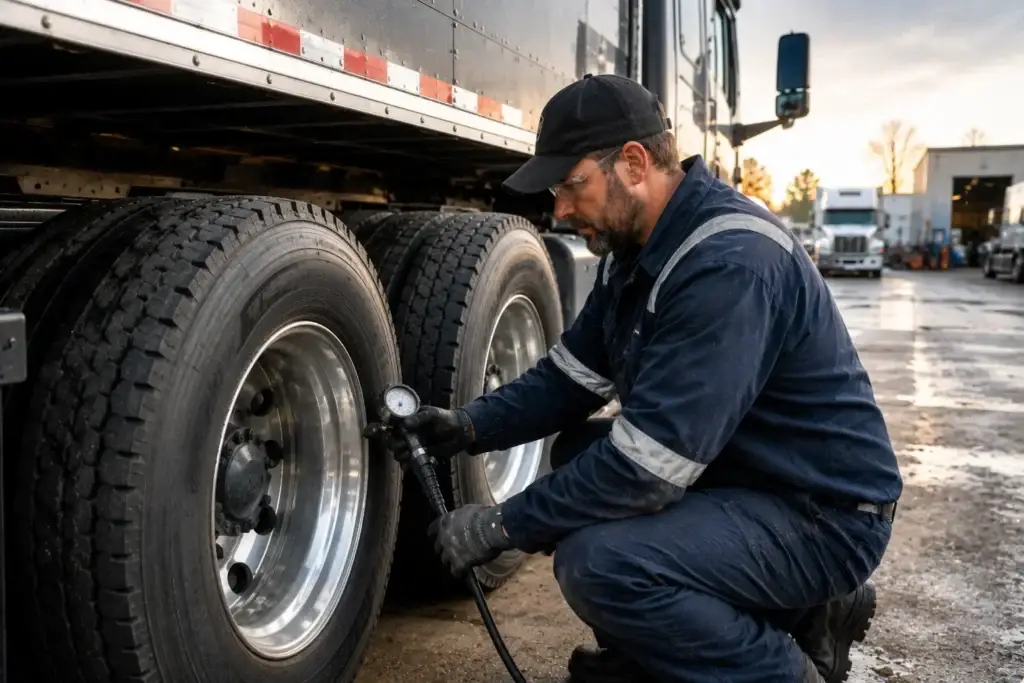
    Manual checking requires equipping vehicles with quality tire pressure gauges and training drivers to perform daily inspections. This approach demands minimal capital investment, typically under $50 per vehicle. However, success depends entirely on consistent execution and driver discipline.

    Automated TPMS provides real-time monitoring with dashboard alerts and centralized data tracking. These systems continuously measure pressure and temperature, immediately notifying drivers and dispatchers when values fall outside acceptable ranges.

    Investment in automated TPMS ranges from $100 to $300 per vehicle depending on system sophistication. Basic systems monitor pressure only, while advanced platforms track temperature, provide predictive alerts, and integrate with fleet management software.

    Many successful fleets adopt hybrid approaches balancing cost with operational needs. High-value tractors and vehicles with demanding routes receive automated systems, while lighter-duty vehicles in controlled environments use manual protocols.

    Monitoring MethodInitial InvestmentLabor RequirementsBest Application
    Manual Checks$25-50 per vehicle5-10 min daily per vehicleSmall fleets, local operations
    Basic TPMS$100-150 per vehicleMinimal – alert response onlyRegional fleets, mixed operations
    Advanced TPMS$200-300 per vehicleMinimal – data analysisLong-haul, large fleets
    Hybrid Approach$75-125 per vehicle averageVaries by vehicle typeCost-conscious, diverse fleets

    Calculating TPMS Return on Investment

    A comprehensive ROI analysis should account for fuel savings, extended tire life, and reduced breakdown incidents to capture the complete value proposition.

    Start with fuel economy improvements. A 100-vehicle fleet averaging 50,000 miles annually at 6 MPG consumes approximately 833,333 gallons yearly. At $3.50 per gallon, total fuel cost reaches $2,916,667. A conservative 3% improvement from proper tire pressure saves $87,500 annually.

    Next, calculate tire longevity gains. If your fleet uses 400 tires annually at $400 each, total tire expenditure equals $160,000. Extending tire life by 17% through proper inflation delays 68 tire purchases, saving $27,200 annually.

    Finally, factor breakdown reduction. Commercial tire failures average $1,500 per incident including service calls, driver downtime, and schedule disruptions. Reducing monthly breakdowns from 5 to 3 through better pressure management saves $36,000 yearly.

    Combined annual savings total approximately $150,700 for this 100-vehicle example. Investing $20,000 in automated TPMS creates a payback period of just 1.6 months, with ROI typically reaching 650% in the first year.

    Strategy 2: Establish Regular Tire Rotation and Alignment Schedules

    The difference between a 40,000-mile tire and a 60,000-mile tire often comes down to consistent rotation practices and proper wheel alignment. These preventive maintenance activities work together to ensure even tread wear across all tire positions.

    When executed properly, rotation and alignment can extend tire life by 25% or more while delivering measurable improvements in fuel economy. Proper maintenance including rotation and alignment can improve fuel mileage by up to 12%, translating to substantial savings across entire fleets.

    tire rotation patterns and wheel alignment check procedures for fleet vehicles

    Service Intervals by Vehicle Classification

    Different fleet vehicles require tailored rotation approaches based on their weight class, duty cycle, and operational environment. Light-duty delivery vans experience different wear patterns than heavy-duty tractors.

    Light-duty vehicles benefit from rotation every 5,000-6,000 miles or during every other oil change. This frequency prevents the uneven wear that commonly develops on front tires due to steering and weight distribution.

    Medium-duty trucks and service vehicles require rotation every 6,000-8,000 miles depending on load characteristics. These vehicles often carry variable payloads that create inconsistent wear patterns.

    Heavy-duty tractors and trailers need position-specific rotation strategies every 25,000-40,000 miles. Steer tires require more frequent attention than drive or trailer positions due to higher wear rates.

    Vehicle TypeRotation IntervalRecommended PatternExpected Benefit
    Light-Duty Vans5,000-6,000 milesFront-to-back20-25% life extension
    Medium-Duty Trucks6,000-8,000 milesCross-pattern25-30% life extension
    Heavy-Duty Tractors (Steer)25,000 milesPosition-specific15-20% life extension
    Heavy-Duty Tractors (Drive/Trailer)40,000 milesSide-to-side10-15% life extension

    How Misalignment Destroys Tires and Wastes Fuel

    Wheel alignment affects every mile a tire travels. Even slight misalignment creates excessive friction and uneven contact with the road surface. This accelerated wear can reduce tire life by 25% or more.

    Specific tire wear patterns reveal alignment problems before they become critical. Feathering indicates toe misalignment, where tread ribs develop smooth edges on one side and sharp edges on the other. Excessive shoulder wear points to camber issues, where the tire tilts inward or outward from vertical.

    The fuel economy impact of misalignment often surprises fleet managers. As little as 0.5 degrees off manufacturer specifications increases rolling resistance enough to reduce fuel efficiency by 2-3%. Across a 100-vehicle fleet, this seemingly minor issue can cost thousands of dollars annually in wasted fuel.

    “Improperly aligned vehicles cause uneven wear on tires while making the ride less comfortable for the driver. Alignment can shift during towing, hitting a curb, or getting into an accident.”

    — Technology & Maintenance Council (TMC) Recommended Practice

    Common causes of alignment issues include pothole impacts, curb strikes, and overloaded vehicles. Worn suspension components also contribute to alignment drift over time. Fleet managers should schedule alignment checks every 25,000 miles or whenever unusual tire wear patterns appear during inspections.

    Building an Automated Scheduling Framework

    Creating a fleet maintenance calendar that integrates rotation and alignment services requires both mileage-based triggers and time-based intervals. Manual tracking becomes unmanageable as fleet size grows.

    Modern fleet management software automates scheduling and sends alerts when vehicles approach service intervals. The foundation of effective scheduling combines historical data with manufacturer recommendations.

    Automated systems prevent vehicles from falling through scheduling gaps. Software tracks individual vehicle mileage and generates work orders when rotation intervals approach. These systems can also flag vehicles showing unusual wear patterns based on tire depth measurements entered during inspections.

    Integration with existing preventive maintenance schedules maximizes efficiency. Combining tire rotation with oil changes or other regular service appointments reduces downtime and labor costs.

    Documentation within the maintenance calendar creates accountability and enables trend analysis. Recording rotation dates, alignment measurements, and tire condition at each service builds a comprehensive history that helps identify recurring problems and validates return on investment.

    Strategy 3: Deploy Advanced Fleet Tire Management Software

    Fleet tire management software acts as a force multiplier, enabling companies to implement systematic tracking and analytics that were previously impossible with manual methods. This technology transforms tire management from reactive scrambling into strategic operations built on real-time data and automated workflows.

    Cloud-based solutions have become the industry standard because they provide access from any location at any time. Fleet managers can check tire status, log changes, and generate reports whether in the office or at remote maintenance facilities.

    cloud-based fleet tire management software showing comprehensive tracking dashboard

    Professional tire tracking platforms provide individual tire lifecycle monitoring and performance analytics.

    Essential Capabilities That Distinguish Professional Platforms

    Modern tire tracking systems include features specifically designed to address the unique challenges of commercial tire management. These capabilities go far beyond what generic spreadsheets or basic fleet management technology can offer.

    Professional tire inventory management platforms provide comprehensive tracking that follows each tire through its entire lifecycle. Every tire receives a unique identifier that connects purchase data, installation records, maintenance history, and performance metrics.

    The most valuable features include:

    • Real-time inventory tracking across multiple locations with automatic stock level alerts
    • Individual tire identification systems that track each tire from purchase through multiple retreads
    • Automated maintenance scheduling based on mileage intervals or calendar dates for rotations and inspections
    • Tire performance analytics showing cost-per-mile comparisons across brands and models
    • Predictive replacement alerts based on tread depth projections and historical wear patterns
    • Vendor management tools for pricing comparisons and automated purchase order generation
    • Mobile applications that let technicians record tire changes and inspections instantly from the field
    • Integration capabilities with telematics for automatic mileage data capture

    These features work together to eliminate manual paperwork and reduce data entry errors. When maintenance technicians can scan tire IDs and record changes directly from their mobile devices, the data flows immediately into central systems.

    Transforming Tire Decisions Through Analytics and Insights

    Data-driven tire decisions separate high-performing fleets from those that struggle with excessive tire costs. Advanced fleet tire management software generates analytics that transform tire management from reactive to strategic.

    Cost-per-mile analysis represents the most powerful analytical capability. By tracking total tire investment against actual mileage delivered, fleet managers can compare tire brands and models with precision. A tire that costs 20% more upfront but delivers 35% more miles becomes an obvious choice when the data is clear.

    Software platforms enable several critical analytical functions:

    1. Brand performance comparison identifying which tire manufacturers deliver the best value for specific applications
    2. Route-based wear analysis comparing tire performance across different routes to optimize specifications
    3. Abnormal wear detection flagging vehicles with unusual tire wear patterns indicating mechanical issues
    4. Warranty claim tracking ensuring all eligible tires receive warranty coverage and reimbursement
    5. Demand forecasting predicting future tire needs based on historical replacement patterns and current inventory

    Real-world insights can be transformative. One fleet discovered through software analysis that a particular delivery route caused 30% faster tire wear than the company average. This insight prompted them to specify more durable tires for vehicles assigned to that route, immediately reducing replacement frequency and costs.

    Analytical CapabilityBusiness ImpactTypical Cost Reduction
    Cost-per-mile trackingOptimized tire brand selection based on actual performance data15-20% reduction in tire spend
    Predictive replacement alertsPrevents roadside failures through proactive tire changes40-50% reduction in emergency tire costs
    Warranty claim automationMaximizes reimbursement from manufacturers for defective tires5-8% recovery of tire investment
    Route-based wear analysisMatches tire specifications to specific operational demands10-15% improvement in tire lifespan

    Connecting Your Technology Ecosystem for Maximum Value

    Fleet management technology delivers the greatest value when systems communicate seamlessly. Tire management software should integrate with your broader technology ecosystem, creating a unified data environment that eliminates duplicate entry and ensures consistency across platforms.

    Integration with telematics systems provides automatic mileage data that triggers maintenance alerts without manual input. When a vehicle reaches its rotation interval, the system generates a work order automatically.

    Connections with maintenance management software create complete vehicle service records. Tire changes, rotations, and inspections appear alongside oil changes, brake work, and other maintenance activities.

    Accounting system integration streamlines financial processes by automatically transferring tire purchase data and maintenance costs to financial records. This eliminates manual data entry and ensures accurate cost allocation across vehicles, departments, or customer accounts.

    Successful implementation requires careful planning. Start with data migration from legacy systems, ensuring historical tire records transfer accurately into the new platform. Invest in comprehensive staff training that covers not just how to use the system, but why the new processes deliver better results.

    A phased rollout strategy minimizes disruption while maximizing adoption. Begin with a pilot group of vehicles or a single location to identify issues before full deployment.

    Stay Ahead of Industry Trends

    Get expert insights, equipment reviews, and operational strategies delivered to your inbox weekly.

    Subscribe to Our Newsletter

    Strategy 4: Optimize Tire Selection Based on Route and Load Characteristics

    Every commercial vehicle in your fleet faces unique demands that require specific tire characteristics for optimal performance. A one-size-fits-all approach to tire procurement leaves money on the table by failing to match tire capabilities with actual operating conditions.

    The difference between appropriate and inappropriate tire selection can mean 20,000 additional miles per tire and significant fuel savings across entire fleets. Many fleet managers focus solely on purchase price when ordering tires, ignoring critical factors like route conditions, typical load weights, climate variations, and vehicle assignments.

    Implementing route-specific tires delivers measurable benefits. Research shows that switching to low rolling resistance tires can increase fuel efficiency by 3-4%, translating to thousands of dollars in annual savings per vehicle.

    Matching Tire Specifications to Operational Demands

    Six fundamental tire characteristics determine performance and longevity in commercial applications. Understanding these attributes helps make informed decisions during fleet tire procurement cycles.

    Tread depth and pattern directly affect traction, wear rate, and operating noise levels. Deeper treads provide better grip but may increase rolling resistance slightly. Tread patterns designed for highways differ significantly from those optimized for mixed-use or urban environments.

    Load ratings ensure each tire safely supports typical cargo weights with appropriate safety margins. Underrated tires wear faster and create safety risks. Overrated tires may cost more without delivering additional value for lighter applications.

    Key specifications to evaluate include:

    • Sidewall construction impacting durability, ride quality, and resistance to damage from curbs and road debris
    • Speed rating must match or exceed typical operating speeds for safety and warranty coverage
    • Seasonal capabilities with all-season designs versus specialized winter or summer compounds based on climate
    • Rolling resistance coefficient where lower values improve fuel economy but may compromise other performance attributes

    Analyze fleet operations systematically to determine which characteristics deliver the greatest value. Vehicles spending 90% of their time on interstate highways need different tire profiles than those navigating city streets with frequent stops and starts.

    Long-Haul vs. Regional vs. Urban Delivery Tire Requirements

    Three distinct fleet applications demand different tire optimization strategies. Matching commercial tire specifications to operational patterns maximizes both performance and cost-effectiveness.

    Long-haul operations covering 300+ miles daily on primarily highway routes benefit most from low rolling resistance designs. These tires maximize fuel economy and deliver even wear patterns at consistent highway speeds. Quality long-haul tires should achieve 80,000+ miles on steer positions and 120,000+ miles on drive positions.

    Regional operations running 100-300 miles per day on mixed highways and secondary roads require balanced tire designs. These route-specific tires handle varied conditions while maintaining durability. Moderate rolling resistance and versatile tread patterns suit both highway and local road surfaces.

    Fleet ApplicationDaily MileagePriority Tire CharacteristicsExpected Tire Life
    Long-Haul Transport300+ milesLow rolling resistance, highway tread pattern, even wear properties120,000+ miles (drive)
    Regional Delivery100-300 milesBalanced design, versatile tread, all-condition capability80,000-100,000 miles (drive)
    Urban DeliveryUnder 100 milesCut/puncture resistance, curb damage protection, strong braking50,000-70,000 miles (drive)

    Urban delivery operations present the most challenging conditions despite lower daily mileage. High stop frequency, low-speed maneuvering, and exposure to curbs and debris demand tires that prioritize cut and puncture resistance over maximum mileage ratings.

    tire selection criteria matching specifications to fleet operational demands

    Balancing Initial Cost with Total Cost of Ownership

    Purchase price represents only a fraction of true tire costs over the complete lifecycle. A comprehensive tire total cost of ownership analysis reveals which products deliver genuine value rather than merely appearing economical.

    Smart tire selection strategy evaluates six cost components beyond the initial price tag. Expected mileage to removal directly affects per-mile costs. Fuel economy impact accumulates significantly over thousands of operating miles. Retreadability and the number of potential retreads multiply tire value substantially.

    Consider this practical example: A premium tire costing $400 that delivers 75,000 miles and accepts two quality retreads provides better economics than a budget tire at $300 achieving only 50,000 miles with no retread capability. The premium tire generates 225,000 total miles (original plus two retreads at 75,000 miles each) while the budget option delivers just 50,000 miles.

    Cost FactorPremium Tire ($400)Budget Tire ($300)Value Difference
    Initial miles75,000 miles50,000 miles+50% mileage advantage
    Retread capability2 retreads possibleNo retreads3x lifecycle potential
    Total lifecycle miles225,000 miles50,000 miles350% more value
    Cost per 1,000 miles$1.78$6.0070% cost reduction

    The tire total cost of ownership formula accounts for maintenance requirements and downtime risks as well. Premium tires typically require fewer roadside repairs and generate less unplanned downtime.

    Fleet managers who shift from lowest-price purchasing to TCO-based decision making consistently achieve 15-25% reductions in overall tire expenses. This analytical approach to fleet tire procurement ensures every dollar spent delivers maximum operational value.

    Strategy 5: Institute a Tire Retreading and Lifecycle Management Program

    A well-managed tire retreading and lifecycle program can single-handedly reduce fleet tire expenses by 30-40%, making it one of the highest-impact strategies in commercial tire retreading. This approach extends the productive life of quality tire casings through multiple service cycles.

    By implementing systematic tire casing management, fleet operators transform what was once considered a disposable expense into a renewable asset. The foundation of successful tire lifecycle management rests on understanding the true economics of retreading, maintaining rigorous quality standards, and implementing tracking systems that follow each casing through multiple tire generations.

    The Economics of Retreading vs. New Tire Replacement

    The financial advantage of commercial tire retreading becomes clear when examining the numbers. A new premium commercial tire typically costs between $350 and $500. A quality retread for the same tire runs just $150 to $200, representing immediate savings of 60-70% per tire.

    The real value emerges when you consider the complete lifecycle. Quality commercial tire casings can be retreaded 2-3 times before final retirement. A tire casing purchased for $450 can deliver 240,000 to 300,000 total miles through its original tread and two subsequent retreads.

    Lifecycle StageCost per TireMiles DeliveredCost per Mile
    New tire (first life)$450100,000$0.0045
    First retread$175120,000$0.0015
    Second retread$175120,000$0.0015
    Total lifecycle cost$800340,000$0.0024
    Three new tires alternative$1,350300,000$0.0045

    The cost-per-mile comparison reveals a 67% reduction in operating costs when using retreaded tires strategically. When you retread, you increase the mileage until you need to purchase a new set of tires by 120,000 miles at just over one-third the price of buying new tires.

    Beyond direct cost savings, retreading delivers environmental benefits. The process consumes 70% less oil than manufacturing new tires. It also diverts thousands of pounds of rubber from landfills annually.

    tire lifecycle management tracking system showing multiple retread generations

    Comprehensive tracking systems follow tire casings through multiple service lives to maximize value extraction.

    Quality Standards and Safety Considerations for Retreaded Tires

    Safety concerns about retreaded tires often stem from outdated information or confusion with substandard products. Modern commercial tire retreading performed to industry standards produces tires that meet all federal safety requirements and perform equivalently to new tires in rigorous testing.

    The key is working with certified retreaders. Look for certification from the Tire Retread & Repair Information Bureau and adherence to Tire Industry Association standards. These certifications ensure the retreader follows proven quality protocols.

    The professional retreading process includes five critical stages:

    • Casing inspection using shearography and visual inspection to identify internal and external damage
    • Buffing removes old tread rubber down to the base casing, creating a clean bonding surface
    • Repair of any identified issues using industry-approved materials and techniques
    • Tread application through either mold cure or pre-cure processes, depending on tire type
    • Final inspection with comprehensive testing before the tire returns to service

    Position considerations matter significantly. Most fleets use retreaded tires in drive and trailer positions where they perform exceptionally well. Many operators prefer new tires for steer positions, though certified retreads are approved for all positions.

    Casing retirement decisions depend on three factors. Age plays a role, as casings beyond 7-10 years may show material degradation regardless of appearance. Condition assessment identifies structural damage that prevents safe retreading. The number of previous retreads also matters, with most casings suitable for 2-3 retreads before final retirement.

    Tracking Tire Generations for Maximum Value Extraction

    Effective tire casing management requires robust tracking systems that follow each casing through its complete service life. Without systematic tracking, you cannot optimize retread decisions or identify waste patterns.

    The tracking framework begins with unique identification for each tire casing. Each casing should receive a permanent identifier that stays with it throughout its life. Options include serial numbers, RFID tags, or barcodes embedded in the rubber.

    Your tracking system should record comprehensive data for each tire:

    1. Original purchase date, supplier, and cost
    2. Mileage accumulated at each removal from service
    3. Reason for removal (scheduled rotation, damage, wear limit)
    4. Retreading dates, costs, and service provider
    5. Vehicle and position assignments throughout service life

    This data enables intelligent decision-making across your tire program. You can determine the optimal point to retread versus retire specific casings. Analytics reveal which tire brands provide the best casings for multiple tire generations.

    For example, tracking might reveal that certain routes consistently damage casings beyond retreading viability. Or specific drivers may generate wear patterns that reduce retread candidates. This insight allows targeted interventions that protect tire investment.

    Storage and handling practices protect removed casings awaiting retreading. Mark each casing clearly with its identifier and removal date. Store casings in a cool, dry location away from direct sunlight and petroleum products. Process casings for retreading within 90 days of removal to prevent deterioration.

    The tracking system should also identify and control waste. Casings retired prematurely due to preventable damage represent lost value. By analyzing retirement reasons across your fleet, you can implement corrective actions that extend the value extracted from tire investment.

    Strategy 6: Train Drivers on Tire-Conscious Operating Techniques

    The connection between driver behavior and tire expenses remains one of the most overlooked opportunities for cost reduction in fleet operations. Even with premium tires, advanced monitoring systems, and rigorous maintenance schedules, poor driving habits can undermine every investment you make in tire management.

    Studies show that aggressive driving habits reduce fuel efficiency by 15-30% at highway speeds, and these same behaviors create similarly devastating effects on tire longevity. Your drivers control vehicles worth hundreds of thousands of dollars, yet many fleets invest minimal resources in teaching tire-conscious operating techniques.

    Comprehensive fleet driver education transforms your workforce from a liability into an asset, directly contributing to tire wear reduction and extended replacement intervals.

    driver training program focused on tire preservation techniques for commercial fleets

    The Physics of Driving Behavior and Tire Degradation

    Every action a driver takes creates physical forces that either preserve or destroy tire integrity. Understanding the driving behavior impact on tire lifespan requires examining the specific mechanisms through which poor techniques accelerate wear.

    Aggressive acceleration causes tire slippage that generates excessive heat buildup in the tread compound. This thermal stress accelerates chemical degradation of rubber polymers, reducing their flexibility and grip. Drive axle tires suffer the most severe consequences, with tread life decreasing by 20-30% compared to smooth acceleration patterns.

    Hard braking creates localized flat spots where rubber compounds experience extreme compression and heat generation. These spots develop into irregular wear patterns that propagate across the tire surface. The repeated stress cycles from sudden stops cause micro-fractures in the tire structure that eventually lead to catastrophic failures.

    Taking corners at excessive speeds generates lateral scrubbing forces that wear shoulder areas prematurely. The tire sidewalls flex beyond their design parameters, creating internal stress that weakens the casing structure.

    Impact damage from potholes, curbs, and road debris represents another significant threat. Drivers who fail to scan ahead and avoid hazards subject tires to violent impacts that create internal structural failures. These failures may not produce visible external damage initially, but they compromise tire integrity and lead to premature replacement.

    Driving BehaviorPrimary Tire DamageImpact on Tire LifePrevention Technique
    Aggressive AccelerationHeat buildup, tread slippage20-30% reductionGradual throttle application
    Hard BrakingFlat spots, irregular wear15-25% reductionAnticipatory braking
    Excessive Cornering SpeedShoulder wear, sidewall stress18-28% reductionReduced entry speeds
    Poor Hazard AvoidanceImpact damage, structural failure30-40% reductionRoad scanning, defensive driving

    Building a Comprehensive Driver Education Curriculum

    Effective driver training programs must address both technical knowledge and practical skills. Your curriculum should create lasting behavior change rather than simply checking a compliance box.

    Initial orientation training for new drivers establishes the foundation. Begin with tire construction basics so drivers understand what they’re protecting. Cover load ratings, speed ratings, and how exceeding these specifications causes premature failure.

    Pre-trip inspection training teaches drivers to identify potential tire problems before they become roadside emergencies. Drivers should learn to recognize:

    • Uneven wear patterns indicating alignment or inflation issues
    • Cuts, punctures, and embedded objects requiring immediate attention
    • Bulges or deformities suggesting internal structural damage
    • Tread depth measurements and legal minimum requirements
    • Proper procedures for reporting tire concerns to maintenance teams

    Vehicle handling modules focus on the specific techniques that preserve tire integrity. Use both classroom instruction and behind-the-wheel coaching to demonstrate proper acceleration, braking, and cornering methods.

    Hazard awareness training develops the scanning and anticipation skills that help drivers avoid road threats. Teach defensive driving principles specifically focused on tire protection. Emphasize the financial consequences of impact damage and the safety risks of tire failures.

    Loading and weight distribution education ensures drivers understand how improper cargo placement affects tire stress. Cover proper loading procedures, weight limits for different axle configurations, and the signs of overloading that drivers should monitor.

    Ongoing refresher training maintains focus on tire-conscious behaviors long after initial orientation. Conduct quarterly or semi-annual sessions that review current tire costs, analyze fleet-specific tire challenges, and reinforce best practices.

    Leverage telematics systems to identify drivers who exhibit tire-damaging behaviors. Hard braking events, rapid acceleration instances, and speeding violations all correlate with increased tire wear. Use this data for targeted coaching rather than punitive measures.

    Motivating Tire-Friendly Performance Through Incentives

    Knowledge alone rarely changes ingrained driving habits. Driver incentive programs create the motivation necessary to sustain tire-conscious behaviors over time.

    Recognition programs acknowledge drivers who maintain exceptional tire performance on their assigned vehicles. Measure success using concrete metrics such as miles per tire set, lowest tire-related maintenance costs per mile, or fewest tire-related incidents.

    Financial incentives provide direct monetary rewards for achieving tire performance benchmarks. Structure bonuses based on exceeding expected tire mileage targets for specific vehicle classes and route types. Quarterly payouts maintain engagement better than annual programs by providing more frequent reinforcement.

    Gamification approaches transform tire management into friendly competition. Create leaderboards showing tire performance metrics across drivers or teams. Award points for various achievements: consecutive months without tire issues, best improvement in tire longevity, or highest scores on tire inspection audits.

    Transparency forms the foundation of effective driver incentive programs. Drivers must access their own tire-related data and understand how specific behaviors contribute to tire costs. Provide regular feedback showing each driver’s performance relative to fleet averages and top performers.

    Fair program design accounts for variables outside driver control. Different route types, vehicle ages, and cargo characteristics all influence tire performance. Create comparison groups based on similar operational conditions rather than comparing long-haul drivers directly with local delivery operators.

    Sustaining engagement requires evolving your incentive structure over time. Initial programs might focus on basic compliance with tire inspection procedures. As that behavior becomes habitual, shift focus to advanced metrics like tire wear rates or fuel efficiency improvements.

    Combined with comprehensive training, well-designed driver incentive programs create a culture of tire consciousness throughout your organization. This cultural shift transforms tire management from a maintenance department responsibility into a shared commitment across all drivers.

    Strategy 7: Build Strategic Partnerships with Tire Vendors and Service Providers

    No fleet operates in isolation, and the quality of your tire vendor partnerships directly impacts your bottom line and operational efficiency. Most fleets benefit significantly from establishing strong relationships with tire suppliers and service providers rather than attempting to handle everything in-house.

    These strategic alliances deliver advantages that extend well beyond simple purchase discounts. The right vendor partnerships create a support network that reduces costs, improves service reliability, and provides access to specialized expertise.

    Smart fleet managers recognize that tire vendors can serve as valuable partners in achieving operational excellence. These relationships require careful development and ongoing management to deliver maximum value.

    Securing Competitive Pricing Through Strategic Agreements

    Effective negotiation with tire suppliers can reduce your tire costs by 15-25% compared to retail pricing. The key is consolidating your tire purchases to increase buying power and demonstrate your value as a customer.

    “If your fleet does not have its own mechanic, you’ll need to have a designated vendor for service and repairs. Choose a mechanic who offers quality service and fair prices. Ask about bulk discounts for servicing your fleet.”

    — FMCSA Fleet Management Best Practices

    This principle applies equally to tire procurement. When negotiating with tire vendors, focus on several strategic elements that deliver long-term value:

    • Fleet pricing programs where major tire manufacturers offer specialized fleet programs with substantial discounts
    • Payment terms optimization requesting net-30 or net-60 terms to improve cash flow management
    • Price protection agreements that lock in pricing for 12-month periods to shield against market fluctuations
    • Value-added services negotiating free mounting, balancing, and disposal with tire purchases
    • Performance guarantees requesting warranty terms that protect against premature tire failure

    Tire service agreements should define clear expectations beyond just pricing. Service level agreements establish standards for maximum response times for tire deliveries, guaranteed availability of common sizes, quality standards for installation, and warranty processing procedures.

    Always put agreements in writing with specific terms regarding pricing structures, services included, performance standards, and contract duration. Written agreements protect both parties and eliminate misunderstandings that can damage relationships.

    Agreement ComponentStandard TermsPremium TermsBusiness Impact
    Volume Discount10-15% off retail20-25% off retailDirect cost savings on every tire purchased
    Delivery Response48-72 hours24-48 hoursReduced vehicle downtime waiting for tires
    Payment TermsNet-30 daysNet-60 daysImproved cash flow management
    Free ServicesMounting and balancingMounting, balancing, disposal, rotationLower total cost of ownership

    Building Reliable Emergency Response Networks

    Tire-related breakdowns create costs that extend far beyond the replacement tire itself. When a vehicle is stranded due to tire failure, you face multiple financial impacts simultaneously.

    Driver downtime typically consumes 2-4 hours for roadside tire service. During this period, you’re paying driver wages while generating zero revenue. Cargo delays can trigger customer service failures that damage relationships and future business opportunities.

    Safety risks compound the problem when drivers are stranded in unsafe locations or hazardous weather conditions. Establishing relationships with emergency service providers who offer 24/7 response capabilities minimizes these impacts significantly.

    Several service models provide different levels of emergency support:

    1. National tire dealer networks provide standardized pricing and service across geographic regions, ensuring consistent quality
    2. Mobile tire service providers dispatch trucks equipped with tire inventory and mounting equipment directly to breakdown locations
    3. Emergency service agreements offer contracts with guaranteed response times, typically 2-hour maximum for critical situations

    When evaluating emergency roadside tire service options, assess coverage areas to ensure all your routes have adequate support. Review typical pricing models, which often include $150-300 in service fees plus tire and materials costs.

    Set up efficient dispatch procedures so drivers know exactly who to call and what information to provide when tire service is needed. Clear protocols reduce confusion during stressful breakdown situations and expedite service delivery.

    Accessing Specialized Knowledge for Program Optimization

    Quality tire vendors employ technical specialists who can audit your fleet operations and identify improvement opportunities. These experts bring insights that internal teams may miss, especially regarding unusual wear patterns or specification mismatches.

    Vendor technical audits typically examine several critical areas. They identify improper tire specifications for specific applications, maintenance practices that could be enhanced, unusual wear patterns indicating vehicle or operational problems, and opportunities to reduce costs through different tire selections or retreading programs.

    Structure your tire vendor partnerships to access this expertise systematically. Schedule quarterly business reviews where vendors present data on your fleet’s tire performance, wear patterns, and specific recommendations for improvements.

    While vendors naturally want to sell products, reputable fleet tire suppliers recognize an important truth: helping customers optimize total tire costs builds long-term relationships more effectively than maximizing short-term sales volume.

    Identify vendors who bring genuine consultative value rather than those who simply process orders. Evaluate potential partners using these criteria:

    • Technical expertise including staff qualifications and certifications in tire technology and fleet applications
    • Analytics capabilities including quality of reporting, data presentation, and actionable insights provided
    • Proactive engagement where vendors identify and communicate opportunities without prompting
    • Customer references with testimonials from similar fleets regarding service quality and value delivery
    • Industry involvement through participation in fleet associations and continuing education programs

    The best vendor relationships operate as true partnerships where both parties invest in mutual success. Your fleet reduces costs and improves operations while the vendor gains reliable, long-term business that’s more valuable than sporadic transactions.

    These strategic alliances in fleet tire procurement create competitive advantages that single transactions never deliver. By combining volume purchasing power with service reliability and expert consultation, you build a tire management program that consistently outperforms industry benchmarks.

    Share Your Expertise

    Join Heavy Duty Journal as a guest author and reach thousands of industry decision-makers.

    Become a Guest Author

    Conclusion: Your Roadmap to Sustainable Tire Cost Reduction

    The seven strategies outlined deliver substantial fleet tire cost savings when implemented systematically. Fleet managers who combine tire pressure monitoring, rotation scheduling, management software, optimized selection, retreading programs, driver training, and vendor partnerships create comprehensive programs that achieve the 40% cost reduction target.

    Start with foundational elements. Implement tire management software and pressure monitoring systems first. These tools provide the data infrastructure needed for all other strategies. Quick wins come from rotation schedules and driver training, which deliver measurable results within three to six months.

    Fleet efficiency improvement requires consistent attention. Review tire data monthly. Adjust strategies based on performance metrics. The tire program ROI typically delivers payback within 12 to 24 months, with ongoing savings continuing indefinitely.

    Begin your journey today. Conduct a tire cost audit to establish baseline spending. Select two strategies that address your fleet’s biggest challenges. Set measurable goals for the next 12 months. Track progress monthly and refine your approach based on results.

    Sustainable fleet operations demand proactive tire management. The 40% cost reduction represents an achievable target for fleets committed to systematic implementation. These strategies reduce costs, improve operations, and prepare your fleet for greater profitability and potential expansion opportunities.

    Frequently Asked Questions

    How realistic is a 40% reduction in fleet tire costs?

    A 40% reduction in fleet tire costs is highly achievable for fleets that systematically implement all seven strategies outlined in this guide. This target is based on real-world implementations across commercial fleets of various sizes.

    The savings come from multiple sources that compound rather than simply add together: proper tire pressure monitoring delivers 10% savings through extended tire life and fuel economy improvements, strategic tire selection and retreading programs provide 15-20% savings through lower cost-per-mile, regular rotation and alignment extend tire life by 15-25%, and driver training reduces premature tire wear by 10-15%. When implemented together within a data-driven management framework, these strategies consistently deliver cumulative savings in the 35-45% range within 12-18 months of full implementation.

    What is the typical payback period for investing in tire management software?

    Most fleet tire management software investments deliver positive ROI within 12-18 months, with larger fleets seeing even faster payback. The software typically costs between $50-150 per vehicle annually depending on the platform and features selected.

    A 100-vehicle fleet spending approximately $10,000-15,000 annually on software can expect savings of $20,000-40,000 in the first year through improved maintenance scheduling, better procurement decisions, reduced tire waste from tracking errors, warranty recovery, and data-driven tire selection. The payback accelerates because the software enables all other cost-reduction strategies to function more effectively by providing the visibility and tracking needed for optimization.

    Should I use manual tire pressure checks or invest in automated TPMS systems?

    The optimal approach depends on your fleet size, vehicle utilization, and budget. Manual tire pressure checks cost virtually nothing in capital but require consistent discipline and labor time, making them suitable for smaller fleets (under 25 vehicles) with strong maintenance cultures and lower daily mileage.

    Automated TPMS systems represent $100-300 per vehicle in upfront investment but deliver superior consistency, real-time monitoring, centralized data tracking, and immediate alerts to pressure loss. TPMS makes the most sense for fleets with 25+ vehicles, high daily mileage operations, or vehicles operating in remote areas where roadside breakdowns are particularly costly. A hybrid approach works well for many mid-sized fleets, installing TPMS on high-mileage or high-value vehicles while using manual checks for lower-priority units.

    How often should commercial fleet vehicles have tire rotations and alignment checks?

    Rotation frequency depends on vehicle type and application. Light-duty delivery vans and passenger vehicles should rotate tires every 5,000-6,000 miles or every other oil change. Medium-duty trucks and service vehicles require rotation every 6,000-8,000 miles depending on load characteristics.

    Heavy-duty tractors need position-specific rotation strategies every 25,000-40,000 miles, with steer tires requiring more frequent attention than drive or trailer positions. For alignment checks, the recommended interval is every 25,000 miles or whenever unusual tire wear patterns appear. Vehicles should also receive immediate alignment checks after significant impacts such as hitting potholes, curbs, or other road hazards, or when drivers report handling changes such as pulling to one side.

    Are retreaded tires as safe and reliable as new tires for commercial fleets?

    Yes, properly retreaded tires manufactured to industry standards are completely safe and perform equivalently to new tires in testing. Retreads must meet all federal safety requirements and, when produced by Tire Retread & Repair Information Bureau certified retreaders following Tire Industry Association standards, deliver the same reliability as new tires.

    The retreading process includes comprehensive casing inspection using advanced techniques like shearography to identify any internal or external damage, repair of any issues found, application of new tread through mold cure or pre-cure processes, and final inspection and testing. Major commercial fleets, including those operated by FedEx, UPS, and countless trucking companies, rely extensively on retreaded tires for drive and trailer positions. The key to success is working with certified retreaders, maintaining proper records to track casing age and retread generations, and following appropriate guidelines for which positions should use retreads.

    What percentage of my total fleet operating costs should tires represent?

    For most commercial fleets, tire costs typically represent 10-15% of total operating expenses, making them one of the top three cost categories alongside fuel and maintenance. The specific percentage varies based on fleet type, with long-haul trucking operations often at the higher end (12-15%) due to high annual mileage, while light-duty delivery fleets with lower daily mileage may be at the lower end (8-12%).

    If your fleet’s tire costs exceed 15% of operating expenses, this indicates significant optimization opportunities. Conversely, if tire costs are below 8%, this may indicate underinvestment in quality tires or maintenance, which often results in higher costs in other categories such as fuel efficiency losses, breakdown expenses, or reduced vehicle availability.

    How can I calculate the total cost of ownership for different tire options?

    To calculate tire TCO, use this formula: Total Cost of Ownership = (Initial Purchase Price + Total Retread Costs + Installation/Disposal Fees) ÷ Total Miles Delivered.

    For example, a premium tire costing $450 that delivers 100,000 miles on original tread, then receives two retreads at $175 each (delivering 100,000 miles per retread), plus $50 per mounting/disposal over three cycles results in: ($450 + $350 + $150) ÷ 300,000 miles = $0.00317 per mile. Compare this to a budget tire costing $300 that delivers only 60,000 miles and cannot be retreaded: ($300 + $50) ÷ 60,000 miles = $0.00583 per mile. This calculation demonstrates that the premium tire delivers 46% lower cost-per-mile despite costing 50% more initially. Your TCO calculation should also factor in fuel economy impacts (lower rolling resistance tires reduce fuel costs by 3-5%) and downtime risks (premium tires typically have lower failure rates).

    What specific driving behaviors have the biggest impact on tire wear?

    The driving behaviors with the most significant impact on tire longevity are aggressive acceleration (causing tire slippage and heat buildup that accelerates tread wear by 15-20%), hard braking (creating flat spots and uneven wear while generating extreme heat), excessive speed particularly on corners (creating lateral scrubbing that wears shoulder areas prematurely), and poor hazard awareness (hitting potholes, curbs, and road debris that causes impact damage).

    Collectively, aggressive driving habits can reduce tire life by 20-30% compared to smooth, defensive driving techniques. Overloading vehicles beyond rated capacity also dramatically accelerates tire wear and increases failure risk. Training drivers on smooth acceleration and braking, appropriate cornering speeds, hazard scanning and avoidance, and proper loading procedures can extend tire life significantly while also improving fuel economy and reducing other vehicle wear.

    How do I negotiate better pricing with tire vendors for my fleet?

    Effective tire vendor negotiation starts with consolidating purchases to maximize your buying power rather than spreading purchases across multiple suppliers. Request fleet pricing programs from major manufacturers like Michelin, Bridgestone, and Goodyear, which typically offer 15-25% discounts compared to retail pricing for committed volume.

    Negotiate payment terms that improve cash flow such as net-30 or net-60 terms rather than payment on delivery. Establish 12-month tire supply agreements that lock in pricing to protect against market fluctuations. Request value-added services at no additional cost including mounting, balancing, disposal, tire storage for seasonal changeovers, and priority service for emergency situations. Ask for tire performance guarantees where the vendor commits to minimum mileage targets and shares risk if tires underperform. Finally, leverage competitive quotes—having documented proposals from multiple suppliers strengthens your negotiating position significantly.

    What tire management software features are most important for fleet operations?

    The most critical tire management software features are comprehensive tire inventory tracking showing real-time stock levels across locations, individual tire identification and lifecycle tracking from purchase through multiple retreads to disposal, automated maintenance scheduling based on mileage or time intervals, tire performance analytics showing cost-per-mile by brand and model, predictive replacement alerts based on tread depth projections and wear patterns, vendor management with pricing comparisons, and mobile applications for technicians to record tire changes instantly.

    Strong integration capabilities with telematics systems for automatic mileage data and with existing fleet management platforms are essential for creating a unified data ecosystem. The software should generate actionable reports including tire spend by vehicle and fleet segment, warranty claim tracking and recovery, tire performance benchmarking across vehicles and routes, and forecasting of future tire needs based on historical patterns.

    When should I retire a tire casing rather than retreading it again?

    Tire casings should be retired rather than retreaded when they reach any of these conditions: age exceeds 6-7 years regardless of condition (rubber compounds degrade over time), visible structural damage including cuts deeper than 75% of casing thickness, separation of components, bulges indicating internal failure, or sidewall damage, excessive wear beyond the point where sufficient rubber remains for successful retreading, reaching the manufacturer’s recommended maximum number of retreads (typically 2-3 for commercial tires), or failing inspection by a certified retreader who identifies issues not visible externally.

    Quality tire management software should track casing age, number of previous retreads, and total mileage delivered to help make informed retirement decisions. Retiring casings at the appropriate time is essential both for safety and for cost optimization, as attempting to retread casings that are too degraded results in premature failure and wasted retreading investment.

    How do I determine the right tire specification for different vehicles in my fleet?

    Matching tire specifications to operational demands requires analyzing key characteristics and how they align with each vehicle’s typical use. Start by categorizing your fleet by primary application: long-haul operations (300+ miles daily, primarily highway) benefit from low rolling resistance tires optimizing fuel economy with highway-focused tread designs, regional operations (100-300 miles daily, mixed conditions) need balanced designs handling varied conditions with moderate rolling resistance, and urban delivery (high stop frequency, challenging conditions) requires tires prioritizing cut and puncture resistance and curb damage protection.

    Consider load characteristics—vehicles consistently operating at or near maximum capacity need higher load rating tires with reinforced construction. Evaluate route conditions including road surface quality, typical weather and seasonal factors, elevation changes and grades, and frequency of turns versus straight-line travel. Consult with tire technical specialists from vendors like Michelin or Bridgestone who can recommend specific tire models based on your operational profiles, and pilot test new tire specifications on a small subset of vehicles before fleet-wide deployment.

    What ROI can I expect from implementing a comprehensive driver training program focused on tire preservation?

    A well-designed driver training program focused on tire-conscious operating techniques typically delivers 10-15% extension in tire life through reduced aggressive driving behaviors, representing substantial cost savings with minimal investment. For a 100-vehicle fleet spending $200,000 annually on tires, a 12% improvement in tire longevity would save $24,000 annually.

    Driver training programs typically cost $100-300 per driver for initial training and $50-100 for quarterly refreshers, meaning a 100-driver fleet invests approximately $15,000-35,000 in the first year and $5,000-10,000 annually for ongoing training. This delivers ROI of 70-160% in the first year with even stronger returns in subsequent years. Beyond direct tire cost savings, tire-conscious driving techniques also improve fuel economy by 5-10% and reduce brake wear and other maintenance costs, making the true ROI significantly higher when considering total fleet operating cost impacts.

    Should small fleets with fewer than 25 vehicles implement these same strategies?

    Yes, small fleets benefit from these strategies just as much as large fleets, though implementation may look different based on scale and resource constraints. Small fleets should prioritize the strategies delivering the highest return with minimal infrastructure investment: consistent tire pressure monitoring through manual checks or low-cost wireless TPMS systems, establishing regular rotation and alignment schedules integrated with existing maintenance routines, training drivers on tire-conscious driving techniques, and building a relationship with one primary tire vendor who can provide fleet pricing, technical consultation, and 24/7 emergency service.

    Small fleets may choose to use simplified tracking tools such as spreadsheets rather than specialized tire management software initially, upgrading to dedicated software as the fleet grows beyond 25-30 vehicles. Even at small scale, implementing systematic tire pressure monitoring, regular maintenance schedules, and driver training can readily deliver 25-30% cost reductions within the first year.

    How do I measure success and track progress toward tire cost reduction goals?

    Effective measurement of tire management program success requires establishing baseline metrics before implementation and tracking key performance indicators monthly or quarterly. The primary metrics are total tire cost per mile (calculated as total tire expenses including purchase, mounting, disposal, and emergency service divided by total fleet miles), average tire life measured in miles per tire set by vehicle type, tire-related breakdown incidents per 100,000 miles, fuel economy trends (properly maintained tires improve fuel efficiency by 3-5%), and percentage of eligible tires receiving warranty coverage.

    Establish your baseline by calculating these metrics for the 12 months before implementing tire management improvements, then track them consistently using the same methodology. Set realistic improvement targets such as 10% cost-per-mile reduction in the first six months, 25% reduction at 12 months, and 40% reduction at 18-24 months. Conduct quarterly business reviews examining the data, identifying which strategies are delivering results and which need adjustment, and celebrating wins with your team to maintain engagement and momentum.

    Share This Article

    Share this post with your network and help other industry professionals stay informed.

    Leave a Comment

    Your email address will not be published. Required fields are marked *

    Sponsored

    Emergency Breakdown?

    Find Certified Repair Shops Near You

    24/7 Mobile Service
    Verified Facilities
    Nationwide Coverage
    Find Repair Shops Now →

    Trusted by thousands of fleet operators