By Michael Nielsen, Editor & Publisher | 15+ Years in Diesel Repair
Last Updated: January 2026
📖 Estimated reading time: 19 minutes
Fleet managers evaluating disc brakes vs drum brakes for commercial vehicles face a decision affecting safety performance, maintenance costs, and operational efficiency for years to come. The North American air disc brake market now exceeds $500 million annually, with adoption rates climbing past 40% as major OEMs increasingly specify disc brakes as standard equipment on new tractors.
Air disc brakes deliver measurably superior performance compared to traditional drum systems, reducing stopping distances by 20 feet and completing maintenance procedures four times faster. These advantages translate directly into improved safety records and reduced operational costs across commercial fleets operating in demanding conditions.
This comparison examines the engineering differences, performance metrics, and total cost implications of each brake technology. The analysis draws from Federal Motor Carrier Safety Administration data, real-world fleet experiences, and industry testing to provide actionable insights for brake system selection decisions affecting entire fleet operations.
Key Takeaways
- Performance Advantage: Air disc brakes reduce stopping distances by 20 feet compared to drum systems, exceeding federal requirements by 16%.
- Maintenance Efficiency: Disc brake pad replacement takes one-quarter the time of drum brake service, reducing shop downtime by 75%.
- Market Direction: Industry projections show disc brake adoption exceeding 50% market share by 2027-2028 as OEMs standardize the technology.
Heavy Duty Truck Braking System Fundamentals
Commercial truck braking systems operate through pneumatic pressure rather than the hydraulic systems found in passenger vehicles. This fundamental distinction exists because vehicles weighing up to 80,000 pounds require immense stopping force that hydraulic systems cannot reliably deliver across the demanding operating conditions heavy trucks face daily.
The physics of stopping a fully loaded tractor-trailer demands consistent, reliable performance under extreme stress conditions. Air brake systems provide the fail-safe characteristics essential for commercial transportation—loss of air pressure automatically engages the brakes through powerful spring mechanisms, preventing runaway vehicles on grades and during system failures.
Federal Motor Carrier Safety Administration regulations through 49 CFR 393.52 establish minimum brake performance standards requiring commercial vehicles to stop within 250 feet from 60 mph. Understanding these requirements provides context for evaluating how different brake technologies exceed baseline safety expectations and deliver meaningful safety margins in emergency situations.
Air Brake System Operation in Commercial Vehicles
Air brake systems convert compressed air into mechanical stopping power through a carefully engineered sequence. When drivers press the brake pedal, compressed air releases from storage reservoirs into brake chambers mounted at each wheel position, initiating the stopping process.
Inside brake chambers, compressed air pushes against flexible diaphragms connected to push rods. These rods extend outward, transferring pneumatic force into mechanical movement that activates either S-cams in drum systems or calipers in disc configurations.
Air pressure typically operates between 100-120 PSI in commercial applications. Onboard air compressors continuously replenish the system, ensuring adequate pressure reserves for multiple brake applications even during extended downhill descents where repeated braking becomes necessary.
Critical Components of Heavy Duty Braking Systems
Understanding braking system components provides essential context for evaluating performance differences between disc and drum configurations. Each element plays a specific role in converting driver input into controlled deceleration, and failure of any component can compromise stopping ability.
Key architectural components include air compressors generating 14-16 cubic feet per minute, storage reservoirs maintaining adequate air supply, brake chambers converting air pressure to mechanical force, slack adjusters transferring force while providing adjustment capability, and brake valves managing air flow throughout the system.
Modern systems incorporate electronic monitoring continuously assessing air pressure, brake adjustment, and component health. These diagnostic capabilities enable predictive maintenance strategies preventing failures before they compromise safety, representing a significant advancement over traditional inspection-based approaches.
Drum Brake Technology: Traditional Design and Limitations
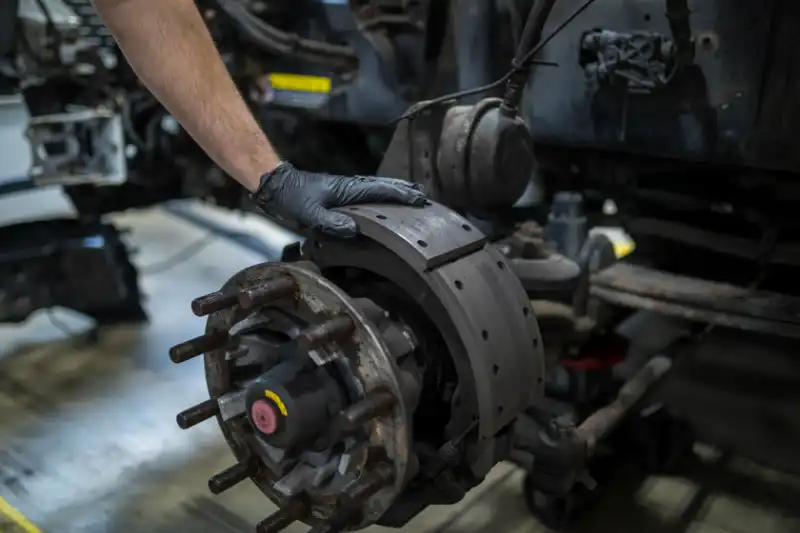
Traditional drum brake systems utilize an enclosed design where curved brake shoes press against the interior surface of a rotating drum. This proven technology has served the trucking industry for decades, offering cost-effective stopping power through friction generated within a cylindrical enclosure.
The fundamental operation relies on air pressure activating mechanical components that force friction materials outward against a cylindrical metal surface. Fleet operators must understand these engineering principles to make informed decisions about brake system selection that balance upfront costs against long-term operational performance.
S-Cam Brake Configuration and Operation
S-cam brakes represent the dominant design in North American commercial vehicles. This system uses an S-shaped cam shaft that rotates when the brake chamber pushes against it. As the cam rotates, its profile forces brake shoes apart and against the drum interior, generating the friction necessary for stopping.
The mechanical advantage of the cam design provides powerful braking force with relatively modest air pressure input. S-cam brakes have proven reliability across millions of commercial vehicles, offering a balance of stopping power, serviceability, and cost-effectiveness that established them as the industry standard.
However, the complexity of these systems directly impacts truck brake service costs. Technicians must verify air pressure levels, check for leaks, and ensure all components function correctly during maintenance procedures, adding time and labor expense to every service interval.
Thermal Management Challenges in Drum Systems
The enclosed nature of drum brake design creates inherent thermal management challenges affecting performance during sustained braking operations. Every brake application converts kinetic energy into thermal energy through friction, raising component temperatures that must dissipate between stops.
Unlike open-air designs, the cylindrical drum enclosure traps heat inside the assembly. Limited airflow around internal components restricts the rate at which thermal energy dissipates. This heat accumulation becomes particularly problematic during extended braking periods such as mountain descents where drivers must apply brakes continuously.
⚠️ Safety Warning
Brake fade from overheated drum brakes significantly increases stopping distances and can lead to complete brake failure on extended downgrades. Drivers experiencing spongy pedal feel or reduced stopping power should immediately seek a safe location to allow brakes to cool before continuing.
In extreme cases, continuous braking generates sufficient heat to cause brake fade—a dangerous condition where braking effectiveness deteriorates dramatically. The friction materials reach temperatures altering their molecular structure, temporarily reducing stopping force generation capability and requiring cooling time before full effectiveness returns.
Disc Brake Technology: Advanced Engineering Solutions
Modern air disc brake systems combine pneumatic actuation with precision-engineered components delivering reliable performance across diverse operating conditions. The fundamental advantage lies in the exposed design allowing continuous cooling during operation, maintaining consistent stopping power regardless of use intensity.
Air disc brakes adapt passenger car disc brake principles to heavy duty applications by substituting compressed air for hydraulic fluid. This pneumatic approach leverages existing air supply systems already present in commercial vehicles while eliminating hydraulic fluid leak concerns that can compromise braking effectiveness.
Air Disc Brake System Architecture
A pneumatic actuation chamber converts compressed air pressure into mechanical clamping force applied through the caliper assembly. When drivers press the brake pedal, air pressure builds within the actuation chamber, pushing a piston that forces brake pads against the rotating brake rotor.
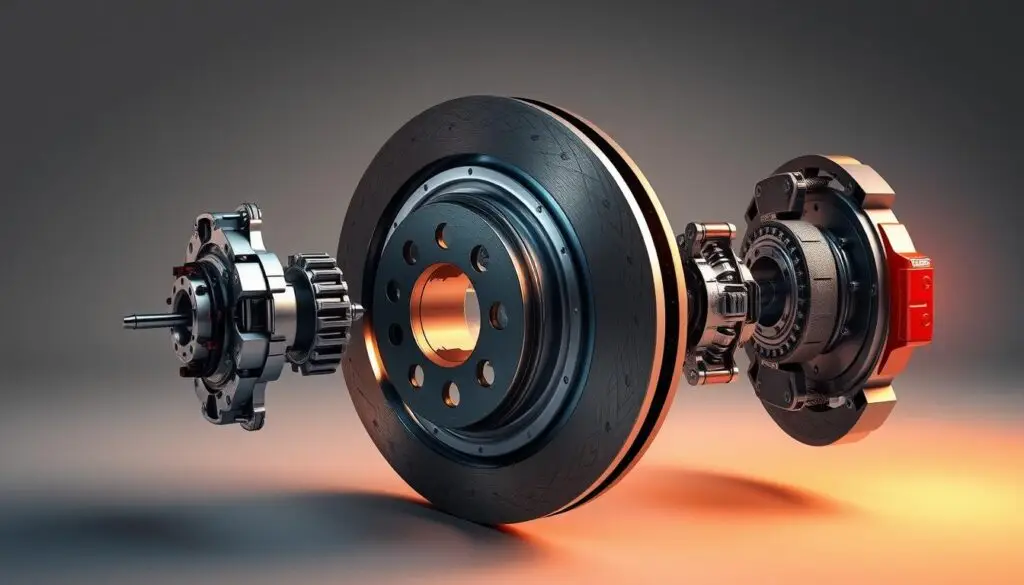
The exposed brake surfaces allow ambient air to continuously cool friction components. Unlike enclosed drum designs, the brake rotor remains visible and accessible, facilitating superior heat dissipation during both braking events and recovery periods between stops.
Key architectural components include pneumatic actuation chambers, caliper assemblies housing brake pads, metal brake rotors rotating with wheel hubs, engineered friction materials optimized for heavy duty applications, and mounting brackets securing calipers to axle assemblies.
Ventilated Rotor Technology and Thermal Advantages
Ventilated rotors incorporate internal cooling vanes positioned between two friction surfaces. These vanes create channels actively pumping air through the rotor interior as it rotates, generating powerful cooling effects similar to centrifugal fans that continuously remove heat.
The vane geometry receives careful engineering attention optimizing airflow volume and turbulence characteristics. Curved or directional vanes enhance the pumping effect compared to simple radial designs, dramatically increasing heat dissipation capacity and maintaining consistent braking performance.
Ventilated rotors can dissipate two to three times more heat than solid rotor designs of equivalent mass. This thermal management superiority translates into multiple practical benefits including shorter stopping distances, predictable pedal feel, and extended component life that reduces total ownership costs.
Performance Metrics: Disc Brakes vs Drum Brakes
The performance gap between air disc brakes and drum brakes becomes clear when examining measurable stopping distance data and thermal management capabilities. Testing data from controlled environments and field applications reveals significant differences in brake system effectiveness that directly impact fleet safety.
Federal Motor Vehicle Safety Standard 121 requires commercial vehicles to stop from 60 mph within 250 feet, but modern air disc brakes consistently achieve stops in 230 feet or less—a 16% improvement delivering approximately one truck length of additional safety margin in emergency situations.
Brake Fade Resistance Under Continuous Use
Brake fade occurs when repeated braking causes temperature buildup reducing friction coefficients between braking surfaces. Air disc brakes feature exposed rotors with ventilated cooling passages continuously shedding heat during operation, maintaining effectiveness throughout demanding braking sequences.
Extended braking scenarios such as mountain descents demonstrate brake fade resistance differences dramatically. Disc brake systems maintain full stopping power throughout sustained downhill operations while drum brakes progressively lose effectiveness as temperatures climb inside enclosed assemblies.
Testing shows disc brakes maintain 90-95% of their stopping power even after extended downhill braking, while drum brakes can experience performance reductions of 30-40% on severe grades with heavy loads. This consistency represents the critical safety advantage driving disc brake adoption.
| Performance Metric | Air Disc Brakes | Drum Brakes | Advantage |
|---|---|---|---|
| Stopping Distance (60 mph) | 230 feet average | 245 feet average | Disc: 15 feet shorter |
| Brake Fade (5 stops) | Less than 5% loss | 15-20% loss | Disc: 3-4x better |
| Wet Recovery Time | 1-2 seconds | 4-6 seconds | Disc: 3x faster |
Wet Weather and Extreme Condition Performance
Air disc brakes shed water quickly from exposed rotor surfaces through centrifugal force and airflow. The open design prevents water accumulation, allowing friction surfaces to return to full effectiveness within one to two seconds after driving through standing water or heavy rain.
Drum brakes retain water inside the enclosed drum assembly after driving through standing water or heavy rain. The trapped moisture reduces friction coefficients until centrifugal force expels the water through drain holes, adding critical feet to stopping distances during the recovery period.
Mountain grade operations demand sustained braking as gravitational acceleration continuously adds energy that brakes must dissipate. Air disc brakes maintain effectiveness throughout extended descents due to superior heat dissipation capacity, while drum systems progressively lose stopping power as internal temperatures climb.
Safety Performance and Electronic System Integration
When emergency situations demand maximum braking performance, the technological differences between disc and drum systems become critical safety factors. Air disc brakes deliver enhanced stopping ability reducing stopping distances by up to 20 feet compared to traditional drum configurations—distance that can mean the difference between a close call and a collision.
The integration capabilities with modern electronic control systems represent a fundamental advantage for disc brake technology. Both emergency braking effectiveness and accident prevention capabilities depend on sophisticated interactions between mechanical components and computerized safety systems increasingly required on commercial vehicles.

Electronic Stability Control and ABS Integration
Electronic stability control systems rely on rapid, precise individual wheel braking to prevent loss of control during evasive maneuvers. The effectiveness of these interventions depends entirely on how quickly and accurately brake systems respond to computer commands during critical moments.
Disc brake systems provide superior integration through faster response times and more consistent force modulation. The direct pad-to-rotor contact eliminates mechanical lag inherent in S-cam drum brake actuation mechanisms, enabling electronic systems to make rapid corrections.
Testing data demonstrates that ABS systems paired with disc brakes achieve 15-20% faster modulation cycles compared to drum brake configurations. This advantage proves especially significant on ice, snow, or wet pavement where maximum ABS effectiveness prevents extended stopping distances and maintains vehicle control.
The National Highway Traffic Safety Administration continues emphasizing advanced safety system adoption in commercial vehicles through ongoing heavy vehicle safety initiatives. These regulatory trends favor disc brake technology’s superior electronic integration capabilities.
Maintenance Requirements and Service Efficiency
Maintenance requirements distinguish disc and drum brake systems more clearly than any other performance characteristic. The procedures, frequency, and complexity of brake maintenance directly affect fleet uptime, labor costs, and parts inventory management—factors that compound across large fleet operations.
The contrast becomes immediately apparent when examining actual shop floor procedures. Drum systems require extensive disassembly and adjustment protocols demanding significant technician time, while disc configurations simplify nearly every aspect of brake maintenance and enable faster vehicle turnaround.
Drum Brake Maintenance Complexity
Traditional drum brake systems demand comprehensive maintenance protocols at regular service intervals. Technicians must remove heavy brake drums to access internal components for inspection and measurement, requiring specialized tools and careful handling procedures.
Complete drum brake service includes removing wheel assemblies and brake drums, inspecting return springs and hardware, measuring lining thickness and drum diameter, evaluating S-cam condition and bushing wear, cleaning and lubricating components, and adjusting slack adjusters to maintain proper clearances.
Slack adjusters represent one of the most critical and maintenance-intensive components. These adjustment mechanisms require periodic inspection and adjustment every 10,000 to 15,000 miles to ensure optimal braking performance and compliance with 49 CFR Part 396 inspection and maintenance requirements.
Disc Brake Service Simplification
Air disc brake systems dramatically simplify maintenance procedures. The exposed design allows technicians to visually inspect pad wear without disassembly, reducing diagnostic time and enabling accurate service planning without taking vehicles out of service for inspection.
Modern disc brake systems eliminate numerous components requiring regular maintenance in drum configurations. The absence of slack adjusters, S-cams, brake spiders, and complex spring assemblies reduces parts inventory requirements and simplifies technician training while reducing installation error possibilities.
Air disc brakes require reduced maintenance with four times faster pad changes than conventional brake jobs—technicians complete four disc brake pad changes in the same time required for one drum brake shoe replacement, dramatically improving shop throughput.
| Service Operation | Drum Brake System | Disc Brake System | Time Advantage |
|---|---|---|---|
| Routine Inspection | 45-60 minutes | 15-20 minutes | 66% faster |
| Pad/Shoe Replacement | 4-5 hours per axle | 1-1.5 hours per axle | 75% faster |
| Complete Service | 6-8 hours | 2-3 hours | 70% faster |
The HDJ Perspective
The disc brake transition represents one of the most significant equipment standardization shifts in commercial trucking since the adoption of anti-lock braking systems. Fleet managers hesitating on disc brake adoption risk falling behind on safety performance, maintenance efficiency, and electronic system compatibility as automated driving technologies become increasingly common. The 30% initial premium continues declining as production volumes increase, while the total cost of ownership advantage becomes more pronounced with higher annual mileage. For fleets specifying new vehicles today, disc brakes should be the default configuration—the question is no longer whether to adopt, but how quickly to transition existing equipment.
Total Cost of Ownership Analysis
The true financial impact of brake system choices extends far beyond initial purchase price, encompassing maintenance labor, component longevity, and operational efficiency. Understanding the complete financial picture requires examining both immediate capital requirements and long-term operational costs that compound over vehicle lifecycles.
Fleet managers evaluating disc brake versus drum brake systems need comprehensive total cost of ownership calculations accounting for every expense throughout a vehicle’s operational lifetime. This analysis reveals how seemingly expensive upfront investments deliver substantial returns through operational savings.
Initial Equipment and Installation Costs
Air disc brake systems carry a significant price premium compared to traditional drum brake configurations. The upfront costs typically run 30% higher for disc brake installations—approximately $400-600 per wheel position versus $300-400 for drum brakes depending on specifications and supplier.
For a typical Class 8 tractor, this translates into $3,200-4,800 additional investment for full disc brake specification. While substantial, this represents roughly 2-3% of a $150,000 tractor purchase price—a modest increment given the safety and operational benefits delivered.
The premium reflects advanced engineering, superior materials, and sophisticated manufacturing processes. These quality differences contribute to higher initial costs but drive performance and longevity advantages that offset the investment over time.
Long-Term Maintenance Cost Savings
The maintenance cost equation dramatically favors disc brake systems over extended ownership periods. Technicians complete four disc brake pad changes in the same time required for one drum brake shoe replacement, generating substantial labor savings at every service interval.
Typical drum brake service jobs cost $800-1,000 in combined labor and parts. Comparable disc brake pad replacements run $400-500 per service. With similar service intervals of 50,000-60,000 miles, each brake service saves $300-500 with disc brake systems.
Over a vehicle’s operational lifetime, just 6-8 brake services can offset the initial price premium through labor savings alone. High-utilization fleets performing more frequent brake maintenance see even faster payback on disc brake investment, often recovering costs within two to three years.
Component Longevity and Replacement Costs
Component service life directly impacts lifecycle costs through replacement frequency and associated downtime. Disc brake rotors typically last 150,000-200,000 miles before requiring replacement, while drum assemblies often need replacement at 100,000-150,000 miles under similar operating conditions.
Caliper service life spans 200,000-250,000 miles before requiring remanufacturing. This longevity exceeds typical drum brake component service life, meaning fewer major service events throughout ownership periods and reduced capital expenditure requirements.
The total cost of ownership analysis typically shows cost recovery within 200,000-300,000 miles of operation. Beyond this breakeven point, disc brake systems deliver ongoing operational savings throughout the vehicle’s service life, improving fleet profitability with every subsequent mile.
Free Professional Fleet Tools
Cost calculators, fault code lookup, maintenance planners, and more—built for owner-operators, fleet managers, and diesel techs. No signup required.
Fleet Deployment and Industry Applications
Real-world performance data from thousands of commercial vehicles demonstrates how disc brake technology delivers measurable benefits across diverse applications. Major OEMs including Freightliner, International, and Kenworth now specify air disc brakes as standard equipment on new trucks, reflecting confidence in the technology’s reliability and return on investment.
Contemporary air disc brakes have evolved significantly from early implementations. Modern systems are lighter, quieter, and deliver fuel-saving benefits while providing brake feel comparable to passenger vehicle systems. These refinements address earlier concerns about driver adaptation and component weight.
Leading Brake System Manufacturers
Fleet managers benefit from multiple qualified brake manufacturers offering comprehensive product lines. Leading suppliers include Meritor with their D-Series disc brakes, Bendix offering ADB22X and ADB24 solutions, Haldex with ModulX and DuraMax products, and WABCO providing advanced integration features across various vehicle platforms.
Each supplier brings unique engineering approaches tailored to different operational requirements. Service network availability and parts distribution infrastructure vary by manufacturer, making supplier selection important for operational efficiency and minimizing downtime during service events.
The competitive landscape ensures continuous innovation and provides pricing flexibility for fleet buyers. This broad manufacturer support makes disc brake adoption practical for commercial vehicle operations of all sizes, from owner-operators to large regional and national fleets.
Application-Specific Performance Results
Long-haul carriers operating primarily highway miles experience distinct advantages from disc brake implementation. The 20-foot stopping distance improvement at highway speeds provides critical safety margins during emergency situations where every foot matters.
Vocational trucks experiencing frequent stops and high thermal loads benefit even more dramatically from disc brake thermal management. Refuse collection fleets document 60% reductions in brake service calls after equipping vehicles with air disc brakes, demonstrating substantial operational improvements.
Heavy-haul operations moving overweight loads on mountain routes report similar benefits. Disc brakes maintain stopping power during sustained descents where drum brakes experience progressive fade, providing both safety advantages and driver confidence in demanding conditions.
Market Trends and Future Outlook
Market trends in heavy-duty truck braking systems reveal an accelerating transition fundamentally reshaping fleet specifications. The North American air disc brake market now exceeds $500 million annually, demonstrating substantial commercial momentum as adoption rates continue climbing.
According to industry analysis, disc brake penetration has grown from 15% in 2015 to over 40% by 2024, representing more than 150% growth in less than a decade. This rapid expansion demonstrates growing confidence in the technology’s reliability and return on investment across fleet operations of all sizes.
Adoption Rate Projections
Industry projections indicate air disc brake penetration will exceed 50% by 2027-2028. Market researchers anticipate disc brake systems becoming the majority configuration as fleet standardization accelerates and the remaining price premium continues declining with higher production volumes.
Major original equipment manufacturers standardizing air disc brakes creates a tipping point where disc brakes transition from optional upgrade to default specification. This OEM standardization accelerates market adoption across all fleet segments and reduces the price premium as production volumes increase.
The Technology & Maintenance Council’s research on electromechanical braking systems indicates that future brake technologies under development are likely to be exclusively disc brakes, positioning this technology as essential for advancing vehicle safety systems including automated driving capabilities.
Technology Integration Advancements
Modern air disc brakes incorporate sophisticated monitoring and diagnostic technologies transforming them from passive components into intelligent vehicle systems. Predictive maintenance capabilities enable condition-based scheduling rather than time-based intervals, optimizing service efficiency.
Telematics integration brings brake system data into fleet management platforms providing centralized operational intelligence. Connected vehicle systems transmit real-time brake condition information enabling proactive maintenance planning before failures occur.
The emergence of electric commercial vehicles adds another dimension to market growth. Electric trucks universally adopt disc brake technology for superior thermal management and regenerative braking integration capabilities, making disc brakes essential for fleet electrification strategies.
Trailer Brake Considerations for Complete Fleet Transition
Fleet managers must consider trailer brake systems alongside tractor specifications for a complete brake strategy. The Commercial Vehicle Safety Alliance reports brake-related issues remain among the top out-of-service violations during roadside inspections, with trailer brakes frequently cited according to CVSA out-of-service criteria.
Mixing disc-equipped tractors with drum-equipped trailers creates brake balance considerations drivers should understand. While the combination is operationally acceptable, fleets pursuing complete disc brake standardization should evaluate trailer equipment alongside power unit specifications.
Trailer disc brake adoption lags tractor implementation but follows similar trajectories. Fleets operating primarily with company-owned trailers can implement coordinated transition strategies, while operators using leased or pooled trailer equipment face more complex planning requirements.
Frequently Asked Questions
What is the main performance difference between disc and drum brakes on heavy duty trucks?
The primary difference is stopping distance and thermal management. Air disc brakes achieve stops approximately 20 feet shorter than federal requirements—230 feet versus 250 feet from 60 mph. This stems from exposed rotor designs dissipating heat more effectively than enclosed drum configurations. Disc brakes maintain consistent stopping power during repeated stops or mountain descents while drum brakes experience fade as heat accumulates. Testing shows disc brakes retain 90-95% effectiveness after extended use versus 30-40% performance loss in drum systems under demanding conditions.
How much more do air disc brakes cost compared to drum brakes?
Air disc brake systems carry approximately 30% price premiums—$400-600 per wheel position versus $300-400 for drums. Full tractor disc specification adds $3,200-4,800 to vehicle cost. However, maintenance labor savings offset this premium since disc brake pad replacement takes one-quarter the time of drum service. Most fleets recover initial investment within 200,000-300,000 miles through reduced labor costs, with high-utilization operations seeing faster payback periods often within two to three years of purchase.
Are disc brakes suitable for vocational and severe-duty applications?
Disc brakes excel in vocational applications experiencing frequent stops and high thermal loads. Refuse collection fleets document 60% reductions in brake-related service calls after disc brake adoption. Concrete mixers, dump trucks, and heavy-haul operations benefit from superior fade resistance during repeated stops. Manufacturers offer specific products designed for severe-duty operations. The combination of consistent performance and simplified maintenance makes disc brake technology increasingly standard for vocational fleets facing demanding operating conditions.
Do disc brakes integrate better with electronic safety systems?
Yes, disc brakes provide superior integration with ABS and electronic stability control. The direct pad-to-rotor interface eliminates mechanical lag inherent in S-cam drum actuation, enabling faster response to computer commands. Testing demonstrates 15-20% faster ABS modulation cycles with disc brakes—critical for low-traction stopping performance on ice, snow, or wet pavement. This enhanced integration makes disc brakes preferred for vehicles with collision mitigation and automated driving assistance technologies becoming standard on new commercial vehicles.
What maintenance advantages do disc brakes offer fleet operations?
Disc brakes dramatically simplify maintenance through exposed designs allowing visual pad inspection without disassembly. Service procedures take approximately 75% less time than drum brake maintenance. The simplified component list eliminates slack adjusters, S-cams, and complex spring assemblies, reducing parts inventory and installation errors. Wear sensing technology provides advance maintenance warnings enabling planned service rather than roadside failures. These advantages compound across fleet lifecycles, reducing both direct costs and operational disruption.
What are market adoption projections for disc brakes through 2030?
Market data shows accelerating disc brake adoption with penetration growing from 15% in 2015 to over 40% by 2024. Industry projections forecast disc brakes exceeding 50% market share by 2027-2028 as major OEMs standardize the technology. The Technology and Maintenance Council identifies disc brakes as essential for future automated vehicle systems, establishing the technology as the clear industry direction rather than a specialty option for forward-thinking fleet operators.
Making the Right Brake System Decision
The disc brakes vs drum brakes decision facing fleet managers represents a critical investment in safety and operational efficiency. Air disc brakes deliver measurable advantages directly impacting commercial vehicle braking performance across every metric that matters—stopping distance, maintenance efficiency, and long-term cost effectiveness.
The evidence strongly supports disc brake technology for heavy duty truck operations. Twenty-foot shorter stopping distances prevent accidents. Maintenance procedures completing four times faster reduce downtime. Superior thermal management maintains consistent performance under demanding conditions where traditional systems fade.
While the 30% initial cost premium deserves consideration, fleet financial analysis shows investment recovery within 200,000-300,000 miles through reduced lifecycle costs. Market adoption rates tell the compelling story—disc brake penetration now exceeds 40% with projections reaching majority market share by 2027-2028. Fleet managers should prioritize disc brake specifications for new vehicle purchases, positioning operations for success as disc brakes become the industry standard.
Help Fellow Fleet Professionals Make Informed Decisions
Share this brake system comparison with colleagues evaluating equipment specifications for their operations.