
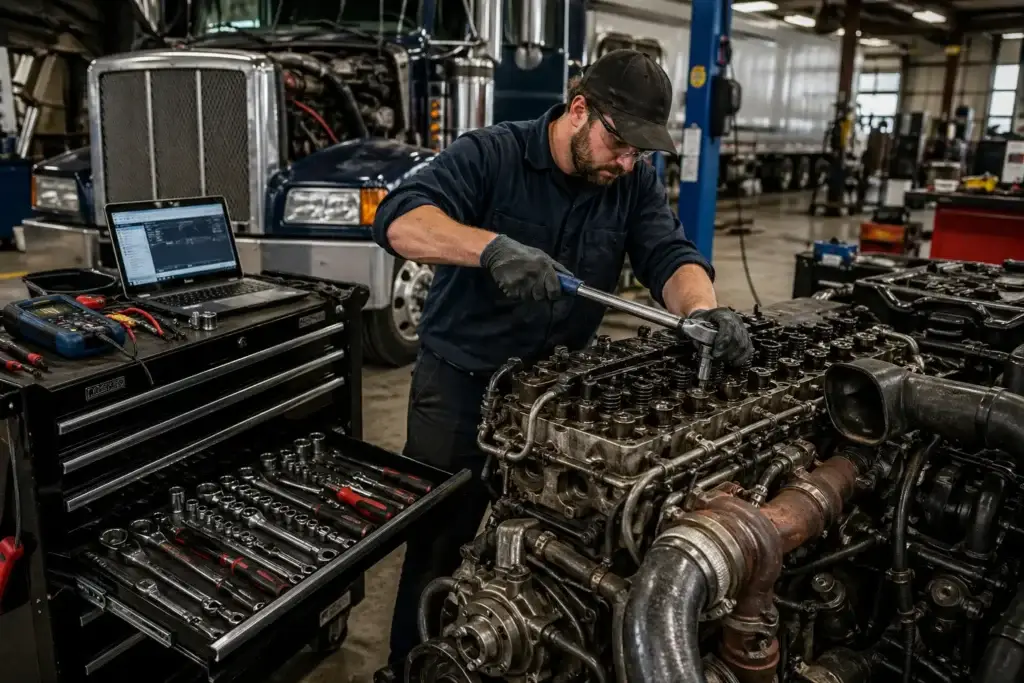
Professional diesel mechanic using torque wrench on heavy-duty truck engine in commercial repair shop with organized tools and diagnostic equipment

Diesel Mechanic Tools List: Shop, Field, and Service Truck

Table of Contents
    Add a header to begin generating the table of contents

    By Michael Nielsen, Editor & Publisher | 15+ Years in Diesel Repair

    Last Updated: April 2026

    📖 Estimated reading time: 20 minutes

    Every diesel mechanic accumulates tools over a career, but not every technician builds that collection with intention. After 15 years working in diesel repair and fleet operations — in shop bays, on farm calls, and at highway breakdown sites at two in the morning — I can tell you that the difference between a fast, confident technician and one who struggles through every job usually comes down to one thing: whether the right tool is in their hand or not. This diesel mechanic tools list is not a student starter guide. It is a working professional’s reference, organized by the environment you actually work in and the systems you actually touch on commercial diesel vehicles — Class 6 through Class 8 trucks, heavy equipment, farm machinery, and everything in between.

    The lists that show up at the top of search results when you search this topic are written for trade school freshmen. They will tell you to buy a screwdriver set and a basic socket kit. That is not what a professional diesel technician in a commercial shop needs to read. What follows is the comprehensive diesel mechanic tools list built from real shop experience — organized so you can use it to assess what you have, identify what you are missing, and build toward a complete professional setup over time.

    Key Takeaways

    • Foundation first: A complete socket set in all three drive sizes, a quality wrench set, and a True-RMS digital multimeter are the non-negotiables before any specialty tool investment.
    • Diesel is different: Commercial diesel work requires larger drive sizes, higher-rated lifting equipment, diesel-specific diagnostic adapters, and specialty tools that have no automotive equivalent.
    • Shop versus field: Mobile service truck technicians need a different tool configuration than shop bay technicians — portable power generation and cordless tool platforms replace stationary shop equipment.
    • Build over time: Specialty tools should be purchased as jobs demand them, not pre-emptively. Foundation hand tools and diagnostics are the priority investment.
    • Tool quality matters: In commercial diesel work, failed tools under load are a safety issue, not just an inconvenience. Professional-grade tools from established brands are not optional.

    Why Your Diesel Mechanic Tools List Matters More Than You Think

    In most commercial diesel shops, technicians are responsible for their own hand tools. The employer provides specialty tools, heavy shop equipment, and OEM diagnostic software — but the foundation set that gets used on every job, every day, comes out of the technician’s own toolbox and their own paycheck. This is standard industry practice, and it means that the quality of your diesel mechanic tools list directly affects the quality and speed of your work in a way that is entirely within your control.

    According to the U.S. Bureau of Labor Statistics, diesel service technicians and mechanics represent one of the more specialized skilled trades in the transportation sector, with demand driven directly by the commercial trucking, agriculture, and construction industries. That specialization extends to the tools the work requires — tools that are fundamentally different from what a general automotive technician carries, built for the torque loads, component weights, and system complexities of commercial diesel vehicles.

    The other factor that separates a diesel mechanic’s tool list from an automotive one is environment. A shop bay diesel technician works in a controlled environment with stationary equipment and shop air. A field service technician works from a service truck with limited space, no shop air, no overhead lift, and whatever the weather gives them. These two environments demand different configurations of tools. This guide covers both — with the commercial truck and heavy equipment professional as the intended reader, not the trade school student.

    The Foundation: Hand Tools Every Diesel Mechanic Needs First

    Before any specialty tool investment, a diesel technician needs a complete, professional-grade foundation of hand tools. These are the tools used on every job, every day — the ones that define whether a technician is fast or slow, organized or scrambling. Every item in this section should be professional grade, meaning forged steel construction, heat-treated to specification, and from a brand with a genuine warranty. Cheap hand tools are false economy in commercial diesel work, where fasteners are large, torque is high, and a rounded socket or a snapped wrench in a tight spot costs time and sometimes injury.

    Socket Sets and Drive Configurations for Commercial Diesel

    A diesel technician needs a complete socket set in three drive sizes: 1/4-inch, 3/8-inch, and 1/2-inch as the daily foundation, with 3/4-inch and 1-inch drive sets added for drivetrain and wheel service work. Each size should include both SAE and metric coverage, standard and deep wall, and a mix of chrome and impact versions. The 1/4-inch drive set handles sensor ports, electrical connectors, and small fasteners. The 3/8-inch drive set is the workhorse for mid-range torque work — EGR systems, cooling components, air plumbing. The 1/2-inch drive handles engine fasteners, suspension bolts, and brake hardware. The 3/4-inch and 1-inch drive sets enter the picture for transmission work, differential service, and wheel end work on Class 7 and 8 trucks where torque values exceed what a 1/2-inch drive can safely handle.

    Six-point sockets are preferred over twelve-point for impact work — they apply force to the flat faces of fasteners rather than the corners, reducing the chance of rounding. This is particularly important on commercial diesel work where fasteners are often corroded and require significant force to break free. A set of Torx sockets from T20 through T70 handles the Torx fasteners found throughout cab, body, and electronic component work on modern commercial trucks. Hex/Allen drive sockets in both SAE and metric round out the socket set for the high-strength hex fasteners found in suspension and hydraulic systems.

    Wrenches for Commercial Diesel Applications

    A complete combination wrench set from 3/8-inch through 1-1/4-inch SAE and 8mm through 32mm metric handles the range of fasteners across Class 6-8 truck work. Beyond the standard combination set, a diesel technician needs a set of flare nut wrenches for fuel and brake line fittings — regular open-end wrenches round off these soft fittings quickly — and at minimum one or two large adjustable wrenches for improvised fits and plumbing work.

    Flex-head ratcheting wrenches deserve a place in every diesel toolbox. The ability to work in tight spaces without repositioning the wrench on every stroke cuts significant time on complex engine bay and cab-over work where access is limited. A set covering the most common sizes from 10mm through 19mm metric and 3/8-inch through 3/4-inch SAE handles the majority of daily use cases efficiently.

    Pliers, Cutters, and Specialty Grips

    A diesel technician’s plier set should include standard combination pliers, needle nose in at least two sizes, diagonal cutters, slip-joint adjustable pliers in large and extra-large sizes for hose clamps and plumbing work, and a quality set of retaining ring pliers covering internal and external snap rings in the range found in drivetrain and hydraulic components. Locking pliers in multiple sizes handle the rounded fasteners, seized clamps, and creative holds that diesel work generates constantly.

    Hose clamp pliers deserve specific mention. Spring-style radiator hose clamps throughout a diesel engine’s cooling system are difficult to compress and reposition by hand, especially in the cramped spaces of a Class 8 engine bay. A dedicated hose clamp plier set with multiple jaw configurations saves time and avoids knuckle injuries on every cooling system job. Wire strippers and crimpers rated for automotive and commercial vehicle wiring gauge ranges, a set of terminal release tools for the weather-pack and DT connectors used throughout commercial truck electrical systems, and a quality inspection mirror and telescoping magnet complete the hand tool foundation.

    15+ Years

    The experience behind this diesel mechanic tools list — built from real shop and field work on Class 6-8 trucks, heavy equipment, and farm diesel. The tools on this list have earned their place through daily use, not catalog browsing.

    Diagnostic and Electronic Tools for Modern Diesel Systems

    Modern commercial diesel engines are sophisticated electronic systems. A Cummins X15, a Detroit DD15, a PACCAR MX-13 — these engines contain hundreds of sensors, actuators, and control modules communicating over J1939 CAN networks. Diagnosing them without proper electronic tools means guessing. Professional diesel technicians do not guess; they verify. The diagnostic tools section of a diesel mechanic tools list is where entry-level and professional setups diverge most sharply — and where underinvestment costs the most diagnostic time.

    Heavy-Duty Scan Tools and Adapter Systems

    A laptop-based diagnostic system using an SAE J1939-compliant adapter — such as the Nexiq USB-Link 3 — paired with OEM software provides the deepest access to commercial truck ECMs. Cummins Insite, ServiceMaxx for Navistar engines, and JPRO for multi-OEM coverage are the professional standard for shop-level diagnostics. These systems read and clear fault codes, perform active tests, access live data parameters, and run component calibrations that a generic scanner cannot perform. The Nexiq USB-Link 3 carries the largest number of OEM approvals in the commercial vehicle market, supporting CAN FD and DoIP protocols required for modern emissions system diagnostics.

    For technicians who prefer or need a standalone tablet scanner, the TOPDON ArtiDiag HD covers more than 60 commercial truck brands including Freightliner, Peterbilt, Kenworth, Cummins, and Detroit across all vehicle systems — with service functions including DPF regeneration, SCR reset, injector coding, urea drive reset, and idle speed adjustment built in. The right answer for most professional shops is both — a laptop-based OEM system for deep work and a quality standalone scanner for quick reads and multi-brand mobile service.

    Electrical Measurement Tools

    A True-RMS digital multimeter is the single most important diagnostic instrument a diesel technician owns. The Fluke 87V is the industry benchmark — True-RMS measurement handles the electrical noise of modern diesel systems, the low-pass filter cuts interference on variable-frequency circuits, and the 1,000V CAT III safety rating covers commercial vehicle electrical work. Auto-ranging, frequency measurement, and diode test functions complete the capability set needed for J1939 fault diagnosis, VGT actuator testing, and DEF heater circuit analysis.

    A clamp-on ammeter with a minimum 600-amp rating handles commercial battery bank and starter circuit diagnosis. Starting circuits on Class 8 diesels can exceed 1,000 amps under cranking loads, which is beyond the range of any standard automotive clamp meter. The Fluke 381 with iFlex flexible current probe reaches 2,500 amps and allows one technician to collect readings while operating from a remote location — a genuine two-person job done by one. For intermittent faults and signal waveform analysis, a graphing multimeter or entry-level oscilloscope opens diagnostic capability that static measurements cannot provide.

    Pressure and Compression Testing Equipment

    A diesel compression tester rated to 1,000 PSI with adapters for commercial diesel glow plug and injector port sizes gives the baseline mechanical data that no scan tool can provide. A cooling system pressure test kit, a boost pressure and charge air circuit test kit for turbocharger system diagnosis, and an injector return flow test kit for common-rail engines round out the mechanical diagnostic toolkit. An infrared thermometer covering 0 to 1,200°F handles exhaust temperature variation analysis, brake drum temperature checks after a road test, and DPF surface temperature assessment quickly and without contact. A heavy-duty battery load tester rated for commercial battery banks — Midtronics MDX-700P HD covers 12V and 24V systems from 100 to 2,000 CCA — completes the diagnostic set with seven-second battery test capability that produces a printed result for customer documentation.

    Stay Current on Diesel Tools and Technology

    Heavy Duty Journal delivers practical diesel maintenance guides, diagnostic walkthroughs, and tool recommendations to your inbox — written by working professionals for working professionals. Always free.

    Engine and Powertrain Specialty Tools

    The engine and drivetrain specialty tools section is where a diesel mechanic’s tool investment diverges most sharply from automotive. These are not tools you buy before your first job — they are tools you acquire as the work demands them, and they represent some of the highest-value investments in a professional’s collection because they are the tools that make difficult jobs manageable and dangerous jobs safe.

    Torque Wrenches for Commercial Diesel Work

    A diesel technician needs torque wrenches covering three ranges: a 3/8-inch drive unit from 20 to 200 in-lbs for sensors and small fasteners, a 1/2-inch drive unit from 20 to 150 ft-lbs for mid-range engine fasteners, and a 3/4-inch drive unit from 80 to 400 ft-lbs for cylinder head bolts, main caps, and connecting rod bolts on Class 8 engines. The TMC Recommended Practices for diesel engine maintenance specify torque procedures throughout — none of which can be executed accurately without the right tool for the torque range involved.

    Click-type torque wrenches from CDI, Snap-on, or Norbar provide the accuracy and repeatability needed for critical fastener torque in engine work. Never use a torque wrench as a breaker bar, store them at minimum setting when not in use, and calibrate annually or after any overload event. A torque wrench used beyond its range or stored under tension gives inaccurate readings — and an improperly torqued cylinder head bolt discovered after reassembly is among the more expensive diagnostic mistakes a diesel technician can make.

    Engine-Specific Service Tools

    Injector pullers sized for the specific engine being serviced — Cummins ISX, Detroit DD15, Navistar A26 — are non-negotiable for any shop doing in-chassis injector work. Carbon-seized injectors on high-mileage commercial engines cannot be safely removed without proper tooling; attempting it without the correct puller destroys the injector bore and turns a manageable job into a head replacement. An OTC 6069 handles Cummins 5.9L 24-valve injector and connector tube removal. A slide hammer-style puller with M8, M12, and M14 thread adapters covers common-rail injectors across Detroit, Volvo, CAT, and European engine platforms.

    A cylinder liner puller for wet-sleeve engines used in Cummins, CAT, and Mack platforms, a harmonic balancer puller and installer set for front crankshaft component service, a valve spring compressor sized for diesel cylinder heads, and a complete Helicoil-style thread repair kit covering M6 through M14 round out the engine specialty set that covers the most common in-chassis engine work. An oil pressure test kit with the correct adapters for common diesel sending unit ports provides the calibrated mechanical reading that tells a technician whether a low oil pressure condition is a sensor problem or the start of a bearing failure — the most consequential diagnostic call in diesel engine service.

    Drivetrain, Brake, and Chassis Tools

    Drivetrain and brake work on commercial vehicles requires tools that simply do not exist in the automotive world. A transmission jack rated for a 700-lb Eaton Fuller 13-speed, a U-joint puller handling Spicer 1880 series driveline loads, an S-cam brake spring tool — these are purpose-built for commercial vehicle service and they make dangerous jobs manageable and manageable jobs fast.

    A 2-ton low-profile transmission jack with a tilting saddle and Eaton Fuller adapter handles Class 8 transmission work safely for one technician. The OTC 5019A is the professional standard — its 8-1/4-inch low profile clears aerodynamic truck ground clearance, the included adapter fits nearly all Class 7 and 8 transmissions, and the tilting saddle provides the precise alignment needed during installation. Without it, removing or installing a manual transmission is a two-person operation with significant injury risk from component weight and awkward positioning.

    Air brake service deserves specific attention because of the safety implications involved. CVSA North American Standard Inspection criteria for brakes include measurement and adjustment requirements that must be met using calibrated tools. A brake drum micrometer covering 10 to 19-inch drum diameters, an automatic slack adjuster tool set, a brake anchor pin press for S-cam systems, and a spring brake caging tool are mandatory for any technician performing commercial air brake service.

    ⚠️ Safety Warning

    Spring brake chambers on commercial trucks store significant mechanical energy. Always use a proper caging tool before performing any service on a spring brake chamber. Never attempt to disassemble or remove a chamber without caging the spring first. The internal spring stores enough energy to cause fatal injuries if released suddenly. Commercial vehicle brake system requirements are specified under 49 CFR Part 393.

    The Service Truck Tool List: What Field Technicians Carry

    A mobile diesel service technician’s toolkit is a different configuration from a shop bay setup. The principle is the same — right tool in hand — but the constraints are different. Limited truck bed space, no shop air, no overhead lift, no stationary power supply, and the need to solve a wide range of problems at a single call all shape what goes on a service truck. The best mobile service technicians share a common characteristic: everything on their truck has earned its place through use, and everything has a specific, assigned location.

    Power Generation and Air Supply

    A portable inverter generator in the 2,200 to 5,000-watt range is the foundation of independent field service capability. The Honda EU2200i is the benchmark for professional service truck generator use — inverter output protects sensitive diagnostic electronics, the commercial-grade GXR120 engine handles continuous duty cycles, and the CO-Minder automatic carbon monoxide shutoff provides critical safety protection in enclosed service environments. Two EU2200i units can be paralleled for 4,400 watts when heavier power demands arise on equipment removal or welding jobs.

    A truck-mounted or portable 12V air compressor — the VIAIR 400P delivers 150 PSI at 2.3 CFM from a direct battery connection — handles tire inflation and light pneumatic tool use in the field. For service trucks requiring sustained air tool operation, a PTO-driven air compressor system provides the volume and pressure needed to run impact wrenches and air-powered equipment without depleting a portable compressor’s duty cycle.

    Cordless Tool Platforms for Field Service

    A matched cordless tool platform eliminates air hose management in the field. The Milwaukee M18 FUEL platform offers the most complete lineup for diesel service truck use — a 1/2-inch high-torque impact wrench delivering 1,000 ft-lbs of fastening torque and 1,400 ft-lbs of nut-busting torque, a 3/4-inch high-torque impact for drivetrain fasteners, a 1/4-inch hex ratchet for tight-space work, a cordless angle grinder, and a cordless work light — all running on the same M18 battery platform. DeWalt’s 20V FLEXVOLT system offers comparable performance if that platform is already established in a shop’s tool inventory.

    The key advantage of cordless tools for field service extends beyond convenience. Air hoses create trip hazards, require compressor operation, and limit range from the service truck. A fully cordless impact wrench set lets one technician work completely independently at any distance from the vehicle, in any orientation, without managing an air hose through tight engine compartments or under running gear.

    Fluid Handling and Field Essentials

    A 12V fluid transfer pump — the Fill-Rite FR1614 delivers 15 GPM from a direct battery connection and handles diesel fuel, gear oil, and hydraulic fluid — makes field oil changes and fluid top-offs professional operations rather than makeshift ones. A fully automatic pneumatic grease gun — the Lincoln 1162 delivers 6,000 PSI with a variable-speed trigger — reaches the 40 to 80 grease fittings on a commercial truck that need service on schedule, far faster than a manual gun. A LockNLube locking grease coupler that stays on the Zerk fitting without popping off eliminates the wasted grease and time that standard push-on couplers generate on every service call.

    A Class 8-rated lithium jump starter pack — the NOCO GB150 delivers 3,000 amps for diesel engines up to 7.0 liters — handles the dead battery calls that represent a significant share of commercial roadside service work. A portable LED tripod work light providing minimum 10,000 lumens, commercial-grade 1-gauge jumper cables as backup for battery banks too large for the jump pack, and a DOT-compliant roadside emergency kit with LED road flares, reflective triangles, and high-visibility vest round out the service truck essentials that separate professional mobile technicians from the improvised.

    The HDJ Perspective

    The diesel technician shortage is well documented across the industry, but the tool investment barrier that contributes to it is rarely discussed in the same conversation. A complete professional diesel mechanic tools list represents a $10,000 to $30,000 investment built over years — a significant capital commitment that technicians in other trades do not face at the same scale. Shops and fleets that understand this and offer structured tool assistance programs, tool loan programs for beginning technicians, or tool purchase support as part of compensation packages have a measurable recruiting and retention advantage. A tool program costs a fraction of what a technician vacancy costs in lost productivity, overtime, and recruitment expense.

    Shop Bay Equipment and Heavy Lifting

    The shop bay tools that a diesel technician relies on — versus owns personally — represent the major capital equipment side of the tools equation. A 20-ton hydraulic floor jack, rated jack stands, an engine hoist, a shop press, and a transmission jack are typically shop-owned. But for technicians who own their own operation or equip a field service truck, these represent the backbone investments that make commercial diesel work possible and safe.

    A 20-ton rated low-profile hydraulic floor jack handles the lifting demands of Class 6-8 trucks and heavy equipment axle ends. The Norco 72080A is the professional standard for commercial truck shop floor jacks — air/hydraulic operation eliminates manual pumping under load, and the compact design fits between tandem wheels on roadside service calls. Jack stands rated for commercial loads — minimum 25-ton capacity, pin-type ratchet design rather than notch-ratchet for reliability under vibration — are the safety infrastructure that no shop should compromise on.

    An aqueous parts washer in the 20 to 40-gallon range handles heads, blocks, and large drivetrain components. Solvent-based washers face increasing regulatory pressure under OSHA hazardous materials guidance — aqueous systems using biodegradable solution produce equivalent cleaning results without the disposal complexity. A 20-ton H-frame shop press handles bearings, bushings, seals, U-joints, and press-fit components throughout drivetrain work. A 2-ton folding engine hoist for pulling Class 6-8 diesel engines, and a low-profile rolling oil drain rated for 30 gallons to handle the fluid capacity of commercial diesel engines, complete the shop bay equipment fundamentals.

    Free Professional Fleet Tools

    Cost calculators, fault code lookup, maintenance planners, and more — built for owner-operators, fleet managers, and diesel techs. No signup required.

    Explore Free Tools →

    PPE and Shop Safety: The Non-Negotiables on Every Diesel Mechanic Tools List

    Every diesel mechanic tools list must include personal protective equipment — not as an afterthought, but as a primary category. The cumulative occupational health exposure in a commercial diesel shop is significant. Diesel exhaust particulates, repeated chemical exposure through skin contact, sustained noise from impact tools and running engines, and physical hazards from sharp components and heavy parts all contribute to real long-term health consequences when PPE is not consistently used.

    ANSI Z87.1-rated safety glasses with side shields are the minimum standard for any shop work. Keep multiple pairs accessible throughout the shop. Cut-resistant work gloves rated at ANSI Level A4 or above protect against the sheet metal edges and worn brake hardware that cause the majority of hand lacerations in commercial diesel shops. Heavy-duty 6-mil black nitrile disposable gloves in bulk — buy cases, not boxes — make it practical to glove up for every fluid contact rather than reserving them for the obviously messy jobs where the exposure has already happened.

    Electrical hazard-rated steel-toe or composite-toe work boots, hearing protection with a minimum NRR of 31 dB for sustained noise exposure from impact tools and diesel engines running in enclosed shop bays, and a NIOSH-approved half-face respirator with OV/P100 cartridges for brake dust, grinding particulates, and solvent vapors during parts cleaning represent the safety equipment investment that protects long-term working capacity. The ASE Medium/Heavy Truck certification program covers diesel technician competency across eight system areas — and professional certification and professional PPE are complements, not substitutes.

    How to Build Your Diesel Mechanic Tools List Over Time

    The question every technician at every career stage eventually asks is: what do I buy next? The answer depends on where you are in your career and what work is in front of you — but the framework is consistent regardless of experience level.

    Start with foundation hand tools: a complete socket set in 1/4, 3/8, and 1/2-inch drive, a full combination wrench set, a quality digital multimeter, a 1/2-inch drive torque wrench, a complete plier set, and a professional-grade tool cabinet to organize and protect the investment. This foundation, purchased from professional-grade brands, will cost between $1,500 and $3,000 and will be in daily use for the duration of a career.

    The second phase is diagnostic tools: a laptop-based diagnostic adapter and at least one OEM software subscription, a diesel compression tester, and a cooling system pressure test kit. These tools pay for themselves quickly — a technician who can diagnose accurately and efficiently generates more billable work in less time than one working from guesswork or relying entirely on the shop’s shared diagnostic equipment.

    Specialty tools — injector pullers, timing kits, transmission jacks, bearing driver sets, cylinder liner pullers — should be purchased as specific jobs arrive rather than speculatively. Most are available for next-day delivery. The exception is safety-critical tools: a spring brake caging tool, rated jack stands, and complete PPE should be on hand before the job arrives, not ordered after it does. The field service technician adds power generation and a cordless tool platform as the third major investment phase, enabling truly independent operation from any location.

    Key Recommendation

    The HDJ Diesel Mechanic Tools Guide covers 96 professional tools across 9 categories — each with field-tested descriptions and direct purchase links. Use it as a working reference alongside this article for building your tool inventory or equipping a shop or service truck operation. Browse the full guide →

    Frequently Asked Questions

    What tools does a diesel mechanic need to start their career?

    A beginning diesel mechanic needs a complete socket set in 1/4, 3/8, and 1/2-inch drive covering both SAE and metric sizes, a combination wrench set from 3/8 to 1-1/4 inch, a quality digital multimeter, torque wrenches in 3/8-inch and 1/2-inch drive, a complete set of screwdrivers and pliers, and basic PPE including safety glasses, work gloves, and steel-toe EH-rated boots. Budget $1,500 to $3,000 for a professional starter set. Avoid the temptation to buy cheap — quality tools from established brands hold value and perform reliably under the torque demands of commercial diesel work. The tool cabinet investment should be made early; a good 72-inch rolling cabinet is the foundation that the rest of the set grows around.

    What is the difference between automotive tools and diesel mechanic tools?

    Diesel mechanic tools are built for higher torque outputs, larger fastener sizes, and heavier component weights than passenger car tools. Key differences include larger drive sizes (3/4-inch and 1-inch drive are standard in diesel work versus rarely used in automotive), higher-rated jacks and stands (20-ton floor jacks versus 3-ton automotive), diesel-specific diagnostic adapters for J1939 and J1708 networks that automotive OBD-II scanners cannot access, compression testers rated to 1,000 PSI versus 300 PSI for gasoline engines, and specialty tools for diesel-only systems like injector pullers, DPF differential pressure kits, air brake caging tools, and commercial tire service equipment. Standard automotive tools will physically fit some diesel jobs but lack the strength and range for daily commercial truck work.

    What diagnostic tools do diesel mechanics use?

    Professional diesel mechanics use a laptop-based diagnostic adapter such as the Nexiq USB-Link 3 paired with OEM software like Cummins Insite, ServiceMaxx, or JPRO for deep ECM access. A standalone tablet scanner such as the TOPDON ArtiDiag HD provides coverage for 60+ commercial truck brands without a laptop. A True-RMS digital multimeter such as the Fluke 87V handles electrical diagnosis. A diesel compression tester rated to 1,000 PSI, a cooling system pressure tester, and a DPF differential pressure test kit handle mechanical diagnosis. An infrared thermometer speeds up temperature-based diagnostics across exhaust, brake, and cooling system work. A battery load tester rated for commercial battery banks completes the professional diagnostic toolkit.

    Do diesel mechanics need to buy their own tools?

    In most commercial diesel shops, technicians are responsible for providing their own hand tools, while the employer provides specialty tools, heavy shop equipment, and OEM diagnostic software. This is standard industry practice. The technician’s personal set covers the daily-use foundation: sockets, wrenches, pliers, screwdrivers, torque wrenches, and basic diagnostic instruments. Specialty tools — those costing hundreds to thousands of dollars and used for specific procedures — are typically provided by the shop. Some larger fleets and dealerships provide tool assistance programs or tool loans for beginning technicians. Always confirm the tool policy with an employer before your first day so you know exactly what is expected and what will be provided.

    What tools does a mobile diesel service truck need?

    A mobile diesel service truck should be equipped with a portable inverter generator rated minimum 2,200 watts for diagnostic equipment, a 12V portable air compressor or onboard air system, a complete cordless impact wrench kit in 1/2-inch and 3/4-inch drive on a matched battery platform, a Class 8-rated lithium jump starter pack, a pneumatic grease gun with long-reach hose, a 12V fluid transfer pump for oil and diesel fuel, a portable LED tripod work light rated minimum 10,000 lumens, commercial-grade heavy-duty jumper cables as backup, a DOT-compliant roadside emergency kit with LED road flares and reflective triangles, and a systematic aluminum underbody toolbox organization system. The same diagnostic equipment carried by a shop tech travels on the service truck — the difference is the power generation and fluid handling tools that make independent field operation possible.

    How much does a complete diesel mechanic tool set cost?

    A professional-grade diesel mechanic tool set ranges from $3,000 to $10,000 for a well-equipped starting point, and grows to $20,000 to $50,000 or more for a senior technician with specialty tools accumulated over a career. The largest single investment is typically a quality tool cabinet — expect $1,500 to $5,000 for a professional 72-inch cabinet. Diagnostic equipment adds another $2,000 to $5,000 depending on OEM software licenses required. The practical approach is to build gradually: buy foundation hand tools first, add diagnostic tools once employed, and accumulate specialty tools job by job. The technician who tries to buy everything at once before their first job either buys cheap — which is money wasted — or goes into significant debt unnecessarily.

    A Diesel Mechanic Tools List Is Built, Not Bought

    The most complete diesel mechanic tools list in the world is useless if it stays on paper. The purpose of this guide is to give working professionals a reference framework for building the physical toolkit that the work actually demands — organized not by what looks comprehensive in a catalog, but by what commercial diesel technicians use on real jobs in real environments.

    Start with the foundation, add diagnostics, acquire specialty tools as jobs arrive, and never compromise on safety-critical equipment. That is the professional approach, and it is the one that results in a tool collection that actually serves the work rather than just occupying drawer space. The nine categories covered in the HDJ Diesel Mechanic Tools Guide — linked throughout this article — go deep on each area with specific product recommendations, field-tested descriptions, and purchase links. Use both resources together, and build your diesel mechanic tools list with the intention it deserves.

    Share This With Your Shop and Fleet

    If this diesel mechanic tools list has been useful for your own professional development, for equipping a new technician, or for assessing your shop’s tool inventory, share it with the mechanics and fleet managers in your network. The more professional information circulates in the commercial diesel trade, the better the work gets for everyone in it.

    Leave a Comment

    Your email address will not be published. Required fields are marked *

    Free Guide

    The Working Tech's
    Tool Guide

    Shop-Tested. Field-Approved. Zero Fluff.

    9 Categories Covered:

    🔧 Shop & Bay 🔍 Diagnostic ⚙️ Engine 🔩 Drivetrain 💨 Air & Brake 🚛 Service Truck 🏗️ Heavy Equipment 🦺 PPE & Safety 🛞 Tire Repair
    Vetted Tools Only gear a diesel pro would actually buy
    All Disciplines From shop bay basics to heavy equipment
    Always Free No login. No paywall. Just the guide.
    Browse the Tool Guide →

    Expert Diesel Knowledge. Always Free.
