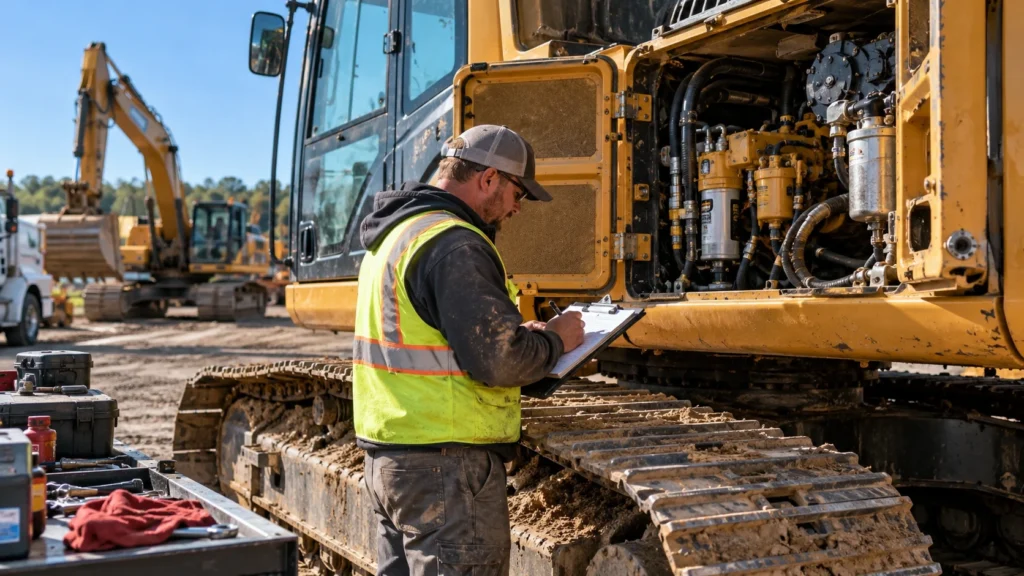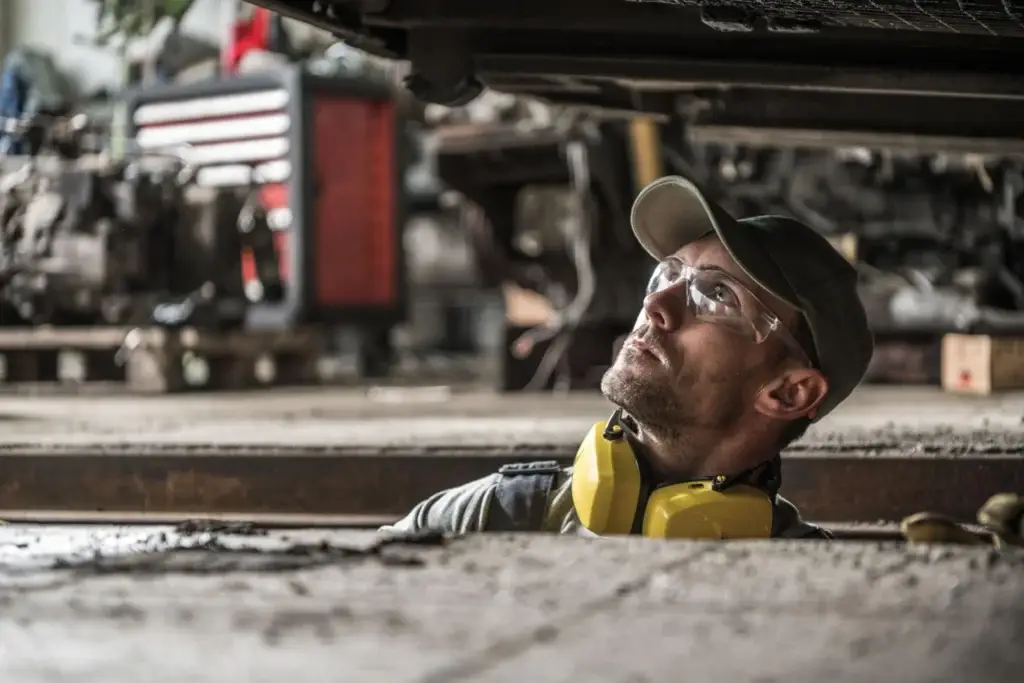
diesel mechanic wearing safety glasses and hearing protection inspecting the underbody of a heavy duty truck in a commercial repair shop

Diesel Mechanic Safety Equipment: PPE for Commercial Shops

Table of Contents
    Add a header to begin generating the table of contents

    By Michael Nielsen, Editor & Publisher | 15+ Years in Diesel Repair

    Last Updated: April 2026

    📖 Estimated reading time: 20 minutes

    Diesel mechanic safety equipment doesn’t get nearly the attention it deserves. Walk into most commercial repair shops and you’ll find technicians wearing the right boots and safety glasses — but ask them why a specific glove material matters for fuel system work, or what OSHA requires when noise levels in the bay hit 87 decibels, and the answers get murky fast. That gap between knowing PPE matters and understanding exactly what’s required — and why — is where real injuries happen.

    Commercial truck shops present a hazard profile that goes well beyond what a light automotive technician encounters. Common rail fuel injection systems operate at pressures exceeding 30,000 PSI. Diesel particulate filter cleaning generates carcinogenic particulate. DEF systems introduce ammonia vapor. Modern heavy-duty platforms carry high-voltage electrical systems. The work is physically demanding, chemically intense, and acoustically punishing — and every one of those hazards has a corresponding PPE requirement with a specific standard behind it.

    This guide breaks down the complete diesel mechanic safety equipment picture for commercial shops: what OSHA requires, what the ANSI standards actually mean, how to match PPE to specific tasks, and how to build a program that keeps technicians protected and keeps your shop compliant.

    Key Takeaways

    • OSHA regulates all commercial truck maintenance: All vehicle maintenance activities — in terminals and on the highway — fall under OSHA’s General Industry standards, not just DOT regulations. Employers are legally responsible for hazard assessment and PPE provision.
    • ANSI ratings tell you what the protection actually does: Z87.1 for eye protection, ISEA 105 for gloves, Z89.1 for head protection, ASTM F2413 for footwear — these stamps on your PPE confirm it meets the performance standard OSHA references.
    • Task-specific PPE selection matters more than generic compliance: Chemical-resistant gloves for solvent work differ from cut-resistant gloves for sharp metal work. Matching protection to the hazard is both an OSHA requirement and the only approach that actually prevents injury.
    • Diesel exhaust is a Group 1 carcinogen: Routine engine-running for diagnostics in enclosed bays creates real DPM exposure risk. Ventilation systems and respiratory protection programs are not optional in enclosed commercial shops.
    • A hearing conservation program is required at 85 dB — not 90 dB: Most diesel shops trigger this threshold. Annual audiometric testing, monitoring, and training are required components.

    Why the Hazard Profile in a Commercial Diesel Shop Is Different

    The risks a diesel technician encounters every day are categorically different from what light automotive work involves — in scale, in pressure, in chemical complexity, and in the consequences of a PPE failure. Understanding that distinction is the foundation of any effective shop safety program.

    Heavy-duty diesel engines operate at compression ratios of 14:1 to 25:1, compared to roughly 10:1 in gasoline engines. Common rail direct injection systems on platforms like the Cummins X15 or Detroit DD15 deliver fuel at pressures up to 30,000 PSI. A pinhole fuel system leak at that pressure doesn’t drip — it creates an invisible jet capable of penetrating skin and causing catastrophic injection injuries that are frequently misdiagnosed as minor punctures. This alone warrants a different level of eye and face protection than you’d reach for working on a passenger car.

    The chemical exposure picture is equally distinct. A commercial shop runs through DEF by the pallet, handles engine coolant containing ethylene glycol and silicates, stores quantities of diesel fuel, and uses aggressive solvent-based brake cleaners and parts wash chemicals. Each of these has a different glove compatibility profile — a pair of nitrile gloves that handles motor oil appropriately may provide only minutes of permeation protection against certain halogenated solvents.

    Acoustically, heavy truck service bays are punishing environments. Impact wrenches, air ratchets, running engines during diagnostic testing, and the diesel exhaust brakes that clatter during road test evaluations can collectively push time-weighted average noise exposures well above 85 decibels. The OSHA trucking industry vehicle maintenance page makes clear that all general industry standards — including those governing noise exposure and respiratory hazards — apply to everyone performing maintenance on commercial motor vehicles, regardless of where that work takes place.

    From a physical standpoint, the sheer mass of components in commercial truck service creates ergonomic and crush hazards that don’t exist in light vehicle work. A Class 8 brake drum weighs 50 to 80 pounds. Wheel-end assemblies on drive axles can exceed 300 pounds. Transmissions and rear axle assemblies require lifting equipment and still demand physical handling at the extremes. The injury data reflects this: according to the Bureau of Labor Statistics, diesel service technicians and mechanics consistently report above-average rates of nonfatal occupational injuries and illnesses, with upper extremities and trunk accounting for the largest share of injury cases.

    OSHA’s PPE Framework for Commercial Repair Shops

    Before addressing specific PPE categories, it’s essential to understand what OSHA actually requires from the employer — because the regulatory framework establishes not just what protection to use, but who is responsible for determining it, providing it, and ensuring it’s worn correctly.

    The foundation is 29 CFR 1910.132 — OSHA’s general personal protective equipment standard. This regulation requires employers to conduct a documented hazard assessment of the workplace to determine whether hazards are present that require the use of PPE. The assessment must be certified in writing, identifying the workplace evaluated, the name of the person performing the assessment, and the date it was completed. This isn’t a one-time box-checking exercise — it should be updated whenever shop operations change, new chemicals are introduced, or new equipment is added to the bay.

    The regulation also establishes the employer’s training obligations. Employees must be trained to know when PPE is necessary, what PPE is appropriate for the hazard, how to properly wear and adjust it, its limitations, and how to care for, maintain, and dispose of it. Training must be documented, and retraining is required whenever there’s reason to believe an employee lacks the required understanding or skill.

    On the question of cost: under 29 CFR 1910.132(h), employers are generally required to provide PPE at no cost to the employee when it is required for regulatory compliance. Safety-toe footwear and prescription safety eyewear carry limited exceptions, but the rule broadly places the financial responsibility on the shop — not the technician. Fleet managers and shop owners who have been treating basic PPE as the technician’s personal financial responsibility should review this carefully.

    OSHA also requires that PPE meet or be equivalent to standards developed by the American National Standards Institute (ANSI). This is why the ANSI markings on PPE items matter — they confirm the item has been tested to the performance levels OSHA references in its specific standards for each protection category.

    Eye and Face Protection: ANSI Z87.1 and When to Step Up to Goggles or a Shield

    Eye injuries are among the most common — and preventable — injuries in mechanical service environments. In a diesel shop, the hazards driving this risk include fuel injection spray, grinding sparks, chemical splash, compressed air debris, and flying metal fragments during fastener removal. Each scenario calls for a specific level of protection, and confusing them is where technicians get hurt.

    OSHA’s eye and face protection standard, 29 CFR 1910.133, requires that eye protection meet or be equivalent to ANSI Z87.1. Look for this marking on the lens and frame of any safety eyewear before using it in the shop — standard prescription glasses and most over-the-counter sunglasses do not meet this standard and must not be used as primary eye protection.

    Safety Glasses vs. Goggles vs. Face Shields

    Safety glasses with side shields are appropriate as baseline eye protection for most general service tasks — working under the vehicle, using hand tools, performing fluid checks. The Z87+ rating (note the plus sign) indicates a high-impact designation, which is required for tasks involving grinding wheels, chisels, or any operation where a high-velocity fragment could strike the lens.

    Safety goggles provide a sealed environment around the eye, protecting against chemical splash and vapor that can bypass the side shields on standard safety glasses. Technicians handling diesel exhaust fluid, battery acid, coolant, brake fluid, or parts wash solvents should be wearing indirect-vent chemical splash goggles, not standard safety glasses. The distinction matters — DEF contains urea and can cause serious eye irritation on contact, and some parts wash solvents are corrosive.

    2,000+

    Eye injuries occur in U.S. workplaces every day, according to OSHA — the agency estimates that proper eye protection could prevent or reduce the severity of 90 percent of those injuries. Source: OSHA Eye and Face Protection Overview

    Face shields are secondary protection — they are worn over safety glasses or goggles, not instead of them. Use a face shield whenever a task creates risk of large splash, high-energy projection, or thermal hazard. Grinding operations on brake rotors, drums, or structural components are the classic case in a diesel shop. Impact work on seized fasteners with a significant strike risk also warrants the additional coverage.

    Prescription Safety Eyewear in the Shop

    Technicians who wear corrective lenses must have ANSI Z87.1-rated prescription safety frames and lenses — or wear approved over-the-glass (OTG) safety eyewear that fits properly over their prescription glasses. Neither standard prescription frames nor contact lenses alone constitute acceptable eye protection. If the shop requires prescription safety eyewear, the 29 CFR 1910.132(h) cost exemptions that apply to standard non-specialty safety-toe footwear do not automatically apply — the employer’s specific program and whether it meets defined conditions determines cost responsibility.

    Hand Protection: Matching the Glove to the Hazard

    In a commercial diesel shop, hand protection is not a one-size-fits-all proposition. The chemicals, temperatures, and mechanical hazards technicians encounter in a single shift can vary enough that no single glove type adequately addresses all of them. OSHA’s hand protection standard, 29 CFR 1910.138, requires employers to select and require the use of appropriate hand protection based on the work performed, the conditions present, and the hazards and potential hazards identified — specifically referencing the Safety Data Sheet for each chemical as the reference for glove selection.

    Glove Selection by Chemical Exposure

    Nitrile gloves are the most versatile general-purpose glove for diesel shop work. They resist petroleum-based fluids including diesel fuel, motor oil, gear oil, and most hydraulic fluids, and they do not carry the latex allergy risk associated with natural rubber gloves. For routine tasks — fluid changes, general inspection, brake component handling — disposable nitrile gloves (at least 6-mil thickness for durability) provide a reasonable baseline.

    For heavier solvent exposure, nitrile falls short. Chlorinated solvents — including the perchloroethylene and methylene chloride found in some older brake and parts cleaners — permeate nitrile rapidly. Neoprene gloves offer broader resistance across solvents and acids. Butyl rubber provides the strongest protection against ketones, esters, and highly aggressive chemical formulations. The key reference is the chemical permeation data in the glove manufacturer’s chemical resistance chart — this tells you the breakthrough time for a given chemical, which is the maximum safe wear duration before the chemical penetrates the glove material.

    Latex gloves should not be used in diesel repair settings. Beyond the latex allergy risk, they provide poor resistance to petroleum products and are not appropriate for the chemical profile of a diesel shop.

    Cut and Puncture Protection

    Sharp metal edges on body panels, exhaust components, and sheet metal engine covers are persistent cut hazards in heavy truck service. For these tasks, ANSI/ISEA 105-rated cut-resistant gloves are appropriate — the cut level designation (A1 through A9) indicates the force required to cut through the material, allowing you to match the protection level to the severity of the sharp-edge hazard. Higher-level cut-resistant gloves are appropriate when working with sheet metal, sharp exhaust components, or removing and reinstalling body panels.

    Stay Current on Shop Safety and Compliance

    OSHA regulations, PPE standards, and compliance requirements evolve. HDJ delivers free, field-focused updates on diesel safety, regulatory changes, and fleet management practices — straight to your inbox.

    Hearing Protection: Understanding the 85 dB Threshold

    Noise is one of the most consistently underestimated hazards in diesel repair shops — partly because hearing loss is cumulative, invisible, and painless until significant damage has occurred, and partly because technicians who have worked in loud environments for years have already normalized the sound levels they’re experiencing.

    OSHA’s occupational noise exposure standard is found at 29 CFR 1910.95. The permissible exposure limit (PEL) is 90 decibels as an 8-hour time-weighted average. But the action level — the point at which a hearing conservation program becomes mandatory — is 85 dB. This is a critical distinction. A hearing conservation program triggered at 85 dB requires noise monitoring, annual audiometric testing, hearing protector provision and training, employee notification of monitoring results, and recordkeeping of all audiometric tests.

    What Diesel Shop Noise Looks Like in Practice

    A diesel engine idling in an enclosed bay typically generates 80–90 dB. Impact wrenches run 100–105 dB. Pneumatic grinders and chisels exceed 100 dB. A diesel engine under load for exhaust brake testing can reach 110 dB. During a normal heavy service shift involving engine diagnostics, brake work, and suspension components, many technicians experience time-weighted average exposures that exceed the 85 dB action level — and some exceed the 90 dB PEL — without realizing it.

    Shop owners should conduct a noise survey using a calibrated sound level meter or dosimeter to establish actual employee exposures. Without measurement, you’re guessing — and if your employees’ audiometric tests reveal progressive hearing loss, OSHA can treat that as evidence that your hearing conservation program was inadequate.

    Earplugs vs. Earmuffs: Which to Use and When

    Both earplugs and earmuffs are effective when selected and worn correctly. The key metric is the Noise Reduction Rating (NRR) — the higher the NRR, the more noise reduction the device provides under ideal conditions. OSHA derate tables adjust the real-world protection estimate downward to account for imperfect fit and wear compliance.

    Foam earplugs with an NRR of 25–33 dB are among the most effective options available when properly inserted, making them suitable for high-noise tasks like impact gun work and grinder operation. The downside is insertion technique — improperly inserted foam plugs deliver a fraction of their rated protection. Earmuffs are more consistent in protection level because fit is less technique-dependent, but they lose effectiveness when temple pieces from safety glasses break the seal. For sustained high-noise environments, dual protection — wearing both earplugs and earmuffs — provides the maximum attenuation and is appropriate when working continuously near running diesel engines.

    Foot and Leg Protection: Beyond the Basic Steel Toe

    Safety footwear in a commercial diesel shop must meet ASTM F2413, which is the standard referenced for protective footwear. The common designations are: I/75 C/75 for impact and compression resistance to 75 foot-pounds; EH for electrical hazard resistance; and Mt/75 for metatarsal protection. Understanding what each designation protects against helps technicians and shop managers select footwear appropriate to actual hazards rather than defaulting to the cheapest option with a steel toe.

    Metatarsal Protection in Heavy Component Work

    Standard safety-toe boots protect the toes — they do not protect the top of the foot across the metatarsal bones. In a commercial shop where technicians regularly handle brake drums, wheel ends, driveshaft components, and transmission assemblies, a falling component can strike the top of the foot well behind the toe box. Metatarsal guards — either integrated into the boot or as an add-on strap-on protector — provide this additional coverage and should be standard equipment for any technician who regularly handles heavy components.

    EH-Rated Footwear for Electrical and Hybrid Work

    The proliferation of electric and hybrid-electric commercial vehicles — including Class 6-8 platforms from multiple OEMs — is expanding the electrical hazard exposure in diesel shops. EH-rated safety footwear provides secondary protection against electrical contact hazards by providing a degree of resistance to electrical current flow through the boot to ground. This is not a substitute for proper lockout/tagout procedures and insulated tools when working on high-voltage systems, but EH-rated footwear is an appropriate baseline for shops servicing any electric or hybrid-electric commercial vehicles.

    The HDJ Perspective

    The commercial diesel industry is in a period where its PPE requirements are actively expanding — not because OSHA is adding new regulations, but because the vehicles themselves are changing faster than most shops’ safety programs are adapting. High-voltage hybrid systems, higher-pressure fuel injection, DPF systems that concentrate carcinogenic particulate, and DEF infrastructure all introduce hazards that weren’t present in classic diesel service ten years ago. A shop whose PPE program was written in 2015 and hasn’t been updated since is operating with a hazard assessment that doesn’t reflect the actual risk profile of its current vehicle mix. The shops that get ahead of this update their written program annually — not because an OSHA inspector told them to, but because their experienced technicians know the work has changed.

    Respiratory Protection: Diesel Exhaust, DEF Vapor, and Chemical Hazards

    Respiratory protection is the most complex PPE category in diesel shops — and the one most often handled with inadequate rigor. The regulatory framework under 29 CFR 1910.134 requires employers to conduct an exposure assessment, and when respirators are required, to implement a written respiratory protection program that includes hazard identification, respirator selection, medical evaluation, fit testing, training, and maintenance.

    Diesel Particulate Matter: The Carcinogenic Exposure in Every Shop

    Diesel particulate matter (DPM) — the fine carbonaceous particles in diesel exhaust — is classified as a Group 1 carcinogen by the International Agency for Research on Cancer. Long-term occupational exposure has been linked to lung cancer and bladder cancer in multiple cohort studies. Every time a diesel engine runs inside an enclosed service bay without direct exhaust extraction, DPM concentrations build in the air technicians are breathing.

    The most effective control is engineering — exhaust hose hookups that connect directly to the vehicle’s tailpipe and route exhaust outside, or vehicle exhaust ventilation (VEV) systems that capture exhaust at the source. In shops without adequate exhaust extraction infrastructure, respiratory protection becomes critical during engine-running diagnostic work. An NIOSH-approved N95 filtering facepiece respirator reduces DPM exposure and is the minimum appropriate protection for incidental exposure. For sustained exposure in poorly ventilated environments, a half-face elastomeric respirator with combination organic vapor and particulate cartridges (OV/P100) provides significantly better protection.

    ⚠️ Safety Warning

    Single-strap dust masks — often called “nuisance dust masks” — are not NIOSH-approved respirators and do not provide protection against diesel exhaust particulate, chemical vapors, or any hazardous airborne substance regulated by OSHA. They must not be used as respiratory protection in any situation where OSHA or the employer’s hazard assessment identifies a respiratory hazard. Ensure all respirators used in the shop carry the NIOSH approval marking and appropriate cartridge designation.

    DEF and AdBlue Handling: Ammonia Exposure Risk

    Diesel exhaust fluid is commonly assumed to be benign because it is non-flammable and non-petroleum-based. In liquid form, DEF is a relatively mild irritant. The hazard emerges when DEF is heated — on hot engine surfaces or during filling operations near exhaust components — releasing ammonia vapor. Ammonia is an irritant at low concentrations and acutely toxic at high concentrations, with OSHA’s permissible exposure limit set at 50 parts per million (PPM) as an 8-hour time-weighted average. Technicians working around DEF systems on hot engines, or handling bulk DEF transfer operations in enclosed areas, should have access to respiratory protection appropriate for ammonia vapor. An acid gas cartridge in a half-face respirator provides protection against ammonia at concentrations that exceed safe ambient limits.

    Welding Fumes and Brake Dust

    Exhaust system repair and chassis welding generate metal fumes that require respiratory protection even in well-ventilated shops. Weld fumes from mild steel require at minimum an N95 filtering facepiece. Work involving chrome-containing alloys or galvanized metal generates hexavalent chromium and zinc oxide respectively — both of which require a P100 particulate filter and, in the case of hexavalent chromium exposure above OSHA limits, may trigger the hexavalent chromium standard under 29 CFR 1910.1026.

    Brake dust in commercial truck service environments may contain copper, antimony, and, in older vehicles and imported aftermarket parts, residual asbestos. The safest practice is to treat all brake dust as potentially hazardous — using a low-pressure vacuum with HEPA filtration to remove dust from brake components before service, rather than using compressed air to blow it out.

    Free Professional Fleet Tools

    Cost calculators, fault code lookup, maintenance planners, and more — built for owner-operators, fleet managers, and diesel techs. No signup required.

    Explore Free Tools →

    Head and Body Protection in Commercial Diesel Service

    Head protection requirements are frequently overlooked in diesel service environments — partly because hard hats are associated in the industry mind with construction work rather than vehicle maintenance. OSHA’s head protection standard under 29 CFR 1910.135 requires hard hats when employees are working in areas where there is a potential for injury from falling objects or from bumping into fixed objects. Both conditions exist in heavy truck service.

    Technicians working under raised vehicles on a lift — particularly during undercarriage inspections, driveline work, or undercoating evaluation — are in a fall-zone for tools, components, and debris. Exhaust systems and driveshaft components that haven’t been fully secured can shift. Hard hats meeting ANSI Z89.1, Type I or Type II, Class E (electrical protection) are appropriate for this work. Some technicians prefer bump caps — which protect against laceration from fixed overhead objects like frame rails and crossmembers — for routine under-vehicle work. Bump caps do not provide impact protection equivalent to ANSI Z89.1 hard hats and should not be used where falling objects are a risk.

    High-Visibility Clothing in Active Shop Environments

    Commercial truck repair facilities frequently involve vehicle movement — trucks being driven in and out of bays, yard trucks moving vehicles, forklifts handling parts and tires, and technicians on foot moving between work areas. ANSI/ISEA 107 high-visibility safety apparel — Class 2 minimum — is appropriate for any technician or staff member who works in or around areas where vehicles are actively moving. The standard defines the minimum background material and retroreflective tape configuration required to make a person visible to vehicle operators in daylight and low-light conditions.

    Chemical-Resistant Aprons and Body Protection

    Technicians who perform large-scale fluid work — transmission flushes, coolant system service, hydraulic system maintenance on vocational equipment — benefit from chemical-resistant aprons or splash suits that protect clothing and skin from fluid exposure. Ethylene glycol coolant is a moderate skin irritant with nephrotoxic properties at repeated dermal exposure. Hydraulic fluids and transmission fluids can contain additives including organophosphates and sulfur compounds. A chemical-resistant apron provides a practical barrier for the torso and legs during high-volume fluid handling without requiring a full-body suit.

    PPE for High-Risk Specific Tasks in Commercial Diesel Shops

    Beyond the baseline protection categories, certain tasks in commercial diesel service carry elevated risk profiles that warrant specific PPE combinations beyond what a technician might wear for general shop work.

    DPF Cleaning and Ash Removal

    Diesel particulate filter cleaning — whether using pneumatic cleaning equipment or thermal regeneration — releases concentrated diesel ash containing heavy metals including cerium, iron, and platinum group catalytic materials. DPF ash is respirable fine particulate. Technicians performing DPF cleaning operations should wear an N100 or P100 respirator, safety goggles, chemical-resistant gloves, and a disposable Tyvek suit or dedicated work clothes reserved for this task. The HEPA-filtered vacuum should be used for all ash collection — never compressed air.

    ⚠️ Safety Warning

    Common rail fuel injection systems on modern heavy-duty diesel engines operate at pressures up to 30,000 PSI. At this pressure, a fuel spray leak — even from a pinhole — is not visible and will penetrate skin in milliseconds, causing a high-pressure injection injury. These injuries are frequently fatal or result in limb amputation if not treated within hours as a vascular emergency. Never use bare hands to check for fuel system leaks under pressure. Always use a piece of cardboard or dedicated leak detection paper and keep all body parts well clear of any fitting under pressure.

    Battery Service on Conventional and High-Voltage Systems

    Conventional 12V battery service requires chemical splash goggles and chemical-resistant gloves to protect against sulfuric acid from flooded lead-acid batteries. For 24V systems and group battery boxes on Class 8 trucks, the scale of potential acid exposure increases proportionally.

    High-voltage battery service on electric and hybrid commercial vehicles — including the high-voltage battery systems on platforms from multiple OEMs — requires category-specific PPE including Class 0 insulating gloves rated for 1,000 volts AC, a face shield over safety goggles, and arc flash protection appropriate to the available fault current at the battery system voltage. This work should be performed only by technicians who have completed OEM-specific high-voltage safety training and have been authorized to work on the specific platform. The general diesel mechanic PPE standard is not sufficient for HV battery work.

    Coolant System Service on Pressurized Systems

    Class 8 cooling systems hold 40 to 60 quarts of coolant at operating temperatures up to 220°F. Coolant system service on a warm or hot engine — opening the radiator cap, disconnecting hoses, or removing thermostat housings before the system has fully cooled — creates flash steam and scalding liquid hazard. Always allow sufficient cool-down time before opening any pressurized coolant system fitting. When hot coolant contact is possible, face shield over chemical splash goggles and insulated heat-resistant gloves provide appropriate protection.

    Building a PPE Program That Actually Works

    Individual PPE items are only as effective as the program around them. A box of nitrile gloves sitting on a parts shelf does nothing for a technician who doesn’t reach for them consistently. A pair of safety glasses that a technician removes when they fog up under a hot engine has stopped providing any protection. Effective PPE programs in commercial diesel shops share several structural elements that move compliance from occasional to habitual.

    The Written Hazard Assessment

    OSHA requires the PPE hazard assessment to be certified in writing. In practice, this means documenting each job task, the hazards associated with it, and the PPE required for each. A task-by-task matrix covering the full range of service operations — from oil changes and tire work to high-pressure fuel system service and high-voltage battery work — gives technicians and supervisors a clear reference rather than a vague “wear your PPE” mandate. The OSHA personal protective equipment overview includes guidance on conducting hazard assessments and selecting appropriate PPE for identified hazards.

    PPE Inspection and Replacement

    PPE that has been compromised by damage, chemical permeation, or degradation is worse than no PPE — it creates false confidence while providing reduced or no protection. Establish a clear inspection schedule and replacement criteria for each PPE category. Safety glasses should be inspected for lens scratching, frame damage, and missing side shields. Gloves should be checked for pinholes and permeation discoloration before each use. Respirator face pieces should be inspected for seal condition, cracked straps, and valve function before each use. Expired cartridges — including cartridges that have been exposed to high concentrations of chemicals, even if within their calendar date — must be replaced.

    Training That Addresses the Real Gaps

    Most PPE training in diesel shops covers the basics: put on your safety glasses, wear your gloves. The gaps that cause injuries are in the details — a technician who doesn’t know how to correctly insert foam earplugs is receiving a fraction of the NRR printed on the package. A technician who selects nitrile gloves for brake cleaner exposure because “gloves are gloves” is getting chemical exposure through the material within minutes. Training that walks technicians through the why behind each PPE requirement — the specific chemical, the specific hazard, the specific failure mode — builds understanding that translates into consistent use. Pair training with a written acknowledgment and document it. In the event of an OSHA inspection or a workers’ compensation claim, that documentation matters.

    Frequently Asked Questions

    Is an employer required to pay for PPE in a diesel repair shop?

    In most cases, yes. Under 29 CFR 1910.132(h), employers are required to provide PPE at no cost to employees when it is used to comply with OSHA standards. This includes safety glasses, hearing protection, gloves, hard hats, and respiratory protection when those items are required by OSHA regulations. There are limited exceptions — for example, non-specialty safety-toe footwear and non-specialty prescription safety eyewear are not required to be employer-provided if the employer allows employees to use PPE they already own. However, if the employer selects specific PPE or requires a particular standard be met, they bear responsibility for providing it. Fleet managers and shop owners should review OSHA’s PPE payment rule carefully to ensure their policies are compliant.

    What is the minimum eye protection rating for diesel mechanic work?

    Eye protection used in a diesel repair shop should meet ANSI Z87.1, which is the standard referenced by OSHA for occupational eye and face protection under 29 CFR 1910.133. Look for the Z87 or Z87+ marking on the lens or frame. The Z87+ designation indicates high-impact resistance, which is appropriate for tasks involving grinding, impact gun use, or work near high-pressure systems. For chemical splash exposure — such as handling coolants, DEF, brake fluid, or fuel — safety goggles with indirect ventilation provide better protection than standard safety glasses because they seal around the eye. Face shields are required as secondary protection during grinding or any task that risks large debris or splash. Never use standard prescription eyewear without compliant side shields and impact-rated lenses.

    What type of gloves should diesel mechanics wear when handling fuel and solvents?

    Nitrile gloves are the most commonly used general-purpose glove in diesel shops and offer good resistance to petroleum-based fluids, including diesel fuel and motor oil. For heavy solvent exposure — such as brake cleaner, parts wash solvents, or cleaning chemicals — neoprene or butyl rubber gloves provide stronger chemical resistance. Latex gloves should not be used, as they offer minimal protection against petroleum products and carry a latex allergy risk. OSHA’s hand protection standard under 29 CFR 1910.138 requires employers to assess chemical hazards and select gloves accordingly, referencing the Safety Data Sheet (SDS) for each chemical. The glove manufacturer’s chemical resistance chart and the SDS permeation data are the authoritative references for glove selection — no single glove material protects against all shop chemicals.

    When does OSHA require a hearing conservation program in a diesel shop?

    Under 29 CFR 1910.95, OSHA requires employers to implement a hearing conservation program when employee noise exposures equal or exceed an 8-hour time-weighted average of 85 decibels (dB). This is the action level — lower than the permissible exposure limit (PEL) of 90 dB. A full hearing conservation program includes noise monitoring, annual audiometric testing, hearing protection provision and training, employee notification of results, and recordkeeping. In a commercial diesel shop, impact wrenches, air tools, running diesel engines during diagnostics, and diesel exhaust brakes can easily exceed 85 dB. Employers should conduct a noise survey of their facility to determine whether a formal program is required. When noise levels cannot be reduced through engineering controls, hearing protection must be provided and worn.

    Do diesel mechanics need respiratory protection for everyday shop work?

    This depends on ventilation conditions and task type. Diesel particulate matter (DPM) from running engines is a known carcinogen — the International Agency for Research on Cancer (IARC) classifies diesel exhaust as a Group 1 carcinogen. In poorly ventilated enclosed bays, even routine engine-running for diagnostic purposes can generate harmful DPM concentrations. Tasks such as DPF cleaning, brake dust removal, welding, and solvent work carry additional respiratory risks requiring appropriate NIOSH-approved respirators. Under 29 CFR 1910.134, employers must conduct an exposure assessment and implement a written respiratory protection program when respirators are required. Even in voluntarily-worn situations, a limited program with fit testing and training is still required. Shops with adequate exhaust ventilation and engine exhaust hose hookups can reduce DPM exposure significantly, reducing the need for routine respirator use.

    Diesel mechanic safety equipment is a professional investment, not a compliance burden. Every item covered here — from the ANSI Z87.1 rating on a pair of safety glasses to the NRR number on a set of earmuffs to the permeation data behind a glove selection — exists because someone, somewhere, was injured in a way that was preventable. Commercial diesel shops run on the expertise of skilled technicians who spent years mastering their craft. Protecting that workforce requires the same precision and rigor that technicians bring to the vehicles they service: right tool, right spec, right reason. A shop that builds that standard into its daily culture doesn’t just avoid OSHA citations — it retains experienced technicians, reduces lost-time incidents, and runs better.

    Help a Fellow Tech Stay Safe in the Shop

    If this guide helped you understand the PPE requirements and OSHA standards behind diesel shop safety, share it with your team, your shop manager, or a technician just getting started in the trade. Knowledge is the first piece of protection.

    Leave a Comment

    Your email address will not be published. Required fields are marked *

    Free Guide

    The Working Tech's
    Tool Guide

    Shop-Tested. Field-Approved. Zero Fluff.

    9 Categories Covered:

    🔧 Shop & Bay 🔍 Diagnostic ⚙️ Engine 🔩 Drivetrain 💨 Air & Brake 🚛 Service Truck 🏗️ Heavy Equipment 🦺 PPE & Safety 🛞 Tire Repair
    Vetted Tools Only gear a diesel pro would actually buy
    All Disciplines From shop bay basics to heavy equipment
    Always Free No login. No paywall. Just the guide.
    Browse the Tool Guide →

    Expert Diesel Knowledge. Always Free.