
By Michael Nielsen, Publisher | 15+ Years in Diesel Repair
Last Updated: September 2026
⏱ Estimated reading time: 15+ minutes
A flat on a loaded 80,000-pound rig at 2 a.m. and a drive tire blowing at highway speed are two very different problems — but both live or die by the same question: do you have the right tool available for the situation in front of you? Commercial truck tire repair tools span two distinct operating environments: the controlled conditions of a maintenance shop and the unpredictable reality of the roadside.
Michael Nielsen and Heavy Duty Journal's editorial team built this guide to draw a hard line between those two worlds, then connect your tool selection directly to the regulatory requirement that determines whether your operation stays rolling — or gets parked by a CVSA inspector. A fleet manager who treats those two environments with a single, undifferentiated approach to tool procurement ends up with a shop stocked for a roadside emergency and a truck carrying gear too heavy to be useful.
Key Takeaways
- ✓Two distinct tool environments: a shop tool is built for precision, permanence, and volume; a roadside tool prioritizes portability, speed, and safe recovery to get the vehicle to a qualified facility.
- ✓External plugs are temporary only: a proper permanent repair requires an internal patch-plug combination vulcanized from the inside — no exceptions under industry standards, regardless of how clean the plug looks from the outside.
- ✓ATIS status changes the compliance math: a tire with a tread-area leak and no automatic tire inflation system is an immediate out-of-service condition, making a calibrated pressure gauge a non-negotiable part of every driver's toolkit.
- ✓Regulatory baseline comes first: tool selection for commercial truck tire repair must be anchored to 49 CFR 393.75 tread depth standards and the current CVSA out-of-service criteria, not just operational convenience.
- ✓Documentation is part of the repair process: accurate DVIR entries and inspection records for tire condition protect your CSA score and support your defense during an audit.
In This Guide
- The Regulatory Foundation for Commercial Truck Tire Repair
- Shop-Grade Commercial Truck Tire Repair Tools
- Roadside Commercial Truck Tire Repair Tool Essentials
- Temporary vs. Permanent Repairs: Understanding the Critical Distinction
- CVSA Tire Out-of-Service Criteria and Their Impact on Tool Requirements
- Building a Tire Tool Inventory by Operation Type
- Tire Inspection Tools and Compliance Documentation
- Frequently Asked Questions
The Regulatory Foundation for Commercial Truck Tire Repair
Before you specify a single tool, understand the legal baseline your repairs have to satisfy. The Federal Motor Carrier Safety Administration codifies a minimum tire condition standard under 49 CFR 393.75, which defines what constitutes an operable tire for a commercial motor vehicle in interstate commerce. The requirement covers an exposed body ply or belt material, a tread depth minimum, a load rating compliance, an inflation pressure, and a prohibited tire type for a specific axle position.
A tread depth minimum is the number every tech and driver needs to know cold. A steer tire — the front axle of a bus, truck, and truck tractor — must have at least 4/32 inch of tread depth measured at any point on a major tread groove. A drive tire and trailer tire must maintain a minimum of 2/32 inch. These measurements aren't made at a tie bar, hump, or fillet.
Any tire operating below these depths, or showing an exposed cord or belt material through the tread or sidewall, triggers an immediate out-of-service order — a violation under 393.75(a)(3) (flat or audible leak) is among the most frequently cited tire violations in commercial vehicle enforcement.
OSHA adds a separate layer of requirements specifically for a shop environment. Under 29 CFR 1910.177, OSHA mandates a specific safety protocol for servicing a multi-piece and single-piece rim wheel, including a mandatory use of a restraining device during inflation, a required demounting procedure, and a strict limit on who can perform a rim assembly work without training. A shop manager who stocks a tire service tool without accounting for OSHA compliance in their procedures exposes the operation to a federal workplace safety citation entirely separate from FMCSA enforcement.
The repair category a tire falls into also has regulatory implications. An industry standard — adopted by a tire manufacturer, retread processor, and repair facility — recognizes a defined repairable zone limited to the crown and tread area, generally measured as no closer than one inch from the shoulder break. A sidewall damage, including any separation, delamination, or cut reaching belt material, mandates tire replacement. No tool in your shop changes that — the tool selection question only applies to a damage that falls within the repairable zone.
Shop-Grade Commercial Truck Tire Repair Tools
A properly equipped heavy-duty tire shop handles everything from a steer tire swap to a drive axle retread mounting to a structural puncture repair. The tools required for that work are purpose-built for a commercial tire size, load rating, and the physical demand of handling a tire that can exceed 200 pounds per unit. This isn't equipment you improvise.
Tire Mounting and Demounting Equipment
A commercial truck tire requires a dedicated mounting machine or manual demounting tool engineered for a rim diameter that ranges from 17.5 to 24.5 inches in most fleet applications, with an agricultural and specialty vocational application going larger. A powered truck tire changer — available in semi-automatic and fully automatic configuration — uses a reinforced bead breaker arm and mounting assist system designed for the stiff sidewall and high-pressure bead of a radial truck tire.
For a high-volume shop environment, a powered unit dramatically reduces tech fatigue and the risk of a mounting injury compared to a manual method.
A manual bead breaker tool remains essential even in a shop with powered equipment. A quality steel bead breaker bar provides the leverage needed to free a bead that has fused to a rim flange after extended service, and it serves as a backup when the powered unit is occupied or unavailable.
For a roadside tire service truck, a portable hydraulic bead breaker is the standard choice — these units mount to the tire without requiring it to be removed from the vehicle and use hydraulic ram pressure to break the bead cleanly without rim damage.
⚠️ Safety Warning
A multi-piece rim wheel presents a serious explosion risk if inflated outside a restraining device. OSHA 29 CFR 1910.177 requires that every multi-piece wheel assembly be inflated inside a safety cage or with the wheel restrained by a restraining device or anchored to the ground. Never inflate a reassembled multi-piece rim wheel while it's free-standing or held in place manually. A fatal accident from a wheel assembly failure during inflation is documented in OSHA fatality reports.
Vulcanizing and Patch Application Tools
A permanent tire repair in a shop setting follows a defined process: identify the injury, remove the tire for internal inspection, prepare the injury area, apply a patch-plug combination, and vulcanize the repair. Each step requires a dedicated tooling. A spot cure vulcanizing unit — an electric press that applies controlled heat and pressure to the patch area — is the standard for a shop permanent repair.
The vulcanizing process bonds the patch rubber to the inner liner through heat-activated adhesion, creating a repair that restores the tire's ability to carry its rated load.
A patch-plug combination unit, sometimes called a combo repair or injury repair, is the only repair type that simultaneously seals the inner liner and fills the injury channel through the carcass. These are commercially available in truck-specific sizes from a tire repair materials manufacturer. The patch component spans the inner liner across the injury, while the plug fills the bore and prevents moisture from migrating into the carcass.
Using a patch alone — without filling the injury channel — leaves a pathway for water intrusion that degrades the carcass steel over time.
Buffing and Surface Preparation Tools
No patch bonds reliably to an unprepared surface. A shop buffing equipment removes the inner liner's release coating and contaminant from the injury area, creating the roughened surface texture that a vulcanizing cement and patch adhesive requires. A power buffing machine is the standard in a production tire shop — these use a carbide or wire wheel attachment calibrated to remove material without generating excessive heat that could damage surrounding rubber.
A tire repair cement or vulcanizing fluid is applied to the buffed surface before patch placement. The specific cement or adhesive should be compatible with the patch manufacturer's materials — mixing product lines from a different manufacturer introduces a variability in cure chemistry that can lead to a patch delamination under load.

Stitching Tools
After patch placement, an air pocket between the patch and the prepared surface must be eliminated before vulcanization. A tire stitching roller — a narrow metal wheel mounted on a handle — is worked systematically from the center of the patch outward, pressing the patch flat against the inner liner and driving out any trapped air. Inadequate stitching is one of the most common causes of a patch edge lift and premature repair failure in commercial tire shop work.
Tire Balancing Equipment
Commercial truck tire balancing uses a heavy-duty wheel balancer designed for the weight and diameter range of a truck and trailer assembly. A road-force balancer applies a simulated load during the measurement cycle to identify a balance and uniformity issue that static balancing cannot detect. For a drive axle running a dual, both tires should be match-mounted — a process of aligning the high-force variation point of each tire with the low-force variation point of the other to minimize the combined uniformity effect.
Shop Air Systems and Inflation Tools
Commercial tire inflation in a shop setting runs through a dedicated air supply capable of sustaining a high-volume fill for a large tire volume. A steer tire on a typical Class 8 tractor may run 110–130 PSI cold; a drive and trailer tire typically runs 95–110 PSI depending on load rating. A shop compressor needs sufficient capacity — measured in CFM at the working pressure — to keep up with demand across multiple bays.
An inline gauge at each tire inflation station should be calibrated regularly against a known reference gauge. An uncalibrated inflation gauge that reads 5 PSI high means you're systematically underinflating every tire you service.
Tire cost is a real, growing line item worth building this tool investment against. Per ATRI's 2026 Analysis of the Operational Costs of Trucking, tire cost per mile averaged $0.050 in 2025 — up 6.4% year over year — among the fastest-rising line items in the report alongside tolls and repair and maintenance. HDJ's tire management guide covers the pressure, rotation, and wear-pattern discipline that keeps that cost trend from getting worse.
Roadside Commercial Truck Tire Repair Tool Essentials
A roadside tire repair tool serves a fundamentally different purpose than shop equipment. The goal isn't to perform a permanent, load-rated repair — it's to stabilize the tire safely and get the vehicle to a location where a permanent repair can be performed. Every tool decision for the roadside kit should be evaluated against that objective.
A tool that can't be operated by one person in a highway shoulder environment, that requires more than minimal setup time, or that weighs more than the situation calls for, reduces the kit's real-world utility.
Portable Tire Plug and Patch Kits
A commercial truck tire plug kit for roadside use isn't the same product as a light-duty plug kit sold for a passenger vehicle roadside emergency. A truck-specific kit uses a heavier gauge plug strip designed for the thicker tread rubber of a commercial tire, a larger insertion needle, and a reamer tool capable of cleaning a bore through a heavy-duty carcass material.
The needle insertion tool — typically a T-handle or pistol-grip design — must be robust enough to push a plug through the full depth of a commercial tread without bending or breaking.
A complete roadside plug kit for a commercial operator should include: a spiral-wound rasp or reamer for bore preparation, a T-handle or push-through needle insertion tool, a sufficient supply of a commercial-grade plug string (brown or gray rubber string of appropriate gauge for a truck tire), a knife or flush trimmer for trimming a protruding plug end, and a rubber cement compatible with the plug material. These kits are designed to be single-person operable and sized to store in a standard toolbox or underseat compartment.
Portable Air Compressors
Re-inflating a commercial truck tire after a plug repair requires a compressor capable of reaching and sustaining a high pressure output — typically 125 PSI or higher for most steer and drive tire applications. A standard 12-volt passenger car tire inflator cannot meet this requirement; a commercial truck operator needs either a dedicated 12-volt truck-rated compressor, a portable 120/240-volt unit powered from a generator, or a CO2 or nitrogen tank setup.
The compressor's duty cycle matters as much as its peak PSI rating — a unit that reaches 125 PSI but overheats after 60 seconds of continuous run isn't adequate for filling a commercial tire from near-flat.
For an owner-operator equipping a cab or toolbox, a 12-volt compressor rated for commercial tire use is available in the 150–200 PSI range with a metal pump head designed for sustained operation. For a fleet service truck making a roadside call, a truck-mounted compressor drawing from the service vehicle's air system is the most practical solution — these tap into the existing air supply and deliver consistent pressure without any warm-up time.
Tire Pressure Gauges
A calibrated tire pressure gauge is the single most important tire maintenance tool a driver can carry, and it's required equipment for a pre-trip inspection. The gauge you carry on a revenue service truck needs to be accurate to within 2–3 PSI across the full operating range of your tire applications. A stick gauge is inexpensive but prone to inaccuracy under road conditions. A digital gauge with a backlit display provides better readability in a low-light condition and maintains calibration better than a stick type under rough handling.
For a dual-tire axle, a dual-foot chuck allows pressure checking on the inner dual without removing the valve cap and struggling to access the valve stem between tires. This isn't an optional convenience — it's a practical requirement for completing a thorough pre-trip inspection efficiently.
Lug Wrenches, Torque Tools, and Impact Equipment
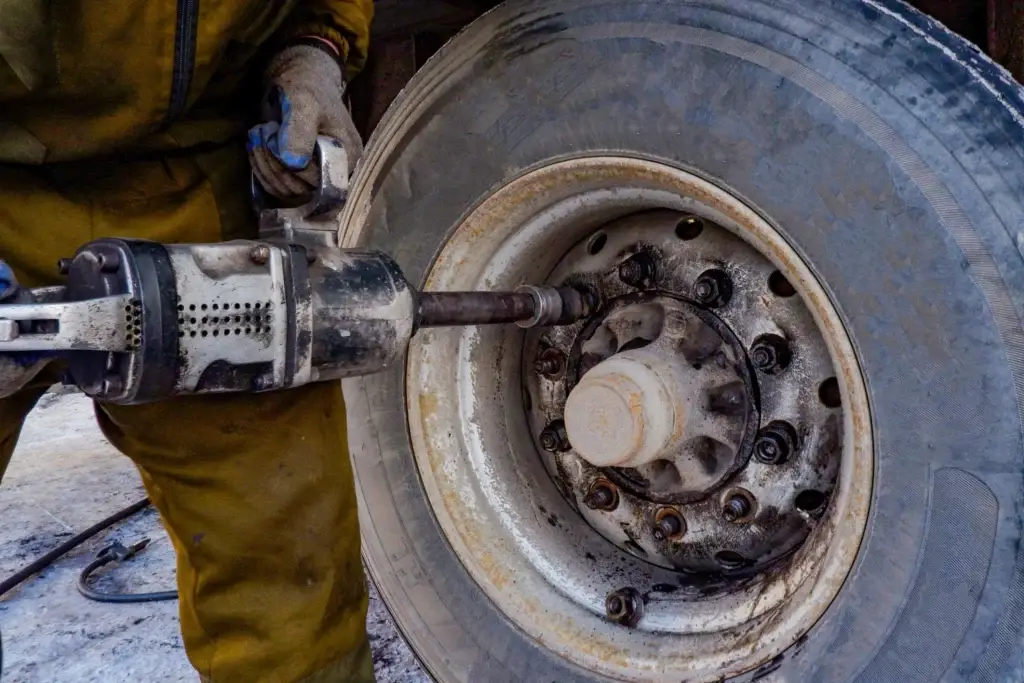
Changing a damaged tire on a Class 8 truck requires removing a wheel fastener typically torqued to 450–500 ft-lb on a standard 10-stud hub. A manual breaker bar with the appropriate socket is the minimum capability for a roadside wheel removal, but it requires significant physical effort on a corroded or overtightened fastener.
A cordless or pneumatic impact wrench rated for a heavy truck lug nut removal dramatically reduces the time and effort required. HDJ's trailer bearing adjustment guide covers the torque discipline that matters on the wheel-end side of the same job.
Equally important is the torque wrench or torque stick used for reinstallation. An undertorqued fastener leads to a wheel separation — one of the most dangerous outcomes in commercial vehicle operation. An overtorqued fastener stretches or cracks a stud. Every spare tire or wheel swap performed at the roadside should use a torque wrench or calibrated torque stick to achieve the manufacturer's specified fastener torque before the vehicle returns to service.
Safety and Visibility Equipment
Roadside tire work on a highway shoulder is a hazardous environment by definition. A federal regulation under FMCSA Part 392 requires placement of a warning triangle or flare when a vehicle is stopped on a roadway or its shoulder. The practical standard for roadside tire repair should include at minimum: three reflective triangles or LED safety flares placed at 10 feet, 100 feet, and 200 feet from the rear of the vehicle; a high-visibility safety vest worn throughout the repair; and a wheel chock to prevent vehicle movement.
Temporary vs. Permanent Repairs: Understanding the Critical Distinction
No aspect of commercial tire repair causes more operational confusion — or more compliance risk — than the line between a temporary roadside fix and a permanent shop repair. Understanding that distinction isn't just best practice; it directly affects how you categorize your tools, how you train your drivers, and how you explain your maintenance decisions during a CSA audit.
A temporary repair seals the air leak and stabilizes the tire sufficiently to move the vehicle safely to a qualified repair facility. An external plug — driven through the tread into the bore of a puncture — is a temporary repair. A can of tire sealant inflated through the valve stem is a temporary measure.
These approaches work as recovery tools, not as an in-service fix. A plugged tire that goes back into full-load highway service without an internal inspection and permanent repair hasn't been properly repaired under industry standards — it has been temporarily stabilized and is operating on borrowed time.
A permanent repair removes the tire, inspects the carcass from the inside, confirms the damage is within the repairable zone, prepares the injury area, and applies an internal patch-plug combination that's vulcanized to the inner liner. This is the only repair type that restores the tire's ability to carry its rated load for continued commercial service.
Key Recommendation
Any puncture in the shoulder area of a commercial truck tire — within one inch of the shoulder break — or any damage involving the sidewall should be treated as non-repairable. No shop tool, patch, or plug restores structural integrity to a shoulder or sidewall damage. The tire must be replaced. Document the damage in your maintenance records before disposal.
For a fleet manager building a maintenance protocol, this distinction needs to be communicated clearly and enforced consistently. A driver who plugs a tire and puts it back into full-load service without informing dispatch or scheduling a shop inspection isn't cutting corners — they may not understand that they're operating a temporarily stabilized tire as if it were a permanently repaired one.
Closing that training gap starts with connecting tool purpose to repair category: when a driver knows that a plug kit is a "get to the shop" tool and not a "fix the problem" tool, the protocol becomes intuitive.
CVSA Tire Out-of-Service Criteria and Their Impact on Tool Requirements
The CVSA's North American Standard Out-of-Service Criteria is republished every year, effective April 1, and tire-related conditions have been a recurring focus of that annual revision. Two changes made in recent editions remain in force under the current handbook and directly shape what belongs in a driver's toolkit.
The first involves a tire with a tread-area leak and the role of an automatic tire inflation system (ATIS), added to the criteria effective April 1, 2024. A tire with a noticeable tread-area leak is an immediate out-of-service condition if the vehicle isn't equipped with an ATIS. If an ATIS is present and the system is maintaining pressure above 50% of the maximum sidewall pressure, the condition doesn't trigger an OOS order.
The practical implication: a driver operating a vehicle without ATIS needs to understand that a slow tread leak observed during a pre-trip inspection can't be driven on — it's a vehicle-grounding condition at a roadside inspection.
Effective April 1, 2025, CVSA added a further condition: any tire with a sidewall leak is an automatic OOS condition regardless of leak rate and regardless of whether ATIS is present. That same edition also eliminated the previous distinction between radial and bias-ply tire OOS conditions, consolidating them into a single unified standard. Neither provision has been reversed in a subsequent edition, so both remain the current, enforceable standard today.
Sidewall structural integrity is non-negotiable under these criteria, which reinforces why sidewall damage belongs exclusively in the replacement category — carrying a roadside repair tool should never create the impression that a sidewall issue can be addressed in the field. Fleet managers should review the CVSA's out-of-service criteria reference directly each year and ensure their driver training materials reflect the current edition rather than a legacy version.
Free DOT Status Check
Enter a USDOT number and quickly review public carrier status, operating authority and key FMCSA registration data.

Building a Tire Tool Inventory by Operation Type
The right tool inventory for tire repair depends on the scale of your operation, the environments your vehicles run in, and whether your organization performs its own shop repairs or relies on outside service. A single owner-operator running a regional route has a different requirement than a fleet maintenance manager overseeing a shop with five bays.
Owner-Operator Essentials
An owner-operator's tire repair capability is appropriately limited to roadside stabilization and safe transit to a qualified repair facility. The full roadside kit for an owner-operator running a Class 8 tractor-trailer should include a calibrated digital tire pressure gauge, a commercial-grade plug kit with a T-handle insertion tool and adequate plug supply, a portable 12-volt compressor rated for commercial tire pressure ranges, a torque wrench or torque stick sized for your wheel fasteners, a 1-inch or 3/4-inch breaker bar for lug nut loosening,
a minimum of three safety triangles, a high-visibility vest, a wheel chock, and a quality flashlight or headlamp for nighttime work.
Beyond the immediate repair kit, an owner-operator should establish a relationship with a roadside tire service provider or national network before a breakdown occurs. Knowing who to call and having the number saved eliminates the delay of searching for assistance while a load sits on a highway shoulder.
Small Fleet Requirements (5–25 Units)
A small fleet typically operates a hybrid model: a driver-level roadside tool on every truck, supplemented by a limited shop capability at the terminal or yard. At this scale, investing in a quality bead breaker, a wheel balancer capable of handling a truck and trailer assembly, an electric vulcanizing press for a permanent patch repair, and a proper shop compressor with an inflation cage creates the ability to handle a routine repair in-house rather than trucking every flat to an outside shop.
For a small fleet, an annual inspection compliance under 49 CFR 396.17 creates a documentation requirement that extends to tire condition. An annual inspection record must be retained for 14 months and cover tire condition as a mandatory inspection item. HDJ's DOT inspection checklist guide covers the broader documentation framework this tire-specific requirement fits into.
Fleet Shop and Large Operation Requirements
A fleet maintenance shop handling 50 or more units requires commercial-grade equipment across every tire service category. The basic complement for a four-to-six bay operation includes: a powered truck tire changer for both standard truck wheels and super-single applications, at least one heavy-duty wheel balancer, a stand-alone bead breaker for manual assistance, a vulcanizing press, a buffing machine with appropriate wheel attachments, a carbide cutter set,
an inflation cage capable of handling the largest rim assembly in your fleet, a multi-position air chuck and dual-foot chuck set for inflation work, a torque wrench calibration program for every fastener torque tool used in tire service, and a dedicated tire spreader for an internal injury inspection.
A large shop also benefits from a tire inventory management system that tracks each tire by its DOT serial number, records repairs, and monitors position history and mileage accumulation. This isn't tire repair tooling per se, but it's the data infrastructure that makes a tire repair decision — repair versus replace, rotation timing, mileage-based replacement thresholds — defensible and consistent across your technician team.
Tire Inspection Tools and Compliance Documentation
A tire inspection tool is as important to fleet compliance as a repair tool is to fixing damage. The ability to detect a problem before it becomes a roadside violation — or a catastrophic failure — is the practical value of a systematic inspection program supported by the right instrument.
A tread depth gauge is the fundamental inspection instrument. A quality metal-body dial gauge or digital gauge with a 0–25mm measurement range covers the full spectrum of a commercial truck tire tread depth from new to well-worn. The gauge probe needs to reach into a major tread groove without rocking, and the measurement should be taken at the shallowest point in each groove rather than the deepest.
A tire probe and pick tool is used to inspect a tread area injury and detect an embedded object — a screw, nail, glass, metal fragment — that hasn't yet caused a perceptible leak. A systematic probe inspection of each tire's tread surface during every scheduled PM service catches an embedded object before it migrates deeper into the carcass.
Removing a nail from a tire that hasn't lost pressure is a five-minute shop repair; dealing with the same nail after it works its way through and causes a roadside flat is a several-hour ordeal with significantly higher total cost.
A tire pressure monitoring record should be part of every fleet's formal maintenance documentation. A driver completes a pre-trip inspection under the daily vehicle inspection report requirements at 49 CFR Parts 396.11 and 396.13, and tire condition is a mandatory element. HDJ's CSA score improvement strategies guide covers how a documented tire condition ties into the broader Vehicle Maintenance BASIC.
A pressure reading taken at pre-trip with a calibrated gauge and noted on the DVIR provides a documented chain of custody for tire condition that protects the carrier during a post-accident investigation and FMCSA compliance review.
Quick Reference: Minimum Tread Depth Standards (49 CFR 393.75)
- Steer tires (all trucks and truck tractors): 4/32 inch minimum, measured at any point on a major tread groove
- Drive tires: 2/32 inch minimum in any major tread groove
- Trailer tires: 2/32 inch minimum in any major tread groove
- Immediate OOS condition: Any tire with body ply or belt material exposed through tread or sidewall
- Immediate OOS condition: Any tire with a flat or audible leak (393.75(a)(3)) — highest frequency tire violation in enforcement
- Current CVSA criteria: A tread-area leak without ATIS is an immediate OOS condition; any sidewall leak is an automatic OOS condition regardless of ATIS
Frequently Asked Questions
What commercial truck tire repair tools should every owner-operator carry?
Every owner-operator should carry a calibrated tire pressure gauge, a quality plug-and-patch kit for temporary roadside sealing, a portable air compressor capable of reaching at least 125 PSI, a heavy-duty lug wrench or breaker bar, a torque stick or torque wrench rated for your wheel fasteners, a safety triangle and high-visibility vest, and a tread depth gauge. These cover the most common roadside scenarios and help you stay compliant with a pre-trip inspection requirement — they don't replace a professional shop repair for structural or sidewall damage.
Can a commercial truck tire be plugged and legally driven on the highway?
An external plug is a temporary repair measure only and isn't a permanent fix under industry standards. Commercial tire repair standards require that a permanent repair use an internal patch-plug combination, properly vulcanized from inside the tire. Operating on a plug alone may not immediately violate a specific statute, but if the tire fails inspection or shows exposed belt material, you face an out-of-service order under 49 CFR 393.75. Best practice: get to a qualified shop, then have a technician perform the permanent repair.
What is the minimum tread depth required for commercial truck tires?
Under 49 CFR 393.75, a steer tire on a commercial motor vehicle must have at least 4/32 inch of tread depth measured at any point on a major tread groove. A drive tire and trailer tire must maintain a minimum of 2/32 inch. A tire that falls below these thresholds, or shows body ply or belt material exposed through tread or sidewall, is an immediate out-of-service violation. A CVSA inspector applies these federal standards during a roadside inspection, and a violation can halt operations until the condition is corrected.
What tools are needed to perform a permanent tire repair in a shop?
A proper permanent commercial tire repair requires a tire spreader or bead breaker to dismount the tire, a buffing machine or carbide cutter to prepare the injury area, a vulcanizing press to bond the patch, an appropriate patch-plug combination sized for commercial tires, a compatible repair cement, a stitching tool to eliminate air pockets under the patch, a tread depth gauge and probe to inspect the injury, and an inflation cage for safe re-inflation. OSHA 29 CFR 1910.177 governs safe servicing of multi-piece and single-piece rim wheels.
How do the current CVSA out-of-service criteria affect tire inspection requirements?
A tire with a noticeable leak in the tread area is placed out of service if the vehicle lacks an automatic tire inflation system, a provision in force since the April 2024 edition. Any tire with a sidewall leak is an automatic out-of-service condition regardless of ATIS, added in the April 2025 edition alongside a consolidation of the previously separate radial and bias-ply criteria into one standard. Both remain current. Fleets should ensure a technician understands the ATIS interaction rule and every driver carries a functional pressure-monitoring tool.
A commercial truck tire repair tool is ultimately a decision about what level of capability — and what level of risk — your operation can afford in each environment. A roadside kit that can safely stabilize a tire and move a loaded vehicle to qualified help is the minimum acceptable standard for any commercial driver.
A shop equipped to perform a permanent, inspection-ready repair in-house creates the compliance and cost control that keeps a fleet competitive over the long haul — the same discipline Michael Nielsen and Heavy Duty Journal's editorial team hold every guide on heavydutyjournal.com to. Tires need to be in compliance before they leave the yard, and the tools to verify and maintain that compliance need to be part of every operation's standard equipment, not an afterthought.
Share This Guide With Your Fleet Team
If your shop techs or drivers could use a clear breakdown of what tools belong in each environment — and what the current CVSA criteria actually mean for tire compliance — pass this along. Knowing the difference between a temporary roadside fix and a permanent repair could keep your drivers safe and your CSA score clean.


