By Michael Nielsen, Publisher | 15+ Years in Diesel Repair
Last Updated: October 2026
⏱ Estimated reading time: 14 minutes
A truck wheel balancer has to match the wheel it will carry, not just the tire shop's habits. A heavy assembly needs a lift, a rim range that covers 22.5-inch wheels, and a way to measure imbalance on two planes. This guide compares electronic and manual balancers and the published specifications of five real truck models.
Heavy Duty Journal's editorial team, led by publisher Michael Nielsen, rebuilt this guide for shop managers, fleet maintenance directors, and technicians. HDJ read manufacturer pages and spec sheets from Hunter, Ranger, Corghi, and Snap-on, plus the federal tire rule, all checked as of October 2026. HDJ did not test any balancer.
According to Heavy Duty Journal's October 2026 review, the biggest correction is which machines belong in a truck guide. Two models in the earlier version, the Hunter Road Force Elite and the Ranger DST2420, list weight limits of 175 and 145 pounds, which is passenger and light-truck territory, so they now sit in their own section.
Key Takeaways
- ✓Weight limit decides the fit. The Hunter HD Elite lists 500 pounds, the Ranger RB30T 330 pounds, and the Hunter Road Force Elite only 175 pounds.
- ✓Check the rim range first. The Ranger RB30T lists 13 to 24 inches, so a 24.5-inch wheel may fall outside it, while the Hunter HD Elite lists 10 to 30 inches.
- ✓Manual means one plane. A static balancer reads imbalance in a single plane, while an electronic machine measures two planes and reports weight and angle.
- ✓Accuracy is not comparable. HDJ found 1.0-gram resolution on Hunter and Ranger pages and no accuracy figure for any manual balancer, so none is claimed.
- ✓Federal rules are silent on balance. The federal tire rule, section 393.75 of Title 49 of the Code of Federal Regulations (CFR), covers tread depth, load rating, and damage, and it does not mention balance or vibration.
- ✓No prices or savings are claimed. The earlier fuel, tire-life, and payback figures had no source, so HDJ removed them.
In This Guide
- How a Truck Wheel Balancer Works
- Electronic vs. Manual Truck Wheel Balancers
- Truck Wheel Balancer Specifications Compared
- Light-Duty Balancers That Do Not Fit Truck Wheels
- Power, Space, and Wheel Handling
- What Federal Rules Say About Balance
- Buying Checklist: Questions to Put in Writing
- Frequently Asked Questions
- The Bottom Line
How a Truck Wheel Balancer Works
A truck wheel balancer spins a wheel and tire assembly on a horizontal shaft and measures the force the uneven mass produces at the bearings. The machine converts those readings into a weight and a position, and the technician places weights to cancel the imbalance. The physics is the same for every size of wheel.
The force follows a simple relationship: force equals mass times radius times angular velocity squared. Speed matters most, because the force rises with the square of rotation. That is why a wheel that feels fine in the shop can shake the steering wheel on the highway.
HDJ ran an illustrative example. Assume 4 ounces of imbalance at the 11.25-inch radius of a 22.5-inch rim, on a tire with a rolling diameter of 40 to 42 inches at 65 miles per hour. The assembly turns about 520 to 546 revolutions per minute (rpm), and the unbalanced force comes to roughly 22 to 24 pounds.
22-24 lb
The unbalanced force from 4 ounces at a 22.5-inch rim radius at 65 mph, by HDJ's own arithmetic with assumed tire sizes; it is an illustration, not a manufacturer figure.
At that speed the wheel turns roughly nine times per second, so the force pushes the axle once per turn. Drivers feel it as a vibration that tracks road speed. HDJ's driveline vibration diagnosis guide covers how to separate wheel imbalance from driveline causes.
Balance has two parts. Static imbalance is a heavy spot that makes the wheel bounce, and couple imbalance is two heavy spots on opposite sides and opposite planes that make it wobble. A truck wheel balancer that measures only one plane can correct the first and miss the second.

Electronic vs. Manual Truck Wheel Balancers
Electronic and manual balancers differ in what they can sense. An electronic, or dynamic, balancer spins the wheel and reads force sensors on two planes. A manual, or static, balancer such as a bubble or gravity unit shows only the heavy side of a wheel at rest, so it cannot detect couple imbalance.
| Feature | Manual (static) balancer | Electronic (dynamic) balancer |
|---|---|---|
| Planes measured | One | Two (inner and outer) |
| Spins the wheel | No, it relies on gravity | Yes, on a powered shaft |
| Output | Shows the heavy side of the wheel | Shows weight amount and position for each plane |
| Couple imbalance | Cannot detect it | Detects and corrects it |
| Published accuracy figure | HDJ found none | 1.0 g listed by Hunter (HD Elite) and Ranger (RB30T, DST2420X) |
| Needs power | No | Yes, single-phase supply on the models read |
The table reflects how the two methods work and what HDJ could read on manufacturer pages as of October 2026. HDJ found no manufacturer specification for a manual truck balancer, so it does not give an accuracy number for that type. The earlier version's gram ranges for manual units had no source.
A manual unit can suit a low-volume yard that balances a few steer-axle wheels. HDJ recommends confirming that the shop's balance spec, or the tire or vehicle maker's, allows single-plane balancing. If a vibration complaint comes back after a static balance, the next step is a spin balance on a dynamic machine.
Electronic machines add features beyond the two planes. The Hunter HD Elite page lists a diagnostic load roller that detects the high spot of a tire so it can be machined. Hofmann's geodyna 980 L release lists a split weight mode that hides weights behind spokes.
Those features cost shop floor space and training time. HDJ advises asking whether a feature changes the work the shop actually does, such as steer-axle balancing on 22.5-inch wheels, before paying for it. Features on a light-duty machine do not help if the wheel is too heavy for it.
Truck Wheel Balancer Specifications Compared
The table below compares the truck-capable electronic balancers HDJ could read on manufacturer pages and spec sheets as of October 2026. A dash means the page HDJ read did not state the figure. HDJ did not test any of these machines, and it lists no prices.
| Model | Max wheel or tire weight | Rim diameter | Rim width | Other published detail |
|---|---|---|---|---|
| Hunter HD Elite | 500 lb (227 kg) | 10 to 30 in | 1.5 to 19.5 in | 1.0 g resolution; 100 rpm; lifts up to 227 kg |
| Ranger RB30T | 330 lb | 13 to 24 in | 4 to 20 in | 7 s car or 20 s truck cycle; pneumatic lift |
| Ranger RB24T | — | Up to 30 in (tires up to 50 in) | 20 in | 500-lb push-button wheel lift; three-phase drive motor |
| Corghi ET1450 TruckLine | Lifts up to 150 kg | 28 in diameter acquisition listed | — | 40 mm shaft; automatic width calculation |
| Hofmann geodyna 980 L | — | — | — | Heavy-duty wheel lift; 4/5-arm star adapter; split weight mode |
Hunter HD Elite
As of October 2026, Hunter's HD Elite brochure lists a maximum tire weight of 227 kilograms (500 pounds), a rim diameter of 10 to 30 inches, and a rim width of 1.5 to 19.5 inches. Imbalance resolution is listed at 1.0 gram, with placement accuracy of 512 positions within 0.35 degrees, at a balancing speed of 100 rpm.
The brochure lists a 196 to 253-volt, 10-amp, single-phase supply, and says the machine lifts wheel assemblies up to 227 kilograms. Hunter's page describes it as a heavy-duty diagnostic balancer for buses and trucks. The brochure also says it services cars and light trucks.
Hunter's ForceMatch HD page lists the same 500-pound limit with a 30-inch rim and 19.5-inch width. HDJ did not find an accuracy figure on that page, so it is not compared here.
Ranger RB30T and RB24T
As of October 2026, Ranger's RB30T page lists a 330-pound maximum wheel weight, a 13 to 24-inch diameter, and a 4 to 20-inch width. It lists 208 to 240 volts, single phase, and an integrated pneumatic wheel lift. The page names buses, semi-trucks, over-the-road (OTR) applications, light-duty trucks, and passenger vehicles.
Cycle time is listed as 7 seconds for a car and 20 seconds for a truck wheel. The 24-inch top of the diameter range matters, because a 24.5-inch wheel may fall outside it. Confirm the size with Ranger before buying for a fleet that runs that wheel.
The RB24T page lists tires up to 50 inches, rim sizes up to 30 inches, a 20-inch width, and a 500-pound push-button wheel lift. It also lists a three-phase 380-volt drive motor with a built-in digital phase converter, but the page did not state a maximum weight or accuracy.
Corghi ET1450 TruckLine and Hofmann geodyna 980 L
As of October 2026, Corghi's ET1450 TruckLine page says it lifts wheels weighing up to 150 kilograms, about 331 pounds, and lists a 40-millimeter shaft and automatic acquisition of distance and 28-inch diameter. It also lists an automatic width calculation system. The page did not state a maximum width, accuracy, or power draw.
As of October 2026, Snap-on's March 2025 release for the Hofmann geodyna 980 L lists a heavy-duty wheel lift, a 4/5-arm star adapter, a raised monitor with a digital LED display, semi-automatic data entry, and split weight mode. It gives no weight, diameter, or accuracy figures, so ask Hofmann for the full specification.
HDJ dropped four models from the earlier version. It could not find a Hofmann 9900p, a Weaver W-937, a Coats 1500-3D, or a Coats 1055 on a manufacturer page, and Hunter's spec sheet names the Road Force Elite rather than an RFE2.
Light-Duty Balancers That Do Not Fit Truck Wheels
Some well-known balancers are built for cars and light trucks, and the published limits show it. As of October 2026, Hunter's Road Force Elite spec sheet lists a maximum tire weight of 175 pounds and a rim diameter of 10 to 30 inches. Ranger's DST2420X page lists a 145-pound maximum.
| Model | Max wheel weight | Rim diameter | Rim width | Other published detail |
|---|---|---|---|---|
| Hunter Road Force Elite | 175 lb (79 kg) | 10 to 30 in | 1.5 to 20.5 in | 0.01 oz (0.28 g) resolution; 300 rpm; roller force up to 1,250 lb |
| Ranger DST2420X | 145 lb | 8 to 30 in | 2 to 18 in | 1 g (0.035 oz) accuracy; 7 s cycle; cars and light trucks |
The Road Force Elite's spec sheet does not name vehicle types, but a 175-pound limit points to passenger and light-truck assemblies. Ranger's page describes the DST2420X for cars and light trucks. The earlier version of this guide placed both in a truck-balancer roundup and gave the DST2420 a truck capacity that its page does not support.
The difference between the Hunter lines is clear on paper. The Road Force Elite lists a finer resolution of 0.01 ounce and a 300 rpm balancing speed, while the HD Elite lists 1.0 gram and 100 rpm. The truck machine trades resolution and speed for weight capacity and a lift.
Shops that service both pickups and Class 8 tractors may need two machines. A light-duty unit is quick and fine for passenger and pickup work, and a heavy unit handles 22.5-inch assemblies. HDJ advises against forcing a heavy assembly onto a machine whose page lists a lower limit.
Power, Space, and Wheel Handling
A balancer is only as useful as the shop can feed it. Power is the first question. As of October 2026, Hunter's HD Elite brochure lists a single-phase 196 to 253-volt supply at 10 amps, and Ranger's RB30T lists 208 to 240 volts, single phase. The RB24T's drive motor is three-phase.
Ranger lists a built-in phase converter for the RB24T, but its page does not state what supply the machine needs. HDJ recommends getting the electrical requirement in writing and having an electrician confirm the circuit before the machine arrives. Do not assume a shop's existing outlet will work.
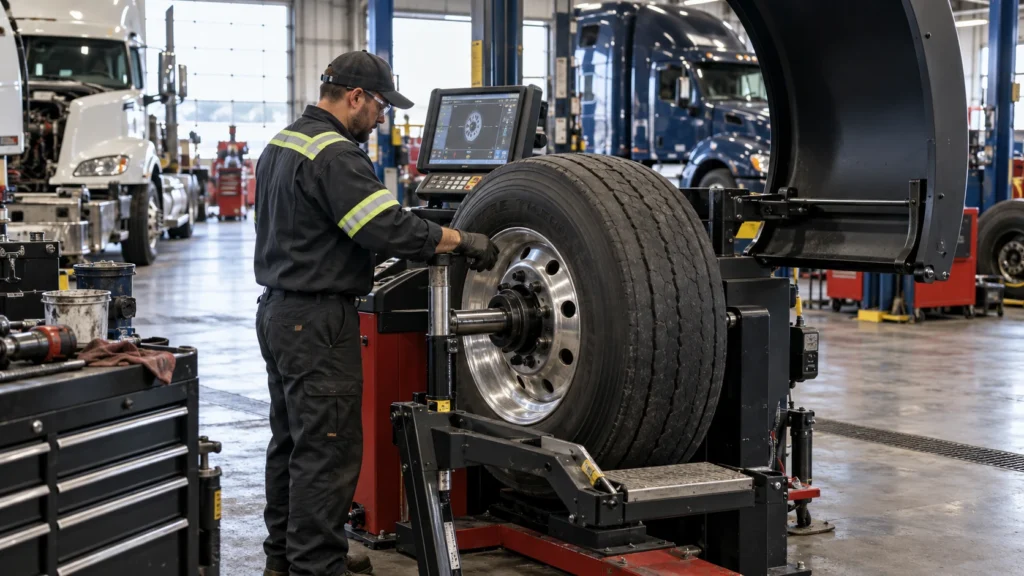
The wheel is the second question. Lift capacities on the pages HDJ read range from 150 kilograms, about 331 pounds (Corghi), to 500 pounds (Hunter and the Ranger RB24T). A mounted 22.5-inch assembly is heavy enough that manual lifting onto a balancer shaft is a repeated strain risk.
⚠️ Safety Warning
Mount only assemblies within the balancer's listed weight and size limits. Use the machine's wheel lift instead of lifting a heavy assembly by hand, clamp the wheel with the hardware the maker supplies, and keep hands and tools clear while it spins. Follow the maker's manual for guards and procedures.
Mounting comes before balancing, and a poorly seated bead produces a false reading. HDJ's commercial tire changer guide compares the machines that put the tire on the rim.
Repairs come first too. A wheel that left the shop with a patched tire or a replaced valve should be balanced after the work is done. HDJ's tire repair tools guide covers the tools used before the wheel reaches the balancer.
Floor space and a clear lane to roll wheels in also matter, and the pages HDJ read did not list footprints, so ask for dimensions. A balancer is precision equipment, and an out-of-tolerance machine balances every wheel wrong. Ask the maker how often it recommends checking calibration, and write it into the shop's routine.
Free Diesel Maintenance Checklist
Get HDJ's free, field-tested diesel maintenance checklist delivered instantly to your inbox — print it, laminate it, keep it in the shop.
Instant PDF • 100% Free • No Spam
Record the date of each calibration check and who ran it. A short log shows the shop treats the machine as measuring equipment, and it makes a drifting balancer easy to spot over time. A known test weight on a known wheel is the simplest check, and the manual should describe the exact procedure.
What Federal Rules Say About Balance
The federal tire rule does not set a balance tolerance. As of October 2026, 49 CFR 393.75 requires at least 4/32 inch of tread on the front wheels of a bus or truck and 2/32 inch on other tires. It bars tires that carry more weight than the sidewall marking and tires that are flat or have an audible leak.
The same section prohibits exposed ply or belt material, tread or sidewall separation, and cuts that expose ply or belt material. It does not mention balance or vibration. The earlier version of this guide linked federal and industry pages as if they set balance limits, but none supported that claim.
So the balance spec comes from the tire, wheel, or vehicle maker, or from the fleet's own policy. HDJ recommends writing that spec into the shop procedure, including how much residual imbalance is acceptable and which wheels get a spin balance. If the maker publishes a tolerance, that number governs.
Tire wear has many causes, and HDJ found no primary source that puts a number on fuel savings or tire life from balancing, so it makes no such claim. HDJ's tire management guide covers pressure, rotation, and wear patterns.
For fleets that set cost targets, HDJ's fleet tire management strategies guide covers program-level tire practices. Any balancing savings should come from the fleet's own records, such as wear and complaint history, not from a generic percentage.
Buying Checklist: Questions to Put in Writing
Before you accept a quote for any truck wheel balancer, ask the dealer to put these answers on paper so the figures on the sheet become commitments:
- Maximum wheel and tire weight, compared with your heaviest mounted assembly
- Rim diameter and width ranges, including 22.5-inch and 24.5-inch wheels if you run them
- Wheel lift capacity and whether it is built in
- Electrical requirement: voltage, phase, and amperage
- Whether the machine measures two planes and how it reports weight and position
- Published accuracy or resolution, and the test it was measured with
- Calibration procedure and recommended interval
- Warranty term, parts availability, and who services the machine
The list is built around the figures that varied on the pages HDJ read. Weight limits ran from 145 to 500 pounds, diameter ranges stopped at 24 or 30 inches, and one truck model's power page was silent on supply. Missing figures should be requested, not guessed.
Compare quotes on the same basis. A machine that lists a lower limit may cost less because it is a light-duty unit, and the quote tells you nothing about that unless the weight and size limits are on it. HDJ lists no prices because none could be verified from a primary source.
Training and service matter as much as the spec. Ask who trains the technicians, how a service call is handled, and what happens if the machine is down. A balancer that sits idle waiting for a part delays every tire job behind it.
Frequently Asked Questions
What is the difference between an electronic and a manual truck wheel balancer?
A manual or static balancer shows the heavy side of a wheel at rest and reads one plane. An electronic balancer spins the wheel and measures two planes, reporting weight and position for each. HDJ found no manufacturer accuracy figure for manual balancers as of October 2026.
Can a car wheel balancer balance truck wheels?
Only if the wheel is inside its published limits. As of October 2026, Hunter lists 175 pounds for the Road Force Elite and Ranger lists 145 pounds for the DST2420X, while the Hunter HD Elite lists 500 pounds. Check weight, diameter, and width against the model page.
What rim sizes do truck wheel balancers handle?
It varies by model. Hunter lists 10 to 30 inches for the HD Elite and Ranger lists 13 to 24 inches for the RB30T, so a 24.5-inch wheel may not fit the Ranger. Confirm the exact wheel size with the maker before buying.
Does a federal rule require balancing truck tires?
No. As of October 2026, 49 CFR 393.75 covers tread depth, load rating, flat tires, and damage such as exposed ply or separation, and it does not mention balance or vibration. The balance spec comes from the tire, wheel, or vehicle maker, or from the fleet policy.
How much weight can a truck wheel balancer lift?
It depends on the model. Corghi lists up to 150 kilograms for the ET1450, and Hunter lists up to 227 kilograms (500 pounds) for the HD Elite. Ranger lists a 500-pound lift for the RB24T. Use the lift, not your back, for heavy assemblies.
The Bottom Line
A truck wheel balancer earns its place when its weight limit covers your heaviest assembly, its rim range covers the wheels you run, and it measures two planes. The Hunter HD Elite and the Ranger RB30T and RB24T publish enough to compare, while Corghi and Hofmann need follow-up questions.
Heavy Duty Journal's guidance at heavydutyjournal.com, from publisher Michael Nielsen and the HDJ editorial team, is to confirm weight, rim size, power, and calibration in writing, use the wheel lift for heavy assemblies, and take the balance spec from the tire or vehicle maker.
Share This Guide With Your Team
If a shop manager or fleet director on your team is choosing a truck wheel balancer, pass this heavydutyjournal.com guide along so they can compare published weight limits, rim ranges, and the federal tire rule before they request quotes.