By Michael Nielsen, Editor & Publisher | 15+ Years in Diesel Repair
Last Updated: January 2026
📖 Estimated reading time: 22 minutes
Commercial fleet tire management separates profitable operations from those bleeding money on preventable expenses. The numbers tell the story: average fleets spend 8-12% of operating costs on tires while top performers keep expenses under 6%. That difference translates to tens of thousands in annual savings for operations running multiple vehicles—savings achieved through systematic tire programs rather than reactive replacement.
Most fleet managers treat tires as consumables, replacing them when worn and moving on. This approach costs companies thousands annually through premature tire failures, excessive fuel consumption, and emergency roadside service calls. Industry analysis from the American Transportation Research Institute reveals that structured tire management protocols deliver 35% cost reductions and significantly longer tire life compared to reactive approaches.
With tire costs rising annually and supply chain pressures mounting, proper commercial tire maintenance has become a competitive necessity rather than a maintenance afterthought. This comprehensive guide presents the proven protocols that separate successful fleet operations from struggling competitors—covering tire pressure fundamentals, rotation strategies, wear pattern diagnosis, and the regulatory compliance requirements every fleet manager must master.
Key Takeaways
- Cost difference is dramatic: Top-performing fleets achieve under 6% operating cost allocation to tires versus 8-12% for average operations—a gap that compounds across every vehicle in your fleet.
- Tire life extension is achievable: Systematic programs extend tire life from 28,000 miles to 45,000+ miles through proper pressure management, strategic rotation, and proactive maintenance.
- Pressure precision matters: A 20% deviation from optimal inflation causes 19-22% tire mileage loss and increases blowout risk by 4x—making accurate pressure monitoring non-negotiable.
- Rotation delivers ROI: Proper tire rotation patterns extend service life by 20-30% by equalizing wear across positions with different stress profiles.
- Wear patterns are diagnostic tools: Center wear indicates over-inflation, shoulder wear signals under-inflation, and cupping reveals suspension problems—each requiring specific corrective action.
- Compliance requirements vary by position: FMCSA mandates 4/32″ minimum tread depth for steer tires and 2/32″ for drive and trailer positions under 49 CFR 393.75.
The Financial Impact of Fleet Tire Management
The difference between fleet profitability and financial struggle often comes down to one overlooked area: strategic tire management. While many fleet managers view tires as necessary maintenance expenses, industry leaders recognize them as controllable profit centers. The financial gap between reactive tire replacement and proactive tire expense management creates competitive advantages that directly impact the bottom line.
Understanding the true economics of tire programs reveals opportunities most fleets leave on the table. Systematic approaches to pressure monitoring, rotation scheduling, and wear analysis deliver measurable returns that compound over time. The data shows that optimized fleets operate with fundamentally different cost structures than their competitors.
Tires as a Major Operating Expense
Tires consistently rank among the top five fleet operating costs, yet their impact varies dramatically based on management practices. Average commercial fleets allocate 8-12% of total operating costs to tire-related expenses, including direct purchases, mounting, balancing, and associated labor. According to ATRI’s Operational Costs of Trucking analysis, tire expenses represent a significant controllable cost category for most carriers.
Top-performing fleets tell a different story. Through strategic tire programs, industry leaders maintain tire expenses under 6% of operating costs. This three to six percentage point difference translates to substantial annual savings for operations running multiple vehicles.
The cost-per-mile metric provides the clearest performance indicator. Fleets with systematic tire management achieve rates under $0.05 per mile. Operations lacking structured programs typically experience costs reaching $0.072 per mile—a 44% increase that erodes profit margins across every route.
61% longer tire life
Well-managed fleets achieve 45,000+ miles per tire versus 28,000 miles for operations with poor tire maintenance practices.
Direct tire costs represent only part of the equation. Indirect expenses compound the financial impact through fuel economy losses of 3-8% from improper inflation, unplanned downtime disrupting schedules and customer commitments, premium rates for emergency roadside service compared to scheduled maintenance, driver productivity losses during unexpected tire incidents, and safety incident costs from preventable blowouts.
Calculating Returns from Systematic Tire Programs
The tire ROI calculation starts with straightforward comparison. Moving from reactive to proactive tire management delivers a 35% cost reduction across the tire budget. For a 50-vehicle fleet spending $180,000 annually on tires, this represents $63,000 in annual savings.
Proper tire pressure maintenance alone generates significant returns. Maintaining optimal inflation improves fuel economy by 5-8%. For commercial vehicles consuming 10,000 gallons annually at $3.50 per gallon, this translates to $1,750-$2,800 in fuel savings per vehicle each year.
| Management Approach | Cost Per Mile | Average Tire Life | Annual Cost (50 vehicles) |
|---|---|---|---|
| Reactive Maintenance | $0.072 | 28,000 miles | $180,000 |
| ✓ Systematic Program | $0.050 | 45,000 miles | $125,000 |
| Difference | -31% | +61% | $55,000 savings |
Blowout prevention delivers both direct and indirect financial benefits. Systematic tire programs prevent the majority of unexpected tire failures. Each avoided roadside incident saves $400-$800 in emergency service costs, plus 2-4 hours of driver time and potential load delays.
Emergency replacement timing creates hidden costs that systematic programs eliminate. Unplanned tire purchases typically carry 25% cost premiums due to expedited shipping, limited vendor options, and inability to negotiate bulk pricing. Predictable replacement schedules enable volume purchasing and competitive bidding.
Tire Pressure Fundamentals for Heavy-Duty Applications
Tire pressure represents the critical bridge between engineering specifications and real-world fleet performance. Every commercial vehicle depends on properly inflated tires to carry loads safely, operate efficiently, and deliver predictable service life. The relationship between inflation pressure and tire performance follows precise engineering principles that fleet managers must understand to optimize operations.
Heavy-duty tires differ fundamentally from passenger vehicle tires in their pressure requirements and sensitivity to inflation deviations. Commercial applications demand rigorous attention to tire inflation pressure because consequences of improper settings multiply across fleet operations. A single pressure mistake repeated across dozens of vehicles creates measurable financial damage within weeks.
The Engineering Connection Between Load and Pressure
Every tire’s load-carrying capacity directly correlates with its inflation pressure through engineering principles established by tire manufacturers. The sidewall rating represents maximum capacity—not the recommended operating pressure for every situation. Fleet managers must match pressure to actual axle loads rather than defaulting to maximum ratings.
Load capacity in tires functions through air pressure supporting the vehicle weight, not the tire structure itself. The compressed air inside creates an inflation cushion that carries the load while the tire casing contains this pressure. When pressure drops, the tire’s ability to support weight decreases proportionally.
Manufacturers provide load and inflation tables that specify exact pressure requirements for different weight conditions. A tire rated for 6,000 pounds at 110 PSI might only need 95 PSI when carrying 5,000 pounds. Running higher pressure than necessary accelerates center tread wear and compromises ride quality.
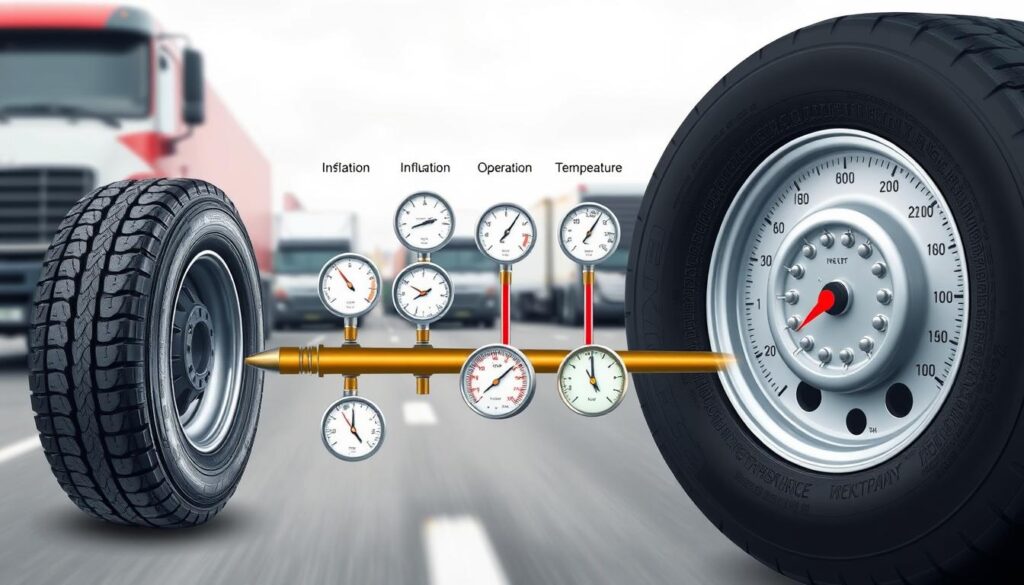
Dual tire assemblies require special consideration because load distribution between paired tires depends on equal inflation. A 5 PSI difference between duals causes the higher-pressure tire to carry disproportionate weight, leading to premature failure of the overloaded tire.
Quantified Impact of Inflation Deviations
The consequences of improper tire inflation pressure extend far beyond theoretical concerns into measurable operational losses. Research demonstrates that under-inflation creates the most severe performance penalties across multiple categories. A tire running 20% below recommended pressure suffers a 19% reduction in expected mileage.
Under-inflation effects compound through several mechanisms that simultaneously attack tire longevity and fleet efficiency. Increased rolling resistance raises fuel consumption by up to 8% per vehicle. Excessive flexing generates heat buildup that increases blowout risk by four times. Accelerated shoulder wear creates irregular tread patterns requiring early removal. Reduced load capacity compromises safety margins during maximum weight operations.
| Pressure Deviation | Tire Mileage Loss | Fuel Economy Impact | Blowout Risk Factor |
|---|---|---|---|
| 20% Under-Inflation | 19% reduction | 8% increase in consumption | 4x higher risk |
| ±15 PSI Deviation | 10% reduction | Variable impact | Elevated risk |
| 20% Over-Inflation | 22% reduction | Minimal benefit | Reduced traction |
Over-inflation presents equally destructive consequences through different failure modes. A tire inflated 20% above specification experiences 22% mileage loss—actually worse than under-inflation. The over-inflation damage manifests as rapid center tread wear because the contact patch shrinks to a narrow band.
Even moderate pressure deviations create significant losses. A variation of just ±15 PSI from optimal settings produces approximately 10% mileage reduction. This finding demonstrates how tight pressure tolerances must be maintained for fleet profitability.
Temperature’s Critical Role in Pressure Management
Ambient temperature changes create constant pressure fluctuations that complicate tire management protocols. The tire pressure temperature relationship follows a predictable pattern: every 10°F temperature change produces approximately 1 PSI pressure variation. This physical principle means tires checked at 40°F morning temperatures will measure 5-7 PSI higher by afternoon when ambient temperature reaches 90°F.
Fleet managers in regions with significant daily temperature swings face particular challenges. A tire properly inflated during cold morning checks may run over-inflated during hot afternoon operations. Conversely, tires set to specification during warm conditions will operate under-inflated the following cold morning.
⚠️ Critical Temperature Consideration
Always check cold tire pressure—measured before the vehicle operates or at least three hours after shutdown. Operating heat can add 10-15 PSI beyond ambient temperature effects, creating misleading readings if checked immediately after driving.
Regional climate patterns demand adjusted monitoring approaches. Fleets operating in hot climates must account for elevated temperatures that increase tire pressure and blowout risk during summer months. Winter operations in northern regions require vigilance against pressure drops that push tires into dangerous under-inflation.
Seasonal pressure adjustments based on temperature forecasts help maintain optimal inflation year-round. Adding 3-5 PSI before winter compensates for cold-weather pressure loss. Conversely, reducing pressure slightly before summer prevents over-inflation during peak heat periods.
Implementing Effective Pressure Monitoring Systems
A robust tire pressure management program begins with standardized procedures that every driver and technician can follow consistently. Commercial fleets need layered monitoring approaches that combine traditional inspection methods with advanced technology. This dual strategy creates redundancy that catches pressure problems before they escalate into costly failures.
Pressure monitoring protocols must account for fleet size, operational patterns, and vehicle utilization rates. High-mileage operations require more frequent verification than vehicles with limited daily use. The foundation of any system rests on accurate measurement techniques and reliable equipment.
Manual Inspection Protocols and Equipment
Cold tire pressure checks deliver the most accurate readings for fleet management decisions. Measure pressure before vehicles begin their routes or wait at least three hours after operation stops. Heat from driving increases internal pressure readings by 10-15 PSI, which creates false data leading to under-inflation.
Quality tire pressure gauges form the cornerstone of manual verification programs. Digital gauges with ±1 PSI accuracy specifications provide the precision commercial applications demand. Analog gauges lack this consistency and often drift out of calibration within months of regular use.
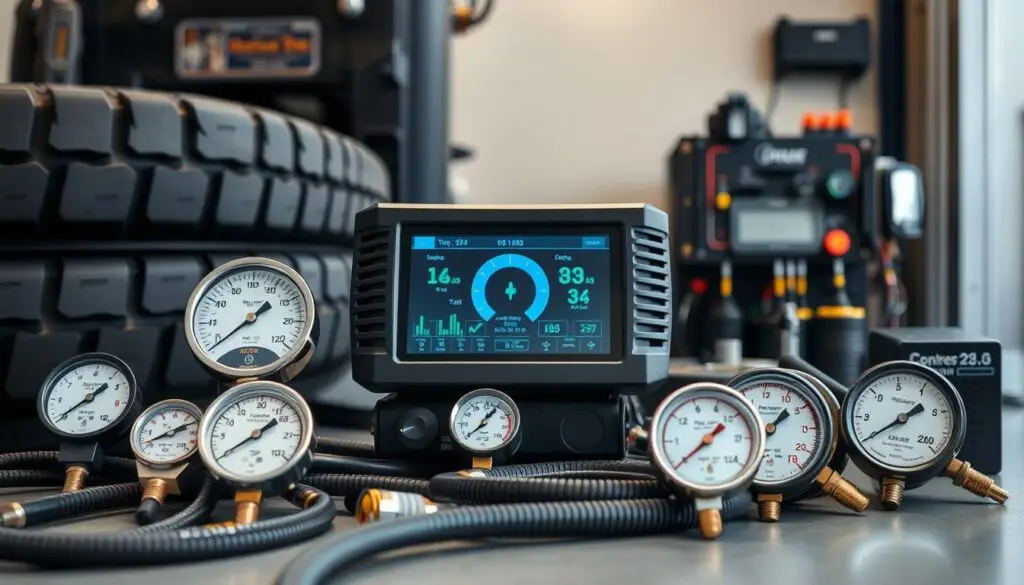
Proper measurement technique requires pressing the gauge firmly onto the valve stem and holding it perpendicular to prevent air leakage. Quick, decisive contact produces reliable readings. Record each measurement by tire position using a standardized documentation form that tracks patterns over time.
| Equipment Type | Specification | Primary Function | Maintenance |
|---|---|---|---|
| Digital Pressure Gauge | ±1 PSI accuracy, 0-150 PSI | Precise cold pressure measurement | Calibrate quarterly |
| Dual-Head Chuck | Inner and outer valve access | Dual tire inflation | Inspect monthly for leaks |
| Portable Air Compressor | 5+ CFM output, 150 PSI capacity | On-site pressure adjustment | Service semi-annually |
| Valve Core Tool | Standard brass construction | Core removal for leak diagnosis | Replace when worn |
Documentation processes separate effective programs from informal approaches. Record pressure by wheel position on each vehicle using consistent notation systems. Note any deviations exceeding 5 PSI from target specifications. Track patterns that indicate slow leaks, valve problems, or systematic under-inflation across specific positions.
Tire Pressure Monitoring System Technologies
Modern TPMS systems provide real-time pressure and temperature data transmitted wirelessly to cab displays or fleet management platforms. Sensors mounted inside tire assemblies or on valve stems continuously monitor conditions during operation. These systems alert drivers to rapid pressure loss from punctures or gradual decreases from natural permeation.
Alert thresholds typically activate when pressure drops 10-15% below programmed targets. Temperature warnings trigger when readings exceed normal operating ranges. Advanced systems integrate with telematics platforms that aggregate data across entire fleets for analysis and predictive maintenance scheduling.
However, TPMS systems supplement rather than replace manual verification protocols. Sensors experience battery depletion, physical damage, and calibration drift that compromise accuracy. Technical malfunctions create false security when operators assume automated systems catch all pressure problems. Battery life remains a practical limitation, with most sensors requiring replacement every three to five years depending on technology type.
Establishing Daily and Weekly Pressure Check Routines
Daily tire inspections should occur before every shift or trip begins. Drivers perform visual assessments checking for obvious deflation, visible damage, and foreign objects lodged in treads. This pre-trip inspection takes less than five minutes but catches critical problems before vehicles enter service.
Visual indicators of under-inflation include bulging sidewalls, excessive flexing during low-speed turns, and tires that appear flatter than adjacent positions. Drivers trained to recognize these signs provide the first defense against pressure-related failures. Document findings on pre-trip inspection reports that become part of vehicle maintenance records.
Weekly comprehensive checks involve physical pressure measurement on all tire positions using calibrated gauges. Schedule these inspections for consistent days when vehicles return to terminals. Early week timing allows mid-week corrections before weekend operations. High-mileage vehicles operating 500+ miles daily require increased inspection frequency—pressure verification every three days rather than weekly intervals.
Determining Correct Tire Pressure for Your Fleet
Load inflation tables provide the scientific foundation for tire pressure decisions that directly impact your fleet’s bottom line. Determining accurate tire pressure specifications eliminates the costly guesswork that leads to premature tire failure and safety hazards. Fleet managers who master this technical process gain measurable advantages in tire longevity and operational efficiency.
The methodology for setting proper inflation pressure differs fundamentally from passenger vehicle approaches. Commercial applications demand load-specific pressure calculations based on actual axle weights and operating conditions. This precision-based approach replaces simplified advice with engineered specifications tailored to your fleet’s unique requirements.
Using Load and Inflation Tables
Load inflation tables serve as the authoritative reference for matching tire pressure to actual vehicle weight. These manufacturer-provided charts cross-reference axle loads with corresponding inflation pressures required to safely carry that weight. Every tire manufacturer publishes these tables for their commercial tire lines, representing engineering calculations rather than general recommendations.
The first critical distinction involves understanding where to find accurate pressure specifications. The tire sidewall maximum pressure represents an absolute limit—not a recommendation for your specific application. This number indicates the highest pressure the tire structure can safely contain, typically ranging from 105 to 120 PSI for heavy-duty applications.
“The most common mistake in commercial tire management is using sidewall maximum pressure as the operating standard. This approach ignores actual load requirements and leads to over-inflation in most applications.”
— Technology & Maintenance Council Recommended Practice Guidelines
To properly use load inflation tables, follow this systematic process. First, weigh each axle under typical loaded conditions using certified scales. Divide the axle weight by tire count on that axle to determine per-tire load. Locate your tire model’s load and inflation table from the manufacturer. Cross-reference the per-tire load with the corresponding pressure requirement. Finally, verify the load index number stamped on the tire sidewall matches the load capacity needed.

| Load Condition | Axle Weight | Per-Tire Load | Required Pressure |
|---|---|---|---|
| Fully Loaded Tractor Drive Axle | 34,000 lbs | 4,250 lbs | 105 PSI |
| Empty Tractor Drive Axle | 18,000 lbs | 2,250 lbs | 75 PSI |
| Loaded Trailer Tandem | 34,000 lbs | 4,250 lbs | 105 PSI |
| Vocational Truck Steer Axle | 12,000 lbs | 6,000 lbs | 110 PSI |
Adjusting Pressure for Variable Load Conditions
Variable load adjustment presents one of the most complex challenges in commercial tire management. Fleets operating under changing weight conditions face a difficult decision: maintain constant pressure for maximum load capacity or adjust pressure to match actual load throughout operational cycles.
The traditional approach maintains pressure for maximum anticipated load regardless of actual weight. This method ensures the tire always has sufficient inflation for the heaviest condition but results in over-inflation during light-load or empty operations. Consequences include accelerated center tread wear, reduced traction, and harsher ride quality.
Progressive fleet operations implement load-specific pressure protocols that adjust inflation based on actual operating conditions. This approach optimizes tire performance and wear patterns but requires systematic pressure management and driver compliance. The practical challenges include time requirements, equipment availability, and operational disruptions.
Several operational scenarios demand specific variable load adjustment strategies. Backhaul operations with vehicles running loaded in one direction and empty returning benefit from pressure adjustment at terminals. Seasonal weight variations in agricultural or temperature-sensitive commodities require seasonal protocol adjustments. Multi-stop delivery routes with weight decreasing throughout the day maintain pressure for starting loaded weight, as attempting adjustments at each stop creates safety risks and operational inefficiency.
Critical safety considerations govern all variable load adjustment decisions. Never operate below the minimum pressure required for any anticipated load condition. Under-inflation creates catastrophic failure risks including tire separation, loss of vehicle control, and excessive heat buildup. When uncertain, maintaining higher pressure provides safer operation than risking under-inflation.
Strategic Tire Rotation for Extended Service Life
Rotating tires across different axle positions counteracts the uneven wear patterns that naturally develop from weight distribution variations in heavy-duty applications. This practice stands as one of the most effective methods for maximizing tire investment returns. Strategic tire rotation directly addresses the fundamental challenge that different axle positions expose tires to dramatically different operating conditions throughout their service life.
Steer axle tires experience distinct forces compared to drive axle tires, which face different challenges than trailer positions. Each location creates unique wear characteristics that accelerate deterioration when tires remain in fixed positions. By systematically moving tires through various positions, fleet managers equalize the cumulative stress each tire experiences.
The Engineering Rationale Behind Extended Service Life
Proper tire rotation delivers documented tire life extension ranging from 20-30% across commercial vehicle applications. This significant improvement results from the fundamental principle of distributing accumulated wear evenly across all tire positions throughout the operational lifecycle. The mechanics behind these tire rotation benefits stem from how forces, heat, and load concentrate differently at each axle location.
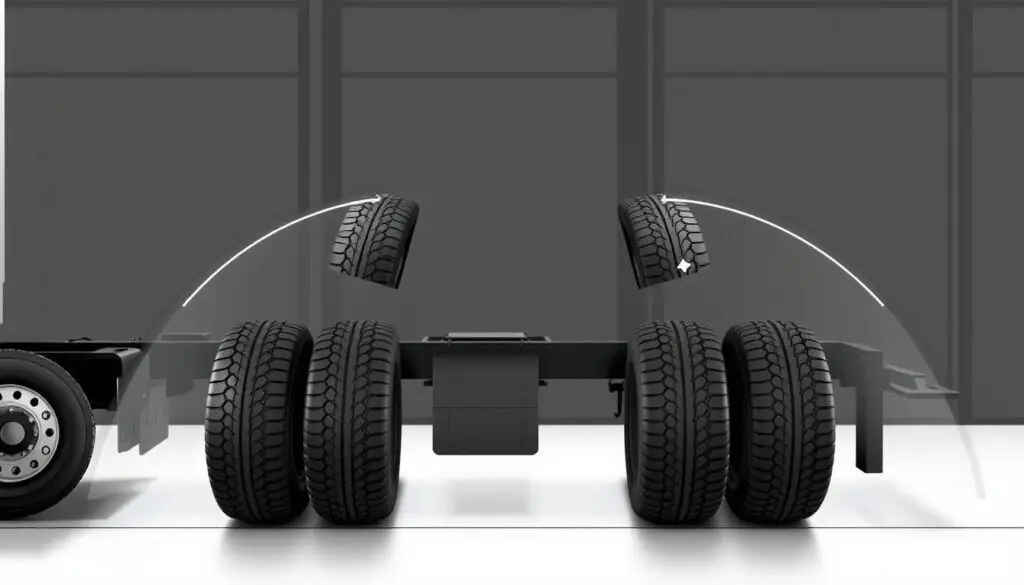
Weight distribution creates the primary driver of uneven wear patterns in heavy-duty vehicles. Inside dual tires experience relatively greater loads compared to their outside counterparts due to weight transfer dynamics during operation. This increased loading accelerates tread consumption on inside positions, creating imbalanced wear rates that rotation directly counters.
Heat absorption presents another critical factor that position changes address. Inside dual tires absorb substantially more thermal energy from brake drums while suffering from reduced ventilation compared to outside positions. This elevated temperature accelerates rubber degradation and compound breakdown, particularly in applications involving frequent braking cycles.
The combination of increased load and reduced cooling creates a challenging environment for inside tire positions. Without systematic rotation, these tires can wear out 40% faster than outside positions. Strategic rotation eliminates this disparity by ensuring each tire spends equal time in high-stress and lower-stress locations.
Establishing Effective Rotation Intervals
Determining optimal rotation schedules requires understanding the distinction between mileage-based and time-based approaches. Each methodology offers specific advantages depending on fleet utilization patterns and operational characteristics. Mileage-based rotation schedules work best for fleets with consistent daily usage and predictable route structures.
Commercial heavy-duty vehicles should undergo tire rotation every 15,000 to 25,000 miles under typical operating conditions. This interval balances labor investment against wear equalization benefits while minimizing unnecessary handling. Fleets operating in severe service applications may benefit from more frequent rotation at the lower end of this range.
| Vehicle Configuration | Mileage Interval | Time Interval | Typical Application |
|---|---|---|---|
| Front-Wheel Drive | 5,000-7,500 miles | Every 6 months | Delivery vans, light commercial |
| Rear-Wheel Drive | 6,000-8,000 miles | Every 6-8 months | Standard pickups, chassis cabs |
| All-Wheel Drive | 3,000-5,000 miles | Every 3-4 months | Heavy-duty pickups, specialized equipment |
| ✓ Commercial Heavy-Duty | 15,000-25,000 miles | Every 3-6 months | Class 7-8 tractors, straight trucks |
Time-based rotation schedules provide better solutions for operations with variable utilization patterns. Vehicles experiencing seasonal fluctuations or inconsistent mileage accumulation benefit from calendar-based rotation intervals. Monthly or quarterly schedules ensure tires don’t remain in high-stress positions for extended periods regardless of actual miles driven.
Integrating rotation services with other scheduled maintenance activities maximizes efficiency and minimizes vehicle downtime. Coordinating rotation with oil changes, brake inspections, or preventive maintenance intervals eliminates dedicated shop visits. This integration approach reduces perceived cost burden while ensuring rotation occurs consistently according to the established schedule.
Rotation Patterns for Different Commercial Vehicle Types
Effective truck tire rotation begins with recognizing that tractor-trailers, straight trucks, and vocational vehicles each require specialized patterns. Vehicle configuration directly influences which rotation strategy delivers optimal tire life extension. The weight distribution, axle count, and operational profile all determine the most effective approach for your specific fleet composition.
Tractor-Trailer Tire Rotation Strategies
Tractor-trailer configurations require position-specific rotation patterns that account for the distinct demands placed on steer, drive, and trailer positions. Steer tires typically remain in their front axle position but benefit from left-to-right swaps to equalize wear from road crown effects. This simple swap can extend steer tire life by 15% without compromising steering precision.
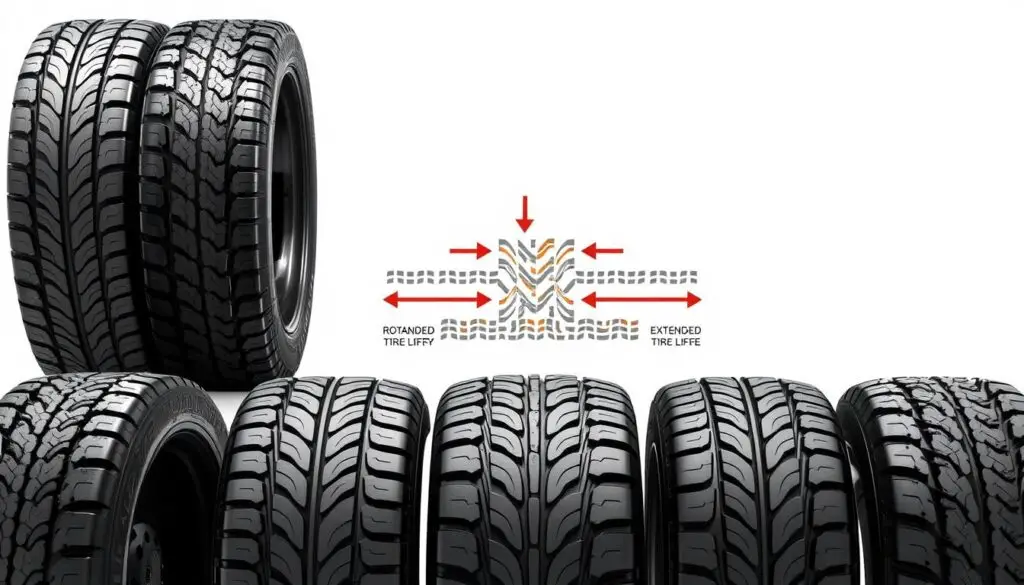
Drive axle rotation patterns for tandem configurations focus on equalizing different wear rates between forward and rear drive positions. The forward drive axle experiences higher torque loads during acceleration while the rear position handles more braking forces. Rotating these positions every 25,000-30,000 miles balances these stress differences effectively.
For dual tire positions, the inside-to-outside rotation proves critical for maximizing tire life. Inside duals operate at higher temperatures and experience greater loads due to weight transfer dynamics. Moving inside duals to outside positions during each rotation cycle ensures both tires wear evenly rather than replacing inside duals prematurely.
Trailer tire rotation demands attention to multi-axle configurations where weight distribution varies significantly. Front trailer axles typically carry more weight than rear positions, creating faster wear rates. Cross-rotation between trailer axles combined with side-to-side swaps equalizes these wear patterns and extends overall trailer tire life by 20-25%.
Straight Truck and Vocational Vehicle Patterns
Straight truck rotation patterns adapt to the vehicle’s weight distribution profile and mission requirements. Delivery vehicles with relatively balanced weight distribution benefit from modified X-patterns that move front tires to the rear opposite side while rear tires move forward on the same side. This pattern works effectively for vehicles in the 20,000-33,000 pound gross vehicle weight range.
Vocational vehicle tires face specialized demands based on extreme weight bias characteristics. Waste haulers with significant front-weight concentration require more frequent front tire rotation to prevent rapid shoulder wear. Concrete mixers and dump trucks with rear-weight dominance need rotation patterns prioritizing rear axle positions where the majority of wear occurs.
Heavy-duty vocational vehicles operating in severe service conditions benefit from position-specific tire selection combined with targeted rotation patterns. Using more aggressive tread patterns on drive positions while maintaining highway treads on steer positions optimizes both traction and tire longevity. Rotation intervals for these applications should decrease to 15,000 miles due to accelerated wear rates.
Handling Mixed Tire Brands and Tread Depths
Tread depth matching becomes critical when rotating tires across different positions to prevent drivetrain stress and handling issues. The maximum acceptable tread depth difference for dual tire applications is 2.5mm, beyond which differential rotation speeds cause irregular wear and potential mechanical damage. Measuring tread depth before rotation prevents mismatched pairings that accelerate wear.
Mixed tire brands require careful attention to tread pattern compatibility during rotation planning. Maintaining the same pattern on each axle ensures symmetrical handling characteristics. Left and right tires must present identical tread designs to prevent steering pull and uneven braking response that compromises vehicle control.
Load index and size specifications must remain consistent across all tire positions during rotation activities. Different load indexes or sizes on the same axle create unbalanced weight distribution that leads to handling difficulties. Fleet managers should maintain detailed tire inventory records showing specifications for each position to prevent incompatible rotation assignments.
The HDJ Perspective
The tire management practices separating top-performing fleets from average operations aren’t proprietary secrets—they’re disciplined execution of fundamentals. After 15 years covering this industry, the pattern is clear: fleets that treat tires as managed assets rather than consumables consistently outperform on cost-per-mile metrics. The technology exists to automate much of this through TPMS and fleet management software, but technology without systematic protocols just generates data nobody acts on. Start with consistent cold tire pressure checks and work up from there.
Comprehensive Tire Wear Pattern Recognition
Every tire in your fleet tells a story through its wear pattern, revealing underlying vehicle problems before they become costly failures. Learning to read these patterns transforms routine inspections into powerful diagnostic opportunities. Fleet managers who master wear pattern diagnosis can identify mechanical issues early and prevent catastrophic breakdowns.
Abnormal wear patterns rarely develop overnight. They emerge gradually as vehicles accumulate miles with improper inflation, misalignment, or failing suspension components. Regular tread inspections provide early warnings that allow corrective action before tire replacement becomes necessary.
Identifying Over-Inflation Through Center Tread Wear
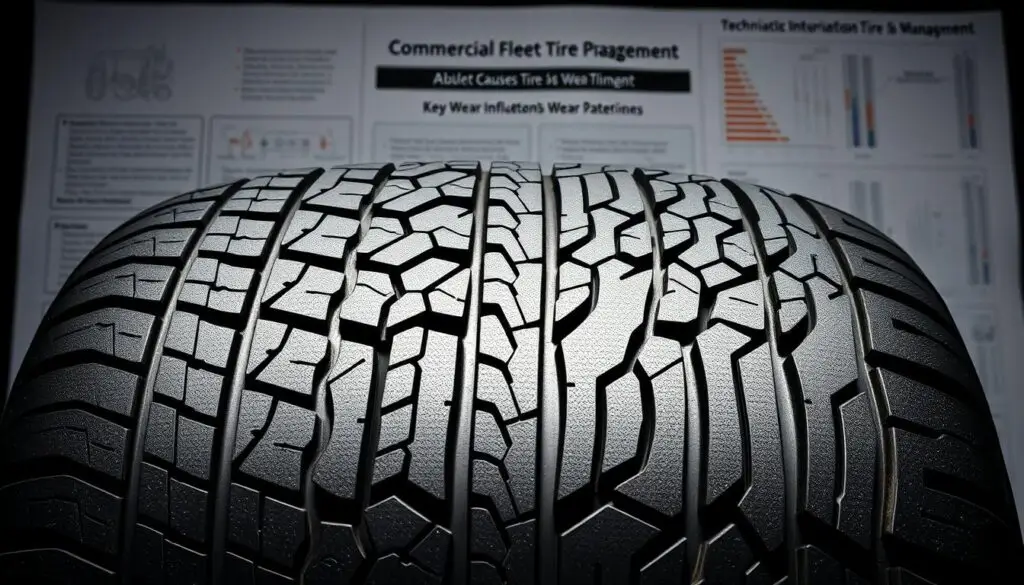
A center wear pattern develops when excessive inflation pressure reduces the tire’s contact patch to primarily the middle tread area. The tire crown bears disproportionate load while shoulder regions make minimal road contact. This concentration of force accelerates wear in the center section.
Visual identification of center wear shows noticeably worn tread blocks in the middle two or three ribs while outer shoulder blocks remain relatively unworn. The difference becomes obvious when comparing tread depth measurements across the tire width. Center ribs may measure 6/32″ while shoulders still show 10/32″ or more.
Corrective action requires reducing tire pressure to manufacturer specifications based on actual load conditions. Use load and inflation tables to determine proper pressure for current vehicle weight. Recheck pressure weekly to ensure it remains within acceptable range.
Recognizing Under-Inflation From Shoulder Wear
Under-inflated tires develop characteristic shoulder wear patterns on both outer edges. Insufficient pressure causes excessive sidewall flexing that transfers load concentration to the tire shoulders. The center tread makes reduced contact with the road surface.
This wear pattern appears as accelerated tread loss on the outer ribs of both shoulders while center tread blocks remain deeper. Shoulder blocks may show heat damage or cracking from the excessive flexing and heat generation. The tire sidewalls often appear more rounded or bulged compared to properly inflated tires.
Temperature effects complicate shoulder wear diagnosis because pressure naturally decreases as ambient temperature drops. A tire properly inflated at 70°F may lose 10-15 PSI when temperatures fall to 20°F. Establish pressure check routines that account for temperature variations throughout operating seasons.
Diagnosing Alignment Problems Through One-Sided Wear
One-sided wear patterns indicate alignment issues where camber settings position wheels at incorrect angles. Positive camber tilts the tire top outward, causing outer shoulder wear. Negative camber tilts the tire top inward, wearing the inner shoulder.
This distinctive wear appears on only one side of the tire while the opposite shoulder and center tread show normal wear. The difference can be dramatic, with the affected shoulder worn to minimum depth while the other side retains substantial tread. Feathering often accompanies one-sided wear, creating sharp edges on one side of tread blocks.
Measurement reveals the extent of the problem. Use a tread depth gauge to measure across the tire width at multiple circumferential locations. Document readings for inside shoulder, center, and outside shoulder. A difference exceeding 2/32″ between shoulders indicates alignment issues requiring immediate attention.
Identifying Suspension Failures Through Cupping and Scalloping
Irregular wear creating high and low spots around the tire circumference indicates cupping and scalloping patterns. These distinctive patterns develop when tires bounce or hop during operation rather than maintaining consistent road contact. The result appears as scooped-out wear in repeating patterns around the tread.
Cupping creates distinct dips in the tread surface, typically spaced 3-4 inches apart around the circumference. Running your hand across the tread reveals the pattern clearly as alternating high and low areas. Scalloping produces a similar effect but with more gradual transitions between high and low spots.
These patterns signal suspension problems affecting tire contact consistency. Worn shock absorbers allow excessive wheel bounce. Failed bushings create loose connections permitting irregular motion. Worn wheel bearings introduce play causing erratic tire contact. Unbalanced wheels create vibrations contributing to uneven wear.
Diagnosis requires systematic inspection of suspension components. Check shock absorbers by bouncing each corner of the vehicle and observing rebound behavior. Properly functioning shocks should stop bouncing after one or two cycles. Inspect bushings for cracking, deterioration, or excessive movement. Check wheel bearings for play by attempting to rock the wheel while raised.
Free Professional Fleet Tools
Cost calculators, fault code lookup, maintenance planners, and more—built for owner-operators, fleet managers, and diesel techs. No signup required.
Conducting Systematic Tire Wear Inspections
Establishing consistent inspection protocols transforms reactive maintenance into proactive fleet management that delivers measurable cost savings. A structured approach to tire condition monitoring captures critical data before minor issues escalate into expensive failures or safety hazards. Fleet managers who implement standardized tire wear inspection routines see immediate improvements in tire longevity and reduced roadside breakdowns.
Tread Depth Measurement Techniques
Accurate tread depth measurement forms the cornerstone of tire condition assessment. Digital tread depth gauges provide precision readings with 0.5mm or 1/32-inch accuracy, making them the preferred tool for commercial fleet applications. These instruments deliver consistent, reliable measurements that eliminate guesswork from tire replacement decisions.
Proper measurement technique requires collecting data at multiple points across each tire. Take readings at three positions across the tire width: inside shoulder, center, and outside shoulder. Record measurements at several locations around the tire circumference to identify irregular wear patterns that indicate mechanical problems.
Document both the deepest and shallowest measurements for each tire. This practice reveals uneven wear that signals alignment issues, improper inflation, or suspension problems requiring attention. Fleet managers should maintain records showing measurement location, depth readings, and date for trend analysis.
Quick Reference: Measurement Tools
- Digital tread depth gauges: Professional-grade with memory functions for data recording
- Mechanical depth gauges: Durable analog instruments without battery or calibration requirements
- Built-in wear indicator bars: Molded into grooves, flush with surface at 2/32″ depth
- Electronic tread scanners: Capture complete tire profile data for high-volume operations
Federal Motor Carrier Safety Administration regulations under 49 CFR 393.75 establish minimum tread depth requirements based on tire position. Steer tires must maintain at least 4/32-inch tread depth for safe operation. Drive and trailer tires require minimum 2/32-inch depth, though many fleets replace tires before reaching legal minimums to maintain optimal performance.
Visual Inspection Checklist
Systematic tire wear inspection extends beyond tread depth to encompass complete tire condition assessment. Visual examination identifies damage types that measurement tools cannot detect, including structural defects that compromise safety and performance. Daily pre-trip inspections catch problems before vehicles enter service.
A comprehensive visual inspection checklist ensures consistent evaluation across all fleet vehicles. Examine tread and sidewalls for cuts and punctures exposing internal tire construction. Identify surface cracks and weather checking from age, UV exposure, or chemical contamination indicating tire deterioration. Detect sidewall bulges and blisters signaling internal structural failure requiring immediate replacement. Check for foreign objects including nails, screws, stones, or debris lodged in tread grooves or embedded in rubber. Look for sidewall abrasions, scuffing, gouges, or impact marks from curb strikes and road hazards. Verify valve caps are present, stems show no cracks, and cores maintain proper seal. Document unusual tread wear indicating mechanical problems requiring diagnosis and correction.
| Inspection Point | Frequency | Critical Indicators | Required Action |
|---|---|---|---|
| Tread Surface | Daily | Exposed cords, deep cuts, embedded objects | Immediate removal from service |
| Sidewall Integrity | Daily | Bulges, blisters, separation, deep abrasions | Replace tire immediately |
| Valve Stem | Weekly | Cracks, missing caps, air leaks | Replace stem or cap, verify seal |
| Weather Checking | Monthly | Deep cracks exposing underlying material | Monitor closely, plan replacement |
Out-of-service conditions require immediate tire removal from fleet operations. According to CVSA out-of-service criteria, tread or sidewall separation, exposed belt material, and bulges constitute safety hazards demanding instant attention. Cuts penetrating to cord material or punctures larger than 1/4-inch in the tread area also mandate replacement.
Digital Tracking and Fleet Management Software
Modern fleet management software revolutionizes tire condition monitoring through automated data collection and predictive analytics. Digital tire tracking systems eliminate manual paperwork while providing comprehensive historical records for every tire in the fleet. This technology transforms tire management from reactive maintenance into strategic asset optimization.
Fleet management software integrates multiple data sources into unified tire tracking platforms. Tire pressure monitoring systems feed real-time inflation data directly into maintenance databases. Tread depth measurements entered via mobile applications automatically calculate remaining tire life and project replacement timing.
Advanced tire tracking systems offer capabilities that manual record-keeping cannot match. Automated maintenance alerts generate notifications when tires reach predetermined thresholds for pressure, tread depth, or service intervals. Predictive replacement scheduling through analytics engines forecasts tire lifespan based on historical wear rates and current condition data. Cost-per-mile tracking calculates actual tire expenses across different brands, positions, and vehicle types for procurement optimization. Warranty claim management provides documentation supporting manufacturer claims for premature tire failures. Compliance reporting generates inspection records demonstrating regulatory compliance during DOT audits and roadside inspections.
Return on investment from digital tire tracking typically materializes within the first year of implementation. Reduced tire expenses from optimized replacement timing, decreased roadside failures, and improved fuel efficiency from proper inflation offset software subscription costs. Many fleets report 15-20% reductions in total tire expenditures after implementing comprehensive tire tracking systems.
Root Cause Analysis and Corrective Actions
Fleet managers who master root cause analysis can transform tire wear from a costly problem into a diagnostic opportunity. Every irregular wear pattern tells a specific story about vehicle maintenance issues that need immediate attention. Instead of simply replacing worn tires, successful fleet operations investigate the underlying mechanical problems that caused premature failure in the first place.
Systematic root cause analysis saves money by preventing the same problems from destroying replacement tires. This diagnostic approach identifies whether issues are vehicle-specific or affect the entire fleet. When multiple vehicles show similar wear patterns, the problem likely stems from operational practices or incorrect pressure specifications rather than individual mechanical faults.
Reading Tires as Diagnostic Tools
Tire wear patterns function as visible records of mechanical performance that reveal problems before they cause breakdowns. Each type of irregular wear points directly to specific mechanical diagnosis issues that trained personnel can identify and correct. Center wear typically indicates over-inflation concentrating contact pressure in the tread middle. Shoulder wear on both edges reveals under-inflation causing excessive flexing and heat buildup. When only one shoulder shows accelerated wear, alignment problems are causing the tire to run at an angle.
Cupping or scalloping creates a wavy wear pattern around the circumference indicating worn suspension components like shocks or bushings that allow the tire to bounce. Flat spots result from locked wheels during hard braking or from tires sitting in one position for extended periods.
The diagnostic process requires examining wear patterns across all tire positions. Comparing wear on steer axles versus drive axles versus trailer axles helps identify position-specific issues versus problems affecting the entire vehicle. Document wear patterns photographically to track progression over time and validate whether corrective actions successfully resolved the underlying causes.
Precision Alignment and Balance Requirements
Proper alignment is necessary for even tread wear and precise steering control in commercial vehicles. The three critical wheel alignment specifications include camber, caster, and toe angles that must fall within manufacturer specifications. Camber measures the inward or outward tilt of the wheel when viewed from the front. Caster refers to the steering axis angle when viewed from the side. Toe describes whether wheels point inward or outward when viewed from above.
Key Technical Note
One degree of misalignment has the mechanical effect of dragging the tire sideways 7 meters for every kilometer traveled. Over a typical 100,000-kilometer tire life, one degree of toe misalignment forces the tire to scrub sideways for 700 kilometers—equivalent to dragging it the distance from New York to Detroit.
| Alignment Angle | Function | Typical Spec Range | Wear Pattern When Incorrect |
|---|---|---|---|
| Camber | Wheel vertical tilt | 0° to 1° positive | One-sided shoulder wear |
| Caster | Steering axis angle | 3° to 5° positive | Steering instability, uneven wear |
| Toe | Wheel pointing direction | 1/16″ to 1/8″ total | Feathering across tread |
| Thrust Angle | Rear axle alignment | Within 0.1° of centerline | Dog-tracking, irregular wear |
Tire balancing becomes increasingly critical as operational speeds increase. At highway speeds, small imbalances create enormous destructive forces. At 110 km/h, an unbalanced weight of just 300 grams generates 230 kilograms of disturbing force that hammers suspension components and causes irregular tire wear. This force multiplies with speed—the same imbalance that’s barely noticeable at 50 km/h becomes violently destructive at 110 km/h.
Brake Performance and Wear Connections
Brake system wear creates distinctive tire damage patterns that alert fleet managers to maintenance needs. Dragging brakes generate excessive heat that damages tire compounds and causes localized tread separation. A brake that fails to fully release keeps constant friction on the wheel, heating the tire and accelerating rubber degradation.
Uneven braking across an axle causes differential tire wear that shortens service life. When one wheel brake applies more force than its mate, that tire experiences greater stress during every stop. Over thousands of braking cycles, this imbalance creates visible wear differences between tires on the same axle.
Inspect wheel end components including bearings, seals, and hub caps during brake evaluations. Worn bearings allow wheels to wobble, creating irregular tire contact. Failed seals permit contamination leading to bearing failure and potential wheel-off incidents. Overheating from brake problems can damage these critical components.
Root cause analysis transforms reactive tire replacement into preventive vehicle maintenance. By diagnosing mechanical issues from wear patterns, correcting alignment and balance problems, and evaluating brake system wear, fleet managers address underlying problems rather than symptoms. This systematic approach maximizes tire lifespan while maintaining vehicle safety and performance.
Maximizing Tire Lifespan Through Preventive Maintenance
Maximizing your fleet’s tire investment requires a holistic approach combining operational excellence with systematic environmental protection measures. Preventive tire maintenance goes beyond scheduled inspections to address the human and environmental factors that significantly impact tire longevity. Fleet managers who implement comprehensive prevention strategies consistently achieve 20-30% longer tire life compared to reactive maintenance approaches.
Building a Driver-Centered Tire Preservation Program
Driver behavior represents the single most controllable factor affecting tire wear rates and failure frequencies. Implementing targeted driver training programs creates immediate measurable improvements in tire performance metrics. Professional drivers who complete comprehensive training reduce tire-related incidents by up to 40% within the first year.
Effective operational best practices begin with fundamental driving techniques. Acceleration and braking patterns directly influence tread wear rates and internal tire stress levels. Gradual acceleration distributes forces evenly across the tire footprint, while progressive braking prevents flat-spotting and excessive heat generation.
Cornering practices significantly impact shoulder wear patterns. Drivers should reduce speed before entering curves rather than braking through turns. This approach minimizes the scrubbing action that accelerates edge wear on steer and drive tires.
Speed management on rough surfaces protects tire casings from impact damage. Training should emphasize reducing speed on unpaved surfaces to minimize stone penetration and sidewall flexing stress, approaching railroad crossings at 45-degree angles when possible to distribute impact forces, maintaining awareness of road surface conditions including potholes, debris, and pavement irregularities, navigating curbs with appropriate clearance to prevent sidewall scuffing and bead damage, and monitoring load distribution to ensure weight remains within axle capacity ratings.
Protecting Tires Through Environmental Management
Seasonal tire care addresses temperature-related challenges that affect tire pressure and performance characteristics. Temperature changes create predictable pressure variations requiring systematic adjustments. The fundamental relationship follows a consistent pattern: tire pressure changes approximately 1 PSI for every 10°F temperature shift.
This temperature sensitivity demands regular pressure monitoring during seasonal transitions. Fleet managers should schedule comprehensive pressure checks when ambient temperatures rise or fall more than 20 degrees from previous baseline readings. Failure to adjust for temperature changes results in under-inflation during cold weather and over-inflation during heat.
| Climate Condition | Primary Challenge | Required Response | Inspection Frequency |
|---|---|---|---|
| Hot Weather (>85°F) | Elevated pressure and blowout risk | Monitor pressure increases; avoid overloading | Daily morning checks |
| Cold Weather (<32°F) | Pressure loss and reduced traction | Adjust pressure upward; verify tread depth | Every operational day |
| Seasonal Transitions | Inconsistent pressure readings | Recalibrate to new temperature baseline | Weekly during transition |
| Extreme Heat (>100°F) | Accelerated aging and casing failure | Reduce speeds on hot pavement | Pre-trip and mid-day |
Storage protocols preserve tire integrity during periods of non-use or inventory holding. Proper storage prevents environmental degradation that compromises structural integrity regardless of remaining tread. Store in cool, dry locations with temperatures between 50-70°F and low humidity. Protect from direct sunlight and ultraviolet exposure that causes surface cracking. Keep away from ozone sources including electric motors, welders, and battery chargers. Prevent hydrocarbon exposure from petroleum products, solvents, and chemical cleaners. Position vertically when possible to prevent sidewall deformation from prolonged weight.
Tire aging occurs independently of use patterns through oxidation and chemical breakdown. Rubber compounds lose elasticity over time, developing dry rot and structural weakness. Industry standards recommend evaluating tires for replacement after six years from manufacture date, even when tread depth remains adequate. The manufacturing date appears on the tire sidewall as a four-digit DOT code where the first two digits indicate the week and the final two show the year of production.
Safety Regulations and Compliance Requirements
Understanding and implementing tire safety regulations separates compliant fleets from those facing violations and fines. Commercial vehicle operators must navigate a comprehensive regulatory framework that establishes minimum tire standards for legal operation. These requirements protect public safety while holding fleet managers accountable for vehicle condition.
The consequences of non-compliance extend beyond financial penalties. Violations can result in out-of-service designations that immediately ground vehicles and drivers. Fleet safety ratings suffer when inspection reports reveal systematic tire deficiencies, potentially affecting insurance rates and customer contracts.
Federal Motor Carrier Safety Administration Standards
The Federal Motor Carrier Safety Administration establishes tire requirements under 49 CFR Part 393. These FMCSA standards apply to commercial motor vehicles operating in interstate commerce. The regulations specify conditions that make tires unacceptable for highway use.
Prohibited tire conditions include any tire with exposed cords or fabric, which creates immediate safety hazards. Inspectors will issue out-of-service orders when they discover tires with visible belt material. These violations carry serious consequences during roadside inspections and terminal audits.
Sidewall damage that exposes underlying materials also violates federal requirements. Cuts, cracks, or breaks that penetrate to the cord body make tires unsuitable for commercial service. Tread separation of any size constitutes a critical safety defect requiring immediate tire replacement.
Regrooved tire restrictions apply specifically to steer axle positions. Federal regulations prohibit regrooved tires on steering axles due to structural integrity concerns. Drive and trailer positions may use properly regrooved tires if the original tread design permits regrooving.
Minimum Tread Depth Requirements by Position
Federal tread depth requirements vary by axle position based on each location’s specific demands. Steer tires require deeper tread because they control vehicle direction and bear critical safety responsibilities. The minimum tread depth for steer axle tires stands at 4/32 of an inch measured in any two adjacent major grooves.
Drive and trailer axle tires must maintain at least 2/32 of an inch tread depth. This reduced requirement reflects different performance demands at these positions. However, many fleet managers replace tires before reaching legal minimums to maintain optimal traction and fuel efficiency.
| Axle Position | Minimum Tread Depth | Measurement Location | Safety Rationale |
|---|---|---|---|
| Steer Axle | 4/32 inch | Any two adjacent major grooves | Critical for steering control and wet traction |
| Drive Axle | 2/32 inch | Major grooves at three locations | Adequate for traction and load support |
| Trailer Axle | 2/32 inch | Major grooves at three locations | Sufficient for tracking and stability |
| All Positions | No exposed cords | Visual inspection entire tire | Structural integrity requirement |
The engineering rationale behind position-specific tread depth requirements reflects vehicle dynamics. Steer tires channel water away from the contact patch to maintain directional control. Inadequate tread depth on steer axles dramatically increases hydroplaning risk and reduces emergency maneuver capability.
Documentation for Roadside Inspections
Comprehensive record-keeping demonstrates compliance and supports fleet safety management systems. Roadside inspection documentation must be readily accessible to enforcement officers conducting vehicle examinations. Well-organized records expedite inspections and validate systematic maintenance programs.
Pre-trip and post-trip inspection logs form the foundation of tire documentation. These daily records must show driver verification of tire condition before and after each trip. Inspection logs should document tire pressure readings, visible damage observations, and any corrective actions taken.
Maintenance and rotation records track systematic tire management activities. Documentation should include date and odometer reading for each tire rotation performed, pressure adjustment records with readings before and after correction, tire replacement documentation including position and reason for removal, wheel alignment and balancing service records with specifications verified, and retreading or repair documentation with tire identification numbers.
Purchase receipts and specification sheets prove tires meet load and speed ratings. Receipts should clearly identify tire size, load index, and speed rating for each tire purchased. This documentation verifies compliance with vehicle manufacturer recommendations and DOT compliance standards.
Retention periods for tire records typically span three years for most documentation types. However, accident-related records should be maintained for longer periods as potential evidence. Digital fleet management systems simplify record retention and retrieval during audits or investigations.
Frequently Asked Questions
How often should commercial fleet tires be rotated?
Commercial heavy-duty trucks should undergo tire rotation every 15,000 to 25,000 miles under typical operating conditions. High-mileage fleets operating multiple shifts may benefit from more frequent rotation at the lower end of this range. All-wheel drive vehicles require more frequent rotation at 3,000 to 5,000 mile intervals due to continuous power distribution across all tire positions. Time-based schedules work better for operations with variable utilization patterns, with monthly or quarterly intervals ensuring tires don’t remain in high-stress positions regardless of actual miles driven. Integrating rotation with other scheduled maintenance activities like oil changes maximizes efficiency and minimizes vehicle downtime.
What is the correct tire pressure for commercial trucks?
Correct tire pressure depends on actual axle loads, not sidewall maximum ratings. Use manufacturer load and inflation tables to match pressure to your specific weight conditions. First, weigh each axle under typical loaded conditions using certified scales. Divide the axle weight by the number of tires on that axle to determine per-tire load. Then cross-reference this load with the tire manufacturer’s inflation table to find the required pressure. A tire rated for 6,000 pounds at 110 PSI might only need 95 PSI when carrying 5,000 pounds. Always measure cold tire pressure—before the vehicle operates or at least three hours after shutdown—since operating heat can add 10-15 PSI to readings.
What causes uneven tire wear on commercial vehicles?
Uneven tire wear results from specific mechanical issues that can be diagnosed by the wear pattern. Center tread wear indicates over-inflation where the tire crown bears disproportionate load. Shoulder wear on both edges reveals under-inflation causing excessive sidewall flexing. One-sided wear points to alignment problems with incorrect camber angles—positive camber causes outer shoulder wear while negative camber wears the inner shoulder. Cupping or scalloping patterns indicate suspension issues like worn shock absorbers or failed bushings that allow the tire to bounce during operation. Each pattern requires different corrective action targeting the root cause rather than simply replacing the damaged tire.
What are the minimum tread depth requirements for commercial truck tires?
Federal Motor Carrier Safety Administration regulations under 49 CFR 393.75 establish position-specific minimums. Steer axle tires require at least 4/32 inch tread depth measured in any two adjacent major grooves due to their critical role in vehicle control and wet traction. Drive and trailer axle tires must maintain at least 2/32 inch depth. Many fleet managers replace tires before reaching these legal minimums to maintain optimal traction, fuel efficiency, and safety margins. Any tire with exposed cords or fabric creates immediate safety hazards requiring out-of-service orders during DOT inspections regardless of remaining tread depth.
How does tire pressure affect fuel economy in commercial trucks?
Tire pressure directly impacts fuel economy through rolling resistance. Under-inflated tires increase fuel consumption by up to 8% per vehicle due to excessive flexing and increased contact patch friction. For a commercial vehicle consuming 10,000 gallons annually at current fuel prices, this represents substantial annual savings of $1,750 to $2,800 per vehicle simply from maintaining proper inflation. The relationship follows engineering principles where every 10°F temperature change produces approximately 1 PSI pressure variation, requiring systematic cold tire pressure checks for accurate measurement and consistent fuel economy benefits.
What tire tracking and management software features matter most for fleets?
Essential fleet management software features for tire programs include automated maintenance alerts when tires reach predetermined pressure or tread depth thresholds, predictive replacement scheduling based on historical wear rates, and cost-per-mile tracking across different tire brands and vehicle types. Integration with TPMS sensors provides real-time pressure and temperature data transmitted directly to maintenance databases. Warranty claim management features ensure proper documentation for manufacturer claims on premature tire failures. Mobile inspection applications enable field data collection with photo documentation capabilities. The best systems achieve full ROI within 8 to 14 months through improved replacement timing and reduced failures.
Putting Your Tire Management Program into Action
The gap between struggling fleets and top performers comes down to systematic execution of tire management fundamentals. Fleets achieving 45,000+ mile tire life don’t rely on premium brands or luck—they execute proven protocols daily. Every pressure check completed protects your investment. Every rotation performed equalizes wear. Every inspection documented prevents failures before they strand drivers.
The financial case is clear: proper fleet tire management reduces costs by 35% and extends tire life by 50%. These numbers represent real savings from consistent pressure monitoring, strategic rotation schedules, and comprehensive wear analysis. The difference is preventive tire maintenance versus reactive crisis management.
Your current tire practices determine your competitive position. Systematic programs eliminate the majority of preventable blowouts while transforming unpredictable consumables into managed assets. Daily pressure checks build reliability or invite roadside failures. Scheduled rotations either maximize your investment or surrender value to uneven wear. Documented inspections create actionable intelligence for continuous improvement.
Assess your current practices against the standards presented throughout this guide. Implement systematic improvements based on data rather than convenience. Measure results through cost-per-mile and tire life metrics. Start with consistent cold tire pressure checks and work up from there—the fundamentals executed consistently beat sophisticated programs applied haphazardly every time.
Share This Guide With Your Team
This fleet tire management guide can help other fleet managers, maintenance supervisors, and drivers optimize their tire programs. Share it with colleagues who could benefit.