By Michael Nielsen, Publisher | 15+ Years in Diesel Repair
Last Updated: September 2026
⏱ Estimated reading time: 15+ minutes
Your diesel engine's fuel system is the heart of equipment performance — and proper diesel fuel system maintenance determines whether you get decades of reliable service or face catastrophic failures that cost thousands. Across transportation, construction, agriculture, and manufacturing, diesel powerplants have earned their reputation through proven durability. Michael Nielsen and Heavy Duty Journal's editorial team built this guide because that reputation depends entirely on how well the fuel system — from storage tank to precision injector — gets protected through consistent care.
Every component in the fuel delivery process must work in perfect harmony. When this system breaks down, you face decreased power output, higher operating costs, and potentially equipment-destroying failures. The domino effect of neglected maintenance starts small: clogged filters restrict flow, contaminated injectors spray fuel inefficiently, worn pumps fail to maintain pressure. Each issue compounds the others, accelerating wear throughout the engine.
Key Takeaways
- ✓Filter replacement prevents catastrophic damage: A modest filter change protects injector and pump components worth many times that cost.
- ✓Water is the primary threat: Daily water separator inspection and draining prevents corrosion, microbial growth, and injection system damage.
- ✓Injector care maintains efficiency: Clean, properly functioning injectors improve fuel economy and reduce emissions while maintaining rated power output.
- ✓Fuel quality determines system lifespan: Where you buy fuel and how you store it affects component wear more than almost any other factor.
- ✓Systematic scheduling beats reactive repairs: Preventive maintenance costs a fraction of emergency repairs while eliminating unplanned downtime.
In This Guide
- Understanding Your Diesel Fuel System Components
- Why Preventive Maintenance Prevents Costly Repairs
- Diesel Fuel Injector Care and Cleaning
- Fuel Filter Replacement and Selection
- Fuel Quality and Contamination Prevention
- Common Diesel Fuel System Problems and Solutions
- Comprehensive Maintenance Schedule
- Frequently Asked Questions
Understanding Your Diesel Fuel System Components
The diesel fuel system represents a sophisticated engineering achievement that transforms stored fuel into precisely timed combustion events. This integrated network begins at the fuel tank and ends at the combustion chamber, with each component playing a vital role in engine performance. Understanding how these components interact helps maintain the engine effectively — and recognize problems before they escalate.
The entire system operates on a simple principle: deliver clean fuel at the correct pressure and timing. Executing this principle requires precision engineering measured in microns — modern diesel engines demand exacting standards because even microscopic contamination can disrupt combustion and damage components.
How Diesel Fuel Systems Operate
Diesel engines differ fundamentally from gasoline engines in their ignition method. Instead of spark plugs, diesel engines use compression ignition, where air is compressed to extremely high pressures and temperatures — typically 400–800 PSI and 800–1,200°F. When fuel enters this superheated environment, it ignites spontaneously.
The fuel delivery process starts when the fuel pump draws diesel from the tank, generating enough pressure to overcome resistance throughout the system. Fuel then travels through primary filtration before reaching the injection pump, which increases pressure dramatically for final delivery. Modern electronic diesel controls, built on the SAE J1939 vehicle network standard, monitor this entire process in real time.
Timing is everything in diesel combustion — fuel must enter the cylinder at precisely the right moment during the compression stroke, and even microsecond variations affect power output and emissions significantly. This is why fuel system components must maintain such tight tolerances.
Two main injection system types dominate today's market. Mechanical injection systems use engine-driven pumps with mechanical timing mechanisms — remarkably durable and requiring less frequent service, which is why they remain popular in heavy-duty applications. Common rail systems represent modern diesel technology, maintaining fuel in a high-pressure rail typically exceeding 30,000 PSI, with computer modules controlling when and how much fuel each injector delivers, allowing multiple injection events per combustion cycle for cleaner, more efficient combustion.
Critical Components Requiring Regular Attention
The fuel tank serves as more than storage — it must protect fuel from contamination while allowing proper venting. Tanks are particularly vulnerable to water accumulation from condensation, leading to corrosion and microbial growth. Regular inspection of the tank and its drain valve prevents these issues.
Filtration systems form the first line of defense against contamination. Primary filters catch larger particles (10–30 microns) while separating water from fuel; these typically include a water separator with a drain requiring periodic attention. Secondary filters provide finer filtration, trapping particles as small as 2.5–5 microns — essential protection because fuel system components operate with tolerances measured in microns.
| Component | Function | Common Issues | Service Interval |
|---|---|---|---|
| Fuel Tank | Stores fuel, allows settling | Water accumulation, sediment, corrosion | Inspect monthly, drain quarterly |
| Primary Filter | Removes 10–30 micron particles, separates water | Clogging, water overflow, seal failure | Every 10,000–15,000 miles |
| Secondary Filter | Final filtration to 2.5–5 microns | Restriction, bypass valve failure | Every 15,000–20,000 miles |
| Fuel Pump | Generates pressure for fuel delivery | Contamination wear, seal leaks | Inspect at service intervals |
| Fuel Injectors | Atomizes and delivers precise fuel quantities | Carbon buildup, spray degradation | Clean every 30,000–50,000 miles |
The Role of Fuel Injectors in Engine Performance
Diesel fuel injectors perform the critical final step in fuel delivery — precision instruments that atomize fuel into an extremely fine mist mixing thoroughly with compressed air. The quality of this atomization directly determines combustion efficiency and engine performance.
Modern injectors operate with tolerances tighter than a human hair. Spray nozzles contain multiple tiny holes creating specific spray patterns that distribute fuel evenly throughout the combustion chamber; opening duration and delivery volume are carefully calibrated for each operating condition — tiny quantities with short opening times at idle, substantially more fuel held open longer under heavy load.
The relationship between injector performance and engine output is immediate. Worn or contaminated injectors create poor spray patterns resulting in incomplete combustion — reduced power, increased fuel consumption, excessive smoke, and higher emissions. Even microscopic deposits on injector nozzles alter spray patterns significantly, leading to progressively worse performance.
Why Preventive Maintenance Prevents Costly Repairs
Proactive diesel fuel system maintenance creates a protective barrier against catastrophic engine failures and operational disruptions. The difference between systematic care and reactive repairs extends beyond immediate costs to reliability, safety, and long-term equipment value. Most fuel system problems develop gradually, giving attentive operators multiple opportunities to intervene before minor issues become expensive emergencies.
Performance and Efficiency Benefits
Clean fuel systems deliver consistent power output operators can depend on under demanding conditions. Optimized fuel atomization results in complete combustion, extracting maximum energy from each drop of diesel — when injectors maintain precise spray patterns and proper fuel pressure, engines respond with immediate throttle response and smooth power delivery across the entire RPM range.
Well-maintained systems prevent the gradual performance degradation operators often fail to notice until significant power loss occurs. Unrestricted fuel flow ensures engines receive adequate supply under heavy loads, maintaining torque output when it matters most. Clean injectors and filters keep combustion temperatures within design specifications, reducing thermal stress on pistons, rings, and cylinder walls — and degraded injectors and clogged filters do measurably drag down fuel economy, though the exact percentage varies too much by engine, fuel quality, and duty cycle to state as a single fixed figure.
For commercial operations consuming thousands of gallons annually, even a modest efficiency gain from proper fuel system care translates directly to real bottom-line savings that dwarf maintenance costs — a fleet burning 50,000 gallons a year, for instance, saves real money from even a single-digit percentage efficiency improvement, well beyond what the maintenance itself costs.
Cost Comparison: Preventive vs. Reactive
The financial case for preventive maintenance becomes compelling when comparing routine service investments against emergency repair expenses. Routine filter replacement costs a modest amount depending on equipment size and filter quality. Professional injector cleaning runs a few hundred dollars, while complete injector replacement can run into the thousands for a full set.
Fuel pump failures represent some of the most expensive diesel system repairs, often running into the thousands including parts, labor, and related component damage. These catastrophic failures rarely occur in properly maintained systems where fuel cleanliness prevents premature wear. ATRI's Operational Costs of Trucking research documents maintenance as one of the most controllable fleet operating expenses.
| Service Type | Preventive Cost | Reactive Repair Cost |
|---|---|---|
| Fuel Filter Replacement | $50–$200 | $150–$400 (emergency) |
| Injector Cleaning | $300–$500 | $2,500–$6,000 (replacement) |
| Fuel System Service | $200–$400 | $3,000–$8,000 (pump failure) |
| Annual Maintenance Program | $800–$1,500 | $5,000–$15,000 (system overhaul) |
Unscheduled downtime creates cascading costs exceeding direct repair expenses. Missed delivery schedules damage customer relationships and contract compliance; equipment sitting idle generates zero revenue while fixed costs continue accumulating. Emergency repairs also tend to cost noticeably more than planned maintenance for the same job — premium parts pricing, overtime labor rates, and expedited shipping charges all stack on top of the base repair.
Environmental and Regulatory Impact
Properly maintained fuel systems reduce harmful emissions by ensuring complete combustion. Clean injectors produce fine fuel mist that burns thoroughly, minimizing unburned hydrocarbons, particulate matter, and carbon monoxide. Well-maintained engines pass emissions inspections and meet increasingly stringent EPA emissions standards for heavy trucks.
Environmental stewardship extends beyond exhaust emissions to fuel waste prevention and contamination avoidance. Efficient operation means less diesel consumed per unit of work accomplished, and properly maintained systems prevent fuel leaks that contaminate soil and groundwater — avoiding real cleanup costs and regulatory exposure that dwarf whatever the preventive maintenance would have cost.
Diesel Fuel Injector Care and Cleaning
Maintaining healthy fuel injectors is essential for preserving engine power, fuel economy, and emissions compliance. These precision components atomize fuel into a fine mist that burns efficiently within the combustion chamber. When injectors become compromised by carbon deposits, contamination, or wear, engine performance deteriorates rapidly. HDJ's diesel fuel injector failure guide covers full diagnosis and repair procedure once symptoms actually appear; this section focuses on prevention.
Signs Your Injectors Need Attention
Engine misfires and stuttering represent the most common indicators of inconsistent fuel delivery — smooth operation becomes interrupted by irregular firing patterns when carbon deposits restrict fuel flow through injector nozzles.
Rough idle conditions transform the engine's characteristic purr into an uneven rumble with increased vibration through the steering wheel or chassis, an effect cold weather often makes worse. Loss of power under load signals reduced fuel delivery to combustion chambers — throttle response becomes sluggish and the engine struggles on inclines.
| Symptom | Severity | Likely Cause | Action Required |
|---|---|---|---|
| Slightly rough idle | Early Warning | Minor carbon buildup | Fuel additive treatment |
| Hard cold starting | Progressive | Restricted nozzles | Professional cleaning |
| Black exhaust smoke | Progressive | Poor atomization | Injector testing required |
| Complete cylinder misfire | Critical | Stuck pintle or failed solenoid | Immediate replacement |
| Fuel in engine oil | Critical | Leaking injector seal | Emergency service needed |
Excessive smoke from the exhaust provides visible confirmation of injector problems. Black smoke indicates unburned fuel from inadequate atomization, while white smoke signals water contamination in the fuel system. Both conditions demand immediate attention to prevent engine damage.
Professional Injector Cleaning Methods
Qualified diesel technicians employ advanced equipment to restore injector performance when deposits and contamination compromise fuel delivery — results DIY methods cannot match, particularly for modern high-pressure common rail systems.
Ultrasonic cleaning represents the gold standard for removing stubborn carbon deposits from injector internals. Technicians remove injectors and place them in a specialized tank filled with cleaning solution; high-frequency sound waves create microscopic bubbles that implode against injector surfaces, dislodging deposits without damaging precision components. This process reaches internal passages and nozzle openings that other cleaning methods cannot access.
Flow bench testing measures each injector's output volume and spray pattern against manufacturer specifications, eliminating guesswork from the diagnostic process. Electronic testing verifies injector solenoid operation and response times — modern diesel injectors open and close thousands of times per minute, requiring precise electrical control.
⚠️ Safety Warning
Common rail diesel fuel systems operate at pressures exceeding 30,000 PSI — enough to penetrate skin and cause serious injury. Never attempt to loosen high-pressure fuel lines on a running engine. Allow pressure to bleed down completely before any fuel system service.
When Injector Replacement Becomes Necessary
Injector replacement becomes necessary when cleaning procedures no longer restore proper performance. Worn internal components cannot be restored through cleaning — nozzles develop enlarged orifices from erosion preventing proper atomization, and pintle valves wear at seating surfaces allowing fuel leakage when closed.
Failed electrical solenoids stop responding to control signals from the engine computer; injector testing revealing incorrect resistance values or slow response times mandates replacement, since individual solenoids are not serviceable. Cracked injector bodies or damaged threaded connections create external fuel leaks posing safety hazards.
Replace all injectors simultaneously when one fails to ensure balanced performance across all cylinders — mixing old and new injectors creates variations in fuel delivery affecting engine smoothness and power output. Invest in OEM or equivalent quality aftermarket parts; cheap replacement injectors often fail prematurely and may not meet original specifications.
Fuel Filter Replacement and Selection
Diesel fuel filters represent the most cost-effective insurance policy against expensive injector repairs. These critical components stand between the fuel tank and precision injection system, removing contaminants that could cause thousands of dollars in damage. Understanding filter types and maintaining proper replacement schedules protects the investment while ensuring optimal engine performance.
Types of Diesel Fuel Filters
Primary filters serve as the first checkpoint in the fuel system, catching larger particles (10–30 microns) while simultaneously separating water from diesel fuel. Most feature a clear or translucent bowl at the bottom allowing visual inspection of water accumulation and contamination levels — the water separation function relies on density differences, with water settling to the bottom where it can be drained through a petcock valve.
Secondary filters are positioned closer to the engine and provide final-stage protection, using finer media capturing particles as small as 2.5–5 microns. This ultra-fine filtration is essential for modern common rail systems where injection pressures exceed 30,000 PSI, and it focuses exclusively on particle removal since the primary filter has already addressed moisture.
Specialty filters address specific challenges: fuel-water separators with enhanced removal capacity for marine or high-humidity environments, fuel polishing systems that continuously clean stored fuel, heated filter assemblies preventing fuel gelling in extreme cold, and filters with antimicrobial additives inhibiting bacterial growth.
Replacement Intervals and Warning Signs
Manufacturer recommendations typically specify intervals between 200–300 engine operating hours or 10,000–15,000 miles for primary filters, with secondary filters often following similar or slightly extended schedules. Operating conditions significantly impact these intervals — dusty environments, high humidity, or questionable fuel quality may call for cutting intervals meaningfully shorter.
The TMC Recommended Practices from the Technology & Maintenance Council provide industry-standard guidance for fuel system service intervals. Annual filter replacement represents the absolute minimum service interval, even for engines with low operating hours, because diesel fuel degrades over time and creates sediment regardless of mileage.
Warning signs indicating immediate filter replacement include fuel filter restriction warning lights, engine power loss during acceleration or under load, hard starting especially in cold weather, rough idle or engine surging, and visible water or sediment in the primary filter bowl. Never ignore these symptoms — a contaminated filter bypassing unfiltered fuel can cause catastrophic injection system damage within hours. HDJ's diesel injector problems guide covers what that cascading damage actually looks like once it starts.
Step-by-Step Filter Replacement
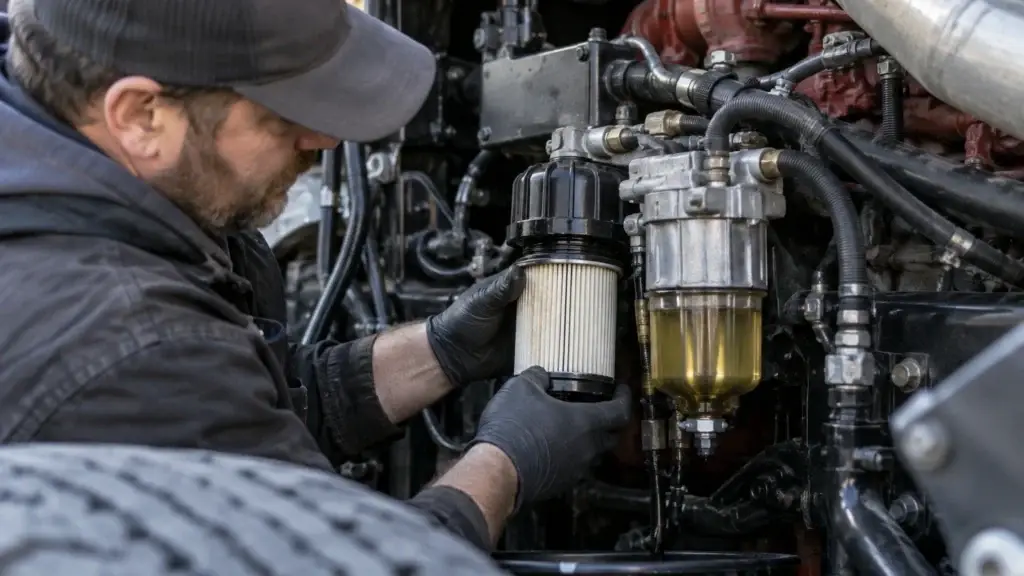
Cleanliness during fuel system service is absolutely paramount — even microscopic contamination introduced during filter changes can damage expensive components. Park on level ground, allow the engine to cool, and gather clean tools, new filters, and disposable gloves. Place absorbent pads under the work area to catch spilled fuel and relieve fuel system pressure according to manufacturer specifications.
For primary filter replacement: close the fuel supply valve if equipped, unscrew the filter canister, drain accumulated water, and inspect for contamination. Clean the filter housing and sealing surfaces with lint-free shop towels. Secondary filter replacement requires extra care due to proximity to injection components — remove carefully to minimize fuel spillage and inspect O-ring grooves for cracks or debris.
Installation procedure: lubricate new filter gaskets with clean diesel fuel, install filters hand-tight to proper torque specification, fill filter housings with clean diesel to reduce air in the system, prime using manual pump or ignition cycling, start the engine and run at idle for several minutes, check all connections for leaks, and dispose of used filters according to environmental regulations. Never over-tighten filter housings — most seal properly at hand-tight plus one-half to three-quarters turn.
Free Diesel Maintenance Checklist
Get HDJ's free, field-tested diesel maintenance checklist delivered instantly to your inbox — print it, laminate it, keep it in the shop.
Instant PDF • 100% Free • No Spam

Fuel Quality and Contamination Prevention
The diesel fuel system's worst enemy isn't wear and tear — it's contaminated fuel. Even the most diligent maintenance routine cannot protect precision components from poor fuel quality. Contaminated fuel acts like liquid sandpaper, gradually destroying injectors, pumps, and other high-precision parts that depend on clean fuel for both combustion and lubrication.
Understanding Diesel Fuel Grades
Diesel fuel comes in distinct grades formulated for specific applications. #1 diesel blends with kerosene for superior cold-weather performance, preventing gel formation in freezing temperatures but containing less energy per gallon. #2 diesel serves as the standard fuel for most applications, delivering higher energy content and better fuel economy but requiring winter additives in cold regions.
Ultra-low sulfur diesel (ULSD) now dominates the market for on-road applications, mandated to reduce emissions with less than 15 parts per million of sulfur. While environmentally beneficial, the refining process removes natural lubricants, requiring fuel additives to protect injection systems from premature wear. The ASTM D975 diesel fuel specification defines quality standards all commercial diesel must meet.
Biodiesel blends (B5, B10, B20) offer renewable alternatives with excellent lubricity but can attract moisture and support microbial growth more readily than petroleum diesel. Operators using biodiesel must implement more vigilant water management and fuel storage practices.
Water Contamination Prevention
Water enters diesel fuel systems through multiple pathways. Condensation forms inside partially-filled tanks as temperatures fluctuate between day and night — the larger the empty space above fuel, the more moisture accumulates. Contaminated fuel stations with poorly-maintained storage transfer water directly during fueling, and rainwater infiltration through damaged caps or improperly sealed vents adds another entry point.
The destructive effects of water contamination extend throughout the entire fuel system. Water promotes rust and corrosion on metal components, creates ideal environments for microbial growth at the fuel-water interface, and provides zero lubrication when it reaches injection components operating with micron-level clearances. In extreme cases, water reaching combustion chambers creates hydraulic lock that can bend connecting rods or crack cylinder heads.
Proper water separator maintenance prevents these problems through simple, regular procedures. Daily visual inspection reveals accumulated water as a distinct layer beneath fuel. Drain by opening the separator's drain valve until pure fuel appears — never assume the bowl is empty after a fixed time. Replace water separator filter elements every 100–200 hours of operation or annually.
Preventing Microbial Growth
The "diesel bug" describes bacteria, fungi, and microorganisms thriving at the fuel-water interface inside tanks. These organisms colonize the water layer, feeding on hydrocarbons and multiplying rapidly in warm conditions, with metabolic byproducts including thick sludge and corrosive acids attacking tank walls and clogging fuel filters.
Microbial growth produces distinctive signs: filters clog prematurely requiring frequent replacement, a foul sulfurous smell emanates from fuel or filter housing, and dark stringy material appears in fuel samples or separator bowls. Prevention focuses on eliminating conditions microorganisms need — minimize water in fuel systems, implement rigorous water separator maintenance, and ensure proper fuel turnover to prevent long-term storage.
When contamination occurs, biocide fuel additives kill existing microorganisms — powerful chemicals requiring careful dosing according to manufacturer instructions. After treatment, change fuel filters to remove dead organisms before they decompose into corrosive acids.
Common Diesel Fuel System Problems and Solutions
A diesel engine communicates distress through telltale signs when fuel system problems emerge. Recognizing these symptoms early allows an operator to address issues before they cause permanent damage or leave a truck stranded. Engine misfires, rough idle, and power loss each point to specific root causes requiring targeted solutions.
Hard Starting and Poor Idle Quality
Difficulty starting a diesel engine, especially in cold weather, means the fuel system isn't delivering the pressure or volume needed for ignition. Air in fuel lines prevents proper pressure buildup, weak fuel transfer pumps cannot move adequate fuel volume, and restricted filters starve the engine of fuel needed for quick starts.
Cold weather compounds starting difficulties through multiple mechanisms: inadequate glow plug operation fails to preheat combustion chambers, fuel gelling transforms diesel into a thick substance that cannot flow, and low fuel pressure from temperature-related viscosity changes delays injection timing. Under 49 CFR Part 396 inspection requirements, fuel system condition is part of the vehicle systems a carrier must keep in safe operating order — not a separate, optional line item.
Poor idle quality manifests in three patterns: rough idle from misfiring cylinders creates noticeable vibration, hunting idle produces rhythmic RPM fluctuations, and unstable idle varies randomly, indicating multiple contributing factors. Systematic solutions include bleeding air from fuel systems, replacing filters on schedule, testing glow plugs individually, and verifying fuel pressure meets specifications under all operating conditions.
Loss of Power and Increased Fuel Consumption
Loss of power and slow throttle response indicate fuel starvation — the engine cannot access the energy it needs. Fuel system restrictions create the most common power loss scenario: clogged filters or failing fuel pumps starve the engine under load, and the engine cannot maintain rated speed because insufficient fuel reaches combustion chambers.
Injector problems reduce fuel delivery through clogged nozzles restricting flow volume and worn injectors with poor atomization preventing complete combustion — both conditions waste fuel while reducing available power. Turbocharger issues reduce boost pressure essential for power production, and exhaust restrictions from clogged diesel particulate filters create backpressure opposing piston movement.
Diagnostic approaches begin with baseline measurements: performance testing verifies actual power output against specifications, fuel consumption monitoring against historical data reveals gradual deterioration, and diagnostic trouble codes provide electronic system insights. If problems persist after servicing, consult a specialist with advanced diagnostic equipment — modern diesel fuel systems require sophisticated testing tools to measure injection timing, fuel pressure dynamics, and electronic control parameters.
Comprehensive Maintenance Schedule
The difference between diesel engines lasting hundreds of thousands of miles and those requiring major repairs far sooner often comes down to consistent maintenance scheduling. A structured schedule balances manufacturer recommendations with real-world operating conditions — operating hours provide a more accurate measurement than mileage alone, since equipment that idles extensively or operates under varying loads wears differently than steady highway miles.
Daily and Weekly Inspection Points
Quick daily checks prevent major problems through early detection. Visual inspection of the engine compartment and ground beneath for fuel leaks takes minutes but provides maximum value. Check the primary fuel filter water separator bowl for water accumulation — it appears golden or clear beneath darker diesel fuel, and sediment indicates contamination requiring immediate attention. Verify fuel levels are adequate and note any unusual engine behavior during startup.
Weekly inspection procedures expand with thorough fuel line examinations from tank to engine, checking for abrasion, cracking, loose connections, or deterioration. Rubber fuel lines show age through surface cracking and should be replaced before failure. Drain the water separator weekly by opening the drain valve until clean fuel appears, and review any diagnostic trouble codes that appeared during the week.
Monthly, Quarterly, and Annual Tasks
Monthly tasks include detailed inspection of all fuel system connections and fittings for tightness and leak prevention, since vibration gradually loosens connections over time. Examine fuel tank fill caps and vents for damage or obstruction, inspect tank mounting straps for corrosion, and review fuel consumption records to identify trends indicating developing problems.
Quarterly maintenance adds fuel quality sampling and visual inspection for contamination, detailed inspection of injection pumps and high-pressure fuel lines, and evaluation of whether fuel additive treatment would benefit the system. Document quarterly findings to track system condition over time.
Annual comprehensive service includes replacing all fuel system filters regardless of apparent condition, thorough cleaning of water separator components, fuel pressure testing across all system points, and professional injector cleaning or testing if performance has declined. Major service at 1,000–1,500 operating hours involves removing, testing, and often rebuilding injectors, inspecting fuel pumps for wear, and considering fuel tank cleaning if contamination history suggests accumulation.
Quick Reference
- Daily: Visual leak inspection, water separator check, fuel level verification
- Weekly: Fuel line inspection, water separator draining, filter housing check
- Monthly: Connection tightness, tank inspection, consumption review
- Quarterly: Fuel sampling, pressure testing, pump inspection
- Annual: All filter replacement, injector service, complete system evaluation
HDJ's DEF system troubleshooting guide covers the adjacent SCR/DEF side of emissions-system maintenance that a comprehensive fuel system program should also account for, since the two systems interact more than they might first appear to.
Frequently Asked Questions
How often should diesel fuel filters be replaced?
Primary fuel filters should be replaced every 10,000–15,000 miles or 200–300 engine operating hours, whichever comes first, with secondary filters typically following similar intervals. Operating conditions matter too — dusty environments, high humidity, or questionable fuel quality can call for meaningfully shorter intervals. Annual replacement is the absolute minimum regardless of mileage, since diesel fuel degrades over time and creates sediment that clogs filters.
What causes diesel fuel injector problems?
Three primary causes: contamination, carbon deposits, and mechanical wear. Contaminated fuel containing water, dirt, or microbial growth damages precision injector components operating with tolerances tighter than a human hair. Carbon deposits gradually accumulate on nozzle tips from combustion byproducts, restricting fuel flow and altering spray patterns critical for complete combustion. Mechanical wear from normal operation eventually enlarges internal clearances, affecting fuel delivery precision.
How do you prevent water contamination in diesel fuel?
Keep fuel tanks as full as practical to minimize condensation space — partially-filled tanks accumulate moisture as temperatures fluctuate. Purchase fuel from high-volume stations with rapid turnover, avoiding purchases immediately after fuel truck deliveries that stir up sediment. Inspect and drain water separators daily, replace water separator filters on schedule, use quality fuel additives with water dispersants, and ensure tank vents and fill caps seal properly.
What are signs of a failing diesel fuel pump?
Hard starting especially when warm indicates the pump struggles to build adequate pressure. Loss of power under load suggests insufficient fuel delivery to meet engine demands. Engine surging or hesitation during acceleration points to inconsistent fuel flow, and unusual whining or clicking sounds from the fuel tank area indicate mechanical wear. Complete pump failures often follow contamination damage when fuel filters are neglected, making preventive filter maintenance critical for pump longevity.
Can you use fuel additives to clean diesel injectors?
Quality diesel fuel additives help prevent carbon buildup and maintain injector cleanliness when used regularly. These detergent-based products gradually dissolve deposits before they restrict fuel flow, but they cannot restore severely clogged or mechanically worn injectors. For significant deposit accumulation affecting engine performance, professional ultrasonic cleaning provides thorough restoration additives cannot achieve — additives work best as prevention, not correction.
Protecting Your Diesel Investment
Diesel fuel system maintenance stands as the cornerstone of reliable engine operation. A diesel engine represents a significant investment that demands systematic care to deliver peak performance and maximum lifespan — regular filter changes, injector care, and fuel quality management prevent the costly breakdowns that sideline equipment and drain budgets.
Preventive maintenance delivers measurable returns that compound over years of service. Clean injectors improve fuel economy; fresh filters protect precision components; quality fuel prevents contamination. Start with a comprehensive inspection today, establish a maintenance schedule based on actual operating conditions, and document performance to track improvements — the same discipline Michael Nielsen and Heavy Duty Journal's editorial team hold every guide on heavydutyjournal.com to.
Share This Guide With Your Team
Help fellow fleet managers, diesel technicians, and owner-operators protect their equipment investments. Share this comprehensive maintenance guide.