
By Michael Nielsen, Publisher | 15+ Years in Diesel Repair
Last Updated: September 2026
⏱ Estimated reading time: 15+ minutes
Modern diesel engines depend on diesel particulate filter service to capture harmful soot and keep commercial vehicles compliant with federal emissions standards. These critical aftertreatment components determine whether your trucks run at peak efficiency or sit idle in the maintenance bay costing you money.
Neglected DPF systems create expensive cascading failures. Warning lights appear, engine power drops into derate mode, and what should have been routine maintenance becomes an emergency repair costing thousands. Michael Nielsen and Heavy Duty Journal's editorial team built this guide around the gap between reactive and proactive DPF maintenance — a gap that directly impacts a fleet's bottom line.
Key Takeaways
- ✓Professional cleaning is far cheaper than replacement: Cleaning typically runs $300–$800; filter replacement runs $1,500–$8,000+.
- ✓Service intervals vary by duty cycle: 200,000–250,000 miles for long-haul; 100,000–150,000 miles for urban/vocational.
- ✓Warning signs require immediate action: DPF lights, power loss, and excessive regeneration cycles signal developing problems.
- ✓Low-ash API CK-4 or CJ-4 oils meaningfully reduce the permanent ash accumulation that shortens filter life.
- ✓Federal law prohibits tampering: Clean Air Act violations carry penalties up to $5,580 per day per vehicle.
- ✓Condition-based monitoring outperforms mileage-only schedules for optimizing maintenance timing.
In This Guide
- Understanding Diesel Particulate Filters in Commercial Operations
- Warning Signs Your Fleet's DPF Needs Attention
- Professional DPF Cleaning Methods
- DPF Maintenance Schedules for Maximum Efficiency
- In-House vs. Professional Service Decisions
- Preventive Strategies to Extend DPF Life
- DPF Monitoring Systems and Diagnostic Tools
- Cost Analysis: DPF Maintenance vs. Replacement
- Common DPF Maintenance Mistakes to Avoid
- Environmental and Operational Benefits
- Frequently Asked Questions
Understanding Diesel Particulate Filters in Commercial Operations
Diesel particulate filters became mandatory equipment on heavy-duty diesel engines starting with model year 2007, when EPA emissions standards required a 90% reduction in particulate matter to just 0.01 grams per brake horsepower-hour. These federal emission limits transformed how fleet operators approach vehicle maintenance and compliance management.
The DPF serves as the primary component within the aftertreatment system, capturing microscopic carbon particles generated during combustion before they escape into the atmosphere. This soot capture technology operates through ceramic or silicon carbide materials structured in a honeycomb pattern — exhaust gases flow through these channels, particulate matter becomes trapped within the filter walls, and clean gases pass through.
How DPF Regeneration Works
Three distinct regeneration processes keep filters functional. Passive regeneration occurs automatically during sustained highway driving when exhaust temperatures reach 550–650°F, burning accumulated soot naturally without intervention — the ideal scenario for filter health.
Active regeneration engages when the engine control unit detects soot levels reaching predetermined thresholds. The system injects additional fuel into the exhaust stream, raising temperatures sufficiently to incinerate trapped particles. Fleet vehicles operating in stop-and-go urban environments rely heavily on this mechanism.
When both passive and active regeneration fail to adequately clean the filter, forced regeneration becomes necessary. A qualified technician must initiate this manual process using diagnostic scan tools — typically needed when filters reach critical clogging levels that prevent automatic cleaning cycles from functioning effectively.
Business Impact on Fleet Performance
Properly functioning DPF systems maintain engine performance and protect operational efficiency across an entire fleet. Filter malfunctions create cascading problems that disrupt logistics chains — vehicles experiencing DPF issues often enter derated mode, where engine power becomes severely limited to prevent damage.
Per ATRI's Operational Costs of Trucking research, repair and maintenance costs averaged $0.198 per mile in 2024, with trucks traveling an average of 38,249 miles between breakdowns that year. Unscheduled maintenance from DPF failures represents one of the costliest disruptions in fleet management — missed delivery windows, customer dissatisfaction, and emergency repair expense compound rapidly.
$2.260 per mile
Average cost of operating a truck in 2024, per ATRI — with non-fuel costs reaching a record $1.779 per mile that year.
Federal Standards and Legal Obligations
The EPA established stringent emissions standards mandating DPF installation on virtually all modern diesel commercial vehicles, making functional filtration a legal requirement rather than an optional upgrade.
Operating vehicles with disabled, removed, or malfunctioning emissions controls carries serious legal consequences. The EPA's enforcement policy on vehicle tampering under Clean Air Act Section 203(a)(3) can result in civil penalties up to $5,580 per day of violation. Inspection protocols require fleet managers to maintain detailed service records demonstrating regular maintenance and proper system function.
Warning Signs Your Fleet's DPF Needs Attention
Commercial vehicles constantly signal DPF health status through dashboard alerts, performance changes, and physical indicators requiring prompt action. Catching these signs early prevents minor issues from escalating into repairs that sideline trucks for days.
Dashboard Indicators and Error Codes
The DPF warning light is the first line of defense against filter failure. This amber indicator typically appears when soot accumulation reaches 70–80% capacity, signaling that regeneration should occur soon — ignoring this initial warning lets the problem progress to more serious stages.
Common diagnostic trouble codes include P2002 (efficiency below threshold), P2453 (pressure sensor range issues), and P244B (restricted filter), each giving technicians precise information about the nature and severity of the problem.
When warnings go unheeded, vehicles enter limp mode as a protective measure — power becomes restricted and maximum speed drops, typically to around 50 mph or less at first, with the system gradually reducing allowable speed in stages if the driver continues operating without addressing the underlying issue.
Performance Degradation Symptoms
Performance issues often show up before dashboard lights do. Drivers may notice sluggish throttle response, particularly accelerating from a stop or climbing a grade — power loss that happens because excessive exhaust backpressure restricts the engine's ability to expel combustion gases efficiently.
Fuel economy deterioration is another reliable indicator, since a clogged filter forces the engine to work harder and burn measurably more fuel. Fleet managers tracking efficiency metrics should investigate any vehicle showing a consistent downward trend.
Excessive regeneration cycles indicate the filter can't clean itself effectively through normal processes. Healthy DPF systems typically regenerate roughly every 400–600 miles depending on duty cycle and load — when regeneration happens far more often than that, the filter has likely accumulated ash deposits that passive cleaning can't remove. HDJ's DPF regeneration troubleshooting guide covers the diagnostic sequence once regeneration frequency crosses into that territory.
⚠️ Safety Warning
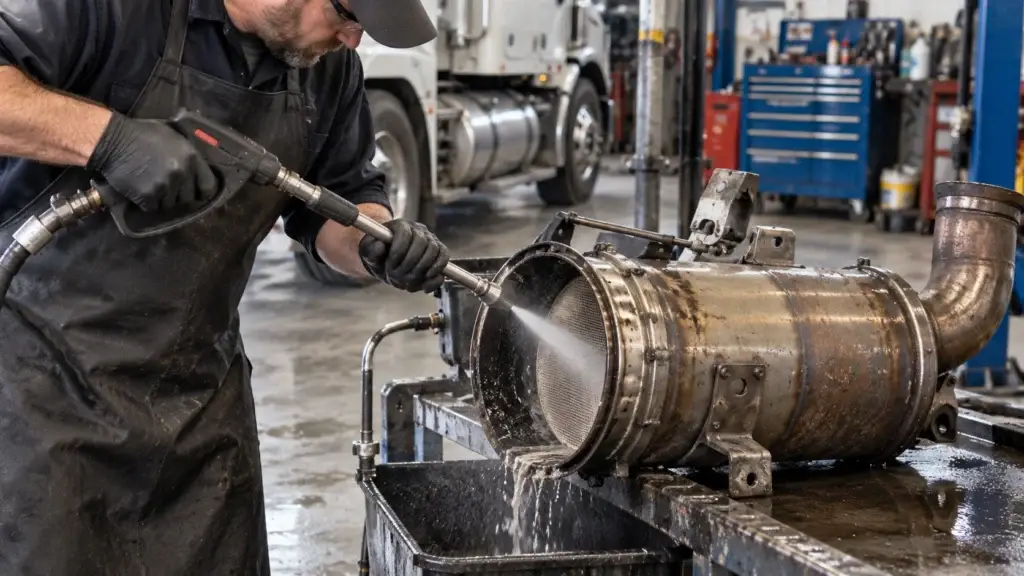
Never attempt to clean DPF systems using power washers, compressed air at excessive pressure, or unapproved chemical additives. These methods can crack ceramic substrates, damage sensors, and create complete filter failure requiring replacement costs of $1,500–$8,000 or more.
Physical Inspection Indicators
Visual inspection reveals problems electronic systems may not catch immediately. Black smoke during acceleration suggests incomplete regeneration or a fuel system issue contributing to excessive soot; blue-gray smoke often indicates an oil consumption problem contaminating the filter with ash.
Check exhaust backpressure with a specialized gauge during routine maintenance — normal systems typically show 2–10 PSI at idle and 15–30 PSI under load, and readings consistently above those ranges confirm significant restriction requiring professional cleaning or replacement.
TMC Recommended Practice 355A, from the Technology & Maintenance Council's published RP library, calls for visually checking DPF inlet and outlet condition during routine PM inspection: no soot should be observed on the outlet side, just a light brown color, while some soot on the inlet side is normal as long as it's black and relatively dry rather than wet or oily.
Professional DPF Cleaning Methods
When carbon deposits and ash accumulation compromise filter performance, professional cleaning offers proven restoration. Quality service facilities test before cleaning — visual inspection for physical damage, weight measurement to quantify contaminant accumulation, and airflow measurement against manufacturer specification.
Thermal Baking Process
Thermal baking is the foundation of effective filter restoration. Specialized ovens heat filters to roughly 900–1,100°F, combusting accumulated carbon through controlled oxidation — a high-temperature process that breaks down organic compounds mechanical methods alone can't remove.
Filters remain in the oven for two to eight hours depending on contamination severity, with temperature control maintaining precise heat throughout the chamber to ensure complete carbon combustion without damaging the ceramic substrate. Thermal cleaning removes most of the total organic contaminant load, but it leaves behind inorganic ash deposits — mineral residue from engine oil additives and fuel impurities that can't burn at any temperature, which is why thermal cleaning must be followed by mechanical removal to achieve complete restoration.
Pneumatic Ash Removal
Pneumatic ash removal uses high-pressure compressed air, typically in the 80–120 PSI range, to dislodge and extract ash remaining after thermal cleaning. Technicians position filters in containment chambers before beginning, using careful technique to prevent substrate damage from excessive pressure or improper nozzle positioning — this method is particularly effective for ash in end caps and peripheral areas where thermal processes show limited reach.
Aqueous and Ultrasonic Cleaning
Aqueous cleaning uses specialized detergent solutions to dissolve oil-based contaminants that resist thermal and pneumatic methods — lubricant residue, unburned fuel deposits, hydrocarbon films coating the substrate.
Ultrasonic cleaning is the most advanced technology available for DPF restoration. High-frequency sound waves create microscopic bubbles in the cleaning solution through cavitation; when these bubbles collapse, they generate shock waves that dislodge contaminant particles at a fine level. The technology is particularly effective for restoring filters with advanced substrate designs, including catalyzed DPFs.
| Cleaning Method | Contaminants Targeted | Typical Duration |
|---|---|---|
| Thermal Baking | Carbon soot, organic deposits | 2–8 hours |
| Pneumatic Blasting | Ash deposits, mineral residue | 30–60 minutes |
| Aqueous Chemical | Oil residue, fuel deposits | 1–3 hours |
| Ultrasonic | Fine particles, mixed contamination | 1–2 hours |
Professional service providers combine multiple methods for comprehensive restoration. The most effective protocols begin with thermal cleaning to remove carbon deposits, followed by pneumatic ash removal, then aqueous cleaning for oil residue — facilities offering ultrasonic technology typically apply it as a final step.
DPF Maintenance Schedules for Maximum Efficiency
Establishing clear service intervals prevents costly breakdowns and optimizes fleet efficiency. A comprehensive schedule balances manufacturer recommendation with real-world operating conditions. HDJ's diesel engine maintenance schedule guide covers how DPF service fits into a fleet's broader interval-based PM program.
Standard Service Intervals by Application
Most DPFs need professional cleaning between 150,000 to 250,000 miles under normal conditions — a baseline that varies meaningfully by application type and duty cycle.
Long-haul trucks operating primarily on highways often reach the upper end of this range, benefiting from sustained high-speed operation that promotes passive regeneration. Regional delivery fleets typically fall in the middle at 180,000–220,000 miles. Urban delivery vehicles and municipal fleets need more frequent attention — stop-and-go traffic prevents filters from reaching optimal regeneration temperatures, so these vehicles may need preventive cleaning every 150,000–180,000 miles. Construction equipment and vocational trucks face the shortest intervals at 100,000–150,000 miles due to heavy loads, idling, and dusty environments.
Condition-Based Monitoring
Condition-based maintenance offers real precision advantages over mileage-alone approaches. Modern diagnostic systems provide real-time insight into filter performance, enabling service decisions based on actual condition rather than an arbitrary interval.
Backpressure reading is the primary indicator of filter loading — elevated differential pressure signals rising soot accumulation, with most systems triggering a warning once backpressure exceeds manufacturer threshold. Regeneration frequency pattern also reveals filter health: a filter needing regeneration every 200–300 miles indicates excessive loading, while normal operation runs 400–600 miles or longer under highway conditions. Fuel economy trend provides another cue, with gradual decline often preceding an obvious filter problem.
Seasonal Adjustments
Temperature variation meaningfully affects regeneration efficiency. Cold weather reduces passive regeneration opportunity, since lower ambient temperature keeps exhaust from reaching optimal regeneration threshold during normal driving — fleets operating in northern climates should generally shorten service intervals through winter. Summer operation in hot climates presents a different challenge: high ambient temperature can trigger more frequent active regeneration, which helps keep filters cleaner but may indicate an underlying problem if it becomes excessive.
| Fleet Application | Standard Interval | Key Metrics to Track |
|---|---|---|
| Long-Haul Trucking | 200,000–250,000 miles | Backpressure, regen frequency, MPG |
| Regional Delivery | 180,000–220,000 miles | Regen cycles, pressure differential |
| Urban/Municipal | 150,000–180,000 miles | Soot load %, failed regens, idle time |
| Construction/Vocational | 100,000–150,000 miles | Operating hours, backpressure trends |
Free Diesel Maintenance Checklist
Get HDJ's free, field-tested diesel maintenance checklist delivered instantly to your inbox — print it, laminate it, keep it in the shop.
Instant PDF • 100% Free • No Spam
In-House vs. Professional Service Decisions
Whether to build in-house DPF maintenance capability or partner with a professional service provider requires weighing capital outlay, ongoing operating cost, technical expertise requirement, and service quality expectation.
Equipment and Training Investment
In-house DPF capability demands substantial equipment investment — professional-grade thermal cleaning ovens alone run roughly $25,000–$75,000 depending on capacity and automation, and comprehensive service also needs pneumatic cleaning systems, flow bench testing equipment, and diagnostic scan tools on top of that.
Training is an equally real cost. Technicians need specialized certification in aftertreatment diagnostics, thermal regeneration procedure, and emissions compliance standards — a real coursework and hands-on commitment, plus ongoing education to keep current with evolving technology.
When In-House Makes Sense
In-house capability generally starts making financial sense somewhere around fleets servicing 15–20 DPF units monthly, though the exact breakeven varies by labor cost, facility expense, and service complexity — operations at higher volume can achieve real per-unit savings against outsourced pricing.
Hidden costs often tip the analysis toward professional service for smaller operations. Equipment maintenance, calibration, utilities, and insurance all add to operating overhead, and facilities have to account for environmental compliance cost tied to particulate matter disposal and air quality management too.
When to Outsource
Small to medium fleets rarely reach the service volume needed to justify in-house investment, and benefit from the flexibility and expertise a specialized provider offers instead. Complex diagnostic situations especially favor professional service — when DPF issues stem from an underlying engine problem, fuel system malfunction, or another aftertreatment component failure, specialized diagnostic capability becomes essential.
Organizations without dedicated diesel technicians who have real emissions system expertise should default to outsourcing — DIY attempts using improper methods frequently damage delicate substrate structures, turning a serviceable filter into scrap that now requires full replacement.
Preventive Strategies to Extend DPF Life
Proactive DPF care delivers meaningfully better return than reactive repair. Fuel quality, oil selection, driver behavior, and regeneration management, applied systematically, reduce maintenance cost while maximizing uptime.
Fuel Quality Management
Fuel quality directly affects how quickly filters accumulate contaminants. Ultra Low Sulfur Diesel with sulfur limited to 15 ppm is the minimum acceptable standard for modern aftertreatment-equipped engines — sulfur above that level accelerates ash formation and drives chemical reactions that damage filter substrate.
Fleet operators should establish vendor qualification programs verifying fuel quality through regular testing. Contaminated fuel introduces particles, water, and biological growth that contribute to premature clogging, and storage tank maintenance prevents fuel degradation from transferring straight into the DPF.
Low-Ash Engine Oil Selection
Engine oil selection ranks among the most critical decisions affecting DPF longevity. Traditional oils contain metallic additives that create ash deposits inside the substrate — and unlike soot, which burns off during regeneration, ash accumulation is permanent and progressively restricts exhaust flow until professional cleaning becomes necessary.
Low-ash formulations designed specifically for DPF-equipped engines meaningfully reduce this buildup. Per the American Petroleum Institute's own specifications, current categories including CK-4 and FA-4 limit sulfated ash content to 1% or less — older specifications like CH-4 and CI-4 carry higher ash content and can plug a DPF, trigger excessive regeneration, and reduce engine life when used in a modern aftertreatment-equipped engine.
Driver Training for DPF-Conscious Operations
Driver behavior meaningfully influences DPF health and maintenance frequency. Training that emphasizes DPF-conscious operation covers letting active regeneration cycles complete without interruption, maintaining highway speed for a sustained stretch weekly to trigger passive regeneration, avoiding excessive idling that lowers exhaust temperature below the regeneration threshold, and responding immediately to a DPF warning light rather than delaying service.
Route planning should account for regeneration requirements too — scheduling highway segments or sustained operating periods enables the passive regeneration that prevents excessive soot accumulation in the first place.
Regeneration Cycle Optimization
Create operational conditions that support effective regeneration through strategic scheduling. Planning stationary regeneration during non-revenue hours prevents productivity loss while ensuring filters get the cleaning cycle they need — vehicles returning to terminals can regenerate during evening hours rather than mid-route.
Monitoring regeneration frequency gives early warning of a developing problem. A vehicle needing active regeneration more often than baseline points to fuel system issues causing incomplete combustion, air intake restriction reducing combustion efficiency, or an EGR malfunction increasing soot production.
DPF Monitoring Systems and Diagnostic Tools
Real-time diagnostics and monitoring platforms let fleet managers address DPF issues before they escalate into a breakdown. Modern monitoring has shifted maintenance strategy from reactive response to proactive intervention, collecting continuous performance data and delivering actionable insight that optimizes filter lifespan.
Telematics Integration
Fleet telematics continuously gathers performance metrics from each vehicle's onboard diagnostics, flowing to centralized dashboards presenting filter health across all assets — regeneration frequency and duration, soot accumulation level, temperature during regeneration cycles, and fault code history, all tracked simultaneously. Remote monitoring is especially valuable for geographically dispersed operations, letting a manager oversee filter condition without a physical inspection.
Differential Pressure Monitoring
Differential pressure sensors are the primary diagnostic component for DPF condition — measuring the pressure difference between inlet and outlet, directly indicating restriction from accumulated particulate matter. Most systems run 2–5 PSI under clean conditions; as particulate accumulates, differential rises proportionally, with readings in the 6–10 PSI range typically triggering automatic regeneration and readings above 12–15 PSI often preventing successful regeneration and requiring professional cleaning.
Predictive Maintenance Alerts
Predictive alerts are the real operational advantage of an integrated monitoring system, informing managers and drivers about a developing issue before it causes a vehicle failure. A multi-level escalation protocol — initial alerts to drivers about upcoming regeneration needs, secondary notification to fleet managers as service intervals approach, and critical alerts escalating to maintenance supervisors — ensures the right person gets timely information.
Cost Analysis: DPF Maintenance vs. Replacement
Professional Cleaning Costs
Cleaning cost varies by vehicle class, filter size, and contamination severity — roughly $300–$500 for light-duty, $450–$650 for medium-duty, and $600–$800 for heavy-duty commercial trucks given their larger filters and more complex systems. Pricing generally breaks down into filter removal and installation labor, the cleaning process itself, performance testing and flow verification, and documentation and compliance reporting.
Replacement Expense Comparison
Replacement becomes necessary when a filter suffers physical damage or substrate deterioration. Light-duty units start around $1,200–$2,000 for OEM parts, medium-duty jumps to $2,500–$5,000, and heavy-duty commercial filters run $4,000–$8,000, with specialized applications reaching higher still.
These figures don't include installation labor or related repair — a clogged filter causes backpressure that damages turbochargers and fuel injectors, and addressing that secondary failure adds real cost on top. Complete engine failure from extreme, prolonged neglect is the worst case, running into engine rebuild territory.
Illustrative Cost Comparison
A medium-duty truck getting $500 professional cleaning twice a year ($1,000 total) against a plausible neglect scenario — a $4,000 filter replacement, $2,000 in related repair, and 4 days of downtime at $400/day in lost revenue ($1,600) — works out to $7,600 in total cost from deferred maintenance. That's roughly 7.6x the annual cleaning cost, and it's before counting the customer relationship damage from a missed delivery window.
Downtime Financial Impact
Fleet downtime cost goes well beyond the direct repair bill. Every day a vehicle sits idle is lost revenue on top of the repair — a delivery truck generating real daily revenue costs that same amount every day it's unavailable.
Emergency repairs typically take several days including diagnosis, parts ordering, and service completion, versus a day or two for scheduled maintenance with advance planning — the gap between those two timelines is most of the value case for proactive scheduling. Delivery schedule disruption creates its own cascading problems: late deliveries damage customer relationships, may trigger contractual penalties, and hand competitors an advantage when a fleet can't meet its commitments.
Common DPF Maintenance Mistakes to Avoid
Delaying Critical Service
The most expensive mistake in fleet DPF management is waiting for the warning light before acting. That treats a dashboard indicator as an initial alert when it actually represents a late-stage problem — by the time the engine management system triggers a warning, significant restriction has already occurred.
Budget pressure and tight scheduling often drive the decision to postpone — the vehicle is still running, so the reasoning goes maintenance can wait. That ignores the progressive damage accumulating inside the filter and through the emissions system, and fuel consumption climbs as the engine fights mounting backpressure well before the problem finally gets addressed.
Improper DIY Cleaning Attempts
Some fleets try to save money through makeshift cleaning that causes more harm than good. Power washing with high-pressure water destroys delicate ceramic substrate and damages sensors; chemical additives poured into the fuel tank rarely deliver results and may accelerate component deterioration.
Makeshift thermal cleaning using shop equipment poses a real safety risk too — without proper temperature control and monitoring, these attempts can crack substrate or generate toxic fumes. Professional cleaning costs a fraction of a replacement filter; it's not close.
Ignoring Root Causes
DPF problems rarely occur in isolation. A recurring filter issue almost always indicates an upstream malfunction that needs root cause analysis — cleaning the filter without investigating why it got clogged just guarantees fast re-contamination.
Faulty fuel injectors are a common root cause: when injectors fail to atomize diesel properly, unburned fuel enters the exhaust stream and overwhelms the DPF. EGR malfunctions dump excessive soot into the exhaust. Turbocharger oil leaks contaminate the filter with lubricant that can't be removed through standard regeneration. These underlying issues need addressing before cleaning can produce a lasting result — HDJ's SCR system failure guide covers the adjacent aftertreatment components a recurring DPF problem often traces back to.
Poor Documentation Practices
Poor documentation undermines even a well-intentioned DPF program. Without detailed service records, a fleet manager can't identify patterns or predict future maintenance needs — complete documentation should include cleaning dates, service provider details, and before-and-after test results.
Filter history matters for warranty claims especially, since manufacturers require proof of proper maintenance to honor coverage — missing documentation can void a warranty and leave a fleet paying for a replacement that should have been covered.
Environmental and Operational Benefits
Emissions Reduction
A properly functioning DPF reduces harmful particulate matter emissions by roughly 90–95% compared to unfiltered diesel exhaust, consistent with the EPA 2007 standard the technology was built to meet — a real reduction across a commercial fleet's total soot output annually.
Emissions compliance gets meaningfully easier with regular professional service, and well-maintained systems pass inspection protocols consistently without needing an emergency repair or expedited cleaning. California's CARB truck and bus regulations require diesel trucks over 14,000 lbs GVWR to meet particulate matter filter requirements — proper maintenance is what keeps a fleet compliant with that ongoing.
Fuel Economy Optimization
A clean DPF meaningfully reduces exhaust backpressure, letting the engine operate more efficiently — excessive backpressure from a clogged filter forces the engine to work harder and burn additional fuel to maintain performance. Fleet operators consistently report a real fuel efficiency gain comparing a well-maintained DPF against one that's neglected and approaching failure, a difference that compounds across a fleet's annual mileage.
Equipment Longevity
Comprehensive DPF care protects expensive engine components from the damaging effects of excessive backpressure and failed regeneration cycles. A severely clogged filter drives elevated exhaust gas temperature, increased cylinder pressure, and accelerated wear on turbochargers and exhaust valves.
Fleets running a rigorous DPF service schedule tend to get real extended vehicle service life compared to operations that defer maintenance — delaying capital replacement and maximizing return on the vehicle investment, with documented maintenance history also commanding a better resale value when the vehicle is eventually sold.
Frequently Asked Questions
How often should diesel particulate filters be professionally cleaned?
Most DPFs need professional cleaning between 150,000 and 250,000 miles depending on duty cycle. Long-haul trucks often reach the upper end of that range; urban delivery and vocational trucks may need service every 100,000–150,000 miles because stop-and-go operation prevents effective passive regeneration. TMC Recommended Practice 355A provides detailed application-specific guidance.
What causes diesel particulate filters to clog prematurely?
Excessive idling that keeps exhaust temperature below the regeneration threshold, faulty fuel injectors causing incomplete combustion, EGR malfunctions increasing soot production, non-compliant high-ash engine oil, and underlying problems like a turbocharger oil leak. Stop-and-go driving that never allows passive regeneration accelerates clogging significantly too.
How much does professional DPF cleaning cost compared to replacement?
Professional cleaning typically runs $300–$800 depending on vehicle class and contamination severity, versus $1,500–$8,000 or more for replacement on heavy-duty applications — regular maintenance is the clearly more economical path, and the gap widens further once related component damage and downtime are factored in.
What are the warning signs that a DPF needs immediate attention?
The DPF warning light, check-engine lights with DPF-related codes like P2002 or P244B, noticeable power loss or sluggish acceleration, reduced fuel economy, excessive regeneration cycles well outside the normal interval, and the vehicle entering limp mode with restricted speed. Black smoke during acceleration also points to a filter issue worth investigating.
Is it legal to remove or disable a diesel particulate filter?
No. Clean Air Act Section 203(a)(3) strictly prohibits removing or rendering inoperative any emissions control device, including a DPF. The EPA can impose civil penalties up to $5,580 per day of violation. Many states also conduct emissions inspections that would flag a tampered vehicle, and California requires CARB-certified filters for heavy-duty diesel trucks operating in the state.
What type of engine oil should be used to protect diesel particulate filters?
Low-ash engine oil meeting API CK-4 or CJ-4 specification, formulated for DPF-equipped engines and limited to 1% or less sulfated ash content. Older specifications like CH-4 and CI-4 carry higher metallic additive content that can plug filters and damage catalytic materials in the aftertreatment system. Always confirm against OEM recommendations for the specific engine.
Building Your DPF Maintenance Program
A clean diesel particulate filter represents more than regulatory compliance — it's the foundation for vehicle performance, fuel efficiency, and environmental responsibility. Fleet managers implementing comprehensive DPF maintenance programs gain measurable advantage in operating cost and vehicle reliability.
Audit current maintenance practice against the standards in this guide — service schedules, monitoring systems, driver training, documentation — and partner with a specialized service provider bringing proven expertise and the right equipment to the job. The investment in proper maintenance, quality service, and monitoring technology pays dividends through lower operating cost, better compliance, and cleaner emissions, the same discipline Michael Nielsen and Heavy Duty Journal's editorial team hold every guide on heavydutyjournal.com to.
Help Your Peers Maintain Compliance
Know a fleet manager or diesel tech who could benefit from this guide? Share it with your network.