20-Ton vs 50-Ton Heavy Duty Floor Jacks: 2025 Buying Guide

Table of Contents
    Add a header to begin generating the table of contents

    By Michael Nielsen, Editor & Publisher | 15+ Years in Diesel Repair

    Last Updated: February 2026

    📖 Estimated reading time: 23 minutes

    Selecting the right heavy duty floor jack can make or break your shop operations. Professionals across automotive repair, construction, and industrial sectors face a critical choice between 20-ton and 50-ton capacity systems—a decision that impacts safety, efficiency, and your bottom line every time you position a jack under a vehicle.

    The 20-ton model offers an ideal balance of portability and power for most commercial applications. It handles everything from Class 6-7 trucks to agricultural machinery with ease. Meanwhile, the 50-ton variant delivers maximum lifting capability for Class 8 heavy trucks, mining equipment, and the most demanding industrial scenarios.

    The 2025 market brings significant improvements in hydraulic technology and safety features. Modern air hydraulic systems provide faster operation and better control, while improved seal materials and construction methods extend service life well beyond previous generations. Understanding capacity requirements prevents costly mistakes—choosing equipment that’s too small creates dangerous situations, while selecting oversized systems wastes capital and reduces mobility.

    This comprehensive guide covers everything you need to make the right investment: capacity ratings and certifications, head-to-head model comparisons, industry-specific recommendations, safety protocols, cost analysis, and maintenance best practices.

    Key Takeaways

    • 20-ton jacks handle 80-90% of commercial lifting tasks while maintaining single-operator portability at 32-80 pounds.
    • 50-ton capacity becomes essential for Class 8 heavy trucks, mining equipment, and industrial machinery exceeding 40,000 pounds at the lift point.
    • Price differential is significant: quality 20-ton models run $450-$850 versus $1,200-$2,500 for 50-ton units.
    • Air compressor compatibility matters: 50-ton jacks demand 8-12 CFM, potentially requiring compressor upgrades costing hundreds more.
    • ASME PASE certification is the primary safety standard—always verify third-party testing before purchasing.
    • Proper maintenance extends service life to 15-20 years, making quality equipment a sound long-term investment.

    Understanding Heavy Duty Floor Jack Capacity Ratings

    Capacity ratings serve as the fundamental specification that defines what loads a floor jack can handle without compromising safety or performance. These ratings provide the baseline information mechanics and operators need when selecting equipment for specific lifting tasks. Knowing how manufacturers determine and test these ratings protects both personnel and equipment investments.

    The numerical values assigned to floor jack capacity ratings represent extensive engineering calculations and real-world testing protocols. Manufacturers conduct rigorous assessments that account for structural integrity, hydraulic system performance, and material strength under extreme conditions.

    Floor jack capacity ratings comparison chart for 20-ton and 50-ton models

    Decoding the Numbers Behind Tonnage Capacity

    A 20-ton floor jack is engineered to safely lift 40,000 pounds (approximately 18,144 kilograms). A 50-ton model handles 100,000 pounds (roughly 45,360 kilograms). These specifications assume ideal operating conditions with centered loads on stable surfaces. Understanding these conversions helps operators match equipment capacity to actual vehicle or equipment weights.

    The difference between metric tonnes and US tons creates occasional confusion in international markets. Metric tonnes measure 1,000 kilograms each, slightly heavier than the 907-kilogram US ton. Professional buyers should always verify which measurement system specifications reference to avoid capacity miscalculations that could compromise safety.

    Engineering Safety Margins That Protect Your Operations

    Reputable manufacturers design their equipment to withstand significantly more weight than the stated capacity rating. Most quality floor jacks incorporate safety factors requiring them to handle 150% to 200% of rated capacity before experiencing permanent deformation. A 20-ton jack designed with these margins won’t buckle until subjected to 60,000-80,000 pounds.

    This engineering buffer compensates for off-center loading, dynamic forces during the lifting process, and gradual material fatigue over years of service. Workplace conditions rarely match ideal testing environments—operators may position jacks at slight angles, lift loads with uneven weight distribution, or work on surfaces with minor irregularities.

    ⚠️ Safety Warning

    Never deliberately exceed rated capacity despite built-in safety margins. These margins protect against unavoidable variations in real-world conditions—not intentional overloading. Always verify actual load weight before each lift, regardless of theoretical safety factors.

    Certification Standards That Validate Performance Claims

    ASME PASE (Portable Automotive Service Equipment) standards establish the benchmark for hydraulic jack certifications in North American markets. The American Society of Mechanical Engineers developed these standards through collaboration with industry experts, safety professionals, and engineering specialists.

    Certified equipment undergoes extensive testing protocols that verify performance claims. Load-holding tests confirm jacks maintain lifting height under maximum rated capacity for specified durations. Overload protection verification ensures hydraulic relief valves function properly. Cycle durability assessments subject jacks to thousands of lifting cycles simulating years of commercial use. Only products passing all evaluations earn official certification marks.

    Beyond ASME PASE standards, manufacturers serving international markets pursue additional certifications. CE marking indicates compliance with European Union safety requirements. ISO 9001 confirms consistent manufacturing quality management. EAC certification opens access to Eurasian Economic Union markets.

    CertificationTesting RequirementsMarket RecognitionVerification
    ASME PASELoad holding, overload protection, cycle durability, structural integrityNorth America (primary)Third-party lab testing
    CE MarkingSafety directives, EMC compliance, machinery directiveEuropean UnionManufacturer declaration with technical docs
    ISO 9001Quality management systems, manufacturing consistencyGlobal recognitionRegistered certification body audit
    EAC CertificationTechnical regulations, safety standards, customs union requirementsEurasian Economic UnionAccredited certification center

    Smart buyers verify certification claims by checking manufacturer documentation and requesting test reports. Legitimate certifications include identification numbers, issuing body information, and expiration dates where applicable. Third-party verification provides stronger quality assurance than manufacturer self-certification for professional operations where equipment failure could cause injuries or damage expensive vehicles.

    Key Differences Between 20-Ton and 50-Ton Floor Jacks

    Physical dimensions, operational requirements, and financial considerations create significant differences between 20-ton and 50-ton floor jacks. These variations extend beyond simple capacity numbers to affect daily workshop operations, storage logistics, and air compressor requirements. Understanding these distinctions helps shop owners select equipment that matches their specific lifting needs without overspending on unnecessary capacity.

    Side-by-side floor jack size comparison between 20-ton and 50-ton capacity models

    Size, Weight, and Portability

    A standard 20-ton floor jack typically weighs between 60 and 80 pounds with overall dimensions measuring approximately 24 to 30 inches in length. One operator can position these units without mechanical assistance. In contrast, 50-ton models weigh between 150 and 200 pounds with lengths frequently exceeding 40 inches. Moving these jacks around the workshop requires either multiple operators or mechanical lifting equipment.

    Portability becomes a critical consideration in active service environments. Smaller shops with limited floor space find 20-ton models easier to maneuver around vehicles and equipment. Larger facilities with dedicated service bays accommodate the substantial dimensions of 50-ton jacks more effectively. Mobile repair operations are essentially limited to 20-ton equipment due to transport constraints.

    Lifting Height Range Comparison

    Standard 20-ton air hydraulic jack models offer minimum heights between 6 and 8 inches with maximum extensions reaching 16 to 20 inches. This range accommodates most commercial trucks and medium-duty equipment. The 50-ton models typically start at 10 to 12 inches minimum, while maximum extension reaches 18 to 24 inches.

    The higher minimum clearance on 50-ton jacks limits access to lower-profile vehicles but provides greater stability for extremely heavy loads. Shops servicing diverse vehicle types benefit from the lower minimum height of 20-ton jacks. Facilities focused exclusively on heavy equipment find the 50-ton height range more appropriate.

    Specification20-Ton Models50-Ton Models
    Unit Weight60-80 lbs150-200 lbs
    Length24-30 inches40+ inches
    Minimum Height6-8 inches10-12 inches
    Maximum Height16-20 inches18-24 inches
    Price Range$400-$850$1,200-$2,500+
    CFM Requirement4-6 CFM @ 90-120 PSI8-12 CFM @ 90-120 PSI
    Single Operator?YesNo (requires assistance)

    Price Point and Budget Considerations

    Quality 20-ton air hydraulic floor jacks from reputable manufacturers command $400 to $850 depending on brand reputation and feature sets. This price point makes them accessible for independent shops and small service centers. The 50-ton category commands significantly higher prices—professional-grade units typically cost between $1,200 and $2,500, with premium models exceeding $3,000.

    Budget-conscious operators must evaluate return on investment objectively. Purchasing excessive capacity that remains unused represents wasted capital that could fund other essential equipment. The “bigger is better” mentality often leads to unnecessary expenses in professional shop environments.

    Air Pressure and Compressor Requirements

    Both capacity ranges operate within standard shop air pressure specifications of 90-120 PSI. However, air volume requirements differ significantly. Standard 20-ton models demand approximately 4-6 CFM during active lifting operations—this aligns with most mid-size shop compressor systems without overtaxing available capacity.

    The 50-ton category requires 8-12 CFM during operation, potentially doubling the compressed air demand. Inadequate air supply creates operational inefficiencies: undersized compressors result in slow lifting speeds and extended cycle times that reduce productivity. Some facilities discover they need compressor upgrades after purchasing high-capacity jacks, adding unexpected costs to their equipment investment.

    Best 20-Ton Heavy Duty Floor Jack Models for 2025

    Two manufacturers have dominated the 20-ton floor jack category through engineering excellence and consistent performance in demanding professional environments. Both models featured here have earned widespread recognition across commercial applications through proven durability and operational efficiency. The selection criteria focus on verifiable performance metrics rather than marketing claims.

    Comparison of top-rated 20-ton air hydraulic floor jack models for professional use

    Torin Big Red T92007A 20-Ton Air Hydraulic Jack

    The Torin Big Red T92007A represents exceptional value engineering for professional operations requiring frequent heavy-lifting capabilities. This air hydraulic jack features all-welded steel construction that eliminates potential leak points common in bolted assemblies. Dual operation modes—manual hydraulic and air-assisted—provide operational flexibility invaluable when working in locations without compressed air access.

    With a rated capacity of 44,029 pounds, this model handles everything from heavy-duty trucks to agricultural equipment. The T92007A weighs approximately 32 pounds, making it surprisingly portable for its substantial lifting capacity. This combination of power and maneuverability explains its popularity among mobile repair services and shops with space constraints.

    The all-welded construction methodology eliminates dozens of potential failure points inherent in bolted designs. A wide base plate measuring approximately 6 inches in diameter distributes load forces across foundation surfaces, preventing concrete cracking and providing stability on varied shop floor materials. The safety valve calibration occurs at the factory, automatically releasing pressure when approaching dangerous load levels. Pricing typically falls in the $450-$650 range.

    On the downside, the higher minimum lift height (10.2 inches) limits use with very low-clearance vehicles. The jack requires a capable air compressor to realize full speed potential, and manual operation mode proves notably slower for high-volume work environments. Regular hydraulic fluid maintenance remains essential to preserve seal integrity.

    Stay Current on Heavy Duty Equipment Reviews

    Get expert equipment analysis, maintenance insights, and industry updates delivered to your inbox. Written for the professionals who keep heavy equipment running.

    Hein-Werner HW93720 20-Ton Air Hydraulic Service Jack

    The Hein-Werner HW93720 positions itself as a premium alternative with enhanced build quality justifying its higher price point. This air hydraulic jack incorporates superior hydraulic seals manufactured to tighter tolerances than industry standards require. Extended warranty coverage reflects the manufacturer’s confidence in component longevity under demanding commercial conditions.

    Professional technicians recognize Hein-Werner’s reputation for exceptional durability in high-volume repair facilities. The HW93720 maintains consistent performance through thousands of lift cycles without pressure loss or seal degradation. Hydraulic cylinder walls receive honing processes that create mirror-smooth surfaces, reducing seal wear and friction losses. The air valve assembly incorporates aerospace-grade materials that resist corrosion from moisture contamination in compressed air systems.

    The premium investment ($700-$850) is offset by superior component quality and extended service life that benefits high-volume commercial operations. However, similar operational characteristics to less expensive alternatives may not justify the cost difference for occasional users. Unit weight is slightly heavier (38-42 lbs), reducing portability compared to the Torin.

    SpecificationTorin Big Red T92007AHein-Werner HW93720
    Weight Capacity44,029 lbs (20 tons)40,000 lbs (20 tons)
    Unit Weight32-35 lbs38-42 lbs
    Lifting Range10.2″ – 19.7″10.5″ – 19.5″
    Air Pressure Required90-120 PSI90-125 PSI
    Price Range$450 – $650$700 – $850
    ✓ Best ForValue-conscious shops, mobile repair, budget priorityHigh-volume commercial ops, longevity priority

    Top 50-Ton Heavy Duty Floor Jack Models for 2025

    Industrial operations demanding maximum lifting capacity rely on specialized 50-ton floor jacks engineered for extreme-load scenarios. These units represent the upper tier of portable lifting technology, designed specifically for semi-truck maintenance, heavy construction equipment servicing, and large-scale industrial applications. The difference between adequate and exceptional performance becomes critical when working with vehicles and equipment valued at hundreds of thousands of dollars.

    Sunex 6350 50-Ton Air Hydraulic Jack

    The Sunex 6350 stands as a workhorse solution for operations requiring consistent 50-ton lifting capability. This pneumatic jack delivers 100,000 pounds of lifting capacity through precision-engineered hydraulic systems paired with air-powered operation. Sunex designed this unit specifically for loaded semi-trucks, large agricultural machinery, construction equipment, and industrial components where standard floor jacks prove insufficient.

    Sunex 50-ton air hydraulic floor jack being used in industrial service bay

    Robust all-steel welded construction forms the foundation of this jack’s reliability for repeated heavy-load cycles. Heat-treated components throughout the hydraulic system ensure consistent performance under maximum capacity. The 10.5 to 16.5-inch lifting range provides sufficient ground clearance for large equipment chassis. Integrated transport wheels facilitate positioning despite the 68.8-pound weight, allowing single-operator movement across workshop floors. Pricing typically ranges from $1,400 to $1,800.

    The significant weight requires two-person handling for loading and unloading from service vehicles. Storage space demands exceed standard shop equipment allocations, and the absolute requirement for a high-capacity air compressor (10-12 CFM at 90-120 PSI) makes this jack unsuitable for locations without adequate compressed air infrastructure.

    OTC 5196 50-Ton Capacity Air Lift Jack

    The OTC 5196 represents the premium choice for operations demanding absolute highest reliability and build quality. OTC engineers this jack to exacting standards with precision-machined components that exceed industry baseline specifications. Professional heavy equipment service centers and municipal fleet maintenance operations select OTC equipment for its reputation and comprehensive technical support infrastructure.

    Enhanced seal materials resist degradation from hydraulic fluid contamination and temperature extremes common in heavy industrial environments. Superior build quality manifests in tighter manufacturing tolerances and premium alloy selection throughout load-bearing components. Precision-ground ram surfaces ensure smooth operation throughout service life. The manufacturer’s extensive dealer network ensures parts availability and service support across North America.

    Premium pricing ($1,800-$2,300) positions the unit beyond budget constraints for smaller operations. The specialized nature limits the resale market compared to more common 20-ton models, and lead times can extend several weeks during peak demand periods.

    SpecificationSunex 6350OTC 5196
    Lifting Capacity50 tons (100,000 lbs)50 tons (100,000 lbs)
    Lifting Range10.5″ – 16.5″11″ – 17″
    Unit Weight68.8 lbs72 lbs
    Air Requirement90-120 PSI, 10-12 CFM90-120 PSI, 12-15 CFM
    Price Range$1,400 – $1,800$1,800 – $2,300
    ✓ Best ForHigh-volume ops prioritizing cost efficiencyMission-critical environments, extended service life

    Selection between these models depends on operational priorities and budget parameters. Facilities performing dozens of heavy lifts weekly find the OTC’s extended maintenance intervals offset higher initial costs. Operations with seasonal demand or moderate usage patterns achieve better ROI with the Sunex model’s lower capital requirement.

    Which Industries and Applications Need Each Capacity

    Matching floor jack capacity to industrial requirements prevents safety risks while optimizing capital investment. The difference between 20-ton and 50-ton models extends far beyond raw lifting power—different sectors face distinct challenges that determine appropriate tonnage based on load frequency, equipment scale, and operational context.

    Optimal Uses for 20-Ton Floor Jacks

    The 20-ton capacity range delivers exceptional versatility for mid-weight commercial operations. This tonnage handles Class 6-7 commercial trucks with gross vehicle weight ratings between 26,000 and 33,000 pounds. Fleet maintenance facilities servicing delivery trucks and box trucks find this capacity ideal for routine service work.

    Agricultural operations benefit tremendously from 20-ton equipment. Large tractors and combines require substantial lifting capacity for maintenance, and individual component weights typically fall within this range. Construction equipment maintenance is another prime application—mid-size excavators and skid steers require reliable lifting during service intervals, and rental facilities managing diverse equipment fleets rely on 20-ton jacks as their primary lifting solution.

    Additional commercial applications include lifting shipping container corners for inspection, supporting heavy machinery during installation where multiple jacks distribute loads, servicing recreational vehicles and motorhomes, and positioning prefabricated building components during construction projects.

    When 50-Ton Capacity Becomes Essential

    Certain industrial scenarios demand maximum lifting capacity for both safety and operational efficiency. Class 8 heavy-duty trucks with gross vehicle weight ratings exceeding 33,000 pounds require 50-ton equipment, especially when servicing loaded vehicles or working on tandem-axle configurations.

    Mining operations face extreme equipment weights that make 50-ton capacity standard rather than optional—individual components on haul trucks and processing equipment routinely exceed 40,000 pounds. Bridge construction, structural steel work, shipyards, rail maintenance facilities, power generation plants, logging operations, and aerospace manufacturing facilities all require this maximum capacity for their specialized lifting demands.

    IndustryPrimary EquipmentRecommendedTypical Load
    Commercial TruckingDelivery trucks, box trucks, medium-duty20-Ton15,000-30,000 lbs
    AgricultureTractors, combines, harvesters20-Ton18,000-35,000 lbs
    Heavy ConstructionLarge excavators, bulldozers, cranes50-Ton40,000-80,000 lbs
    Mining OperationsHaul trucks, heavy excavators50-Ton50,000-100,000+ lbs
    Automotive/Fleet RepairCommercial vehicles, heavy SUVs, vans20-Ton8,000-25,000 lbs

    Key Recommendation

    For most commercial truck repair shops, agricultural service centers, and construction equipment rental facilities, a 20-ton capacity handles 80-90% of lifting tasks encountered in normal operations. Reserve 50-ton investment for facilities that regularly service Class 8 loaded trucks, mining equipment, or specialized industrial machinery.

    Safety Considerations for Heavy Duty Floor Jack Operations

    Every year, improper hydraulic jack operations result in preventable injuries and fatalities across industries. Understanding and implementing comprehensive floor jack safety protocols protects workers while extending equipment lifespan. Both 20-ton and 50-ton models present significant hazards when misused, making adherence to established safety procedures absolutely essential.

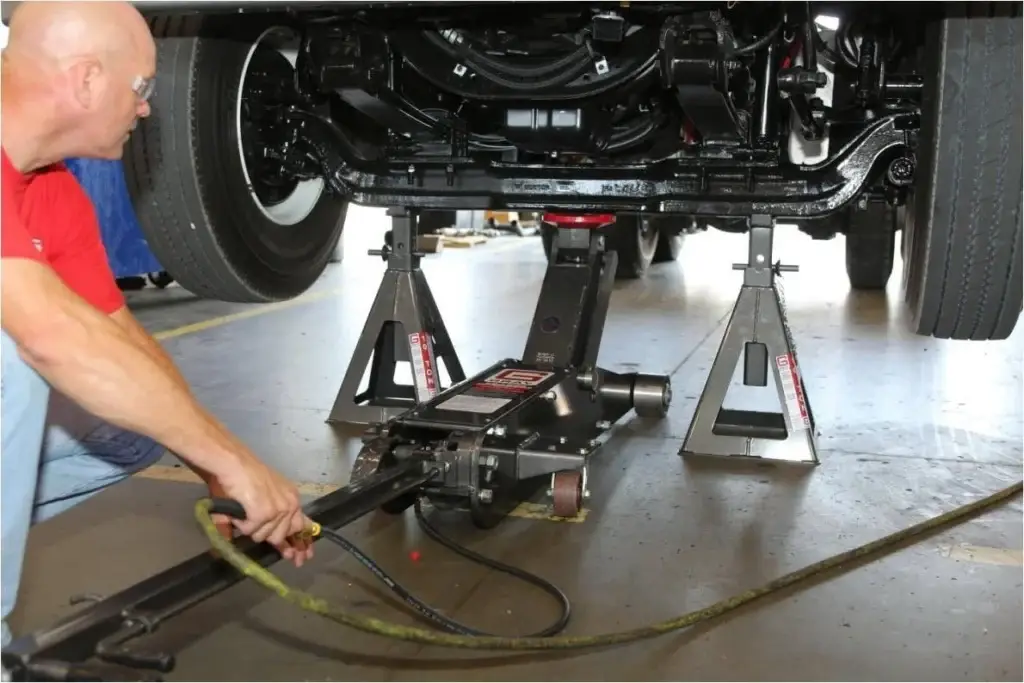
    Floor jack safety protocols demonstration showing proper jack stand placement

    Jack Stands Are Mandatory, Not Optional

    Hydraulic jacks are lifting devices, never supporting devices. This fundamental principle forms the cornerstone of safe lifting procedures across all industries. The moment a floor jack raises a load to working height, appropriately rated jack stands must be positioned before any work begins underneath. Hydraulic systems can fail due to seal deterioration, fluid leaks, or valve malfunctions—even brief work periods under jack-only support expose workers to unacceptable risk.

    Proper jack stand usage requires selecting stands rated at or above the actual lifted weight. Industry best practice recommends stands rated at least 25% higher than the load weight to provide adequate safety margin. Stand placement must occur at manufacturer-specified support points—vehicle frames, axle housings, and equipment chassis feature designated locations engineered to bear concentrated loads.

    ⚠️ Safety Warning

    Always lower the load onto jack stands while maintaining slight jack pressure to prevent sudden settling. Only after confirming stable stand contact should you fully release jack pressure. Never work under a vehicle supported only by a hydraulic jack.

    Surface Stability and Foundation Requirements

    Both the floor jack and supporting stands must rest on solid, level, load-bearing surfaces. Concrete floors represent the ideal foundation. Asphalt surfaces provide acceptable stability only in cold conditions—heat causes asphalt to soften and deform under concentrated loads, reducing load-bearing capacity by 60% or more compared to winter conditions. Soft soil, gravel, or uneven surfaces are prohibited for jack placement regardless of rated capacity.

    Understanding pressure physics explains why surface matters. A 50-ton jack with a 6-inch diameter base creates approximately 14,000 PSI ground pressure. Steel base plates or heavy timber boards distribute loads when working on marginal surfaces—a 12-inch square steel plate increases contact area sixteen-fold, reducing ground pressure proportionally.

    OSHA automotive servicing standards provide federal workplace safety requirements applicable to hydraulic lifting equipment operations. While OSHA doesn’t mandate specific hydraulic jack operator certification, employers bear legal responsibility for ensuring operators demonstrate proper knowledge and skill.

    Surface Type20-Ton Suitability50-Ton SuitabilityPrecautions
    Reinforced ConcreteExcellentExcellentVerify level placement
    Asphalt (Cold)AcceptableUse base platesMonitor for sinking
    Asphalt (Hot)Requires base platesNot recommendedWide steel plates mandatory
    Gravel/SoilProhibitedProhibitedRelocate to solid surface

    Operator Training and Documentation

    Comprehensive training covers hydraulic principles, capacity calculations, safety procedures, inspection protocols, and emergency response. Operators must understand not just what to do, but why specific procedures exist. Formal programs should include both classroom instruction and hands-on practice—theoretical knowledge about safety protocols means little without practical experience in setup, operation, and troubleshooting.

    Key training topics include capacity rating interpretation and safety factor application, pre-operation inspection procedures, proper jack stand usage and placement, surface evaluation and base plate utilization, center of gravity assessment, emergency procedures for hydraulic failure, and maintenance documentation practices. Refresher training should occur annually or when incidents reveal knowledge gaps. Documentation proves training occurred and creates accountability during safety audits or incident investigations.

    The HDJ Perspective

    After 15 years in diesel repair, I’ve seen the consequences of cutting corners on lifting equipment firsthand. The shops that invest in quality jacks, maintain them religiously, and train every operator properly are the same shops with the best safety records and lowest equipment damage costs. The floor jack market has improved significantly—2025 models offer better seal technology, stronger construction, and smarter safety features than anything available five years ago. But no amount of engineering replaces proper operator training and disciplined maintenance. If your shop doesn’t have a documented lifting equipment safety program, that’s the first investment to make—before any new jack purchase.

    Cost Analysis: Initial Investment vs Long-Term Value

    Making an informed floor jack purchase requires balancing initial investment against years of operational value. Professional shops and industrial facilities must evaluate heavy duty floor jacks as business investments rather than simple tool acquisitions. A comprehensive cost analysis considers total lifetime economics including purchase price, maintenance expenses, and productivity improvements.

    Purchase Price and the False Economy of Budget Models

    Quality 20-ton air hydraulic floor jacks command $450 to $850 depending on construction quality and warranty terms. Established brands like Torin, Hein-Werner, and Sunex dominate this range with proper safety certifications and reliable hydraulic systems. The 50-ton category represents a 2-3x price multiplier at $1,400-$2,500, reflecting substantially heavier construction, larger hydraulic cylinders, and more robust components throughout.

    Economy models priced significantly below these ranges present serious concerns. A $200-$300 jack marketed as “20-ton capacity” typically lacks proper safety certification and uses inferior materials with inadequate welds. The false economy becomes apparent when premature failure necessitates replacement—or worse, creates safety risks leading to equipment damage or worker injuries.

    Maintenance and Operating Costs

    Annual hydraulic fluid replacement runs $20-$40. Periodic seal replacement becomes necessary every 3-5 years: $80-$150 for 20-ton jacks, $120-$200 for 50-ton models. Annual safety inspections add $50-$100 per unit when outsourced. Compressed air consumption typically costs $0.15-$0.25 per hour of jack operation based on typical compressor efficiency and current industrial electricity rates.

    Total five-year ownership costs paint a complete picture. Quality 20-ton jacks typically accumulate $650-$1,100 in combined purchase and maintenance expenses. The 50-ton models run $1,700-$3,000 over the same period. Operational costs represent 30-40% of total ownership expenses beyond the initial investment.

    ~50 lifts to payback

    A $600 air hydraulic jack saves approximately 15 minutes per lift versus manual methods. At $125/hour labor rates, investment recovery occurs in roughly 50 lifts—achievable within 2-3 months in high-volume shops.

    Return on Investment by Business Type

    Commercial truck repair shops experience rapid cost recovery through improved productivity. High-volume operations may reach payback within 2-3 months. The ROI continues accumulating through reduced technician fatigue and faster vehicle turnaround.

    Construction equipment rental facilities evaluate value differently—proper lifting equipment justifies its purchase many times over by preventing even a single equipment damage incident, which typically costs $5,000-$15,000 in repairs and lost rental revenue. Industrial maintenance operations should consider that worker compensation claims and lost-time accidents create costs far exceeding any equipment investment, and stable, properly supported equipment enables thorough inspections that extend asset life.

    Choosing the Right Heavy Duty Floor Jack for Your Operation

    The decision between a 20-ton and 50-ton floor jack hinges on accurately matching equipment capabilities to your actual operational needs rather than assumptions. Understanding the critical selection factors prevents costly purchasing mistakes and ensures your investment delivers optimal performance for years.

    Calculating True Lifting Capacity Requirements

    Accurate capacity assessment begins with identifying actual component weights at lift points rather than total vehicle specifications. Most technicians overestimate their lifting needs because they focus on gross vehicle weight instead of the actual load the jack supports. When lifting one corner of a four-point supported vehicle, you’re typically raising only 25-40% of the total weight.

    Follow this systematic approach: determine the heaviest single lifting point in regular operations, add a 25-30% safety margin for uneven load distribution and real-world variables, then select jack capacity based on this calculated requirement. Servicing a 60,000-pound truck by lifting one corner involves approximately 18,000-20,000 pounds—comfortably within 20-ton capacity. However, lifting a loaded 80,000-pound tractor-trailer at the rear tandem axles might involve 35,000-40,000 pounds, requiring genuine 50-ton capacity.

    Workshop Space and Compressor Compatibility

    A 50-ton floor jack measuring 40+ inches long and weighing 150-200 pounds requires dedicated storage with appropriate access clearance. These units may not fit in service vehicle tool compartments for mobile operations. Twenty-ton models at 32-35 pounds offer substantially greater flexibility for space-constrained operations and mobile service.

    Air compressor compatibility directly affects operational efficiency. Twenty-ton jacks requiring 4-6 CFM work with standard 60-gallon two-stage compressors. Fifty-ton models demanding 8-12 CFM often exceed standard compressor capacity, necessitating upgrades to 80-gallon or larger systems. Factor compressor upgrade costs ($500-$2,000+) into your total investment analysis when considering 50-ton equipment.

    Free Professional Fleet Tools

    Cost calculators, fault code lookup, maintenance planners, and more—built for owner-operators, fleet managers, and diesel techs. No signup required.

    Explore Free Tools →

    Manufacturer Warranty and Support Infrastructure

    Established manufacturers typically offer 1-3 year warranty coverage on heavy duty floor jacks, with premium manufacturers sometimes extending coverage to 5 years. Warranty terms matter less than the manufacturer’s actual reputation for honoring claims—research customer experiences regarding claim processing, replacement part availability, and technical support responsiveness.

    Domestic service centers provide substantially faster turnaround times compared to international-only support structures. When equipment failure halts operations, the difference between 2-day and 2-week repair times directly impacts your bottom line. Brands like Torin, Sunex, Hein-Werner, and OTC have supported their products for decades, building distribution networks that ensure long-term parts availability. The CVSA out-of-service criteria create additional urgency—when a vehicle is pulled from service during an inspection, having reliable shop equipment ready to go directly affects how quickly you can return that truck to revenue service.

    Maintenance and Longevity Best Practices

    Professional-grade floor jacks can provide 15-20 years of dependable operation when maintenance best practices are followed. Regular inspection and preventive maintenance ensure continued safe and efficient performance throughout the equipment’s service life. Neglected equipment fails prematurely regardless of initial quality.

    Heavy duty floor jack technical specifications showing inspection and maintenance points

    Routine Inspection Procedures

    Daily pre-use inspections should become standard practice before every work session. Check for hydraulic fluid leaks around seals and fittings, verify base plate integrity with no cracks or deformation, confirm the release valve operates smoothly through full range, perform a test lift without load to verify smooth ram extension, and inspect air fittings for damage on pneumatic models.

    Weekly inspections for high-use environments include detailed examination of welds for crack development, measurement of the ram for scoring or corrosion, verification of overload valve function, air hose condition assessment, and cleaning accumulated dirt from all moving parts. The SAE engineering standards provide technical specifications for hydraulic component testing that inform professional inspection protocols. Documentation matters—creating maintenance records tracks equipment condition over time and provides evidence for warranty claims and liability protection.

    Hydraulic Fluid Service Requirements

    Hydraulic oil should be changed annually in commercial service or every 200-300 lifting cycles, whichever comes first. The complete procedure includes draining all fluid from reservoir and cylinder, internal cleaning to remove contaminants and sediment, refilling with manufacturer-specified hydraulic fluid (typically ISO 32 or ISO 46 grade), bleeding air from the system through multiple lift cycles, and proper disposal of used fluid per EPA used oil management standards.

    Never substitute automotive fluids or incorrect hydraulic grades. Using proper hydraulic oil maintains seal compatibility and ensures consistent performance across temperature ranges. Incorrect fluids void warranties and damage internal components.

    Troubleshooting Common Problems

    SymptomLikely CausesSolutions
    Fails to lift or lifts slowlyLow fluid, air in system, worn pump seals, clogged air supplyCheck fluid level, bleed air, inspect seals, verify air pressure
    Lifts but won’t hold pressureFailed check valve, damaged ram seals, internal cylinder scoringInspect valves, replace ram seals, assess cylinder condition
    Won’t lower or lowers too fastRelease valve adjustment, damaged valve componentsAdjust valve mechanism, replace valve assembly
    Uneven or jerky liftingAir in hydraulic system, contaminated fluid, worn pumpBleed system (10-15 full cycles), change fluid, assess pump

    Seal replacement represents the most common repair for aging floor jacks—ram seals typically require replacement every 3-5 years in commercial service. Keeping manufacturer-specific seal kits in inventory minimizes downtime. Professional assessment becomes necessary when troubleshooting reveals internal cylinder damage, structural cracks, or pump failure, where replacement may provide better long-term value than repair.

    Frequently Asked Questions

    What size floor jack do I need for a semi truck?

    For most semi truck maintenance, a 20-ton floor jack handles the majority of single-point lifting tasks. When lifting one corner or one axle end, you’re typically supporting only 25-40% of the total vehicle weight. A 60,000-pound truck lifted at one corner puts roughly 18,000-20,000 pounds on the jack—well within 20-ton capacity. However, if you regularly service loaded Class 8 trucks at rear tandem axles where loads can reach 35,000-40,000 pounds, a 50-ton jack provides the necessary safety margin. Always add 25-30% to your calculated load requirement when selecting capacity.

    Can I use a 20-ton floor jack on a loaded commercial vehicle?

    It depends on the vehicle’s gross weight and where you position the jack. A 20-ton floor jack safely lifts 40,000 pounds. For loaded medium-duty trucks (Class 6-7) with GVWRs between 26,000 and 33,000 pounds, a 20-ton jack provides adequate capacity with appropriate safety margins for single-point lifts. For loaded Class 8 vehicles exceeding 33,000 pounds GVWR—especially when lifting tandem axle configurations—you should use a 50-ton jack. Never rely on theoretical safety margins to justify exceeding rated capacity.

    How often should I change hydraulic fluid in a heavy duty floor jack?

    Replace hydraulic fluid annually in commercial service environments, or every 200-300 lifting cycles, whichever comes first. Use manufacturer-specified hydraulic fluid, typically ISO 32 or ISO 46 grade. The complete procedure includes draining all fluid, internal cleaning to remove contaminants, refilling with fresh fluid, and bleeding air through 10-15 full lift cycles. Never substitute automotive fluids or incorrect hydraulic grades—this damages seals and voids warranties.

    Do I need to upgrade my air compressor for a 50-ton floor jack?

    Most likely. A 50-ton air hydraulic floor jack typically requires 8-12 CFM at 90-120 PSI during operation—roughly double the 4-6 CFM that 20-ton models demand. Standard 60-gallon shop compressors delivering 11-13 CFM at 90 PSI may not sustain these requirements while powering other pneumatic tools. You’ll generally need an 80-gallon or larger two-stage compressor delivering 14+ CFM. Inadequate air supply extends lift times from under one minute to three minutes or more as the tank repressurizes.

    What certifications should I look for when buying a heavy duty floor jack?

    For North American operations, ASME PASE (Portable Automotive Service Equipment) certification is the primary standard. This requires third-party laboratory testing of load holding, overload protection, cycle durability, and structural integrity. CE marking indicates European Union compliance, and ISO 9001 confirms consistent manufacturing quality. Always verify certifications by checking manufacturer documentation for identification numbers, issuing body information, and expiration dates. Third-party verification provides stronger assurance than self-certification.

    How long does a professional-grade heavy duty floor jack last?

    A professional-grade floor jack can deliver 15-20 years of dependable service when properly maintained. Key factors include annual hydraulic fluid replacement, periodic seal replacement every 3-5 years, daily pre-use inspections, and proper storage protecting components from temperature extremes. Quality construction—forged steel bases, heat-treated rams with hard-chrome plating, and high-durometer synthetic seals—significantly extends service life. Neglected equipment fails prematurely regardless of initial quality.

    Making the Right Heavy Duty Floor Jack Investment

    Your heavy duty floor jack decision starts with honest assessment of actual lifting requirements at the lift point—not gross vehicle weight. For most commercial truck service, agricultural equipment maintenance, and construction repair operations, a 20-ton capacity delivers optimal balance of power, portability, and value. The 50-ton category becomes necessary only when your shop regularly handles mining equipment, loaded Class 8 trucks at tandem axles, or specialized industrial machinery exceeding 40,000 pounds per lift point.

    Quality manufacturers like Torin, Hein-Werner, Sunex, and OTC offer certified equipment representing sound long-term value—budget models create false savings through premature failure and increased safety risks. Remember that your floor jack forms one element of a complete lifting system: proper jack stands, operator training, and disciplined maintenance protocols are equally critical. View this purchase as a decade-long investment in operational capability and technician safety.

    Share This Guide With Your Team

    Know a shop manager, fleet supervisor, or technician deciding on lifting equipment? Share this comparison guide to help them make an informed investment.

    Leave a Comment

    Your email address will not be published. Required fields are marked *

    Sponsored

    Emergency Breakdown?

    Find Certified Repair Shops Near You

    24/7 Mobile Service
    Verified Facilities
    Nationwide Coverage
    Find Repair Shops Now →

    Trusted by thousands of fleet operators