
By Michael Nielsen, Editor & Publisher | 15+ Years in Diesel Repair
Last Updated: February 2026
📖 Estimated reading time: 22 minutes
Every diesel engine built after 2010 requires diesel exhaust fluid to meet federal emissions standards, and more than 12 million vehicles across North America depend on this fluid for proper operation. A DEF test kit is the most practical safeguard against contaminated fluid reaching your SCR system—where a single bad fill can trigger thousands of dollars in repair costs, engine derating, and lost revenue from vehicle downtime. This guide reviews the top DEF testing solutions available in 2025, compares testing methodologies, and provides practical guidance for fleet operators and owner-operators who need reliable quality verification before every refill.
The EPA released updated guidance in August 2025 requiring manufacturers to prevent sudden power loss when fluid runs low, making regular diesel exhaust fluid testing more important than ever. Contamination happens at multiple points in the supply chain—during storage, transfer, and even from purchasing substandard products. Testing each refill protects your SCR system and prevents costly repairs that can sideline a truck for days.
Key Takeaways
- Test every refill: Contamination occurs during distribution and storage, not just manufacturing—verify quality before adding DEF to your tank.
- Match equipment to usage: Refractometers deliver the best long-term value for fleets testing daily; test strips suit occasional users at lower upfront cost.
- Concentration matters: DEF must contain exactly 32.5% urea to function—readings outside 31.8%-33.2% indicate problems that damage SCR components.
- Prevention beats repair: A $20-$400 testing investment protects against SCR system repairs exceeding $5,000 and vehicle downtime costing $500-$2,000 per day.
- No single test catches everything: Refractometers detect concentration issues; chemical strips detect fuel contamination. Comprehensive protection often requires multiple methods.
- 2025 EPA guidance: New federal requirements mandate protection against sudden power loss from fluid depletion, increasing the stakes for proper monitoring.
Understanding Diesel Exhaust Fluid and Why Testing Matters
Diesel Exhaust Fluid plays a critical role in reducing harmful emissions from today’s commercial vehicles. Since 2010, the Environmental Protection Agency has required heavy-duty diesel engines to meet strict emission standards requiring diesel exhaust fluid systems, pushing manufacturers to adopt selective catalytic reduction systems that depend entirely on DEF quality for proper operation.
Testing DEF ensures your vehicle’s emissions system functions as designed. Contaminated or diluted fluid triggers warning lights, reduces fuel efficiency, and can damage expensive aftertreatment components. The fluid must contain exactly 32.5% automotive-grade urea and 67.5% deionized water to work properly. This precise formula represents the eutectic point where the solution achieves the lowest freezing temperature—any deviation compromises the entire emissions control process.

The SCR system injects DEF into the hot exhaust stream at temperatures between 350°F and 1,000°F. At these temperatures, DEF decomposes and releases ammonia gas that reacts with nitrogen oxides inside the SCR catalyst. This chemical reaction converts harmful NOx into harmless nitrogen gas and water vapor, eliminating up to 90% of nitrogen oxide pollutants. Without proper urea concentration, this conversion rate drops dramatically.
| Component | Specification | Acceptable Range | Purpose |
|---|---|---|---|
| Urea Content | 32.5% | 31.8% – 33.2% | Ammonia source for NOx conversion |
| Deionized Water | 67.5% | 66.8% – 68.2% | Solution carrier and reaction medium |
| Freezing Point | 12°F (-11°C) | 10°F – 14°F | Cold weather operability |
| Alkalinity | ≤ 0.2% NH₃ | Lab verified | Prevents corrosion and deposits |
How DEF Quality Affects Engine Performance and Compliance
Modern diesel engines monitor NOx levels continuously through downstream sensors. When the system detects inadequate NOx reduction from poor-quality DEF, it initiates progressively severe countermeasures. Dashboard warning lights appear first. If the problem persists, the engine control module reduces power output through derating. In severe cases, the vehicle may refuse to restart after shutdown—protective measures designed to prevent non-compliant vehicles from operating on public roads.
“The quality of the DEF going into your vehicle is as important as the quality of the engine oils or fuels.”
— Bill O’Ryan, American Petroleum Institute
API-certified DEF meets rigorous purity standards established by the ISO 22241 standard for diesel exhaust fluid quality. Detroit Diesel and other major manufacturers specifically recommend using only API-certified products in their engines. This certification ensures consistent quality across different suppliers and provides a baseline that field testing can verify.
Financial Risks from Contaminated Fluid
Contaminated DEF creates expensive problems that extend far beyond simple fluid replacement. The SCR system contains precision components designed to operate within tight tolerances. Contaminated fluid damages injectors, clogs filters, and deposits crystals throughout the system. A single SCR injector replacement typically costs between $800 and $1,500, while complete system repairs can exceed $5,000 in parts and labor.
Operational consequences often prove more costly than repair bills. A derated truck operates at reduced power, limiting speed and load capacity—meaning missed delivery windows and unsatisfied customers. Complete emissions system failures force vehicle shutdown, generating towing costs, cargo transfer expenses, and lost revenue that commercial operators report at $500 to $2,000 per day for immobilized vehicles. The SCR system requires DEF additions at approximately 5-10% of diesel fuel consumption, making quality verification a routine necessity.
Prevention through testing costs pennies compared to these repair expenses. A $20 test strip kit can identify contamination before it damages components worth thousands. Fleet managers who implement regular testing protocols report significantly lower aftertreatment system failure rates across their operations.
Key Features to Evaluate in a DEF Test Kit
Your choice of DEF test equipment determines how effectively you protect diesel engines from costly contamination damage. Several critical performance characteristics separate professional-grade testing from inadequate options, and understanding these factors ensures you invest in equipment that meets your specific requirements.

Accuracy and Precision Standards
DEF testing accuracy determines whether you can trust results to make critical fluid quality decisions. Different testing technologies offer varying levels of measurement precision. Refractometer-based systems typically provide accuracy within ±0.1% to ±0.2% of actual concentration, making them the preferred choice for operations requiring rigorous verification. Chemical test strips offer ±1% to ±2% accuracy—sufficient for basic screening but potentially unable to detect subtle contamination issues. Compliance with ISO 22241 specifications represents the international benchmark, and test kits referencing this standard demonstrate alignment with engine manufacturer requirements worldwide.
Contamination Detection Range
Comprehensive contamination detection capabilities distinguish advanced test kits from basic concentration-only models. Quality test kits should detect water dilution that reduces urea concentration below acceptable limits, diesel fuel cross-contamination that causes severe system damage even in trace amounts, metallic contaminants from storage tanks and handling equipment, and particulate matter that clogs filters and restricts fluid flow through SCR systems. Industry experts recommend testing DEF each time it’s refilled, highlighting the importance of equipment that identifies multiple impurity types in a single session.
Portability and Ease of Use
Testing equipment serves no purpose if it remains too complicated or cumbersome for regular field use. Portable designs enable fleet managers and owner-operators to conduct quality checks at fuel stops, storage facilities, and remote job sites. Consider compact dimensions that fit in toolboxes, durable construction for field conditions, simple operation requiring minimal training, and clear result displays readable in various lighting. Fleet operations benefit particularly from equipment that drivers can operate independently, enabling verification before adding questionable DEF supplies to vehicle tanks.
Testing Speed and Result Interpretation
Refractometers deliver instant results, typically providing concentration readings within 30 seconds. Chemical test strips require 1 to 5 minutes depending on parameters tested. Professional laboratory analysis offers the most comprehensive testing but requires days for results, making it impractical for routine decisions. Digital displays showing numerical values provide clear, objective measurements, while color-change indicators on strips require comparison against reference charts—introducing subjective judgment that may affect consistency between operators.
Price Point Analysis and Long-Term Value
| Testing Method | Initial Investment | Per-Test Cost | Best For |
|---|---|---|---|
| Refractometer | $150-$400 | $0.00 | High-volume users and fleets |
| Test Strips | $20-$50 | $1-$3 | Occasional testing and small operations |
| Digital Meter | $300-$800 | $0.10-$0.50 | Professional service facilities |
| Laboratory Analysis | $0 | $25-$75 | Detailed contamination investigations |
High-volume users benefit substantially from refractometers despite higher upfront costs. With zero per-test expenses, refractometers achieve cost recovery after approximately 50-150 tests compared to disposable strips. Fleet operations conducting daily testing realize rapid return on investment. Occasional users may prefer lower-cost test strips that eliminate significant initial capital investment, matching equipment cost structure to limited testing frequency.
Best DEF Test Kit Options Reviewed for 2025
The marketplace offers solutions ranging from professional-grade refractometers to convenient test strips, each designed for different operational environments and expertise levels. The following reviews evaluate five leading products representing the full spectrum of available testing technologies.

Mira Safety DEF Refractometer Test Kit
The Mira Safety DEF Refractometer represents a professional-grade optical testing solution designed for users who demand laboratory-quality accuracy in field conditions. This handheld device measures urea concentration through light refraction principles, providing instant readings without chemical consumables. Built with industrial-grade aluminum housing, it functions across temperature ranges that challenge lesser instruments.
The unit measures urea concentration from 0% to 40% with ±0.2% precision and automatic temperature compensation between 50°F and 86°F. The dual-scale display shows both urea percentage and specific gravity simultaneously. The kit includes a protective carrying case, calibration screwdriver, pipette, and microfiber cleaning cloth. The precision prism features a chemical-resistant coating that withstands repeated DEF exposure, and sample requirements measure just 2-3 drops.
Strengths include exceptional accuracy matching professional laboratory standards, zero ongoing costs, and durable construction for jobsite conditions. The main limitations are higher initial investment, a learning curve for proper sample preparation and reading interpretation, and the need for periodic calibration with distilled water.
Cummins Filtration DEF Quality Test Strips
Cummins Filtration test strips bring OEM credibility to convenient chemical testing. As products from a leading diesel engine manufacturer, these strips meet exacting standards that major engine producers require for warranty compliance. Each container includes 50 individually sealed strips with a 24-month shelf life. The strips detect urea concentration from 30% to 34%, indicating whether DEF falls within ISO 22241 specifications, with color-change reactions completing within 45-60 seconds.
OEM backing and minimal training requirements make these strips practical for fleet-wide deployment. The portable format fits easily in toolboxes. However, ongoing replacement costs accumulate, the strips detect concentration issues but not specific contaminant types, and result interpretation relies on subjective color perception.
Stay Ahead of DEF Quality Issues
Get testing tips, contamination alerts, and maintenance insights delivered to your inbox. Heavy Duty Journal keeps fleet managers and techs informed on what matters.
Peak BlueDEF Test Kit Pro
The Peak BlueDEF Test Kit Pro comes from Old World Industries, a recognized leader in the DEF market. This comprehensive kit combines concentration measurement with contamination detection, checking both urea levels and common adulterants in a single procedure. The kit includes chemical test strips for concentration verification, contamination detection reagents, sample collection bottles, and protective gloves. Testing takes approximately 3-5 minutes, and concentration strips measure urea from 28% to 36% with 1% resolution. Contamination tests specifically target diesel fuel cross-contamination. The kit provides supplies for 25 complete tests.
The multi-parameter approach and brand reputation stand out as primary advantages. The moderate price point and consumable replacement requirements are considerations, along with the multiple-step testing process.
SimplexHealth DEF Concentration Tester
SimplexHealth employs a digital electronic approach using conductivity sensors to determine urea concentration through electrical resistance measurement. The digital display eliminates interpretation subjectivity. The device measures concentration from 0% to 40% with 0.1% resolution on a backlit LCD screen, stores up to 100 test results with timestamps for fleet record keeping, and features automatic temperature compensation between 32°F and 104°F. The conductivity probe extends 4 inches for testing in containers and vehicle tanks without sample extraction, and the unit operates on AAA batteries lasting approximately 500 tests.
Digital precision, consistent results across operators, and data logging capability distinguish this option. Higher cost, sensor maintenance requirements, and battery dependency are trade-offs to consider.
Alliance Diesel Exhaust Fluid Refractometer
The Alliance refractometer positions as a value-oriented optical testing option for budget-conscious users. It delivers reliable accuracy adequate for determining whether DEF meets concentration specifications using the same refraction principles as premium models. The unit measures urea concentration from 0% to 35% with ±0.5% accuracy. The compact design fits in glove boxes and tool kits, and no consumables are required.
The affordable entry point and elimination of ongoing costs appeal to independent truckers. However, basic plastic construction offers less durability than premium alternatives, manual temperature compensation requires correction calculations in extremes, and the base package includes limited accessories.
| Product | Method | Accuracy | Best For |
|---|---|---|---|
| ✓ Mira Safety Refractometer | Optical Refraction | ±0.2% | High-volume fleet operations |
| Cummins Test Strips | Chemical Reaction | ±1% | Regular monitoring schedules |
| Peak BlueDEF Pro Kit | Multi-parameter Chemical | ±1% + contaminants | Comprehensive quality verification |
| SimplexHealth Digital | Electronic Conductivity | ±0.3% | Data logging and documentation |
| Alliance Refractometer | Optical Refraction | ±0.5% | Occasional testing needs |
The choice between refractometers, test strips, and digital meters ultimately depends on your testing environment, frequency, and required features. Refractometers offer long-term value through elimination of consumable costs. Test strips provide maximum convenience for occasional verification. Digital meters satisfy users who prioritize data documentation and eliminate result interpretation variability.
DEF Testing Methods Compared
The diesel industry recognizes four primary testing approaches that comply with ASTM D7826 standard test methods and API certification requirements. Each method offers distinct advantages depending on your testing frequency, accuracy needs, and budget.

Optical Measurement (Refractometers)
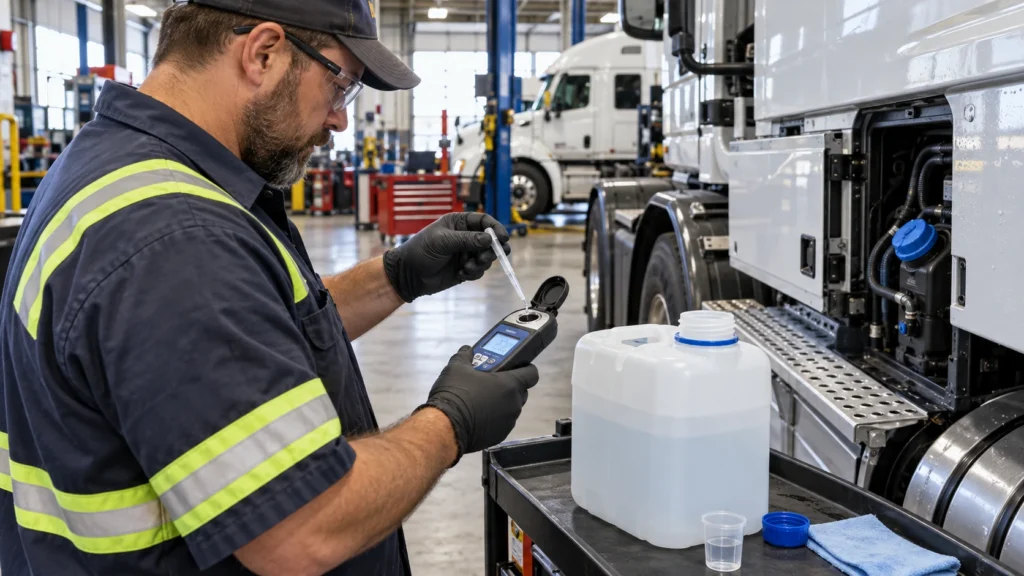
Refractometer testing uses optical principles to measure the refractive index of DEF samples, providing accurate concentration readings by analyzing how light bends through the fluid. Shell Rotella recommends that shop personnel be familiar with this method due to its reliability and cost-effectiveness. The device features a viewing window where you read urea concentration directly on a calibrated scale, and most quality models include automatic temperature compensation. The reusability makes refractometers ideal for fleet operators who test frequently—simply clean the prism between samples with distilled water and a soft cloth.
Chemical Reaction Testing (Test Strips)
Test strips rely on chemical reactions producing color changes that indicate urea concentration and contamination presence. The procedure requires dipping the strip into fresh DEF and comparing the resulting color to a manufacturer-provided reference chart. While accuracy limitations make strips less suitable for precision applications, their convenience and low per-test cost appeal to independent truckers and smaller operations. Some strips include additional reaction zones that detect diesel fuel or other foreign substances.
Digital Electronic Measurement
Electronic testing equipment uses conductivity measurements to determine fluid quality, featuring LCD displays that provide numerical readouts with greater precision than visual comparison methods. Many instruments include data logging that records results with timestamps—valuable for fleet management documentation and quality assurance tracking. The higher initial investment delivers benefits through increased accuracy, efficiency, and elimination of subjective interpretation.
Laboratory Analysis Services
Professional laboratory analysis examines multiple parameters including precise urea concentration, pH levels, metallic contaminants, and biuret content. These services detect trace contamination that field testing might miss. Turnaround times typically range from three to seven business days, with costs between $50 and $200 per sample. While impractical for routine checks, laboratory services provide definitive answers during contamination investigations, bulk supply verification, or dispute resolution.
| Method | Accuracy | Cost Per Test | Result Time |
|---|---|---|---|
| Refractometer | ±0.2-0.5% | $0.10-$0.25 | 30 seconds |
| Test Strips | ±1-2% | $1-$3 | 1-5 minutes |
| Digital Meter | ±0.2-0.3% | $0.20-$0.40 | 15-20 seconds |
| Laboratory | ±0.1% | $50-$200 | 3-7 days |
Fleet managers often combine approaches effectively—using refractometers or digital meters for routine field checks and reserving laboratory analysis for comprehensive verification of bulk supply deliveries or contamination investigations.
How to Properly Test DEF Quality
Getting reliable results depends on proper handling from sample collection through result interpretation. Many fleet operators discover that contamination occurs during distribution and storage rather than at the manufacturing stage, making correct testing procedures essential for protecting expensive SCR systems.

⚠️ Safety Warning
Always use clean, dedicated sampling equipment that has never contacted diesel fuel, coolant, or other chemicals. Cross-contamination from even trace amounts of these fluids will compromise your sample and produce misleading results that could allow contaminated DEF to reach your SCR system.
Collecting Samples Correctly
Draw your sample from mid-depth in the storage container rather than from the surface or bottom—contaminants tend to concentrate at these extreme levels, producing false readings. Use a clean plastic or stainless steel sampling tool designed specifically for DEF. Store samples in sealed, clean containers away from direct sunlight if you cannot test immediately, maintaining temperatures between 12°F and 86°F. Test the source tank before refilling your vehicle tank. This simple step catches contamination before it enters your SCR system.
Step-by-Step Refractometer Testing
Start by calibrating your refractometer with distilled water at room temperature. Clean the prism surface with a soft, lint-free cloth, then apply 2-3 drops of DEF to the prism. Close the cover plate to spread the sample evenly, wait 30 seconds for temperature stabilization, and read the concentration value on the scale. Clean the prism immediately after reading. For test strips, immerse completely for the manufacturer-specified time, remove and gently tap against the container edge, hold horizontally during the development period, and compare colors under natural daylight or full-spectrum lighting.
Interpreting Results and Taking Action
Field testing equipment typically offers ±0.5% accuracy, meaning acceptable readings range from 32.0% to 33.0%. Readings below 32.0% suggest water contamination or DEF degradation—your SCR system may not achieve proper NOx reduction. Readings above 33.0% indicate excessive concentration that can cause crystallization and system damage. Document all results including date, source container identification, test method, and concentration reading. Take immediate action when tests show contamination—do not use DEF that falls outside acceptable ranges, and isolate the contaminated source to prevent further distribution.
Common Mistakes That Compromise Accuracy
Using contaminated sampling equipment ranks as the most frequent error in DEF quality testing—even trace amounts of diesel fuel or chemicals skew results dramatically. Temperature-related errors occur when testing DEF at extreme conditions without proper compensation. Failing to calibrate refractometers regularly leads to measurement drift, and sample evaporation between collection and testing changes concentration levels artificially. Test samples within 15 minutes of collection when possible, and check calibration with distilled water before each session.
Maintaining Your DEF Test Equipment
Proper maintenance directly influences the accuracy of every measurement. DEF testing tools face unique challenges from the chemical properties of the fluid, which leaves residue affecting optical surfaces and electronic sensors. Temperature fluctuations and environmental exposure add additional stress to sensitive components.

Cleaning and Storage Best Practices
Clean testing equipment after each use to prevent crystal formation that degrades accuracy. For refractometers, use only distilled water and soft, lint-free cloths—never use tap water, as mineral deposits create false readings. Allow a few drops of distilled water to sit on the prism for 30 seconds to dissolve remaining fluid, then gently wipe using a circular motion. The ATA’s support for EPA diesel exhaust fluid guidance recommend storing DEF and testing equipment below 86°F. Store refractometers in protective cases to shield optical components from dust and impact, and keep test strips in original containers with lids tightly sealed. Protect all equipment from direct sunlight, which degrades plastic housings and alters chemical strip composition.
Calibration Schedules
Commercial fleets conducting daily tests should calibrate weekly, while occasional users can extend to monthly checks. Calibrate using distilled water—the reading should display exactly 0% on the DEF concentration scale. If measurement deviates by more than 0.5%, turn the calibration screw slowly while viewing through the eyepiece until the boundary line aligns with zero. Certified calibration solutions provide verification beyond basic water checks by testing multiple points on the measurement scale. When equipment consistently fails calibration, the instrument may have internal damage requiring professional service or replacement.
Replacing Consumable Components
Most test strip manufacturers specify a two-year expiration period from the production date—check dates before every session and discard strips showing discoloration, moisture damage, or physical deterioration. Inspect refractometer prism covers monthly for scratches or cloudiness affecting light transmission. Replace O-rings and seals annually, as these rubber components become brittle from temperature exposure. Source replacement parts from authorized distributors to ensure specifications match. When cumulative repair costs over 12 months exceed 60% of new equipment cost, replacement typically provides better value.
The HDJ Perspective
In 15 years of covering diesel maintenance, DEF contamination has consistently ranked among the most preventable yet costly problems in the industry. The economics are straightforward: a $200 refractometer pays for itself the first time it catches a bad batch that would have damaged a $5,000 SCR system. What we see repeatedly is that fleet operators who build testing into their standard fueling procedures—treating it like checking oil level—virtually eliminate contamination-related failures. The real shift happening in 2025 is that EPA’s new anti-derating guidance makes quality verification not just smart maintenance, but an operational compliance requirement.
Common DEF Contamination Issues and How to Detect Them
DEF contamination can occur at multiple points in the supply chain despite limited producers. According to Old World Industries, impure DEF clogs fuel injectors, blocks fuel systems, and causes significant buildup in SCR systems. Off-spec DEF remains one of the most common user complaints in the diesel industry, making effective contamination detection essential.

Water Dilution
Excess water dilutes urea concentration below the required 32.5%, reducing effectiveness in converting NOx emissions. Condensation forms inside storage tanks exposed to temperature fluctuations, particularly in humid climates. Improper mixing during production and contaminated distribution equipment also introduce excess water. Test kits detect this through low urea readings on refractometers or discolored test strips. Beyond reduced NOx conversion, diluted DEF has elevated freezing points that cause cold-weather operational failures.
Diesel Fuel Cross-Contamination
Even small amounts of diesel fuel entering DEF systems cause catastrophic engine damage, making this the most severe quality issue. Contamination typically occurs through shared distribution equipment or improperly cleaned transfer pumps. Visual inspection reveals an oily appearance or sheen, and a distinct diesel odor provides another warning. Specialized test strips confirm petroleum-based contamination through color reactions. Old World Industries reports that fuel system damage from contaminated DEF costs thousands to repair, as diesel attacks seals, gaskets, and plastic components throughout the SCR system.
Metal and Particle Contamination
Storage tank corrosion releases metal particles into DEF, while degraded distribution equipment sheds material during transfer. Environmental dust and debris contaminate fluid during storage or handling. These contaminants clog SCR injectors and filters, reducing system performance. Visual inspection for cloudiness or suspended particles provides initial detection, and some test kits include filtration tests. Old World Industries recommends DEF filter replacement every 200,000 miles to remove crystallized urea and accumulated contaminants.
| Contamination Type | Detection Method | Visual Indicators | Consequences |
|---|---|---|---|
| Water Dilution | Refractometer (below 32.5%) | Clear, normal odor | Reduced NOx conversion, freezing |
| Diesel Fuel | Hydrocarbon test strips | Oily sheen, diesel smell | Severe SCR damage, seal failure |
| Metallic Particles | Visual inspection, filtration | Cloudiness, visible particles | Injector clogging, filter blockage |
| Crystallized Urea | Filtration test, visual check | White crystals, sediment | System blockages, flow restriction |
No single test kit detects all contamination types, so comprehensive protection often requires combining multiple methods. Fleet operators managing large DEF inventories typically use field testing for routine concentration checks and periodic laboratory analysis for detailed contamination profiling.
Free Professional Fleet Tools
Cost calculators, fault code lookup, maintenance planners, and more—built for owner-operators, fleet managers, and diesel techs. No signup required.
Who Benefits Most from DEF Testing Equipment
DEF testing equipment serves diverse industries, each facing unique contamination risks. With more than 12 million North American vehicles requiring DEF, the scope of potential users spans from individual owner-operators to massive commercial fleets. Jorge Noval of Yara Industrial Solutions emphasizes that continuous, undisrupted DEF supply is vital for the functioning transport sector—extending to food supplies, pharmaceutical distribution, and hospital logistics.
Fleet operators managing multiple diesel vehicles face exponential risk from contaminated DEF affecting entire operations. A single contaminated bulk storage tank can compromise dozens of vehicles simultaneously. Testing before bulk tank refilling protects entire fleets from widespread system failures. Prevost specifically recommends boxed DEF for bus operations due to quality concerns with pump DEF at fuel stations—a recommendation that underscores how seriously major manufacturers take contamination risks.
Owner-operators whose livelihoods depend on single vehicles face particularly acute risks. Unlike fleet operators with backup vehicles, independent truckers experience complete income loss when their truck needs SCR repairs. Testing equipment provides affordable insurance against repairs that could sideline their entire business, especially since independent operators frequently fuel at various locations with inconsistent quality control.
Construction companies operate SCR-equipped excavators, generators, and machinery in remote locations where contamination diagnosis is difficult and service calls multiply repair costs. Automotive service centers need testing to diagnose customer complaints accurately, protect against liability, and differentiate their service through professional quality verification.
| User Type | Primary Need | Risk Without Testing | Testing Frequency |
|---|---|---|---|
| Commercial Fleets | Bulk storage verification | Multiple vehicle failures | Before each bulk delivery |
| Owner-Operators | Point-of-purchase check | Complete income loss | Before each refill |
| Construction | Remote equipment protection | Project delays, remote service | Before equipment refills |
| Service Centers | Customer vehicle diagnosis | Liability and reputation | During service appointments |
The common thread across all user types involves prevention of expensive consequences through simple quality verification. Whether protecting fleets, individual livelihoods, remote equipment, or service reputations, testing provides assurance that DEF quality meets the specifications required for reliable SCR system operation. The TMC Recommended Practices for fleet maintenance emphasize that fluid quality verification should be part of every preventive maintenance program.
Frequently Asked Questions
How often should you test diesel exhaust fluid quality?
Industry best practice calls for testing DEF every time you refill your tank, particularly when purchasing from an unfamiliar source. Fleet operators managing bulk storage should test each incoming delivery before distributing fluid to vehicles. Testing the source container before adding fluid to your vehicle provides the best protection, since contamination most often occurs during distribution and storage rather than at the manufacturing stage. Operations fueling from the same verified source regularly may reduce frequency to weekly spot checks, but any change in supplier, storage conditions, or seasonal temperatures warrants immediate testing.
What is the correct urea concentration for diesel exhaust fluid?
DEF must contain exactly 32.5% automotive-grade urea and 67.5% deionized water per the SAE J2819 standard for diesel exhaust fluid. This precise ratio represents the eutectic point where the solution achieves the lowest possible freezing temperature of approximately 12°F (-11°C). The acceptable range for field testing is 31.8% to 33.2% urea concentration. Readings outside this range indicate dilution or concentration problems that can trigger dashboard warnings, engine derating, or SCR system damage requiring expensive repairs.
Can contaminated DEF damage my engine?
Yes, contaminated DEF causes severe and expensive damage to your selective catalytic reduction system. Diesel fuel cross-contamination is the most destructive, attacking seals, gaskets, and plastic components. A single SCR injector replacement typically costs $800 to $1,500, while complete system repairs can exceed $5,000 in parts and labor. Beyond repair costs, contaminated fluid triggers engine derating that reduces power output, limits speed and load capacity, and can eventually prevent the vehicle from starting after shutdown.
What is the difference between a DEF refractometer and test strips?
Refractometers use optical principles to measure urea concentration with high precision (±0.2% to ±0.5%), deliver instant results, and have zero per-test cost after the initial $150-$400 investment. Test strips use chemical reactions producing color changes, offer lower precision (±1% to ±2%), cost $1-$3 per test, but require minimal upfront investment. Refractometers suit high-volume fleet operations that test daily, while test strips work well for owner-operators and occasional testing. Some fleet managers combine both methods for comprehensive coverage.
How long does diesel exhaust fluid last in storage?
DEF remains viable for approximately 12 months when stored at temperatures below 86°F according to API guidelines. Higher storage temperatures accelerate degradation significantly. Temperature fluctuations and direct sunlight exposure also reduce shelf life faster than consistent cool storage. The fluid should never be stored in containers previously used for other chemicals. Always check expiration dates before use and test stored DEF with a refractometer or test strips to confirm concentration remains within the 31.8% to 33.2% acceptable range.
Do I need API certified DEF for my truck?
Major engine manufacturers including Detroit Diesel and Cummins specifically recommend using API-certified DEF meeting 40 CFR Part 1036 emissions compliance requirements. API certification ensures the fluid meets rigorous purity standards for urea concentration, alkalinity, and contaminant levels. Using non-certified fluid risks voiding warranty coverage on SCR components and introduces contamination risks that field testing alone cannot fully mitigate. The API certification mark on the container provides assurance of consistent quality across different suppliers.
Protect Your SCR Investment with Consistent DEF Testing
A DEF test kit investment of $20 to $400 protects against SCR system repairs costing thousands of dollars and vehicle downtime that drains revenue daily. With 2025 EPA guidance raising the stakes for proper fluid monitoring, testing each refill is no longer optional for responsible diesel vehicle care—it is fundamental preventive maintenance.
Select equipment matching your operational scale: refractometers for daily fleet testing, test strips for occasional verification, or digital meters for operations requiring documentation. Implement proper sampling and testing procedures before each refill, maintain your equipment following manufacturer guidelines, and combine field testing with periodic laboratory analysis for comprehensive quality assurance. These steps establish professional standards that protect your equipment, maintain emissions compliance, and keep your trucks earning revenue on the road.
Help Fellow Diesel Professionals
Know a fleet manager or owner-operator dealing with DEF quality issues? Share this guide so they can protect their equipment and avoid costly SCR system failures.