By Michael Nielsen, Publisher | 15+ Years in Diesel Repair
Last Updated: October 2026
⏱ Estimated reading time: 13 minutes
Commercial tire changers for semi trucks differ from car machines in three ways that matter before price: the rim sizes they clamp, the weight of the wheel assembly they handle and the safety rules that govern the work.
This buying guide from Heavy Duty Journal (HDJ), written by publisher Michael Nielsen, explains how to match a machine to your wheels, read a spec sheet, plan power and space, and test a changer before you pay.
HDJ rebuilt the earlier version of this page around published specifications and federal safety sources. It no longer ranks named models or quotes prices, because HDJ has not tested these machines and could not verify the earlier claims.
Key Takeaways
- ✓Match the rim range first. Semi truck wheels are commonly 22.5 and 24.5 inches. Confirm the spec sheet names heavy trucks, not only a maximum rim size.
- ✓Check weight and diameter. Get the maximum wheel-and-tire weight and diameter in writing for the exact model.
- ✓The machine does not replace the rules. The Occupational Safety and Health Administration (OSHA) rim-wheel standard still requires training and a restraining device or barrier.
- ✓Plan power and floor space early. Spec sheets list voltage, phase and amperage, so have an electrician confirm them.
- ✓Compare total cost, not the sticker. Training, accessories, service and downtime all count.
- ✓Test on your own wheels. A demonstration with your hardest wheel shows more than a brochure.
In This Guide
- What Commercial Tire Changers for Semi Trucks Must Handle
- Match the Machine to Your Wheels
- Published Specifications: Examples, Not a Ranking
- Clamping, Bead Breaking and Wheel Protection
- Safety Rules the Machine Does Not Replace
- Plan Power, Air and Floor Space
- Count the Total Cost, Not Just the Price
- Test Before You Buy
- Frequently Asked Questions
- The Bottom Line
What Commercial Tire Changers for Semi Trucks Must Handle
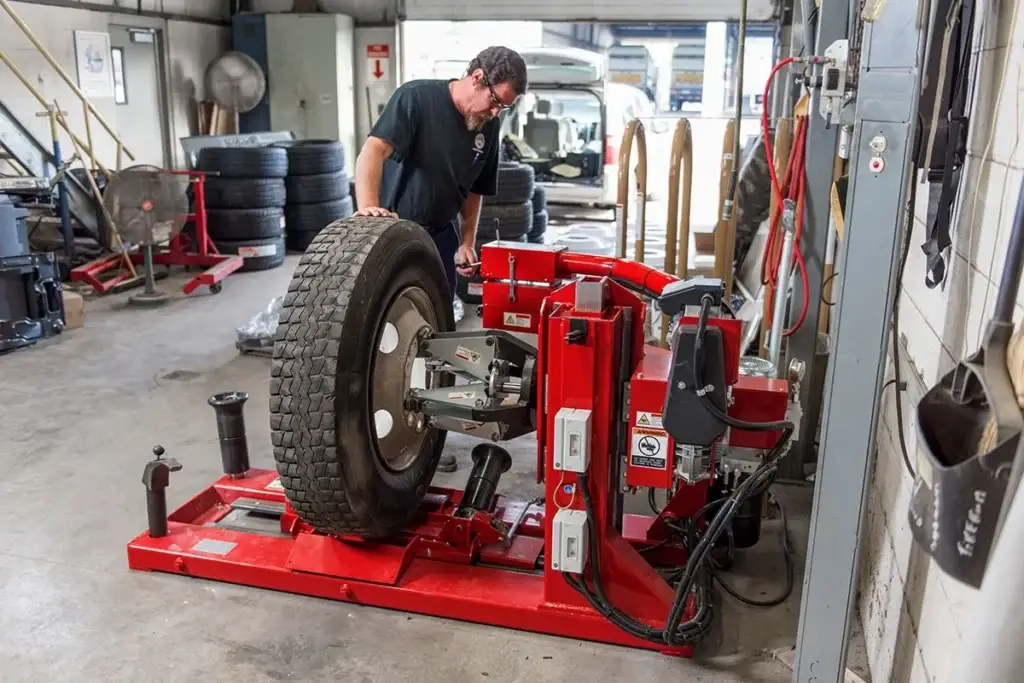
A tire changer for heavy trucks does the same three jobs as any other: break the bead, demount the tire and mount it again without damaging the wheel. What changes is scale. A semi truck wheel is large, the assembly is heavy and the tire stores enough energy to injure or kill when something goes wrong.
Some machines sold as commercial are built for passenger vehicles and light trucks. Published pages for them show rim limits near 30 inches and describe cars, pickups and run-flat tires, not heavy-truck wheels. Treat a missing heavy-truck rating as a reason to ask questions, not a detail to assume.
Fleet wheels also arrive corroded, stuck or worn, and a machine that handles a clean wheel in a demonstration may struggle with the hardest one in your yard. That is why this guide returns to testing before it ends.
Semi tractors and trailers commonly run 22.5-inch and 24.5-inch wheels, so a machine for this work should list those sizes. It should also state the largest wheel-and-tire assembly it can lift and turn, since a spec that covers the rim but not the assembly can leave you with a machine that cannot hold the wheels you service.
Who This Guide Is For
This guide suits shop owners, fleet maintenance managers and independent shops choosing a stationary changer. Roadside and mobile work uses different equipment, and HDJ's guide to commercial truck tire repair tools covers shop and roadside tools.
Match the Machine to Your Wheels
Start with a list of what actually crosses your floor: rim diameters, tire widths, wheel materials and the heaviest assembly. Then compare it with the published limits for each machine. A changer that covers most of your work but rejects the rest will cost you in sublets and workarounds.
| Specification | What to confirm | Why it matters |
|---|---|---|
| Rim diameter range | The range lists 22.5 and 24.5 inches | Machines for cars and light trucks list different ranges |
| Maximum diameter | The largest tire, not only the rim | A tall tire can exceed the limit even when the rim is in range |
| Wheel weight | The heaviest assembly it can lift and turn | Overloading strains the lift and turntable |
| Tire width | The widest tire it will mount | Wide tires need wide capacity |
| Clamps | Accessories for steel and aluminum wheels | Clamps that fit steel may mark aluminum |
| Power and air | Voltage, phase, amperage and air supply | The wrong supply stops the installation |
Ask the seller to state each limit in writing for the exact model and configuration. A single published sheet can cover several versions of one model that differ in voltage or phase, and the version delivered should match the one you priced.
Write the list as a one-page profile: your five most common wheels, your heaviest assembly and the three jobs that cause the most trouble today. Hand the same page to every seller so each one answers the same question.
Do Not Buy Capacity You Will Never Use
A shop that never touches off-road tires does not need an extended-range machine, but leave room for work you expect to add. HDJ's diesel technician tool investment guide explains how to weigh an equipment purchase against shop volume.
Ask each seller how long a routine 22.5-inch wheel takes on the machine, and ask a reference shop to confirm the answer. A changer that handles huge tires but is awkward on the wheels you service every day is the wrong fit.
Count the wheels you service weekly, not the ones you can imagine servicing. If a size appears only a few times a year, a sublet may cost less than paying for extra capacity every day.
Published Specifications: Examples, Not a Ranking
As of October 2026, manufacturers publish specifications that show how much machines differ. The table uses published figures for three commercial tire changers for semi trucks and similar heavy equipment. HDJ has not tested these machines, and the table is a reading exercise, not a ranking or a recommendation.
| Model | Rim diameter | Maximum diameter | Wheel weight |
|---|---|---|---|
| Hunter TCX625HD | 14.5 to 24.5 in. | 55 in. | 1,545 lb |
| Hunter TCX635HD | 14.5 to 24.5 in. | 58 in. | 1,545 lb |
| Coats CHD-9041 | 14 to 46 in. (to 56 in. with extensions) | 90.5 in. | Not stated in the listing |
Figures come from Hunter Engineering specification sheets and The Coats Company product listing, cited by name. The maximum-diameter label differs between sheets, so confirm what each seller means by it.
Two things stand out. The two Hunter models share a rim range and weight but differ in maximum diameter and turntable speed, 7 revolutions per minute on one sheet and 9 on the other, so a model name alone does not tell you what you are buying. The Coats listing covers a far wider range and also shows how a listing can omit a number you need.
Match the table to your shop. If you service only on-highway wheels, a machine rated for 14.5 to 24.5 inches covers the common sizes. If you also take construction or agricultural work, ask about extended-range machines and confirm their power and space needs separately.
A changer is half of wheel service. HDJ's truck wheel balancer guide covers the other half, which matters if you plan to equip both stations together.

Clamping, Bead Breaking and Wheel Protection
Clamping decides whether a wheel stays centered and unmarked. Published sheets list separate accessories for steel and aluminum wheels, and one listing describes a four-jaw chuck on an open frame for moving wheels. Ask how each machine grips the wheel, which clamp accessories come in the box and which cost extra.
Bead breaking is the step most likely to injure a technician who improvises. A machine should free a stubborn tire with its own system, so no one reaches for a hammer or pry bar. Ask how the bead breaker is positioned, how the operator controls it and whether it reaches the bead on the widest tire you service.
Wheel protection is a safety question as well as a cost question. A federal motor carrier safety rule in the Code of Federal Regulations (CFR), 49 CFR 393.205, says wheels and rims shall not be cracked or broken and stud or bolt holes shall not be elongated. Inspect every wheel as it comes off and before it goes back on.
Operator Position and Ergonomics
The National Institute for Occupational Safety and Health (NIOSH) publishes the Revised NIOSH Lifting Equation, which calculates the risk of back injury from two-handed lifting and recommends a lifting index of 1.0 or lower. Heavy truck wheel assemblies are heavy enough that lifting them by hand is hard to justify.
Ask how each machine brings the wheel to working height and how far the technician must reach, bend or twist. A changer that keeps the assembly low and the controls within reach protects your people before it saves a minute.
Safety Rules the Machine Does Not Replace
As of October 2026, 29 CFR 1910.177 covers servicing of single-piece and multi-piece rim wheels on large vehicles such as trucks, tractors, trailers and buses. It excludes automobile wheels and pickup or van wheels that use automobile or light-truck tires, so semi truck wheels fall inside it.
The standard requires a training program. No employee may service rim wheels until trained, and employees must demonstrate and maintain the skills, including standing outside the trajectory during inflation. A new machine trains no one, so budget time for every technician who will use it.
Under the same standard, as of October 2026, employers must furnish a restraining device for multi-piece wheels and a restraining device or barrier for single-piece wheels, unless the wheel is bolted to the vehicle during inflation. The device must withstand the force of a separation at 150 percent of the tire's maximum specified pressure, and it must be inspected visually before each day's use.
⚠️ Safety Warning
Do not inflate a single-piece rim wheel unless it is inside a restraining device, behind a barrier or bolted to the vehicle with the lug nuts fully tightened. Stay out of the trajectory during inflation, and never work on an inflated tire.
The air line matters as much as the machine. OSHA requires an assembly with a clip-on chuck, an in-line valve with a gauge or presettable regulator, and enough hose for the employee to stand outside the trajectory. On a changer, inflate only to the minimum pressure needed to seat the bead. Inflation beyond that still follows the rules above.
Keep the current rim manual or chart for each wheel type in the service area and use only the tools it recommends. A 2006 NIOSH-supported California fatality report describes a 20-year-old apprentice mechanic killed when a truck tire exploded while he stood over it. Its recommendations include never doing maintenance on an inflated tire and verifying skills through testing.
Machine guarding is a separate duty. 29 CFR 1910.212 requires one or more guarding methods to protect operators and others from hazards such as rotating parts and the point of operation. Ask what guards and emergency stops each machine includes. OSHA's vehicle maintenance page adds that all general industry standards apply to commercial vehicle maintenance.
HDJ's OSHA guide for heavy-duty shops covers the wider compliance picture, including training records and inspections.
Plan Power, Air and Floor Space
Spec sheets state electrical needs plainly. As of October 2026, Hunter's TCX625HD sheet lists versions at 230 volts single-phase and three-phase, and its TCX635HD sheet lists 208 to 240 volts, single-phase, 20 amps. Voltage and phase come from your building, not the machine, so check them before you sign.
Have a licensed electrician confirm the circuit, the outlet type and whether the panel needs an upgrade. Ask the seller what installation requires: floor condition, anchoring, clearance around the machine and where the restraining device, air line and wheel storage will sit.
Plan the workflow as well. Wheels should arrive and leave without crossing a main walkway, and the technician should never have to move a heavy assembly around the machine to reach the next step.
Count the Total Cost, Not Just the Price
Prices for commercial tire changers for semi trucks change by model, accessory package and region, and HDJ has no verified price list, so this guide gives none. Ask each seller for a written quote that names the exact model and every accessory, then compare quotes line by line. A quote should show:
- The machine and every listed accessory
- Clamps for steel and aluminum wheels
- Delivery and installation
- Operator training for your technicians
- Warranty terms in writing
- The restraining device and air line assembly, if you lack them
A payback estimate uses your own numbers. Multiply minutes saved per tire change by changes per day and your labor cost per minute, then divide the quote by the daily saving. With made-up numbers, 10 minutes saved on 8 changes a day at $1 per minute is $80 a day, so a made-up $10,000 quote pays back in 125 working days.
Count downtime too. If the changer is down, every tire job waits or leaves. Ask how fast the seller's technicians respond, which parts they stock and what a maintenance contract covers. Those answers can matter as much as the purchase price.
Test Before You Buy
A demonstration shows what a brochure cannot. Bring your hardest wheels: the corroded steel wheel, the aluminum wheel you cannot afford to scratch and the widest tire you mount. Have your own technicians run the machine, not the salesperson. Use this checklist:
- Can a technician load a wheel without lifting it by hand?
- Does the clamp hold each wheel type without marking it?
- Can the bead breaker reach the widest tire you service?
- Are the guards, controls and emergency stops within reach?
- Can a new operator follow the controls after a short briefing?
- Does the seller put the capacity limits in writing?
Ask for references from shops of similar size that use the same model. Find out how quickly they get parts and service, and how often the machine has been down. Fleets that track tire work already know their volume, and HDJ's heavy-duty tire management guide shows how to count it.
Finish by asking each seller what happens after the sale. Request the training plan, the parts list for common wear items and the name of the person who will answer your first service call. A seller who answers these questions plainly is easier to work with when the machine is five years old.
Compare what you learn with your wheel profile. A machine that passes the demonstration but fails one line of your profile, such as the heaviest assembly or the power supply, is not the right machine yet. Resolve that line in writing or keep looking.
Key Recommendation
Write down your wheel sizes, heaviest assembly and daily tire count before you call a seller, then ask each one to confirm in writing that the exact model covers them.
Frequently Asked Questions
What rim sizes does a semi truck tire changer need to handle?
Semi tractors and trailers commonly use 22.5-inch and 24.5-inch wheels, so look for a machine that lists both. Published heavy-duty sheets show a 14.5 to 24.5 inch range. Also confirm the maximum diameter and weight, and that the machine is rated for heavy trucks.
How much weight can a commercial tire changer lift?
It depends on the model. As of October 2026, Hunter's sheets for two heavy-duty changers list 1,545 pounds, while a Coats listing did not state wheel weight. Ask the seller to confirm the maximum in writing for the exact model and configuration.
Does OSHA cover semi truck tire servicing?
Yes. 29 CFR 1910.177 covers servicing rim wheels on large vehicles such as trucks, tractors, trailers and buses. It requires training and a restraining device or barrier for inflation. It excludes automobile wheels and pickup or van wheels that use automobile or light-truck tires.
Can a tire changer inflate the tire safely?
Only to seat the bead. OSHA says to inflate on a changing machine to the minimum pressure needed to seat the bead. Further inflation of a single-piece wheel belongs inside a restraining device, behind a barrier or bolted to the vehicle, with everyone outside the trajectory.
Should I buy the most capable tire changer I can afford?
Not automatically. Buy the range and weight capacity your work needs, plus margin for wheels you expect to add. Extra capacity adds cost and may add power and space needs, while too little means turning work away. List your wheels first, then compare machines.
How do I compare tire changer prices?
Ask each seller for a written quote naming the exact model, every accessory, delivery, installation, training and warranty. HDJ lists no prices because it has no verified price list. Divide each quote by your estimated daily labor savings to compare payback in working days.
The Bottom Line
Commercial tire changers for semi trucks earn their place when the published capacity matches your wheels, the power and space are ready and the people using them are trained under OSHA's rim-wheel rules. Price comes last, after rim range, assembly weight and diameter, clamps and service are confirmed.
Michael Nielsen and the HDJ editorial team publish more equipment guidance at heavydutyjournal.com. This week, list your wheel sizes and heaviest assembly, then ask two sellers to confirm in writing that their exact model covers them.
Share This Buying Guide
Know a shop owner or fleet manager choosing tire equipment? Share this guide with them. Michael Nielsen and Heavy Duty Journal publish it free at heavydutyjournal.com.