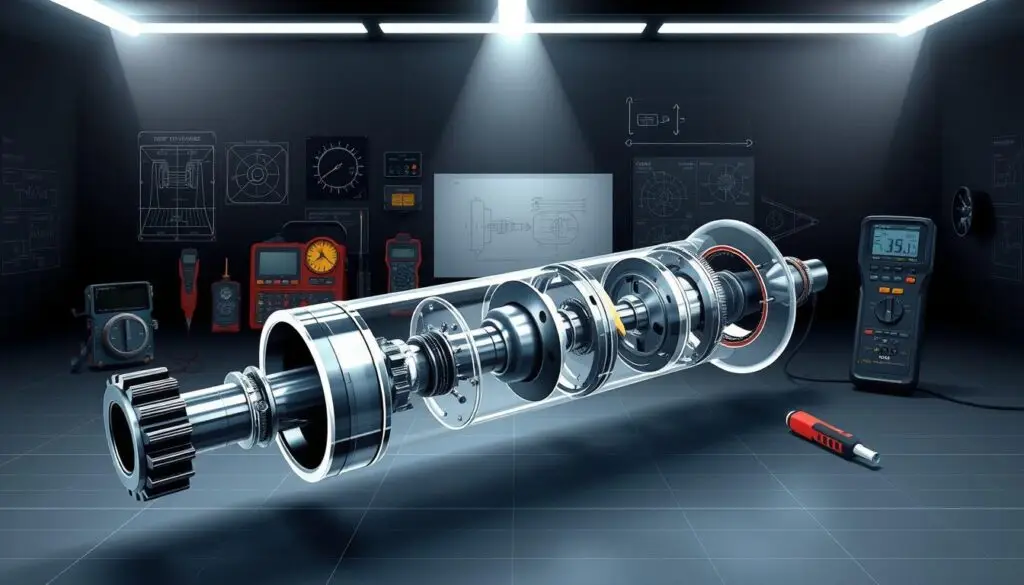
Effective driveline vibration diagnosis separates professional technicians from parts replacers who waste time and money chasing symptoms instead of root causes. These frustrating shakes and shudders stem from multiple sources within the drivetrain system, and understanding how to pinpoint the exact problem component saves fleet operations thousands in unnecessary repairs. Worn universal joints, damaged slip splines, and out-of-balance driveshafts all create similar symptoms that puzzle even experienced mechanics without a systematic diagnostic approach.
This comprehensive guide equips fleet managers, diesel technicians, and owner-operators with proven diagnostic protocols to identify the exact source of driveline vibrations. Whether troubleshooting a lifted work truck or a high-mileage tractor, the systematic approach presented here helps you distinguish between angle-related problems that appear at lower speeds versus dynamic issues that intensify at highway speeds. You’ll learn professional inspection techniques and field-tested methods that prevent unnecessary component replacement and get equipment back on the road faster.
Last Updated: November 2025
Key Takeaways
- Speed patterns reveal cause: Angle-related vibrations occur at 0-40 mph and worsen under load, while dynamic issues intensify above 50 mph regardless of throttle input.
- U-joint inspection is critical: Any perceptible rotational play indicates excessive wear requiring immediate replacement—properly functioning joints exhibit zero play.
- Operating angles matter: U-joint angles exceeding 3 degrees for continuous operation accelerate wear dramatically, with lift kit modifications commonly creating excessive angles.
- Professional balancing is essential: Driveshaft balance issues require specialized equipment achieving tolerances under 0.5 ounce-inches that field methods cannot replicate.
- Systematic inspection prevents misdiagnosis: Following a structured road test and physical inspection protocol saves time and prevents unnecessary parts replacement.
- Regulatory compliance applies: Commercial vehicle driveline components must meet FMCSA maintenance standards and pass CVSA inspection criteria.
Understanding Driveline Systems and Vibration Fundamentals
Accurate driveline vibration diagnosis begins with understanding the fundamental architecture of this rotating assembly. The driveshaft transfers power from your transmission to the differential, spinning at speeds exceeding 3,000 RPM during highway operation. When components wear or fall out of balance, even minor defects create noticeable vibrations throughout the vehicle that affect driver comfort and component longevity.
Core Components of the Driveline Assembly
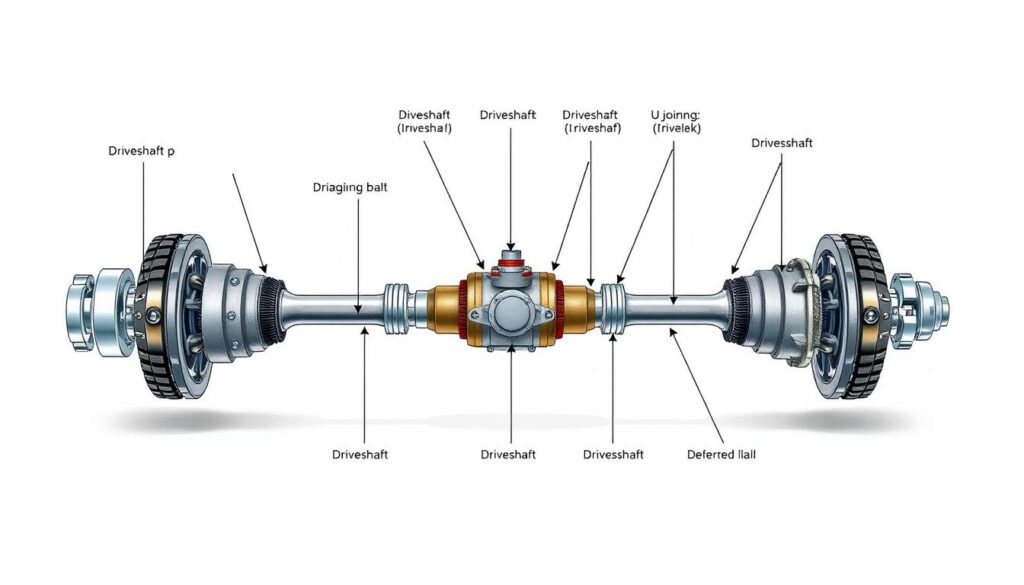
Driveline components work as an integrated system to deliver power efficiently. The main rotating shaft spans from transmission to differential, with universal joints providing flexible couplings that accommodate suspension movement and angle changes. The slip yoke allows length changes as the suspension compresses and extends, while the flange yoke connects the driveshaft to the differential pinion. Longer driveshafts on trucks and SUVs often include a carrier bearing that supports the shaft at a midpoint.
Four-wheel-drive vehicles typically feature both front and rear driveshafts. The front driveshaft may spin continuously even in two-wheel-drive mode, making it a potential vibration source that technicians sometimes overlook during diagnosis.
How Vibrations Travel Through Your Vehicle
Understanding vibration transmission paths proves essential for accurate diagnosis. Driveline components connect to your vehicle through multiple mounting points, creating several routes for vibrations to reach the cabin.
Vibrations transfer through three primary pathways. First, they move through transmission mounts into the body structure. Second, they travel through the differential housing into rear suspension components. Third, they transmit through the carrier bearing mount directly to the frame. This explains why a single driveline fault can manifest as steering wheel shake, floor vibrations, or seat resonance depending on the vibration frequency and which transmission path dominates.
Normal Operation Versus Problem Indicators
A properly functioning drivetrain operates with minimal perceptible vibration across all speeds. You should experience smooth power delivery during acceleration, cruising, and deceleration.
Problem indicators include any rhythmic shaking that correlates with vehicle speed, shuddering during acceleration, vibrations that intensify at specific speeds, or clunking sounds during direction changes. These symptoms distinguish mechanical faults from normal operational characteristics. Speed-related vibrations typically indicate balance issues, while load-dependent problems point toward U-joint or yoke wear. Recognizing these patterns early prevents component failure and potential safety hazards.
Identifying Different Types of Driveline Vibration
Different vibration types reveal distinct clues about what’s failing in your driveline system. Accurate identification represents the most critical diagnostic step, as it immediately narrows potential causes and directs inspection efforts toward specific components. Understanding how vibrations behave under various driving conditions provides the foundation for effective troubleshooting and prevents wasted time replacing parts that aren’t causing the problem.
Speed-Related Vibration Patterns
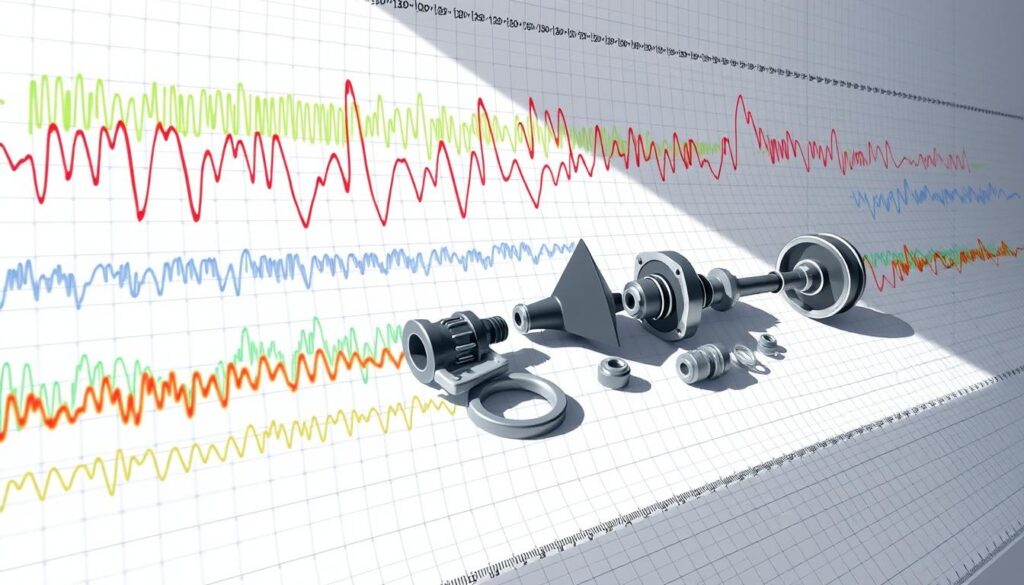
Vibrations that appear only within specific speed ranges typically indicate balance issues or first-order vibrations where the frequency matches driveshaft rotation speed. For example, a vibration felt exclusively between 45-55 mph points toward an imbalanced driveshaft component.
Speed-dependent vibration that persists across broad speed ranges suggests different problems entirely. These continuous vibrations usually stem from angle-related issues or higher-order vibrations caused by failing universal joints. The distinction matters because balance problems require professional shop equipment, while angle issues often result from improper lift kit installation.
Load-Induced Vibration Characteristics
Load-sensitive vibration manifests distinctly during power application. Angle-related vibration produces pronounced shuddering during acceleration, climbing grades, or towing when operating angles reach maximum deviation and U-joint binding occurs.
These vibrations typically start immediately after lift kit installation and worsen under heavy throttle at lower speeds between 0-40 mph. A defining characteristic: the vibration diminishes or disappears completely when coasting in neutral. This behavior provides a definitive diagnostic indicator distinguishing angle problems from balance issues.
Acceleration and Deceleration Vibrations
Directional vibrations reveal additional information about driveline health. Vibrations worsening during acceleration but improving during deceleration point toward worn slip yoke splines or excessive U-joint play.
Conversely, vibrations intensifying during deceleration indicate loose components that rattle when torque load reverses. Common culprits include loose yoke retaining hardware, worn carrier bearing mounts, loose differential mounting bolts, and damaged transmission tail housing bolts.
Constant Versus Intermittent Issues
Constant vibrations remaining consistent in intensity typically stem from static imbalances or geometric problems like bent driveshafts. These produce predictable, steady feedback that doesn’t vary with temperature or operating duration.
Intermittent issues that vary in intensity result from failing components with variable play. Worn U-joint bearings may bind in certain rotational positions, creating dynamic vibration that changes character. Temperature-dependent conditions affecting lubrication breakdown and component clearances also produce intermittent symptoms that worsen as operating temperatures increase.
Universal Joint Wear and Failure Mechanisms
Most universal joint failures stem from three primary causes: bearing deterioration, lubrication loss, and excessive angles. Each mechanism creates distinct patterns of damage that progress from minor wear to complete breakdown. Understanding these failure modes helps identify problems before they escalate into dangerous situations that could result in driveshaft separation.
U-Joint Bearing Cap Deterioration
The U-joint bearing caps contain needle bearings that support the cross journals during rotation. These microscopic rollers experience tremendous forces as power transfers through the driveline. Over time, the bearing surfaces develop wear patterns that increase internal clearances.
As gaps expand between components, the cross begins moving within the caps. This movement creates second-order vibrations—two disturbances per driveshaft revolution. The characteristic “clunk” sound indicates advanced U-joint wear where metal-to-metal contact occurs during load changes. Initial micro-wear accelerates geometrically, as small imperfections create impact loading that speeds further deterioration in an escalating cycle.
Lubrication Breakdown and Contamination
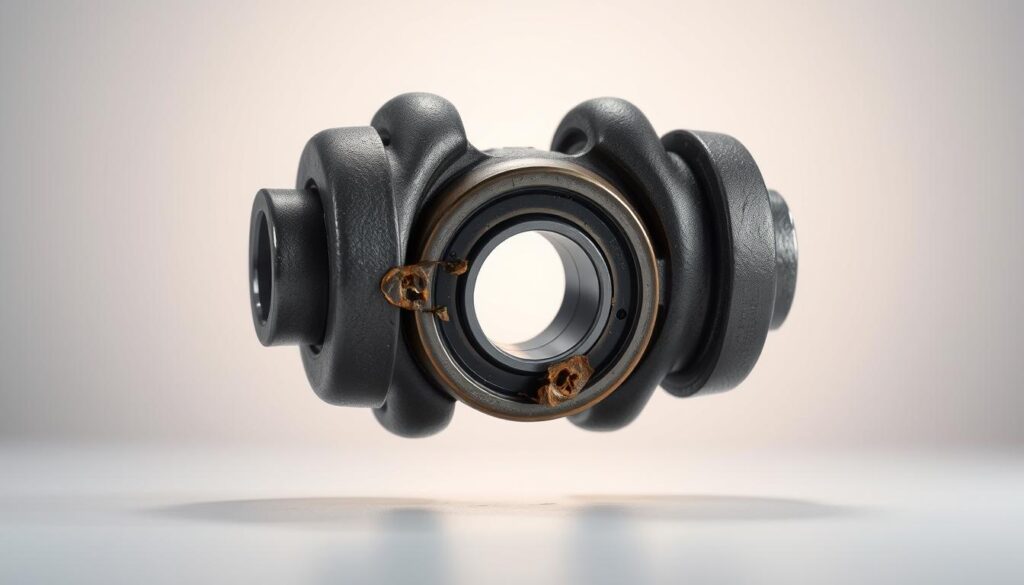
Grease films separate bearing surfaces and prevent direct metal contact. Without proper lubrication, universal joint failure accelerates dramatically. The lubricant degrades through oxidation from prolonged heat exposure, thermal breakdown from excessive operating angles, water intrusion past damaged seals, and dirt contamination creating abrasive compounds.
Many modern U-joints come permanently sealed without grease fittings. This design eliminates maintenance but establishes a predetermined service life. Once the factory lubricant degrades, replacement becomes the only option.
Excessive Operating Angles
U-joint geometry causes the output shaft to alternately speed up and slow down relative to the input shaft when operating at angles. Greater angles produce more severe speed fluctuations and generate significant heat. These conditions represent the most damaging operating angles for driveline components.
Industry standards limit U-joint angles to specific ranges for reliable operation. Continuous operation should maintain angles at 3 degrees or less for normal service life. Temporary conditions may briefly tolerate up to 7 degrees. Modified vehicles operating at 5-8 degrees experience accelerated wear requiring more frequent inspection and replacement.
Effects of Lift Kits and Modifications
Suspension modifications frequently create excessive operating angles by altering the relationship between the transfer case and differential. Stock vehicles typically maintain 2-3 degree angles. Lift kit installations often result in angles increasing to 5-8 degrees or more, generating vibrations at lower speeds that worsen under load as torque amplifies the speed fluctuations inherent in angled U-joint operation.
Recognizing U-Joint Failure Symptoms
Failed or failing U-joints produce distinct tactile and auditory indicators. Early detection prevents catastrophic driveshaft separation that can cause severe vehicle damage. Initial symptoms include subtle vibrations during acceleration. As U-joint wear progresses, these sensations intensify into pronounced shuddering. Eventually, metallic clunking sounds emerge during direction changes when bearing cap play allows direct contact between internal surfaces.
Second-order vibrations from deteriorated U-joints can be felt at very low speeds and persist at highway speeds. This distinguishes them from balance-related problems that typically appear only at specific speed ranges.
Comprehensive U-Joint Inspection Techniques for Driveline Vibration Diagnosis
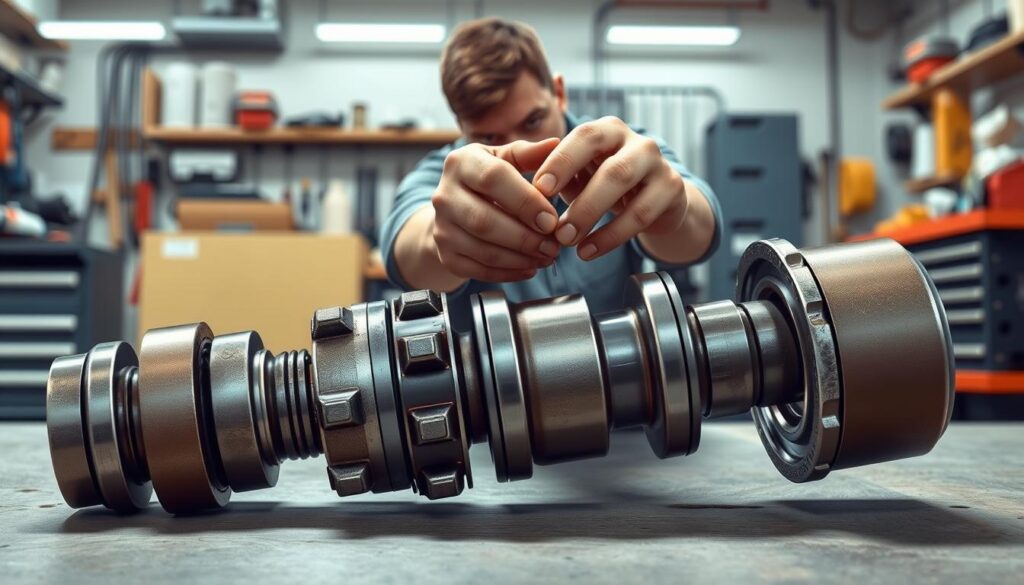
Detecting U-joint wear before catastrophic failure demands comprehensive inspection techniques applied in the correct sequence. A methodical approach combines visual assessment with hands-on testing to reveal problems that might otherwise remain hidden. Understanding proper inspection procedures empowers technicians to identify issues early, preventing expensive repairs and dangerous road failures.
Pre-Inspection Safety Procedures
Safety establishes the foundation for effective driveline inspection. Position the vehicle on level ground with the parking brake fully engaged and wheel chocks placed behind the rear wheels. Place the transmission in neutral rather than park to allow driveshaft rotation during testing.
Support the vehicle using jack stands rated for the vehicle’s weight—never rely solely on hydraulic jacks. Wear safety glasses throughout the inspection process. These precautions prevent vehicle movement and protect against falling components or debris.
Visual Assessment Methods
Visual examination provides the first diagnostic layer, revealing obvious deterioration before physical testing begins. Examine each U-joint carefully for signs of damage, contamination, or structural compromise.
Rust staining around bearing cap perimeters indicates seal failure and water intrusion. Look for surface rust on cross journals visible at seal edges, which confirms lubrication loss. Rust jacking can separate bearing caps from yoke ears, compromising structural integrity and requiring immediate replacement.
Examine rubber seals closely for cracks, tears, hardening, or displacement from their mounting positions. Compromised seals lead directly to lubrication loss and contamination. Even minor seal damage allows moisture and dirt to enter, accelerating bearing deterioration.
Physical Play Testing
Hands-on manipulation delivers definitive assessment of U-joint condition. Set the park brake and chock wheels, then put the vehicle in neutral with the engine off. Get underneath and give each driveshaft a hard shake up and down—any movement or knocking sounds indicate loose components needing attention.
Grasp the driveshaft on each side of the U-joint and attempt rotation in opposite directions. Any perceptible movement indicates excessive wear and necessitates replacement. Properly functioning U-joints exhibit zero rotational play when tested in this manner.
Apply force perpendicular to the driveshaft axis while observing the U-joint cross for movement within bearing caps. This bearing play test reveals worn bearings that allow the cross journal to shift. Test each U-joint in multiple rotational positions, as wear patterns may create variable play depending on cross journal position.
Interpreting Wear Patterns
Understanding failure progression enhances diagnostic accuracy. Uneven wear across bearing caps indicates misalignment or excessive operating angle problems. Uniform wear suggests normal service life exhaustion or lubrication failure affecting all bearings equally.
Look for spalling—surface flaking that indicates bearing material breakdown. Brinelling appears as impact damage creating indentations in bearing races. These patterns indicate shock load exposure from clutch dumping or severe binding events requiring immediate component replacement.
Stay Current on Driveline Diagnostics and Fleet Maintenance
Get expert insights on driveline troubleshooting, preventive maintenance protocols, and equipment reliability strategies delivered directly to your inbox.
Subscribe to Our NewsletterYoke Component Failures and Detection
The yoke assemblies connecting your driveshaft to the transmission and differential endure tremendous rotational forces that gradually lead to predictable failure patterns. These forged steel components act as critical junction points where power transfers between driveline sections. Recognizing yoke failure symptoms requires systematic inspection techniques that go beyond surface-level observation.
Problems with transfer case or pinion yokes, though less common than U-joint issues, create significant vibration when they occur. A yoke machined slightly off-center at the factory will cause the entire driveshaft to run with an eccentric rotation pattern. Bent output shafts represent another serious concern, particularly in vehicles with slide-in slip yoke attachments that have experienced driveshaft separation during operation.
Slip Yoke Wear Mechanisms
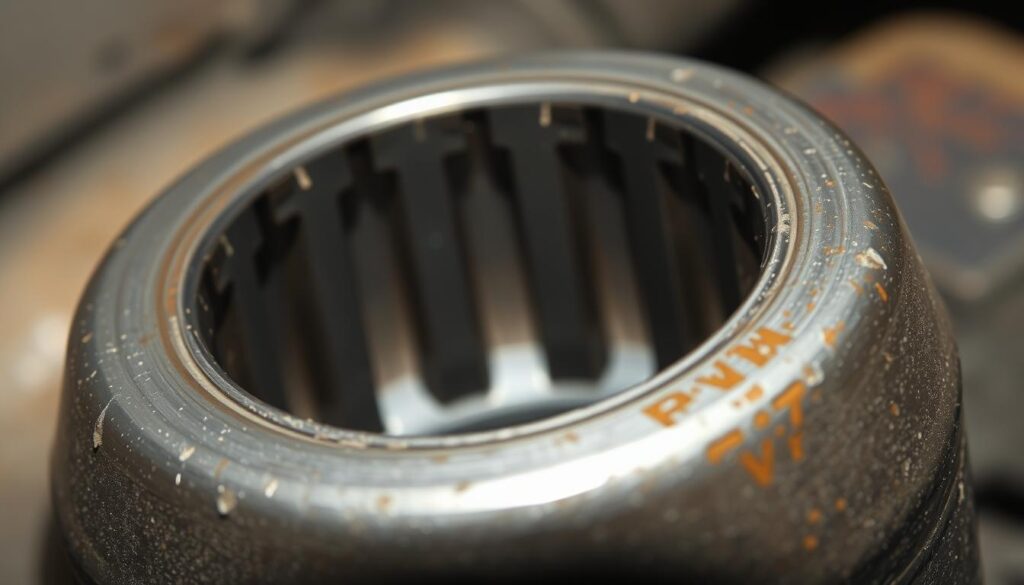
Slip yoke wear develops at the sliding interface between the yoke and the transmission or transfer case output shaft. This telescoping connection must accommodate suspension travel while maintaining precise rotational alignment. The constant sliding motion under load gradually removes material from both the internal yoke splines and external shaft splines.
Excessive clearance from wear allows radial movement that produces vibrations during power transmission. You’ll notice characteristic clunking sounds when shifting between drive and reverse. Contamination entering through failed seals accelerates the deterioration process significantly.
Flange Yoke Problems
The flange yoke at the differential end faces different stress patterns than the slip yoke. Bolt hole elongation occurs when mounting hardware loosens, allowing impact loading with each torque reversal. The pilot diameter that centers the yoke on the pinion snout wears unevenly, creating runout that manifests as vibration.
Face surface damage prevents proper mating between the yoke and pinion flange. Even minor surface irregularities cause the assembly to run out of true. Inspecting bolt holes with a flashlight reveals elongation that standard torque specifications cannot correct.
Yoke Ear Cracking and Deformation
Stress concentrations at bearing cap mounting points make yoke ears vulnerable to cracking. When U-joints fail, impact loading transfers directly to the yoke ears. Operating angles exceeding design specifications generate excessive bending forces that gradually deform the ears.
Cracks typically initiate at the bearing cap bore radius and propagate outward. Visual inspection often misses these cracks until catastrophic separation occurs. Yoke failure from cracked ears happens suddenly, creating immediate safety hazards.
| Yoke Component | Common Failure Mode | Primary Symptom | Detection Method |
|---|---|---|---|
| Slip Yoke Splines | Progressive spline wear from sliding friction | Clunking on direction changes | Measure radial play at yoke |
| Flange Yoke Pilot | Uneven wear causing eccentric rotation | Speed-related vibration | Check runout with dial indicator |
| Yoke Ears | Stress cracking at cap bores | Sudden catastrophic failure | Dye penetrant testing |
| Balance Weights | Missing or loose attachment hardware | RPM-proportional vibration | Visual inspection and weight verification |
Driveshaft Balance Problems and Root Causes
Perfect driveshaft balance requires precision engineering, as even minor weight discrepancies generate substantial forces during high-speed rotation. When components spin at thousands of RPM during highway driving, small imbalances multiply into significant vibration problems. Understanding these balance issues helps you identify causes and recognize when professional rebalancing becomes necessary.
Driveshaft imbalance creates what technicians call first-order vibration—one complete shake cycle per driveshaft revolution. This distinction matters because balance problems never produce second or higher-order vibrations, helping narrow your diagnostic focus.
Principles of Driveshaft Balancing
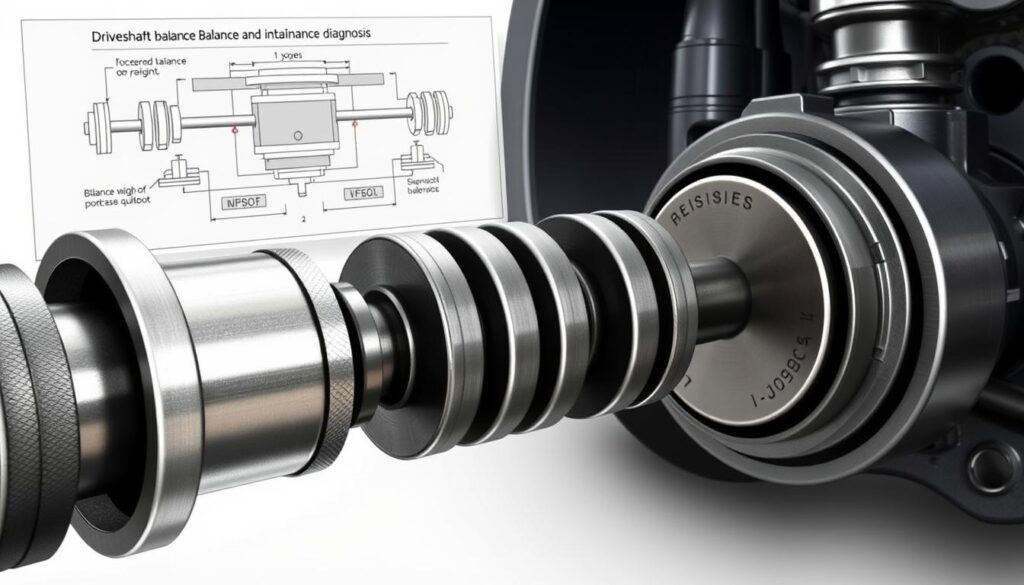
Balancing ensures mass distribution remains uniform around the driveshaft centerline. When perfectly balanced, rotation generates equal centrifugal force in all directions. These opposing forces cancel each other out, creating smooth operation without net force pulling in any direction.
Manufacturing processes cannot achieve absolute symmetry. Professional balancing equipment identifies heavy spots along the shaft. Technicians then add counterweights at opposing positions to neutralize the imbalance. Modern balancing achieves tolerances measured in gram-inches. At 3,000 RPM, just a few grams of excess weight generates noticeable vibration forces. This precision explains why driveshaft balance requires specialized equipment rather than visual guesswork.
Common Causes of Imbalance
Several factors disrupt the carefully calibrated balance established during manufacturing or professional service. Small balance weights attach to the driveshaft tube through hose clamps, welds, or adhesive. Loss of a single weight immediately creates imbalance proportional to the weight’s mass and distance from centerline. These weights often go unnoticed during routine maintenance, yet driveshafts spin faster than wheels while weighing considerably more.
Off-road driving allows mud to coat driveshaft surfaces. Dried mud adheres firmly and adds mass at random locations, creating substantial driveshaft imbalance. This explains why vibrations sometimes appear after trail riding and disappear following thorough cleaning underneath the vehicle.
Field repairs involving welding disrupt original balance calibration. Welding adds material in localized areas. Heat distortion can warp tubes, and both conditions create imbalance requiring professional rebalancing before the driveshaft returns to service.
Static Imbalance Versus Dynamic Imbalance
These two distinct conditions require different correction approaches. Static imbalance involves unequal mass distribution in a single plane—one heavy spot along the shaft length. You can detect this by placing the shaft on knife-edge supports where the heavy spot rotates downward due to gravity.
Dynamic imbalance involves unequal mass distribution across multiple planes. Heavy spots exist at different locations along shaft length but at different radial positions. This creates a couple that causes shaft ends to orbit rather than remaining centered during rotation.
Speed-Specific Vibration Patterns from Imbalance
Imbalance creates predictable vibration patterns that intensify with speed. First-order vibration from imbalance increases with the square of speed change. A barely noticeable vibration at 30 mph becomes severe at 60 mph, generating four times the force. At 75 mph, that same imbalance produces nearly six times the force experienced at 30 mph. This mathematical relationship explains why balance issues typically manifest above 30 mph and become intolerable at highway speeds.
HDJ Perspective
The increasing prevalence of lifted work trucks and aftermarket suspension modifications in fleet applications has made driveline vibration diagnosis a more common—and more complex—service demand. Forward-thinking shops are investing in digital inclinometers and vibration analysis equipment that pays for itself within months through faster, more accurate diagnoses. As vehicle modifications become more prevalent across commercial fleets, technicians who master these diagnostic fundamentals position themselves as indispensable problem-solvers.
Professional Diagnostic Tools and Equipment
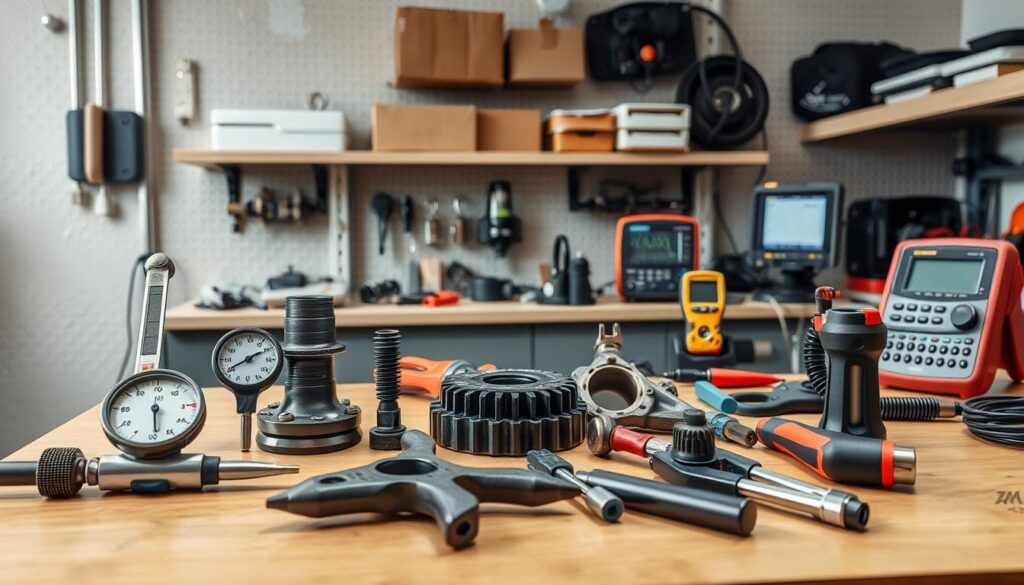
Effective vibration diagnosis begins with assembling the right combination of hand tools and precision instruments. Professional mechanics rely on specialized equipment that transforms subjective observations into measurable data. The proper diagnostic tools enable accurate identification of problems that visual inspection alone cannot detect.
Essential Hand Tools for Inspection
Basic inspection requires quality socket sets with both standard and deep-well configurations. Impact sockets withstand the force needed for stubborn fasteners. Pry bars help manipulate components during play testing, while wire brushes clean inspection surfaces effectively. C-clamps and dedicated U-joint pressing tools facilitate removal and installation procedures. Paint markers or soapstone preserve component orientation markings to ensure proper reassembly phasing after disassembly.
Precision Measurement Instruments
Quantified analysis separates professional diagnosis from guesswork. Measurement instruments reveal microscopic deviations that cause vibration problems. A dial indicator with magnetic base measures critical dimensions to 0.001-inch resolution. This instrument detects driveshaft runout, slip yoke movement, and bearing play, revealing wear patterns invisible during standard visual examination.
Digital inclinometers function as precise angle finder devices for driveline geometry verification. These instruments measure operating angles between transmission output shafts and driveshaft centerlines. Smartphone applications with inclinometer functions provide affordable alternatives to dedicated angle finder tools, ensuring angles stay within the 3-degree specification.
Vibration Analysis Technology
Advanced vibration analyzer equipment uses accelerometers attached directly to driveline components. These sensors measure vibration frequency and amplitude during operation. Spectral analysis software identifies vibration orders and pinpoints source components based on rotational characteristics. The technology distinguishes between first-order, second-order, and third-order vibrations, helping technicians isolate whether problems originate from balance issues, U-joint wear, or other mechanical failures.
Balancing Machine Capabilities
Professional balancing equipment provides both static and dynamic correction capabilities. These machines spin driveshafts at operational speeds while sensors detect imbalance magnitude and angular location. Computer systems calculate precise correction weight placement. Dynamic balancing addresses two-plane corrections that field methods cannot achieve. The equipment reaches tolerances measured in gram-inches, eliminating vibrations caused by manufacturing variations or component wear.
| Tool Category | Primary Function | Measurement Capability | Typical Application |
|---|---|---|---|
| Dial Indicator | Runout Detection | 0.001-inch resolution | Driveshaft lateral deviation measurement |
| Digital Angle Finder | Angle Verification | 0.1-degree accuracy | Operating angle compliance checking |
| Vibration Analyzer | Frequency Analysis | Multi-order detection | Component-specific vibration isolation |
| Balancing Machine | Dynamic Correction | Gram-inch precision | Two-plane imbalance correction |
Systematic Diagnostic Protocol for Driveline Vibration
Professional technicians rely on proven diagnostic protocols to methodically isolate driveline vibration sources rather than replacing parts randomly. A structured approach eliminates guesswork and identifies the exact component causing problems. This systematic method saves time and money while ensuring accurate repairs.
The diagnostic protocol begins with gathering baseline information before any disassembly occurs. Each testing phase builds upon previous findings to narrow down possibilities systematically. Following this sequence prevents overlooking subtle clues that point toward specific failure modes.
Conducting a Detailed Road Test
A comprehensive road test provides the foundation for all subsequent diagnostic work. Select test routes that safely allow operation from complete stops through highway speeds on smooth pavement. This controlled environment reveals vibration characteristics without interference from rough road surfaces.
During the road test, note precisely when vibrations occur and their intensity at different speeds. Pay attention to whether the vibration feels like rapid buzzing, slow shuddering, or single pulses per wheel revolution. These frequency characteristics provide valuable clues about the component source.
Document the exact speeds where vibrations appear, intensify, or disappear completely. Speed-specific vibration occurring between 45-50 mph typically indicates critical speed resonance or balance problems. Vibrations present across broad speed ranges suggest U-joint operating angle issues rather than balance concerns.
Distinguishing when vibrations occur under different load conditions separates angle-related problems from balance issues. Vibrations that worsen during acceleration but improve when coasting point toward excessive U-joint angles or worn components. Balance problems remain constant regardless of throttle position. Deceleration vibrations often indicate loose components or excessive play in the driveline.
Lift-Based Visual Inspection Sequence
After completing the road test, perform a methodical visual inspection with the vehicle safely supported on lift equipment. Begin at the transmission or transfer case output, examining the slip yoke seal for leaks or damage. Fluid leakage indicates seal failure that can allow contamination into U-joint bearings.
Progress forward along the driveshaft checking for obvious damage, dents, missing balance weights, or debris accumulation. Examine each U-joint for rust staining, grease leakage, or physical damage to bearing caps. Check carrier bearing mounts for cracks, deterioration, or excessive movement.
Complete the inspection sequence at the rear axle by examining the pinion yoke, final U-joint, and differential mounting. Look for worn splines, cracked yoke ears, or loose flange bolts. This front-to-back progression ensures no component escapes scrutiny.
Component Isolation Testing
Component isolation definitively identifies whether suspected parts actually cause the vibration through systematic testing. This process separates driveshaft problems from issues originating in tires, axles, or differential assemblies.
Place reference marks on the driveshaft and its mating flanges before conducting your initial test drive. After confirming the vibration, rotate the driveshaft 180 degrees relative to the axle flange and secure it in the new position. Perform another test drive under identical conditions. If the vibration character changes or shifts to a different frequency, the driveshaft contains the imbalance or defect. When vibration remains identical despite rotation, look elsewhere for the source—typically tires, wheels, or axle components.
Driveshaft Runout, Phasing, and Alignment Issues
Even perfectly balanced driveshafts produce severe vibrations when installed incorrectly or operating at improper angles. Geometric accuracy determines whether components deliver smooth operation or rapid failure. Understanding these shaft alignment principles prevents repeated repairs and correctly identifies root causes.
Measuring Lateral and Radial Runout
Measuring driveshaft runout quantifies straightness and installation accuracy using dial indicators. Position the dial indicator against the driveshaft tube near the center point. Rotate the shaft slowly through complete revolutions while recording measurements.
Lateral runout measures side-to-side deviation perpendicular to the shaft axis. This reading shows how far the centerline deviates from true rotation. Radial runout indicates vertical displacement, revealing bent shafts or improperly centered components.
Industry standards specify maximum 0.010 inches total indicator reading (TIR) for lateral runout. Radial runout requires tighter limits at 0.005 inches maximum. High-speed applications demand even stricter tolerances for vibration-free operation.
U-Joint Phasing Requirements
U-joint phasing requires precise angular alignment between yokes at each driveshaft end. Proper phasing ensures speed fluctuations created by the input U-joint are canceled by opposite fluctuations from the output U-joint. On most applications, yokes remain in phase when yoke ears run parallel to each other.
Shaft assemblies feature line-up arrows stamped into the tubing and yokes. These factory marks guide correct reassembly after component replacement. Never ignore these alignment indicators during installation. Phasing problems generate severe second-order vibrations felt throughout the vehicle.
Driveline Angle Verification
Driveline angles directly affect vibration levels and component longevity. Measure operating angles at each U-joint using an angle finder or inclinometer. Maintain both angles within 3 degrees for optimal performance. Input and output angles should stay within 1 degree of each other. This equal angle relationship ensures proper cancellation of speed fluctuations. Take all measurements at normal ride height under static load conditions.
Double cardan (CV) shafts must be installed with the CV joint at the transfer case end. Installing these assemblies backwards creates severe operational problems and rapid component destruction.
Proven Repair Solutions for Driveline Vibration Components
Addressing driveline vibration issues effectively means using proven repair techniques that eliminate root causes rather than masking symptoms. The success of any driveline repair depends on selecting quality components, following precise installation procedures, and verifying proper operation after work completion.
U-Joint Replacement Best Practices
Premium U-joints feature precision-ground bearing journals with tight tolerances that minimize play and vibration. High-quality needle bearings maintain proper hardness ratings between 58-62 Rockwell C, ensuring they resist deformation under load. The seals should use synthetic materials that withstand temperature extremes from -40°F to 300°F without cracking or losing flexibility.
Greaseable U-joints offer maintenance capability through periodic lubrication, extending service life when properly maintained. Sealed designs provide convenience and contamination resistance but have finite non-serviceable lifespans. Premium options typically cost 40-60% more than economy versions but deliver three to five times longer service life.
Remove old bearing caps carefully without damaging yoke ears, as deformed mounting surfaces prevent proper cap seating. Clean bearing cap bores thoroughly with brake cleaner and wire brushes, removing all rust, old adhesive, and metal particles. Press bearing caps using proper tools that apply force to cap edges rather than cross journals. Applying pressure directly to journals damages needle bearings and causes premature failure.
Professional Driveshaft Balancing
Professional balancing utilizes specialized equipment capable of both static and dynamic balancing procedures. Technicians mount the driveshaft in precision bearings and spin it to operational speeds while sensors detect imbalance magnitude and location. They add or remove weight at calculated positions until residual imbalance falls below 0.5 ounce-inches for passenger vehicles.
The driveshaft should always receive balancing after replacing any components to prevent transverse vibrations from developing. Professional balancing typically costs $75-150 and proves worthwhile when considering the consequences of operating with an imbalanced driveshaft.
Complete Driveshaft Replacement Considerations
Complete replacement becomes necessary when driveshaft repair costs approach new component prices or when design limitations prevent resolving vibrations. Bent driveshafts cannot be straightened reliably, as metallurgical changes from bending stress create weak points prone to catastrophic failure.
Vehicle modifications like lift kits often require longer driveshafts or CV joint designs that accommodate altered operating angles. Critical speed limitations of existing designs sometimes necessitate larger diameter shafts or alternative materials.
Preventive Maintenance and Long-Term Driveline Health
A comprehensive preventive maintenance program protects your investment by addressing driveline wear before vibrations and failures develop. Regular inspection and servicing dramatically extend component service life while preventing inconvenient roadside breakdowns. Establishing a structured maintenance schedule eliminates most driveline problems before they compromise vehicle performance.
Recommended Inspection Schedule
Standard vehicles under normal operating conditions benefit from comprehensive driveline inspection every 12,000 to 15,000 miles. This inspection examines U-joints for rotational play, checks slip yoke condition, verifies balance weight security, and identifies any visible damage or fluid leaks.
Severe service conditions require more frequent attention, with inspection intervals decreasing to 6,000 to 8,000 miles for vehicles operating under demanding circumstances. Vehicles regularly towing heavy trailers experience increased torque loads that accelerate U-joint deterioration. Modified vehicles with lift kits operate at increased driveline angles that accelerate wear patterns.
According to 49 CFR 396.3, motor carriers must systematically inspect, repair, and maintain all motor vehicles subject to their control, including driveline components. The Commercial Vehicle Safety Alliance (CVSA) includes driveline/driveshaft inspection as part of their North American Standard Level I and Level II inspections.
| Operating Condition | Inspection Interval | Primary Concern | Critical Components |
|---|---|---|---|
| Normal Driving | 12,000-15,000 miles | Gradual wear progression | U-joints, slip yoke seals |
| Heavy Towing | 6,000-8,000 miles | Accelerated bearing wear | U-joint bearings, yoke ears |
| Off-Road Use | 5,000-7,000 miles | Contamination and impact | Seals, balance weights, shaft |
| Lifted Vehicles | 6,000-9,000 miles | Excessive operating angles | U-joints, CV joints, angles |
Proper Greasing Procedures for Serviceable U-Joints
U-joint greasing represents the most effective preventive maintenance practice for extending component service life. Serviceable U-joints feature grease fittings that allow periodic lubrication to flush contaminants and restore bearing protection.
Apply grease using a quality grease gun until clean grease purges from all four bearing cap seals. This purging indicates complete bearing cavity filling and contamination flushing. Perform greasing every 5,000 miles under normal conditions, or more frequently in dusty or wet environments. Use only high-quality lithium-based or synthetic grease specifically formulated for U-joint applications.
Early Warning Signs Requiring Attention
Recognizing early warning signs allows intervention before minor wear escalates into component failure. Any new or changed vibrations warrant immediate investigation, as vibration patterns indicate developing problems that worsen rapidly. Slight clunking sounds during direction changes signal developing U-joint play requiring replacement soon. Visible rust staining around U-joint bearing caps indicates seal failure and contamination entry.
Share Your Driveline Diagnostic Expertise
Are you a fleet maintenance manager, master technician, or driveline specialist with insights on troubleshooting challenging vibration issues? Heavy Duty Journal welcomes contributions from industry professionals.
Become a Guest AuthorFrequently Asked Questions
What causes driveline vibration only at specific speeds like 45-55 mph?
Speed-specific vibrations appearing within narrow speed ranges typically indicate balance issues or first-order vibrations where the disturbance frequency matches the driveshaft rotation speed. At certain vehicle speeds, the driveshaft reaches rotational frequencies that excite natural resonance frequencies of vehicle components or the driveshaft itself. This phenomenon amplifies vibrations that might be barely perceptible at other speeds. Missing balance weights, mud accumulation, or manufacturing variations create imbalances that generate centrifugal forces increasing with the square of speed. Professional driveshaft balancing typically resolves these speed-specific vibrations by ensuring mass distribution around the driveshaft centerline remains uniform.
How can I tell if my universal joints are failing before complete breakdown?
Universal joint failure produces progressive symptoms that intensify as wear advances. Initial signs include subtle vibrations during acceleration that weren’t previously present, followed by more pronounced shuddering under load. As deterioration continues, you’ll hear metallic clunking sounds during direction changes—shifting from drive to reverse or vice versa. Visual indicators include rust staining around bearing cap perimeters indicating seal failure and visible surface rust on cross journals at seal edges. The definitive test involves grasping the driveshaft on each side of the U-joint and attempting rotation in opposite directions. Any perceptible movement indicates excessive wear requiring immediate replacement, as properly functioning U-joints exhibit zero rotational play.
What U-joint operating angle is acceptable, and why do lift kits cause problems?
Professional specifications typically limit individual U-joint operating angles to 3 degrees maximum for continuous operation, with brief excursions to 7 degrees acceptable under temporary conditions. U-joint geometry creates speed fluctuations where the output shaft alternately accelerates and decelerates relative to the input shaft when operating at angles. Greater angles produce more severe fluctuations and heat generation. Lift kits frequently create excessive angles by raising the vehicle body and differential while the transfer case remains in its original position, often increasing angles from acceptable 2-3 degrees to problematic 5-8 degrees or more. Corrective measures include adjustable control arms, transfer case drop kits, or CV-style driveshafts designed for higher angle operation.
Can I balance a driveshaft myself, or does it require professional equipment?
Professional driveshaft balancing requires specialized equipment that cannot be replicated with field methods for precision results. Balancing machines mount the driveshaft in precision bearings and spin it to operational speeds while sensors detect both the magnitude and angular location of imbalance, computing exact correction weight placement for tolerances of 0.5 ounce-inches or tighter. While you can perform basic checks—cleaning accumulated mud, verifying balance weights remain attached, and ensuring no components are loose—actual precision balancing demands professional service. The investment typically ranges from $75-150 and proves worthwhile, as proper balancing eliminates vibrations that field attempts cannot resolve.
Why does my vibration appear only during acceleration but not when coasting?
Load-sensitive vibrations that manifest during power application but disappear when coasting point directly toward angle-related problems or worn U-joint components. When U-joint operating angles exceed specifications, the joints bind under load, creating pronounced shuddering during acceleration. The vibration typically worsens when climbing grades or towing heavy loads. This behavior pattern distinguishes angle problems from balance issues, which remain constant regardless of throttle position. Common causes include lift kit installations that altered driveline geometry, worn U-joints with excessive play, and deteriorated slip yoke splines. Measuring operating angles with a digital inclinometer confirms whether angles exceed the 3-degree specification.
What causes the clunking sound when I shift from drive to reverse?
Clunking during direction changes results from excessive clearance or play in driveline components that allows metal-to-metal impact when torque load reverses. Common sources include worn U-joint bearing caps with increased radial clearances, worn slip yoke splines creating rotational play, loose yoke retaining hardware, and worn differential side gears. The characteristic clunk represents the sound of clearances being taken up as torque transitions from forward drive to reverse. This condition demands immediate attention, as impact loading accelerates wear geometrically and can progress to complete component failure. Systematic inspection starting at the transmission output and progressing through each driveline component identifies the specific worn element requiring replacement.
Conclusion
Successful driveline vibration diagnosis requires a systematic approach that separates symptoms from root causes. The testing procedures outlined in this guide provide a clear path from initial road test observations through component-specific inspections to definitive problem identification.
Understanding the relationship between U-joint angles, component wear patterns, and balance issues allows you to target diagnostic efforts effectively. Speed-specific vibrations point toward balance problems while load-dependent issues typically indicate worn U-joints or yokes. This knowledge eliminates guesswork and prevents unnecessary parts replacement.
Professional diagnosis becomes essential when specialized equipment is required. Driveshaft balancing machines, precision angle measurement tools, and vibration analyzers provide data that hand tools cannot capture. Recognizing these limitations saves time and prevents incorrect repairs that waste resources without solving the underlying problem.
For fleet operations, implementing the inspection schedules and greasing procedures described earlier extends component life significantly. Early detection of wear patterns allows planned replacement before catastrophic failure occurs. These driveline vibration solutions protect your investment while ensuring safe vehicle operation and maintaining compliance with FMCSA maintenance requirements and CVSA inspection standards.
Help Fellow Fleet Professionals Solve Driveline Problems
Know a fleet manager or technician struggling with persistent vibration issues? Share this diagnostic guide to help them identify root causes faster.