By Michael Nielsen, Publisher | 15+ Years in Diesel Repair
Last Updated: November 2026
⏱ Estimated reading time: 15 minutes
Fifth wheel maintenance is the scheduled cleaning, lubrication, inspection and adjustment that keeps a tractor's fifth wheel holding the trailer kingpin securely. It comes down to four checks: lubricate the right surfaces, confirm the lock closes fully around the kingpin, measure movement against federal limits, and replace worn parts. Federal inspection standards fail a fifth wheel at more than 1/2 inch of horizontal movement between its two halves.
As of November 2026, 49 CFR Part 396, Appendix A still sets those limits, and the manufacturer manuals reviewed for this guide supply the lubrication and inspection intervals. This Heavy Duty Journal guide by Michael Nielsen combines them into one schedule for technicians and fleet managers. Intervals vary by model, so confirm them against your own manual.
Key Takeaways
- ✓Federal limits are small and measurable. Appendix A fails a fifth wheel for more than 1/2 inch of movement between the halves, more than 3/8 inch at a pivot bracket or slider, a handle that is not closed, or light showing through the coupler.
- ✓The manuals set the schedule. Both manuals reviewed use a three-month cycle, one at 30,000 km (about 18,600 miles) and one at 30,000 miles, and one adds a six-month deep clean of the lock parts.
- ✓Lubricant depends on the design. Conventional top plates take water-resistant lithium grease, low-lube plates need no more after break-in, and a power grease gun can damage one design's lube line.
- ✓Worn locks mean replacement. Adjustment corrects a loose or tight lock, but SAF-Holland's manual says worn locks or a bent release handle require replacing the fifth wheel.
In This Guide
- Fifth Wheel Maintenance at a Glance
- How a Fifth Wheel Works and Where It Fails
- Federal Rules for Fifth Wheel Inspection
- Fifth Wheel Maintenance Schedule
- Fifth Wheel Lubrication: Which Part Gets What
- How to Inspect a Fifth Wheel
- Fifth Wheel Lock Adjustment and Wear
- Sliding Fifth Wheel Maintenance
- Kingpin and Upper Coupler Inspection
- Winter and Seasonal Fifth Wheel Care
- Records and Inspection Readiness
- Frequently Asked Questions
- The Bottom Line
Fifth Wheel Maintenance at a Glance
A fifth wheel is the coupling plate and locking mechanism mounted on a tractor frame that engages the trailer's kingpin. Fifth wheel maintenance covers the daily driver check, the written report of defects, a quarterly service, a deeper clean twice a year and a periodic inspection at least every 12 months. The table below puts each task against its interval and its source.
| Task | Interval | Basis |
|---|---|---|
| Driver confirms coupling devices are in good working order | Before driving | 49 CFR 392.7(a) |
| Written report of any coupling device defect | End of each day's work | 49 CFR 396.11 |
| Inspect mounting and cycle the lock with a lock tester | Every 3 months or 30,000 miles | Jost manual, JSK 37U |
| Lubricate the locking mechanism | Every 3 months or 30,000 km | SAF-Holland manual, FW0001 |
| Thoroughly clean the lock's moving parts | Every 6 months or 60,000 km | SAF-Holland manual, FW0001 |
| Periodic inspection to Appendix A | Within the previous 12 months | 49 CFR 396.17 |
The manual intervals come from two specific models, so treat them as examples of a common rhythm, not a rule for every unit. Heavy Duty Journal recommends starting from the manual for the exact fifth wheel on each tractor, then adding the federal tasks that apply to every one of them.
How a Fifth Wheel Works and Where It Fails
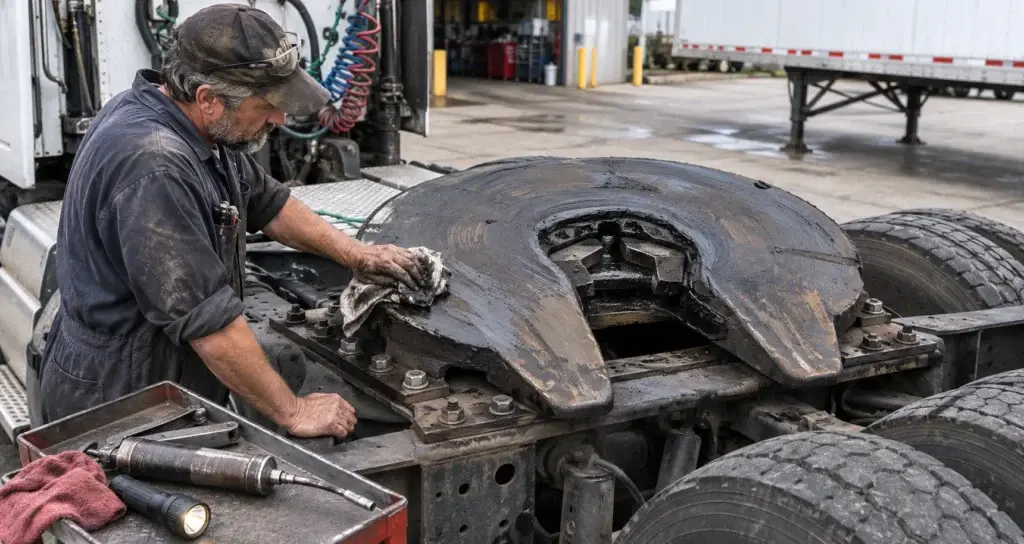
A fifth wheel works by closing a locking mechanism around the trailer's kingpin, and it fails when wear, contamination or loose mounting lets the kingpin move or the lock open. The lower coupler is the fifth wheel on the tractor. The upper coupler is the plate and kingpin on the trailer. Maintenance has to cover both halves.
Fifth Wheel Parts That Wear or Loosen
- Mounting: brackets, fasteners and frame attachment that hold the lower half to the tractor
- Bracket pins and pivot brackets: let the plate tilt; they loosen or lose their locking tabs
- Top plate: the surface the trailer rides on; it can crack, wear or dry out
- Locking mechanism and jaws: close around the kingpin; wear creates slack
- Release handle: opens the lock; it can bend or fail to return to the closed position
- Slider: on sliding units, lets the plate move fore and aft, and adds its own latches and stops
- Kingpin and upper coupler plate: the trailer-side half of the connection
Most failures give warning before they become dangerous. A lock that has worn loose shows fore-and-aft play, a dry top plate drags and a bent handle stops returning to its closed position. Those symptoms are cheap to catch at a quarterly service and expensive to find on the road, which is why this guide builds the schedule around them.
Separation of the tractor and trailer is the outcome everything in this guide is meant to prevent. SAF-Holland's owner manual states that failure to properly maintain the fifth wheel could result in vehicle-trailer separation, and lists improper coupling, a malfunctioning fifth wheel, improper mounting and a non-SAE-compliant kingpin among the causes.
Federal Rules for Fifth Wheel Inspection
Four federal provisions govern fifth wheel maintenance: construction rules in 49 CFR 393.70(b), the driver's duty in 392.7, the defect report in 396.11 and the periodic inspection in 396.17 with its Appendix A standards. The first sets what a fifth wheel must be, and the other three decide whether the one on your truck still qualifies.
| Provision | What it requires | Who acts |
|---|---|---|
| 49 CFR 393.70(b) | Secure mounting with a device that positively prevents the lower half from shifting; a locking mechanism that holds the halves together unless a positive manual release is activated | Installer and carrier |
| 49 CFR 392.7(a) | Driver is satisfied that coupling devices are in good working order before driving | Driver |
| 49 CFR 396.11 | Written driver report covers coupling devices | Driver and carrier |
| 49 CFR 396.17 | Vehicle passes a periodic inspection to Appendix A within the previous 12 months | Carrier |
Read the text at the source: 49 CFR 393.70 covers mounting, locking and placement of the fifth wheel, 49 CFR 392.7 lists coupling devices among the parts a driver must check, and 49 CFR 396.11 includes them in the driver vehicle inspection report. Heavy Duty Journal's Driver Vehicle Inspection Report: A Complete DVIR Guide walks through that report.
The measurable limits sit in Appendix A. The 49 CFR 396.17 periodic inspection rule requires an inspection to those standards within the previous 12 months, and the Appendix A fifth wheel standards list the failing conditions in the table below. See Heavy Duty Journal's Annual Vehicle Inspection Requirements: Complete DOT Guide for the wider inspection picture.
| Appendix A item | Fails when |
|---|---|
| Upper and lower halves | Horizontal movement exceeds 1/2 inch |
| Pivot bracket pin and bracket | More than 3/8 inch of horizontal movement |
| Slider bracket and slider base | Movement of more than 3/8 inch |
| Coupler separation | Light shows through from side to side |
| Operating handle | Not in the closed or locked position |
| Kingpin | Not properly engaged |
| Locking mechanism | Parts missing, broken or deformed so the kingpin is not securely held |
1/2 inch
Maximum horizontal movement between the upper and lower fifth wheel halves under 49 CFR Part 396, Appendix A, as of November 2026.
Roadside inspectors work from a different document. The Commercial Vehicle Safety Alliance publishes its North American Standard Out-of-Service Criteria annually, effective April 1, and its Part II coupling devices section includes the upper coupler and kingpin. Those thresholds are in a purchased publication, so this guide does not reproduce them. Check the current edition before you set a shop standard.
Fifth Wheel Maintenance Schedule
As of November 2026, the fifth wheel maintenance schedule has three layers: a check on every trip, a quarterly service and a periodic inspection each year. The quarterly service is the one that prevents most problems, because it is where lubrication, lock testing and mounting checks happen together. Use whichever of the mileage or calendar limit arrives first.
| Interval | Task | Basis |
|---|---|---|
| Every trip | Confirm the handle is closed, there is no gap at the plate and the kingpin is engaged | 49 CFR 392.7(a); SAF-Holland manual |
| Every 3 months or 30,000 miles | Remove old grease and debris, regrease contact surfaces, lubricate the lock, cycle it with a lock tester, check fasteners and bracket pin tabs | SAF-Holland and Jost manuals |
| Every 6 months or 60,000 km | Thoroughly clean and inspect the lock's moving parts | SAF-Holland manual |
| Every spring (snow and ice) | Extra cleaning and lubrication of the locking mechanism | SAF-Holland manual |
| Every 12 months | Periodic inspection to Appendix A | 49 CFR 396.17 |
The SAF-Holland manual lists its intervals in kilometers only, so 60,000 km works out to about 37,300 miles, which is HDJ arithmetic. The Jost manual uses miles. If a fleet runs units from both makers, put the calendar interval on the work order and let the odometer break ties.
Fit the quarterly service into your existing PM cycle instead of running it separately. Heavy Duty Journal's Trailer Maintenance Checklist: Complete Fleet Guide covers the trailer side of the same visit, and its DOT Pre-Trip Inspection: Complete Checklist and Guide covers the driver's every-trip check.
Fifth Wheel Lubrication: Which Part Gets What
As of November 2026, the two manuals reviewed show that fifth wheel lubrication depends on the design of the unit: conventional top plates take water-resistant lithium grease, low-lube plates take almost none and the lock and moving parts have their own requirements. Greasing every point the same way is the common mistake. The table summarizes what the two manuals reviewed for this guide specify, by part.
| Part | Lubricant in the manuals | Caution |
|---|---|---|
| Conventional top plate contact surface | Water-resistant lithium-based grease after removing old grease and debris (SAF-Holland) | Clean first; do not grease over debris |
| Low-lube liner plates | One light coat of lithium EP grease at break-in, then none (Jost) | Replace plates worn down to the securing bolts |
| Lock and kingpin contact | Grease where the jaws contact the kingpin (SAF-Holland); grease through the skirt zerk with a hand pump (Jost) | Jost warns a power grease gun can damage the lube line |
| Moving parts | Light oil (Jost) | Use light oil, as the manual specifies |
| All contact surfaces | Dry film lubricant, if the design calls for it (SAF-Holland) | Check the manual for the model |
Two points matter most. First, find out whether each tractor has a conventional or low-lube plate before you pick up a grease gun, since that decides whether the plate gets grease at all. Second, use a hand pump on any zerk the manual names, because the Jost manual states the pressure from a power gun can damage the lube line.
Remove old grease and debris before you apply new lubricant. SAF-Holland's manual calls for this step on the contact surfaces, and it matters because grease that has been sitting holds grit that grinds the plate and the trailer's upper coupler. A clean plate also makes cracks and wear visible during the inspection that follows.
How to Inspect a Fifth Wheel
A fifth wheel inspection has two parts: checks with the tractor uncoupled, where you can see and test the parts, and checks after coupling, where you confirm the lock actually closed. Both manuals reviewed say to do maintenance with the tractor uncoupled from the trailer and to use qualified personnel.
Uncoupled checks
Start with the mounting. Repair or replace any missing or damaged fasteners and broken components, and confirm the locking tabs are securing the bracket pin bolts. Then check the top plate for cracks and wear, look for bent, worn or broken parts, and replace anything damaged with manufacturer parts.
Next, cycle the lock several times with a lock tester, which is the tool the Jost manual specifies for this test. The release handle should operate cleanly. SAF-Holland's manual says a damaged or bent release handle requires replacing the fifth wheel. A hand pump grease gun and a lock tester cover most of the quarterly service, and Heavy Duty Journal's Diesel Mechanic Tools Guide covers what else belongs on the cart.
Coupled checks
After coupling, confirm the locks are closed around the kingpin, the secondary release handle sits behind the locking block and there is no gap between the trailer's upper coupler plate and the fifth wheel. That is SAF-Holland's post-coupling check. Appendix A adds two visible failures: an operating handle not in the closed or locked position, and light showing through between the couplers.
Coupling also joins the trailer's air and electrical lines, so use the same stop to check them. When the electrical side misbehaves, Heavy Duty Journal's 7-Way Trailer Connector Troubleshooting: Complete Diagnostic Guide covers the diagnostics. Do not drive a unit that fails any of these checks.
Fifth Wheel Lock Adjustment and Wear
A fifth wheel lock is adjusted correctly when it locks and unlocks easily and the lock tester rotates freely. The Jost manual for its JSK 37U fifth wheel describes the test: cycle the lock several times, then read the result. Other models differ, and SAF-Holland's FW0001 manual includes no adjustment procedure, so follow the manual for your own unit.
| Lock tester result (Jost JSK 37U) | Meaning | Action |
|---|---|---|
| Locks and unlocks easily; tester rotates freely | Properly adjusted | No change |
| Fore-and-aft play when pulling and pushing the tester handle | Too loose | Loosen jam nut, turn screw counterclockwise one full turn, retighten, retest |
| Tester does not rotate freely | Too tight | Loosen jam nut, turn screw clockwise one full turn, retighten, retest |
| Worn locks or bent release handle | Parts worn out (SAF-Holland) | Replace the fifth wheel |
Repeat the one-turn adjustment and retest until the lock passes. Adjustment corrects slack in a serviceable lock and does not repair a worn one. If you reach the end of the adjustment range and still see play, the parts are worn, and the correct response is replacement, not another turn of the screw.
Sliding Fifth Wheel Maintenance
Sliding fifth wheel maintenance adds a second set of parts to inspect: the slider bracket, base, latching fasteners, stops and locking plungers. Appendix A fails a slider for missing or ineffective latching fasteners, a missing or loose fore or aft stop, more than 3/8 inch of movement between the slider bracket and base, or a cracked slider component.
The Jost manual adds the shop-level checks. Inspect the bracket for cracks or missing and damaged parts, and confirm the locking plungers fully engage. If plungers will not release, check the air cylinder or plunger adjustment. If they are loose, check plunger adjustment and spring compression, and replace springs if needed.
Slider position also affects weight distribution. Under 49 CFR 393.70(b), the lower half must be placed so the kingpin-to-axle relationship distributes weight properly and does not interfere with steering or braking. That is HDJ's reading of the rule: it applies every time the slide moves, so confirm the plungers are fully seated after each adjustment.
Kingpin and Upper Coupler Inspection
Kingpin and upper coupler inspection covers the trailer's half of the connection, and the standard kingpin is a 2-inch, SAE-compliant pin securely mounted to the trailer. SAF-Holland's manual lists that requirement, and notes a loose kingpin requires trailer repair. The manual says to check the kingpin for acceptable wear and replace it if necessary but gives no wear limit.
SAE J133 is the performance standard behind that pin. The SAE J133 kingpin performance standard sets test procedures and minimum performance for kingpins and their supporting structures, and references the dimensions in SAE J700 so any fifth wheel can mate with any kingpin built to the specification. SAE lists the 2011 edition as stabilized.
Because the manuals give no wear limit, use the gauge or procedure your trailer manufacturer specifies and record the result. On the trailer side, Appendix A and the CVSA criteria both cover the upper coupler and kingpin engagement, including movement between the halves. The trailer owner is responsible for those items, so report them through the driver vehicle inspection report.
⚠️ Safety Warning
Service a fifth wheel only with the tractor uncoupled, using qualified personnel. SAF-Holland's manual warns that failure to maintain the unit could result in vehicle-trailer separation, and Jost's manual says not to use any fifth wheel that fails to operate properly. Under 49 CFR 392.7, the driver must be satisfied the coupling devices are in good working order before driving.
Winter and Seasonal Fifth Wheel Care
Winter and seasonal fifth wheel care comes down to cleaning off what the road leaves behind and refreshing lubrication before it is needed. SAF-Holland's manual calls for extra spring lubrication of the locking mechanism for units run in snowy or icy climates, in addition to routine service. The fall service before the first storm is the other half of that rhythm.
Salt, slush and grit collect on the plate and lock area, and corrosion follows. Heavy Duty Journal's Winter Fleet Maintenance: Essential Cold Weather Strategies covers cold-weather preparation across the truck, and its Truck Corrosion Prevention: Essential Fleet Rust Guide covers rust control, both of which apply to the fifth wheel area.
A practical seasonal plan has two stops. In fall, run the full quarterly service with a deep clean of the lock's moving parts. In spring, clean off winter residue, re-lubricate the lock and re-check the mounting fasteners, bracket pin tabs and plate for cracks before the heavy-haul season.
Records and Inspection Readiness
Free Diesel Maintenance Checklist
Get HDJ's free, field-tested diesel maintenance checklist delivered instantly to your inbox — print it, laminate it, keep it in the shop.
Instant PDF • 100% Free • No Spam
Records prove that fifth wheel maintenance happened and show the trend that tells you when to replace a part. At each quarterly service, record the date, mileage, lock tester result, any visible play and what was lubricated, adjusted or replaced. A shop that logs the lock tester result every time sees slack arriving long before an inspector would.
The driver's written report is the second record. Because 49 CFR 396.11 includes coupling devices, a driver who notes a stiff handle or a lock that feels loose gives the shop the earliest warning it will get. Route that report to the same work order as the quarterly service so defects and PM history sit together.
The annual inspection is the third. Keep the Appendix A inspection record with the vehicle file, and treat each of the seven items in the earlier table as a line on your own checklist. Heavy Duty Journal's free checklist above gives you a starting format, and the periodic inspection then becomes a confirmation of work already done.
Frequently Asked Questions
How often should you grease a fifth wheel?
Both manuals reviewed use a three-month cycle. SAF-Holland calls for lubricating the locking mechanism every 3 months or 30,000 km, and Jost calls for inspection every 3 months or 30,000 miles, with lubrication as required. Low-lube plates need no further grease after break-in.
What kind of grease do you use on a fifth wheel?
SAF-Holland specifies water-resistant lithium-based grease on the contact surfaces, applied after removing old grease and debris. Jost specifies lithium EP grease for low-lube plates at break-in only, a hand pump on the zerk, and light oil on moving parts. Check the manual for your model.
How do you know if a fifth wheel is worn out?
Appendix A fails a fifth wheel for more than 1/2 inch of horizontal movement between the halves, light showing between the couplers or a handle that is not closed. SAF-Holland says worn locks or a bent release handle require replacing the fifth wheel.
How tight should a fifth wheel lock be?
Per the Jost manual, the lock should lock and unlock easily with the lock tester rotating freely. Fore-and-aft play means too loose, and a tester that will not rotate freely means too tight. Adjust one full turn at a time, retighten the jam nut and retest.
What size is a kingpin?
SAF-Holland's manual specifies a 2-inch diameter, SAE-compliant kingpin in good condition and securely mounted to the trailer. SAE J133 sets kingpin performance test procedures and references SAE J700 for the dimensions, so any compliant fifth wheel can mate with any kingpin built to the specification.
Is a fifth wheel inspection required by DOT?
Yes, in three ways. The driver must be satisfied that coupling devices are in good working order before driving under 392.7, the driver report covers them under 396.11, and the vehicle must pass a periodic inspection to Appendix A within the previous 12 months under 396.17.
The Bottom Line
Fifth wheel maintenance is a short list done on schedule: a check on every trip, a quarterly service that lubricates, cleans and cycles the lock, a deeper clean twice a year and a periodic inspection against Appendix A. The federal limits of 1/2 inch and 3/8 inch give you numbers to measure against, and the manuals give you the rhythm.
Michael Nielsen and the Heavy Duty Journal (HDJ) team publish maintenance and compliance guides at heavydutyjournal.com, and this fifth wheel maintenance guide on heavydutyjournal.com will be updated when the CFR or manufacturer guidance changes. Confirm every figure at the sources linked here before you set a shop standard.
Share This With Your Shop Team
Know a technician or fleet manager who services fifth wheels? Share this guide so they can build a quarterly schedule from the federal limits and manuals.