
By Michael Nielsen, Publisher | 15+ Years in Diesel Repair
Last Updated: November 2026
⏱ Estimated reading time: 14 minutes
Pharmaceutical freight transportation is the movement of medicines, vaccines and related life-science products by truck under controlled conditions, with temperature, security and documentation requirements that ordinary dry freight does not carry. A carrier that hauls these loads must hold the product within its labeled temperature range, protect it from theft and tampering, keep drivers and equipment on schedule, and prove all of it with records the shipper can audit.
This Heavy Duty Journal guide explains how pharmaceutical freight transportation works for fleets: the rules and standards that shape it, the equipment and monitoring it depends on, how truckload and LTL moves differ, and what shippers look for when they vet a carrier.
Key Takeaways
- ✓Process over equipment: Shippers buy documented temperature control, security and communication, not just a reefer trailer and a tracker.
- ✓Know who sets the rules: FDA rules and DSCSA tracing sit on the shipper side, while TAPA TSR and customer contracts set security expectations for the carrier.
- ✓Security is a real risk: Verisk CargoNet data reported in 2026 shows cargo theft losses and confirmed thefts rising, and strategic theft is increasingly common.
- ✓Partial loads add handling: Every extra stop, terminal or transfer is another chance for a temperature break or a security gap.
- ✓Be ready to prove it: Temperature records, route history and a written excursion plan decide whether a claim is paid or disputed.
In This Guide
- What Pharmaceutical Freight Transportation Involves
- Rules and Standards That Shape Pharmaceutical Freight
- Temperature Control and Monitoring Requirements
- Cargo Security for Pharmaceutical Loads
- Truckload, Partial and LTL Pharmaceutical Moves
- Drivers, Hours of Service and Time-Sensitive Delivery
- Documentation, Chain of Custody and Excursion Response
- How Shippers Vet Pharmaceutical Carriers
- Frequently Asked Questions
- The Bottom Line
What Pharmaceutical Freight Transportation Involves
Pharmaceutical freight transportation covers trucking for prescription and over-the-counter drugs, vaccines, biologics, clinical supplies and related products, moved from manufacturers to distributors, pharmacies and health systems. The freight itself is usually high in value and sensitive to temperature, and the consequences of a failure go beyond a damaged load because product that has left its labeled range may not be usable.
Pharmaceutical freight transportation differs from dry freight in four ways. The product must stay inside a temperature range printed on its label, whether that is refrigerated, frozen or controlled room temperature. The cargo is a theft target. The shipper expects records, not just delivery. And the delivery window is often tight, because the product has a limited shelf life or a patient waiting.
Most pharmaceutical loads fall into a few groups. Refrigerated and frozen loads need an active reefer unit and continuous monitoring. Controlled room temperature loads still need protection from heat and cold, which makes a dry van in summer or winter a real risk. High-value loads need security measures regardless of temperature. Some products are also regulated as hazardous materials, which adds placarding, training and handling rules on top of everything else.
Rules and Standards That Shape Pharmaceutical Freight
No single rulebook governs pharmaceutical freight transportation for carriers. Federal drug rules apply mainly to manufacturers and the supply chain trading partners they deal with, while security standards and customer contracts pass requirements down to the carrier. Understanding which rule belongs to whom helps a fleet answer a shipper's audit questions accurately.
FDA Rules and the Drug Supply Chain Security Act
The Drug Supply Chain Security Act, or DSCSA, is the federal framework for tracing certain prescription drugs through the supply chain. As of November 2026, FDA's DSCSA page (last reviewed October 2025) describes the law as steps toward an interoperable, electronic way to identify and trace certain prescription drugs at the package level, and says firms must notify FDA within 24 hours after determining a product is illegitimate.
FDA's page does not address carriers directly, so do not assume DSCSA creates a specific carrier obligation. Ask each shipper which documents and data it needs from you, and get that in writing, because shippers often write their own requirements into transportation agreements.
Current Good Manufacturing Practice and Storage Conditions
FDA's current good manufacturing practice rules apply to drug makers, but they explain why shippers care so much about transit conditions. Under 21 CFR 211.142, written warehousing procedures must provide for storage of drug products under appropriate temperature, humidity and light conditions so that identity, strength, quality and purity are preserved.
The companion rule, 21 CFR 211.150, requires written distribution procedures, including a system that lets the distribution of each lot be readily determined so recalls are possible. A carrier does not write those procedures, but its records are part of how the shipper proves they were followed.
TAPA Trucking Security Requirements
The Transported Asset Protection Association publishes the Trucking Security Requirements, or TSR, a global standard for secure road transport that buyers and logistics providers can use in their contracts. As of November 2026, the TSR 2023 standard defines three certification levels, Level 1 for elevated protection, Level 2 for moderate and Level 3 for basic, across hard-sided truck, rigid van and sea container modules, with the soft-sided truck module available at Level 3 only.
TSR covers cargo moved in owned, leased or subcontracted equipment, and it requires subcontracted carriers to meet the standard under contract. The standard is voluntary unless a customer requires it, and the document does not address LTL or multi-drop moves, so ask the shipper how it expects those to be handled.
Key Recommendation
Treat every pharmaceutical load as a documented process, not just a cold or secure trailer. Before the first pickup, agree in writing with the shipper on the temperature range, the alarm response, who is called when something goes wrong, and which records you will hand over at delivery. Most disputes come from missing records, not missing equipment.
Temperature Control and Monitoring Requirements
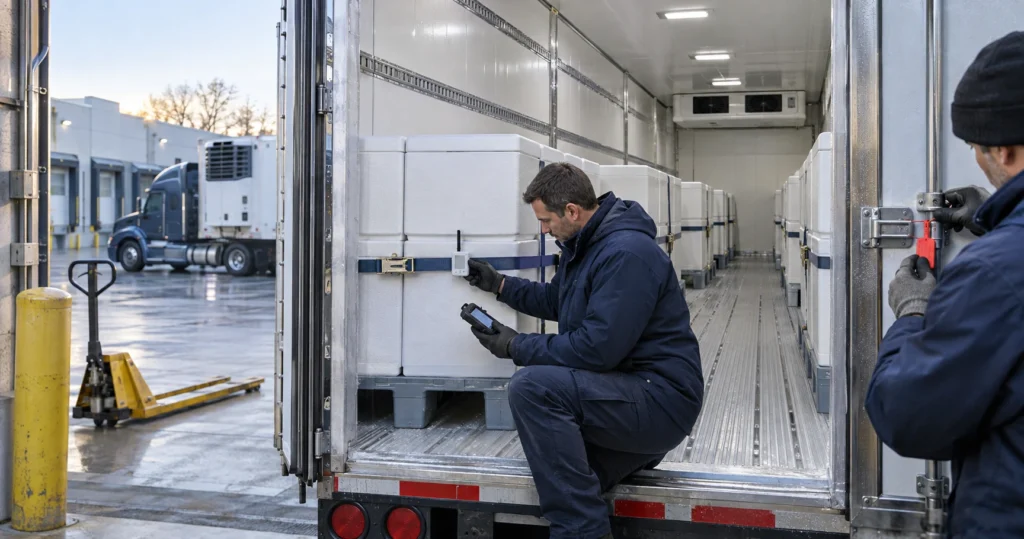
Temperature control in pharmaceutical freight transportation means holding the product inside its labeled range for the entire move, including loading, dwell time, stops and delivery. The reefer unit is only one part of that. Pre-cooling, loading discipline, airflow and monitoring decide whether the product arrives in range.
Equipment Readiness
Start with a unit that is in good mechanical condition. Check the reefer unit, fuel supply, airflow chutes, door seals and floor before each pharmaceutical load, and set the unit to the shipper's required range and mode. HDJ's Reefer Trailer Maintenance: Complete Fleet Service Guide [2026] covers the inspection and service points that keep a unit running through a long haul.
Pre-cool the trailer to the required setpoint before loading, and confirm the shipper's instructions for continuous or cycle operation, because the right mode depends on the product. Keep the cargo area clean, and keep pallets arranged so air can circulate around them.
Continuous Monitoring and Data Loggers
Shippers increasingly expect continuous temperature records, not a driver's word. A data logger is a device that records temperature at set intervals and produces a time-stamped record of the trip. Telematics and sensors can add real-time alerts that let dispatch react before a problem becomes a loss. HDJ's IoT Sensors in Heavy-Duty Vehicles: Fleet Telematics Guide 2025 explains how remote monitoring sensors work in heavy-duty equipment.
Agree with the shipper on which device is the record of authority, where the sensor is placed and how the data will be shared. A sensor placed in the wrong spot in the trailer can give readings that do not reflect the product's temperature, which is a common reason for disputes.
Door Openings and Dwell Time
Every door opening and every wait at a dock is a temperature risk. Limit door openings to the stops the shipper approved, keep dwell time at docks short, and record any delay with its cause. Document the reason for every unscheduled stop, because an unexplained stop is both a security question and a temperature question.
Cargo Security for Pharmaceutical Loads
Cargo security in pharmaceutical freight transportation is the set of procedures and equipment that protect high-value loads from theft, tampering and diversion. It matters more here than on most freight, because the product is valuable, easy to resell and sometimes dangerous in the wrong hands.
$725 million
Estimated 2025 cargo theft losses, up about 60 percent, with confirmed thefts rising from 2,243 to 2,646. Source: Verisk CargoNet data, as reported by FleetOwner in April 2026.
As of November 2026, the full-year CargoNet figures reported by FleetOwner are the most recent HDJ reviewed. The same report quotes industry experts who say true losses are likely well above the estimate, and it describes strategic theft schemes in which criminals use fraud, deception or insiders instead of force.
Strategic Theft and Carrier Fraud
Strategic theft is cargo theft that relies on deception, such as a criminal posing as a legitimate carrier or driver. FleetOwner reported in April 2026 that thieves have placed a crew member as a driver at a legitimate carrier, intercepted carrier email with lookalike domains, and exploited pickup points where turnover is high and training is limited. TAPA Americas leadership was quoted on these schemes.
The defenses are procedural. Verify who is arriving to pick up a load, confirm the driver and truck against the dispatch record, secure your email and dispatch accounts, and train dock staff on what a legitimate pickup looks like. HDJ's GPS Spoofing and Cargo Theft: Facts, Risks and Defenses covers how attackers can interfere with tracking itself, which is why monitoring should not be your only control.
Practical Security Measures
Security measures for pharmaceutical loads
- Route and stop planning: plan approved stops and secure parking before the trip, and avoid unscheduled stops.
- Locks and seals: use the seal type the shipper specifies, record seal numbers and inspect seals at every stop.
- Tracking and alerts: use real-time tracking with alerts for route deviation, door opening and extended stops.
- Driver procedures: brief drivers on no-stop rules, communication protocol and what to do when they suspect surveillance.
- Parking: use secured or monitored parking, and never leave a pharmaceutical load unattended in a high-risk area.
- Information discipline: limit who knows the load contents, route and schedule.
TAPA's TSR gives fleets a structured way to organize these controls, and a TSR-certified operation has already shown it can meet a recognized standard. Customers that require it will say so in their contracts.
Truckload, Partial and LTL Pharmaceutical Moves
Pharmaceutical shipments move as dedicated truckloads, expedited team-driven loads, partial or shared loads and LTL, and each has a different handling profile. The right choice depends on shipment size, temperature range, value, transit time and how much risk the shipper will accept.
Smaller pharmaceutical shipments often move on partial loads, and the transportation of less than truckloads adds handling points, terminal dwell and trailer changes that a dedicated truckload avoids. For temperature-sensitive or high-value product, each transfer is another opportunity for a door-open event, a mislabeled pallet or a security gap, so shippers often prefer fewer touches.
| Move Type | Typical Handling Points | Main Risk | Best Fit |
|---|---|---|---|
| Dedicated truckload | Pickup and delivery only | Theft at stops, equipment failure | Full loads, high value, strict temperature range |
| Expedited team-driven | Pickup and delivery, continuous movement | Higher cost, equipment failure | Time-critical, short shelf life |
| Partial or shared truckload | Pickup, additional pickups or drops | Door openings at every stop | Mid-sized shipments with compatible loads |
| Less than truckload | Origin terminal, line-haul, destination terminal, possible cross-dock | Dwell and extra handling during transfers | Small shipments where terminals are qualified |
If a shipment must move as a partial or LTL load, ask how the carrier handles temperature-controlled freight at terminals, how it records each handoff and whether it can limit transfers. Those answers matter more than the rate.
Drivers, Hours of Service and Time-Sensitive Delivery
Driver performance is one of the biggest variables in pharmaceutical freight transportation, because the driver is the only person with the load for most of the trip. Drivers need to understand the product's temperature requirement, the alarm procedure and the security rules, and they need the authority to stop and call for help when something goes wrong.
Hours of service shape what a time-sensitive pharmaceutical delivery can look like. As of November 2026, FMCSA's hours of service summary says a property-carrying driver may drive a maximum of 11 hours after 10 consecutive hours off duty, cannot drive past the 14th consecutive hour after coming on duty, and must take a break of at least 30 minutes after 8 cumulative hours of driving without one.
Plan routes and delivery appointments around those limits, and use team drivers or relay planning when the transit time demands it. A schedule that depends on a driver exceeding hours is a compliance problem and a security problem, because rushed drivers take shortcuts and unplanned stops.
Build a breakdown plan before it is needed. Know which roadside providers can service a reefer unit, who authorizes the call, and how the load is protected while the truck is down. HDJ's Commercial Truck Roadside Assistance: Complete Fleet Guide explains how fleets structure that support.
Documentation, Chain of Custody and Excursion Response
Chain of custody is the documented record of who held a load, where it was and what condition it was in at each point. In pharmaceutical freight transportation, that record is what lets a shipper release product, file a claim or answer a regulator, so a carrier's paperwork is part of the service.
Keep the bill of lading, seal numbers, temperature records, pickup and delivery times and any exception notes together for each load. Record who signed at each handoff and the condition of the seals and the trailer. Retain the records for the period the shipper's contract requires, since a quality investigation can start long after delivery.
Temperature Excursion Response
A temperature excursion is a period when the product's temperature falls outside its labeled range. The carrier does not decide whether the product is still usable, since that is the shipper's quality team's call, but the carrier must report the excursion immediately and preserve the evidence. The table below outlines a typical response.
| Situation | Immediate Action | Record to Keep |
|---|---|---|
| Reefer alarm or unit failure | Check the unit and setpoint, call dispatch, and contact the shipper contact named in the plan | Alarm time, readings, actions taken |
| Unscheduled door opening | Stop at a safe place, check the seal and the cargo, and report | Seal numbers, time, reason, photos |
| Delay or breakdown | Notify dispatch and the shipper, arrange service, and protect the load | Delay cause, duration, temperature log |
| Suspected tampering or theft | Do not open the trailer, move to a safe place, and call dispatch and law enforcement | Seal condition, location, time, witnesses |
Agree on this plan with each shipper before the first load. A carrier that can show a written plan and follow it consistently is easier to qualify and easier to keep.
How Shippers Vet Pharmaceutical Carriers
Shippers vet pharmaceutical carriers by looking at safety history, security controls, equipment, monitoring, procedures and references, usually in that order. A carrier that can answer these questions with documents, not promises, moves through qualification faster. For a view of the carrier side of vetting, see HDJ's CSA Score Improvement Strategies: Essential Guide for Fleets.
What shippers commonly check
- Operating authority and safety record: active authority, insurance and a clean safety history.
- Equipment: age, condition and maintenance records for tractors and temperature-controlled trailers.
- Monitoring: continuous temperature recording, real-time tracking and alerts.
- Security controls: procedures, driver training and any recognized certification such as TAPA TSR.
- Quality procedures: written excursion response, record retention and corrective action.
- Contingency planning: breakdown support, backup equipment and communication protocols.
Free DOT Status Check
Enter a USDOT number and quickly review public carrier status, operating authority and key FMCSA registration data.

Verifying a carrier's operating authority and safety record is the first step, and HDJ's free DOT status check tool lets shippers and carriers confirm that information from federal records. Ask for certifications by name, and verify them with the certifying body instead of relying on a logo on a website.
Frequently Asked Questions
What is pharmaceutical freight transportation?
It is trucking for medicines, vaccines and related products under controlled conditions. The load must stay within its labeled temperature range, stay secure from theft and tampering, and arrive with records the shipper can audit. It differs from dry freight because product quality, security and documentation are part of the service.
What certifications do pharmaceutical carriers need?
No single certification applies to every carrier. Shippers set their own requirements in contracts, and many ask for recognized security standards such as TAPA TSR, quality system certifications and clean safety records. Ask each shipper what it requires, and verify certifications with the issuing body.
How do carriers keep pharmaceuticals at the right temperature in transit?
They use a well-maintained reefer unit set to the shipper's range, pre-cool the trailer before loading, limit door openings and monitor temperature continuously with a data logger or telematics sensor. A written alarm response plan and clear communication with the shipper complete the process.
Is LTL a good option for pharmaceutical shipments?
It can work for small shipments, but every terminal handoff adds handling, dwell and security exposure. Ask the carrier how it handles temperature-controlled freight at terminals, how it records each transfer and whether transfers can be limited. High-value or highly sensitive product often fits a dedicated load better.
What should a driver do if a reefer unit alarms on a pharmaceutical load?
Pull over safely, check the unit and setpoint, and call dispatch right away. Do not open the trailer unless the plan allows it. Notify the shipper contact, record the alarm time and readings, and follow the written excursion plan. The shipper decides whether the product is still usable.
Does DSCSA apply to trucking companies?
FDA describes DSCSA as a framework for tracing certain prescription drugs, and its page does not address carriers directly. Shippers may still require carriers to supply specific records under contract. Ask each customer which documents and data it needs, and get those requirements in writing.
The Bottom Line
Pharmaceutical freight transportation rewards carriers that treat the load as a documented process. Temperature control, security, driver procedures and records have to work together, and the shipper needs to see proof of each one, not just a clean delivery.
Start with the basics: know which rules and standards your customers rely on, maintain the equipment, monitor the trip, plan for the excursion before it happens and keep records that stand up to an audit. Michael Nielsen and the Heavy Duty Journal team publish operations guides like this one at heavydutyjournal.com so fleets can prepare before the first pharmaceutical load.
Share This Pharmaceutical Freight Guide
Help fellow fleet managers and dispatchers prepare for pharmaceutical freight. Share this guide with your operations team.