
By Michael Nielsen, Editor & Publisher | 15+ Years in Diesel Repair
Last Updated: July 2026
⏱ Estimated reading time: 15+ minutes
Truck corrosion prevention for fleets means combining regular washing, protective undercoating, and scheduled inspections to stop road salt and moisture from attacking a vehicle's frame, body, and electrical systems before they cause structural damage or roadside failure. An effective program starts with identifying high-risk corrosion zones — frame rails, cross members, wheel wells, and electrical connectors — then applying the right coating for each area and inspecting on a fixed interval rather than waiting for visible rust to appear.
For fleet managers and diesel technicians, corrosion is not a cosmetic problem. A rusted frame rail can trigger a roadside out-of-service order under North American Standard inspection criteria, and corroded wiring harnesses cause the kind of intermittent electrical faults that eat up diagnostic hours in the shop. This guide covers how corrosion forms, which components fail first, how undercoating products compare, and how to structure a preventive maintenance (PM) program that holds up through a full winter of road salt exposure.
Key Takeaways
- Chloride-based de-icers are the real driver. Sodium, magnesium, and calcium chloride brines conduct electrical current across a truck's frame and body, turning ordinary surface moisture into an active corrosion cell — plain water alone rarely causes this level of damage.
- A cracked or badly corroded frame can take a truck out of service on the spot. Under CVSA's North American Standard Out-of-Service Criteria, frame corrosion that compromises structural integrity is a roadside violation, and the vehicle may have to be towed rather than driven to a shop.
- Coating choice depends on the vehicle's rust stage, not personal preference. Lanolin-based products are the better call once surface rust has already started because they displace trapped moisture; hard rubberized coatings should only go on clean, rust-free steel because they can trap water against bare metal if applied over existing corrosion.
- Electrical grounds fail quietly and expensively. Corroded battery terminals and chassis ground points cause voltage drops and false fault codes long before anyone notices visible rust, making them one of the highest-value places to focus a corrosion prevention budget.
In This Guide
- How Road Salt and De-Icing Chemicals Accelerate Truck Corrosion
- High-Risk Corrosion Zones on Commercial Trucks and Trailers
- Truck Frame Corrosion and CVSA Out-of-Service Risk
- Undercoating and Rustproofing Options for Fleet Vehicles
- Building a Fleet Corrosion Prevention Program
- Electrical and Component-Level Corrosion Protection
- Weighing the Cost of Corrosion Prevention Against Repair and Downtime
- Frequently Asked Questions
How Road Salt and De-Icing Chemicals Accelerate Truck Corrosion
Road salt accelerates truck corrosion by dissolving into an electrolyte solution on contact with moisture, which conducts electrical current across a vehicle's metal surfaces and dramatically speeds up the natural oxidation process. Corrosion itself is an electrochemical reaction: iron in steel loses electrons to oxygen in the presence of water, forming iron oxide — the reddish-brown flaking most people simply call rust.
Plain rainwater causes this reaction slowly. Chloride-based de-icers change the chemistry entirely, because de-icing salts supply an unusually efficient electrolyte for that process. Sodium chloride is the most common winter de-icer, but many states and provinces have shifted toward magnesium chloride and calcium chloride brines because they work at lower temperatures. Both are hygroscopic — they pull moisture out of the air — which means treated pavement stays wet longer after a storm than it would with rock salt alone, extending the window during which a truck's undercarriage sits in a corrosive film.
Galvanic corrosion adds a second failure mode fleets often overlook. Galvanic corrosion occurs when two dissimilar metals — say, an aluminum wheel and a steel hub, or a stainless fastener threaded into a mild-steel bracket — are in contact in the presence of an electrolyte, causing the more reactive metal to corrode faster than it would on its own. Salt brine is an excellent electrolyte, so any fleet running mixed-metal components (aluminum wheels, steel frames, brass fittings) sees accelerated failure at those junction points specifically, not uniformly across the vehicle.
As of July 2026, most state departments of transportation (DOTs) continue expanding brine pre-treatment programs because it reduces salt volume and cost per lane-mile, which means the corrosive chemistry fleets deal with each winter is shifting toward chloride mixes rather than away from them. That trend makes chemical exposure — not just visible snow and ice — the metric worth tracking when planning a corrosion prevention budget.
Do Electronic Corrosion Protection Systems Actually Work?
Electronic corrosion protection systems, sometimes called impressed-current or cathodic protection systems, work by running a small electrical current through the truck's metal structure to interrupt the electrochemical reaction that produces rust. A handful of fleets have adopted these systems as a supplement to — not a replacement for — coatings and washing. Results reported by users are mixed, and the physics behind cathodic protection is well established in marine and pipeline applications at a much larger scale than a single truck frame. For most fleets, an electronic system is worth considering only after the fundamentals — washing, undercoating, and inspection — are already locked into the PM schedule, not as a shortcut around them.
High-Risk Corrosion Zones on Commercial Trucks and Trailers
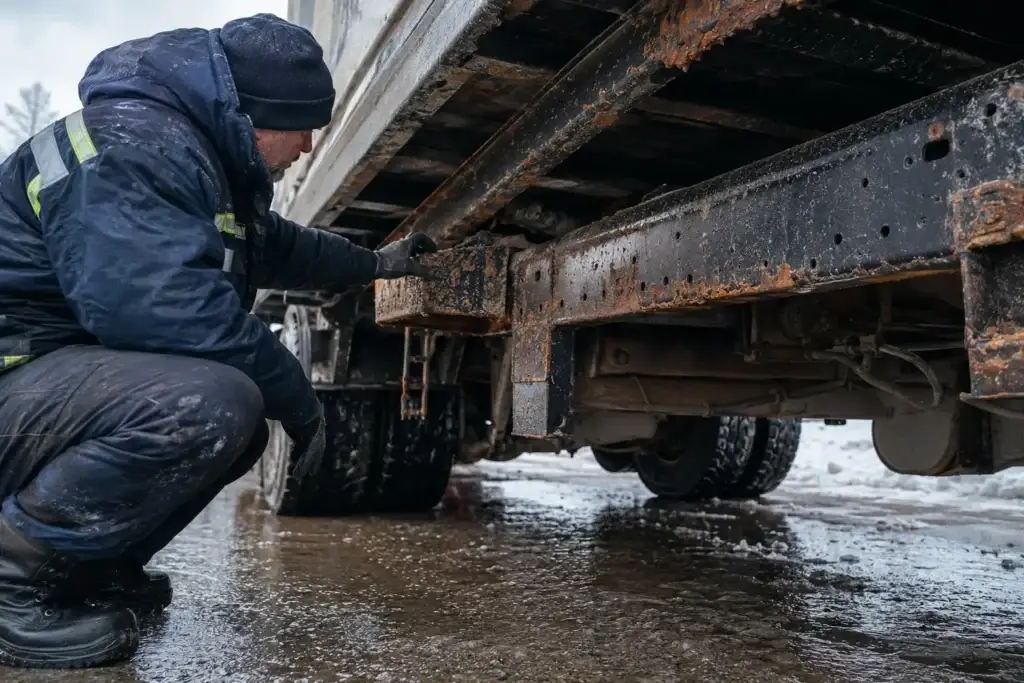
The highest-risk corrosion zones on a commercial truck are the areas where moisture collects and airflow is limited — frame rails and cross members, wheel wells, battery boxes, and any cavity where road spray settles and never fully dries. Corrosion rarely starts on broad, exposed surfaces; it starts in the seams, pockets, and boxed sections that stay damp long after the rest of the vehicle has dried out.
Frame rails and cross members take the most direct hit from road spray and are also the most structurally consequential — sustained exposure at these points can undermine both the rail's structural integrity and the vehicle's load capacity over time. Brake and fuel lines run a close second: steel and aluminum-alloy lines are prone to pitting corrosion that eats through the wall from the outside in, which turns a slow-forming cosmetic issue into a direct safety liability once the line wall thins enough to leak or fail under pressure.
Wheel-end hardware deserves its own line item on any inspection sheet, because corrosion that reaches the wheel end through a displaced grease seal can trigger premature failure of components that are directly safety-critical. Battery terminals and chassis ground points round out the highest-priority zones. These corrode quietly — without the visible flaking that shows up on frame steel — and the result is often a voltage drop, a false sensor reading, or an intermittent fault that gets misdiagnosed as an electronic control module (ECM) problem when the real cause is a green crust on a ground strap.
| Corrosion Zone | Why It's Vulnerable | Recommended Inspection Interval |
|---|---|---|
| Frame rails & cross members | Direct road spray exposure; boxed sections trap brine | Every PM service; detailed check quarterly |
| Wheel ends & hub assemblies | Grease seal displacement lets moisture reach bearings | Every PM service |
| Brake & fuel lines | Pitting corrosion weakens line walls from the outside in | Every PM service |
| Battery terminals & chassis grounds | Silent voltage drops; often misdiagnosed as ECM faults | Monthly, or at every driver pre-trip |
| Wiring harness connectors | Backshell seals degrade, letting brine wick into pins | Quarterly |
Keep Your Fleet Running at Full Capacity
Get HDJ's maintenance guides, compliance updates, and fleet management strategies delivered weekly — built for working diesel professionals.
Truck Frame Corrosion and CVSA Out-of-Service Risk
Frame corrosion becomes a regulatory problem, not just a maintenance one, the moment it compromises the structural integrity of the rail — at that point it can trigger an out-of-service order during a roadside inspection. The Commercial Vehicle Safety Alliance (CVSA) publishes the North American Standard Out-of-Service Criteria (OOSC), the pass-fail standard inspectors use to decide whether a driver, vehicle, or cargo presents an imminent hazard.
Federal regulation backs this up directly. 49 CFR 393.201 states that the frame or chassis of a commercial motor vehicle shall not be cracked, loose, sagging, or broken, and that any welded repair of the frame must follow the vehicle manufacturer's recommendations — a detail that matters because corrosion-thinned steel often fails a weld repair that would hold fine on undamaged rail. Separately, 49 CFR 396.3 requires every motor carrier to systematically inspect, repair, and maintain all vehicles under its control, with parts and accessories kept in safe and proper operating condition at all times — corroded frame components fall squarely inside that requirement.
⚠️ Safety Warning
A frame rail with corrosion severe enough to compromise structural support is an out-of-service condition, and the vehicle typically cannot be driven to a repair facility — it must be towed. Never attempt a field weld repair on a corroded frame section without first confirming manufacturer-approved procedures under 49 CFR 393.201(d); welding over thinned or pitted steel can create a repair that fails faster than the corrosion it was meant to fix.
HDJ Editor Michael Nielsen has walked enough roadside and shop-floor frame inspections to note that inspectors specifically call out corrosion on frame and structural checklists — not as a minor cosmetic note, but as a defect category on par with cracked or bent rail. Building a corrosion inspection step into every pre-trip and PM interval, rather than waiting for the annual inspection required under Part 396, is the difference between catching pitting while it's still surface-level and discovering a rail that's already lost enough wall thickness to fail under normal load.
Undercoating and Rustproofing Options for Fleet Vehicles
Undercoating is a sprayed-on protective barrier applied to a vehicle's undercarriage — frame rails, floor pans, wheel wells, and control arms — to block moisture and de-icing chemicals from reaching bare steel. Rustproofing is the broader term, typically covering the undercarriage plus internal cavities like door panels, rocker panels, and tailgate seams, often through small drilled access holes that get plugged after treatment.
Three coating families dominate the fleet market, and choosing wrong can do more harm than doing nothing. Lanolin-based coatings, sold under names like Fluid Film and Woolwax, stay soft and pliable indefinitely and never form a hard shell, which lets them creep into seams through capillary action and displace moisture that's already trapped against the metal. Wax-based products are cheaper and work well on clean, rust-free vehicles but offer moderate protection and typically need reapplication within a year. Rubberized and asphalt-based coatings provide the best resistance to rock and gravel impact on exposed frame areas, but they form a hard shell — one that can crack, and once cracked, seal moisture against the frame rather than keeping it out.
That last point is the one that trips up fleets buying on price alone: never apply a hard rubberized or asphalt coating over existing surface rust. Once a frame already shows oxidation, a lanolin-based product is almost always the safer call, since it works with the moisture already present rather than trying to seal against it.
| Coating Type | Typical Reapplication | Best Suited For | Avoid If |
|---|---|---|---|
| Lanolin-based (Fluid Film, Woolwax) | 1–2 years | Vehicles with existing surface rust; seams and cavities | You need maximum impact/abrasion resistance |
| Wax or paraffin-based | Several months to 1 year | New or rust-free vehicles; budget-conscious PM cycles | Frame already shows pitting or scale |
| Rubberized / asphalt-based | 3–5 years (until cracking) | High rock/gravel impact zones on clean steel | Any existing rust is present beneath the coating |
Product formulation standards matter here too. Coating durability claims are commonly tested using accelerated corrosion methods such as the ASTM B117 salt spray (fog) test, which exposes coated and uncoated metal samples to a controlled saline mist to generate comparative corrosion-resistance data. It's worth asking any undercoating vendor whether their published protection claims are backed by B117 or equivalent testing rather than marketing language alone.
Application Best Practices for Fleet Undercoating
Undercoating only performs as well as the surface prep behind it. The frame needs to be washed and fully dry before application — coating over trapped moisture or road grime seals the problem in rather than keeping it out. Fleets running their own application program typically use a pressure gun with an extension wand to reach boxed frame sections and door cavities, while a lanolin product's low viscosity when warm makes it easier to push through small access holes than a thicker rubberized compound. Whether the work is done in-house or through a mobile service, the same rule applies: apply before the first hard freeze of the season, not during it, since cold product atomizes poorly and coats unevenly compared to a thin, even film applied at moderate temperatures.
Building a Fleet Corrosion Prevention Program
A fleet corrosion prevention program combines four fixed elements — regular washing, seasonal undercoating, scheduled inspection, and driver reporting — applied on a calendar rather than left to individual judgment. Industry guidance on structured corrosion prevention programs consistently points to the same conclusion Heavy Duty Journal has found across 15+ years of shop-floor experience: fleets that treat corrosion prevention as an ad hoc task rather than a scheduled PM line item see it slip during the exact months — deep winter — when it matters most.
Washing comes first because it is the cheapest and most effective step available, but soap choice matters more than fleets tend to assume — an all-purpose detergent formulated for general road film will not fully break down the chloride residue left by modern brine-based de-icers, particularly magnesium chloride. Specialized detergents designed specifically for de-icing chemical removal earn their higher cost in winter months for exactly that reason. Washing frequency should scale with exposure: fleets running lanes treated with liquid chloride brine need more frequent washing than fleets in regions using dry rock salt alone, because brine residue clings to painted and unpainted surfaces longer.
Undercoating should be scheduled before winter exposure begins, not after damage is already visible. Trailers and fleet vehicles are built predominantly from iron and steel, which are among the most corrosion-prone structural metals in common use — a fact that makes timing the coating application matter almost as much as the product choice itself. A pre-winter coating application, timed to a fresh wash and dry cycle, does more good than the same product applied mid-February onto a frame that's already carrying three months of accumulated brine.
Inspection is the third leg, and it needs to be a documented step on the PM checklist, not a verbal reminder to "keep an eye on it." Pair the inspection interval from the High-Risk Corrosion Zones table above with driver-reported defects: a driver who notices a new patch of surface rust during a pre-trip walk-around and reports it through the standard vehicle inspection report gives the shop weeks of lead time that a scheduled quarterly inspection alone would miss.
Documenting the Program for DOT and CVSA Review
A corrosion prevention program does double duty as compliance documentation. Maintenance records showing scheduled undercoating, wash frequency, and corrosion-specific inspection findings give a fleet a paper trail if a frame defect is ever disputed during a roadside stop or a DataQ challenge, and they satisfy part of the systematic inspection, repair, and maintenance recordkeeping that 49 CFR 396.3 already requires every motor carrier to keep. Fleets that log corrosion findings as a distinct category — rather than burying them inside general "frame inspection" notes — can also spot which trucks, routes, or yards are seeing disproportionate corrosion and adjust coating schedules or washing contracts accordingly.
Electrical and Component-Level Corrosion Protection
Electrical and component-level corrosion protection focuses on the connectors, terminals, and grounds where even a small amount of oxidation causes an outsized diagnostic problem — dielectric grease, terminal protectant sprays, and sealed connector backshells are the primary tools. Unlike frame corrosion, which announces itself visually, electrical corrosion hides inside a connector shell and shows up only as an intermittent fault code, a slow crank, or a sensor reading that drifts without explanation.
Battery terminals are the highest-frequency failure point. A thin coat of dielectric grease or a felt anti-corrosion washer at the terminal stops the white or blue crusty buildup that forms when battery acid vapor meets road salt residue. Chassis ground straps deserve the same attention — a ground point corroded down to a thin conductive path can still pass a basic continuity check while causing voltage drops that manifest as dim lighting, slow starter engagement, or electronic control module (ECM) communication errors that send a technician chasing the wrong module.
Wiring harness connectors, particularly those routed near the frame rail or wheel wells, rely on rubber backshell seals that harden and crack with age and temperature cycling. Once that seal fails, capillary action pulls brine directly into the pin cavity — the same physics that makes lanolin-based undercoating effective works against a fleet here, wicking corrosive moisture deep into a connector where it can't be seen or wiped away. Replacing a cracked backshell seal during a PM visit costs a few dollars in parts; replacing the harness after internal pin corrosion sets in can run into hundreds of dollars in parts and diagnostic labor.
DEF System and Sensor Corrosion
Diesel exhaust fluid (DEF) is itself a corrosive agent to the wrong materials, which makes DEF tank sending units, dosing module connectors, and NOx sensor harnesses another component-level corrosion zone worth its own attention. DEF is engineered to be compatible with stainless steel, certain plastics, and specific alloys, but any connector or fitting that isn't rated for DEF contact — including a corroded ground or a cracked seal that lets road-salt moisture mix with a minor DEF leak at a fitting — can develop crystallized deposits that interfere with electrical contact or restrict fluid flow. Technicians who see DEF-related fault codes should check connector and ground condition around the dosing module before assuming the sensor itself has failed.
100% Free · No Signup Required
Free Professional Fleet Tools
Fault Code Lookup
Decode SPN/FMI codes instantly
Cost Calculators
Downtime & repair ROI
Maintenance Planner
Stay ahead of PM schedules
Weighing the Cost of Corrosion Prevention Against Repair and Downtime
Corrosion prevention costs a fraction of what corrosion-related repair and downtime cost, which makes it one of the easiest maintenance line items to justify to ownership even on a lean budget. A professional undercoating application typically runs $200 to $500 per truck, and a specialized de-icing detergent adds a modest premium to a routine wash — both figures are trivial next to the cost of an unplanned frame repair, a towed roadside breakdown, or the diagnostic labor spent chasing an intermittent fault back to a corroded ground strap.
Repair and maintenance spending is already one of the categories fleets are watching most closely. As of July 2026, ATRI's Analysis of the Operational Costs of Trucking shows the industry-average per-mile cost to operate a truck at its highest point in the report's history, with non-fuel operating costs — the category that includes repair and maintenance — rising faster than overall costs. Corrosion-related work doesn't show up as its own line in that data, but every avoidable frame repair, tow bill, or diagnostic comeback lands inside a cost category fleets are already under pressure to control.
The HDJ Perspective
According to Heavy Duty Journal's field experience across 15+ years of diesel repair, the most consistent point of frame failure in fleets that skip winter washing isn't the exposed rail drivers can see — it's the boxed section behind the fifth-wheel mounting plate, where slush packs in and never fully drains. That cavity holds a near-saturated salt brine against bare steel for months at a stretch, and by the time rust bleeds through a weep hole, the internal wall thickness is already well past cosmetic damage. If a fleet only has budget to inspect one hidden zone this winter, that's the one worth a flashlight and a mirror.
The math holds up even for owner-operators running a single truck. Prevention spending is scheduled, predictable, and shows up on a maintenance calendar; corrosion repair spending is unscheduled, disruptive, and almost always shows up at the worst possible time — mid-route, during a roadside inspection, or right before a load is due.
Resale and trade-in value add another layer to the calculation that fleets often leave out. A visibly corroded frame or a truck with rust bleeding through wheel wells and cab mounts signals deferred maintenance to any buyer or appraiser, regardless of how well the drivetrain has been cared for, and it invites a harder negotiation on trade-in value than a clean undercarriage would. Fleets that document a consistent corrosion prevention program — the same records kept for DOT compliance — can point to that history when negotiating a sale or trade, turning a maintenance cost into evidence of asset care.
Frequently Asked Questions
How often should a fleet undercoat trucks for rust prevention?
Most fleets operating in road-salt regions should apply lanolin-based undercoating once a year, typically in early fall before winter chloride exposure begins. Wax-based products may need reapplication twice a year depending on wash frequency and mileage, while rubberized coatings can last three to five years but should be inspected annually for cracking.
Can a truck fail inspection because of rust?
Yes. Under CVSA's North American Standard Out-of-Service Criteria and 49 CFR 393.201, a frame or chassis that is cracked, sagging, or structurally compromised by corrosion is a critical violation that can place the vehicle out of service on the spot, regardless of how it looks from the driver's seat.
Is lanolin or wax-based undercoating better for trucks with existing rust?
Lanolin-based coatings are the better choice for a truck that already shows surface rust, because they stay soft, penetrate seams through capillary action, and displace trapped moisture rather than sealing over it. Hard wax, rubberized, or asphalt-based coatings should generally be reserved for clean, rust-free steel.
What causes electrical corrosion on truck battery terminals?
Electrical corrosion at battery terminals typically forms when acid vapor from the battery combines with road salt residue and moisture, producing a white, green, or blue crusty deposit that increases resistance and causes voltage drops. Dielectric grease and felt anti-corrosion washers are standard preventive measures.
Does magnesium chloride cause more corrosion than regular road salt?
Magnesium chloride and calcium chloride brines are hygroscopic, meaning they pull moisture from the air and keep treated surfaces wet longer than dry rock salt (sodium chloride) alone. That extended wet exposure — rather than the chemical itself being dramatically more corrosive per application — is the main reason fleets in states using liquid chloride brines report more persistent corrosion challenges through the winter season.
Should a fleet do undercoating in-house or hire a mobile service?
Either can work if the surface prep and product choice are right. In-house application gives a fleet control over scheduling and lets technicians coat trucks between other PM work, but it requires the wash-and-dry step to actually happen first, which is easy to skip under shop time pressure. A mobile or shop-based service typically bundles the wash into the appointment and carries product-specific application tools, which can be the better option for smaller fleets without a dedicated undercoating bay.
Truck corrosion prevention works best as a scheduled program, not a reaction to visible rust. Fleets that pair regular de-icer-rated washing with seasonal undercoating, documented frame inspections, and routine attention to electrical grounds consistently avoid the two outcomes that cost the most — an out-of-service frame violation and an intermittent electrical fault that takes hours to trace back to a corroded connector. The tools and schedule matter less than the discipline of running the program every season, not just the one after a rail finally shows visible rust.
Whether a fleet runs five trucks or five hundred, the same four steps apply at the same intervals — wash for the chemistry actually on the road, coat before exposure rather than after damage, inspect on a documented schedule, and protect the electrical grounds that fail silently. None of it requires exotic products or a large capital outlay, just the discipline to keep it on the calendar through every winter the fleet operates.
Send This to Whoever Runs Your PM Schedule
If your shop is still treating undercoating as an occasional extra rather than a seasonal line item, this is the guide that makes the case for changing that before the next winter hits.


