By Michael Nielsen, Publisher | 15+ Years in Diesel Repair
Last Updated: September 2026
⏱ Estimated reading time: 15+ minutes
Every day, thousands of heavy-duty trucks and commercial vehicles depend on a critical component that most drivers overlook until something goes wrong. The brake chamber sits behind the wheel, converting compressed air into the stopping power that brings tons of cargo to a safe halt. Understanding how this component works, recognizing a failure symptom, and knowing when replacement becomes necessary can prevent a costly breakdown and protect a life on the road.
This comprehensive guide covers brake chamber function, common failure mode, diagnostic procedure, and replacement protocol. Michael Nielsen and Heavy Duty Journal's editorial team built it for a fleet manager, diesel technician, and owner-operator who needs to identify a problem early, maintain safe operations, and stay compliant with 49 CFR Part 393 requirements for commercial motor vehicle braking systems.
Key Takeaways
- ✓Critical safety component: a brake chamber converts compressed air into the mechanical force that activates the stopping mechanism on a truck, bus, or trailer operating at 90–120 PSI.
- ✓Early detection saves money: recognizing an air leak, a reduced braking performance, and visible corrosion prevents a dangerous roadside failure and an emergency repair cost.
- ✓Spring brake hazard: a spring brake chamber stores roughly 1,200–2,500 pounds of force and requires specialized tool and training for safe service — never attempt disassembly without proper equipment.
- ✓Replacement interval: most brake chambers deliver 5–7 years or 500,000–700,000 miles of service life under normal condition, though a severe duty cycle and environmental factor accelerate wear.
- ✓Compliance requirement: FMCSR 393.45 and 393.47 establish an out-of-service criterion including an audible air leak and excessive pushrod stroke that require immediate correction.
In This Guide
- Understanding Brake Chamber Function in Air Brake Systems
- How Air Brake Chambers Convert Pressure to Stopping Power
- Common Brake Chamber Failure Modes
- Warning Signs Your Brake Chamber Needs Attention
- Step-by-Step Brake Chamber Diagnostic Procedures
- Essential Tools and Equipment for Brake Chamber Diagnosis
- When to Replace Your Brake Chamber
- Brake Chamber Replacement Process Overview
- Critical Safety Considerations During Replacement
- Preventive Maintenance to Extend Brake Chamber Life
- Cost Factors and Quality Considerations
- Frequently Asked Questions
Understanding Brake Chamber Function in Air Brake Systems
A brake chamber serves as the vital link between a truck's air supply and its ability to stop thousands of pounds of cargo. This cylindrical component mounts directly to the vehicle's axle assembly and converts compressed air into physical braking force — without a properly functioning brake chamber, even the most robust air supply system can't deliver adequate stopping power.
Every commercial driver and fleet maintenance professional should understand how this critical safety device works. The brake chamber operates at the intersection of a pneumatic and a mechanical system, making it one of the most important elements in the entire braking chain — proper function depends on maintaining precise tolerance and material integrity throughout repeated high-pressure cycling.
What Is a Brake Chamber and Why It Matters
A brake chamber is a sealed cylindrical unit that converts air pressure into mechanical motion. When the driver presses the brake pedal, compressed air flows into the chamber and pushes against an internal flexible membrane called the diaphragm — this action creates the force needed to activate the brake shoe or pad that slows the vehicle.
The safety implication of brake chamber performance can't be overstated. A single failed chamber can compromise braking effectiveness on that wheel, leading to uneven stopping, an increased stopping distance, and a potential loss of vehicle control. For a vehicle weighing 80,000 pounds fully loaded, even a modest reduction in braking capacity creates a serious hazard.
A commercial vehicle relies on a brake chamber because it provides consistent, reliable force conversion across a wide range of operating conditions. Unlike a hydraulic system, an air brake system maintains effectiveness in extreme temperature and can deliver powerful braking force repeatedly without fade.
Primary Components and Their Roles
Understanding brake chamber components helps a technician diagnose a problem and perform an effective repair. Each part plays a specific role in the pressure conversion process, and failure of any single component can disable the entire unit.
The diaphragm assembly forms the heart of service brake chamber operation. This flexible rubber disk separates the chamber into two compartments — the pressure side and the non-pressure side. When compressed air enters the pressure chamber, the diaphragm flexes outward, converting pneumatic energy into mechanical motion. A modern diaphragm uses a reinforced rubber compound that resists deterioration from heat, ozone, and petroleum product across a temperature range from -40°F to over 200°F.
The pushrod is a hardened steel rod extending from the chamber housing to connect with the slack adjuster. As the diaphragm moves under air pressure, it drives the pushrod outward, rotating the slack adjuster and applying the brakes — pushrod stroke length varies by chamber size, typically ranging from 1.5 to 2.5 inches.
The chamber housing provides structural support and protection for the internal components. This sealed metal casing consists of two halves that bolt together with a gasket seal preventing air leakage, and it must withstand a repeated pressure cycle up to 120 PSI while protecting a sensitive internal part from road debris, moisture, and corrosion.
Types of Brake Chambers Used in Commercial Vehicles
A commercial vehicle uses a different brake chamber design depending on the specific braking requirement. A standard service chamber handles normal braking operation while the vehicle is in motion, containing only the diaphragm assembly, pushrod, and housing — this single-function unit releases immediately when brake pedal pressure decreases.
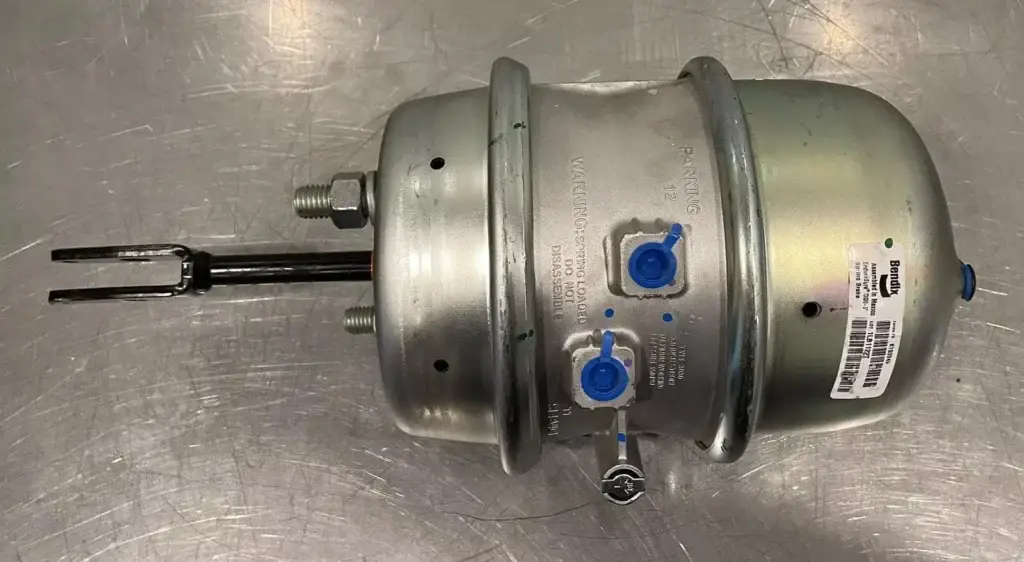
A spring brake chamber combines service braking and parking/emergency function in a single unit. Often called a "piggyback" chamber, this assembly features a large coil spring housed in a secondary chamber behind the service chamber — this powerful spring provides mechanical force that applies the brakes when air pressure is absent, meeting FMVSS 121 requirements for a parking and emergency brake system.
A long-stroke brake chamber features extended pushrod travel capability compared to a standard unit, providing up to 3 inches of stroke length and creating a larger safety margin before the brake goes out of adjustment. Federal regulation requires a long-stroke chamber on certain vehicle configurations to reduce brake adjustment frequency and improve the safety margin.
| Chamber Type | Primary Function | Stroke Length | Typical Application |
|---|---|---|---|
| Standard Service | Service braking only | 1.5–2.0 inches | Trailer axles, older vehicles |
| Spring Brake | Service + parking/emergency | 1.75–2.5 inches | Truck/tractor drive axles |
| Long Stroke | Extended adjustment range | 2.5–3.0 inches | Heavy-duty commercial vehicles |
How Air Brake Chambers Convert Pressure to Stopping Power
The physics behind brake chamber operation centers on converting pneumatic energy into usable mechanical force. A commercial vehicle air brake system typically operates at 90 to 120 PSI, with pressure acting directly against the diaphragm surface area — the larger the diaphragm, the greater the force output for a given pressure level.
Chamber size designation directly correlates to force generation capacity, since the "type" number is literally the diaphragm's effective area in square inches. A Type 20 chamber, at 90 PSI, produces roughly 1,800 pounds of pushrod force (20 in² × 90 PSI). A Type 30 chamber, at 100 PSI, produces the commonly cited figure of 3,000 pounds. Real-world output runs somewhat below this simple calculation once the diaphragm's rolling geometry and return-spring preload are factored in, so treat these as reasonable approximations rather than exact values for a specific chamber.
The Diaphragm Action During Braking
The brake application sequence begins the moment a driver presses the brake pedal. Compressed air from the vehicle's storage tank flows through the brake line into the pressure chamber, pushing against the flexible diaphragm and causing it to flex forward within the chamber housing.
As the diaphragm moves, it pushes the attached pushrod outward from the chamber. The pushrod connects to the slack adjuster, which then rotates the S-camshaft — this rotation forces the brake shoe outward against the brake drum, creating the friction necessary to slow the vehicle, and the entire process happens in a fraction of a second.
When the driver releases the brake pedal, air pressure exhausts from the chamber through the brake valve. A strong return spring immediately pulls the diaphragm and pushrod back to their resting position, ensuring complete brake release and preventing drag.
Spring Brake Chamber Operation
A spring brake chamber incorporates dual functionality providing both service braking and parking brake capability. The service chamber portion handles normal brake application, while the spring chamber section contains a powerful coil spring under constant compression when air pressure is maintained.
During normal operation, compressed air holds the spring in the compressed (released) position. When the driver activates the parking brake control, air releases from the spring chamber, allowing the spring to extend and apply the brakes mechanically — this same action occurs automatically if air pressure drops below approximately 60 PSI, providing fail-safe emergency braking. The spring engagement system delivers roughly 1,200 to 2,500 pounds of force depending on chamber size, a fail-safe design ensuring the brakes automatically engage if an air system failure occurs.
Common Brake Chamber Failure Modes
Several critical failure mechanisms can compromise brake chamber performance, each presenting a unique diagnostic challenge and safety risk. Recognizing these failure patterns early lets a technician prevent a complete brake system breakdown and a dangerous road incident. A commercial vehicle operator faces four primary brake chamber failure categories that account for most service interventions.
Diaphragm Ruptures and Tears
The flexible diaphragm represents the most vulnerable component within any brake chamber assembly. This rubber membrane converts air pressure into mechanical force, but constant flexing during brake application creates stress that eventually leads to material breakdown — diaphragm rupture remains the leading cause of brake chamber failure across every commercial vehicle type.
Age-related deterioration attacks a diaphragm through natural rubber degradation over time. The elastomer material loses flexibility as it ages, becoming brittle and prone to cracking — most manufacturers specify a service life of 5–7 years, though actual longevity varies significantly based on operating condition.
Contamination from oil or moisture in the air system accelerates diaphragm breakdown dramatically. Even a small amount of compressor oil can soften a rubber compound, causing premature failure. Excessive heat exposure from a nearby brake drum compounds rubber degradation, with a temperature exceeding 200°F causing rapid deterioration of a standard diaphragm material.
Pushrod Damage and Corrosion
The pushrod transfers force from the diaphragm to the brake slack adjuster, making it critical for proper brake function. Impact damage from road debris or a maintenance accident can bend a pushrod, causing it to bind in the housing or misalign with the slack adjuster.
Corrosion is the most common cause of pushrod problems in a commercial vehicle. Road salt exposure during winter months creates an aggressive corrosive environment that attacks the steel pushrod surface — pitting corrosion develops first, followed by scaling that increases pushrod diameter and causes binding within the housing.
A lack of proper lubrication compounds these issues significantly. The pushrod requires regular lubrication at the clevis pin connection and housing seal interface — a dry pushrod experiences increased friction, premature wear, and eventual binding that prevents full brake stroke travel.
| Failure Type | Primary Causes | Observable Symptoms | Safety Impact |
|---|---|---|---|
| Diaphragm Rupture | Age, contamination, heat | Air leaks, reduced brake force | Gradual performance loss |
| Pushrod Damage | Corrosion, impact, dry operation | Binding, uneven application | Single wheel brake failure |
| Housing Cracks | Impact damage, metal fatigue | Visible cracks, air leaks | Complete chamber failure risk |
| Spring Brake Malfunction | Cage bolt deterioration | Brake dragging, parking issues | Catastrophic release hazard |
Spring Brake Malfunctions and Cage Bolt Issues
A spring brake chamber incorporates a powerful spring that applies the parking and emergency brake when air pressure releases. This spring stores tremendous mechanical energy that poses an extreme danger during service work — spring brake malfunction presents both an operational failure and a catastrophic safety hazard during maintenance.
Cage bolt deterioration is one of the most dangerous failure modes in commercial vehicle brake systems. These bolts hold the compressed power spring within its housing under thousands of pounds of force — corrosion, fatigue, or improper installation can cause cage bolt failure, resulting in a violent spring release that can cause severe injury or death.
Regular inspection of cage bolt condition remains critical for vehicle safety. Look for a sign of corrosion, a crack, or a deformation around a bolt head. Any questionable cage bolt requires immediate replacement by a qualified technician using proper safety procedure.
Warning Signs Your Brake Chamber Needs Attention
A brake chamber communicates its condition through several distinct indicators demanding immediate attention. Recognizing these warning signs early during routine brake inspection helps prevent a complete system failure that compromises safety. The most reliable indicator falls into four categories: audible symptom, performance change, visible deterioration, and handling characteristic.
Audible Air Leaks and Hissing Sounds
A distinct hissing sound from the brake chamber area represents one of the clearest warning signs of diaphragm failure. This noise typically occurs when applying or releasing the brakes, indicating air escaping through a tear or rupture in the diaphragm — even a small air leak compromises system pressure and reduces braking effectiveness across the entire vehicle.
A technician can locate the source of an air leak using two primary methods: listening carefully around each brake chamber during a brake application and release cycle, or applying a soapy water solution to a suspected area and watching for a bubble that indicates escaping air. A serious leak causes the vehicle's air pressure gauge to drop rapidly below the safe operating range.
Reduced Braking Performance
A failing brake chamber can't generate the full mechanical force required to stop a vehicle efficiently. A driver often describes this condition as "weak" or "spongy" brakes requiring a significantly longer stopping distance — the brake pedal may travel further before engaging, indicating reduced force conversion.
Pay attention to how the brakes feel during a routine stop. An increased pedal travel, reduced responsiveness, or the need for more pedal pressure to achieve normal braking performance should raise suspicion of brake chamber deterioration — these subjective indicators often appear before visible damage becomes apparent.
Visible Physical Damage and Corrosion
A regular visual brake inspection reveals many brake chamber problems before they cause failure. Examine the brake chamber housing for a crack, a dent, or a bulge indicating an internal pressure problem or impact damage. Look for rust perforation creating a hole through the metal and paint blistering that signals corrosion developing beneath the surface.
Check the weld seam where the housing halves join together. A crack along this seam allows air leaks and may lead to complete housing separation — any visible crack in the housing requires immediate chamber replacement regardless of size. Verify every mounting bolt remains tight and properly torqued, and inspect the bracket for a crack or a broken weld.
Brake Drag and Uneven Braking
When a brake chamber malfunctions, it may cause the brake to remain partially applied even after the pedal is released. This brake drag generates excessive heat and accelerates component wear — a driver might notice one wheel running hotter than another or detect a burning smell during operation.
If the brake chamber on one side fails to function correctly, it creates a braking imbalance that causes the vehicle to pull or veer sharply during braking. Any pulling or veering during braking requires immediate investigation and correction to prevent loss of vehicle control.
Step-by-Step Brake Chamber Diagnostic Procedures
A professional technician relies on a proven diagnostic procedure to identify a brake chamber problem before it compromises vehicle safety. Effective diagnosis combines multiple inspection methods to ensure an accurate assessment of component condition, starting with visual examination and progressing through pressure testing and measurement protocol.
Visual Inspection Checklist
Visual inspection forms the foundation of brake chamber diagnosis and often reveals an obvious problem without a specialized tool. Begin by examining the entire chamber housing for a visible damage indicator — a crack in the metal casing, especially around the mounting clamp area where stress concentrates during braking. Surface rust appears normal on an older component, but a rust-through hole or deep corrosion pitting signals replacement time.
Verify a mounting bolt remains tight and properly torqued according to manufacturer specification. Loose mounting hardware allows chamber movement that damages a connection and accelerates wear. Inspect the clevis pin connecting the pushrod to the slack adjuster for wear or damage, ensuring it fits snugly without excessive play.
Air Leak Detection Methods
Air leak detection is a critical component of diagnosis, since even a small leak compromises braking performance. Mix a proper soap solution using liquid dish soap and water in a spray bottle, and apply it generously to every chamber seam, connection, and the pushrod boot area — a bubble forming anywhere indicates escaping air requiring immediate attention.
Pay special attention to the crimp line where the two housing halves join together — a bubble at this location suggests diaphragm failure rather than a fitting problem. Perform the soap solution test with the brake system fully pressurized and again with brakes applied, since some leaks only appear under a specific pressure condition.
Pressure-drop testing measures the rate at which air pressure decreases from the brake system. Build system pressure to 90–100 PSI, apply the service brakes fully, and monitor the pressure gauge for one minute — per 49 CFR 570.57, an acceptable pressure drop rate with brakes applied remains under 3 PSI per minute for a single vehicle (4 PSI for a combination vehicle); the limit is tighter, at 2 PSI (single) and 3 PSI (combination), when the test is instead run with brakes released.
Pushrod Stroke Measurement
Stroke measurement provides the most accurate assessment of brake adjustment and chamber condition. Measure free stroke with the brake system depressurized and brakes released, using a tape measure or a stroke gauge, and record this baseline before conducting an applied-stroke test.
Build system pressure to 90–100 PSI and apply the service brakes fully. Measure again from the mounting face to the clevis pin center while maintaining full brake application — the difference between applied and free stroke represents the working stroke distance. Compare the measured stroke against manufacturer specification for the installed chamber size.
A standard chamber typically specifies 1.5 to 2.0 inches of applied stroke as an acceptable range, while a long-stroke chamber allows greater travel. A stroke measurement exceeding specification indicates the brake needs adjustment, or, if adjustment can't correct the issue, complete chamber replacement becomes necessary.
Essential Tools and Equipment for Brake Chamber Diagnosis
Accurate brake chamber diagnosis requires a comprehensive toolkit combining a measurement device with proper safety equipment. Professional brake chamber service demands a precision instrument that measures a stroke distance within 1/16-inch tolerance and detects an air leak that might escape visual inspection.
Diagnostic Tools for Field Inspection
A dedicated brake stroke measurement gauge provides the most accurate reading for a commercial vehicle application. These specialized instruments feature a calibrated scale and reference mark aligning with manufacturer specification, attaching directly to the pushrod and chamber housing to eliminate measurement error.
A dial indicator with a magnetic base offers versatility for measuring stroke in a tight space. An ultrasonic leak detector locates an air leak in a noisy shop environment where a traditional method fails, detecting the high-frequency sound produced by escaping compressed air even when ambient noise masks an audible hiss.
An air pressure test gauge connects directly to a brake chamber test port through a threaded fitting or quick-disconnect coupler. A dual-scale gauge reading in both PSI and kPa accommodates a different manufacturer specification. Proper gauge calibration ensures measurement accuracy critical for reliable diagnosis.
Safety Equipment Requirements
Personal protective equipment forms the first line of defense against a brake chamber service hazard. ANSI-approved safety glasses with side shields protect the eyes from debris, brake dust, and a flying particle. A heavy-duty work glove resistant to cuts and abrasion protects the hands from a sharp edge on a brake chamber housing.
A steel-toed safety boot prevents a crushing injury from a dropped brake chamber weighing 15 to 40 pounds. Hearing protection becomes necessary in a shop environment where an air tool creates a sustained noise level above 85 decibels. Respiratory protection guards against inhaling brake dust containing a harmful particulate.
Spring brake service requires specialized training and cage bolt tools due to the extreme spring force involved. Attempting to disassemble a spring brake chamber without proper equipment and training can result in a fatal accident — many shops replace a spring brake chamber as a complete assembly rather than attempting a field repair.
When to Replace Your Brake Chamber
Brake chamber replacement decisions depend on multiple factors including age, condition, and regulatory compliance requirement. Understanding these criteria helps a fleet manager and owner-operator maintain a safe, reliable braking system while optimizing a maintenance budget — the decision to replace should never be postponed when safety is compromised.
Age-Based Replacement Guidelines
Most brake chambers deliver reliable service for 5 to 7 years or 500,000 to 700,000 miles under normal operating condition. This assumes proper air system maintenance, a moderate duty cycle, and a temperate climate — actual service life varies significantly based on operational factors.
A severe duty cycle involving a frequent stop, a heavy load, and mountainous terrain increases wear on the diaphragm and pushrod. Poor air system maintenance dramatically shortens chamber life — contaminated air containing moisture, oil, or compressor debris attacks a rubber diaphragm and corrodes an internal component. A fleet operating in a coastal environment or an area with road salt faces accelerated corrosion.
Free Diesel Maintenance Checklist
Get HDJ's free, field-tested diesel maintenance checklist delivered instantly to your inbox — print it, laminate it, keep it in the shop.
Instant PDF • 100% Free • No Spam
A progressive fleet operator implements a proactive replacement program, scheduling a brake chamber replacement during a planned maintenance window, typically coordinating with brake reline service. The economic case favors preventive replacement over waiting for failure once a fleet factors in a towing expense, driver detention time, and potential accident liability.
Failure Conditions Requiring Immediate Replacement
Certain brake chamber conditions demand immediate replacement without exception. Complete diaphragm rupture produces massive air loss, typically emptying the air system within seconds — the affected brake loses all apply force, and the vehicle can't maintain safe braking capacity.
A housing crack or break constitutes a structural failure requiring immediate replacement — even a small crack propagates under pressure cycling and eventually leads to complete housing separation. Pushrod separation or severe bending indicates impact damage or an extreme overload condition that prevents proper brake function.
Any air leak detectable without soap solution qualifies as a safety-critical defect under DOT regulation. Excessive pushrod stroke beyond an adjustment limit signals diaphragm deterioration or foundation brake wear requiring replacement. A chamber mounting failure or severe looseness compromises brake force transmission and represents an immediate out-of-service condition.
DOT Inspection Failure Criteria
The Commercial Vehicle Safety Alliance's out-of-service criteria and Federal Motor Carrier Safety Regulation establish a specific failure criterion for a brake chamber under FMCSR sections 393.45 and 393.47. A commercial vehicle failing DOT inspection can't legally operate until completing a required repair — HDJ's DOT inspection checklist guide covers the full range of criteria an inspector checks beyond just the brake system.
An audible air leak at a brake chamber constitutes an automatic out-of-service violation. An excessive pushrod stroke measurement triggers an out-of-service order when exceeding the limit specified in the CVSA handbook — this limit varies by chamber type and size but typically falls between 1.75 and 2.5 inches for a service chamber. A cracked, broken, or loose brake chamber component results in immediate out-of-service classification.
Brake Chamber Replacement Process Overview
A proper brake chamber replacement procedure protects a technician while ensuring reliable brake system performance. This comprehensive process involves multiple critical stages demanding precision and adherence to manufacturer guidelines — the complete procedure typically takes 45 to 90 minutes per chamber depending on vehicle configuration.
Preparation and Safety Measures
Every successful brake service begins with thorough preparation and strict safety protocol. Position the vehicle on a level, solid surface with adequate lighting. Gather every necessary tool and the replacement brake chamber before beginning work, verifying the new chamber matches the specification of the unit being replaced.
Air system depressurization is the most critical safety step. Compressed air trapped in the brake system can cause sudden, violent chamber movement resulting in serious injury. Turn off the engine and set the parking brake, then pump the brake pedal repeatedly until both air pressure gauges read zero — typically 15 to 25 applications depending on system volume. Open the manual drain valve on every air tank to release remaining pressure.
Place a heavy-duty wheel chock on both the front and rear of the tire on the axle opposite the work area, rated for the vehicle's gross weight. Engage the parking brake but don't rely on it as the sole securing method.
Removing and Installing the Brake Chamber
Support the brake chamber's weight before removing the final mounting bolt. Use two wrenches when loosening an air line fitting — one to hold the chamber fitting steady, another to turn the air line nut. Mark each air line position before removal and cap every disconnected line immediately to prevent contamination.
Remove the cotter pin by straightening its bent end and pulling it through the clevis pin. Slide the clevis pin out of the clevis and slack adjuster connection, supporting the pushrod as the pin comes free. Loosen the mounting bolt in a criss-cross pattern to prevent binding.
Position the new chamber onto the mounting bracket with proper alignment. Start every mounting bolt by hand to ensure proper thread engagement, tighten in a criss-cross pattern, and apply final torque specification using a calibrated torque wrench. A typical torque value ranges from 150–180 ft-lbs for a 3/8-inch bolt on a Type 12–20 chamber to 180–220 ft-lbs for a 1/2-inch bolt on a Type 24–30 chamber.
Install a new clevis pin and cotter pin — never reuse old hardware, since it loses retention strength after initial use. Reconnect the air line to the proper port, ensuring it routes without a kink or contact with a moving component.
Post-Installation Testing
Start the engine and allow air pressure to build to the normal operating range. Perform a thorough air leak test on every new connection using soapy water solution. Measure pushrod stroke with brakes applied at 90–100 PSI and compare it to manufacturer specification.
Adjust brake stroke using the slack adjuster if a measurement falls outside specification. Conduct a functional brake test by applying and releasing the brakes multiple times, listening for an unusual noise and checking for proper application and release. Perform a careful test drive in a safe area at low speed to verify both service brake and parking brake function.
Critical Safety Considerations During Replacement
Safety procedure during brake chamber service is a mandatory requirement designed to prevent serious injury and death. Working with an air brake system exposes a technician to multiple hazards that can cause a catastrophic injury within seconds — the force involved in brake chamber operation is immense, and a spring brake assembly contains a compressed spring generating roughly 1,200 to 2,500 pounds of force.
Spring Brake Hazards
The spring inside a spring brake chamber represents one of the most dangerous components in commercial vehicle maintenance. This powerful spring remains under constant compression, held in place only by a cage bolt and the chamber housing — when released improperly, the spring can explode outward with lethal force.
Never attempt to disassemble a spring brake chamber without specialized training and proper equipment. A technician has died from attempting to remove a cage bolt without understanding the force involved. Only a qualified professional with a dedicated spring brake cage tool should service this assembly — when replacing a spring brake chamber, always install a complete sealed assembly, since a reputable manufacturer supplies a replacement unit fully assembled with the spring already caged.
Personal Protective Equipment
Every technician must wear appropriate PPE during every phase of brake chamber service. Safety glasses meeting ANSI Z87.1 standard are mandatory for eye protection. A cut-resistant work glove protects the hands from a sharp edge, and a steel-toed safety boot meeting ASTM F2413 standard prevents a crushing injury from a dropped component.
Respiratory protection may be required when brake dust exposure is possible, since an older brake component can contain asbestos or another harmful material. A NIOSH-approved respirator protects the lungs from inhaling a dangerous particle during component removal and cleaning.
Preventive Maintenance to Extend Brake Chamber Life
Regular preventive maintenance protocol significantly extends a brake chamber's operational life while reducing roadside failure risk. A well-structured maintenance program addresses a systematic inspection schedule, proper component lubrication, and an environmental protection strategy.
The air brake system relies on a constant supply of clean, dry compressed air to function correctly. Moisture and a contaminant can corrode an internal brake chamber component, leading to rust, a weakened seal, and diaphragm damage — ensure the vehicle's air dryer functions properly and replace its desiccant cartridge at a recommended interval, and regularly drain the air tank of accumulated moisture by opening the drain valve.
Recommended Inspection Intervals
A daily pre-trip inspection should include a visual check of every brake chamber for obvious damage or an air leak — a driver can quickly identify a new crack, dent, or rust sign during a walk-around, and listening for a hissing sound indicating a minor air leak takes only seconds but can prevent a small problem from escalating.
A weekly detailed inspection works best for a high-mileage operation, verifying a mounting clamp remains tight and a fitting shows no loosening sign. A monthly comprehensive evaluation should include documentation of a visible wear pattern, verification of proper pushrod travel distance, and assessment of air pressure drop during a brake application.
A quarterly measurement of pushrod stroke and air pressure performance establishes a baseline for each wheel position. An annual complete brake system teardown and inspection suits a severe-duty application like construction, mining, or mountainous terrain operation. HDJ's air brake maintenance guide covers the full inspection and service interval schedule for the rest of the brake system.
Lubrication and Environmental Protection
An anti-seize compound or high-temperature grease works best for a brake chamber lubrication application at the clevis pin, bushing, and pushrod guide surface. Clean these areas thoroughly before applying fresh lubricant to prevent trapping an abrasive contaminant — lubrication frequency typically aligns with the brake adjustment interval, or every 25,000 to 30,000 miles.
Protecting a chamber from road salt exposure starts with regular washing of brake components during winter months. High-pressure water removes a salt deposit before it causes deep pitting. Consider an additional protective coating for a severe winter climate where salt usage is heavy, and inspect for an early rust perforation sign, particularly around a seam and mounting point, since surface rust can progress to structural failure surprisingly quickly under heavy salt exposure.
Cost Factors and Quality Considerations
Cost considerations for a brake chamber extend beyond the initial purchase price to encompass quality, reliability, and total ownership expense. The chamber cost represents just one element in a comprehensive financial equation that includes labor, potential downtime, and the likelihood of premature failure.
OEM vs. Aftermarket Options
An original equipment manufacturer part typically commands a premium price due to guaranteed compatibility and brand recognition, matching the exact vehicle specification. An aftermarket part generally offers a cost saving ranging from 30 to 50 percent, though quality varies considerably across manufacturers.
Every replacement chamber must meet FMVSS 121 requirements for an air brake system used on a commercial vehicle. An additional certification like an SAE standard and ISO certification indicates a superior manufacturing process — independent testing and validation offer additional assurance of component reliability, and purchasing from a supplier providing testing documentation reduces substandard-component risk.
Warranty coverage varies significantly between suppliers. An original equipment manufacturer typically offers one to two years of protection, while a premium aftermarket brand generally provides one-year coverage. The term of the warranty matters as much as duration — some cover a part only, while a comprehensive warranty includes both a part and labor.
Lifecycle Cost Analysis
Comprehensive cost evaluation requires examining every expense over a component's expected service life. A $150 chamber lasting five years outperforms an $80 chamber requiring replacement every two years once installation labor cost is included.
Consider this example, as of September 2026: an OEM brake chamber costs $200 with a five-year expected service life. An aftermarket alternative costs $120 with a three-year service life. Including installation labor at $150 per occurrence, the OEM total cost equals $350 over five years ($70 per year).
The aftermarket total cost equals $540 over five years — two purchases and two installations within the same five-year window — working out to $108 per year. That's a $190 saving with the quality component over the five-year period, and the comparison excludes downtime cost entirely, which would favor the more reliable component even further.
Frequently Asked Questions
What is the average lifespan of a brake chamber on a commercial vehicle?
Under normal operating condition, a brake chamber typically lasts 5–7 years or roughly 500,000–700,000 miles, though the lifespan varies with duty-cycle severity, operating environment, and exposure to extreme temperature or corrosive condition. A coastal or road-salt environment shortens service life from accelerated corrosion. Proper air dryer function and regular drain-valve servicing substantially extend chamber life.
How can I tell if my brake chamber diaphragm has failed?
Diaphragm failure typically presents an audible hissing sound of escaping air, particularly noticeable when the brake pedal is applied, along with reduced braking performance and an increased stopping distance. A soap solution test applied around the chamber housing will produce a bubble at the leak location, confirming diaphragm damage — any suspected failure requires immediate professional inspection.
What is the difference between a standard brake chamber and a spring brake chamber?
A standard service chamber is a single-function unit applying braking force only when air pressure is introduced during normal pedal application. A spring brake chamber, commonly called a "piggyback" chamber, combines service and parking/emergency brake function in one unit — a compressed mechanical spring automatically applies the brakes if air pressure drops below roughly 60 PSI, the fail-safe capability required on most drive and trailer axles.
How dangerous are spring brake chambers to service?
Genuinely dangerous. The powerful spring exerts roughly 1,200 to 2,500 pounds of force, held compressed by a cage bolt — attempting disassembly without proper training and a specialized cage tool can turn a heavy chamber component into a deadly projectile. For routine replacement, install and remove the assembly as a complete sealed unit; only a specialized brake shop should perform spring brake rebuilding.
What does "out of service" mean for a brake chamber violation?
It means the vehicle has a defect serious enough to present an imminent safety hazard and can't legally operate until repairs are completed. For a brake chamber, this includes an audible air leak, excessive pushrod stroke, a missing or broken component, a cracked housing, and loose mounting hardware. When placed out of service roadside, the vehicle must be repaired on-site or towed to a repair facility.
Can I replace just one brake chamber, or should they be replaced in pairs?
While technically possible to replace a single failed chamber, pair replacement is generally recommended to maintain balanced braking, since chambers on the same axle should share a similar response and force output. If one fails catastrophically while its mate is relatively new with verified function, single-chamber replacement may be acceptable after inspection. Many fleets instead use a systematic replacement schedule so every chamber on an axle stays similar in age.
Conclusion
A brake chamber may not be the most visible part of a truck or trailer, but its role in vehicle safety can't be overstated. Understanding how this critical component works and knowing when to replace it is essential for keeping operations safe, compliant, and efficient. Effective maintenance starts with a regular inspection program that catches a problem before it becomes a roadside emergency.
The knowledge to recognize a failure symptom — an air leak, a reduced braking performance, visible damage — empowers a maintenance team to make an informed decision about repair versus replacement. This proactive approach to brake system reliability protects a driver and other road user while controlling long-term operational cost.
A quality replacement component from a reputable supplier delivers better performance and a longer service life than a bargain alternative, with the small premium paying dividends through a reduced failure rate and an extended replacement interval — the same discipline Michael Nielsen and Heavy Duty Journal's editorial team hold every guide on heavydutyjournal.com to.
For a fleet operator and an independent owner-operator alike, investing in proper brake chamber diagnostics, timely replacement, and a comprehensive preventive maintenance program forms the foundation of safe commercial vehicle operation. The stakes are too high, and the regulatory consequence too severe, to treat these essential components as anything less than the critical safety device they are.
Found This Guide Helpful?
Share this comprehensive brake chamber resource with a fellow fleet manager, technician, or owner-operator who can benefit from these diagnostic and maintenance insights.