
By Michael Nielsen, Publisher | 15+ Years in Diesel Repair & Fleet Operations
Last Updated: September 2026
⏱ Estimated reading time: 13 minutes
Supply chain visibility in fleet operations is the ability to see connected, real-time data across telematics, maintenance, parts, and dispatch systems in one place, so decisions get made on current information instead of on whatever each disconnected system happens to show. Two fleets can run identical trucks, buy parts from the same distributors, and follow the same preventive maintenance intervals — and still post very different downtime numbers.
The difference is rarely the parts network or the technicians. It's whether the data those systems already generate reaches the person who needs to act on it before a small problem becomes a parked truck.
Key Takeaways
- ✓Most fleets aren't disconnected, they're partially connected — 87% have invested in digital tools, but 74% still name data accessibility as the single biggest barrier to actually using what those tools generate.
- ✓Predictive maintenance is only as good as the data feeding it — an AI or machine-learning model can't forecast a failure using telematics, maintenance, and parts data it never actually receives in one place.
- ✓A recent federal recordkeeping update raises the documentation stakes — as of the current 49 CFR 396.3, maintenance records must be retained for one year plus six months after a vehicle leaves the carrier's control, and a connected system produces that record far faster than a filing cabinet does during an audit.
- ✓Sequencing beats a single big purchase — fleets that connect telematics and maintenance data first, then extend to parts and dispatch, see results faster than fleets waiting on one "unified platform" to solve everything at once.
In This Guide
- What Is Supply Chain Visibility in Fleet Operations?
- Why Identical Parts Networks Produce Different Downtime Outcomes
- Where Fleet Data Actually Breaks Down: The Fragmented Tech Stack
- Building a Connected Visibility Stack: From Silos to a Single Source of Truth
- From Visibility to Foresight: How AI and Predictive Analytics Change the Equation
- Building a Supply Chain Visibility Strategy: Where to Start
- Common Blind Spots That Undermine Visibility Programs
- Frequently Asked Questions
What Is Supply Chain Visibility in Fleet Operations?
Supply chain visibility, in a fleet context, is the practice of connecting the data generated by telematics, maintenance management, parts inventory, and dispatch systems so that anyone making an operational decision can see current, accurate information without pulling it manually from four different logins. It is not a single piece of software — it's a capability, the result of integrating systems that, left alone, each know only their own slice of the truck's story.
A transportation management system (TMS) knows where a load is supposed to be. An electronic logging device (ELD) knows how many hours a driver has left. A telematics platform knows the truck's fault codes and engine hours. A computerized maintenance management system (CMMS) knows when the last oil sample came back with elevated wear metals.
None of those systems, on its own, can answer the question that actually determines downtime: is this specific truck, on this specific route, likely to need service in the next 500 miles — and if so, is the part it needs sitting on a shelf nearby?
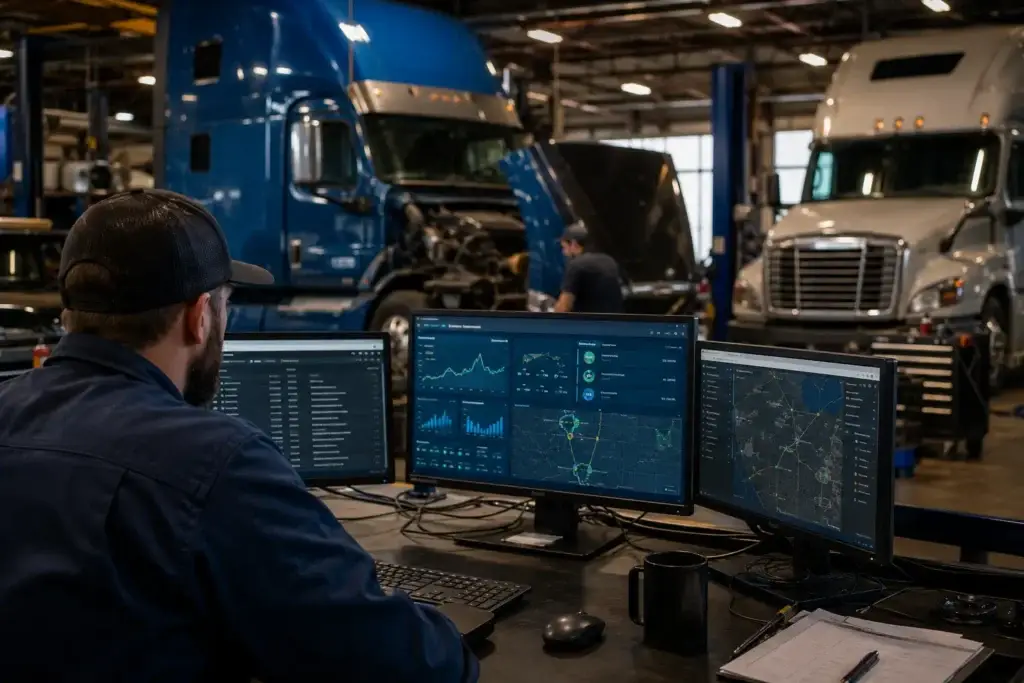
According to Michael Nielsen, Heavy Duty Journal's publisher with 15+ years of diesel repair and fleet operations experience, the fleets with the best uptime records are rarely the ones with the newest trucks or the biggest parts budgets. They're the ones where a service manager can pull up one screen and see telematics fault history, maintenance records, and parts availability for a truck at the same time — because that's what actually shortens the gap between "something's wrong" and "it's fixed."
74% cite data accessibility as their top barrier
Even though 87% of fleets have already invested in digital tools to monitor operations. Source: Teletrac Navman, "Mobilizing the Future of Fleets: 2026 Equipment Utilization Edition," as of March 2026.
Why Identical Parts Networks Produce Different Downtime Outcomes
Two fleets buying from the same national parts distributor, running the same OEM preventive maintenance schedule, and paying comparable labor rates can still show a meaningful gap in downtime per unit. The parts network isn't the variable — the decision layer sitting above it is. Parts availability and lead times matter enormously, but availability only helps if someone knew, early enough, which part a given truck was going to need.
A fleet with connected data can see a DPF (diesel particulate filter) trending toward failure across its telematics fault codes, cross-reference maintenance history to confirm it hasn't been serviced recently, check regional parts availability, and schedule the repair during a planned stop — all before the truck derates on the highway. A fleet without that connection finds out the same information exists, spread across three logins nobody cross-referenced, only after the truck is already down.
Whether the dealer had the part, whether the OEM modeled regional demand correctly, and whether visibility was good enough to catch a shortage before it became a constraint were all decided upstream, often days or weeks earlier.
Where Fleet Data Actually Breaks Down: The Fragmented Tech Stack
Fleet data breaks down at the handoff points between systems that were never designed to talk to each other. Most mid-size and large fleets don't lack data — they lack a way to move it between the telematics platform, the maintenance system, the parts inventory database, and the dispatch or TMS software without someone manually re-entering it, exporting a spreadsheet, or simply not looking at the other system at all.
Data fragmentation is the condition in which operationally relevant fleet information exists across multiple disconnected systems that require manual export, re-entry, or separate review to combine — rather than flowing automatically into a shared view. It's a useful term because it names the actual mechanism, as distinct from simply "not having enough technology." Most fragmented fleets have plenty of technology; what they don't have is integration between the pieces they already bought.
Part of the reason integration lags adoption is technical, not just organizational. For years, fleets connecting a telematics service provider (TSP) to their own systems risked vendor lock-in: switching providers meant rebuilding the integration from scratch. The National Motor Freight Traffic Association's Open Telematics API — the nonprofit standards body better known for freight classification — addressed this directly: a standardized specification for retrieving telematics logs and data that lets a fleet change TSPs without redoing its integration work from zero.
The operational cost of fragmentation shows up in predictable ways: a fault code sits in the telematics dashboard for four days because nobody's job is to check it against the maintenance calendar. A part gets ordered twice because the shop didn't know a similar unit had one in stock. A truck gets dispatched on a long haul the same week its oil analysis flagged elevated wear metals, because the person who assigns loads never sees maintenance data.
Building a Connected Visibility Stack: From Silos to a Single Source of Truth
A connected visibility stack is a set of fleet systems — telematics, maintenance, parts, and dispatch — linked through APIs (application programming interfaces) or middleware so that data entered once in any system becomes visible everywhere it's needed, without manual re-entry. The technical mechanism matters less than the outcome: one accurate picture of a truck's condition, replacing four partial ones.
There are meaningful gradations between "fully fragmented" and "fully connected," and most fleets sit somewhere in the middle. The table below outlines four common maturity levels HDJ sees across shops and fleets of varying size, along with the operational consequence typical at each stage.
| Visibility Maturity Level | What It Looks Like | Typical Downtime Consequence |
|---|---|---|
| Disconnected | Telematics, maintenance, and parts data live in separate systems with no manual or automated cross-checking | Problems discovered reactively — usually roadside |
| Manually Bridged | Staff periodically export or cross-reference data between systems, often weekly | Delays measured in days between a warning sign and action |
| Partially Integrated | Two core systems (commonly telematics and maintenance) share data automatically; parts and dispatch remain separate | Faster maintenance response, but parts and scheduling still lag |
| Fully Connected | Telematics, maintenance, parts inventory, and dispatch share a common data layer in near real time | Repairs and parts staged proactively, largely off the road |
Most fleets sit in the "Manually Bridged" or "Partially Integrated" rows — not because connected systems don't exist, but because integration work competes for budget and attention against more visible priorities. The jump from Partially Integrated to Fully Connected is usually the highest-leverage move available, since it's the point where parts and scheduling data finally join a picture that already includes telematics and maintenance. HDJ's fleet maintenance software integration guide covers the specific platform features and vendor options that make that Fully Connected stage achievable.
From Visibility to Foresight: How AI and Predictive Analytics Change the Equation
Predictive maintenance is a maintenance strategy that uses ongoing analysis of telematics, sensor, and historical repair data to forecast when a specific component is likely to fail — scheduling service based on actual condition rather than a fixed mileage or time interval. It's frequently discussed as an AI capability, but the AI or machine learning model is only as useful as the visibility layer feeding it. A predictive algorithm cannot forecast a failure using data it never receives.
This is the direct link between the visibility work covered above and the data-standardization conversation happening at the industry's own technical bodies. The Technology & Maintenance Council's Vehicle Maintenance Reporting Standards (VMRS) have existed since 1970 specifically to solve this problem for maintenance data: a shared coding convention that lets fleets, OEMs, and suppliers describe a repair the same way, so the data can actually be compared and aggregated across systems rather than trapped in one shop's private shorthand.
VMRS predates the AI conversation by decades, but it's exactly the kind of shared "language" that makes an AI or machine-learning model's output trustworthy once telematics, maintenance, and parts data are actually flowing into the same system it can analyze.
Much of what fleets currently call "AI" in maintenance forecasting is more precisely machine learning: pattern recognition across large volumes of telematics and maintenance data that highlights components trending toward failure faster than a technician reviewing logs manually could catch. That distinction matters operationally — these systems surface priorities and flag anomalies, but they don't replace a technician's diagnostic judgment. Human oversight remains part of the process; the technology narrows where attention goes rather than deciding outcomes on its own.
Building a Supply Chain Visibility Strategy: Where to Start
Building supply chain visibility starts with connecting the two systems that already generate the most operationally relevant data — typically telematics and maintenance management — before expanding to parts and dispatch. Trying to unify every system at once is the most common way visibility initiatives stall; the fleets that make measurable progress usually sequence the work.
Sequencing a Visibility Initiative
- Step 1 — Connect telematics to maintenance: Route fault codes and engine health data automatically into the maintenance scheduling system so service is triggered by condition, not just calendar.
- Step 2 — Establish one record of truth per truck: Consolidate maintenance history, current fault status, and inspection records so any staff member checking one vehicle sees the same complete picture.
- Step 3 — Bring parts inventory into the same view: Connect parts availability data so a flagged repair automatically shows whether the needed component is on hand, on order, or needs sourcing.
- Step 4 — Extend to dispatch and scheduling: Once maintenance and parts data are connected, feed that status into dispatch decisions so trucks flagged for service aren't assigned to routes that delay the repair.
This sequencing matters because each step produces a usable improvement on its own — a fleet that completes only Step 1 and Step 2 already sees faster response to developing problems, even before parts and dispatch are connected.
Free Diesel Maintenance Checklist
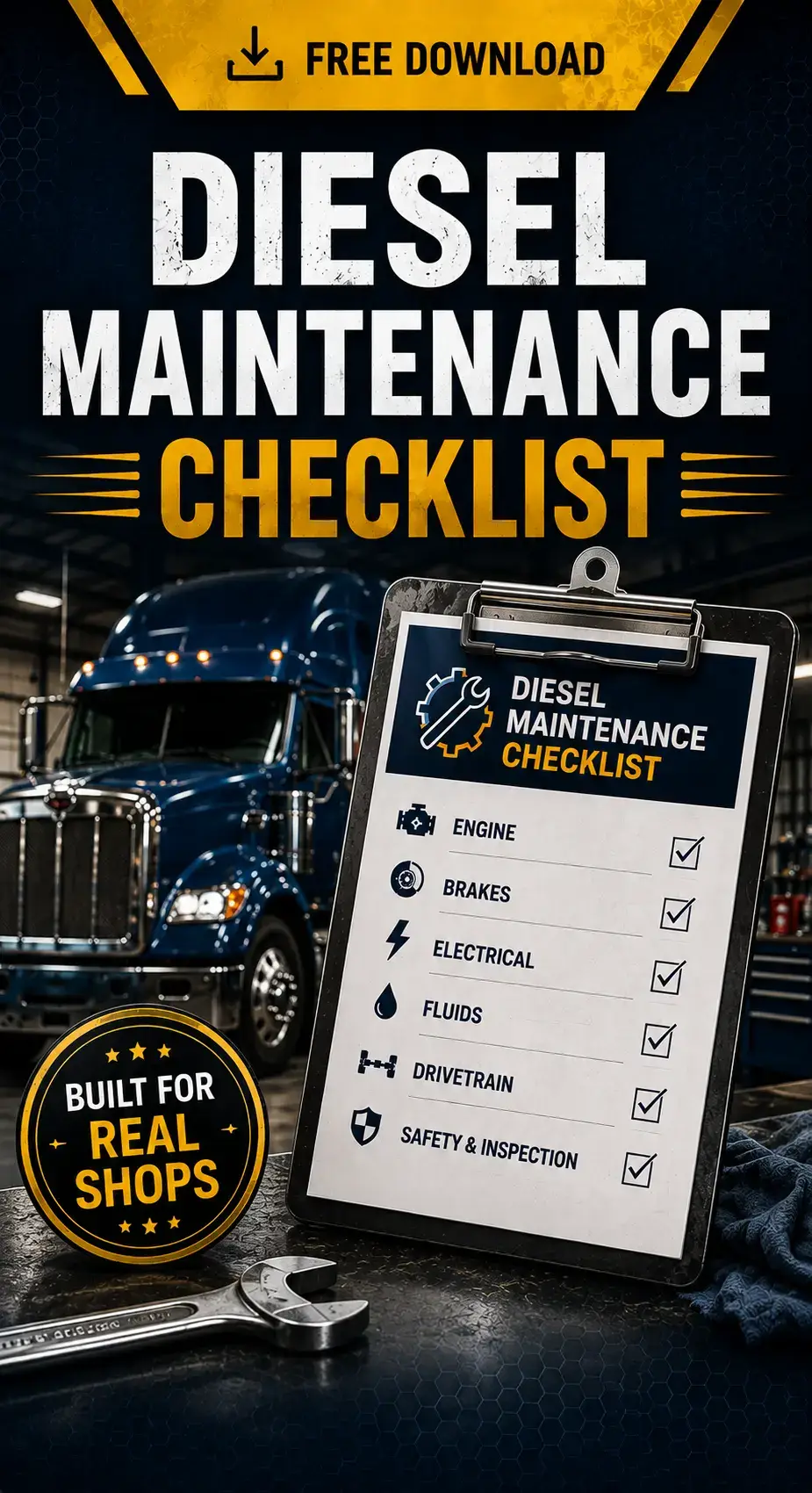
Get HDJ's free, field-tested diesel maintenance checklist delivered instantly to your inbox — print it, laminate it, keep it in the shop.
Instant PDF • 100% Free • No Spam
Vendor-driven implementations sometimes push a "unified platform" as an all-at-once purchase; in HDJ's field experience, the fleets with the most durable results are the ones that treated it as a sequence of integrations rather than a single software rollout.
Recordkeeping is part of this too, and it carries a compliance dimension beyond operational efficiency. As of the current 49 CFR 396.3, motor carriers must maintain a record of inspections, repairs, and maintenance for each vehicle, retained for one year while the vehicle is housed or maintained by the carrier and for six months after it leaves the carrier's control — a retention window the regulation itself was updated to reaffirm as recently as July 2026.
A connected visibility stack that already centralizes maintenance history makes producing that record during a roadside audit substantially easier than reconstructing it from a spreadsheet and a filing cabinet.
Common Blind Spots That Undermine Visibility Programs
The most common blind spot in fleet visibility programs is treating data volume as a substitute for data integration — assuming that because telematics, maintenance software, and an ERP system are all in use, visibility must already exist. Volume and integration are different things, and a fleet can have enormous amounts of data with almost no cross-system visibility.
A second recurring mistake is alarm fatigue: once telematics and predictive tools start generating fault flags, an unfiltered stream of low-priority alerts trains staff to ignore the dashboard altogether, including the alerts that matter. Prioritization logic — surfacing the handful of flags that predict real failures rather than every minor deviation — has to be built into the visibility layer, not left to individual judgment under a flood of notifications.
A third blind spot is skipping technician and staff retraining when new diagnostic or visibility tools go live. A connected dashboard that nobody has been trained to interpret correctly produces the same blind spots as no dashboard at all — the data exists, but the people who need to act on it don't yet know what they're looking at or trust it enough to change how they work.
Finally, many fleets underestimate how much of the visibility gap sits in ownership, not technology. Connected data still needs someone whose job includes checking it and acting on what it shows. Without a named owner, even a fully integrated dashboard tends to go unwatched — the connection exists, but nobody's role depends on using it.
Rising operating costs make the case for fixing this sharper, not softer. As of late 2025, the American Transportation Research Institute's 21st annual Top Industry Issues report found that operating costs climbed to their highest level on record even as freight pricing bottomed out during the industry's extended freight recession. In that environment, downtime that visibility could have prevented isn't a rounding error — it's margin a fleet can't afford to lose to a data connection it already had the pieces to build.
Frequently Asked Questions
What's the difference between supply chain visibility and fleet tracking?
Fleet tracking typically refers to knowing a vehicle's location and basic status through GPS and telematics. Supply chain visibility is broader — it means connecting that location and status data with maintenance history, parts availability, and dispatch information so the data can inform a decision, not just show a dot on a map.
Do small fleets need supply chain visibility, or is it only for large operations?
Smaller fleets often have an advantage here: fewer systems and fewer trucks make integration simpler to implement and easier to keep accurate. A five-truck fleet connecting telematics and a maintenance log can achieve meaningful visibility with far less complexity than a fleet running hundreds of units across multiple legacy systems.
Can supply chain visibility work without buying new software?
Often, yes. Many telematics and maintenance platforms already support API or middleware connections that fleets simply haven't activated. Before purchasing a new platform, it's worth confirming whether the systems already in place can be connected through existing integration options — including standardized options like NMFTA's Open Telematics API, built specifically so fleets aren't locked into rebuilding integrations from scratch.
How does supply chain visibility affect DOT compliance?
Connected maintenance data makes it easier to satisfy 49 CFR 396.3's requirement to retain inspection, repair, and maintenance records for one year, plus six months after a vehicle leaves the carrier's control. It also supports the documentation FMCSA safety investigators request when reviewing a carrier's Vehicle Maintenance BASIC standing — vehicle maintenance files, inspection reports, and DVIRs among them. When those records live in one connected system rather than scattered across paper files and spreadsheets, producing complete documentation during a roadside inspection or audit becomes significantly faster.
What should a fleet connect first if it's starting from scratch?
Telematics and maintenance management are the highest-value first connection for most fleets, since fault code and engine health data flowing directly into maintenance scheduling produces a measurable improvement in response time before parts and dispatch systems are even involved.
Supply chain visibility isn't a technology purchase — it's a decision to stop letting the systems a fleet already owns operate as strangers to each other, a pattern Heavy Duty Journal has tracked consistently across the fleets we cover. The parts network, the maintenance schedule, and the technicians can all be excellent, and downtime will still be inconsistent if the data those pieces generate never reaches the same view at the same time.
Fleets that treat visibility as a sequence of connections, starting with telematics and maintenance, consistently see faster, more predictable uptime than fleets that keep buying more standalone tools and hoping the picture assembles itself.
Send This to Whoever Owns Your Fleet's Data Stack
If your shop or fleet is still bridging telematics and maintenance data by hand, this is worth forwarding to the person who'd actually make the case for connecting them.