Understanding commercial vehicle inspection requirements by state represents a critical compliance responsibility for every fleet manager, owner-operator, and diesel technician operating trucks over 10,000 pounds GVWR. Unlike passenger vehicle programs that vary widely by jurisdiction, commercial vehicle inspections follow federal DOT standards under 49 CFR Part 396—but states add their own layer of requirements that create significant regional variations in enforcement, frequency, and scope.
Federal law mandates annual inspections for all commercial motor vehicles, yet states implement additional safety and emissions programs that fleet operations must navigate. California requires biennial heavy-duty diesel smoke inspections. Texas enforces commercial vehicle safety inspections beyond federal minimums. Pennsylvania demands semi-annual inspections for certain commercial vehicle categories. These state-level requirements layer on top of federal obligations, creating compliance challenges for interstate carriers.
The landscape of DOT annual inspection requirements continues evolving as states modernize enforcement systems and update emissions standards for heavy-duty diesel engines. Recent EPA regulations targeting nitrogen oxide emissions from trucks affect inspection protocols in multiple jurisdictions. CVSA’s Enhanced Commercial Vehicle Inspection Standards now influence how roadside inspections identify violations that trigger out-of-service orders.
Your compliance obligations depend on vehicle classification, operational scope, and base jurisdiction. Fleet compliance requirements determine whether you face federal-only inspections or must satisfy additional state-mandated testing. Understanding these multi-layered regulations prevents costly violations, reduces out-of-service incidents, and maintains your fleet’s operational authority across state lines.
Last Updated: November 2025
Key Takeaways
- Federal baseline: All commercial vehicles over 10,000 lbs GVWR require annual DOT inspections under 49 CFR Part 396.17
- State variations: Additional requirements for safety, emissions, or frequency exist in 23 states beyond federal mandates
- CVSA standards: Roadside inspections follow Commercial Vehicle Safety Alliance protocols affecting fleet compliance nationwide
- Heavy-duty diesel focus: California, Colorado, and Texas enforce specific emissions programs for commercial diesel engines
- Record retention: Inspection documentation must be maintained for 14 months and available for roadside verification
- Interstate complexity: Multi-state operations face layered compliance obligations requiring jurisdiction-specific knowledge
Understanding Commercial Vehicle Inspection Programs
Commercial vehicle inspection programs operate within a dual regulatory framework combining federal safety standards with state-specific requirements. The Federal Motor Carrier Safety Administration establishes baseline inspection protocols through 49 CFR Part 396, creating uniform standards that apply to all interstate commerce operations. State transportation departments then overlay additional requirements based on regional safety priorities, air quality concerns, and infrastructure protection objectives.
These inspection systems serve distinct purposes compared to passenger vehicle programs. Commercial vehicle inspections address the increased risk profile of heavy-duty equipment operating in interstate commerce. A fully loaded Class 8 tractor-trailer requires significantly greater stopping distances than passenger cars. Commercial vehicles transport hazardous materials, operate for extended hours, and accumulate higher annual mileage than personal vehicles.
The regulatory structure reflects this elevated risk through more comprehensive inspection criteria and stricter enforcement mechanisms. Federal regulations mandate annual inspections as a minimum standard. Many states require more frequent checks for specific vehicle categories or operational profiles. Understanding both layers of authority prevents compliance gaps that trigger violations during roadside inspections or facility audits.
Federal DOT Authority Under 49 CFR Part 396
The cornerstone of commercial vehicle inspection requirements appears in 49 CFR Part 396, which establishes comprehensive maintenance and inspection standards for all motor carriers operating in interstate commerce. This regulation creates mandatory protocols that supersede state authority when vehicles cross state lines. Section 396.17 specifically mandates annual inspections performed by qualified inspectors using standardized criteria.
Federal authority extends to all vehicles with a gross vehicle weight rating exceeding 10,000 pounds when used in interstate commerce. This threshold captures Class 4 through Class 8 trucks, encompassing medium-duty delivery vehicles through heavy-duty tractor-trailers. The regulation applies regardless of whether vehicles actually cross state lines—commerce that affects interstate trade triggers federal jurisdiction even for intrastate operations.
FMCSA’s enforcement framework relies on Safety Measurement System data collected through roadside inspections and compliance reviews. Carriers accumulate safety scores across seven Behavior Analysis and Safety Improvement Categories. Inspection violations directly impact these scores, affecting CSA rankings that determine audit priorities and intervention requirements. The connection between annual inspections and SMS scores makes proactive compliance essential for maintaining operational authority.
The FMCSA’s inspection requirements specify minimum standards that qualified inspectors must verify. These include brake systems, steering mechanisms, lighting devices, tires, wheels and rims, emergency equipment, and coupling devices for combination vehicles. States cannot reduce these federal requirements but frequently add supplemental criteria addressing regional concerns.
State Supplemental Requirements and Variations
Twenty-three states impose inspection requirements beyond federal DOT minimums for commercial vehicles operating within their jurisdictions. These supplemental programs address state-specific safety priorities, environmental regulations, and infrastructure protection objectives. State commercial vehicle programs typically fall into three categories: enhanced safety inspections, heavy-duty diesel emissions testing, and specialized requirements for particular vehicle classifications.
Enhanced safety inspection states like Pennsylvania require semi-annual inspections for certain commercial vehicle categories. This twice-yearly frequency exceeds federal annual requirements, targeting vehicles with higher accident rates or public safety implications. School buses, passenger carriers, and for-hire transportation services often face these elevated inspection frequencies regardless of federal classification.
Heavy-duty diesel emissions programs operate in California, Colorado, Texas, and portions of other states with air quality non-attainment designations. These programs specifically target commercial diesel engines, using different testing methodologies than passenger vehicle emissions checks. Opacity testing measures visible smoke from diesel exhaust. Some jurisdictions now incorporate onboard diagnostics for 2010 and newer heavy-duty engines equipped with selective catalytic reduction systems.

Federal DOT inspection requirements establish baseline standards that states supplement with additional regional compliance obligations.
Infrastructure protection programs in states like Michigan implement weight-distance taxes and specialized inspections for overweight vehicles. These requirements protect road infrastructure from damage caused by heavy commercial vehicles. Permit requirements and routing restrictions add complexity for fleet operations traversing multiple jurisdictions with varying infrastructure policies.
The interaction between federal and state authority creates compliance challenges for interstate carriers. A fleet based in California operating routes through Nevada, Arizona, and Oregon must satisfy California’s heavy-duty diesel emissions program while meeting each state’s unique supplemental requirements. This jurisdictional complexity demands systematic compliance management and thorough understanding of applicable regulations across operational territories.
CVSA Inspection Standards and Enforcement
The Commercial Vehicle Safety Alliance provides standardized inspection procedures used by enforcement officers across North America. CVSA inspection standards create consistency in roadside enforcement despite variations in state regulations. These protocols define six inspection levels, each with specific scope and criteria that inspectors follow during vehicle examinations.
Level I represents the most comprehensive roadside inspection, including a 37-step procedure covering driver credentials, vehicle mechanical condition, and cargo securement. This inspection typically requires 45 to 60 minutes and thoroughly examines all safety-critical systems. Violations discovered during Level I inspections generate detailed reports that affect carrier SMS scores and may result in out-of-service orders.
Level II walk-around inspections examine visible vehicle components without physically getting under the vehicle. This streamlined process focuses on obvious defects visible during external examination. Level III driver-only inspections verify credentials, hours-of-service compliance, and required documentation without vehicle examination. Specialized inspections for hazardous materials, vehicle transporter loading, and radioactive materials constitute Levels IV through VI.
CVSA’s annual Roadcheck blitzes intensify enforcement for 72-hour periods each year. These concentrated inspection events place thousands of commercial vehicles out of service for violations discovered during enhanced enforcement activities. Fleets face significantly elevated inspection probabilities during Roadcheck periods, making proactive maintenance and pre-trip inspection protocols essential for avoiding costly delays.
Out-of-service criteria published by CVSA establish thresholds that immediately prohibit vehicle operation until repairs are completed. Brake adjustment exceeding specified limits, tire tread below minimum depth, or inoperative required lighting all trigger out-of-service orders. These roadside violations generate SMS data that accumulates across multiple enforcement encounters, creating long-term compliance consequences beyond immediate operational disruptions.
Annual DOT Inspection Requirements for Commercial Vehicles
Federal regulations under 49 CFR 396.17 mandate that all commercial motor vehicles must undergo systematic inspection, repair, and maintenance to ensure safe operational condition. The annual DOT inspection requirement applies to vehicles with gross vehicle weight ratings exceeding 10,000 pounds used in interstate commerce. This inspection must be performed at least once every 12 months, creating a rolling compliance deadline for fleet operations.
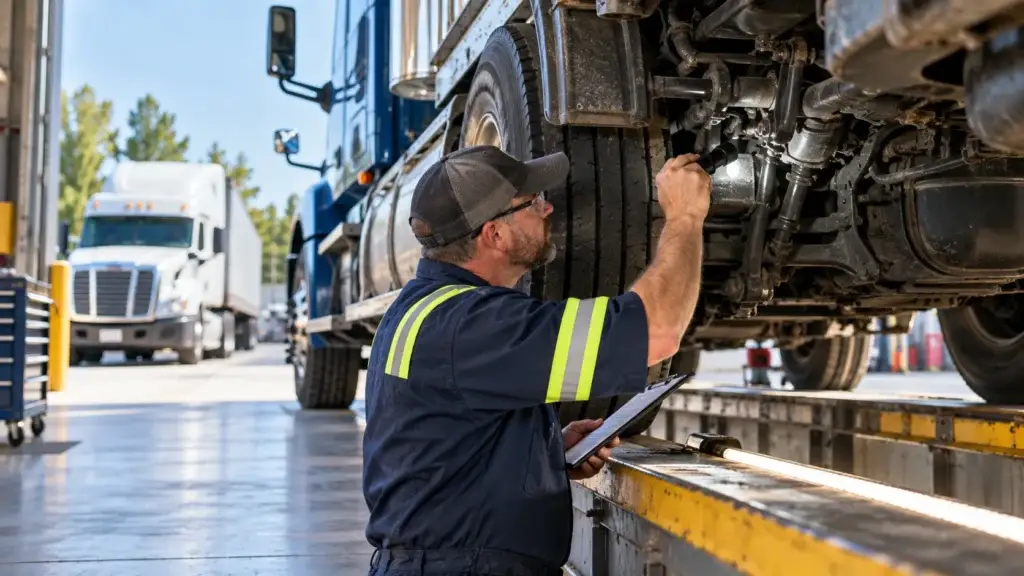
Qualified inspectors must complete these examinations using criteria specified in 49 CFR Part 396 Appendix A. The inspection covers multiple vehicle systems including brake components, steering mechanisms, lighting and electrical systems, frame and cargo securement, wheels and tires, windshield wipers and mirrors, and emergency equipment. For combination vehicles, both power units and trailers require separate annual inspections within the 12-month interval.
Documentation requirements mandate that inspection reports be maintained in vehicle files for 14 months following the inspection date. These records must accompany vehicles during operation or be available at the carrier’s principal place of business. Inspection decals or stickers affixed to vehicles indicate compliance status and allow enforcement officers to verify current inspection validity during roadside encounters.
Qualified Inspector Certification Standards
Federal regulations require that annual inspections be performed by qualified inspectors meeting specific competency standards. A qualified inspector possesses knowledge, training, and experience necessary to identify defects and assess vehicle roadworthiness. Three categories of individuals qualify under federal standards: employees of motor carriers if the carrier employs qualified maintenance personnel, employees of inspection facilities including state inspection programs, and certified mechanics with appropriate credentials.
State inspection programs differ in their certification processes for commercial vehicle inspectors. Some states require successful completion of training programs and written examinations demonstrating knowledge of federal inspection criteria. Others accept ASE certifications in relevant specialty areas as proof of inspector qualifications. Carriers operating self-inspection programs must document inspector qualifications through training records, work experience verification, and competency assessments.
The inspector’s signature on the inspection report creates a legal certification that the vehicle was examined and found to meet applicable standards. This signature carries significant liability implications if defects subsequently cause accidents or injuries. Properly qualified inspectors protect both carriers and the traveling public by identifying safety defects before they result in crashes or breakdowns.
Inspection Report Documentation Requirements
Completed inspection reports must identify the vehicle by unit number, VIN, or other unique designation. The report documents each inspected component and notes any defects discovered during examination. 49 CFR 396.21 requires detailed documentation of repairs made to correct identified deficiencies, including mechanic certification that repairs restore vehicles to safe operating condition.
The inspection report remains in the vehicle file or accompanies the vehicle for 14 months. This retention period allows enforcement officers during roadside inspections to verify recent examination dates. Electronic record-keeping systems must provide immediate access to inspection documentation when requested by authorities. Failure to produce current inspection records during compliance reviews or roadside inspections constitutes a violation subject to civil penalties.
Many carriers exceed minimum federal documentation requirements by implementing preventive maintenance tracking systems. These enhanced records demonstrate systematic maintenance programs that reduce breakdown frequency and extend component service life. Detailed maintenance histories prove valuable during accident investigations by showing proactive safety management that goes beyond minimal compliance.
Inspection Decal and Sticker Requirements
Upon successful completion of annual inspections, qualified inspectors affix decals or stickers to vehicles indicating compliance. These visible indicators allow enforcement officers to quickly verify inspection currency during roadside observations. Decal placement typically occurs on the driver’s side door frame or other conspicuous location specified by state regulations for commercial vehicles.
Inspection decals display the month and year of inspection completion along with the inspector’s identification number or facility designation. This information enables enforcement personnel to verify inspection validity and identify the responsible inspector if questions arise about inspection quality. Expired, altered, or counterfeit inspection stickers constitute serious violations that trigger intensive compliance scrutiny.
Interstate carriers face complexity managing decal requirements across multiple jurisdictions. A tractor-trailer combination operating through ten states may encounter different decal color schemes, placement requirements, and expiration date formats. Fleet managers must ensure that vehicles carry appropriate inspection documentation for each jurisdiction encountered during normal operations to avoid citation for invalid inspection indicators.
CVSA Inspection Levels and Roadside Enforcement
Understanding CVSA inspection protocols prepares fleet operations for roadside encounters that significantly impact operational efficiency and safety scores. The Commercial Vehicle Safety Alliance developed six distinct inspection levels that enforcement officers deploy based on circumstances, available time, and specific concerns triggering the inspection. Each inspection level follows standardized procedures that create consistency across enforcement jurisdictions despite state-by-state regulatory variations.
Level I North American Standard Inspections represent the most thorough roadside examinations, requiring drivers to exit vehicles while inspectors conduct comprehensive 37-step assessments. These inspections examine driver credentials including medical certificates and hours-of-service documentation. Vehicle examination covers brake systems through physical measurement, steering components, suspension systems, lighting devices, tires with tread depth measurement, coupling devices, and cargo securement. Completing a Level I inspection typically consumes 45 to 60 minutes of operational time.
Violations discovered during these examinations generate detailed reports transmitted to FMCSA’s Motor Carrier Management Information System. The severity of violations determines whether vehicles or drivers receive out-of-service orders prohibiting further operation until corrections occur. Even violations not reaching out-of-service thresholds accumulate in carrier safety measurement scores, affecting compliance review priorities and intervention requirements.
Level II Walk-Around Driver and Vehicle Inspection
Level II inspections provide streamlined assessments focusing on readily observable defects without requiring inspectors to physically access vehicle undersides. These walk-around examinations verify driver credentials and hours-of-service compliance while inspecting visible vehicle components. Typical duration ranges from 15 to 30 minutes, making Level II inspections more operationally efficient than comprehensive Level I examinations.
Inspectors examine lighting systems, tire condition from external viewing, visible leaks suggesting brake or hydraulic system problems, obvious frame damage or cracks, and cargo securement from outside the vehicle. Driver documentation review mirrors Level I procedures, ensuring medical certificate validity, proper endorsements for vehicle operation, and hours-of-service record compliance. Violations discovered during Level II inspections carry identical SMS impacts as those identified through more thorough Level I procedures.

CVSA Level I inspections follow standardized 37-step procedures that thoroughly assess commercial vehicle safety compliance.
Specialized Inspection Levels III Through VI
Level III driver-only inspections verify credentials, medical fitness, and hours-of-service compliance without vehicle examination. These targeted inspections occur when enforcement priorities focus on driver qualification issues or during operations where vehicle inspection proves impractical. Despite omitting vehicle examination, Level III inspections generate SMS data affecting carrier safety scores through driver-related violations.
Level IV special inspections conduct one-time examinations of particular items. This category includes New Entrant Safety Audits where FMCSA examines carriers within their first 18 months of operation. Level IV also covers targeted inspections responding to specific complaints or crash follow-up investigations. These specialized procedures adapt to circumstances requiring focused examination rather than comprehensive assessment.
Level V vehicle-only inspections assess vehicle condition without driver credential verification. Facilities conducting pre-trip safety checks or terminal inspections use this protocol. Level VI enhanced North American Standard Inspections represent the most thorough examinations possible, typically conducted at fixed inspection facilities with specialized equipment. These comprehensive assessments may require dismantling components for detailed evaluation, consuming several hours of inspection time.
Out-of-Service Criteria and Enforcement Actions
CVSA publishes detailed out-of-service criteria establishing thresholds that immediately prohibit vehicle operation. Brake violations constitute the most common out-of-service defect identified during roadside inspections. Brake adjustment exceeding 20 percent on any single axle, missing or inoperative brake components, or audible air leaks from brake systems trigger immediate prohibition on continued operation until repairs restore functionality.
Tire violations reaching out-of-service levels include tread depth below 4/32 inch on steering axles or 2/32 inch on other axles. Exposed tire cord, sidewall cuts deep enough to expose cord, or flat tires also trigger out-of-service orders. These tire defects present immediate safety risks that enforcement officers cannot permit to continue through temporary repairs or operational adjustments.
Lighting and electrical system deficiencies that render 50 percent or more of required lamps inoperative reach out-of-service thresholds. This includes stop lamps, tail lamps, or turn signals on either the power unit or trailer. Steering system violations involving loose or worn components with excessive freeplay prohibit continued operation due to unacceptable crash risks from impaired vehicle control.
Out-of-service orders carry severe operational and financial consequences beyond immediate delays. Carriers must arrange for on-site repairs or towing to qualified facilities before vehicles resume operation. Driver hours-of-service clocks continue running during repair delays, potentially exhausting available driving time before reaching intended destinations. The SMS impact from out-of-service violations affects carrier safety scores more severely than standard violations, accelerating intervention thresholds.
Stay Ahead of Industry Trends
Get expert insights, equipment reviews, and operational strategies delivered weekly.
State-by-State Commercial Vehicle Inspection Requirements
Commercial vehicle inspection requirements vary significantly across state jurisdictions beyond federal DOT baseline standards. Twenty-three states enforce supplemental inspection programs that impose additional compliance obligations on fleet operations. Understanding these state-specific requirements prevents violations during interstate operations and ensures regulatory compliance across all operational territories.
State programs typically address three primary areas: enhanced safety inspections exceeding federal frequency requirements, heavy-duty diesel emissions testing for environmental compliance, and specialized requirements for particular vehicle classifications or operational profiles. Interstate carriers must navigate these layered regulations while maintaining federal DOT compliance, creating complex jurisdictional challenges for fleet management operations.
California Heavy-Duty Diesel Emissions Programs
California operates the most comprehensive heavy-duty diesel inspection requirements in the nation through its Periodic Smoke Inspection Program. Commercial vehicles exceeding 14,000 pounds GVWR with diesel engines require biennial smoke opacity testing. The program applies to California-based vehicles and out-of-state vehicles regularly operating within California borders, creating compliance obligations for interstate carriers serving west coast markets.
Testing measures visible smoke emissions using opacity standards that limit particulate matter release. Diesel engines must demonstrate opacity levels below 40 percent for model year 1991 and newer engines, with stricter limits for newer vehicles equipped with diesel particulate filters. The California Air Resources Board enforces these requirements through roadside inspections and facility compliance checks targeting commercial diesel fleets.
California’s Truck and Bus Regulation further complicates compliance by mandating diesel particulate filter retrofits or vehicle replacement for older engines. Vehicles operating in California must meet these emission control requirements regardless of base jurisdiction. The regulation phases in requirements based on engine model year, creating ongoing compliance obligations as implementation timelines progress. Non-compliance results in substantial civil penalties and operational restrictions within California jurisdiction.
Texas Commercial Vehicle Safety Inspections
Texas requires annual safety inspections for commercial vehicles in addition to federal DOT requirements. The Texas Commercial Motor Vehicle Inspection Program mandates that all vehicles with GVWR exceeding 10,000 pounds receive annual inspections at state-certified facilities. This requirement applies to both Texas-based fleets and out-of-state carriers operating within Texas, creating jurisdictional compliance obligations for interstate operations.
Inspection criteria mirror federal DOT standards but include additional state-specific requirements for lighting configurations and safety equipment. Texas inspectors examine brake systems, steering mechanisms, tires, lighting devices, coupling equipment for combination vehicles, and cargo securement devices. Vehicles must display current Texas commercial vehicle inspection stickers indicating compliance with state requirements.
Recent legislative changes implemented through House Bill 3297 modified Texas inspection programs for passenger vehicles but maintained commercial vehicle inspection requirements. Fleet operations continue facing annual inspection obligations despite reforms reducing requirements for light-duty vehicles. This regulatory distinction recognizes the elevated safety risks associated with commercial vehicle operations requiring ongoing oversight.
Pennsylvania Enhanced Inspection Frequency
Pennsylvania implements semi-annual inspection requirements for specific commercial vehicle categories beyond federal annual mandates. School buses, passenger-carrying vehicles, and for-hire transportation services require inspections every six months to address elevated public safety concerns. This twice-yearly frequency significantly exceeds baseline federal requirements, imposing additional compliance costs and administrative burdens on affected carriers.
The enhanced inspection schedule reflects Pennsylvania’s policy priorities targeting vehicles transporting passengers. Regular freight-hauling trucks follow annual inspection requirements consistent with federal standards, but passenger-carrying capacity triggers the elevated semi-annual mandate. Fleet operations serving Pennsylvania markets with passenger transportation capabilities must implement compliance tracking systems accommodating these compressed inspection timelines.
Pennsylvania commercial vehicle inspections examine all safety-critical systems specified in federal regulations plus state-specific requirements for emergency equipment and passenger safety devices. Inspections occur at PennDOT-certified commercial vehicle inspection facilities staffed by qualified inspectors meeting state certification standards. Non-compliance results in operational restrictions and civil penalties enforced through Pennsylvania State Police commercial vehicle enforcement units.

Commercial vehicle inspection requirements vary by state, with 23 jurisdictions enforcing programs beyond federal DOT baseline standards.
Northeast Corridor State Requirements
New York requires annual commercial vehicle inspections combining safety and emissions components. The state’s program applies to all trucks exceeding 18,000 pounds GVWR, capturing Class 6 through Class 8 vehicles operating within New York jurisdiction. Inspection facilities must obtain DMV certification for commercial vehicle examinations, ensuring inspectors possess qualifications necessary for evaluating heavy-duty equipment.
New Jersey discontinued safety inspections for passenger vehicles in 2010 but maintains commercial vehicle inspection requirements. Trucks exceeding 10,000 pounds GVWR require annual inspections covering safety systems and diesel emissions where applicable. The state focuses enforcement resources on commercial operations where safety risks justify ongoing regulatory oversight despite reduced requirements for light-duty vehicles.
Massachusetts enforces annual inspections for commercial vehicles combining comprehensive safety evaluation with emissions testing where vehicle specifications trigger testing requirements. The state’s program applies to both in-state registered vehicles and out-of-state commercial vehicles operating regularly within Massachusetts borders. Interstate carriers serving Boston and surrounding markets face compliance obligations regardless of base jurisdiction registration location.
Midwest and Mountain State Programs
Colorado implements heavy-duty diesel emissions testing in the Denver metropolitan area targeting commercial vehicles contributing to air quality concerns. The program requires biennial emissions inspections for diesel-powered commercial vehicles exceeding 14,000 pounds GVWR. Testing uses opacity measurement protocols similar to California standards, establishing smoke emission limits that diesel engines must meet for compliance certification.
Illinois requires emissions testing for heavy-duty commercial diesel vehicles in the Chicago metropolitan area. This regional program addresses air quality non-attainment issues in Illinois’s most densely populated region. Commercial vehicles based outside the testing area but operating regularly through Chicago face compliance obligations when conducting business within the designated metropolitan inspection zone.
Missouri maintains biennial safety inspection requirements for commercial vehicles operating within state jurisdiction. The inspection program covers vehicles exceeding 18,000 pounds GVWR, establishing safety compliance obligations beyond federal annual requirements. Missouri’s program targets mid-size and heavy-duty commercial trucks while exempting lighter commercial vehicles from state-specific inspection mandates.
Southern States Inspection Variations
Virginia enforces annual commercial vehicle inspections combining safety and emissions components for trucks operating within the commonwealth. The program applies to vehicles with GVWR exceeding 10,000 pounds, capturing federal commercial vehicle classifications. Virginia requires immediate inspection upon vehicle registration regardless of valid out-of-state inspection stickers, creating compliance obligations for carriers relocating equipment to Virginia registration.
North Carolina requires annual safety inspections for commercial vehicles until they reach 35 years of age. The state recently modified emissions testing requirements, eliminating programs in 18 counties while retaining testing in Mecklenburg County. This regional approach concentrates environmental compliance resources where air quality concerns justify ongoing emissions inspection programs for commercial diesel engines.
Georgia implements emissions testing exclusively in the 13-county Atlanta metropolitan area for commercial diesel vehicles. This targeted program addresses urban air quality while exempting rural commercial operations from emissions compliance burdens. Fleet operations serving Georgia markets must understand geographic boundaries determining whether individual vehicles face emissions testing obligations based on operational territories.
| State | Safety Inspection Frequency | Emissions Testing | Applicable Vehicle Class |
|---|---|---|---|
| California | Annual (Federal DOT) | Biennial smoke opacity testing | Diesel vehicles over 14,000 lbs GVWR |
| Texas | Annual (state requirement) | Varies by county | Vehicles over 10,000 lbs GVWR |
| Pennsylvania | Annual (Semi-annual for passenger) | As required by vehicle type | All commercial vehicles |
| New York | Annual | Combined with safety inspection | Trucks over 18,000 lbs GVWR |
Heavy-Duty Diesel Emissions Testing Requirements
Heavy-duty diesel engines face specialized emissions testing requirements distinct from passenger vehicle programs. EPA regulations establish federal standards for nitrogen oxide, particulate matter, and hydrocarbon emissions from commercial diesel engines. States with air quality non-attainment areas implement supplemental testing programs targeting commercial vehicles contributing to regional pollution challenges.
Diesel emissions testing protocols differ substantially from gasoline engine testing methodologies. Opacity measurement quantifies visible smoke from diesel exhaust, establishing limits on particulate matter release during engine operation. Modern testing incorporates onboard diagnostics for 2010 and newer engines equipped with selective catalytic reduction and diesel particulate filter systems mandated by EPA emissions standards.
EPA Heavy-Duty Engine Standards Evolution
The Environmental Protection Agency has progressively tightened emissions standards for heavy-duty diesel engines since implementing the first federal limits in 1974. The 2010 emissions standards represent a landmark regulatory change, reducing nitrogen oxide emissions by 90 percent compared to 2007 engine models. This dramatic reduction required manufacturers to implement selective catalytic reduction technology using diesel exhaust fluid to chemically convert nitrogen oxides into harmless nitrogen and water vapor.
EPA’s greenhouse gas emissions standards for medium and heavy-duty vehicles establish fuel efficiency requirements alongside traditional pollutant limits. These standards phase in through model year 2027 for tractors and 2030 for vocational vehicles. Compliance verification occurs through certification testing during vehicle manufacturing rather than periodic in-use testing, but roadside enforcement verifies that emission control systems remain functional throughout vehicle service life.
The progression toward near-zero emissions standards continues with EPA’s recent proposals targeting 2031 and later model years. These advancing requirements will further reduce nitrogen oxide emissions while maintaining particulate matter controls. Fleet operations face ongoing transitions as newer, cleaner engines enter service while aging equipment requires enhanced maintenance to meet existing standards during inspection testing.
State Diesel Smoke Opacity Testing Programs
Opacity testing measures the percentage of light blocked by diesel exhaust, providing a proxy measurement for particulate matter emissions. Snap acceleration testing represents the most common opacity measurement protocol, requiring engines to accelerate quickly from idle to maximum governed speed while testing equipment measures peak exhaust opacity. Results compare against standards typically limiting opacity to 40 percent for engines manufactured after 1991.
California’s smoke testing program requires biennial inspections for commercial diesel vehicles exceeding 14,000 pounds GVWR. Testing occurs at Bureau of Automotive Repair certified stations equipped with opacity measurement equipment. Vehicles must demonstrate opacity levels below established thresholds across three consecutive snap acceleration tests. Excessive opacity triggers failure requiring diagnosis and repair of combustion or emission control system problems.
Colorado enforces similar opacity testing in the Denver metropolitan area with biennial inspection cycles. The program applies to commercial diesel vehicles operating regularly within the testing jurisdiction. Nevada previously operated a diesel emissions program but discontinued requirements after demonstrating improved air quality, illustrating how successful programs may eventually phase out as environmental conditions improve.
OBD Requirements for Modern Diesel Engines
Heavy-duty onboard diagnostic systems monitor emission control component functionality on 2010 and newer diesel engines. Selective catalytic reduction systems, diesel particulate filters, and exhaust gas recirculation components incorporate continuous monitoring that detects malfunctions potentially increasing emissions beyond regulatory limits. When problems occur, systems illuminate malfunction indicator lamps and store diagnostic trouble codes identifying specific defects.
Some state inspection programs now incorporate OBD scanning for modern heavy-duty diesel engines. Inspectors connect diagnostic equipment to retrieve stored trouble codes and verify that all emission control system monitors have completed their diagnostic checks. Active malfunction indicator lamps or incomplete monitor readiness status result in inspection failure, requiring diagnosis and repair before vehicles pass emissions testing.
The transition toward OBD-based heavy-duty emissions testing mirrors the evolution that occurred with passenger vehicles during the 1990s. This testing methodology proves more efficient than opacity measurement while providing superior detection of emission control system malfunctions. As heavy-duty vehicle fleets turn over and older pre-2010 engines retire, OBD testing will increasingly dominate heavy-duty diesel emissions inspection protocols.
Diesel Exhaust Fluid Systems and Tampering Prohibitions
Selective catalytic reduction technology requires diesel exhaust fluid injection to achieve nitrogen oxide reduction targets mandated by EPA standards. DEF tampering or system deletion violates federal law under Clean Air Act provisions prohibiting emission control system modifications. Some operators attempted disabling SCR systems to avoid DEF costs or address reliability concerns during early implementation years, creating enforcement priorities for EPA and state environmental agencies.
Roadside inspections now specifically examine DEF systems, checking for proper fluid levels, functional fill caps, and absence of defeat devices. Visible modifications suggesting SCR system deletion or bypass trigger detailed examinations and potential referrals to environmental enforcement authorities. Civil penalties for tampering reach $4,527 per violation per day for individual owner-operators and substantially higher amounts for fleets or repair facilities conducting systematic defeat device installations.
Diesel particulate filter removal constitutes another common tampering violation that inspection programs target. DPF delete operations temporarily improve fuel economy and eliminate regeneration cycles that some operators find inconvenient. However, particulate matter emissions increase dramatically when filters are removed, creating air quality impacts that justify strict enforcement. Modern inspection protocols include visual examination and OBD interrogation to identify DPF tampering affecting emission control system effectiveness.
Commercial Vehicle Inspection Components and Standards
Commercial vehicle inspections examine safety-critical components using standardized criteria established in 49 CFR Part 396 Appendix A. These comprehensive standards address systems unique to heavy-duty equipment that differ substantially from passenger vehicle inspection criteria. Understanding inspection component requirements helps fleet maintenance operations prioritize repairs and avoid violations during roadside encounters.
The inspection scope extends beyond basic safety systems to include components specific to commercial operations. Coupling devices, air brake systems, cargo securement equipment, and specialized lighting configurations undergo detailed examination. Inspectors assess these components against federal minimum standards, identifying defects that create safety risks or violate regulatory requirements.
Air Brake System Inspection Criteria
Air brake systems require specialized inspection procedures addressing components absent from hydraulic brake systems used in passenger vehicles. Inspectors measure brake adjustment at each wheel position, verifying that automatic slack adjusters maintain proper clearance between brake shoes and drums. Pushrod stroke measurements exceeding specified limits indicate maladjusted brakes that fail to generate adequate stopping force.
Air system integrity testing verifies that compressor output maintains proper pressure and that air loss rates remain within acceptable limits. Inspectors check for audible air leaks suggesting damaged air lines, loose fittings, or failed valve assemblies. Low air pressure warning devices must activate before system pressure drops below 60 psi, ensuring drivers receive adequate warning of air system problems that compromise braking capability.
Brake performance testing evaluates whether service brakes generate sufficient retardation force to stop vehicles safely. Some inspection facilities use roller dynamometers measuring brake force at each wheel position. Visual inspection identifies oil-contaminated brake linings, cracked brake drums, or worn friction materials requiring replacement. Foundation brake components including chambers, slack adjusters, and linkages undergo examination for proper installation and freedom from damage.

Air brake system inspections measure pushrod stroke and verify proper adjustment critical for commercial vehicle stopping performance.
Coupling Device and Fifth Wheel Inspection
Combination vehicles require detailed examination of coupling devices connecting tractors to trailers. Fifth wheel assemblies undergo inspection for proper mounting, absence of cracks in mounting plates or brackets, and adequate locking jaw engagement. Missing or damaged locking pins, excessive wear in kingpin bearing areas, or loose mounting bolts constitute serious safety defects requiring immediate correction.
Inspectors verify that fifth wheel release mechanisms operate properly and that safety latches prevent accidental uncoupling. Adequate lubrication of fifth wheel plates ensures proper articulation during turning maneuvers. Sliding fifth wheels used for weight distribution require functional locking mechanisms securing assemblies against unintended movement during vehicle operation.
Pintle hooks and drawbar connections used with full trailers undergo similar detailed examination. Inspectors assess latching mechanisms, mounting integrity, and freedom from cracks or excessive wear. Safety chains and cables must be properly secured with adequate strength ratings for the towed load. These coupling device inspections address unique risks associated with combination vehicle operations absent from single-unit truck operations.
Cargo Securement Equipment Evaluation
Federal regulations under 49 CFR Part 393 establish cargo securement standards that inspection programs verify during vehicle examinations. Tie-down straps, chains, and binders require inspection for proper working load limits matching cargo characteristics. Damaged or worn securement devices with reduced strength capabilities fail to meet regulatory requirements for restraining loads against acceleration, deceleration, and lateral forces during normal driving conditions.
Inspectors examine cargo securement arrangements to verify that sufficient tie-downs secure loads according to federal requirements. Front-end stops, blocking, and bracing materials must possess adequate strength to prevent forward load movement during emergency braking. Side-to-side load restraint prevents shifting during turning maneuvers that could destabilize vehicles or damage cargo.
Specialized securement requirements apply to particular commodity types including steel coils, logs, heavy machinery, and intermodal containers. Inspectors verify that carriers follow commodity-specific securement protocols when transporting these challenging loads. Improper cargo securement violations trigger out-of-service orders prohibiting continued operation until loads are properly secured using appropriate equipment and techniques.
Lighting and Electrical System Requirements
Commercial vehicle lighting systems extend beyond passenger vehicle requirements to include clearance lamps, identification lamps, and conspicuity markings enhancing visibility. Federal Motor Vehicle Safety Standard 108 establishes lighting configurations that inspectors verify during examinations. Combination vehicles require coordinated lighting between tractors and trailers, with proper electrical connections ensuring trailer lamps function correctly.
Reflective conspicuity tape improves commercial vehicle visibility during nighttime conditions. Regulations require specific tape configurations on trailer sides and rears, enhancing detection by other motorists. Inspectors verify that required conspicuity markings remain present, clean, and reflective. Missing or deteriorated conspicuity materials fail inspection standards, requiring replacement before vehicles pass examination.
Stop lamp timing represents a critical safety component that inspections verify. When brake pedals are depressed, stop lamps must illuminate before vehicle retardation occurs, providing following drivers with advance warning of deceleration. Delayed stop lamp activation or non-functional lamps on either tractor or trailer constitute serious safety defects triggering inspection failure and potential out-of-service orders.
Frame, Suspension, and Steering Components
Commercial vehicle frames carry substantially greater loads than passenger vehicle structures, making frame integrity essential for safe operation. Inspectors examine frame rails for cracks, loose or missing fasteners, and damage suggesting structural weakness. Frame cracks longer than specified limits or located in critical stress areas create unacceptable safety risks requiring repair or replacement before vehicles pass inspection.
Suspension system inspection covers leaf springs, air springs, shock absorbers, and mounting hardware. Broken spring leaves, cracked or damaged air spring bellows, or missing suspension components fail inspection criteria. Excessive frame sag or improper ride height suggests suspension system deterioration requiring comprehensive evaluation and repair.
Steering system components including gear boxes, drag links, tie rods, and Pitman arms undergo detailed examination. Inspectors measure freeplay in steering systems, comparing results against maximum allowable limits. Excessive play indicates worn components that compromise driver control during maneuvering. Loose or missing fasteners securing steering components present immediate safety hazards requiring correction before vehicles resume operation.
Share Your Expertise
Join Heavy Duty Journal as a guest author and reach thousands of industry decision-makers.
Fleet Compliance Strategies and Record Management
Systematic fleet compliance management prevents violations while optimizing maintenance resources across commercial vehicle operations. Proactive inspection scheduling, thorough record retention, and driver training programs create comprehensive compliance frameworks that minimize enforcement encounters and reduce out-of-service incidents. Fleet managers must implement structured processes ensuring all vehicles meet inspection requirements across operating jurisdictions.
Effective compliance strategies integrate annual DOT inspections with preventive maintenance schedules, addressing identified defects promptly while documenting corrective actions. Electronic maintenance tracking systems provide real-time visibility into inspection status across entire fleets, preventing vehicles from operating with expired inspection credentials. These systematic approaches demonstrate regulatory compliance during carrier audits while reducing breakdown frequency through proactive component replacement.
Preventive Maintenance Integration with Inspection Requirements
Leading fleet operations schedule annual DOT inspections to coincide with comprehensive preventive maintenance services. This integration maximizes vehicle downtime efficiency by addressing routine servicing alongside required inspection procedures. Combining oil changes, filter replacements, and component inspections with annual DOT examinations reduces total service bay time while ensuring thorough vehicle evaluation.
Preventive maintenance intervals should align with inspection due dates, creating natural opportunities for qualified inspectors to conduct required examinations. Many fleets establish 25,000 to 30,000 mile service intervals for Class 8 trucks that roughly correspond to annual inspection frequencies for vehicles accumulating 100,000 to 120,000 annual miles. This alignment simplifies scheduling while ensuring inspection requirements don’t expire between preventive maintenance cycles.
Maintenance management software tracks upcoming inspection deadlines alongside component replacement schedules. Automated reminders alert fleet managers when vehicles approach inspection expiration dates, providing adequate lead time for scheduling appointments at qualified facilities. These systems prevent inadvertent operation of vehicles with expired inspections that trigger violations during roadside encounters or terminal audits.
Record Retention and Documentation Best Practices
Federal regulations require maintaining inspection reports for 14 months, but leading fleet operations exceed this minimum retention period. Retaining inspection records for the vehicle’s entire service life provides valuable maintenance history during accident investigations and demonstrates systematic safety management programs. Comprehensive documentation proves especially valuable when carriers face litigation following crashes, showing proactive safety practices that exceed regulatory minimums.
Electronic document management systems organize inspection reports, repair orders, and parts replacement records in searchable databases. These digital systems allow immediate retrieval of specific vehicle maintenance histories during compliance reviews or roadside inspections. Cloud-based platforms provide remote access enabling drivers to display inspection documentation to enforcement officers from mobile devices when printed reports aren’t immediately available.
Inspection documentation should include detailed descriptions of identified defects, corrective actions taken, and parts installed during repairs. Generic repair descriptions like “fixed brakes” provide insufficient detail for compliance verification. Specific documentation noting “replaced left front brake chamber, adjusted slack adjuster to proper specification” demonstrates thorough repair procedures addressing identified deficiencies. This detailed record-keeping protects carriers during disputes about repair adequacy following subsequent inspections or crashes.
Driver Pre-Trip Inspection Training and Enforcement
Federal regulations mandate that drivers conduct pre-trip inspections before operating commercial vehicles, creating the first line of defense against equipment violations. Systematic driver training programs teach proper pre-trip inspection procedures aligned with CVSA out-of-service criteria. Drivers who understand critical defect thresholds can identify problems before roadside inspections, preventing out-of-service orders and operational delays.
Effective pre-trip inspection training emphasizes the most common defects discovered during roadside examinations. Brake adjustment verification, tire condition assessment, lighting functionality checks, and air system leak detection represent high-priority inspection items that drivers can evaluate without specialized equipment. Training should include hands-on demonstration of brake adjustment measurement techniques and air leak identification procedures.
Electronic logging devices and telematics systems now facilitate driver vehicle inspection report completion and transmission. Digital DVIR platforms prompt drivers through inspection checklists, ensuring comprehensive evaluation of required components. These systems immediately alert fleet managers when drivers identify defects, enabling rapid response to address problems before vehicles depart terminals. The digital documentation creates permanent records demonstrating daily inspection compliance during carrier audits.
Multi-Jurisdictional Compliance Management
Interstate carriers operating across multiple states must track varying inspection requirements for each jurisdiction. California’s biennial diesel smoke testing, Texas’s annual commercial inspections, and Pennsylvania’s semi-annual passenger vehicle requirements create complex compliance matrices for fleet operations serving these regions. Centralized tracking systems organize jurisdiction-specific requirements by vehicle base location and operational territory.
Some fleet operations designate specific vehicles for service in states with supplemental inspection requirements, avoiding the need to submit entire fleets to enhanced testing. This strategic vehicle assignment concentrates compliance costs on equipment regularly operating in high-requirement states. However, this approach requires careful dispatch planning ensuring that designated vehicles remain available for loads traversing restricted jurisdictions.
Motor carriers should establish relationships with qualified inspection facilities in each operational region. Pre-negotiated service agreements can secure priority scheduling and consistent pricing for annual inspections across large fleets. These partnerships prove especially valuable during high-volume periods when inspection facilities experience capacity constraints from carriers seeking last-minute compliance before deadline expirations.
| Compliance Element | Best Practice | Benefit |
|---|---|---|
| Inspection Scheduling | Align with preventive maintenance intervals | Reduces downtime, maximizes service efficiency |
| Record Retention | Maintain vehicle lifetime documentation | Supports accident defense, demonstrates safety culture |
| Driver Training | Focus on CVSA out-of-service criteria | Prevents roadside violations, reduces delays |
| Multi-State Operations | Track jurisdiction-specific requirements | Ensures compliance across operational territories |
Conclusion
Navigating commercial vehicle inspection requirements by state demands comprehensive understanding of federal DOT baseline standards and supplemental state programs that create layered compliance obligations. All commercial vehicles exceeding 10,000 pounds GVWR require annual inspections under 49 CFR Part 396, establishing minimum safety standards enforced nationwide. Twenty-three states impose additional requirements addressing regional safety priorities, infrastructure protection, and environmental concerns that interstate carriers must satisfy.
The complexity of multi-jurisdictional operations requires systematic compliance management integrating inspection scheduling with preventive maintenance cycles. Fleet managers must track varying requirements across operational territories, from California’s biennial heavy-duty diesel smoke testing to Pennsylvania’s semi-annual inspections for passenger-carrying vehicles. Failure to maintain current inspection credentials triggers violations during roadside encounters, generating SMS data that affects carrier safety scores and intervention priorities.
CVSA inspection standards create consistency in roadside enforcement despite state regulatory variations. Understanding out-of-service criteria helps fleet operations prioritize maintenance addressing the most severe defects that immediately prohibit continued vehicle operation. Brake adjustment, tire condition, lighting functionality, and steering component integrity represent high-frequency violation categories that proactive maintenance programs systematically address through regular inspections.
Successful fleet compliance strategies extend beyond meeting minimum regulatory requirements to implementing comprehensive safety management systems. Detailed record retention, driver pre-trip inspection training, and preventive maintenance integration with inspection deadlines create operational frameworks that reduce enforcement encounters while improving vehicle reliability. These systematic approaches demonstrate safety culture during carrier audits while minimizing costly roadside delays from preventable equipment violations.
The evolving regulatory landscape continues introducing new requirements as EPA tightens heavy-duty diesel emissions standards and states modify inspection programs responding to improved air quality conditions. Fleet operations must monitor regulatory developments across operational jurisdictions, adapting compliance procedures to address changing requirements. Staying informed about legislative modifications, enforcement priorities, and inspection protocol updates ensures ongoing compliance with commercial vehicle inspection requirements that protect public safety while maintaining operational efficiency.
Frequently Asked Questions
What is the difference between DOT annual inspections and state commercial vehicle inspections?
DOT annual inspections represent federal baseline requirements under 49 CFR Part 396.17 applying to all commercial vehicles exceeding 10,000 pounds GVWR in interstate commerce. These inspections must occur at minimum once every 12 months and cover components specified in federal regulations. State commercial vehicle inspections represent supplemental requirements that individual jurisdictions impose beyond federal standards. Twenty-three states enforce additional inspection programs that may require different frequencies, cover supplemental components, or mandate emissions testing not federally required. Interstate carriers must satisfy both federal DOT requirements and any applicable state supplemental programs for jurisdictions where vehicles operate regularly.
How do CVSA roadside inspections differ from annual facility inspections?
Annual DOT inspections occur at qualified facilities on predetermined schedules using comprehensive protocols examining all required components. These systematic examinations generate documentation retained in vehicle files for 14 months. CVSA roadside inspections represent enforcement encounters initiated by officers during vehicle operation, using standardized inspection levels from comprehensive Level I examinations through limited Level III driver-only checks. Roadside inspections generate SMS data affecting carrier safety scores and may result in immediate out-of-service orders for critical violations. While annual facility inspections fulfill compliance obligations, roadside inspections serve enforcement purposes verifying ongoing vehicle condition between scheduled examinations.
What are the record retention requirements for commercial vehicle inspections?
Federal regulations under 49 CFR 396.21 require maintaining inspection reports for 14 months following the inspection date. Records must be kept at the carrier’s principal place of business or accompany vehicles during operation for enforcement verification. Leading fleet operations exceed this minimum by retaining inspection documentation for vehicles’ entire service lives, providing comprehensive maintenance histories valuable during accident investigations. Electronic record systems must provide immediate retrieval capability when enforcement officers request documentation during roadside inspections or compliance reviews. Inadequate record retention constitutes a regulatory violation subject to civil penalties during FMCSA audits.
Which states require heavy-duty diesel emissions testing for commercial vehicles?
California operates the most comprehensive heavy-duty diesel emissions program, requiring biennial smoke opacity testing for commercial vehicles exceeding 14,000 pounds GVWR. Colorado enforces similar opacity testing in the Denver metropolitan area. Texas implements regional emissions programs in urban areas with air quality concerns. Illinois requires emissions testing for heavy-duty commercial diesel vehicles in the Chicago region. Several other states maintain limited programs targeting specific metropolitan areas where commercial vehicle density contributes to air quality non-attainment. EPA regulations establish federal emissions standards for new engines, but states implement periodic testing programs verifying that in-use vehicles maintain emission control system functionality throughout service life.
What happens if my commercial vehicle fails annual inspection?
Vehicles failing annual inspections cannot legally operate until identified defects are corrected and vehicles pass re-inspection. Inspection reports detail all deficiencies discovered during examination, categorizing problems by severity. Critical safety defects like brake system failures or steering component wear require immediate attention before vehicles resume operation. Less severe violations may permit limited operation to repair facilities under temporary permits where state regulations allow. Most inspection facilities offer free or reduced-cost re-inspection when vehicles return within specified timeframes after completing repairs. Carriers must document corrective actions taken to address identified defects, maintaining repair records alongside inspection reports in vehicle files.
Do out-of-state commercial vehicles need inspections when operating in other states?
Out-of-state commercial vehicles generally satisfy inspection requirements through their base jurisdiction registrations when operating temporarily in other states. Federal DOT annual inspections apply nationwide regardless of where vehicles are registered. However, some states require commercial vehicles operating regularly within their borders to obtain state-specific inspections even with valid out-of-state credentials. California’s heavy-duty diesel emissions requirements apply to out-of-state vehicles regularly operating in California. Carriers should verify requirements for each jurisdiction where vehicles operate frequently, as enforcement policies vary regarding temporary versus regular operations triggering state inspection obligations beyond federal DOT compliance.
Share This With Your Heavy-Duty Network
Help fleet managers and diesel technicians discover valuable insights by sharing this article.