
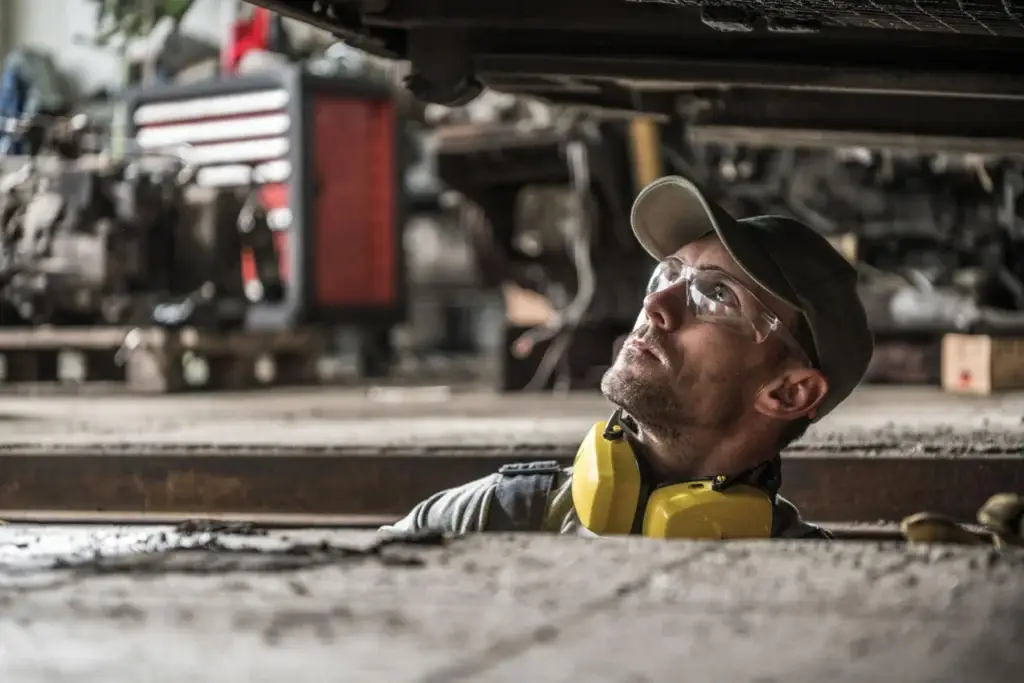
By Michael Nielsen, Publisher | 15+ Years in Diesel Repair
Last Updated: October 2026
Diesel mechanic safety equipment is the personal protective equipment (PPE) a technician wears for the hazards of heavy-duty service, and OSHA's general industry standards in Part 1910 govern how a shop chooses, provides, and documents it. The core rules are a written hazard assessment, task-based selection, employer-paid equipment in most cases, and training.
This Heavy Duty Journal guide checks the key points against the regulation text, corrects several common claims, and focuses on the hazards specific to diesel work: exhaust, solvents, noise, and high-pressure fuel. It does not quote injury rates or decibel levels that could not be traced to a primary source.
Key Takeaways
- ✓Employers generally pay for required PPE. Under 29 CFR 1910.132(h), the main exceptions are non-specialty safety-toe footwear and non-specialty prescription safety eyewear, and only if the employer lets workers wear them off the job site.
- ✓Glove choice is a documented decision. 29 CFR 1910.138(b) bases selection on the task, conditions, duration of use, and hazards, so no single glove covers every shop chemical.
- ✓Hearing conservation starts at 85 dBA. The permissible exposure limit is 90 dBA, but monitoring, audiometric testing, and the rest of the program are triggered at an 8-hour average of 85 dBA.
- ✓Diesel exhaust is a Group 1 carcinogen. IARC classified it in 2012 based on sufficient evidence for lung cancer and limited evidence for bladder cancer.
- ✓Pinhole fuel leaks can inject fluid through skin. About 100 psi is enough to breach skin, and these injuries are treated as surgical emergencies.
In This Guide
- Diesel Mechanic Safety Equipment: What OSHA Requires
- Hazard Assessment, Training, and Who Pays
- Eye, Face, and Hand Protection
- Hearing Protection
- Respiratory Protection for Exhaust, DEF, and Dust
- Foot, Head, and Body Protection
- High-Risk Tasks: Fuel Injection and High-Voltage Work
- Frequently Asked Questions
- The Bottom Line
Diesel Mechanic Safety Equipment: What OSHA Requires
Vehicle repair shops are generally covered by OSHA's general industry standards, and the PPE rules sit in 29 CFR 1910.132 through 1910.138. Other standards add duties for specific hazards, including noise (1910.95) and respiratory protection (1910.134). HDJ's diesel shop safety programs guide covers the wider program, and this article stays on equipment.
Diesel work stacks hazards in a way light-duty work does not: running engines in the bay, solvents and fluids, impact tools, heavy components, and pressurized fuel and air systems. Each hazard needs its own PPE answer, which is why a generic "wear your PPE" rule fails.
Hazard Assessment, Training, and Who Pays
Under 29 CFR 1910.132, the employer must assess the workplace for hazards that call for PPE, select equipment to match, and train employees on when it is needed, what to use, how to wear it, its limits, and how to care for it. The assessment must be certified in writing with the workplace, the person certifying, and the date. See the rule on eCFR.
On cost, 1910.132(h)(1) says the employer provides PPE at no cost, subject to exceptions. Under (h)(2), the employer need not pay for non-specialty safety-toe footwear or non-specialty prescription safety eyewear if it permits wearing them off the job site. Under (h)(5), the employer pays for replacement PPE unless the worker lost it or intentionally damaged it. OSHA lists hearing protection, hard hats, non-prescription eye protection, metatarsal protection, and welding PPE among items the employer pays for.
Document training and write down the reason for each selection. Without a task-by-task record, a technician's glove or respirator choice rests on habit. HDJ's shop safety training requirements guide covers training in more depth.
Eye, Face, and Hand Protection
Eye protection under 29 CFR 1910.133 must meet the ANSI Z87.1 standard. Safety glasses with side shields suit general work; chemical splash goggles suit coolant, fluids, battery acid, and solvents, because they seal around the eye; and a face shield is added over glasses or goggles for grinding or large-splash tasks, not worn alone. A Z87+ marking indicates the high-impact rating.
Prescription wearers need safety eyewear that meets the standard, either prescription safety glasses or protective eyewear that fits over their own. Ordinary glasses are not safety eyewear.
For hands, 29 CFR 1910.138(b) requires the employer to base glove selection on an evaluation of the performance characteristics of the gloves relative to the tasks, conditions, duration of use, and hazards. Many guides say the standard names the Safety Data Sheet, and it does not, but the SDS and the glove maker's chemical resistance chart are the practical inputs to that evaluation.
- Fluids and routine service: nitrile is a common choice for petroleum-based fluids, but check the maker's permeation data for the specific fluid.
- Solvents and brake or parts cleaners: some solvents break through nitrile quickly, so confirm the glove material against the product's SDS before use.
- Sharp edges: cut-resistant gloves are rated under ANSI/ISEA 105 by cut level, so match the level to the edge you handle.
- Heat and coolant: use gloves rated for the temperature, and let systems cool before opening them.
Hearing Protection
Under 29 CFR 1910.95, the permissible exposure limit is 90 dBA as an 8-hour average, but the employer must run a hearing conservation program whenever exposure equals or exceeds an 8-hour average of 85 dBA. See the text on Cornell's CFR page.
At that action level the employer must monitor exposure, notify employees of results, make audiometric testing available, obtain a baseline audiogram and then a new one at least annually, provide hearing protectors, train employees, and keep records. Hearing protectors are required when exposure reaches 90 dBA, or at 85 dBA before a baseline audiogram exists or after a standard threshold shift.
85 dBA
The 8-hour average noise level at which OSHA requires a hearing conservation program, five decibels below the 90 dBA permissible exposure limit (29 CFR 1910.95).
Do not guess the noise level. Impact tools, running engines, and exhaust brakes vary widely, so measure with a sound level meter or personal dosimeter. Choose plugs or muffs by the measured exposure and fit, and train workers to insert plugs correctly, because a poor fit delivers far less than the rated protection.
Respiratory Protection for Exhaust, DEF, and Dust
Diesel engine exhaust is carcinogenic to humans. IARC classified it as Group 1 on June 12, 2012, finding sufficient evidence for lung cancer and limited evidence for a bladder cancer association, as in its press release. In a shop, the first control is source capture: connect an exhaust hose to the tailpipe and route it outside.
Respirators are the backup, not the plan. When a respirator is required, 29 CFR 1910.134 requires a written program, medical evaluation, fit testing before a worker may be required to use a tight-fitting respirator, training, and maintenance. See the standard. For voluntary use, the employer must still give workers the Appendix D information, and fit testing applies when use is required.

Match the respirator to the hazard from the SDS and the task: particulate work, solvent vapor, welding fume, and DEF vapor can each need a different filter or cartridge. A single-strap dust mask is not a NIOSH-approved respirator for these hazards. HDJ's hazmat handling regulations for diesel shops guide covers chemical storage and handling.
For dust and ash, avoid compressed air. Brake dust composition varies, so use a HEPA vacuum or wet methods, and follow the DPF cleaning equipment maker's PPE guidance and the SDS for ash handling.
Foot, Head, and Body Protection
Foot protection is required where employees face foot injury hazards, such as falling or rolling objects, punctures, or electrical hazards, and protective footwear is tested to ASTM F2413, whose markings show impact and compression ratings, metatarsal protection, and electrical hazard resistance. Heavy brake drums, wheel ends, and driveline parts are a good reason to consider metatarsal protection for technicians who handle them.
Head protection under 29 CFR 1910.135 applies where there is a risk of injury from falling objects or electrical shock, which includes work under lifted vehicles. A bump cap protects against bumping fixed objects but is not a substitute for a hard hat where objects can fall.
High-visibility apparel is a good practice where trucks, yard tractors, and forklifts move through work areas, and ANSI/ISEA 107 is the usual apparel standard. Chemical-resistant aprons or sleeves are a practical barrier for large fluid jobs. Treat these as hazard-assessment decisions, not blanket rules.
High-Risk Tasks: Fuel Injection and High-Voltage Work
High-pressure fuel leaks are an injection hazard. Medical references note that about 100 psi can breach skin, and common rail fuel systems can run at far higher pressures, so a small leak can inject fuel into the hand or face. Treat these injuries as surgical emergencies and seek emergency care at once, even if the wound looks minor.
Key Recommendation
Write the hazard assessment as a task list, with the PPE for each task beside it, and revisit it whenever a new chemical, tool, or vehicle type comes into the bay.
Do not check for leaks with your hands. Follow the OEM procedure to relieve pressure before opening any fitting, use a piece of cardboard or similar to locate a leak while keeping body parts clear, and wear eye and face protection. HDJ's OSHA safety violations in heavy duty shops guide covers other frequently cited issues.
High-voltage electric and hybrid truck work needs more than diesel shop PPE. Follow the OEM's high-voltage procedures, work only with qualified and authorized technicians, and use insulating gloves rated for the system voltage, inspected before each use. HDJ's heavy duty truck electrical troubleshooting guide covers the conventional electrical side. Lockout and tagout and the electrical protective equipment rules in 29 CFR 1910.137 also apply, so verify the details with the OEM and OSHA before a shop takes this work on.
For workers' compensation and cost implications of injuries, HDJ's workers' compensation for truck repair shops guide covers how documented safety programs affect claims.
Frequently Asked Questions
Does the employer have to pay for diesel mechanic PPE?
Generally yes under 29 CFR 1910.132(h). The main exceptions are non-specialty safety-toe footwear and non-specialty prescription safety eyewear that the employer lets workers wear off the job site.
When is a hearing conservation program required?
When employee noise exposure equals or exceeds an 8-hour average of 85 dBA under 29 CFR 1910.95. The permissible exposure limit is 90 dBA, but the program starts at 85.
Which gloves should diesel mechanics wear?
It depends on the task and chemical. 29 CFR 1910.138 requires selection based on the tasks, conditions, and hazards, so check the SDS and the glove maker's chemical resistance data.
Is diesel exhaust a carcinogen?
Yes. IARC classified diesel engine exhaust as carcinogenic to humans (Group 1) in 2012, with sufficient evidence for lung cancer. Capture exhaust at the tailpipe and use respirators as a backup.
Do voluntary respirator users need fit testing?
Fit testing applies before a worker may be required to use a tight-fitting respirator. For voluntary use, OSHA requires the employer to provide the Appendix D information, so check 29 CFR 1910.134.
The Bottom Line
Diesel mechanic safety equipment works when the hazard assessment is written as tasks, the PPE matches each task, and the shop pays for what OSHA says it must. The most common corrections are that gloves are chosen by task and chemical, not a single type, and that hearing protection starts at 85 dBA, not 90.
Heavy Duty Journal's guidance at heavydutyjournal.com, from publisher Michael Nielsen and the HDJ editorial team, is to verify each requirement against the standard and to retrain and reassess whenever the work changes.
As of October 2026, OSHA standards and OEM procedures change, so confirm current text before updating your program.
Send This to Your Shop Foreman
Know a shop still buying one glove for every job? Pass this along so the hazard assessment matches the work.