By Michael Nielsen, Publisher | 15+ Years in Diesel Repair
Last Updated: September 2026
⏱ Estimated reading time: 15+ minutes
Heavy duty truck electrical troubleshooting follows one reliable sequence: confirm battery state of charge, verify charging output, measure voltage drop on the power and ground paths, then read the fault codes — in that order. Most North American Class 8 trucks run a 12-volt system fed by three or four batteries wired in parallel, so a single weak battery or one corroded ground can mimic a failed alternator, starter, or control module.
Working the sequence in order is what separates a 30-minute fix from a day of parts-swapping. In this guide, Michael Nielsen and the Heavy Duty Journal editorial team at heavydutyjournal.com cover the tests, thresholds, and fault-code logic technicians need, updated with the latest roadside inspection data as of September 2026.
Key Takeaways
- ✓Test each battery in the bank alone. In a parallel bank, one failing battery drags the others down — a bank that reads 12.6 volts as a group can still hide a battery that collapses under load.
- ✓Heavy-duty trucks speak SPN/FMI, not P-codes. J1939 fault codes pair a Suspect Parameter Number with a Failure Mode Identifier; FMIs 3 through 6 point straight at voltage and current faults worth testing with a meter.
- ✓Voltage drop finds what continuity tests miss. A connection can pass a continuity check and still lose half a volt under load — measure while the circuit is working, on both power and ground sides.
- ✓Lights are an inspection liability, not just a nuisance. Lighting problems were among the top five vehicle out-of-service violations in CVSA's 2026 International Roadcheck, so a pre-trip light check pays for itself.
In This Guide
- Understanding Commercial Truck Electrical Systems
- Essential Diagnostic Tools for Heavy Duty Truck Electrical Troubleshooting
- Battery Failures and Starting System Diagnosis
- Alternator Problems and Charging System Failures
- Common Wiring and Connector Failures
- Blown Fuses and Relay Malfunctions
- Lighting System Failures and Safety Requirements
- Electronic Control Module Issues
- Preventive Maintenance for Electrical Systems
- Frequently Asked Questions
Understanding Commercial Truck Electrical Systems
A commercial truck electrical system is the network of batteries, alternator, starter, wiring, protection devices, and control modules that powers every electrical function from cranking to lighting. When diesel truck wiring problems occur, understanding how these components interact is what lets a technician know where to look first.
Battery, Alternator, and Wiring Network Fundamentals
The battery bank is the system's foundation, storing power for cranking and for running accessories when the engine is off. Most North American Class 8 trucks use three or four Group 31 12-volt batteries wired in parallel, which multiplies cranking capacity while keeping the system at 12 volts. Some specialty and export applications use 24-volt starting systems, so always confirm configuration before testing.
The alternator generates electricity whenever the engine runs, typically holding system voltage around 13.8 to 14.8 volts depending on temperature and battery chemistry. Heavy-duty alternators commonly range from about 160 to 320 amps, with higher-output units specified for trucks running sleeper hotel loads, liftgates, or other auxiliary equipment.
The wiring network distributes power through heavy-gauge battery and starter cables that carry hundreds of amps during cranking, down to thin signal wires carrying milliamps to sensors. Each wire gauge is matched to its circuit's current; undersized or damaged wire creates resistance, heat, and eventually failure.
Fuses, Relays, and Control Module Functions
Fuses protect circuits by opening when current exceeds a safe level, which is why a blown fuse usually points to an underlying fault rather than a part that simply wore out. Blade fuses cover most accessory circuits, while maxi fuses, fusible links, and circuit breakers protect higher-current circuits. Many trucks use manual-reset breakers on certain circuits that require a technician to reset after a trip.
A relay is an electrically controlled switch that lets a small control current operate a much larger load, protecting switches and control modules from carrying high current directly. The engine control module (ECM) monitors sensor inputs and manages fueling, emissions controls, and engine protection, sharing data with other modules over the J1939 vehicle network.
Safety Systems and Electrical Dependencies
Critical safety systems — anti-lock brakes, stability control, collision mitigation, and lane departure warning — all depend on stable voltage and clean network communication. A single corroded ground connection can set fault codes across several unrelated modules at once, which is why a burst of unrelated codes should send a technician to check power and grounds before condemning any module.
Essential Diagnostic Tools for Heavy Duty Truck Electrical Troubleshooting
Accurate electrical diagnosis on a heavy-duty truck takes three tools used together: a quality digital multimeter, a J1939-capable diagnostic scan tool, and a disciplined visual inspection. HDJ's Diesel Mechanic Tools Guide covers how to spec each one for a shop or service truck.
Multimeter Testing for Voltage and Continuity
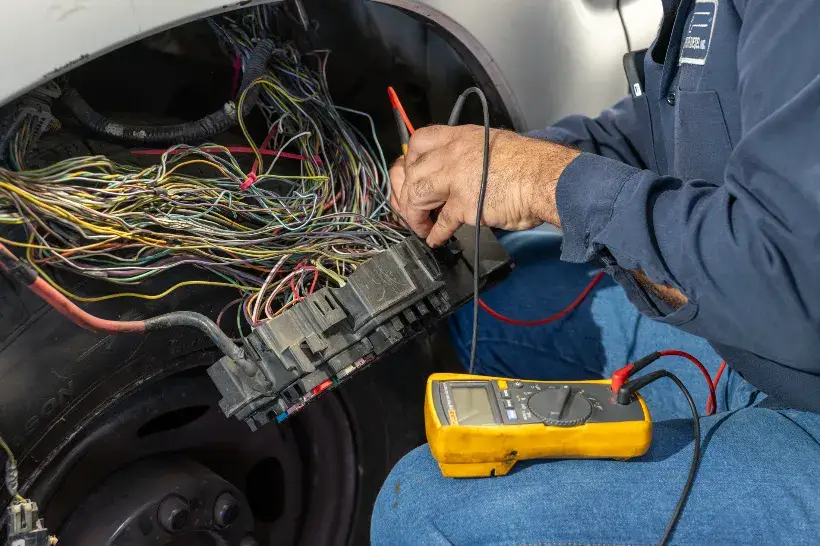
A digital multimeter is the primary tool for testing voltage, resistance, and current on commercial truck circuits. For battery checks, set the meter to DC volts and measure across the terminals with the engine off: a fully charged, rested 12-volt battery reads about 12.6 volts or higher, 12.4 to 12.6 volts indicates partial discharge, and anything lower calls for charging and retesting.
With the engine running, system voltage should rise to roughly 13.8 to 14.8 volts. Readings below about 13.5 volts point to a charging problem, while readings above about 15 volts indicate overcharging that damages batteries and sensitive electronics.
Continuity testing confirms whether a wire or connection is intact, but it is performed with the circuit de-energized and the battery disconnected. A near-zero ohms reading confirms continuity; an open circuit or high resistance points to a break, corrosion, or a connector problem. Continuity alone cannot prove a circuit will carry load — that is what voltage drop testing is for.
Reading J1939 Fault Codes: SPN and FMI
Heavy-duty trucks report faults using SAE J1939 diagnostic trouble codes, not the P-codes used on light-duty vehicles. A J1939 fault code is made up of a Suspect Parameter Number (SPN), which identifies the component or parameter, and a Failure Mode Identifier (FMI), which describes how it failed. SAE J1939-73, the diagnostics standard for these networks, defines both along with the 9-pin service connector.
The FMI is often the most useful part of the code for electrical work, because several FMIs describe electrical conditions directly. Codes still identify a circuit or condition rather than a failed part — a low-voltage FMI on a sensor can come from the sensor, its wiring, a corroded connector, or a supply problem at the module.
| FMI | Meaning | What to Test First |
|---|---|---|
| FMI 2 | Data erratic, intermittent, or incorrect | Connector fit, chafed wiring, intermittent grounds |
| FMI 3 | Voltage above normal or shorted to high source | Short to battery voltage, open ground on the sensor |
| FMI 4 | Voltage below normal or shorted to low source | Short to ground, low supply voltage, damaged harness |
| FMI 5 | Current below normal or open circuit | Broken wire, unplugged or corroded connector |
| FMI 6 | Current above normal or grounded circuit | Shorted load, pinched wire touching chassis |
Older trucks may also use the 6-pin J1708/J1587 connector with MID/PID/FID-style codes, and newer trucks often carry a green 9-pin connector for the faster J1939 network that some older adapters do not support. Manufacturer software adds the proprietary data, bidirectional tests, and calibrations a generic scanner cannot reach.

Visual Inspection Techniques
A thorough visual inspection before connecting any tool often explains the complaint outright. Start at the battery box: white, green, or blue crystalline buildup on terminals impedes current flow, and loose hold-downs let vibration damage batteries internally.
Check harnesses for heat damage, melted insulation, and discolored connectors, and look for chafing and rodent damage — especially on trucks that sit for long periods. Inspect fuse and relay panels for scorch marks or a burnt-plastic smell, which indicate an overload that may already have damaged more than one component.
Battery Failures and Starting System Diagnosis
Battery failure is the most common reason a heavy-duty truck will not start, and cold weather amplifies it by increasing cranking demand while reducing battery capacity. Systematic testing separates a battery that needs replacement from a charging, connection, or parasitic-drain problem that will kill the next battery too.
Testing Battery Voltage and Load Capacity
Voltage testing tells only part of the story; load testing reveals true battery condition. A battery can show normal open-circuit voltage and still collapse under cranking load because of sulfation or internal cell damage. Commercial load testers and conductance testers simulate that demand while measuring how well the battery holds voltage.
In a parallel bank, test each battery on its own. With the batteries connected, a strong battery masks a weak one at rest — and then the weak battery pulls the whole bank down overnight. Disconnect the bank, bring each battery to a full charge, and test individually. Surface charge from recent driving can also inflate readings, so let batteries rest or apply a brief light load before testing.
Identifying Parasitic Drains
A parasitic drain is current drawn from the batteries with the key off, and it is the classic cause of a truck that runs fine all day but will not crank the next morning. Common sources include aftermarket radios and inverters, telematics and ELD hardware, sleeper accessories, a stuck relay, a leaking alternator diode, or a module that never enters sleep mode.
To measure it, connect an ammeter in series with the negative cable and wait for the modules to go to sleep, which can take 30 minutes or more on some trucks. Compare the settled reading to the OEM specification rather than a generic number, since telematics-equipped trucks draw more at rest than older units. Then pull fuses one at a time until the draw drops. HDJ's guide to solving parasitic battery drain walks through the full process.
⚠️ Safety Warning
Lead-acid batteries can release explosive hydrogen gas, especially while charging. Wear eye protection, keep sparks and flames away from the battery box, disconnect the negative cable first and reconnect it last, and never lay tools across battery terminals — a parallel bank can deliver enough current to weld a wrench in place.
Battery Maintenance and Replacement
Clean terminals prevent many battery problems before they start: neutralize acid buildup with a baking soda solution, brush terminals to bright metal, and apply a terminal protectant. Replace cables with frayed strands or cracked insulation rather than cleaning around them.
When replacing batteries, match the OEM specification for group size, cold cranking amps, and reserve capacity, and replace the full bank together where practical so a new battery is not paired with aged ones. Secure hold-downs tightly, since vibration shortens battery life. HDJ's heavy-duty truck battery maintenance guide covers inspection and replacement intervals in detail.
Alternator Problems and Charging System Failures
Alternator problems show up as undercharging, overcharging, or charging that fails only under load. Early warning signs include headlights that dim at idle and brighten with engine speed, an intermittent charge warning light, batteries that need repeated jump-starts despite testing good, and low-voltage fault codes across multiple modules.
Alternator Output Testing
Alternator output testing starts with measuring system voltage at the batteries with the engine at fast idle. A healthy charging system holds roughly 13.8 to 14.8 volts, with the exact target set by the regulator, temperature, and battery type. Readings below about 13.5 volts indicate undercharging; readings above about 15 volts indicate overcharging.
Next, load the system by switching on headlights, the HVAC blower, and other high-draw accessories while watching voltage. A healthy system stays in range. A significant drop points to worn brushes, failing diodes, a slipping belt, or an alternator too small for the truck's actual electrical load — and a voltage drop test across the charging cable and alternator ground will show whether the alternator's output is actually reaching the batteries.
Common Alternator Failure Causes
Many charging failures start outside the alternator. A glazed, cracked, or stretched belt slips under load, and a weak tensioner lets a good belt slip too. Replace belts at the first sign of wear, and inspect tensioners and idler pulleys at the same time, since worn pulleys accelerate belt wear.
Internal failures include worn brushes, a failed voltage regulator that causes over- or undercharging, and failed diodes that reduce output or allow current to leak back to the alternator overnight. Bearing failure produces grinding or whining noise before the alternator seizes.
Common Wiring and Connector Failures
Wiring and connector failures cause a large share of intermittent electrical problems on commercial trucks, often starting small and growing into breakdowns. Symptoms include flickering dash lights, gauges that work intermittently, accessories that fail at random, and the smell of overheated plastic near a connection.
Commercial truck wiring is also regulated: 49 CFR 393.28 wiring system requirements require electrical wiring to be installed and maintained to SAE J1292, which makes repair quality a compliance matter as well as a reliability one.
Detecting Corroded or Loose Connections
Corrosion forms when moisture reaches metal connections, creating oxide layers that add resistance. Road spray, condensation, and winter road chemicals attack every connector on the truck, not just the battery terminals. Loose connections generate heat and intermittent contact that makes faults come and go during testing.
Voltage drop testing is a measurement of the voltage lost across a wire or connection while the circuit is carrying load. With the circuit working, measure from the source to the load on the power side, then from the load ground to the battery negative.
Many shops treat more than about 0.5 volts on a power or ground path as a problem worth chasing, but check the OEM specification — cranking circuits in particular often have tighter limits. Ground-side drops are just as common as power-side drops and are overlooked far more often.
Tracing Wire Damage and Insulation Failures
Wire damage comes from vibration, heat, chemical exposure, and abrasion against sharp edges. Start with the wiring diagram for the specific truck, since manufacturer service information shows routing and connector locations. The most common damage locations and repairs are summarized below.
| Damage Type | Common Location | Repair Approach |
|---|---|---|
| Chafing/Abrasion | Frame rails, cab corners, firewall grommets | Replace damaged section, add split loom protection |
| Heat Damage | Near exhaust manifold, turbo, aftertreatment | Reroute with high-temp wire, add heat shielding |
| Moisture Intrusion | Door harnesses, trailer plugs, roof-mounted accessories | Replace connector, seal with dielectric grease |
| Rodent Damage | Engine compartment, cab interior, battery box | Splice repairs, rodent deterrent application |
Professional Wire Repair Techniques
Proper wire repair matches the original gauge and uses connectors suited to the application. Electrical tape alone is never a permanent repair in commercial service. Soldered or properly crimped splices covered with adhesive-lined heat shrink give the most durable, weather-resistant result, and dielectric grease on sealed connectors helps keep moisture out.
Blown Fuses and Relay Malfunctions
A blown fuse or failed relay can shut down an entire system without warning, but both are quick to test once you know where they are. The key is treating a blown fuse as a symptom and finding what blew it.
Locating and Testing Fuses
Most commercial trucks have multiple fuse and relay panels — in the engine compartment, behind the dash, and sometimes in the sleeper. The panel cover or service information identifies each circuit, and knowing which circuits share a fuse helps narrow the search when several symptoms appear together.
A visual check catches obviously blown fuses, but not hairline breaks. Test each suspect fuse for continuity or check for voltage on both sides with the circuit on. Replace a blown fuse only with one of the identical rating — a higher-rated fuse removes the circuit's protection and creates a fire risk.
Diagnosing Relay Failures
Relays control high-current circuits such as starters, fuel pumps, HVAC blowers, and auxiliary lighting, and a failing relay can make a system work intermittently or not at all. To bench-test a standard relay, measure coil resistance across the control terminals against the relay's specification, confirm the switched contacts are open at rest, then energize the coil and confirm the contacts close.
Intermittent relay faults are hard to catch on the bench, so swapping a suspect relay with a known-good identical unit is a fast way to confirm the diagnosis.
Preventing Electrical Overloads
When adding auxiliary equipment, install dedicated circuits with correctly sized protection instead of tapping into existing ones. Overloading factory wiring with aftermarket accessories causes repeated fuse failures, voltage drop on shared circuits, and potential fire hazards.
Lighting System Failures and Safety Requirements
Lighting failures are both a safety hazard and one of the most common reasons trucks are placed out of service at roadside inspections. The required lamps and reflective devices for each vehicle type are specified in 49 CFR 393.11 lighting requirements, and a failure can mean a citation, a failed inspection, and added crash liability.
1,659
Lighting out-of-service violations recorded across North America during CVSA's 2026 International Roadcheck — 11.9% of all vehicle OOS violations, per the CVSA 2026 Roadcheck results.
Common Lighting Failure Causes
Burnt-out bulbs are the simplest lighting failure, but repeated failures in the same socket point to voltage problems, poor grounds, or socket damage. LED conversions on older trucks sometimes need load resistors or compatible flashers to prevent rapid flash rates and warning lights.
Ground failures often take out several lights at once, because lamps share common ground paths. A single corroded ground stud can disable all the tail, marker, and license lamps on one side, so check grounds early in any lighting diagnosis. Faulty switches are the other common culprit and are confirmed by checking voltage output in each switch position.
Systematic Lighting Diagnosis
Lighting diagnosis starts with the pre-trip walk-around, where each lamp is checked for operation, brightness, and color. HDJ's DOT pre-trip inspection checklist covers the full lighting check sequence.
When a lamp fails, confirm power at the socket with a test light or meter, verify ground continuity to chassis, then trace the wiring between switch and lamp. Trailer lighting problems frequently start at the 7-way connector, where corrosion and spread pins are common.
Electronic Control Module Issues
Electronic control module problems are often power or ground problems in disguise, which is why the ECM should be the last component condemned, not the first. The ECM manages fueling, emissions controls, and engine protection, so its symptoms can look mechanical.
Recognizing ECM Failure Symptoms
ECM-related symptoms include reduced power or a protective derate, rough idle or stalling, higher fuel consumption from default fueling strategies, and warning lights with no clear cause. Several unrelated codes setting at once usually point to a supply voltage, ground, or network problem affecting the module rather than a failed ECM.
Professional ECM Diagnostics
Complete ECM diagnosis requires manufacturer-specific software for live data, bidirectional tests, and calibration checks that generic scan tools cannot reach. Before condemning a module, verify its power and ground supplies under load, clean and reseat its connectors, and check for pending software updates. HDJ's diesel engine troubleshooting guide covers how ECM data fits into broader engine diagnosis.
Software updates from the OEM address known calibration issues, and some are issued as part of safety recalls. The NHTSA recall lookup lets fleets check a VIN for open recalls, including those involving electronic controls.
ECM Repair vs. Replacement Decisions
Software corruption often responds to a reflash with the current calibration, and connector problems often respond to cleaning and reseating. Physical circuit board damage, water intrusion, or a severe electrical event usually means replacement. Remanufactured and rebuilt modules can cost substantially less than new OEM units, but replacement modules frequently need programming to the truck's VIN and configuration, which belongs in the cost comparison.
Preventive Maintenance for Electrical Systems
Free Diesel Maintenance Checklist
Get HDJ's free, field-tested diesel maintenance checklist delivered instantly to your inbox — print it, laminate it, keep it in the shop.
Instant PDF • 100% Free • No Spam
Preventive electrical maintenance is what keeps small resistance, corrosion, and charging problems from turning into roadside failures. Federal rules under 49 CFR 396.3 inspection and maintenance requirements require motor carriers to systematically inspect, repair, and maintain their vehicles, with parts and accessories kept in safe and proper operating condition at all times.
Scheduled Electrical Inspections
Build electrical checks into the preventive maintenance schedule rather than treating them as a separate task. At each PM, test each battery individually, verify charging output under load, check starter current draw, measure voltage drop at major power and ground connections, and inspect harnesses at known problem areas. HDJ's heavy duty truck preventive maintenance checklist shows where these checks fit in each service level, and TMC Recommended Practices provide industry procedures for electrical system testing.
Environmental Protection Strategies
Moisture, winter road chemicals, and heat cycling all accelerate electrical deterioration. Apply dielectric grease to sealed connectors during assembly, protect exposed connectors in the engine compartment and chassis, use adhesive-lined heat shrink on every splice, and route and secure harnesses away from heat sources and vibration points.
Upgrading Older Electrical Systems
Older trucks often carry electrical loads their original design never anticipated — ELDs, telematics, inverters, and sleeper accessories. Upgrading connectors, adding dedicated protected circuits, and matching battery and alternator capacity to the truck's actual load prevents the voltage drop and chronic undercharging that cause intermittent problems.
Frequently Asked Questions
What are the most common electrical problems on semi trucks?
Weak or failed batteries are the most common, followed by charging system faults, corroded or loose connections, blown fuses, and lighting failures. Many trace back to corrosion or a single weak battery in the bank rather than a sudden component failure, which is why routine testing prevents most of them.
Is a semi truck electrical system 12 volts or 24 volts?
Most North American Class 8 trucks run a 12-volt system with three or four batteries wired in parallel for cranking capacity. Some specialty and export trucks use 24-volt starting systems, so confirm the configuration before testing, charging, or jump-starting — connecting 24 volts to a 12-volt system damages electronics.
How do I test semi truck batteries?
Disconnect the bank, fully charge each battery, and test each one individually. A rested battery should read about 12.6 volts, but only a load or conductance test shows whether it can hold voltage under cranking demand. Replace any battery that fails, and investigate why it failed.
What does an FMI code mean on a truck?
The Failure Mode Identifier in a J1939 fault code describes how a component failed. FMIs 3 through 6 indicate voltage or current faults, such as a short to ground or an open circuit — see the FMI table above for what to test first.
What voltage should a truck alternator put out?
With the engine running, system voltage should typically sit around 13.8 to 14.8 volts. Readings below about 13.5 volts suggest undercharging, and readings above about 15 volts suggest overcharging that can damage batteries and electronics. Always verify under load, not just at idle.
How often should commercial truck electrical systems be inspected?
Check lights and visible wiring on every pre-trip, and test batteries, charging output, and voltage drop at each preventive maintenance service. Do a full electrical check before winter, when cold weather exposes marginal batteries, weak charging, and high-resistance connections.
The Bottom Line
Heavy duty truck electrical troubleshooting rewards discipline more than any single tool. Confirm each battery individually, verify charging output under load, measure voltage drop on both power and ground paths, and read J1939 fault codes as a map to the circuit — not a verdict on the part.
Most electrical failures announce themselves early as corrosion, a weak battery, or a small voltage drop long before they strand a truck. Fleets that build these checks into every PM and every pre-trip catch those signs first, spend fewer hours chasing comebacks, and keep more trucks out of roadside out-of-service reports. Michael Nielsen and the Heavy Duty Journal team will keep this guide current at heavydutyjournal.com as inspection data and diagnostic tools evolve.
Send This to the Tech Who Gets Every No-Start
Share this with your shop's electrical go-to — a consistent test sequence, starting with each battery on its own, saves hours on every no-start and repeat charging complaint.