

Electric semi trucks now represent a growing share of new Class 7-8 truck sales, with battery-electric commercial vehicles delivering immediate fuel cost reductions of 45-75% compared to diesel equivalents. Federal tax incentives provide up to $40,000 per vehicle, while state programs add $50,000-$120,000 in additional support.
Current production models from Tesla, Freightliner, Volvo, and Kenworth offer 150-500 miles of range per charge. Regional delivery routes under 250 miles daily demonstrate the strongest return on investment, with payback periods of 2-4 years when combining operational savings and available incentives.
Total cost of ownership advantages emerge from three primary factors. Electricity costs $0.12-$0.24 per mile versus $0.54-$0.70 for diesel fuel. Maintenance requirements drop 20-40% due to simpler drivetrains with approximately 20 moving parts compared to 2,000+ in conventional engines. Federal and state incentive programs reduce net acquisition costs by $90,000-$160,000 per vehicle.
Last Updated: November 2025
Key Takeaways
- Market Growth: Electric Class 8 truck sales increasing rapidly across commercial segments
- Fuel Savings: 45-75% reduction in operating costs compared to diesel equivalents
- Federal Incentives: Up to $40,000 per qualifying vehicle through IRA tax credits
- Range Capability: 150-500 miles per charge depending on model and configuration
- Maintenance Reduction: 20-40% lower maintenance costs than comparable diesel trucks
- Optimal Applications: Regional delivery routes under 250 miles daily show strongest ROI
- Environmental Impact: Significant emissions reductions in urban freight corridors

Fleet depot charging infrastructure enables overnight charging for regional delivery operations
Understanding Electric Semi Truck Technology
Modern electric semi trucks deliver performance comparable to or exceeding diesel equivalents while eliminating emissions. Battery packs ranging from 300-900 kWh power electric motors producing over 1,000 horsepower with instant torque delivery.
These vehicles handle identical payload requirements as traditional trucks while providing superior acceleration characteristics. The simplified drivetrain reduces mechanical complexity and maintenance requirements significantly.
Core Technology Components
Three integrated systems define battery-electric commercial vehicle platforms.
High-capacity battery packs use lithium-ion cells with advanced thermal management systems for consistent performance across temperature extremes. Current production batteries deliver 1.5-2.0 kWh per mile of range, with next-generation chemistries targeting 2.5+ kWh per mile by 2027.
Electric drive motors provide instant torque delivery from zero RPM, enabling superior acceleration and hill-climbing capability without gear changes. Motors convert over 90% of electrical energy into mechanical power compared to 40% efficiency in diesel engines.
Regenerative braking systems capture kinetic energy during deceleration, converting it back to battery charge. This extends effective range by approximately 15-20% in urban operations with frequent stops while dramatically reducing brake wear.
Performance Comparison: Electric vs Diesel
| Performance Metric | Electric Semi | Diesel Semi | Advantage |
|---|---|---|---|
| Energy Efficiency | ~2 kWh/mile | ~6.5 MPG | Electric: 65% efficient vs 40% |
| Acceleration (0-60 loaded) | ~20 seconds | ~60 seconds | Electric: 3x faster |
| Moving Parts | ~20 components | 2,000+ components | Electric: Reduced complexity |
| Brake Wear | 80% reduction | Standard wear rate | Electric: Regenerative braking |
Current Market Adoption and Growth Trends
Zero-emission commercial vehicles have transitioned from pilot programs to production-scale deployments across major fleet operations. Battery-electric truck adoption continues accelerating as infrastructure expands and total cost of ownership advantages become clearer.
The U.S. Department of Transportation tracks commercial EV deployment patterns, showing concentrated adoption in states with strong incentive programs and established charging infrastructure.
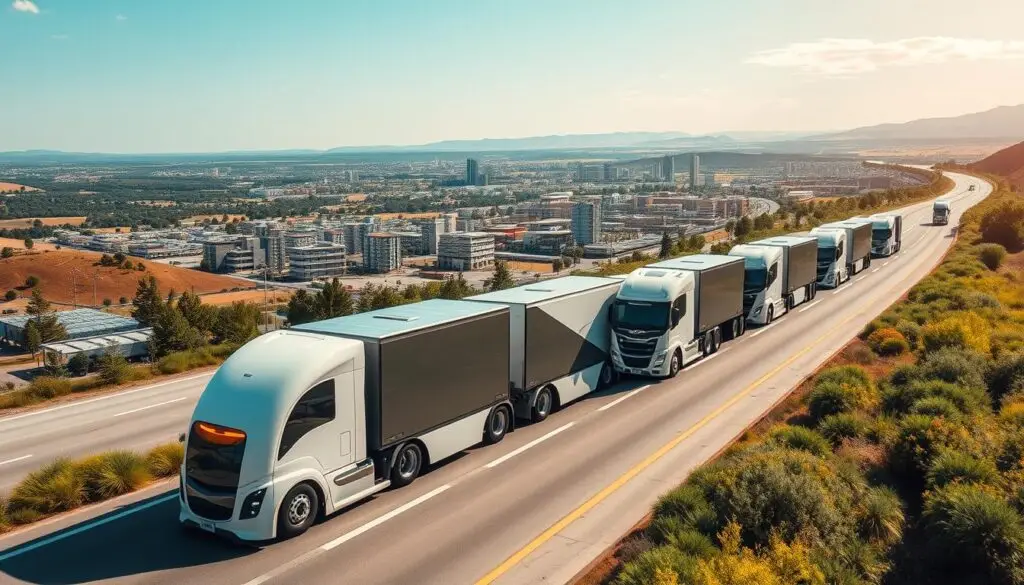
Geographic concentration of electric truck adoption reflects incentive programs and charging infrastructure availability
Leading States in Commercial EV Adoption
Three geographic regions dominate electric truck deployment.
California’s Advanced Clean Trucks regulation drives manufacturer sales requirements and fleet transitions. The state accounts for over 50% of U.S. electric Class 8 truck registrations, supported by the HVIP voucher program providing up to $120,000 per vehicle.
Texas leverages major distribution centers with abundant renewable energy and favorable electricity rates. The state’s TERP grant program funds zero-emission vehicle adoption in NOx reduction zones, particularly around Houston and Dallas-Fort Worth freight corridors.
The Northeast Corridor combines urban delivery demand with state-level incentive programs and emissions standards. New York’s truck voucher program offers up to $185,000 per vehicle when scrapping older diesel units, driving rapid fleet modernization.
Fleet Commitment Patterns
Major commercial carriers demonstrate increasing electrification momentum through multi-year deployment plans.
Large fleets with 100+ vehicles show higher adoption rates with dedicated sustainability commitments and corporate emissions reduction targets. These operations benefit from economies of scale in infrastructure investment and maintenance training.
Regional carriers prioritize predictable routes for electric deployment, focusing on lanes with established charging infrastructure and daily mileage under 250 miles.
Port drayage operations lead adoption due to emissions reduction requirements at major seaports. Short-haul container movements between terminals and warehouses align perfectly with current electric truck capabilities.
Financial Benefits Driving Fleet Adoption
The economics of electric semi trucks create increasingly compelling return on investment scenarios. Industry case studies from early adopters indicate total operating cost reductions of 10-15% over typical vehicle lifespans of 7-10 years.
Payback periods range from 2-6 years depending on three critical factors: annual mileage utilization, regional fuel and electricity pricing, and available federal and state incentive programs. High-mileage operations exceeding 100,000 miles annually demonstrate the fastest payback timelines.
Fuel Cost Comparison Example
Annual savings scenario for high-mileage operation:
- Diesel fuel cost at $4.00/gallon, 6 MPG efficiency: approximately $0.67/mile
- Electric charging at $0.12/kWh, 2 kWh/mile efficiency: approximately $0.24/mile
- 100,000 annual miles: $67,000 diesel vs $24,000 electric
- Total fuel savings: $43,000 annually (64% reduction)
Note: Actual savings vary by regional fuel and electricity prices, charging time-of-use rates, and operational efficiency.
Comprehensive Operating Cost Analysis
Electric trucks deliver savings across multiple cost categories beyond fuel alone.
| Cost Category | Diesel Truck | Electric Truck | Estimated Savings |
|---|---|---|---|
| Fuel/Energy (100k miles) | $65,000 | $24,000 | $41,000 |
| Scheduled maintenance | $15,000 | $9,000 | $6,000 |
| DEF fluid & oil changes | $2,500 | $0 | $2,500 |
| Total Annual Operating | $82,500 | $33,000 | $49,500 |
Maintenance costs drop significantly due to drivetrain simplicity. Electric motors require no oil changes, have no diesel particulate filters to service, and eliminate DEF fluid systems entirely.
Regenerative braking reduces foundation brake wear by 70-80%, extending brake component life from 100,000 miles to 400,000+ miles in many applications. This represents thousands in avoided maintenance costs over vehicle lifetime.
Public Health and Environmental Impact
Zero-emission commercial vehicles deliver measurable air quality improvements in freight corridors and urban areas.
According to EPA Clean Trucks Plan analysis, widespread zero-emission truck adoption will deliver significant public health benefits through improved air quality. The plan projects prevention of tens of thousands of premature deaths by 2050.
Additional health outcomes include substantial reduction in respiratory health incidents including asthma attacks, particularly in communities near major freight corridors. The EPA estimates hundreds of billions in public health cost savings from avoided medical expenses and lost productivity.
Electric trucks eliminate 90% of nitrogen oxide emissions and 100% of particulate matter from tailpipes. These pollutants disproportionately affect communities near ports, warehouses, and interstate highways where diesel truck traffic concentrates.
Charging Infrastructure Development
Infrastructure availability determines electrification feasibility for most fleet operations. The United States continues expanding heavy-duty charging networks, with public and private investment accelerating deployment across major freight corridors.
Total infrastructure investment requirements vary dramatically by fleet size and operational patterns. Small fleets deploying 2-5 vehicles may invest $50,000-$150,000, while large depot operations with 50+ vehicles commonly exceed $2 million in charging infrastructure and electrical upgrades.
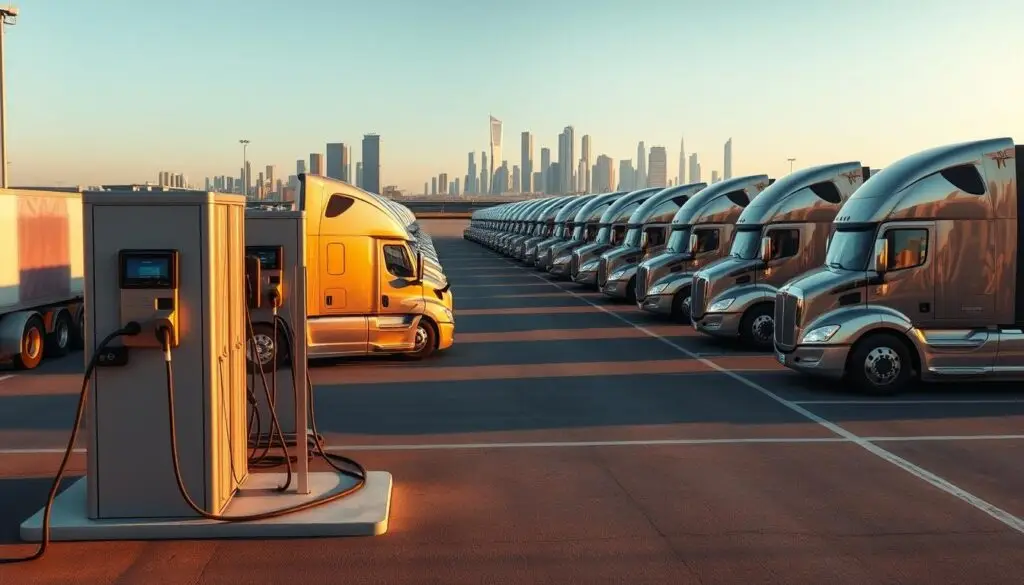
Depot charging infrastructure provides the foundation for successful fleet electrification
Charging Technology Options and Capabilities
Three distinct charging technology tiers serve different operational requirements.
| Charging Type | Power Output | Time to 80% Capacity | Optimal Application |
|---|---|---|---|
| Level 2 AC Charging | Up to 19.2 kW | 8-12 hours | Overnight depot charging |
| DC Fast Charging | 150-350 kW | 1-3 hours | Mid-route opportunity charging |
| Megawatt Charging (emerging) | 1+ MW | 30-45 minutes | High-utilization operations |
Level 2 AC charging works effectively for return-to-base operations with overnight dwell times. Most regional delivery fleets rely primarily on this technology due to lower infrastructure costs and alignment with driver hours-of-service requirements.
DC fast charging enables mid-route charging during driver breaks or loading operations. This technology supports extended daily range for fleets operating 300-400 miles daily across multiple shifts.
Megawatt charging systems under development will deliver 350+ miles of range in approximately 30 minutes. CharIN’s Megawatt Charging System standard targets deployment by 2027 for high-utilization applications requiring rapid turnaround.
Infrastructure Planning Timeline
Fleet electrification requires careful infrastructure planning with lead times substantially longer than vehicle procurement.
Utility grid assessment takes 3-6 months for capacity evaluation and upgrade planning. Fleet operators must engage utility providers 12-18 months before planned vehicle delivery to ensure adequate electrical service availability.
Permitting processes require 2-4 months for local approvals and regulatory compliance. This includes electrical permits, building permits for equipment installation, and potential environmental reviews depending on site characteristics.
Construction and installation spans 6-12 months for depot charging infrastructure depending on required electrical upgrades. Major transformer installations or service line extensions can extend timelines to 18+ months in some scenarios.
Total planning to operation typically ranges 12-24 months from initial assessment to full deployment. Early-stage planning and utility coordination represent critical success factors for meeting electrification timelines.
Stay Ahead of Industry Trends
Get expert insights on fleet electrification, equipment reviews, and operational strategies delivered to your inbox weekly.
Federal and State Incentive Programs
Government incentives substantially reduce electric truck acquisition costs, making zero-emission vehicles economically competitive with diesel alternatives. Combined federal and state programs can lower net vehicle costs by $90,000-$160,000 per truck.
Incentive availability varies significantly by state and changes frequently as programs reach funding caps or undergo reauthorization. Fleet operators should verify current program availability early in the planning process to ensure accurate financial modeling.
Federal Incentive Structure
Primary federal programs support commercial electric vehicle adoption through tax credits and competitive grants.
The IRA Commercial Clean Vehicle Credit provides up to $40,000 per qualifying vehicle over 14,000 pounds GVWR. Eligibility requires vehicles to be placed in service in the United States and used predominantly for business purposes.
The IRS Commercial Clean Vehicle Credit page provides detailed eligibility requirements and application procedures. Fleet operators should consult tax professionals regarding timing and documentation requirements for claiming credits.
The Alternative Fuel Infrastructure Tax Credit offers 30% credit up to $100,000 per charging equipment installation. This applies to both hardware and installation costs, significantly reducing infrastructure investment requirements.
The EPA Clean Heavy-Duty Vehicle Program delivers competitive grant funding for zero-emission vehicle purchases. Awards prioritize environmental justice communities and regions with air quality challenges.
State-Level Incentive Programs
Leading states offer additional financial support beyond federal programs, creating combined incentive packages that can exceed $160,000 per vehicle.
| State | Program Type | Maximum Benefit | Key Requirements |
|---|---|---|---|
| California | HVIP Voucher | Up to $120,000 | Point-of-sale discount, vehicle registration |
| New York | Truck Voucher Program | Up to $185,000 | Scrap older diesel vehicle requirement |
| Texas | TERP Grant Program | Up to $100,000 | NOx reduction zone operation |
California’s HVIP program operates on a first-come, first-served basis with funding rounds that can deplete within days of opening. Fleet operators must maintain ready access to program announcements and act quickly when funds become available.
New York’s program requires scrapping older diesel vehicles, creating additional environmental benefits while supporting fleet modernization. The high incentive levels reflect the state’s aggressive zero-emission vehicle deployment targets.
Texas focuses incentives on NOx reduction zones around major metropolitan areas where air quality challenges persist. The program supports both vehicle purchases and charging infrastructure development.
Leading Manufacturers and Available Models
Multiple manufacturers now offer production-ready electric semi trucks with expanding model lineups. Each manufacturer targets specific operational requirements with varying range capabilities, charging specifications, and price points.
Delivery timelines vary significantly by manufacturer, ranging from immediate availability for some models to 12-24 month lead times for others. Fleet operators should engage manufacturers early to secure production slots and coordinate with infrastructure planning timelines.
Major manufacturers now offer production-volume electric Class 8 trucks with proven reliability
Production Model Comparison and Specifications
| Manufacturer | Model | Advertised Range | Estimated Price |
|---|---|---|---|
| Tesla | Semi | Up to 500 miles | $150-180k base |
| Freightliner | eCascadia | Up to 250 miles | Starting ~$350k |
| Volvo | VNR Electric | Up to 275 miles | Starting ~$370k |
| Kenworth | T680E | 150-250 miles | Starting ~$340k |
Tesla’s Semi offers industry-leading range and proprietary fast charging network access. Lower initial pricing reflects vertical integration and battery manufacturing advantages, though service network remains more limited than traditional manufacturers.
Freightliner’s eCascadia leverages Daimler’s extensive dealer service network across North America. The model targets regional haul applications with proven reliability from early fleet deployments.
Volvo’s VNR Electric incorporates advanced safety systems and driver assistance technology. The manufacturer emphasizes total cost of ownership optimization through maintenance planning tools and telematics integration.
Kenworth’s T680E provides customization options familiar to PACCAR customers. The platform shares components with the Peterbilt 579EV, creating service and parts commonality across the PACCAR family.
The Department of Energy’s Alternative Fuels Data Center maintains updated specifications and availability information for commercial electric vehicles, providing fleet operators with comprehensive model comparisons and technical documentation.
ROI Analysis and Total Cost of Ownership
Electric semi trucks can achieve positive return on investment within 2-6 years for appropriate applications. Despite higher initial purchase prices, sustained operational savings and available incentives create favorable total cost of ownership profiles.
TCO analysis must account for multiple variables beyond simple fuel cost comparisons. These include infrastructure investment amortization, demand charge management, battery degradation assumptions, and residual value projections.
Comprehensive TCO analysis reveals electric truck advantages emerge over 5-7 year ownership periods
Lifetime Cost Comparison
Independent analysis from Lawrence Berkeley National Laboratory evaluating medium and heavy-duty vehicle economics reveals key findings that inform fleet electrification decisions.
Battery-electric trucks demonstrate lower total cost of ownership for regional applications with annual mileage exceeding 80,000 miles. The breakeven point varies by duty cycle, with high-utilization operations achieving cost parity faster.
High-mileage operations exceeding 100,000 miles annually show strongest economic advantages due to fuel savings amplification. Each additional mile driven amplifies the per-mile cost differential between diesel and electric powertrains.
Diesel price volatility creates additional financial risk compared to more stable electricity rates. Historical diesel price swings of $1-$2 per gallon impact operating budgets significantly, while electricity pricing shows greater stability with predictable time-of-use rate structures.
Quick ROI Calculation Example
Scenario: Regional delivery fleet operating 100,000 annual miles
- Vehicle purchase premium over diesel: $200,000
- Federal IRA tax credit: -$40,000
- State incentive program: -$80,000
- Net incremental cost: $80,000
- Annual operating savings (fuel + maintenance): $47,000
- Simple payback period: 1.7 years
Note: Actual results vary significantly by specific operational patterns, regional energy costs, and available incentive programs.
Real-world validation comes from NACFE’s Run on Less – Electric demonstration, where commercial fleets operated electric trucks in actual freight operations. Participating fleets documented operational costs, charging patterns, and performance data that validate TCO models.
Optimal Applications for Electric Commercial Trucks
Electric semi trucks excel in specific operational scenarios defined by predictable routing, daily mileage patterns, and infrastructure access. Matching battery-electric technology to appropriate duty cycles ensures maximum return on investment and operational reliability.
Mismatched applications create operational challenges and financial underperformance. Fleet operators must honestly assess route characteristics, driver schedules, and infrastructure feasibility before committing to electrification.
Best Use Cases by Application Type
| Application | Typical Daily Range | Primary Advantage | Expected ROI Period |
|---|---|---|---|
| Regional Delivery | 100-250 miles | Predictable routing patterns | 2-4 years |
| Port Drayage | 50-150 miles | Emissions compliance requirements | 1.5-3 years |
| Urban Distribution | 75-200 miles | Quiet operation, regenerative braking | 2-4 years |
| Beverage/Food Delivery | 100-175 miles | Return-to-base operations | 2.5-4 years |
Route Characteristics Supporting Success
Certain operational patterns maximize electric truck performance and financial returns.
Predictable daily schedules enable optimized charging window planning that minimizes demand charges and captures off-peak electricity rates. Fleet operators can program charging to occur during lowest-cost periods, typically midnight to 6 AM.
Return-to-base operations allow centralized depot charging infrastructure investments. This eliminates dependency on public charging networks and enables smart charging strategies that balance vehicle needs across the fleet.
High vehicle utilization maximizes fuel and maintenance savings realization. Trucks operating 80,000-120,000 miles annually recover infrastructure investments faster than low-mileage units running 40,000-60,000 miles.
Urban and suburban environments benefit from regenerative braking energy recovery. Stop-and-go traffic patterns that reduce diesel efficiency actually improve electric truck range through energy recapture.
Implementation Strategy for Fleet Electrification
Successful fleet electrification requires systematic planning and phased deployment approaches. A structured methodology minimizes operational risk while building organizational expertise in electric vehicle operations.
Rushing implementation without adequate preparation creates operational disruptions and undermines stakeholder confidence. Fleet operators should resist pressure to accelerate beyond organizational readiness levels.
Three-Phase Implementation Framework
| Phase | Typical Duration | Key Activities | Expected Outcome |
|---|---|---|---|
| Assessment | 3-6 months | Route analysis, utility coordination, feasibility study | Deployment roadmap |
| Pilot Program | 6-12 months | Deploy 2-5 vehicles, train staff, refine processes | Validated business case |
| Scale-Up | 12-36 months | Expand fleet size, optimize operations | Full deployment |
Critical Success Factors
Several organizational factors determine implementation success beyond technology and infrastructure alone.
Early utility engagement should begin 12-18 months before vehicle delivery for grid capacity assessment and upgrade planning. Utility timelines drive overall project schedules more than vehicle procurement lead times in many cases.
Comprehensive driver training must focus on regenerative braking optimization, range management, and charging procedures. Early adopter fleets report 15-25% range improvements once drivers master efficient operating techniques.
Maintenance team preparation requires certification in high-voltage electrical systems and specialized diagnostic equipment. Traditional diesel technicians need supplemental training in battery management systems, electric drivetrains, and high-voltage safety procedures.
Smart charging implementation deploys energy management software for demand charge mitigation. Coordinated charging strategies across fleet vehicles can reduce electricity costs by 20-40% compared to unmanaged charging approaches.
Future Technology Development Trajectory
Electric semi truck technology continues advancing rapidly across battery, charging, and vehicle platform dimensions. Next-generation capabilities will enable expanded operational applications and improved economic performance.
Fleet operators making decisions today should understand technology roadmaps to avoid premature investments in platforms that will be quickly superseded. However, waiting indefinitely for future improvements can sacrifice years of operational savings.
Anticipated Technology Milestones 2025-2030
Industry projections based on manufacturer announcements and research developments indicate significant capability improvements over the next five years.
Between 2025-2026, 500-mile range capability becomes more widely available across manufacturers as battery energy density improves to 2.2-2.5 kWh per mile. Tesla’s Semi demonstrates feasibility, with traditional manufacturers following with competing offerings.
In 2027, megawatt charging infrastructure deployment accelerates on major freight corridors. CharIN’s Megawatt Charging System standard enables 350+ miles of range in 30-minute charging sessions, expanding viable duty cycles significantly.
Advanced battery chemistries enter commercial production in 2028-2029, improving energy density by 30-50% over current lithium-ion technology. Solid-state and lithium-metal batteries reduce weight while increasing range capabilities.
By 2029-2030, vehicles with 600+ mile range become available for specific long-haul applications. These platforms target dedicated lanes with established charging infrastructure rather than universal long-haul replacement.
Integration of autonomous driving capabilities in electric platforms progresses throughout 2028-2030. Zero-emission and autonomous technologies converge to reshape freight operations fundamentally in specific operational domains.
Public Charging Infrastructure Expansion
National Electric Highway System development continues progressing through public-private partnerships.
Major freight corridors will feature high-power charging every 50-100 miles by 2028, enabling longer-distance electric truck operations. Initial focus targets I-5, I-95, and I-10 corridors with highest commercial vehicle traffic.
Public-private partnerships accelerate infrastructure deployment through programs like the National Electric Vehicle Infrastructure Formula Program. Federal funding catalyzes private investment in heavy-duty charging networks.
Standardization efforts improve charging compatibility across manufacturers. Combined Charging System standards enable equipment interoperability, reducing infrastructure investment requirements for fleet operators.
Making the Fleet Electrification Decision
Electric semi trucks represent an increasingly viable option for commercial transportation operations. The technology has matured beyond early demonstration projects to deliver measurable operational advantages and financial returns in appropriate applications.
Fleet operators should approach electrification decisions with realistic expectations and thorough analysis. Neither unrealistic optimism nor excessive caution serves organizations well in this transitional period.
Key Decision Factors Supporting Adoption
Several factors indicate favorable conditions for fleet electrification investment.
Regional routes under 250 miles daily offer strongest near-term return on investment with current technology capabilities. These duty cycles align perfectly with available range and charging infrastructure.
Combined federal and state incentives significantly reduce net acquisition costs in leading markets. Total incentive packages of $90,000-$160,000 per vehicle close the gap with diesel truck pricing substantially.
Fuel savings of $30,000-$50,000 annually per high-mileage vehicle create substantial bottom-line impact. These savings compound over vehicle lifetimes, delivering hundreds of thousands in reduced operating expenses.
Maintenance cost reductions of 20-40% compared to diesel equivalents further improve economics. Simplified drivetrains eliminate thousands of potential failure points while reducing scheduled maintenance requirements.
Improved driver satisfaction and retention in electric vehicle operations provide additional workforce benefits. Quieter cabins, smoother acceleration, and reduced vibration create preferred working environments that support recruitment and retention.
Implementation Recommendations
Fleet operators should follow systematic approaches to minimize risk while building expertise.
Begin with small pilot deployment of 2-5 vehicles on optimal routes that maximize success probability. Early wins build organizational confidence and inform scaling decisions.
Focus initial deployment on predictable, high-annual-mileage applications that deliver fastest payback periods. Reserve challenging duty cycles for later phases once operational expertise develops.
Engage utility providers 12-18 months before planned vehicle delivery to ensure adequate planning time. Grid upgrades and electrical service installation represent critical path items for most deployments.
Apply for available incentive programs early in the planning process, as many operate on first-come, first-served basis. Funding can deplete rapidly, leaving later applicants without financial support.
Invest comprehensively in driver and maintenance technician training programs. Human capital development determines operational success as much as technology and infrastructure investments.
Looking Forward
The commercial transportation industry’s transition to zero-emission operations continues accelerating across geographic and operational segments. Organizations investing strategically in electric semi trucks today position themselves advantageously for tomorrow’s increasingly electrified freight landscape.
With improving economics, expanding technology capabilities, and growing infrastructure networks, the question shifts from “if” to “when” for most fleet operators. Successful electrification requires careful planning, realistic expectations, and systematic implementation approaches tailored to specific operational requirements.
Fleet operators who master electric vehicle operations now will possess competitive advantages as emissions regulations tighten, fuel costs fluctuate, and customer sustainability requirements expand. The transition presents challenges, but also opportunities for forward-thinking organizations willing to lead rather than follow.
Share Your Expertise
Join Heavy Duty Journal as a guest author and reach thousands of industry decision-makers.
Frequently Asked Questions
What is the real-world range of electric semi trucks currently available?
Electric semi trucks offer 150-500 miles per charge depending on model, configuration, and operating conditions. The Tesla Semi advertises up to 500 miles maximum range, while the Freightliner eCascadia and Volvo VNR Electric provide 250-275 miles. Most regional delivery routes under 250 miles daily operate successfully within current range capabilities with overnight depot charging.
How much do electric Class 8 commercial trucks cost?
New electric Class 8 trucks range from approximately $150,000 for base Tesla Semi models to $350,000-$450,000 for traditional manufacturer offerings before incentives. Federal IRA tax credits provide up to $40,000 per qualifying vehicle, while state programs can add $50,000-$120,000 in additional incentives. Net costs after incentives typically range from $110,000-$310,000 depending on model and location.
What financial incentives are available for commercial electric truck purchases?
Federal IRA Commercial Clean Vehicle Tax Credits offer up to $40,000 per vehicle over 14,000 pounds GVWR, plus 30% credit for charging equipment installation up to $100,000. Leading state programs include California HVIP (up to $120,000), New York Truck Voucher Program (up to $185,000), and Texas TERP grants (up to $100,000). Combined incentives can exceed $160,000 per truck in some jurisdictions.
How long does it take to charge an electric semi truck?
Charging duration varies significantly by power level and battery capacity. Level 2 AC charging requires 8-12 hours for full overnight charging at depot facilities. DC fast charging (150-350 kW) reaches 80% capacity in 1-3 hours for mid-route opportunity charging. Emerging megawatt charging systems will provide 350+ miles of range in approximately 30 minutes once infrastructure deploys.
Which manufacturers produce electric semi trucks?
Leading manufacturers include Tesla (Semi), Freightliner (eCascadia), Volvo (VNR Electric), Kenworth (T680E), Peterbilt (579EV and 220EV), BYD, Nikola (battery-electric models), and Lion Electric. Freightliner currently holds significant North American market share for production-volume electric Class 8 trucks through their established dealer network.
What commercial applications work best for electric trucks?
Regional delivery routes under 250 miles daily, port drayage operations (50-150 miles), urban distribution, beverage and food delivery, and return-to-base applications provide optimal return on investment. High-mileage predictable routes with centralized depot charging maximize fuel cost savings and operational efficiency. Long-haul applications remain challenging with current range limitations.
How much can fleet operators save on fuel costs with electric trucks?
Electric trucks reduce fuel costs by 45-75% compared to diesel depending on regional electricity and diesel pricing. A truck operating 100,000 miles annually typically saves $30,000-$50,000 in fuel expenses. Off-peak electricity charging costs approximately $0.12-$0.24 per mile compared to $0.54-$0.70 for diesel at typical efficiency levels.
Are electric commercial trucks reliable for daily fleet operations?
Electric trucks feature approximately 20 moving parts compared to 2,000+ in diesel engines, requiring 20-40% less maintenance. They eliminate oil changes, reduce brake wear by 80% through regenerative braking, and provide fewer opportunities for mechanical failure. Major manufacturers offer comprehensive warranties and expanding dealer support networks for service requirements.
What infrastructure is required for fleet electric truck operations?
Fleet depot charging requires utility grid capacity assessment, electrical service upgrades, charging equipment installation, and energy management systems. Level 2 AC charging works for overnight applications, while DC fast charging (150-350 kW) serves higher-utilization operations. Total infrastructure investment ranges from $50,000-$500,000+ depending on fleet size and charging requirements. Planning timeline typically spans 12-24 months from assessment to operational status.
Share This Article
Share this post with your network and help other industry professionals stay informed.