By Michael Nielsen, Publisher | 15+ Years in Diesel Repair
Last Updated: September 2026
⏱ Estimated reading time: 15+ minutes
Heavy-duty repair facilities face mounting pressure to maintain strict safety compliance as OSHA enforcement continues across commercial vehicle operations. For many consecutive years, fall protection violations have dominated citation records in truck repair shops nationwide. With a civil penalty ranging from $16,550 to $165,514 per infraction as of 2026, an OSHA safety violation heavy duty shops encounter carries a consequence that can threaten the financial stability of even a well-established operation.
Michael Nielsen and Heavy Duty Journal's editorial team built this guide around the six categories of OSHA violations that help a shop manager protect a technician while avoiding a costly enforcement action. A de minimis violation involves a minor procedural issue with no direct health impact. An other-than-serious and serious violation each carries a penalty up to $16,550. A willful and repeated violation triggers the steepest fine at $165,514 per occurrence. A failure to abate violation compounds daily at up to $16,550 until corrected.
An employee complaint receives priority attention from an OSHA inspector, with a worker protected by federal whistleblower law when reporting a safety concern. A technician has six months from any incident date to file a formal complaint, making proactive compliance essential for a heavy-duty repair operation.
Key Takeaways
- ✓Leading citation: fall protection violations remain among the most cited OSHA infractions across general industry year after year.
- ✓Financial impact: a penalty escalates from $16,550 for a serious violation to $165,514 for a willful infraction as of the current 2026 schedule, with daily compounding for an unresolved issue.
- ✓Priority inspections: an employee complaint triggers immediate OSHA investigation at a commercial vehicle repair facility nationwide.
- ✓Protection timeline: a worker maintains a six-month window to report a safety violation with a federal whistleblower protection against retaliation.
- ✓Compliance resources: OSHA's On-Site Consultation Program offers free compliance assistance through a network of Area Offices without citation risk.
In This Guide
- Understanding OSHA Safety Violations Heavy Duty Shops Face Daily
- Fall Protection Requirements in Heavy-Duty Shop Environments
- Hazard Communication Standards for Automotive Repair OSHA Requirements
- Respiratory Protection in Commercial Vehicle Repair Safety
- Lockout/Tagout Procedures for Heavy Equipment Shop Safety Standards
- Machine Guarding and Equipment Safety in Truck Shop Operations
- Powered Industrial Truck Safety in Heavy-Duty Maintenance Facilities
- Creating a Heavy Duty Shop Safety Compliance Program
- Frequently Asked Questions
Understanding OSHA Safety Violations Heavy Duty Shops Face Daily
Commercial vehicle repair facilities confront a unique safety challenge that frequently results in a regulatory citation. These violations stem from a rushed production schedule, an inadequate technician training, and a failure to implement an established protocol. The combination of large equipment, hazardous materials, and a time-sensitive repair creates multiple citation opportunities during a routine OSHA inspection.
Types of Violations and Their Impact on Commercial Vehicle Repair Facilities
OSHA categorizes an infraction into a distinct type based on severity and employer intent, with a specific penalty structure that escalates when a violation demonstrates willful disregard or a repeated non-compliance pattern. Additional frequent violations involve an inadequate lockout/tagout procedure for a hydraulic system, a forklift operation without proper certification, and an absent machine guard on shop equipment.
The OSHA General Industry Standards under 29 CFR 1910 establish a specific requirement for each hazard category in automotive repair operations. HDJ's fleet maintenance best practices guide covers the equipment-condition side of preventing many of these same hazards.
Why Heavy Equipment Shops Receive Frequent Citations
A heavy-duty repair facility faces an elevated citation rate due to the size and complexity of the vehicle serviced. A daily operation involves an overhead work on a trailer exceeding 13 feet in height, exposure to multiple chemical hazards, and operation of a powerful machinery. Many a shop struggles with sustained compliance because a technician becomes complacent with a routine task that carries an inherent risk.
The True Cost of Non-Compliance in Truck Repair Operations
| Violation Type | Penalty Range (2026) | Potential Consequences |
|---|---|---|
| Other-than-serious | Up to $16,550 | Work disruption, corrective actions |
| Serious violations | Up to $16,550 | Mandatory fixes, follow-up inspections |
| Willful violations | Up to $165,514 | Criminal charges, business closure risk |
| Failure to abate | Up to $16,550 per day | Escalating penalties, potential shutdown |
Per OSHA's own 2026 civil penalty adjustment memo, these figures carried over unchanged from 2025 because the government shutdown in fall 2025 prevented the Bureau of Labor Statistics from publishing the CPI data the annual adjustment normally relies on. Penalties are adjusted every January under the Federal Civil Penalties Inflation Adjustment Act, so confirm the current figure directly with OSHA before relying on a number from an older article, including this one.
Beyond a direct financial penalty, a violation damages shop reputation and employee morale. Per the Bureau of Labor Statistics Injury, Illness, and Fatalities program, an automotive repair facility reports an injury rate significantly above the national average, making proactive compliance both ethical and economical.
Fall Protection Requirements in Heavy-Duty Shop Environments
A fall hazard represents a leading cause of workplace fatality in automotive repair operations. Fall protection has remained among OSHA's most frequently cited standards for a number of consecutive years running, with a truck shop safety violation accounting for a substantial portion of the total. The exact annual citation count moves year to year on OSHA's own published Top 10 list, so check the current figure rather than an older cited number if you need it precisely.
Shop owners must understand that OSHA's walking-working surfaces standard under 29 CFR 1910.28 establishes a mandatory fall protection requirement for a general industry work surface — including a truck repair bay, service pit, and elevated vehicle platform.
Working on Elevated Truck Beds and Trailer Decks
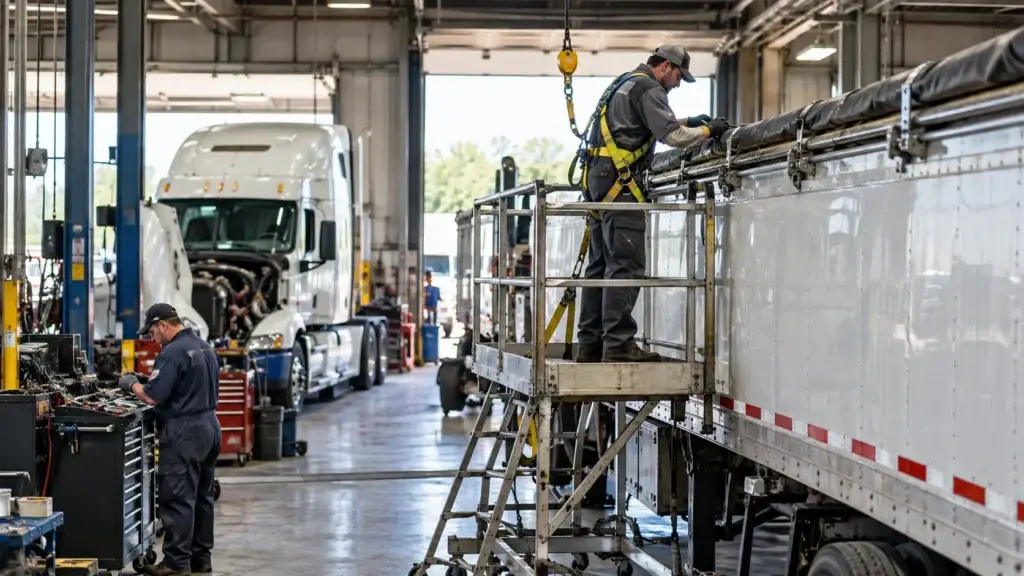
A technician routinely works atop a semi-trailer, dump truck bed, or flatbed deck positioned 4 to 13 feet above ground level. Any elevated work surface mandates a fall protection measure according to federal regulation. Mobile scaffolding and an aerial work platform offer a secure alternative to climbing directly onto a vehicle surface.
OSHA's 29 CFR 1910.28 general industry fall protection standard establishes the specific employer duty that applies directly to a technician working on an elevated truck bed and trailer deck, including the requirement to provide fall protection wherever a worker can fall 4 feet or more. HDJ's truck driver safety tips guide covers the complementary driver-side safety discipline in more depth.
Keep Your Fleet Running at Full Capacity
Get HDJ's maintenance guides, compliance updates, and fleet management strategies delivered weekly — built for working diesel professionals.
Proper Guardrail Installation Around Service Pits
A standard guardrail system requires a top rail positioned 42 inches above the walking surface and a mid-rail installed halfway between the top rail and floor. A toe-board measuring at least 4 inches in height prevents a tool from falling into an occupied pit below. Every guardrail component must withstand a load capacity of 200 pounds applied in any direction along the top edge.
Personal Fall Arrest Systems for Heavy Equipment Technicians
When a guardrail proves impractical for a specific task, a personal fall arrest system becomes mandatory under OSHA standard 29 CFR 1910.140. These systems require an anchor point capable of supporting 5,000 pounds per attached worker. A full-body harness, shock-absorbing lanyard, and self-retracting lifeline protect a technician during an overhead crane work or when accessing a tall equipment.
| Fall Protection Equipment | Inspection Frequency | Common Defects |
|---|---|---|
| Full-Body Harness | Before each use | Frayed webbing, damaged buckles |
| Shock-Absorbing Lanyard | Monthly inspection | Deployed indicator, cuts in webbing |
| Anchor Points | Annual certification | Corrosion, loose mounting hardware |
| Self-Retracting Lifeline | Annual by manufacturer | Cable damage, lock mechanism failure |
Hazard Communication Standards for Automotive Repair OSHA Requirements
A chemical hazard poses a serious health risk in a heavy-duty repair facility. Hazard communication violations stem from an improper container labeling, an inadequate technician training, and a missing safety documentation for a hazardous substance. The hazard communication standard under 29 CFR 1910.1200 establishes a clear automotive repair OSHA requirement for managing a dangerous substance. Every chemical container requires a proper label identifying its contents and associated hazard, and a Safety Data Sheet (SDS) must remain accessible to every technician working with these materials during each shift.
Essential Components of a Hazard Communication Program
A compliant program includes a complete chemical inventory updated quarterly, a current SDS document for every hazardous substance, and an employee training record on chemical handling procedures. A secondary container labeling system and an emergency response protocol for a chemical spill complete an essential program element an inspector verifies during a facility walkthrough.
Training Requirements and Documentation
A technician must understand the specific risk associated with each chemical in the facility, proper handling technique, required personal protective equipment, and emergency first aid procedure. A monthly inspection helps identify a missing label, an outdated SDS document, or a gap in employee knowledge before OSHA conducts a formal investigation.
Respiratory Protection in Commercial Vehicle Repair Safety
A breathing hazard poses a serious health risk in a truck repair facility. From a diesel fume to a welding smoke, a technician faces multiple respiratory dangers throughout daily operations. OSHA standard 29 CFR 1910.134 establishes a mandatory requirement for a facility where air quality poses a documented health risk to a worker.
Diesel Exhaust Exposure Controls
A diesel exhaust contains dozens of toxic air contaminants threatening a shop worker's long-term health. OSHA's 29 CFR 1910.134 respiratory protection standard requires an employer to implement an engineering control — an exhaust extraction, ventilation — before relying on a respirator as the primary defense against diesel exhaust exposure in an enclosed shop environment.
A key control measure includes a tailpipe exhaust extraction system with a flexible hose positioned at each service bay and a high-volume ventilation fan rated appropriately for shop square footage. HDJ's computer vision trucking guide covers a related AI-driven approach to shop and fleet safety monitoring.
Paint Booth and Body Shop Respirator Programs
A body shop technician requires a specialized respiratory protection when spraying a primer, paint, or clear coat. A supplied-air respirator provides the highest protection level for a painting operation involving an isocyanate or volatile organic compound. Shops must conduct an annual fit test and maintain a detailed record for each employee using a respirator.
Welding Fume Protection Requirements
A welding operation generates a metal fume causing serious lung damage without a proper protection measure. A local exhaust ventilation system removes a fume at its source through a properly positioned extraction arm with adequate capture velocity. When an engineering control proves insufficient, a welder requires an appropriate respirator based on an exposure assessment.
Lockout/Tagout Procedures for Heavy Equipment Shop Safety Standards
A lockout/tagout violation ranks among the more serious infractions in a commercial vehicle repair facility, stemming from an improper control of a hazardous energy during an equipment maintenance operation. OSHA standard 29 CFR 1910.147 mandates a written lockout/tagout program isolating an energy source before a technician begins a maintenance work.
Hydraulic System Energy Control
A heavy equipment hydraulic system poses a unique challenge for safety compliance. This process includes cycling a hydraulic control to release system pressure and installing a mechanical blocking device on a raised component. A technician attaches a lockout device to a control valve and verifies zero pressure with a calibrated gauge before disconnecting a pressurized line.
Electrical Disconnect Procedures for Fleet Maintenance
Proper electrical isolation requires locking and tagging a disconnect at both a main electrical panel and an equipment-specific location. Each technician working on an energized equipment must apply their own personal lock and identifying tag. A standardized lockout device with a unique key system prevents an unauthorized equipment operation.
Pneumatic System Isolation Requirements
An air-powered system in a heavy duty shop safety compliance program requires a pressure relief valve engaged before a service operation. A technician must disconnect an air supply line and apply a lockout device preventing an accidental system pressurization. Facilities failing to correct a violation face a compounding daily fine of up to $16,550 until the hazard receives proper remediation.
Machine Guarding and Equipment Safety in Truck Shop Operations
Machine guarding represents one of the more critical aspects of a truck shop safety violation an OSHA inspector frequently cites during a facility inspection. Every grinder, drill press, and lathe in a repair facility requires a proper safeguard protecting a worker from a rotating part, flying debris, and potential contact with a dangerous machinery component. The automotive repair OSHA requirement under standard 29 CFR 1910.212 mandates that every piece of equipment with a hazardous moving part must have a securely attached guard.
OSHA Requirements for Equipment Protection
A truck shop faces a unique challenge with specialized equipment like a tire mounting machine, brake lathe, and high-pressure parts washer requiring a custom guarding solution beyond a standard industrial configuration.
| Equipment Type | Common Guarding Issues | Required Protection |
|---|---|---|
| Bench Grinders | Missing side shields | Adjustable tongue guards within 1/4 inch |
| Brake Lathes | Exposed rotating drums | Interlocked shields during operation |
| Tire Mounting Equipment | Unprotected inflation areas | Safety cages or restraining devices |
| Parts Cleaning Tanks | Open agitator access | Hinged covers with interlock switches |
Inspection and Maintenance Protocols
A training program should emphasize that removing or bypassing a safety guard violates federal regulation and dramatically increases injury risk exposure. A point of operation guarding specifically addresses an area where a machine performs a cutting, shaping, or boring operation on a vehicle component.
Powered Industrial Truck Safety in Heavy-Duty Maintenance Facilities
A powered industrial truck violation ranks among the more frequently cited issues in a heavy-duty repair facility. These violations directly impact commercial vehicle repair safety when a shop fails to establish a proper training program and operational protocol for a forklift, mobile crane, or vehicle lift.
Forklift Certification Requirements for Shop Personnel
Every forklift operator in a heavy-duty maintenance facility must complete an OSHA-approved certification training under standard 29 CFR 1910.178. An operator requires recertification every three years or immediately following any accident or near-miss incident involving a powered industrial truck.
Mobile Crane and Hoist Operation Standards
A mobile crane and hoist in a truck repair facility require a specialized operator certification beyond a basic forklift training credential. A daily pre-operation inspection must verify wire rope condition, hook integrity, and safety latch functionality before a lifting operation commences. Exceeding a rated capacity represents a serious violation risking equipment failure and catastrophic worker injury.
Vehicle Lift Safety Protocols
A vehicle lift demands a strict heavy duty shop safety compliance procedure preventing a catastrophic failure. A technician must position a vehicle according to manufacturer specification and engage every safety lock before working underneath an elevated equipment. A monthly documented inspection should verify hydraulic fluid level, structural component integrity, and proper operation of every safety device.
Creating a Heavy Duty Shop Safety Compliance Program
Building an effective compliance program starts with a comprehensive written policy addressing every potential OSHA safety violation heavy duty shops might encounter.
Essential Program Components
Employee training forms the foundation of a successful heavy equipment shop safety standards program. Schedule a regular training session covering fall protection, hazard communication, respiratory protection, lockout/tagout, and machine guarding, and maintain a detailed record of attendance, topics covered, and competency evaluation. Many a successful shop implements a digital tracking system maintaining a training certificate, an automated reminder for a certification renewal, and a centralized documentation accessible during an OSHA inspection.
Editorial Insight
The HDJ Perspective
The shops with the worst OSHA outcomes tend to share one thing: they treat safety documentation as a bureaucratic burden rather than a diagnostic tool. The same systematic approach a good technician applies to fault code diagnostics — document what's found, trace the root cause, verify the fix — works equally well for safety compliance. The shops that consistently avoid a citation aren't the ones with the most expensive safety equipment; they're the ones where the foreman walks the bay with the same critical eye every Monday morning that an OSHA inspector would bring on any given Tuesday. The inspection isn't the test. The Monday walkthrough is.
Leveraging Free OSHA Resources
OSHA offers free assistance through its On-Site Consultation Program operating from a network of Area Offices nationwide. A shop can receive expert guidance without citation risk through this voluntary program. A consultant conducts a comprehensive facility walkthrough, reviews an existing safety program, and provides a written report detailing findings and recommendations.
Proactive Compliance Strategies
An effective program includes an anonymous hazard reporting system encouraging employee participation and a monthly safety audit catching a violation before a formal inspection. When a violation occurs, a shop has 15 working days to request an informal conference with an Area Director. Filing a Petition for Modification of Abatement can extend a correction deadline when immediate compliance proves technically or economically infeasible.
Frequently Asked Questions
What is the maximum fine for willful OSHA violations in heavy-duty shops?
As of 2026, the maximum civil penalty for a willful violation reaches $165,514 per infraction. When an employee fatality occurs due to willful negligence, a criminal charge can result in a minimum fine of $250,000 for an individual employer and $500,000 for a corporate entity, along with potential imprisonment.
What is the most frequently cited violation in commercial vehicle repair safety?
Fall protection has remained among OSHA's most frequently cited violations across general industry for many consecutive years, including violations involving an elevated truck bed, service pit, and trailer deck in a heavy-duty repair facility. Check OSHA's current published Top 10 list for the exact figure.
How often must respiratory protection fit testing be conducted according to automotive repair OSHA requirements?
An annual fit test is mandatory for every shop employee exposed to a respiratory hazard including diesel exhaust, paint fumes, and welding operations. Additional testing becomes necessary whenever a respirator model changes, a physical change affects facial fit, or an employee reports a fit problem.
What training documentation is required for powered industrial truck operators?
OSHA standard 29 CFR 1910.178 requires a comprehensive operator training program with certification documentation including operator identification, training completion dates, trainer credentials, and competency evaluation results. Refresher training occurs every three years or immediately following an accident or near-miss incident.
What free resources are available to help shops meet heavy equipment shop safety standards?
OSHA's On-Site Consultation Program offers free compliance assistance through a network of Area Offices nationwide. This voluntary program provides expert guidance, a comprehensive facility assessment, and a detailed written recommendation without citation risk, helping a shop identify and correct a hazard proactively.
The Bottom Line
A heavy-duty shop faces substantial financial exposure when ignoring an OSHA safety violation — the same discipline Michael Nielsen and Heavy Duty Journal's editorial team hold every guide on heavydutyjournal.com to. A penalty escalates from $16,550 for a serious violation to $165,514 for a willful infraction as of the current 2026 schedule, with a compounding daily fine for an unresolved issue. Fall protection, hazard communication, respiratory protection, lockout/tagout, machine guarding, and powered industrial trucks demand constant systematic attention in any commercial vehicle repair operation.
Each violation represents real danger to a technician servicing a truck, trailer, or heavy equipment throughout daily operations. A regular training session, proper equipment maintenance, and active employee participation create a sustainable safety culture that outlasts any individual inspection cycle. Strategic shop owners invest proactively, recognizing that preventing an accident costs significantly less than addressing a violation, managing a lawsuit, and recovering a damaged reputation.
Share This With Your Heavy-Duty Network
Know a shop manager who could use a refresher on OSHA compliance? Share this guide to help keep more technicians safe on the job.