
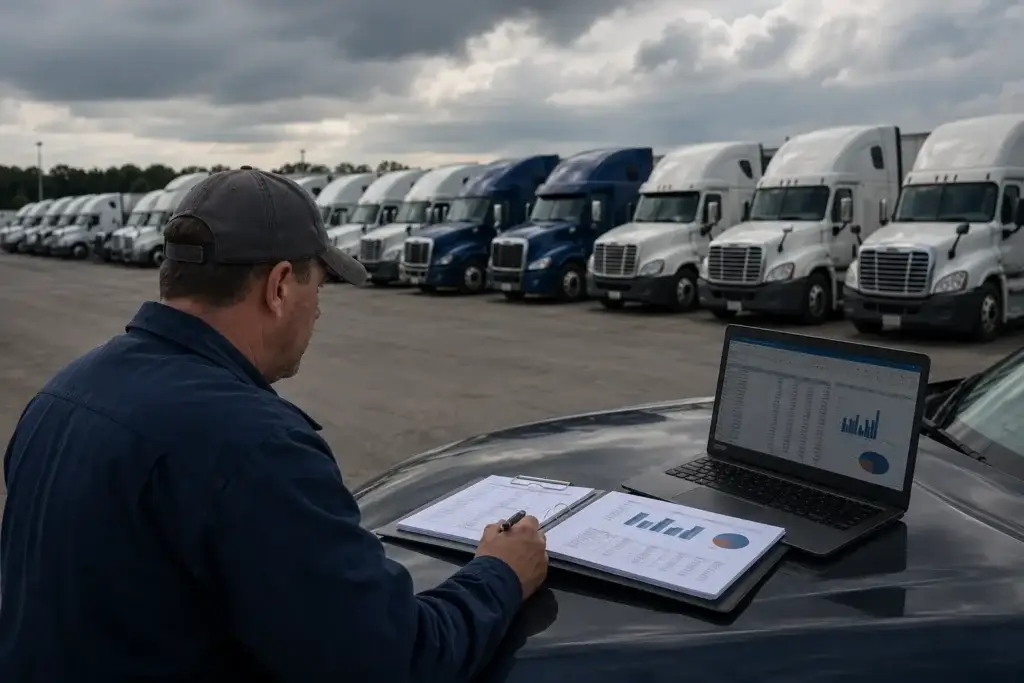
By Michael Nielsen, Publisher | 15+ Years in Diesel Repair & Fleet Operations
Last Updated: September 2026
⏱ Estimated reading time: 14 minutes
Fleet replacement strategy is the systematic process of deciding when to repair, rebuild, or replace a commercial vehicle based on projected future costs rather than age, gut feeling, or how many times a truck has stranded a driver this quarter. The right timing — replacing right before repair costs start their steep climb, not after — routinely separates fleets running lean from fleets bleeding cash on equipment that should have been traded a year ago.
That timing question has gotten harder to answer in 2026. Per the American Transportation Research Institute's 2026 Analysis of the Operational Costs of Trucking, the average cost to operate a truck reached a record $2.336 per mile in 2025 — up from $2.260 the year before — with repair and maintenance costs alone climbing roughly 8.6% year over year.
At the same time, ATRI's fleet survey respondents reported an average truck age and annual mileage both increasing, even as truckload fleets running more than 1,000 trucks grew equipment procurement spending by 16.1% — a split that suggests the largest carriers are still buying, while a broader swath of the market is holding equipment longer under cost pressure.
$2.336/mile
The record average cost to operate a truck in 2025 per ATRI's 2026 report — with repair and maintenance the fastest-rising major cost category, up roughly 8.6% year over year.
This guide walks through the economics and decision frameworks fleet managers use to make this call with data instead of instinct: the sweet spot model, the 50/30/20 rule, defender-vs-challenger analysis, age and hours-based triggers, and multi-factor scoring systems — updated for a market where holding onto trucks longer has become more common, not the clear exception it was a couple of years ago.
Key Takeaways
- ✓Elevated equipment costs and a soft freight market are pushing replacement cycles longer for a meaningful share of the industry — though the largest truckload fleets are actually increasing procurement spending, so "everyone is holding trucks longer" isn't the whole picture.
- ✓Sunk costs are irrelevant to the replace decision — only forward-looking costs matter. A truck with $50,000 in past repairs can still be the cheaper option if its projected costs beat a new unit's payment plus operating expenses; the defender-vs-challenger method exists specifically to force that comparison.
- ✓Calendar-based replacement (e.g., "trade at 5 years") is considered outdated by fleet analysts because two trucks on identical routes wear at different rates depending on driver behavior and load — condition-based, multi-factor scoring catches what a fixed age trigger misses.
- ✓The 50/30/20 rule and the sweet spot model answer different questions and work best together — 50/30/20 is a fast repair-cost trigger; the sweet spot model finds the actual cost-minimizing replacement point, which may fall well before repair costs hit that 50% ceiling.
In This Guide
Fleet Replacement Strategy Fundamentals
Fleet replacement strategy is a systematic framework for deciding when to maintain, repair, rebuild, replace, or retire a vehicle — five distinct capital-allocation choices, not interchangeable words. Maintenance covers preventive actions before failure, including the inspections required under 49 CFR Part 396. Repair restores functionality after a specific failure — a blown turbo hose, a failed alternator — without major capital investment.
Rebuilding commits significant capital (often $25,000–$40,000 for a major engine overhaul) to extend useful life substantially, sometimes by 400,000–600,000 additional miles. Replacement retires the current unit and acquires a new one with current technology and full warranty coverage. Retirement removes the unit from service entirely.
The Four-Step Replacement Process
Michael Nielsen's field experience across 15+ years of shop and fleet operations points to the same pattern regardless of fleet size: the fleets that stay disciplined about this four-step process are the ones that avoid getting surprised by a repair bill.
First, identify vehicles showing declining performance through regular monitoring — rising maintenance frequency, fuel efficiency degradation, repeat failures in the same system. A truck needing its third DEF system repair in six months is signaling something different than one with a single thermostat failure.
Second, analyze the actual financial data comparing repair, rebuild, and replacement options — real numbers, not estimates. Third, select the most cost-effective alternative given operational needs; sometimes an older unit still makes sense on a specific route. Fourth, build an acquisition and financing plan with enough lead time to avoid scrambling when a unit finally fails inspection — HDJ's fleet equipment financing guide covers loan-versus-lease structuring and lender underwriting for that step in more detail.
Defender vs. Challenger Analysis
Defender vs. challenger analysis compares your current vehicle (the defender) against a potential replacement (the challenger) using forward-looking cost projections only. Sunk costs don't matter here — what you've already spent on repairs is irrelevant to which option costs less going forward. A truck with $50,000 in past repairs might still beat a new unit's payment plus operating costs if its projected forward costs are low enough.
The comparison covers total ownership cost, productivity, and reliability over a consistent time horizon (typically 3–5 years) — and requires comparing genuinely similar units; a day-cab regional hauler and a long-haul sleeper don't compare fairly against each other.
Since so much of this decision comes down to where a vehicle sits on its maintenance-cost curve, here is a field-tested reference worth keeping on hand while you run the numbers:
Free Diesel Maintenance Checklist
Get HDJ's free, field-tested diesel maintenance checklist delivered instantly to your inbox — print it, laminate it, keep it in the shop.
Instant PDF • 100% Free • No Spam

The Economics of Fleet Lifecycle Management
Total cost of ownership breaks into three categories tracked across a vehicle's service life. Acquisition costs cover purchase price, financing, registration, and leasing fees at procurement — new Class 8 tractor pricing has stayed elevated into 2026, which is itself a factor behind the "hold longer" trend seen at part of the market.
Once the replace decision is made, HDJ's truck leasing vs. purchasing TCO guide walks through the acquisition-structure side of that decision in more depth than this timing-focused guide has room for.
Operating costs cover fuel, maintenance, insurance, compliance, and driver wages. ATRI's 2026 report puts industry-wide repair and maintenance at roughly $0.215 per mile for the 2025 reporting year, up from about $0.198 the prior year — an 8.6% jump that was the second-fastest-growing major cost category behind only driver compensation and benefits combined, which crossed $1.00 per mile for the first time.
ATRI's full 2026 cost breakdown also shows truck and trailer procurement costs rose 16.1% year over year for truckload fleets running more than 1,000 trucks, even as smaller fleets pulled back on new equipment spending and overall truck counts fell 2.4% industry-wide — a split worth checking against your own fleet size before assuming the industry-wide average applies to you.
Disposal costs cover resale value, auction fees, and end-of-life processing — frequently underestimated, particularly on units carrying deferred maintenance that buyers discount heavily.
Acquisition costs are fixed once paid; operating costs climb as a vehicle ages and warranty coverage lapses, while fuel efficiency degrades with engine wear and emissions-system fatigue. Tracking how these three curves move over time — not just their totals — is what actually reveals when a unit has crossed from "still economical" to "quietly expensive."
The Sweet Spot Model for Replacement Timing
The sweet spot model identifies the point where a vehicle's average cost per hour (or mile) hits its minimum across its entire service life — calculated by dividing total accumulated costs by total hours or miles of operation. Owning costs per hour fall over time as the purchase price spreads across more productive hours; operating costs per hour climb as parts wear and repair frequency increases.
These two curves intersect at the economic replacement point. Units running past that intersection enter what fleet analysts call the "red zone," where a single year's costs can exceed every prior year combined.
| Vehicle Category | Typical Service Life | Mileage/Hours |
|---|---|---|
| Class 8 Line-Haul Tractors | 7–8 years (often longer under current market conditions) | 700,000–900,000 miles |
| Regional Day Cabs | 8–10 years | 500,000–650,000 miles |
| Vocational Trucks | 10–12 years | 8,000–12,000 hours |
| Medium Duty (Class 6–7) | 8–10 years | 200,000–300,000 miles |
These figures describe economic service life under stable market conditions — not the current one. With acquisition costs elevated and freight rates soft for much of the market, a meaningful share of fleets are consciously running units past their historical sweet spot and offsetting the added repair cost with more disciplined preventive maintenance, betting that a rising repair bill still beats a new truck payment in a weak freight year.
Age and Hours-Based Trigger Points in a Slower Replacement Market
Age-based trigger points give fleets a simple visual system: green zone (60–80% of the target replacement age), orange zone (80–120%, signaling active replacement planning), and red zone (over 120%, requiring immediate evaluation). For a fleet targeting a 7-year cycle, that's roughly 4–6 years green, 6–8.5 years orange, and 8.5+ years red.
The data underneath these zones is genuinely mixed right now, and it's worth being precise about that rather than citing a single average that overstates the trend: ATRI's own benchmarking survey — which skews toward larger, more frequent-trading fleets — has historically shown average truck age in the 3.4–3.6 year range, and its 2026 report describes fleets reporting increased average truck age and mileage without a single industry-wide figure to anchor to.
Separately, broader market data covering the full population of trucks in operation (including small carriers and owner-operators who run equipment much longer) has long put average Class 8 age well above ATRI's survey figure. Whichever benchmark you use, don't build a calendar trigger on a number that doesn't match your own fleet's composition — a large for-hire truckload operation and a five-truck regional hauler are not on the same replacement clock.
This is also why fleet analysts increasingly describe the fixed-age replacement cycle as outdated on its own: two trucks running identical routes can wear at completely different rates depending on driver habits, idle time, and load weight, so a calendar date treats mechanically different vehicles identically. Hours-based thresholds solve part of this for vocational equipment, where duty cycle intensity varies more than calendar age does.
| Equipment Type | Hour Threshold | Annual Burn Rate |
|---|---|---|
| Concrete Mixer Trucks | 10,000–12,000 hours | 1,000–1,200 hours/year |
| Refuse Haulers | 8,000–10,000 hours | 1,200–1,500 hours/year |
| Dump Trucks (vocational) | 10,000–14,000 hours | 800–1,000 hours/year |
The 50/30/20 Rule
The 50/30/20 rule is a fast repair-cost trigger: when a repair estimate exceeds 50% of a vehicle's replacement value, replace it — the math no longer favors continued repair. When annual maintenance costs reach 30% of current value, start planning replacement within 12 months; industry experience shows costs at this stage typically climb quickly, often doubling within a year. Below 20%, continue normal maintenance without concern.
| Percentage | Meaning | Action Required |
|---|---|---|
| 50% | Repair cost exceeds half of replacement value | Replace immediately |
| 30% | Annual maintenance reaches 30% of current value | Plan replacement within 12 months |
| 20% | Repairs stay below 20% of vehicle worth | Continue normal maintenance |
Multi-Factor Scoring Systems
Multi-factor scoring evaluates several performance dimensions simultaneously instead of relying on age or mileage alone — the approach fleet analysts point to as the replacement for the "dead" calendar-based cycle. A typical Class 8 evaluation weights year of manufacture, total lifetime miles, miles in the last 12 months, FMCSA's Safety Measurement System inspection history, and labor and parts cost per mile, scoring each 0–10 against defined thresholds.
A 2015 truck with 780,000 miles might score 2.5 overall; a 2022 model with comparable utilization might score 8.5 — the difference reflecting actual performance across every measured category, not just age.
| Factor | Weight | Poor (1–3) | Good (7–10) |
|---|---|---|---|
| Maintenance Cost/Mile | 30% | >$0.35/mile | <$0.20/mile |
| Reliability (Uptime) | 25% | <85% | >95% |
| Miles Between Breakdowns | 20% | <25,000 mi | >40,000 mi |
| Fuel Efficiency | 15% | <5.5 mpg | >7.0 mpg |
| CSA/Safety Record | 10% | Multiple violations | Clean record |
Build thresholds before implementation, not during — define what "good," "acceptable," and "poor" mean for each metric across your fleet so scoring stays consistent as new units are evaluated over time.
Since CSA/safety record is part of that scoring matrix, it is worth knowing exactly where your own carrier stands before you finalize which units score well and which don't:
Free DOT Status Check
Enter a USDOT number and quickly review public carrier status, operating authority and key FMCSA registration data.
Data Tools and Strategic Planning
Modern fleet management software tracks fuel consumption, maintenance schedules, and repair frequency automatically, flagging units that meet multiple replacement criteria at once rather than relying on a manager to notice the pattern. This automation matters more when a larger share of the fleet is running past historical trigger points: manually reviewing every aging unit for replacement risk doesn't scale the way it did when replacement cycles were shorter and the "at-risk" population was smaller.
The regulatory picture has shifted substantially since this guide was last updated, and it changes the planning math. Federal greenhouse gas emissions standards for heavy-duty vehicles — including the Phase 3 rule that was set to tighten requirements starting with model year 2027 — were repealed by EPA in February 2026, alongside the rescission of the underlying 2009 endangerment finding.
Manufacturers currently face no federal obligation to reduce CO2 per mile on new heavy-duty trucks going forward, though separate federal standards for smog-forming pollutants like NOx and particulate matter, along with fuel-economy rules, remain in effect.
California's zero-emission truck mandates have also been substantially pulled back. The state's Advanced Clean Trucks rule — which would have required a rising share of new Class 8 sales to be zero-emission — lost its federal Clean Air Act waiver when Congress revoked it in 2025, and California cannot seek a substantially similar waiver again.
The related Advanced Clean Fleets rule, which would have required private fleets to purchase zero-emission trucks on a phased schedule, was never enforceable against private carriers in the first place because California withdrew its own waiver request for that regulation in January 2025; the state has since moved to formally repeal the private-fleet provisions.
Some state and local government fleet purchase requirements under these programs remain separately in effect, so a public-sector fleet should confirm its own obligations rather than assume the full rollback applies to it.
The practical upshot for a replacement decision: the regulatory pressure that used to push some fleets toward earlier replacement — get ahead of a tightening emissions mandate — has largely lifted for now. That doesn't make the underlying cost math in this guide less relevant; if anything, it removes one more reason to replace early and puts more weight on the economic frameworks above.
⚠️ Regulatory Currency Note
Federal and California heavy-duty emissions policy has changed direction multiple times over the past two years and remains subject to litigation and further rulemaking. Verify current federal and state requirements — including any state or local government fleet purchase mandates that may still apply — before finalizing multi-year acquisition plans.
A few common questions on fleet replacement timing, answered directly:
Frequently Asked Questions
What is the 50/30/20 rule in fleet replacement?
It's a repair-cost trigger system: replace when repair costs exceed 50% of a vehicle's current value, plan replacement within 12 months once annual maintenance reaches 30% of value, and continue normal operation below 20%. Costs at the 30% mark typically escalate quickly — often doubling within a year.
How do I find the optimal replacement timing for a heavy-duty truck?
Use the sweet spot model: divide total lifecycle costs (acquisition, operation, maintenance) by total hours or miles to find where average cost per hour hits its minimum. For most Class 8 tractors this has historically fallen between years five and seven, though elevated new-truck pricing and soft freight rates in parts of the market are pushing some fleets to extend past that window and lean more heavily on condition-based, multi-factor scoring instead of a fixed year target.
Should I rebuild or replace an aging truck?
Rebuild when projected costs are substantially lower than replacement and the rebuilt unit can still deliver reliable extended service — a major engine overhaul (typically $25,000–$40,000) can add 400,000–600,000 miles. Replace when a new unit's warranty coverage and improved fuel efficiency outweigh the rebuild's lower upfront cost. Factor in the opportunity cost of a rebuilt truck lacking modern telematics and safety features new units include standard.
How does defender vs. challenger analysis work?
Compare your current vehicle (the defender) against a potential replacement (the challenger) using forward-looking cost projections only — ignore sunk costs entirely. Calculate projected cost per hour or mile for continuing repairs, rebuilding, or replacing over a consistent 3–5 year horizon, and compare essentially similar units so the analysis stays fair.
Are fleets required to buy zero-emission trucks in California or federally?
Not currently, for most private fleets. Federal GHG emissions standards for new heavy-duty vehicles were repealed in February 2026, and California's Advanced Clean Trucks and Advanced Clean Fleets rules have both lost the federal waiver support needed to enforce their private-fleet requirements. Some state and local government fleet purchase mandates remain in effect separately. This is an active regulatory area — confirm current status before making a purchase decision based on compliance timing.
Why are some fleets keeping trucks longer right now?
Elevated new-truck acquisition costs combined with a soft freight market and thin operating margins have made deferring replacement a more common strategy for part of the industry — though ATRI's 2026 data shows the largest truckload fleets actually increasing equipment procurement spending, so the trend isn't universal. This makes disciplined condition-based monitoring more important, not less, since an older, more heterogeneous fleet carries more variability in failure timing than a fleet on a short, uniform replacement cycle.
Michael Nielsen's take, after 15+ years watching fleets make this call in both directions: building a fleet replacement strategy that holds up right now means leaning less on a fixed calendar and more on the data each vehicle is already generating — cost per mile, uptime, and forward-looking projections that ignore what's already been spent.
The 50/30/20 rule and sweet spot model give you fast triggers; multi-factor scoring gives you the discipline to apply them consistently across a fleet where, for a meaningful share of the industry, average age is trending upward. Start by calculating your own cost-per-mile trend this week, since that number is what every other decision in this guide gets measured against.
Found This Guide Helpful?
Share it with a colleague weighing a repair-vs-replace call right now — a second set of eyes on the defender-vs-challenger math often catches what gets missed under deadline pressure.