By Michael Nielsen, Publisher | 15+ Years in Diesel Repair
Last Updated: September 2026
⏱ Estimated reading time: 15+ minutes
Commercial vehicle accidents cost the trucking industry billions annually. A driver fatigue, distracted driving, and blind spot contribute to thousands of preventable crashes each year, and a traditional safety measure often reacts to an incident after it occurs, leaving a fleet operator searching for a more effective solution.
Michael Nielsen and Heavy Duty Journal's editorial team built this guide because computer vision trucking technology is transforming how a commercial fleet approaches accident prevention. An advanced AI-powered camera and sensor now monitor driver behavior and road conditions in real time, using machine learning and a neural network to analyze visual data continuously and identify a potential hazard before it becomes a collision.
Key Takeaways
- ✓Real-time hazard detection: an AI-powered visual monitoring system analyzes data continuously, working to prevent an accident before it happens through an immediate driver alert.
- ✓Comprehensive behavior monitoring: a machine learning algorithm detects driver fatigue, distraction, and a hazardous road condition with a consistency a periodic human review can't match.
- ✓Vendor-reported ROI is common but not independently audited: treat a specific accident-reduction or insurance-discount percentage as a claim to verify with a platform, not a settled industry statistic.
- ✓A federal AEB mandate for new heavy trucks is still a proposed rule, not yet final — worth tracking, but not something to budget around as an enacted requirement just yet.
- ✓Coaching-focused implementation succeeds: a fleet positioning computer vision as a driver development tool rather than surveillance achieves higher acceptance and a better safety outcome.
In This Guide
- The Escalating Safety Crisis in Commercial Trucking
- What Is Computer Vision Trucking Technology?
- Driver Fatigue Detection: Monitoring Alertness in Real-Time
- Detecting and Preventing Driver Distraction Through AI
- Forward-Facing Cameras for Road Hazard Detection
- Blind Spot and Side-View Computer Vision Systems
- Leading Computer Vision Solutions for U.S. Trucking Fleets
- Quantifiable Safety and ROI Benefits for Fleet Operators
- Overcoming Implementation Challenges and Driver Resistance
- Regulatory Framework and Compliance Requirements
- Frequently Asked Questions
The Escalating Safety Crisis in Commercial Trucking
Per NHTSA crash data, hundreds of thousands of a truck-involved accident occur annually across the United States, resulting in thousands of fatalities and countless injuries that forever change lives.
Human error is commonly cited as a factor in the large majority of road accidents, making driver behavior a critical factor in HDJ's truck driver safety tips guide. A traditional training program and conventional monitoring approach have proven insufficient to address this fundamental challenge consistently across diverse operating conditions.
Several factors compound the difficulty of fleet accident prevention. The industry faces a persistent shortage of an experienced driver, forcing a company to hire a less-seasoned operator, while freight volume continues to put more trucks on already congested roadways during all hours.
| Safety Challenge | Impact on Fleet Operations | Traditional Solution Limitations |
|---|---|---|
| Driver Shortage | Hiring inexperienced operators | Basic training cannot replace years of road experience |
| Increased Freight Volume | More trucks in traffic, longer hours | Scheduling restrictions don't prevent fatigue-related incidents |
| Human Error | Distraction, fatigue, poor judgment | Periodic reviews miss real-time dangerous behaviors |
| Complex Urban Environments | Vulnerable road users, tight spaces | Mirrors and standard cameras have significant blind spots |
The financial consequences are staggering. A fleet operator faces an escalating insurance premium, litigation expense, and property damage cost, with a nuclear verdict exceeding $10 million becoming increasingly common in trucking litigation. Traditional safety measures — a periodic training session, a post-incident review, and a basic fleet monitoring — can't provide the real-time intervention needed to prevent an accident before it occurs.
What Is Computer Vision Trucking Technology?
At the intersection of artificial intelligence and transportation safety lies computer vision trucking technology — a system that gives a commercial vehicle the ability to see, interpret, and respond to a potential hazard. This branch of AI enables a machine to process visual data from the world around it, much like a human vision but with a distinct computational advantage — a continuous attention without fatigue and an instantaneous data processing a human observer can't match.
A machine learning trucking system relies on a strategically positioned camera throughout the vehicle to capture a continuous video feed — facing the driver to monitor behavior, pointing forward to assess road conditions, and covering a blind spot to detect a surrounding vehicle and pedestrian. A neural network trained on millions of driving scenarios analyzes this footage in real time, identifying a specific event and behavior that indicates an elevated crash risk.
Core Components of AI-Powered Vision Systems
The technology stack behind an AI-powered camera includes several integrated components. A high-resolution camera with night vision capability captures clear footage under all lighting conditions, and an edge computing processor analyzes video data locally within the vehicle, enabling an instant alert without relying solely on cloud connectivity.
A cloud connectivity stores footage and enables a fleet-wide analytics across multiple vehicles. An integration API connects a neural network fleet safety platform with existing telematics and fleet management systems, creating a unified safety ecosystem that identifies a dangerous behavior like distraction or drowsiness while simultaneously detecting an external hazard such as a sudden lane departure or forward collision risk. HDJ's fleet telematics software comparison covers how these systems get evaluated alongside a computer vision platform.
How Camera-Based AI Differs from Traditional Fleet Safety Tools
A traditional fleet safety approach relies on a basic dashcam that simply records footage without an intelligent analysis. A periodic driver evaluation misses the day-to-day behavior that creates a risk pattern, and a manual logbook review can't capture a real-time condition or provide an immediate intervention opportunity.
Computer vision provides a continuous, objective monitoring that eliminates a human oversight limitation. Instead of creating a video archive requiring manual review, these systems generate a structured data with a specific event classification and risk score, enabling a proactive intervention before an accident occurs rather than a reactive investigation afterward.
Driver Fatigue Detection: Monitoring Alertness in Real-Time
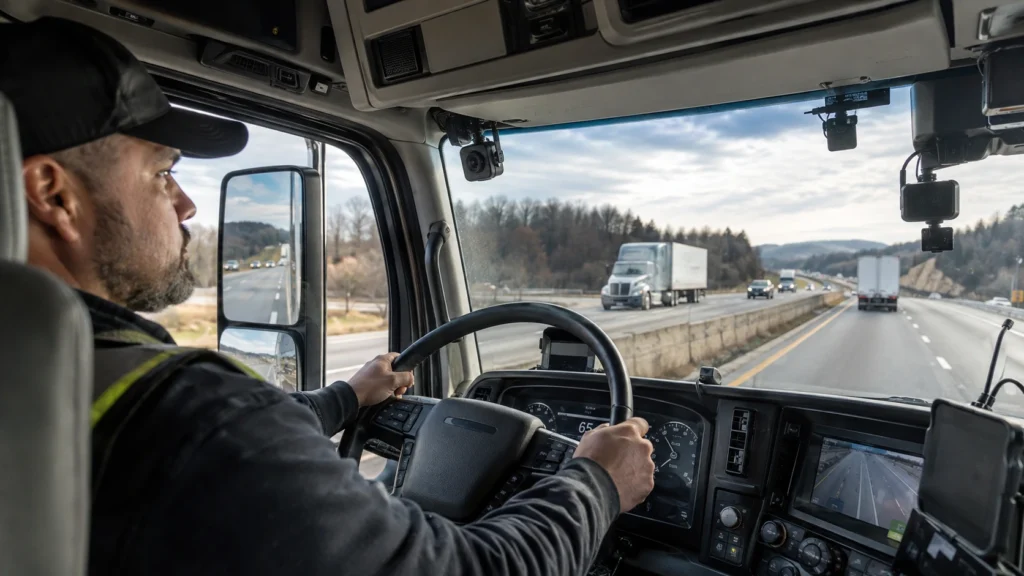
The moment a truck driver's eyelids droop for even a fraction too long, an advanced computer vision technology recognizes the danger and intervenes before disaster strikes. A driver-facing camera equipped with an infrared sensor continuously monitors a driver regardless of lighting condition, tracking a facial feature and behavior that signals declining alertness.
These fatigue management systems operate silently in the background, sending an alert directly to a driver through an in-vehicle interface while simultaneously notifying a fleet manager. This dual-notification approach creates multiple safety checkpoints that can prevent an accident before it occurs.
Eye Tracking and Microsleep Recognition
An advanced driver alertness monitoring system tracks eye closure duration, blink frequency, and gaze pattern with remarkable precision, detecting a microsleep episode — a brief moment of unconsciousness lasting just seconds that proves catastrophic at highway speed. Even a three-second microsleep event at 65 mph means the truck travels nearly 300 feet with an unconscious driver, making early detection critical for preventing a tragedy.
Head Position and Yawning Detection
Beyond eye monitoring, a fatigue management system analyzes head position and movement pattern, recognizing when a driver's head begins to nod or tilt in a way consistent with drowsiness. A facial recognition algorithm identifies a yawning frequency as an early warning sign, giving a driver additional time to respond safely — whether by pulling over for rest or requesting a routing change through dispatch.
Graduated Alert Systems That Prevent Drowsy Driving
A modern drowsy driving detection platform employs a layered warning approach that respects driver autonomy, delivering a gentle audio or visual notification for an early-stage indicator and escalating to a more assertive warning like a seat vibration or louder alarm for a serious drowsiness sign. When a driver exhibits a persistent fatigue symptom, a fleet manager receives a notification enabling a supervisor to mandate a rest break or routing change.
Detecting and Preventing Driver Distraction Through AI
Computer vision algorithms can now recognize a specific distraction pattern in real time, enabling an immediate corrective action before an accident happens. A driver-facing camera equipped with an advanced behavior monitoring capability analyzes thousands of data points per second to identify an unsafe activity that diverts attention from the road, transforming distracted driving prevention from reactive to proactive.
Recognizing Handheld Devices and Mobile Phone Use
A cell phone detection AI represents one of the more sophisticated applications of computer vision trucking technology. The algorithm can distinguish between a driver holding a phone versus a radio microphone or other permitted object by analyzing a hand position, arm angle, and characteristic gesture associated with texting or scrolling, tracking a head orientation pattern that indicates reading a message or watching content.
An advanced recognition capability can even identify when a driver attempts to conceal phone use by holding a device below the dashboard, monitoring a subtle shift in posture and a repeated hand-to-lap movement that signals a hidden device interaction.
Identifying High-Risk Behavioral Patterns
Beyond phone use, a computer vision system detects a comprehensive range of distraction behaviors including eating, drinking, smoking, grooming, and reaching for an object outside the normal driving zone. A machine learning model trained on a diverse dataset accurately identifies these behaviors from multiple camera angles, extending to detecting when a driver turns to address a passenger or becomes focused on an in-cab display for an extended period.
Monitoring Steering Control and Visual Attention
A modern attention tracking system continuously monitors a hand placement on the steering wheel, detecting when a driver removes both hands or maintains only minimal contact insufficient for an emergency maneuver. An advanced system also tracks an eye gaze direction and head position to ensure a driver maintains appropriate visual attention, identifying when attention shifts to a side window or an internal cab area during a critical driving moment.
Forward-Facing Cameras for Road Hazard Detection
The most effective collision avoidance systems integrate a forward-facing camera with artificial intelligence to identify and respond to a road hazard in real time, continuously monitoring the road environment and analyzing a traffic pattern, lane position, and potential obstacle ahead. Working together with a radar and lidar sensor, this computer vision trucking approach creates a comprehensive understanding of the driving environment that helps prevent an accident before it occurs.
Forward Collision Warning and Automatic Emergency Braking
A forward collision warning system uses computer vision to calculate a closing distance with a vehicle or object ahead, assessing a relative speed and measuring a time-to-collision metric with remarkable precision. When the system determines a collision risk exists, it provides an escalating warning, and if the driver has not responded and a collision becomes imminent, an automatic emergency braking system can autonomously apply the brake — an intervention that can prevent an accident entirely or significantly reduce impact severity.
As of September 2026, a federal AEB mandate for new heavy trucks remains a proposed rule, not an enacted requirement. NHTSA and FMCSA issued their original proposal in 2023, but a new administration restarted the process with a revised supplemental proposal expected in 2026, and even once finalized, compliance would likely begin no earlier than 2027. NHTSA also opened an investigation into reports of false AEB activations, which remains open as of late 2025 — worth knowing before treating this as a settled requirement. The figures often cited for the rule's projected impact (roughly 19,000 crashes and 155 lives saved annually) come from NHTSA's own regulatory impact analysis for the proposal, not from a rule that is currently in effect.
Lane Departure Warning and Lane Keep Assist Technology
Computer vision systems continuously identify a lane marking to monitor the truck's position within its travel lane, detecting an unintentional drift that may indicate driver inattention or fatigue and providing an immediate alert through a visual display, audio warning, or haptic feedback. A more advanced system incorporates a lane keep assist capability that provides a gentle steering correction to help maintain proper lane position — particularly valuable during a momentary attention lapse.
Vulnerable Road User Detection for Pedestrians and Cyclists
A specialized algorithm within a forward-facing camera is trained specifically to identify a pedestrian, cyclist, motorcyclist, and other vulnerable road user, distinguishing between a road user type based on size, shape, and movement pattern. These systems predict a movement trajectory to anticipate a potential conflict, an especially critical capability in an urban environment where a truck frequently shares roads with a vulnerable population.
Following Distance Analysis and Tailgating Prevention
A forward-facing computer vision continuously measures a distance to a vehicle ahead, comparing actual spacing to a safe following distance standard based on current speed, road condition, and vehicle weight. Tailgating prevention proves particularly important for a loaded commercial truck, which requires a significantly longer stopping distance than a passenger vehicle.
Blind Spot and Side-View Computer Vision Systems
The extensive blind zone surrounding a commercial truck represents one of trucking's most dangerous safety challenges. A large truck has a blind spot that extends up to 30 feet in front, 200 feet behind, and along both sides of the vehicle — areas that can completely hide a passenger car, motorcycle, pedestrian, and cyclist from the driver's view.
Complete Perimeter Coverage Through Advanced Camera Networks
A multi-camera integration creates a unified view of everything surrounding a commercial truck, typically mounted on both sides, at the rear, and sometimes underneath to eliminate a ground-level blind zone. A 360-degree camera system automatically activates a specific view based on driver action — signaling a right turn brings up the right-side camera, and shifting into reverse triggers the rear camera view immediately.
Intelligent Analysis Beyond Simple Video Display
Blind spot monitoring goes far beyond displaying a camera feed. An advanced computer vision algorithm analyzes video in real time to identify and classify a specific object in a critical zone, distinguishing between a passenger vehicle, motorcycle, bicycle, pedestrian, and stationary object, with a visual indicator, audible alert, or haptic feedback activating when the driver initiates a lane change or turn that could result in a collision.
Leading Computer Vision Solutions for U.S. Trucking Fleets
The commercial trucking industry now has access to several mature computer vision trucking platforms, each offering a distinct approach to driver safety monitoring and collision prevention. Per the American Transportation Research Institute, fleet technology adoption continues accelerating as an operator recognizes AI's role in monitoring vehicles and operations.
Mobileye Shield+ Advanced Driver Assistance System
Mobileye trucking solutions bring an automotive-grade vision technology specifically adapted for a commercial application. The Shield+ system provides a forward collision warning, lane departure alert, and pedestrian detection through a single windshield-mounted camera, calibrating to each vehicle's specific dimensions and load to ensure an accurate distance calculation regardless of trailer configuration or cargo weight.
Netradyne Driveri AI Fleet Safety Platform
The Netradyne fleet safety platform distinguishes itself through a positive driver recognition alongside risk detection, combining a driver-facing and road-facing camera with a cloud-based analytics that identifies both a safe behavior and a potential hazard. This dual approach creates a balanced safety culture rather than focusing exclusively on a violation.
Lytx DriveCam Event Recorder and SF300 Surround View
As one of the more established providers, Lytx dashcam technology has accumulated extensive real-world data across diverse fleet operations. The DriveCam event recorder uses a triggered recording to capture a critical moment when a risky driving occurs, and the SF300 Surround View system extends coverage through a multi-camera integration for backing, lane changes, and blind spot monitoring.
Samsara AI Dash Cams with Cloud Integration
Samsara AI cameras operate within a cloud-native architecture designed for seamless integration, connecting computer vision capability with GPS tracking, electronic logging devices, and vehicle diagnostics through a single dashboard. Real-time alerting enables immediate intervention when a safety event occurs. HDJ's fleet driver management software guide covers this same integrated-platform category in more depth.
Quantifiable Safety and ROI Benefits for Fleet Operators
Investing in AI-powered safety technology requires substantial capital, but a measurable benefit creates a compelling business case for a forward-thinking fleet operator. As with the AEB status above, most of the specific reduction percentages below are commonly reported by vendors rather than independently audited — treat the direction as reliable and the exact figure as a starting point to verify with a specific platform.
Collision Reduction Rates and Safety Performance Data
Vendors and fleet operators commonly report that an operator using an AI-powered dashcam and coaching program experiences meaningfully fewer accidents compared to an operation without this technology, along with a fewer unsafe driving behavior, a reduced FMCSA-reported violation, and a decline in speeding incident once a driver knows AI monitors their performance.
| Safety Metric | Commonly Reported Reduction | Business Impact |
|---|---|---|
| Overall accidents | 20-25% decrease | Lower repair costs and downtime |
| Unsafe driving behaviors | 60-70% decrease | Improved compliance and safety scores |
| FMCSA violations | 35-45% decrease | Better CSA scores and audit results |
| Harsh driving events | 60-70% decrease | Reduced vehicle wear and fuel costs |
Insurance Premium Reductions and Incentive Programs
Commercial trucking insurance costs continue rising, making a cost control strategy essential for profitability. Many a commercial auto insurer now offers a discount ranging from 5% to 15% for a fleet that deploys a comprehensive camera system with an active safety management program, viewing computer vision trucking technology as evidence of a serious safety commitment.
Liability Protection and Claims Cost Savings
Video evidence from a computer vision system provides a definitive documentation of an accident's circumstances, which can exonerate a driver in a false claim and establish a clear fault determination. The trucking industry faces a growing threat from a nuclear verdict — a jury award exceeding $10 million that can devastate a company financially — and a documented safety commitment through technology investment can help prevent an excessive award.
Overcoming Implementation Challenges and Driver Resistance
While computer vision trucking technology offers a powerful safety benefit, achieving driver acceptance remains the primary obstacle for many a fleet. The most sophisticated AI system will fail if a driver actively resists or circumvents the technology — a change management strategy proves just as critical as a technical specification.
Addressing Privacy Concerns and Building Trust
Many a professional driver perceives a constant video monitoring as an invasive surveillance suggesting a management distrust. A fleet manager should establish a clear policy about data collection, storage, and access, limiting a video review to a specific safety event rather than a continuous monitoring. Explaining how a video evidence protects a driver against a false accusation reframes the technology as a protective tool rather than a punishment mechanism.
Technical Integration with Existing Fleet Management Systems
A computer vision platform must work seamlessly with an electronic logging device, a maintenance system, and a payroll software. A fleet operator should evaluate a vendor based on integration support and documentation quality, considering a vehicle electrical system requirement, an optimal camera positioning, and a connectivity need for a cloud-based system.
Creating a Coaching-Focused Safety Culture
A progressive fleet positions computer vision as a driver development tool rather than a punishment mechanism, using a video insight for a constructive coaching conversation that helps a driver improve their skills. A recognition program that rewards a safe driving behavior identified through AI analysis reinforces a positive outcome and transforms a potential resistance into an engagement.
Regulatory Framework and Compliance Requirements
Federal guidelines and state privacy regulations create both opportunities and obligations for a fleet implementing an AI-driven safety system. While computer vision trucking technology remains largely voluntary across the United States, a regulatory incentive strongly encourages adoption.
Federal Motor Carrier Safety Administration Guidelines
The FMCSA's Compliance, Safety, Accountability program creates a powerful incentive for technology adoption by tracking a violation that computer vision helps prevent. A fleet implementing an AI-powered camera system commonly reports fewer unsafe driving violations after deployment, directly improving CSA scores and reducing the likelihood of a roadside inspection.
Video evidence from a camera system supports a compliance effort during a DOT audit and post-accident investigation. Documentation of a driver behavior, hours-of-service adherence, and a safety program's effectiveness strengthens a fleet's position during a compliance review.
State Privacy Laws and Electronic Monitoring Regulations
A state-level electronic monitoring law varies significantly across jurisdictions, creating complexity for a multi-state carrier. Some states require an explicit employee notification or written consent before implementing a driver-facing camera, and an audio recording faces a stricter limitation than video in many a jurisdiction, with a two-party consent law in a state like California and Illinois.
A fleet operator should develop a policy that satisfies the most stringent state requirement to ensure compliance across every operating territory. A written policy should clearly explain a monitoring purpose, a data retention schedule, and who can access a footage. A collective bargaining agreement may also include a provision governing electronic monitoring that requires negotiation before camera deployment.
Free DOT Status Check
Enter a USDOT number and quickly review public carrier status, operating authority and key FMCSA registration data.
Frequently Asked Questions
How much does computer vision trucking technology cost for fleets?
Systems typically run $200-$800 per vehicle for hardware, plus a monthly software subscription of $25-$75 per truck. Total three-year cost of ownership runs roughly $1,500-$3,500 per vehicle. Vendors commonly report ROI through reduced accidents, insurance discounts, and avoided liability — figures worth verifying against a specific platform's own documented case data.
What driver behaviors can AI cameras detect in real-time?
Modern cameras detect drowsiness indicators (eye closure, head nodding, yawning), distraction events (cell phone use, eating, reaching), attention lapses, and fatigue patterns like microsleep. Forward-facing cameras simultaneously monitor following distance, lane position, forward collision risk, and pedestrian proximity in real time.
Are fleet camera systems required by FMCSA regulations?
No. Camera-based driver monitoring remains voluntary, and the federal AEB mandate for new heavy trucks is still a proposed rule, not yet finalized. Many fleets voluntarily adopt camera systems anyway because they commonly reduce CSA violations and provide video evidence for defending against a fraudulent claim, and insurance carriers increasingly offer a premium discount for equipped fleets.
How do drivers respond to in-cab monitoring systems?
Initial resistance is common but typically decreases as drivers experience the benefits. Successful implementations focus on coaching rather than punishment, and many drivers come to appreciate the liability protection — documented footage can exonerate them in an accident caused by another motorist. Clear communication about data privacy meaningfully improves acceptance.
Can computer vision systems work without constant internet connectivity?
Yes. Modern platforms use edge computing to process video locally within the vehicle, enabling real-time alerts without relying on cloud connectivity. When connectivity is available, the system uploads event clips and analytics for fleet-wide reporting — a hybrid architecture that keeps critical safety functions working regardless of cellular coverage.
What is the difference between dashcams and AI-powered computer vision systems?
A traditional dashcam simply records video for later review, creating an archive requiring manual analysis after an incident. An AI-powered system actively analyzes footage in real time, detecting a specific risk, generating an immediate driver alert, and producing a structured safety data. The core difference: a dashcam documents what happened; computer vision works to prevent what might happen.
The Bottom Line
Computer vision systems deliver a measurable accident reduction, insurance saving, and operational improvement across trucking operations of every size — the same discipline Michael Nielsen and Heavy Duty Journal's editorial team hold every guide on heavydutyjournal.com to. Fatigue detection, distraction monitoring, collision warning, and blind spot coverage work together as a comprehensive safety system, even ahead of any federal AEB mandate finalizing.
A fleet decision-maker should begin an evaluation now, treating any specific vendor's accident-reduction or insurance-discount figure as a claim to verify against a documented case rather than a guaranteed outcome to budget around.
Share This Resource
Know a fleet manager evaluating safety technology? Share this comprehensive guide to help them make informed decisions about computer vision systems for their operation.