

Diesel repair facilities face unique safety challenges working with petroleum products, solvents, corrosive batteries, compressed gases, and refrigerants daily. Federal and state authorities have established comprehensive safety standards through OSHA, EPA, and DOT to protect workers and the environment from these hazardous materials.
Compliance with hazmat handling regulations protects your team, customers, and community from catastrophic incidents while avoiding substantial penalties, workplace injuries, environmental damage, and facility shutdowns. Shop owners and managers with credentials such as ASE Master Technician certification, TMC Recommended Practice knowledge, or FMCSA-compliant safety training demonstrate the expertise necessary to implement effective hazmat programs.
Understanding workplace safety regulations requires knowledge of proper classification, documentation, containment systems, and emergency response protocols. This guide provides authoritative information on hazardous materials management for diesel shop owners, managers, and safety officers seeking to maintain compliant, safe working environments.
Last Updated: November 2025
Key Takeaways
- Triple Agency Oversight: Diesel facilities must comply with OSHA Hazard Communication Standard 1910.1200, EPA Resource Conservation and Recovery Act requirements, and DOT transportation regulations simultaneously.
- Generator Status Classification: Monthly hazardous waste volumes determine whether shops are Large Quantity Generators (1,000+ kg), Small Quantity Generators (100-1,000 kg), or Very Small Quantity Generators (under 100 kg), each with distinct storage time limits and documentation requirements.
- Infrastructure Investment Required: Secondary containment must hold 110% of largest container volume, ventilation systems must provide six air changes per hour, and incompatible materials require 20-foot separation or physical barriers.
- Training Documentation Mandates: Initial and annual refresher training covering HazCom, RCRA waste management, and DOT transportation must be documented with certifications retained for minimum three years, with some records kept for employment duration plus 30 years.
- Emergency Response Preparedness: Eyewash stations must be within 10 seconds travel time from corrosive handling areas, spill kits must match facility hazards, and reportable releases require immediate notification to the National Response Center.
Understanding Hazardous Materials in Diesel Repair Facilities
Proper identification of hazardous materials forms the foundation of workplace safety in diesel repair operations. Transportation of Dangerous Goods regulations define dangerous goods as products listed in Schedule 1 or Schedule 3, or those meeting classification criteria outlined in Part 2. All hazardous products require testing and classification by competent persons, with documentation maintained on-site at all times.
Common Hazardous Materials Categories
Diesel shops routinely handle petroleum-based products including diesel fuel, gasoline, brake cleaners, parts washer solvents, degreasers, and lubricants. These Class 3 flammable liquids release vapors that ignite from sparks, static electricity, or hot surfaces. Prolonged skin contact with solvents causes dermatitis and allows chemical absorption into the bloodstream.
Lead-acid batteries contain sulfuric acid, a Class 8 corrosive substance causing severe chemical burns upon contact. Battery electrolyte splashes during jump-starting or when batteries are damaged. Antifreeze solutions contain toxic ethylene glycol that contaminates soil and groundwater if not properly contained. Hydraulic fluids under extreme pressure can spray with enough force to penetrate skin when hoses rupture.

Proper hazmat identification and GHS-compliant labeling form the foundation of workplace safety in diesel repair facilities.
Class 2 compressed gases include oxygen cylinders that dramatically accelerate combustion, acetylene tanks that become explosive when compressed above 15 psi without proper stabilization, and nitrogen that creates asphyxiation hazards in confined spaces. Refrigerants can cause frostbite during direct contact and contribute to ozone depletion when released.
Classification Systems for Hazardous Substances
The Globally Harmonized System provides internationally standardized criteria for categorizing chemical hazards into physical hazards, health hazards, and environmental hazards. Labels must display product identifiers, signal words, hazard statements, pictograms, and precautionary statements. Signal words indicate severity levels, with “Danger” representing more severe hazards than “Warning.”
The National Fire Protection Association diamond system uses four colored sections with numerical ratings from 0 to 4. Blue indicates health hazards, red communicates flammability risks, yellow designates instability hazards, and white provides special hazard information using symbols like “W” for water reactive or “OX” for oxidizers. This quick-reference system helps emergency responders make rapid decisions during incidents.
| Classification System | Primary Purpose | Key Features |
|---|---|---|
| GHS (Globally Harmonized System) | Comprehensive hazard communication and international standardization | Pictograms, signal words, hazard statements, precautionary statements |
| NFPA Diamond Rating | Rapid emergency response assessment | Color-coded diamond with 0-4 numerical ratings |
| TDG Classification | Transportation safety and regulatory compliance | Nine hazard classes, shipping documentation, placarding |
Consequences of Improper Hazmat Handling
Fires and explosions occur when flammable vapors accumulate and ignite from sparks or static discharge. Toxic exposures cause immediate symptoms like dizziness and respiratory distress, while chronic exposures lead to organ damage and cancer. Chemical burns from battery acid or solvents penetrate deep into tissue causing permanent scarring.
Environmental contamination spreads when hazardous materials enter soil or groundwater, with cleanup costs often exceeding millions of dollars. Regulatory violations trigger substantial penalties from OSHA, EPA, and state agencies. Serious violations result in facility shutdowns, destroying customer relationships and often forcing permanent business closure.
Federal and State Hazmat Handling Regulations
Three major federal agencies establish the regulatory framework governing hazmat operations in diesel facilities. OSHA, EPA, and DOT maintain distinct but complementary requirements that diesel shop operators must understand to achieve full compliance. State regulations may impose additional requirements beyond federal minimums.
OSHA Hazard Communication Standard 1910.1200
The Hazard Communication standard mandates that employers provide comprehensive information about hazardous chemicals to all exposed workers. This applies to any workplace where employees encounter hazardous substances during normal operations or emergencies. According to OSHA’s Hazard Communication Standard, employers must implement systematic chemical hazard communication including accurate inventories and proper labeling protocols.
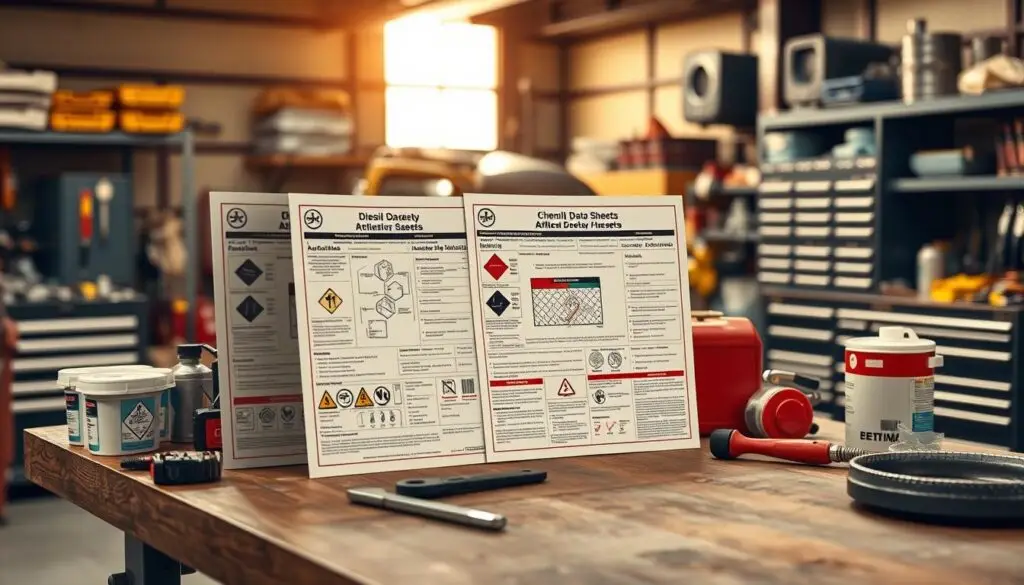
OSHA-compliant Safety Data Sheet management ensures technicians have immediate access to critical chemical hazard information.
Safety Data Sheets serve as primary reference documents following a standardized 16-section format covering identification, hazards, composition, first aid, firefighting, spill response, handling, exposure controls, physical properties, stability, toxicology, ecology, disposal, transport, regulations, and additional data. Employers must maintain current SDS versions and replace outdated documents promptly. Digital management systems enable rapid searches and automatic updates.
Every diesel shop must develop a written hazard communication program outlining implementation procedures. The program identifies the responsible person, describes inventory maintenance and labeling procedures, specifies SDS access methods, and documents employee training protocols. The program must address non-routine tasks and contractor communication requirements.
EPA Resource Conservation and Recovery Act Requirements
EPA hazardous waste regulations establish cradle-to-grave management systems for dangerous materials. Diesel shops producing waste oils, solvents, batteries, or contaminated materials must comply with federal mandates. The EPA’s hazardous waste regulations require proper waste identification through testing or process knowledge.
Generator status determines regulatory obligations. Large Quantity Generators produce 1,000 kilograms or more monthly and face stringent requirements including immediate EPA notification, 90-day storage limits, and comprehensive recordkeeping. Small Quantity Generators operate within 100 to 1,000 kilograms monthly with 180-day storage limits. Very Small Quantity Generators produce less than 100 kilograms monthly with minimal federal oversight.
| Generator Category | Monthly Generation | Storage Time Limit |
|---|---|---|
| Very Small Quantity Generator | Less than 100 kg | No federal limit |
| Small Quantity Generator | 100-1,000 kg | 180 days (270 if over 200 miles) |
| Large Quantity Generator | 1,000 kg or more | 90 days maximum |
Satellite accumulation provisions allow temporary storage of up to 55 gallons at generation points without triggering full storage facility requirements. Containers must remain closed except when adding waste, be labeled “Hazardous Waste” with accumulation start dates, and stay under operator control. Once containers reach capacity, facilities have three days to move them to central accumulation areas.
DOT Hazardous Materials Transportation Regulations
DOT shipping requirements govern hazardous material movement from diesel facilities to disposal sites. The Pipeline and Hazardous Materials Safety Administration establishes regulations for classification, packaging, marking, labeling, and documentation. Shippers bear primary responsibility for proper classification and packaging.
Classification follows a nine-class system based on predominant hazard characteristics. Class 3 covers flammable liquids including petroleum products and solvents. Class 8 includes corrosive materials like battery acid. UN-specification packaging must meet performance testing standards and display proper markings matching hazard class and packing group.
Shipping papers accompany every hazmat shipment with proper shipping name, hazard class, identification number, and packing group in specific sequence. Personnel preparing hazmat for shipment require training covering general awareness, function-specific duties, safety procedures, and security awareness, with recertification every three years.
Stay Ahead of Industry Trends
Get expert insights, equipment reviews, and operational strategies delivered weekly.
Hazmat Storage Requirements and Facility Design
Physical storage facility design directly impacts hazmat management safety. Proper infrastructure prevents accidental releases, protects workers, and demonstrates regulatory compliance through containment systems, environmental controls, material separation protocols, and identification systems working together to minimize risks.
Secondary Containment Systems
Secondary containment captures spills and leaks before reaching soil, groundwater, or drainage systems. All liquid hazmat storage areas must incorporate engineered containment preventing uncontrolled environmental releases. Systems must hold at least 110% of the largest single container’s volume or 10% of total aggregate volume, whichever is greater.
Containment requires chemical-resistant materials like steel, reinforced concrete, or approved polymer composites demonstrating compatibility with stored substances. Steel systems need protective coatings or cathodic protection. Concrete requires chemical-resistant sealants and proper curing. Aboveground tanks must rest on foundations preventing bottom soil contact for corrosion prevention and leak detection.
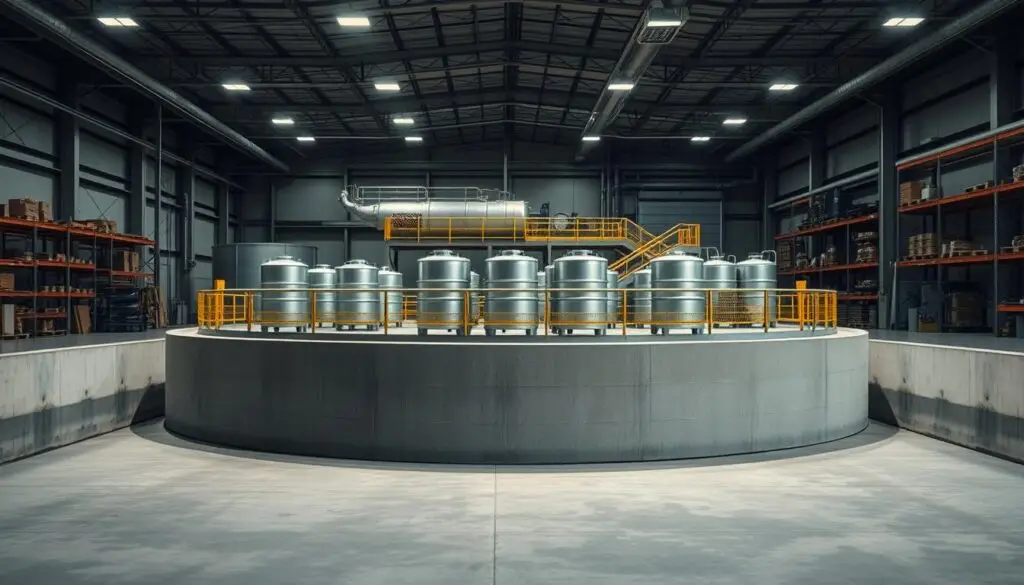
Engineered secondary containment systems with chemical-resistant construction prevent environmental contamination from container failures.
Ventilation and Climate Control
Mechanical ventilation prevents hazardous vapor accumulation creating explosion risks and worker exposure hazards. Enclosed storage spaces must provide minimum six air changes per hour for flammable liquid areas. Ventilation should exhaust vapors at floor level where heavier-than-air vapors naturally accumulate, with intake vents near ceilings creating proper airflow patterns.
Explosion-proof fans and electrical components are mandatory for Class I flammable liquids with flash points below 100°F. Systems must remain operational when hazardous materials occupy storage areas. Climate control maintains temperatures between 40°F and 95°F to prevent product degradation and reduce vapor generation. Automated temperature logs document compliance and identify HVAC malfunctions.
Chemical Segregation and Compatibility
Proper chemical segregation prevents dangerous reactions when incompatible materials mix during spills or fires. Oxidizers must remain separated from flammable materials because contact causes spontaneous combustion or explosions. Acids require isolation from bases preventing neutralization reactions generating heat and toxic fumes. Water-reactive materials need storage away from water sources including sprinkler systems and plumbing.
| Hazard Class | Incompatible With | Minimum Separation |
|---|---|---|
| Flammable Liquids | Oxidizers, Acids | 20 feet or barrier wall |
| Corrosive Acids | Bases, Flammables, Metals | Physical barrier required |
| Corrosive Bases | Acids, Flammables | Physical barrier required |
| Oxidizers | Flammables, Combustibles | 20 feet minimum |
Flammable liquid cabinets must meet NFPA 30 and OSHA specifications with double-walled 18-gauge steel construction and 1.5-inch air space. Cabinets feature self-closing doors with three-point latching mechanisms. Capacity limits are 60 gallons for Class I and II flammables or 120 gallons for Class III combustibles, with maximum three cabinets per fire area.
Personal Protective Equipment Standards
Systematic PPE selection based on comprehensive hazard assessments protects diesel shop employees from hazmat exposures. Requirements vary depending on chemicals handled, work performed, and engineering control effectiveness. Employers must provide appropriate protective gear at no cost and ensure proper training.
Required PPE for Different Hazmat Categories
Safety glasses with side shields provide minimum splash hazard protection during routine diesel fuel, lubricant, and solvent handling. Chemical splash goggles with indirect ventilation become mandatory when pouring or mixing hazardous chemicals, preventing liquids from entering around edges. Face shields must combine with goggles when handling corrosive substances during high-splash-risk operations.

Proper PPE selection based on hazard assessment protects technicians from chemical exposures during maintenance operations.
Air-purifying respirators with organic vapor cartridges are appropriate for solvent exposures below IDLH concentrations. Supplied-air respirators or self-contained breathing apparatus become mandatory for IDLH atmospheres, confined spaces with inadequate oxygen, or emergency spill response situations. OSHA’s Respiratory Protection Standard requires written programs including medical evaluations, annual fit testing, and user seal checks before each use.
Nitrile gloves provide excellent resistance to petroleum products, oils, and greases. Neoprene gloves offer broader chemical resistance including acids and caustics for battery maintenance and radiator servicing. Butyl rubber gloves are necessary for handling ketones and esters in brake fluids and specialized solvents. Chemical-resistant aprons, coveralls, and sleeve protectors provide full-body protection when handling bulk quantities.
Employee Training and Certification Requirements
Comprehensive training programs ensure employees understand hazmat handling protocols before working with dangerous materials. Federal and state agencies mandate specific employee safety education standards directly impacting diesel repair operations. Training must address multiple competency areas preparing employees for real-world hazmat situations.
Initial and Refresher Training Programs
New employees must complete initial training before handling hazardous materials. OSHA requirements under Standard 1910.1200 mandate instruction covering the Hazard Communication Standard, all hazardous chemicals present, physical and health hazards, protective measures, SDS interpretation, access procedures, and the written Hazard Communication Program.

Hands-on training in actual work conditions ensures technicians can safely perform hazmat handling procedures.
Classroom instruction alone does not satisfy certification requirements. Employees must receive hands-on training in actual or simulated work conditions, demonstrating proper techniques for opening, pouring, and dispensing hazardous materials. Trainees practice spill kit deployment, PPE donning and removal, and emergency equipment operation until competency is achieved through supervised practice and verified through direct observation.
Refresher training is required annually at minimum, whenever new chemical hazards are introduced, when new tasks are assigned, or when evidence shows inadequate previous training. Documentation must include employee name, trainer name and qualifications, training date, subjects covered, assessment results, and certifications with signatures from trainer and employee.
Specialized Certifications
RCRA training for waste management requires completion within six months of hire for Large Quantity Generators. Training covers waste identification, characterization, storage requirements, labeling, accumulation time limits, manifesting procedures, and emergency preparedness protocols specific to waste management.
DOT function-specific training must be renewed every three years, covering general awareness of hazmat regulations, function-specific requirements for job duties, safety training on material hazards and self-protection, and security awareness to recognize and respond to threats. Training records must be retained for three years minimum, with OSHA requiring hazmat exposure records for employment duration plus 30 years.
Emergency Response and Spill Management Protocols
Comprehensive emergency response and spill management protocols mean the difference between minor cleanup and catastrophic events. Effective preparedness requires detailed planning, proper equipment, and trained personnel responding quickly to contain hazmat releases while prioritizing human health and safety.
Spill Containment and Cleanup Procedures
When spills occur, first priority is protecting personnel from exposure. Workers must evacuate if spills present inhalation hazards or fire risks, alert nearby personnel through emergency notification systems, stop the source if safely possible, deploy containment barriers using absorbent booms, protect drains and waterways, eliminate ignition sources if flammable materials are involved, and ventilate areas without spreading vapors to occupied spaces. These actions must happen within minutes to prevent material spread.
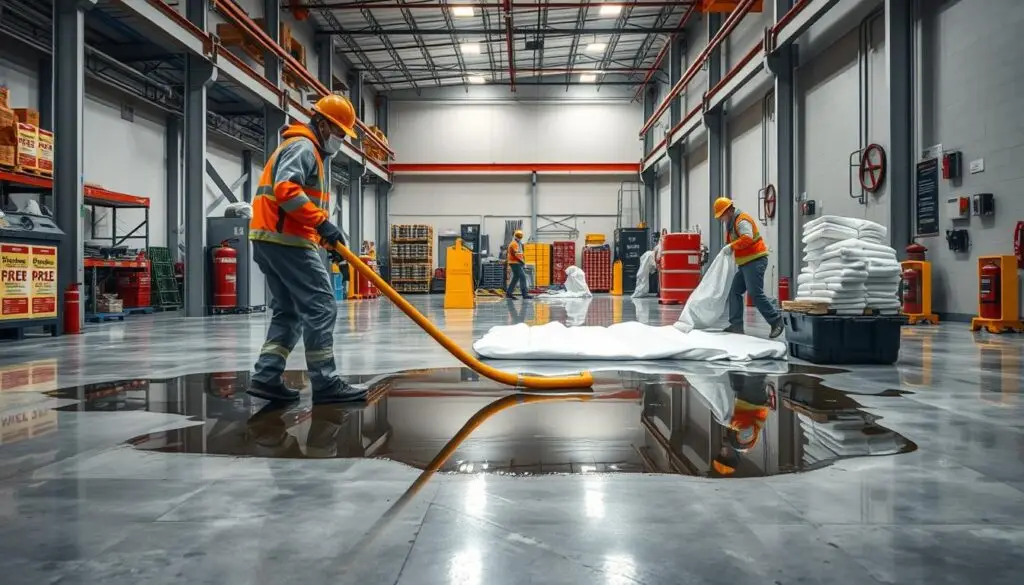
Rapid deployment of spill containment equipment prevents environmental contamination and reduces cleanup scope.
Only trained personnel wearing appropriate PPE should perform cleanup. Workers use commercial absorbents, pads, or granular materials rated for specific chemicals, starting from outer perimeter moving toward center. All contaminated materials must be collected in containers labeled as hazardous waste. After removing bulk material, decontaminate affected areas using compatible cleaning agents and dispose of cleanup materials as hazardous waste following EPA regulations.
Emergency Equipment Requirements
Comprehensive spill kits must contain absorbent pads and rolls, absorbent socks or booms for containment barriers, granular absorbent for larger releases, neutralizing agents for acids and bases, non-sparking tools, hazardous waste containers, appropriate PPE, and instruction cards with step-by-step procedures. Strategic placement near storage and use areas with visible signage ensures accessibility without entering contaminated areas.
ANSI Z358.1 mandates eyewash stations within 10 seconds travel time (approximately 55 feet) from corrosive chemical handling locations, providing 15 minutes of continuous tepid water flow between 60°F and 100°F. Safety showers must deliver 20 gallons per minute for 15 minutes within 10 seconds travel time. Weekly testing of both systems ensures proper emergency operation.
Incident Notification and Reporting
Federal regulations require immediate notification to the National Response Center at 1-800-424-8802 when spills exceed reportable quantities, discharge into navigable waters, require area evacuation, need emergency services response, result in hospitalization or death, or contaminate waterways, sewers, or storm drains. State and local agencies must be notified according to state requirements, with follow-up written reports to EPA within 15 days.
| Contact Type | Purpose | Phone Number |
|---|---|---|
| CHEMTREC | 24-hour chemical emergency information | 1-800-424-9300 |
| National Response Center | Federal incident reporting | 1-800-424-8802 |
| Poison Control Center | Medical emergency guidance | 1-800-222-1222 |
Hazardous Waste Disposal and Documentation
Meticulous tracking from generation through final disposal protects the environment and business from legal consequences. Diesel facilities generate numerous hazardous material types requiring specialized handling, with each waste stream needing proper classification and documentation creating accountability at every disposal stage.
Waste Characterization and Classification
Generators must identify hazardous waste through testing using approved analytical procedures or relying on knowledge of materials and processes creating waste. TCLP testing determines toxicity characteristics, flash point testing identifies ignitability, pH measurement assesses corrosivity, and reactivity testing evaluates instability or dangerous reactions.

Comprehensive waste tracking documentation demonstrates regulatory compliance from generation through disposal.
EPA divides hazardous wastes into listed wastes appearing on official hazard lists regardless of properties, and characteristic wastes exhibiting dangerous properties. Common diesel shop hazardous wastes include improperly drained oil filters, spent brake cleaner and degreasers, antifreeze containing heavy metals, contaminated rags, battery acid, paint wastes, and spent parts washer solvents.
Manifesting and Transportation Requirements
The Uniform Hazardous Waste Manifest accompanies every hazmat shipment creating cradle-to-grave tracking. Generators must complete sections with EPA identification numbers, waste descriptions using proper shipping names and codes, container quantities and types, waste handling requirements, generator certification signatures, and designated permitted facility information. The transporter and receiving facility sign acknowledging receipt, with copies returned confirming proper delivery.
Large Quantity Generators must submit exception reports if confirmation doesn’t arrive within 35 days. Small Quantity Generators have 60 days before filing exceptions with EPA. Choosing qualified transporters with valid EPA identification numbers and verified credentials protects facilities from liability.
Recordkeeping and Reporting Obligations
Large Quantity Generators must submit EPA Form 8700-13A biennial reports by March 1 of even-numbered years covering previous odd-year activities. Reports detail quantities generated, waste shipped to disposal facilities, and on-site management activities. Document retention periods vary: waste determination documentation for three years from final disposal date, manifests and exception reports for three years from shipment, biennial reports for three years from submission, and employee training records for employment duration plus three years.
Share Your Expertise
Join Heavy Duty Journal as a guest author and reach thousands of industry decision-makers.
Compliance Audits and Facility Inspections
Proactive monitoring through internal audits and external facility inspections forms the cornerstone of regulatory compliance. Establishing robust internal audit systems prepares facilities for external reviews while identifying deficiencies before violations occur. This dual approach creates comprehensive compliance frameworks demonstrating safety commitment.
Internal Safety Audits and Monthly Inspections
Regular self-auditing prevents regulatory violations through systematic hazmat management evaluation. Monthly inspections should verify container labeling with contents, hazard warnings, and dates; Safety Data Sheet accessibility for every hazardous material; storage area conditions inspecting for leaks, spills, or improper configurations; flammable storage cabinet functionality; secondary containment integrity; emergency equipment accessibility and inspection dates; hazardous waste accumulation compliance; training currency; and emergency contact posting accuracy.
Deficiencies should be assigned priority levels: critical for immediate safety hazards requiring instant correction, major for significant compliance gaps risking violations if unaddressed, and minor for technical non-conformances posing limited immediate risk. Corrective action plans specify deficiencies identified, root causes, corrective actions, responsible persons, and target completion dates with follow-up verification confirming effectiveness.
Regulatory Agency Inspections
OSHA inspections follow structured sequences: opening conferences explaining purpose and scope, walkthrough examinations observing conditions and noting violations, employee interviews providing worker perspectives, document reviews examining written programs and training records, and closing conferences discussing apparent violations and expected abatement timelines.
EPA inspections focus on waste characterization documentation, storage area compliance with containment and separation standards, accumulation time limit adherence, labeling and marking requirements, manifest documentation for shipments, biennial reports for applicable generators, and preparedness measures including emergency equipment and procedures. Having organized compliance documentation demonstrates management commitment to regulatory adherence.
Violation Penalties and Corrective Actions
OSHA classifies violations with corresponding penalties: other-than-serious and serious violations up to $14,502 per violation, willful violations from $10,027 to $145,027 per violation, and repeat violations up to $145,027 per violation. Failure to abate violations by deadlines results in penalties up to $14,502 per day until corrections are completed.
EPA hazardous waste violations carry substantially higher penalties reaching $76,764 per day. Criminal penalties for environmental violations include fines up to $50,000 per day and imprisonment up to five years for knowing violations, with enhanced penalties for violations knowingly placing others in imminent danger reaching $250,000 for individuals or $1,000,000 for organizations and imprisonment up to 15 years.
EPA’s Audit Policy offers reduced or eliminated civil penalties for qualifying voluntary disclosures meeting criteria including systematic discovery, prompt disclosure within 21 days, discovery independent of enforcement threats, expeditious correction within 60 days, recurrence prevention through systemic improvements, and demonstration that violations were not repeat or willful. OSHA’s Voluntary Protection Program recognizes employers with exemplary safety management systems, providing benefits including reduced inspection frequency and public recognition.
Conclusion
Effective hazmat compliance requires ongoing commitment from every operational level. Management must demonstrate visible regulatory compliance commitment through adequate resource allocation, regular facility improvements, and consistent safety protocol enforcement. When employees see genuine dedication to safety, they become active participants rather than passive observers.
Designate qualified compliance coordinators to oversee hazmat programs, monitoring regulatory changes, coordinating training schedules, conducting internal audits, managing waste disposal relationships, and serving as primary contacts during agency inspections. Look beyond basic compliance to pursue continuous improvement through less hazardous product substitution, waste reduction strategies, engineering control upgrades, and strengthened emergency preparedness.
Investment in proper hazmat handling pays dividends through reduced accident rates, lower insurance costs, improved employee morale, and protection from costly enforcement actions. Your commitment to excellence in hazardous materials management distinguishes your facility as a responsible member of the diesel repair industry.
Frequently Asked Questions
What federal agencies regulate hazardous materials handling in diesel repair shops?
Three primary federal agencies govern hazmat handling in diesel shops. OSHA enforces the Hazard Communication Standard requiring chemical inventory, labeling, Safety Data Sheets, and employee training. EPA administers the Resource Conservation and Recovery Act regulating hazardous waste generation, storage, and disposal. DOT oversees hazardous materials transportation regulations including proper classification, packaging, labeling, and shipping documentation. Each agency maintains distinct but complementary requirements that diesel shop operators must understand to achieve full compliance with federal mandates.
How do I determine my diesel shop’s generator status classification?
Generator status depends on monthly hazardous waste volumes produced by your facility. Large Quantity Generators produce 1,000 kilograms or more per month and face the most stringent requirements including EPA identification numbers, 90-day maximum storage limits, comprehensive recordkeeping, and biennial reporting. Small Quantity Generators produce between 100 and 1,000 kilograms monthly with 180-day storage limits (or 270 days if transporting waste over 200 miles). Very Small Quantity Generators produce less than 100 kilograms monthly with minimal federal requirements but must still manage waste properly and not accumulate more than 1,000 kilograms on-site at any time.
What are secondary containment capacity requirements for hazmat storage areas?
Secondary containment systems must hold at least 110% of the largest single container’s volume or 10% of the total aggregate volume of all containers, whichever amount is greater. This additional capacity accounts for precipitation accumulation in outdoor installations and provides adequate capture volume during emergency situations. For example, a storage area with ten 55-gallon drums requires containment capacity of at least 60.5 gallons. Systems must be constructed of chemical-resistant materials like steel, reinforced concrete, or approved polymer composites that maintain structural integrity and remain impervious to stored chemicals throughout their service life.
How often must employees receive hazmat training and what documentation is required?
Initial training is required before employees handle any hazardous chemicals in the workplace. Refresher training is mandatory whenever facilities introduce new chemical hazards, when assigning new tasks involving hazardous materials, when there’s evidence of inadequate previous training, or at minimum annually. Documentation must include employee name and identifier, trainer name and qualifications, specific training dates, all subjects covered during sessions, assessment results demonstrating competency, and certifications with signatures from both trainer and employee. Retention periods vary: DOT training records for minimum three years, OSHA hazmat exposure records for employment duration plus 30 years.
When is a hazmat spill considered federally reportable to regulatory agencies?
Immediate notification to the National Response Center at 1-800-424-8802 is required when a spill exceeds the reportable quantity established for that specific substance, when hazardous material discharges into navigable waters or adjoining shorelines, when the incident requires evacuation of the facility or surrounding area, when cleanup requires response by emergency services or specialized contractors, when the release results in hospitalization or death of any person, or when contamination reaches waterways, sewers, or storm drains. Additionally, state and local emergency response agencies must be notified according to state-specific requirements, with follow-up written reports submitted to EPA and state environmental agencies within 15 days providing detailed information about cause, response actions, and recurrence prevention measures.
What are the requirements for eyewash stations and safety showers in diesel shops?
ANSI Z358.1 establishes mandatory standards for emergency eyewash and shower equipment in facilities handling corrosive chemicals. Eyewash stations must be located within 10 seconds travel time (approximately 55 feet) from any location where corrosive chemicals are handled, provide 15 minutes of continuous flow of tepid water maintained between 60°F and 100°F, and be tested weekly with all tests documented. Safety showers must deliver at least 20 gallons per minute of tepid water for a full 15-minute period, be positioned within 10 seconds travel time from corrosive chemical handling areas, and undergo weekly testing. Both must be easily accessible without requiring employees to open doors, navigate stairs, or pass through contaminated areas to ensure immediate emergency decontamination capability.
Share This With Your Heavy-Duty Network
Help fleet managers and diesel technicians discover valuable insights by sharing this article.


