

The trucking industry experienced a fundamental shift in December 2017 when federal regulations mandated electronic logging devices for commercial motor vehicles. Electronic logging devices replaced traditional paper logbooks, transforming daily operations for approximately 3.4 million commercial drivers across America. This technological mandate brought new compliance requirements, technical specifications, and operational challenges that every fleet must navigate successfully.
The FMCSA ELD requirements now affect most commercial motor vehicle operators engaged in interstate commerce. These regulations demand that qualifying trucks use electronic logging device systems to automatically record driving time and duty status. Non-compliance carries serious financial consequences, with penalties ranging from $11,000 to $16,000 for egregious violations, plus potential out-of-service orders that can halt operations immediately and damage safety ratings permanently.
This comprehensive guide provides everything fleet managers, owner-operators, and company executives need to maintain proper hours of service documentation under current federal standards. You’ll discover who must comply with ELD regulations, technical device specifications, implementation strategies, and proven methods to avoid costly violations while improving operational efficiency.
Last Updated: October 2025
Key Takeaways
- Federal mandate effective December 2017: Electronic logging devices became mandatory for 3.4 million commercial drivers, fundamentally changing hours of service documentation.
- Significant financial penalties: Violations result in fines up to $16,000 and immediate out-of-service orders that stop operations and damage CSA scores.
- Specific compliance criteria: Most commercial motor vehicles over 10,001 pounds GVWR must use FMCSA-registered electronic logging devices instead of paper logbooks.
- Strategic exemptions exist: Short-haul operations, pre-2000 engine model year vehicles, and specific operational categories may qualify for exemptions with proper documentation.
- Ongoing compliance requirements: Success demands systematic device maintenance, driver oversight, comprehensive internal policies, and continuous regulatory monitoring.
Understanding the ELD Mandate: Regulatory Background and Purpose
Federal efforts to modernize trucking safety through electronic logging began in 2000, launching a contentious regulatory process that required nearly two decades to fully implement. Early attempts by the Federal Motor Carrier Safety Administration to replace paper-based record keeping with digital solutions faced repeated legal challenges from industry groups concerned about implementation costs and operational impacts.
The breakthrough came with MAP-21 legislation in July 2012. Congress passed the “Moving Ahead for Progress in the 21st Century” transportation bill, which included specific language requiring FMCSA to mandate electronic logging devices. This legislative directive provided regulatory agencies the clear authority needed to move forward with comprehensive rulemaking.
In December 2015, FMCSA published its final version of the ELD mandate after extensive public comment periods. The Owner-Operator Independent Drivers Association immediately filed lawsuits challenging the rule’s validity and implementation timeline. However, two federal appeals courts upheld the regulation, and the U.S. Supreme Court refused to hear the case in June 2017, clearing the path for full enforcement beginning December 18, 2017.
The Evolution from Paper Logs to Electronic Systems
For decades, commercial drivers relied exclusively on handwritten logbooks to track their driving hours and rest periods. These paper-based systems created numerous problems that undermined safety and compliance efforts. Drivers could easily miscalculate hours of service rules, leading to unintentional violations. More concerning was the potential for intentional falsification, as drivers facing tight delivery schedules sometimes altered their logs to appear compliant while exceeding safe driving limits.
Enforcement officers had difficulty verifying the accuracy of handwritten records during roadside inspections. The trucking industry’s first technological step involved automatic on-board recording devices, which automatically recorded driving time and engine hours but had limited functionality compared to modern systems. These intermediate solutions addressed some falsification concerns while still requiring manual data entry for certain activities.
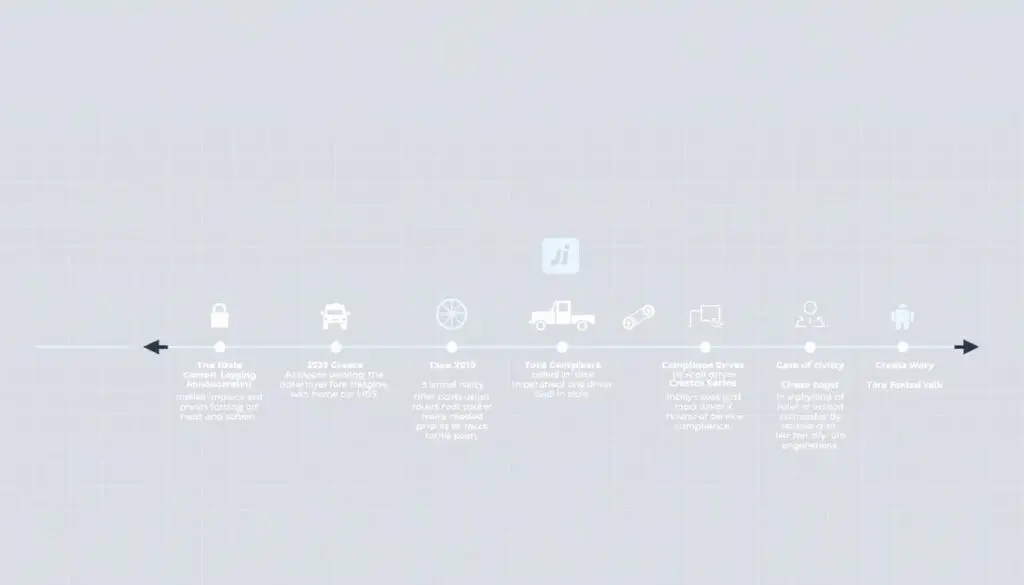
The ELD mandate evolved through two decades of regulatory development, legal challenges, and technology advancement before full implementation.
Modern electronic logging devices brought significant technological advancement beyond what AOBRDs could provide. These devices synchronize directly with vehicle engines to automatically capture driving time, location data, and vehicle movement. They feature user-friendly interfaces that simplify the logging process while creating tamper-resistant records that satisfy federal compliance standards established in 49 CFR Part 395, Subpart B.
Key Objectives of the ELD Rule
The ELD mandate pursues three primary goals that address longstanding safety and operational challenges in commercial trucking. Improving road safety stands as the mandate’s foremost purpose. Driver fatigue contributes significantly to commercial vehicle crashes, and accurate tracking of driving hours helps prevent fatigue-related accidents. Electronic systems eliminate the calculation errors that sometimes led drivers to unknowingly exceed safe driving limits.
The second objective focuses on enhancing regulatory compliance through accurate, tamper-resistant records. Paper logs allowed drivers to retrospectively alter their records or create multiple logbooks to conceal violations. Electronic logging devices automatically record data synchronized with vehicle systems, making falsification extremely difficult. This technological barrier protects honest carriers who follow rules from unfair competition with those who previously gained advantages through logbook violations.
The third goal addresses reducing administrative burden for both drivers and carriers. FMCSA estimated that drivers spent an average of 20 hours annually filling out paper logs and calculating hours of service. Electronic systems automate most of this process, freeing drivers to focus on safe operation rather than paperwork. The agency projected annual savings of $1.8 billion across the industry from reduced administrative time.
Who Must Comply with ELD Requirements
The ELD mandate affects approximately 3.4 million commercial truck drivers, but compliance obligations vary based on vehicle type and operational scope. Understanding whether your fleet falls under federal electronic logging requirements begins with examining specific vehicle classifications and driver activities. Both large carriers and individual owner-operators must evaluate their operations against federal standards, as company size does not automatically exempt any trucking business from these requirements.
Commercial Motor Vehicle Definitions
Federal regulations define commercial motor vehicles through three primary criteria that trigger ELD mandate compliance. Any vehicle meeting one or more of these standards falls under FMCSA jurisdiction per 49 CFR 390.5 and electronic logging requirements.
The first criterion involves vehicle weight ratings. Trucks with a gross vehicle weight rating or gross combination weight rating of 10,001 pounds or more qualify as commercial motor vehicles. This threshold captures most semi-trucks, heavy-duty pickup trucks used in commerce, and vehicles pulling substantial trailers.
Passenger capacity represents the second classification standard. Vehicles designed or used to transport more than eight passengers for compensation—or more than 15 passengers without compensation—meet CMV definitions. The third criterion addresses hazardous materials transportation. Any vehicle transporting quantities of hazardous materials requiring safety placards automatically qualifies as a commercial motor vehicle, regardless of weight or passenger capacity.
Commercial motor vehicle definitions determine ELD compliance obligations based on weight ratings, passenger capacity, and cargo type.
Exemptions and Special Circumstances
Federal regulations provide specific exemptions for operational categories that present reduced safety risks or face technical implementation challenges. These exemptions are narrowly defined, and carriers bear the responsibility of proving qualification. When uncertainty exists about exemption eligibility, compliance with the full ELD mandate remains the safest course.
Short-Haul Exemptions
The short-haul exception provides the most commonly utilized exemption from ELD requirements. This provision applies to drivers operating within a limited geographic radius who return to their starting location daily. The 100-air-mile radius exemption applies to CDL holders who operate exclusively within 100 air miles of their normal work reporting location, return to their starting point within 12 consecutive hours, and maintain time records showing duty start and end times without exceeding 11 hours of driving time.
A broader 150-air-mile exemption exists for non-CDL drivers operating qualifying vehicles. These operators must remain within 150 air miles of their headquarters, return daily to their starting location, and operate within a 14-hour work period. The short-haul exception requires carriers to maintain accurate time records as alternative documentation. Drivers losing exemption eligibility—even temporarily—must immediately begin using electronic logging devices for those trips.
Pre-2000 Vehicle Exception
Vehicles manufactured with engine model years before 2000 qualify for exemption from ELD requirements. This exemption recognizes technical limitations in older vehicles that may lack the electronic architecture necessary for device integration. The exemption applies specifically to the engine model year, not the vehicle registration year or chassis date. Carriers utilizing this exemption must verify engine manufacturing dates through documentation.
Drive-Away and Tow-Away Operations
Drive-away and tow-away operations receive exemption when the vehicle being transported constitutes the commodity itself. This category covers businesses that deliver vehicles from manufacturers to dealerships, reposition commercial equipment, or transport vehicles for sale or lease. The exemption applies only when transporting the actual product vehicle, not when hauling freight in a company truck.
| Exemption Type | Key Criteria | Documentation Required |
|---|---|---|
| 100-Air-Mile Short-Haul | CDL drivers, 12-hour window, daily return | Time records with start/end times |
| 150-Air-Mile Short-Haul | Non-CDL drivers, 14-hour window, daily return | Time records with start/end times |
| Pre-2000 Engines | Engine model year 1999 or earlier | Engine manufacturing documentation |
| Drive-Away/Tow-Away | Vehicle is the delivered commodity | Bills of lading, delivery receipts |
ELD Technical Specifications and Compliance Standards
Compliance with the ELD mandate extends far beyond simply installing a device in your truck. Trucking companies must ensure their electronic logging devices meet comprehensive technical specifications, maintain proper data recording capabilities, and integrate seamlessly with federal hours of service regulations. Understanding these technical standards helps fleet managers make informed purchasing decisions and avoid costly compliance violations.
Technical Specifications for Approved Devices
An electronic logging device must synchronize automatically with a commercial vehicle’s engine through the on-board diagnostic port. This connection allows the device to capture real-time engine data without requiring manual driver input. FMCSA-certified devices must plug directly into the truck’s OBD-II port and maintain continuous communication with the vehicle’s engine control module.
The hardware component must demonstrate tamper-resistant characteristics with multiple layers of data protection. These safeguards prevent unauthorized modification of driving records and ensure data integrity throughout the recording period. Display specifications require that devices provide clear, readable interfaces for drivers to monitor their duty status, including current status, available driving hours, and vehicle location information.
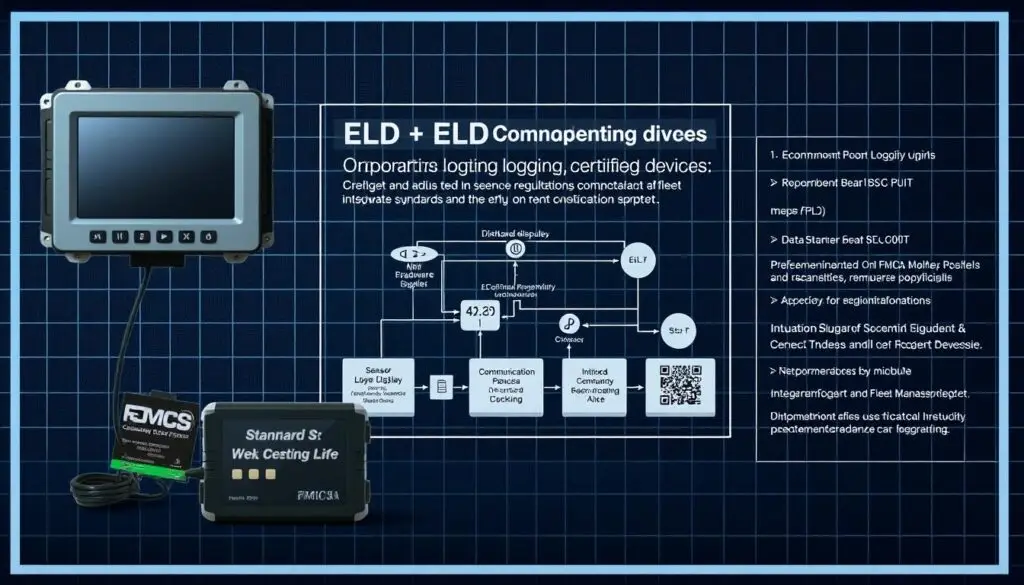
Modern electronic logging devices must meet rigorous technical specifications for engine synchronization, data security, and real-time driver information display.
Data Recording and Transfer Capabilities
Electronic logging devices must capture specific data elements that document driver activities and vehicle operations. The system continuously records engine power status, vehicle motion status, miles driven, engine hours, and precise location information. Each data point receives an authenticated timestamp that establishes when the event occurred.
Driver identification features require the device to record which authorized user operates the vehicle during each duty period. The system must capture authenticated user credentials, vehicle identification numbers, and motor carrier information for every driving session. Data transfer requirements mandate that devices support multiple methods for sharing records with law enforcement during roadside inspections.
The primary transfer method uses telematics systems that send records electronically through web services or email directly to enforcement officials. Local transfer options must include USB connections and Bluetooth capability for situations where wireless transmission is unavailable. These multiple transfer methods ensure compliance regardless of technological constraints at inspection locations.
FMCSA Registration and Self-Certification
ELD manufacturers must complete a mandatory self-certification process with FMCSA before their devices can be used for compliance purposes. This certification requires providers to formally declare that their products meet all technical specifications outlined in federal regulations. The registration process creates a publicly available list of certified devices that motor carriers can reference when selecting equipment.
Based on my research, here’s the corrected section with the proper authoritative link:
CORRECTED SECTION:
Using a non-registered device constitutes a compliance violation regardless of the equipment’s actual capabilities or features. Fleet managers should always verify that a device appears on the FMCSA’s registered ELD list before making purchasing commitments. This verification step protects companies from purchasing non-compliant systems marketed with misleading claims.
Stay Ahead of Industry Trends
Get expert insights, equipment reviews, and operational strategies delivered weekly to your inbox.
Choosing the Right ELD System for Your Fleet
Smart ELD provider selection starts with understanding the difference between minimum compliance and maximum operational value. Trucking companies must evaluate devices not only for their ability to meet federal mandates but also for features that enhance fleet productivity and reduce operational costs. The right system becomes a strategic asset rather than just a regulatory checkbox.
Essential Features and Functionality
Understanding the distinction between mandatory compliance features and value-added capabilities helps companies make informed purchasing decisions. Every certified device must include automatic duty status recording, driver-vehicle association, unassigned driving time alerts, malfunction indicators, and proper data transfer capabilities.
Beyond baseline requirements, modern systems offer features that significantly enhance operational efficiency. IFTA fuel tax reporting automation eliminates manual mileage calculations and simplifies quarterly tax filing. Electronic Driver Vehicle Inspection Reports streamline pre-trip and post-trip inspections. GPS-based geofencing automatically records customer arrival and departure times, while real-time hours of service violation alerts warn drivers before they exceed allowable driving time.
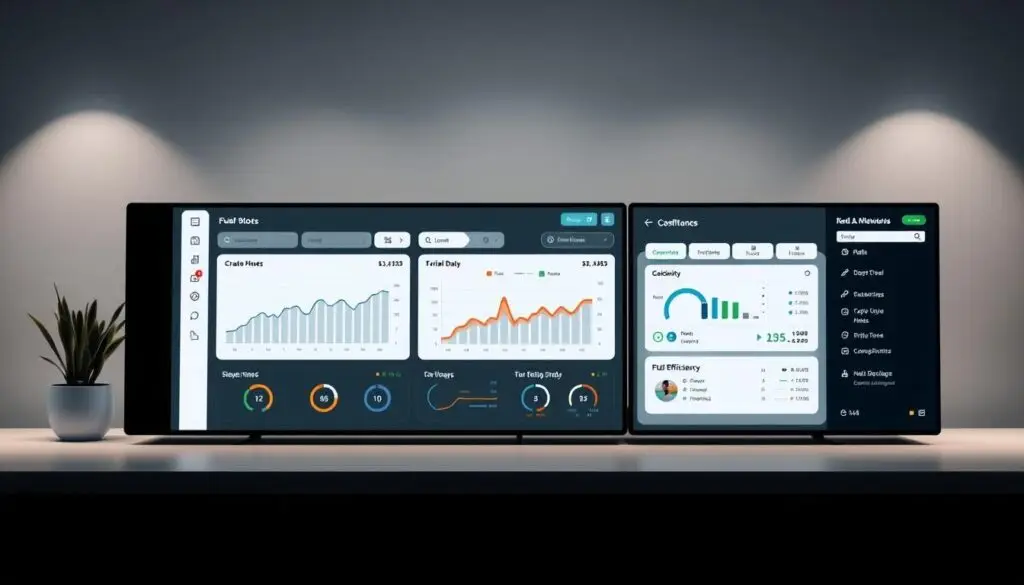
Effective ELD systems integrate with broader fleet management platforms to streamline dispatch, payroll, maintenance, and customer service operations.
Cost Considerations and ROI Analysis
ELD costs vary significantly across providers and service models. FMCSA estimates annual expenses ranging from $165 to $832 per truck, with an average of $495 per device. Many providers offer monthly subscription plans starting at $25 to $35 per vehicle, making the technology accessible for fleets of all sizes.
A comprehensive cost evaluation should include device hardware ($100-$600), monthly service fees ($20-$70 per vehicle), installation expenses ($50-$200 per truck), training costs ($500-$2,000 fleet-wide), and ongoing support. The return on investment calculation extends beyond avoiding compliance violations. FMCSA estimates that electronic logging devices save approximately 20 hours of paperwork per driver annually, generating significant value for larger fleets through reduced administrative overhead and improved operational efficiency.
Implementing ELDs in Your Trucking Operation
The difference between smooth ELD adoption and implementation chaos lies in how thoroughly you prepare your organization for this technological shift. A successful compliance rollout requires coordination across multiple departments, from operations and safety to IT and finance. Companies that approach ELD implementation strategically experience fewer disruptions and achieve faster return on investment.
Planning Your ELD Rollout Strategy
Effective implementation begins with a comprehensive project plan that establishes clear timelines and responsibilities. Your planning team should include representatives from operations, safety, IT, finance, and driver management. Starting with a small pilot group delivers measurable benefits before full deployment. Select drivers who demonstrate technical aptitude or have previous ELD experience as early adopters who can identify system issues and provide valuable feedback.

Comprehensive driver training programs determine whether ELD implementation succeeds or struggles, requiring hands-on practice and transparent communication.
Driver Training and Onboarding
Comprehensive driver training programs determine whether your implementation succeeds or struggles. Drivers must understand not only how to operate the device but also why the mandate exists and how it affects their daily routines. Effective training curriculum should cover regulatory background, hands-on device operation, duty status recording procedures, troubleshooting common technical issues, and protocols for transferring data during roadside inspections.
Many drivers express concerns about privacy, potential harassment, and job security when ELDs are introduced. Acknowledge these concerns directly during training sessions. Emphasize the positives that electronic logging delivers, including increased time on the road through more accurate hours of service tracking, decreased paperwork burdens, faster roadside inspections, and virtually eliminated disputes over log accuracy.
Installation and Device Configuration
Proper device installation establishes the foundation for reliable ELD operation. Electronic logging devices connect to the vehicle’s OBD-II diagnostic port, typically located under the dashboard near the steering column. This connection allows the device to communicate directly with the engine control module and capture required data automatically. The connection must be secure to prevent disconnection during vehicle operation.
Device configuration requires entering specific information that identifies your motor carrier and connects the ELD to your compliance records. Verify that your USDOT number appears correctly in the system, as incorrect motor carrier identification can result in compliance violations even when the device functions properly. Create individual driver accounts with proper credentials before vehicles enter service, ensuring each driver needs unique login information that connects their identity to the logs they generate.
Daily ELD Operations and Record Keeping
Effective ELD operations require drivers to perform specific daily tasks that ensure accurate record of duty status requirements and seamless data transfer during roadside inspections. While electronic logging systems automate much of the data collection process by syncing with vehicle engines, drivers and fleet managers bear responsibility for maintaining record accuracy and compliance.
Driver Daily Procedures and Core Responsibilities
Drivers must follow established procedures each time they begin a duty period to ensure proper duty status recording. The process starts with logging into the ELD system using a unique driver identification credential that associates the driver with the specific vehicle being operated. Once logged in, drivers must verify that the ELD is functioning correctly by checking for malfunction indicators.
While electronic logging devices automatically record driving time when the vehicle is in motion, drivers must manually change their status for non-driving activities including pre-trip and post-trip inspections, fueling activities, loading and unloading operations, sleeper berth periods, and off-duty time. At the end of each 24-hour period, drivers must certify the accuracy of their records, confirming that all duty status changes were properly recorded.

Drivers must be prepared to transfer seven consecutive days of ELD records during roadside inspections using electronic, USB, or Bluetooth methods.
Data Transfer Methods for Roadside Inspections
During roadside inspections, drivers must be prepared to transfer ELD data to enforcement officers using one of three approved methods. The regulations mandate that devices support display screen output for officers to review records directly, telematics transfer via web services or email to inspector equipment, and local transfer through USB or Bluetooth connection to inspector devices. Drivers must produce records for the current day plus the previous seven consecutive days upon request.
Record Retention Standards and Compliance Requirements
Motor carriers must maintain ELD records for six months from the date of receipt to satisfy federal retention requirements. This retention period applies to electronic data files, supporting documents, and any annotations or edits made to original records. Proper record retention protects carriers during audits and investigations while demonstrating systematic compliance management.
Effective retention practices include regular data backup procedures that prevent loss due to system failures or technical issues. Carriers should implement automated backup systems that capture daily records and store them in secure, accessible locations. When regulatory agencies request records, carriers must produce complete documentation that includes original automatically recorded data, all driver-proposed edits with explanatory annotations, carrier acceptance or rejection decisions, supporting documents, and malfunction event records.
ELD Violations, Penalties, and Enforcement
The consequences of failing to maintain ELD compliance include immediate penalties, long-term safety rating impacts, and potential business closure. Federal and state enforcement agencies actively monitor trucking operations through roadside inspections, compliance reviews, and audits. The Commercial Vehicle Safety Alliance began full enforcement of ELD violations on April 1, 2018, with inspectors authorized to issue citations and out-of-service orders.
Common ELD Compliance Violations
Inspectors encounter numerous violations during roadside checks and facility audits. The most serious violation involves operating a commercial motor vehicle without any ELD when regulations require one. This violation immediately places the driver and vehicle out of service until compliance is achieved. Other common violations include using an ELD that is not registered on FMCSA’s approved device list, failing to display current registration or required information on the device, ELD malfunctions not properly noted or addressed within the eight-day repair period, and inaccurate or incomplete records of duty status.
ELD violations trigger immediate penalties, CSA score impacts, and potential out-of-service orders that halt operations until compliance is restored.
Financial Penalties and Safety Rating Impact
The monetary consequences of ELD violations create substantial financial risk for non-compliant carriers. Operating without a required ELD or with a non-compliant device can result in penalties ranging from $100 to $1,000 for drivers and $1,000 to $10,000 for carriers per violation. Individual hours of service violations can result in fines from hundreds to thousands of dollars depending on severity, with egregious violations reaching $11,000 to $16,000 per instance.
ELD violations directly affect a carrier’s Compliance, Safety, Accountability scores under FMCSA’s Safety Measurement System, specifically impacting the Hours of Service BASIC category. Violations are weighted based on their severity and time-sensitivity, with recent violations having greater impact. As violations accumulate, carriers approach intervention thresholds that trigger FMCSA warning letters, investigations, and compliance reviews. Serious compliance problems can result in safety rating downgrades from “Satisfactory” to “Conditional” or “Unsatisfactory,” with an Unsatisfactory rating prohibiting interstate operation.
Out-of-Service Orders and Their Consequences
Out-of-service orders represent the most immediate and disruptive enforcement action. Inspectors have authority to issue these orders for serious ELD violations discovered during roadside inspections. The order prohibits vehicle operation until violations are corrected and compliance is demonstrated. Drivers placed out of service cannot drive until they have accumulated sufficient off-duty time to comply with hours of service requirements.
The practical and financial impact of out-of-service orders can be devastating. Delivery delays damage customer relationships and result in contract penalties. Time-sensitive freight may require expensive alternative transportation arrangements at the carrier’s expense. Out-of-service orders create permanent records in FMCSA’s Compliance, Safety, Accountability system that remain visible for 24 months and significantly impact CSA scores.
Share Your Expertise
Join Heavy Duty Journal as a guest author and reach thousands of industry decision-makers with your insights on compliance, operations, and fleet management.
Best Practices for Maintaining Ongoing Compliance
The difference between companies that struggle with ELD compliance and those that excel lies in their commitment to systematic, ongoing compliance management. Initial implementation represents only the foundation of a comprehensive program that requires continuous attention and strategic oversight. Long-term success demands dedication to device maintenance, driver oversight, comprehensive internal policies, and regulatory monitoring.
Keeping Devices Updated and Properly Maintained
Regular ELD maintenance ensures devices continue operating at certification standards and meet evolving technical requirements. Establishing quarterly schedules for firmware and software updates keeps systems current with manufacturer releases and regulatory changes. Critical updates address security vulnerabilities, fix operational bugs, and maintain FMCSA certification requirements. Delaying these updates can result in devices losing their registered status on the official compliance list.
Backup devices or paper log supplies provide crucial continuity during the eight-day malfunction grace period. Carriers must maintain sufficient backup resources to cover their entire fleet if simultaneous malfunctions occur. Preventive maintenance checks during routine vehicle inspections protect against physical connection failures and mounting hardware issues. Verifying continued registration status on FMCSA’s official list protects against using decertified devices.
Systematic Driver Oversight and Violation Prevention
Effective hours of service monitoring transforms compliance from reactive enforcement to proactive management through real-time data analysis. Daily review of driver logs identifies exceptions, violations, and concerning patterns that require immediate attention. Fleet managers should dedicate time each morning to examining previous day activities across their entire operation. This consistent oversight catches problems early and demonstrates management commitment to compliance.
Weekly or monthly compliance scorecards identify trends and patterns across individual drivers and the entire fleet. These metrics reveal whether violations cluster around specific routes, customers, or operational conditions. Root cause analysis determines whether violations result from inadequate training, operational pressures, system issues, or willful non-compliance. Understanding the why behind violations enables appropriate responses that actually solve problems.
Creating Comprehensive Internal Guidelines
Written compliance policies institutionalize ELD requirements within organizational operations and provide clear guidance for all personnel. Essential policy components begin with clear statements of company commitment to full compliance with federal regulations. Specific procedures for daily ELD operations and record certification eliminate ambiguity about driver responsibilities. Protocols for handling ELD malfunctions and technical issues prevent panic and ensure proper documentation during device failures.
Monitoring the Regulatory Landscape
The ELD regulatory environment continues evolving with periodic technical specification updates, enforcement policy clarifications, and potential mandate expansions. Subscribing to FMCSA email updates provides direct notification of regulatory changes, guidance documents, and enforcement initiatives. Participating in industry associations provides regulatory intelligence and interpretation guidance from experienced compliance professionals.
Attending industry conferences and webinars focused on compliance topics delivers concentrated education and networking opportunities. Establishing internal procedures for evaluating how regulatory changes affect company operations enables rapid response to new requirements. Future mandate expansions to currently exempt categories require monitoring for potential applicability.
Conclusion: Embracing Electronic Logging for Operational Excellence
Electronic logging device mandate compliance has fundamentally transformed the transportation industry since December 2017 implementation. Carriers across the country now recognize that ELDs represent more than regulatory requirements—they deliver measurable operational advantages through accurate hours of service tracking, reduced paperwork burdens, and improved fleet visibility.
The data speaks clearly about mandate implementation success. Electronic logging devices reduce driver fatigue and lower collision risks through precise duty status monitoring. They eliminate time-consuming paper log completion, allowing drivers to focus on safe operations. The technology promotes fairer competition among motor carriers by ensuring all operators follow uniform standards with tamper-resistant documentation.
Trucking companies that embrace ELD technology gain competitive advantages beyond basic compliance. Real-time fleet visibility supports better dispatch decisions and enhanced customer service. Accurate data collection enables informed business planning and operational improvements. Many fleets report that their electronic logging systems generate return on investment through increased productivity, streamlined operations, and reduced violation penalties.
The transition period has ended and enforcement remains active nationwide. Carriers that approach electronic logging as an opportunity rather than a burden position themselves for sustained success in an evolving industry landscape. Systematic device maintenance, comprehensive driver training, robust internal policies, and continuous regulatory monitoring separate compliant operations from those facing costly enforcement actions.
Frequently Asked Questions
What exactly is an ELD and why is it federally mandated?
An Electronic Logging Device is technology that connects to a commercial motor vehicle’s engine to automatically record driving time and hours of service for drivers required to maintain records of duty status. FMCSA mandated ELDs in December 2017 to replace paper logbooks, which were prone to errors and falsification. The mandate aims to improve road safety by accurately tracking driver hours to prevent fatigue-related crashes, enhance regulatory compliance by creating tamper-resistant records, and reduce administrative burden by automating the logging process. ELDs synchronize with vehicle engines through diagnostic ports and must meet specific technical specifications outlined in 49 CFR Part 395, Subpart B.
Does my trucking company need to comply with the ELD mandate, or are small fleets exempt?
The ELD mandate applies to most commercial motor vehicles regardless of fleet size, including individual owner-operators. If your drivers operate commercial motor vehicles with a gross vehicle weight rating of 10,001 pounds or more and are required to maintain records of duty status, they must use ELDs. Company size does not determine exemption status—the requirement is based on vehicle type and driver activity. Specific exemptions exist including the short-haul exception for drivers operating within 100 or 150 air miles who return to their starting location within specific time limits, vehicles with engine model years before 2000, and drive-away operations where the vehicle is the delivered commodity.
What are the financial penalties if my drivers operate without compliant ELDs?
ELD violations carry substantial financial consequences. Operating without a required ELD or with a non-compliant device can result in penalties ranging from $100 to $1,000 for drivers and $1,000 to $10,000 for carriers per violation. Individual hours of service violations result in fines from hundreds to thousands of dollars depending on severity, with egregious violations reaching $11,000 to $16,000 per instance. Beyond direct fines, non-compliance impacts include increased insurance premiums, loss of customer contracts, negative effects on CSA scores that trigger FMCSA interventions, potential downgrades to your safety rating that can prohibit interstate operation, and out-of-service orders that immediately halt operations until violations are corrected.
Can drivers edit their ELD records, and under what circumstances is this allowed?
Drivers have the right and responsibility to propose edits to their ELD records when automatically recorded data does not accurately reflect their actual duty status. Legitimate reasons for editing include corrections when the ELD records driving time during non-driving vehicle movement such as parking lot repositioning, system malfunctions that create inaccurate records, or times when personal conveyance or yard moves were not properly designated. Proper editing procedures require drivers to add explanatory remarks describing why the edit is necessary, and the original unedited record must be retained alongside the edited version. Carriers must review and either accept or reject proposed edits. Improper editing—particularly systematic editing designed to circumvent hours of service limits—constitutes falsification of records subject to serious penalties.
How do ELD violations affect our company’s CSA scores and safety rating?
ELD-related violations directly impact your company’s Compliance, Safety, Accountability scores under FMCSA’s Safety Measurement System, specifically affecting the Hours of Service BASIC category. Violations are weighted based on their severity and time-sensitivity, with recent violations having greater impact. As violations accumulate, your percentile ranking in the HOS BASIC increases, and reaching intervention thresholds triggers FMCSA actions including warning letters, investigations, and compliance reviews. Serious compliance problems can result in your safety rating being downgraded from Satisfactory to Conditional or Unsatisfactory. An Unsatisfactory safety rating prohibits interstate operation, effectively shutting down your business. Poor CSA scores and downgraded safety ratings result in loss of broker and shipper relationships, exclusion from preferred carrier programs, and significantly increased insurance premiums.
What should we do if our ELD system malfunctions or stops working properly?
When an ELD malfunctions, immediate action is required to maintain compliance. Drivers must note the malfunction using the ELD’s diagnostic system if functional, or manually document the malfunction if the system is completely inoperative. Carriers have an eight-day grace period to repair or replace the malfunctioning device, during which drivers must maintain paper logs and carry a note explaining the malfunction and repair timeline. The motor carrier must maintain a register of each ELD malfunction and corrective actions taken. Contact your ELD provider’s technical support immediately when malfunctions occur, implement your backup logging procedures using paper records, schedule device repair or replacement promptly, and document all actions taken. Operating beyond the eight-day grace period with a malfunctioning ELD constitutes a violation subject to penalties.
Share This With Your Heavy-Duty Network
Help fleet managers and diesel technicians discover valuable compliance insights by sharing this comprehensive ELD mandate guide.


