
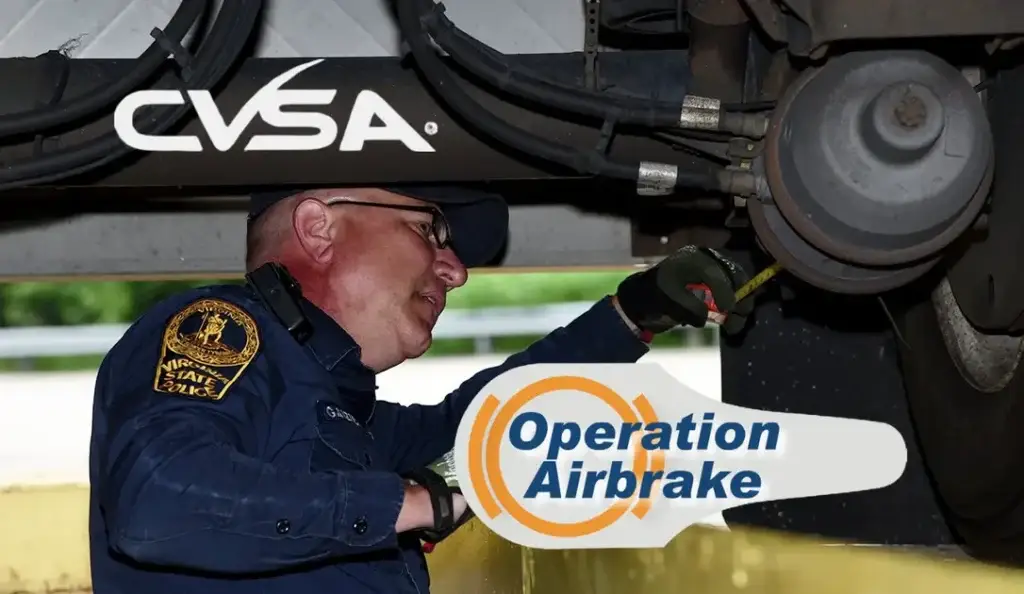
Every year, brake-related violations rank among the most common defects found during roadside checks of commercial vehicles across North America. The stopping systems on heavy-duty trucks face intense scrutiny from enforcement officers who follow strict protocols established by regulatory authorities. When these critical safety components fail to meet established thresholds, vehicles can be placed out of service immediately, disrupting fleet operations and creating significant compliance challenges.
The Commercial Vehicle Safety Alliance works alongside federal agencies to create unified brake inspection standards that protect everyone on the road. These CVSA requirements include detailed measurement criteria, with federal regulations mandating a minimum braking efficiency of 43.5 percent for commercial vehicles. Motor carriers must ensure their fleets undergo thorough evaluations at least once every 12 months under 49 CFR 396.17, with the comprehensive Level I examination covering 37 distinct checkpoint items.
This guide walks you through the specific measurement criteria, out-of-service thresholds, and practical compliance strategies that keep your fleet moving safely and legally. You’ll learn how DOT brake compliance intersects with CVSA enforcement protocols and discover actionable steps to reduce violations during roadside inspections.
Last Updated: November 2025
Key Takeaways
- Unified standards: CVSA establishes comprehensive safety protocols for commercial vehicle brakes across the United States, Canada, and Mexico, ensuring consistent enforcement.
- Minimum efficiency: Federal law requires commercial vehicles to maintain minimum braking efficiency of 43.5 percent to remain in service.
- Thorough inspections: Level I inspections represent the most comprehensive examination with 37 checkpoint items covering stopping systems and driver documentation.
- Annual requirements: Motor carriers must conduct periodic evaluations of their fleets at least once every 12 months per federal regulations.
- Common violations: Brake-related defects consistently rank among the top violations discovered during roadside checks, often resulting from adjustment issues.
- Immediate consequences: Out-of-service violations can immediately halt vehicle operations until repairs are completed and verified.
Understanding CVSA and Its Role in Commercial Vehicle Safety
Behind every roadside inspection and compliance check stands the Commercial Vehicle Safety Alliance, an organization that transformed how North America approaches commercial vehicle safety. This non-profit alliance plays a crucial role in motor carrier enforcement, creating the standardized framework that inspectors use daily. Without CVSA’s coordinated efforts, each jurisdiction would apply different criteria, making compliance nearly impossible for interstate operations.
CVSA functions as a bridge between federal regulations and on-the-ground enforcement. It translates complex safety requirements into practical inspection procedures that work across borders. Fleet managers and drivers alike must understand this organization’s influence, as it directly affects operational compliance and safety ratings.

CVSA-certified inspectors apply uniform brake inspection standards across North American jurisdictions.
History and Mission of the Commercial Vehicle Safety Alliance
CVSA emerged in 1980 when enforcement officials from various states and provinces recognized a critical problem. Commercial vehicles crossed state and international boundaries regularly, but inspection standards varied wildly from one jurisdiction to another. A truck that passed inspection in one state might fail in the next, creating confusion and inconsistency.
The founding members established a clear mission: develop uniform inspection procedures and out-of-service criteria that could be applied consistently across North America. This mission addressed both safety concerns and fairness issues. Carriers needed predictable standards, while enforcement agencies required effective tools to identify unsafe vehicles.
Over four decades, CVSA evolved into the authoritative voice for commercial vehicle safety inspections. The organization now includes members from all U.S. states, Canadian provinces and territories, and Mexico. Its voluntary consensus standards have become the de facto requirement for commercial vehicle inspections throughout the continent.
CVSA’s mission extends beyond creating standards. The organization provides training and certification for inspectors, ensuring that personnel across different jurisdictions apply identical criteria. This standardization protects carriers from arbitrary enforcement while maintaining public safety on highways. According to the CVSA official website, the alliance conducts approximately 3.5 million vehicle inspections annually across member jurisdictions.
CVSA’s Authority and Jurisdiction Across North America
Understanding CVSA authority requires recognizing an important distinction: CVSA itself does not conduct inspections or issue citations. Instead, it establishes the standards that member jurisdictions adopt and enforce. This structure allows for uniform criteria while respecting each jurisdiction’s legal authority.
The organization coordinates closely with the Federal Motor Carrier Safety Administration in the United States. Federal regulations reference CVSA standards, particularly the North American Standard Out-of-Service Criteria. When inspectors place a vehicle out of service, they’re applying CVSA-developed criteria that have been incorporated into federal and state law.
North American inspection standards created by CVSA apply across three countries, creating a harmonized enforcement environment. A CVSA Level I inspection follows the same 37-point procedure whether conducted in California, Ontario, or Nuevo León. This consistency reduces confusion for carriers operating internationally.
CVSA-certified inspectors undergo rigorous training programs that ensure consistent application of standards. These inspectors represent state police, commercial vehicle enforcement units, and federal agencies. The certification process guarantees that an inspector in Maine applies the same criteria as one in Arizona.
How CVSA Standards Impact Heavy-Duty Truck Operations
CVSA standards influence virtually every aspect of heavy-duty truck operations, from maintenance schedules to driver training programs. Fleet managers must structure their preventive maintenance around CVSA criteria, ensuring vehicles consistently meet inspection requirements. The standards define what constitutes a safe, operable commercial vehicle.
Maintenance intervals often align with CVSA requirements for brake adjustments, component wear limits, and system integrity. A fleet that ignores these standards faces roadside violations, out-of-service orders, and potential safety rating downgrades. The financial impact extends beyond citation costs to include towing expenses, load delays, and customer dissatisfaction.
Driver responsibilities expand significantly under CVSA’s framework. Pre-trip and post-trip inspections must identify defects that would violate CVSA criteria. Drivers who understand these standards can catch problems before roadside inspections occur. This knowledge protects both the driver’s record and the carrier’s compliance status.
Safety ratings assigned by FMCSA reflect CVSA inspection results. Violations discovered during CVSA-based inspections feed into the Safety Measurement System, affecting a carrier’s safety score. Poor scores trigger interventions, audits, and potential operating authority restrictions. This connection makes jurisdictional compliance with CVSA standards a business necessity, not merely a legal obligation.
Federal Brake Inspection Requirements and Out-of-Service Criteria
Commercial vehicle brake inspections operate under a comprehensive regulatory framework that combines federal requirements with standardized enforcement criteria. This multi-layered system ensures consistent safety standards across all jurisdictions while providing clear guidelines for fleet operators, mechanics, and enforcement personnel.
Federal Maintenance Requirements Under 49 CFR Part 396
Part 396 of the Federal Motor Carrier Safety Regulations establishes the foundation for commercial vehicle maintenance and inspection programs throughout the United States. This federal regulation mandates systematic inspection, repair, and maintenance procedures that motor carriers must implement to ensure vehicle roadworthiness.
The regulation contains several critical subsections that directly impact brake system compliance. Section 396.17 requires periodic inspection requirements at least once every 12 months by qualified inspectors. Section 396.11 mandates Driver Vehicle Inspection Reports for drivers to document equipment defects. Section 396.13 establishes driver responsibilities for pre-trip inspections before operating vehicles.
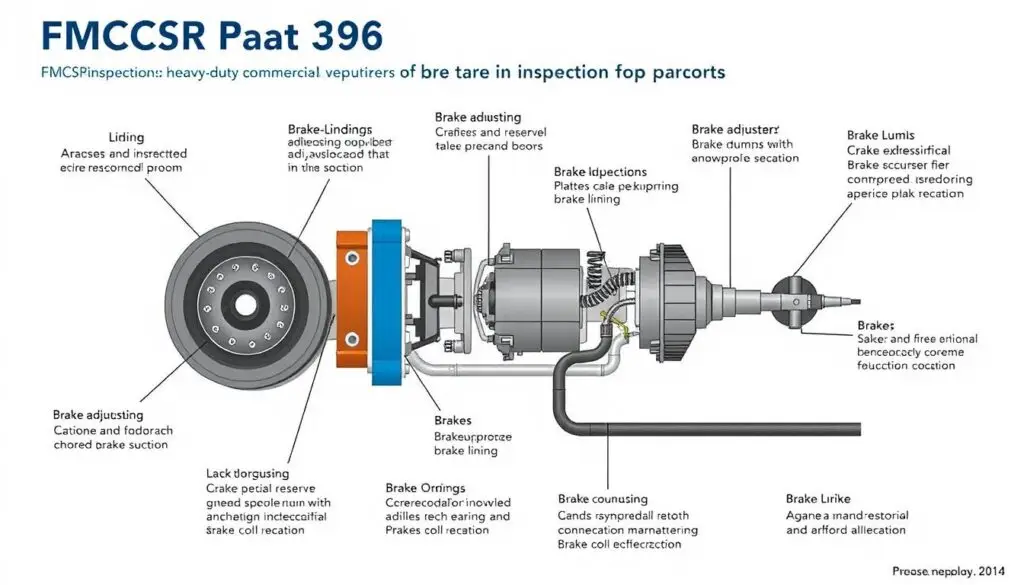
FMCSR Part 396 establishes comprehensive maintenance and documentation standards for commercial vehicle brake systems.
Under Section 396.17, inspections must cover all components listed in Appendix A, which includes comprehensive brake system evaluations. Motor carriers must retain inspection reports and maintenance records for 14 months at their principal place of business. When roadside inspections identify defects, carriers face strict compliance timelines. Inspection reports must be delivered to the motor carrier within 24 hours, and carriers must sign and return the completed report within 15 days.
Standardized Out-of-Service Thresholds
The North American Standard Out-of-Service Criteria provides uniform enforcement standards that apply across the United States, Canada, and Mexico. These criteria establish precise thresholds for when brake defects are severe enough to warrant immediate vehicle removal from service.
The minimum braking efficiency requirement stands at 43.5 percent for commercial motor vehicles. This percentage represents the vehicle’s deceleration force relative to its gross vehicle weight. Vehicles failing to meet this threshold receive immediate out-of-service orders.
Beyond overall braking efficiency, the criteria specify defect thresholds for individual brake components including brake adjustment limits based on brake chamber type and pushrod stroke measurement, minimum thickness requirements for brake linings and friction materials, air system integrity standards including pressure build-up time and leakage rates, and component condition requirements for slack adjusters, chambers, and hoses.
Annual Inspections Versus Roadside Enforcement
Commercial vehicles undergo two distinct types of brake inspections, each serving different purposes within the safety compliance framework. Understanding these differences helps fleet managers develop appropriate maintenance strategies.
Annual vehicle inspection programs function as preventive maintenance requirements. Qualified inspectors conduct comprehensive examinations covering all vehicle systems, including detailed brake component evaluation. These inspections occur at facilities with proper equipment and trained personnel. The systematic nature allows thorough assessment of brake adjustment, lining thickness, air system integrity, and component condition before problems escalate into safety hazards.
Roadside inspections represent enforcement actions conducted by certified commercial vehicle inspectors. These examinations may occur at any time during vehicle operation, typically at inspection stations, weigh stations, or during traffic stops. While less comprehensive than annual inspections, roadside examinations focus on immediate safety concerns and compliance with out-of-service criteria.
| Inspection Element | Annual Inspection | Roadside Inspection |
|---|---|---|
| Primary Purpose | Preventive maintenance documentation | Immediate safety enforcement |
| Inspection Depth | Comprehensive system evaluation | Focused defect identification |
| Conducted By | Qualified maintenance inspectors | Certified enforcement officers |
| Immediate Consequences | Repair recommendations and documentation | Potential out-of-service orders and citations |
Both inspection types contribute to overall fleet safety, but annual inspections provide opportunities to address developing issues before they result in roadside violations. Motor carriers maintaining rigorous periodic inspection requirements typically experience fewer roadside defects and out-of-service orders.
CVSA Brake System Classification and Components
Commercial vehicles utilize three primary brake system types, each requiring specialized knowledge for accurate inspection and compliance verification. These classifications include air brake systems, hydraulic brakes, and electric brake systems, with each presenting unique operational characteristics and inspection requirements.
Level I inspections examine brake systems comprehensively, evaluating service brakes, parking brakes, brake connections, coupling devices, and all related components. Inspectors assess brake hoses, tubing, brake chambers, pushrods, brake linings, and air system integrity according to established criteria.
Air Brake Systems in Heavy-Duty Trucks
Air brake systems represent the predominant braking technology for heavy-duty trucks and commercial vehicles exceeding 26,000 pounds gross vehicle weight rating. These systems use compressed air to generate the mechanical force necessary to stop massive commercial vehicles reliably and consistently.
The air brake system operation begins with an engine-driven air compressor that pressurizes air and stores it in supply reservoirs. When the driver applies the brake pedal, compressed air travels through brake lines to brake chambers mounted at each wheel position. The air pressure pushes a diaphragm inside the brake chamber, which extends a pushrod connected to a slack adjuster.
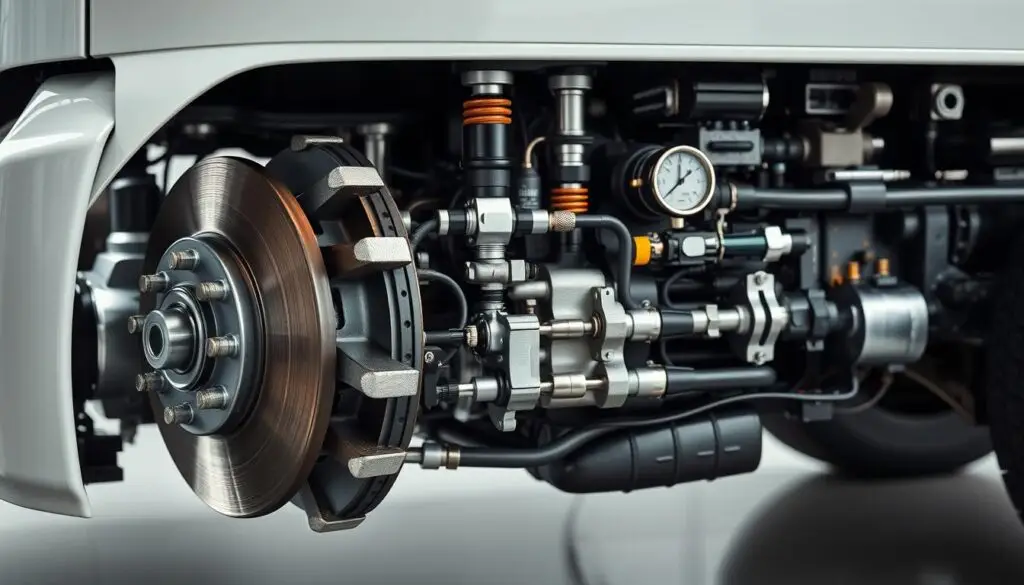
Air brake system components undergo detailed inspection during CVSA Level I examinations.
The slack adjuster converts the linear motion of the pushrod into rotational force, turning the brake camshaft or S-cam. This rotation spreads the brake shoes outward against the brake drum, creating the friction necessary to slow or stop the vehicle. Self-adjusting brake adjusters are mandatory on vehicles manufactured after October 19, 1994 in the United States and May 31, 1996 in Canada.
Anti-lock brake systems must have functioning malfunction lamps that illuminate when power is supplied and then extinguish if the system is operational. ABS technology prevents wheel lockup during hard braking, maintaining steering control and reducing stopping distances. Modern heavy-duty trucks integrate ABS with electronic stability control systems for enhanced safety performance.
Hydraulic and Electric Brake Systems
Hydraulic brakes operate on fundamentally different principles than air brake systems, using incompressible brake fluid to transmit force from the brake pedal to wheel cylinders. These systems are typically found on lighter commercial vehicles under 26,000 pounds GVWR and specialized equipment where air brake systems would be impractical or unnecessary.
In hydraulic brake configurations, the driver’s foot pressure on the brake pedal pushes a piston in the master cylinder. This action forces brake fluid through steel or reinforced rubber brake lines to wheel cylinders or brake calipers at each wheel. The hydraulic pressure causes pistons in the wheel cylinders to push brake shoes against drums or brake pads against rotors.
Electric brake systems represent the newest evolution in brake system types for commercial vehicles, incorporating electronic controls and actuators alongside traditional mechanical components. Electric parking brakes replace traditional spring brake chambers with electric motors that engage parking brakes through electronic control modules. Regenerative braking technology captures kinetic energy during deceleration and converts it to electrical energy for battery storage.
Stay Ahead of Industry Trends
Get expert insights, equipment reviews, and operational strategies delivered weekly to your inbox.
Specific CVSA Brake Performance Requirements
CVSA inspectors evaluate brake systems against specific numerical thresholds and performance benchmarks. These brake performance criteria establish clear boundaries between compliant and deficient braking systems. Understanding these precise measurements helps fleet operators maintain regulatory compliance and prevent out-of-service violations.
Brake Adjustment Specifications and Measurement Methods
Proper brake adjustment is fundamental to safe braking performance. When brakes fall out of adjustment, the pushrod must travel farther to engage the brake shoes or pads. This increased travel distance reduces braking force and extends stopping distances significantly.
Automatic slack adjusters became mandatory on vehicles manufactured after October 1994 in the United States and May 1996 in Canada. These devices automatically maintain proper brake adjustment as friction material wears. Despite automation, these components can fail or malfunction, requiring regular verification.
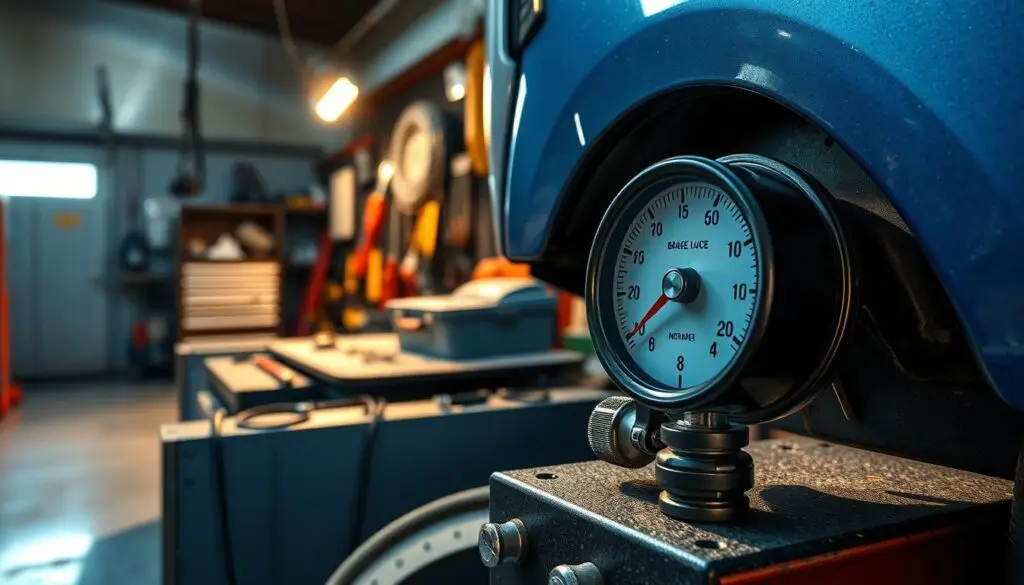
Accurate pushrod stroke measurement determines brake adjustment compliance with CVSA standards.
Inspectors follow a specific procedure to measure pushrod stroke accurately. The vehicle must be positioned on level ground with wheels properly blocked. Spring brakes must be released, and the air system pressurized to between 90 and 100 psi. The measurement process requires marking the pushrod at the brake chamber with chalk or a marker. An assistant then fully applies and holds the service brakes while the inspector measures pushrod travel.
Maximum Stroke Specifications for Brake Chamber Types
Different brake chamber sizes have different maximum allowable brake stroke limits. Exceeding these limits results in an out-of-service violation. The regulation specifies exact measurements for each chamber type used in commercial vehicles.
| Brake Chamber Type | Maximum Stroke Limit | Common Applications |
|---|---|---|
| Type 6 | 1¼ inches | Light commercial vehicles |
| Type 12 | 1⅜ inches | Medium-duty trucks |
| Type 20 | 1¾ inches | Standard heavy-duty trucks |
| Type 30 | 2 inches | Heavy-duty tractors and trailers |
Long-stroke chambers provide additional adjustment range. Type 20LS allows 2 inches of travel, while Type 24LS permits 2½ inches. Type 30LS chambers can accommodate up to 2½ inches of pushrod movement before falling out of specification. The DD3 designation indicates a specific chamber design with unique stroke specifications.
Minimum Thickness Standards and Air Pressure Requirements
Friction material provides the stopping power in brake systems. As this material wears through normal use, braking efficiency decreases proportionally. CVSA standards specify minimum acceptable brake lining thickness to ensure adequate performance.
Drum brake linings must maintain sufficient thickness at the thinnest point. Inspectors measure lining thickness at the shoe center or at the point of most significant wear. Any lining or pad measuring less than the specified minimum triggers an out-of-service condition. Disc brake pads face similar requirements for friction material depth.
Air brake systems depend on adequate pressure to function properly. The compressor must build pressure from 85 to 100 psi within specified time limits. Systems that build pressure too slowly indicate compressor problems or significant air leaks. Minimum pressure thresholds protect against brake failure. The low-pressure warning device must activate before pressure drops below 60 psi.
Air system leakage testing reveals system integrity problems. With the engine off and brakes fully applied, the system must not leak more than specified rates. Single vehicle leakage cannot exceed 3 psi per minute, while combination vehicles must stay below 4 psi per minute.
Out-of-Service Criteria for Brake Systems
When brake inspections reveal critical defects, specific out-of-service standards dictate which violations demand immediate action before another mile is traveled. These enforcement thresholds protect highway safety by removing vehicles with dangerous brake conditions from operation.
Defects Requiring Immediate Vehicle Removal
Critical brake defects represent the most serious brake system failures that inspectors encounter during roadside examinations. These conditions pose immediate safety threats and result in automatic out-of-service orders. Missing or broken brake components on any axle constitute grounds for vehicle removal, as these failures eliminate braking capacity entirely.
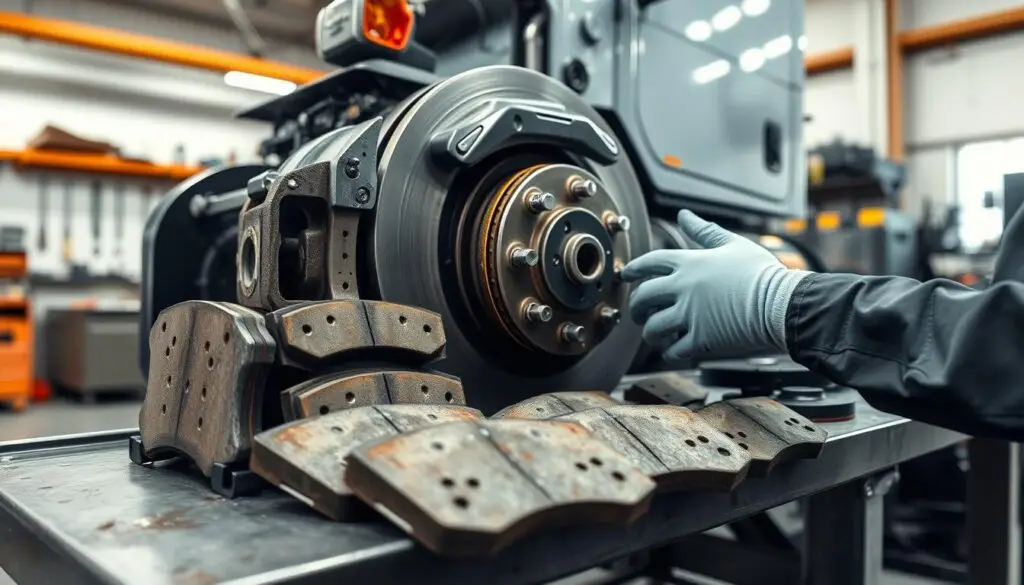
Vehicles with critical brake defects receive immediate out-of-service orders until repairs are verified.
Brake chambers that are inoperative, disconnected, or have damaged mounting brackets trigger immediate out-of-service status. The brake chamber must be securely attached and functioning properly to transmit air pressure into mechanical force. Any crack or break in the mounting system compromises this critical function.
Pushrods that exceed maximum stroke limits represent another category of critical brake defects. When adjustment deteriorates beyond acceptable parameters, braking force diminishes substantially. Inspectors measure pushrod travel and compare findings against established limits for specific brake chamber types.
Brake hose and tubing conditions receive particular scrutiny during inspections. Damage extending through the outer reinforcement ply creates immediate out-of-service criteria because internal structural integrity is compromised. Bulging or swelling when air pressure is applied indicates weakened hose construction that may rupture without warning.
Calculating the Twenty Percent Threshold
The percentage requirements for inoperative brakes establish a mathematical formula that determines when accumulated brake violations warrant vehicle removal from service. The North American Standard specifies that vehicles must be placed out-of-service when 20 percent or more of brakes are defective.
For a five-axle combination vehicle with standard brake configurations, the calculation becomes straightforward when all brakes can be measured. If one axle cannot be measured during inspection, the formula still applies to the measurable brakes. The percentage calculation works differently across vehicle configurations. A single-unit truck with fewer axles reaches the 20 percent threshold more quickly than a multi-axle combination.
| Brake Defect Category | Specific Condition | Out-of-Service Status |
|---|---|---|
| Brake Hose Damage | Damage through outer reinforcement ply | Immediate removal required |
| Air System Leakage | Exceeds 3 PSI in one minute (single vehicle) | Out-of-service until repaired |
| Brake Adjustment | 20% or more brakes defective | Vehicle cannot operate |
| Lining Thickness | Below minimum standards on any wheel | Immediate out-of-service |
Enforcement Actions and Operational Impact
Consequences of out-of-service violations extend far beyond the immediate roadside delay. When inspectors issue an out-of-service order, the vehicle cannot move until all cited defects are corrected and verified. This requirement means arranging mobile repair services or towing the vehicle to a qualified repair facility.
Drivers and carriers face significant penalties for operating vehicles under out-of-service orders. Federal regulations impose civil penalties that increase with each violation. Operating a vehicle placed out-of-service demonstrates willful disregard for safety standards and receives enhanced enforcement attention.
Each brake violation becomes part of the carrier’s safety record in federal databases. These records affect Compliance, Safety, Accountability scores and carrier safety ratings. Accumulated brake violations can lead to increased inspection frequency and additional regulatory scrutiny.
CVSA Level I Inspection Procedures for Brakes
When an inspector initiates a Level I inspection, drivers and carriers face the most thorough brake system evaluation in commercial transportation. This comprehensive roadside inspection examines every accessible component of the braking system according to strict CVSA protocols.
The 37-Point North American Standard Inspection
The North American Standard Level I inspection consists of 37 distinct examination points covering the entire commercial vehicle. Brake system components represent a significant portion of these inspection criteria. Inspectors follow standardized CVSA protocols to maintain consistency across jurisdictions.
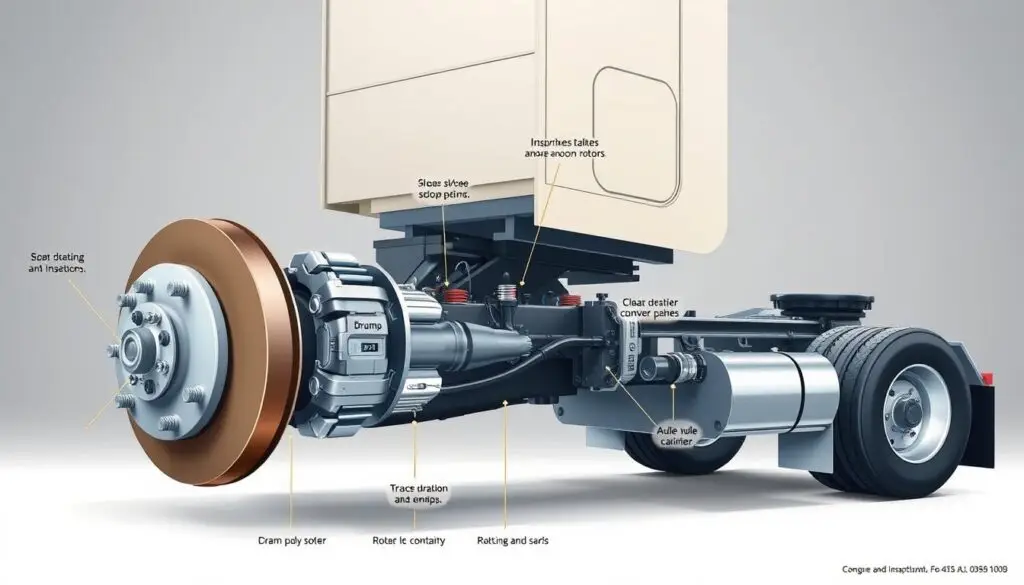
Level I inspections follow a systematic 37-point examination protocol established by CVSA.
This comprehensive examination includes driver documentation verification, hours of service review, and thorough mechanical inspections. The brake system evaluation stands as one of the most critical components. Inspectors examine service brakes, parking brakes, and trailer brake connections with equal attention.
A key distinction exists between Level I and Level II inspections. If inspectors cannot measure more than 20 percent of pushrod travel on exposed pushrods, the examination automatically becomes a Level II Walk-Around inspection. This classification affects the depth of brake system analysis performed during the roadside inspection.
Step-by-Step Brake Inspection Process
The CVSA inspection procedure follows a systematic sequence that ensures thorough evaluation of every brake component. Inspectors begin with visual examinations before moving to physical measurements and testing. This methodical approach prevents overlooked defects that could compromise vehicle safety.
Inspectors pay special attention to pushrod stroke measurements during this process. These measurements directly indicate brake adjustment status and identify potential violations. Each brake chamber type has specific stroke limits that inspectors verify against CVSA standards.
Air pressure testing represents another critical component of the inspection. Inspectors measure pressure buildup time and system leakage rates to ensure air brake systems maintain adequate pressure. Vehicles that fail these tests receive immediate out-of-service orders until repairs are completed. The entire Level I inspection typically requires 45 to 60 minutes to complete properly.
Documentation and Reporting Requirements
Inspection documentation creates an official record of the roadside inspection and any violations discovered. Inspectors complete standardized forms that detail every item examined and all defects found. This paperwork becomes a critical component of vehicle maintenance records and compliance history.
The inspection report must include specific information about the vehicle, driver, and carrier. Inspectors document the date, time, and location of the inspection. They record each violation with corresponding CVSA code numbers that identify the specific defect discovered.
Drivers receive copies of the inspection report immediately upon completion. They must deliver this inspection documentation to their motor carrier within 24 hours of the examination. Motor carriers face strict deadlines for responding to inspection reports. They must sign and return completed reports within 15 days of receipt.
Common Brake Violations and Compliance Issues
The pattern of brake violations discovered during roadside inspections reveals critical areas where fleets must focus their maintenance efforts. Understanding these brake compliance failures helps operators prevent costly citations and service disruptions.
Brake Defects That Lead to Citations
Brakes out of adjustment represent the single most frequently cited violation during commercial vehicle inspections. This occurs when pushrod stroke exceeds the regulation limits specific to each brake chamber type. Inspectors measure this distance carefully, and even small exceedances trigger immediate citations.
Defective or missing brake components rank second among common brake defects identified during roadside checks. These violations include non-functional brakes on any axle, which immediately compromise vehicle safety. Inspectors document each inoperative brake and calculate the percentage of total braking capacity affected.
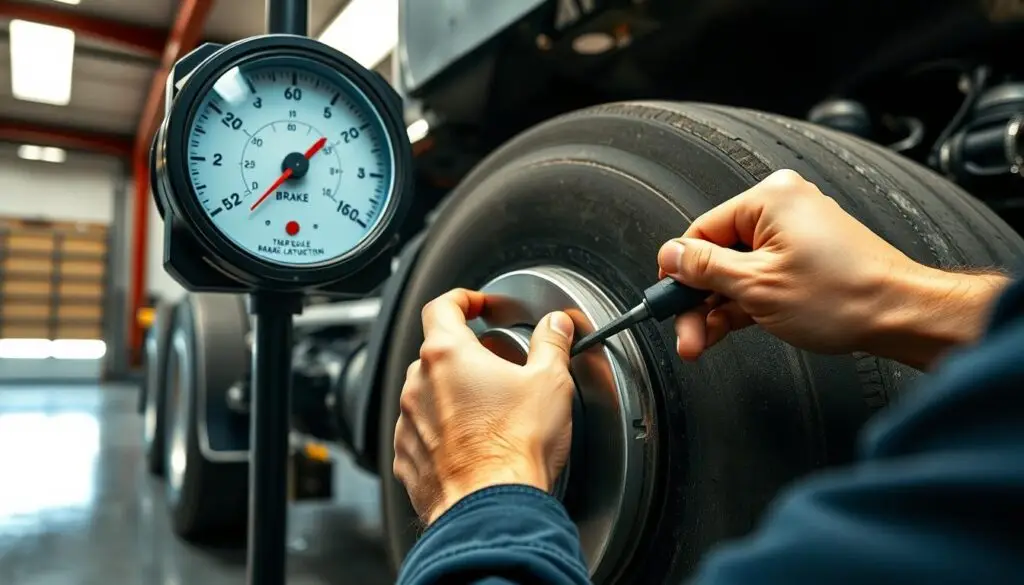
Proper brake adjustment prevents the most common violation discovered during roadside inspections.
Brake hose and tubing damage constitutes another major category of brake violations. Damage through the outer reinforcement ply creates an immediate safety concern. However, inspectors understand that rubber-impregnated fabric covers are not reinforcement plies and assess damage accordingly.
Additional hose violations include bulging or swelling when the system is pressurized. Audible air leaks from hoses or connections also trigger citations. Improper splicing or repairs using unauthorized methods violate federal standards, as does heat damage that causes hardening or crimping of brake lines.
Measurement Confusion and Component Damage
Confusion regarding proper stroke measurement contributes significantly to brake adjustment errors during both self-inspections and roadside checks. Different brake chamber types have distinctly different stroke limits that must be applied correctly. A Type 30 long-stroke chamber allows a maximum stroke of 2.5 inches, while a Type 30 standard chamber permits only 2 inches.
Measurements must be taken with system pressure between 90 and 100 psi to ensure accuracy. Taking measurements at lower pressures produces misleadingly short stroke readings. This leads operators to believe brakes are properly adjusted when they actually exceed limits under normal operating pressure.
Cracked or broken brake chambers represent serious structural failures that inspectors identify immediately. These components operate under significant pressure and mechanical stress. Any visible cracks compromise the chamber’s integrity and create imminent failure risk. Missing or damaged dust shields expose internal brake components to road debris and contaminants.
Moisture and Contamination in Pneumatic Systems
Moisture accumulation in air brake systems causes numerous air system problems that lead to violations and component failures. Water in compressed air freezes in cold weather, blocking passages in valves and preventing proper brake operation. This creates unpredictable brake response that endangers vehicle control.
Oil contamination in air systems results from compressor wear or inadequate separation in the air dryer. Oil coats internal valve components and changes their operational characteristics. This contamination accelerates wear on seals and diaphragms throughout the air system.
Proper air dryer maintenance prevents most moisture-related brake compliance failures in pneumatic brake systems. Dryers use desiccant cartridges that require regular replacement according to manufacturer schedules. Neglecting this maintenance allows moisture to pass through into the brake system unchecked.
Share Your Expertise
Join Heavy Duty Journal as a guest author and reach thousands of industry decision-makers with your technical knowledge and operational insights.
Best Practices for Maintaining CVSA Brake Compliance
A structured approach to brake system maintenance transforms regulatory compliance from a reactive burden into a strategic operational advantage. Fleet operators who establish comprehensive programs benefit from reduced downtime, fewer violations, and enhanced safety records.
Implementing Comprehensive Preventive Maintenance Programs
Effective preventive maintenance extends far beyond minimum regulatory requirements to address potential problems before they become violations. Scheduled brake inspections at intervals shorter than the annual requirement allow maintenance teams to identify wear patterns and developing issues early. Many successful fleets conduct quarterly brake system evaluations rather than waiting for the mandatory annual inspection.
Systematic component replacement strategies prove more cost-effective than reactive repairs. Fleet managers should establish replacement thresholds that provide safety margins above minimum acceptable standards. For example, replacing brake linings at 5/16 inch rather than waiting until they approach the 1/4 inch minimum prevents unexpected failures and compliance issues.
Air system maintenance deserves special attention in any brake maintenance program. Regular servicing of air dryers prevents moisture accumulation that can freeze in cold weather or corrode system components. Establishing a routine schedule for draining air tanks and replacing air dryer desiccant cartridges eliminates many common air brake problems before they develop.
Trending analysis provides valuable insights into fleet-wide brake performance patterns. By tracking brake adjustment measurements, lining wear rates, and component failure data across the fleet, maintenance managers can identify vehicles requiring more frequent attention and predict when major brake work will be needed.
Driver Inspection Responsibilities and Documentation
Drivers serve as the first line of defense in identifying developing brake problems before they escalate into serious violations. Pre-trip inspections under 49 CFR 396.13 require drivers to inspect vehicles before operation and verify that previous defects were adequately repaired.
The pre-trip process includes reviewing and signing the previous driver’s inspection report to certify that required repairs were completed. This continuity of oversight prevents defective vehicles from remaining in service due to communication breakdowns. Drivers must understand they share responsibility for vehicle safety and cannot simply assume repairs were made.
Driver Vehicle Inspection Reports fulfill critical documentation and safety functions. According to 49 CFR 396.11, these reports must be completed at the end of each day’s work for passenger-carrying vehicles. Other commercial vehicles require DVIRs only when defects are discovered during operation.
Motor carriers must repair documented defects before dispatching vehicles and certify repairs on the original DVIR. This closed-loop system ensures defects receive prompt attention and creates an auditable record of maintenance activities. Carriers must retain these reports for three months to demonstrate ongoing compliance efforts.
Establishing Effective Record-Keeping and Training Programs
Proper documentation proves essential for demonstrating fleet compliance during audits and investigations. Comprehensive records show regulatory authorities that carriers take their safety obligations seriously and maintain systematic oversight of vehicle conditions.
Federal regulations establish specific retention periods for different document types. Driver Vehicle Inspection Reports must be retained for 3 months per 49 CFR 396.11. Periodic inspection reports require 14-month retention under 49 CFR 396.17. Roadside inspection reports must be kept for 12 months according to 49 CFR 396.9. Inspector qualification records need retention for 1 year after the inspector ceases work per 49 CFR 396.19.
Qualified personnel form the foundation of any successful brake compliance program. Inspector qualifications under 49 CFR 396.19 require individuals to understand inspection standards, identify defective components, and possess at least one year of relevant training or experience.
Formal training on CVSA inspection standards should cover the specific criteria that inspectors apply during roadside examinations. Mechanics who understand how their work will be evaluated can better align their procedures with enforcement expectations. This alignment reduces the likelihood of violations resulting from differences in interpretation between maintenance facilities and roadside inspectors.
Conclusion
Brake safety compliance represents a fundamental responsibility for every commercial vehicle operator across North America. CVSA standards provide consistent enforcement criteria that protect drivers, cargo, and the traveling public. These regulations establish clear benchmarks for brake system performance and condition that apply uniformly across jurisdictions.
The multi-layered inspection approach combines annual periodic inspections, daily driver checks, and roadside enforcement examinations. This comprehensive system ensures continuous monitoring of brake performance throughout a vehicle’s operational life. Each inspection level serves a distinct purpose in maintaining commercial vehicle safety.
Successful fleet brake management requires proactive maintenance programs rather than reactive repairs. Operators who invest in preventive maintenance, mechanic training, and thorough documentation typically experience fewer violations and reduced downtime. These practices translate into operational efficiency and cost savings over time.
Understanding specific requirements from stroke limits and air pressure thresholds to minimum lining thickness empowers mechanics and drivers to identify potential issues before they become critical defects. Regular training keeps personnel current with evolving standards and inspection procedures. Meeting these requirements protects your drivers, preserves your fleet’s operational status, and contributes to safer highways for everyone.
Frequently Asked Questions
What is the Commercial Vehicle Safety Alliance and what authority does it have over brake inspections?
The Commercial Vehicle Safety Alliance is a non-profit organization dedicated to improving commercial vehicle safety through uniform enforcement standards across North America. While CVSA itself is not a regulatory agency, its standardized inspection criteria are adopted and enforced by member jurisdictions throughout the United States, Canada, and Mexico. CVSA-certified inspectors in these countries apply identical brake inspection standards during roadside inspections, ensuring consistency regardless of location. This means heavy-duty trucks must meet the same brake performance requirements whether operating in California, Ontario, or any other North American jurisdiction.
What are the maximum allowable pushrod stroke limits for different brake chamber types?
Pushrod stroke limits vary depending on brake chamber type and size. Type 30 brake chambers have a maximum stroke of 2.0 inches for standard chambers, while Type 24 chambers have a 1.75-inch limit. Type 36 chambers, the largest standard chambers, have a 2.5-inch stroke limit for long-stroke applications. These measurements represent the maximum permissible pushrod travel from the released position to full application with air pressure between 90-100 psi. Exceeding these limits indicates brakes are out of adjustment and constitutes a violation that can result in out-of-service orders.
How does the 20 percent rule work for determining out-of-service status due to brake defects?
The 20 percent rule establishes that when 20 percent or more of a vehicle’s brakes are defective or out of adjustment, the vehicle must be placed out of service. This calculation applies to the total number of brakes on the vehicle or combination. For example, a tractor-trailer combination typically has 10 brake positions. If two or more of these brakes are defective—meaning pushrods exceed stroke limits, linings are below minimum thickness, or components are missing or damaged—the vehicle meets the threshold and must be removed from service until defects are corrected and verified.
What are the most common brake-related violations discovered during CVSA inspections?
The most frequently cited brake violations include brakes out of adjustment with pushrods exceeding regulation stroke limits, which consistently ranks as one of the top commercial vehicle defects nationwide. Other common violations include brake linings or pads worn below minimum thickness standards, defective or missing brake components such as cracked brake chambers or broken return springs, brake hose and tubing damage that penetrates the outer reinforcement ply, air brake system pressure problems including slow buildup time or excessive leakage rates, and inoperative brake chambers. Understanding these common violations allows fleet managers to focus preventive maintenance efforts on the areas most likely to result in inspection failures.
What are the maximum permissible air brake system leakage rates?
Air brake system leakage rates are measured with the system charged to operating pressure (typically 90-100 psi) and brakes fully applied. For single vehicles, the maximum permissible leakage rate with brakes applied is 3 psi per minute. For combination vehicles, the maximum is 4 psi per minute with brakes applied. With brakes released, single vehicles must not lose more than 2 psi per minute, and combinations must not exceed 3 psi per minute. Inspectors conduct these tests by building system pressure to the required level, applying brakes fully, and monitoring pressure drop over a one-minute period. Leakage rates exceeding these thresholds indicate air system integrity problems that can compromise braking performance.
What is the minimum acceptable thickness for brake linings and pads on heavy-duty trucks?
Brake linings on drum brake systems must have a minimum thickness of 6.4 millimeters (1/4 inch) at the shoe center, or the lining must not be worn to a point where bonding strips or rivets are exposed if the lining is bonded or riveted to the brake shoe. For disc brake pads, the friction material thickness must not be less than 3.2 millimeters (1/8 inch). Inspectors measure lining thickness at the thinnest point, and any measurement below these minimum standards constitutes a violation requiring immediate attention. These minimum thickness requirements ensure adequate friction material remains to generate sufficient braking force and prevent metal-to-metal contact that would damage brake components.
Share This With Your Heavy-Duty Network
Help fleet managers and diesel technicians discover valuable insights by sharing this article with your professional network.