By Michael Nielsen, Publisher | 15+ Years in Diesel Repair
Last Updated: September 2026
⏱ Estimated reading time: 13 minutes
Wheel hub maintenance doesn't get the attention that engines, brakes, or tires get in most maintenance conversations — right up until a hub fails. When a wheel-end assembly loses lubrication or runs out of adjustment tolerance, the failure mode isn't a gradual performance decline like a worn injector or a soft brake pedal. It's often sudden, and at highway speed, a wheel separation is one of the most dangerous mechanical failures a commercial vehicle can experience.
The good news is that wheel hub failures are among the most preventable problems in heavy-duty maintenance. Michael Nielsen and Heavy Duty Journal's editorial team built this guide around a simple fact: whether a hub is lubricated with oil or grease, the maintenance requirements are well documented by the Technology & Maintenance Council and component manufacturers — the failures that do happen almost always trace back to a skipped inspection, the wrong lubricant, or a service interval that ran too long.
Key Takeaways
- ✓Two lubrication types exist: a oil bath and a semi-fluid grease wheel-end, each with distinct inspection and service requirements.
- ✓Drive axles require oil, per TMC Recommended Practice 631: grease isn't recommended for a driven wheel-end, though a non-driven axle can use either.
- ✓Grease grade matters: most a wheel bearing needs an NLGI 2 grade grease, while a sealed and unitized hub may specify an NLGI 00 semi-fluid — the two aren't interchangeable.
- ✓Service intervals range from 100,000 miles to five years depending on axle type, wheel-end design, and lubricant performance, per TMC guidance.
- ✓Lubricant condition is a leading indicator of wheel-end health — checking level and appearance during a routine inspection catches most a developing problem early.
In This Guide
- Understanding Wheel-End Lubrication: Oil vs. Grease
- Checking Oil Levels the Right Way
- Grease Selection: Getting the Grade Right
- Building an Inspection Routine That Catches Problems Early
- Why Bearing Adjustment and Torque Discipline Matter Just as Much as Lubrication
- Common Wheel Hub Problems and What They Indicate
- Regulatory Context: Why This Isn't Just a Maintenance Preference
- Frequently Asked Questions
Understanding Wheel-End Lubrication: Oil vs. Grease
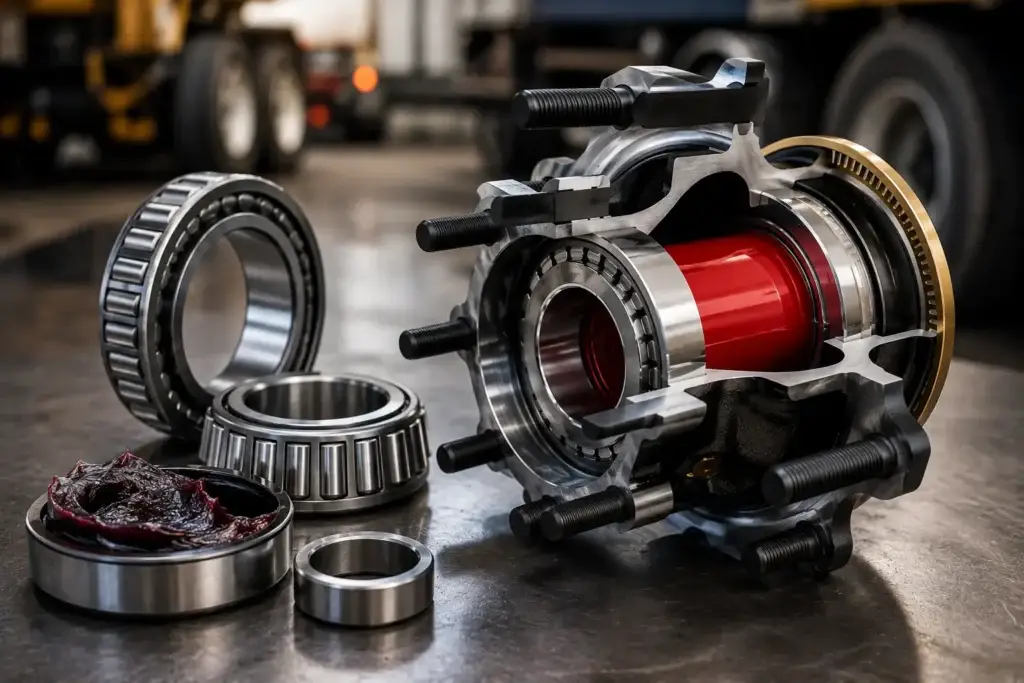
Every wheel-end assembly on a heavy-duty truck or trailer relies on one of two lubrication approaches: an oil bath system, where a liquid lubricant circulates and cushions the bearing inside a sealed hub cavity, or a semi-fluid grease system, where a thicker lubricant packed around the bearing provides similar protection through a different mechanism. Neither approach is universally correct — the right choice depends on the axle's function, and in some case the decision has already been made by the vehicle manufacturer or the wheel-end component supplier.
Which Axles Use Which Lubricant
The distinction that matters most is whether a wheel-end is on a driven or non-driven axle. A non-driven wheel-end — a steer axle, trailer axle, dolly axle, pusher, and tag axle — gives a fleet a genuine choice between oil and grease, and the decision usually comes down to fleet preference, existing shop practice, and component manufacturer recommendation.
A drive axle is a different story entirely: Technology & Maintenance Council Recommended Practice 631 specifies that only oil is recommended for a drive axle wheel-end, not grease. That's not a minor technicality — it reflects a real difference in how each lubricant performs under the specific thermal and mechanical load a drive axle sees.
A lubricant used on a wheel-end also needs to meet a specific performance standard regardless of which type is chosen. Oil — synthetic or mineral — must meet SAE J2360 requirements or API GL-5/MT-1 guidelines, with a common weight including 75W-90, 80W-90, 80W-140, and 85W-140 depending on the application. A semi-fluid grease needs a minimum operating temperature range spanning -20°F to 325°F to handle the full range of condition a wheel-end will encounter over its service life.
Three Types of Wheel-End Systems
Beyond the oil-versus-grease decision, a wheel-end system itself falls into three categories, and knowing which type is on a given vehicle changes how it should be serviced. A manually-adjusted wheel-end — sometimes called a traditional or conventional design — is still the most common design in service today. It uses an adjustable fastening system that requires a technician to set a bearing endplay correctly every time the wheel-end is reinstalled, following TMC Recommended Practice 618.
A pre-adjusted wheel-end arrives from the manufacturer with a preset amount of preload built in, typically using a bearing spacer between the inner and outer bearing to establish a specific dimension. These are generally field-serviceable, but a manufacturer-specific service recommendation should be followed rather than the manual bearing adjustment procedure used for a traditional wheel-end.
A unitized wheel-end system goes a step further — a bearing, seal, and lubricant are all installed at the factory as a sealed unit. When a unitized hub needs service, it's typically replaced as a complete assembly rather than serviced component by component.
Checking Oil Levels the Right Way
An oil bath wheel-end is designed for visual inspection without disassembly. Most a hub cap includes a window or sight glass specifically so a technician — or a driver during a pre-trip inspection — can confirm the oil level and general condition without removing anything. This is one of the simplest, fastest checks in a wheel-end inspection routine, and it's also one of the most informative.
What Healthy Oil Looks Like — and What Doesn't
Clean oil at the correct level, visible through the hub cap window, indicates normal operation. Anything else is worth investigating before the vehicle goes back into service. Oil that appears milky or foamy typically indicates a water contamination, often from a compromised seal or from pressure washing that forced moisture past a seal that wasn't fully sealing to begin with. Darkened or discolored oil suggests the lubricant has broken down or become contaminated with a wear particle from the bearing itself.
Any visible metallic particle in the oil is a clear sign that an internal bearing wear has already begun, and the wheel-end should be pulled for a full inspection rather than simply topped off. A dropping oil level between inspections almost always points to a seal problem rather than normal consumption — an oil bath wheel-end is a sealed system, and it shouldn't be losing lubricant under normal operation.
Chasing a persistent low-oil condition by repeatedly topping off without addressing the underlying leak is one of the more common ways a minor seal issue turns into a bearing failure.
Grease Selection: Getting the Grade Right
A grease-lubricated wheel-end requires more judgment than an oil system because grease isn't a single, interchangeable product — a grade, thickener type, and consistency all matter, and using the wrong combination can cause a problem even when the grease looks and feels similar to what the bearing actually needs.
NLGI Grades and Why They're Not Interchangeable
According to the National Lubricating Grease Institute, most a wheel bearing requires an NLGI 2 grade grease meeting NLGI GC-LB requirements or SAE J2695 specifications. Some a sealed hub unit, however, specifies an NLGI 00 grade semi-fluid product instead — a notably thinner consistency that doesn't meet the same GC-LB or J2695 consistency requirement, because it's designed for an entirely different bearing configuration. Each grade is engineered for its specific bearing design, and NLGI is explicit that one should never be substituted for the other.
The OEM or wheel-end manufacturer should specify exactly which grade and thickener type was originally installed in a given bearing, and that specification should be followed on every relubrication going forward — not just at the initial build. Mixing a grease type with a different thickener chemistry, even when both are nominally the "right" NLGI grade, can degrade the performance of both, since an incompatible thickener system doesn't always blend cleanly.
Service Intervals for Grease-Lubricated Hubs
A service interval for wheel-end grease varies considerably depending on axle type, wheel-end design, and the specific lubricant's performance capability — ranging anywhere from 100,000 miles to five years in over-the-road service. There's no single universal number here, which is exactly why consulting the vehicle, wheel-end, and lubricant manufacturer for the specific application matters more than relying on a generic interval pulled from a different fleet's practice.

Building an Inspection Routine That Catches Problems Early
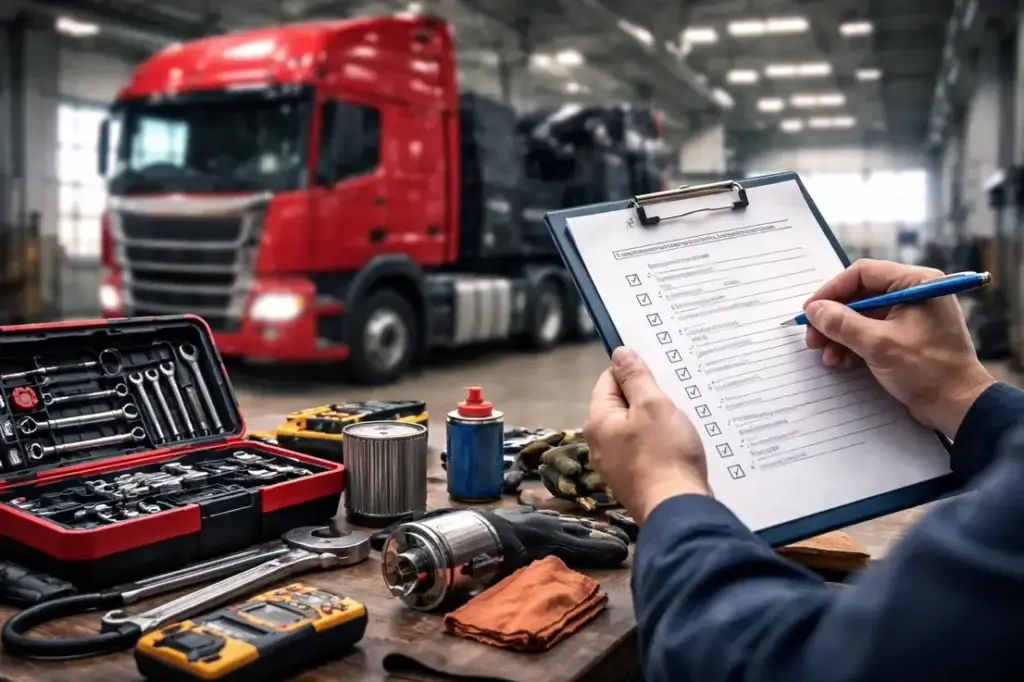
The wheel-end system that fails catastrophically is, in the overwhelming majority of a case, a system that showed a warning sign well before the failure — a slow leak, a slightly elevated temperature, a level that had been trending down for weeks. A consistent inspection routine is what turns those early signs into a scheduled repair instead of a roadside incident. HDJ's preventive maintenance checklist guide covers where a wheel-end inspection fits into the broader PM schedule.
What to Check and How Often
- Every trip (pre- and post-trip): check a hub cap window for oil level and clarity on an oil bath system; check for wetness or staining around a seal on a grease system, which often indicates a leak before it becomes visually obvious any other way.
- Monthly: visually inspect the back of a hub and hubcap for seal or gasket damage and any sign of leakage.
- Every three months: repeat the monthly inspection, and add a hands-on check for roughness when spinning the wheel, or any indication of excessive endplay.
- Annually: remove and disassemble a hub assembly for a full inspection. Clean and inspect every component, replace as necessary, and replace a seal while repacking a bearing with fresh lubricant.
Touch is also a legitimate diagnostic tool during a post-trip inspection. A wheel-end that's warm after a run is normal; one that's too hot to touch isn't, and that alone is reason enough to investigate before the vehicle goes out again.
As a general guideline, a wheel-end temperature shouldn't exceed ambient temperature plus roughly 150°F — so on a 50-degree day, a hub running noticeably hotter than 200°F warrants a closer look, since excessive heat is often the first sign of a bearing or brake-related problem rather than something that will resolve itself.
Why Bearing Adjustment and Torque Discipline Matter Just as Much as Lubrication
⚠️ Safety Warning
Never work under or reach into a wheel-end supported only by a hydraulic jack. Use a jack stand rated for the vehicle's weight, positioned on a frame rail or designated lift point per the service manual, and chock the wheel on the opposite axle before beginning any wheel-off procedure — the lockout/tagout discipline in OSHA 29 CFR 1910.147 applies to any wheel-off work. A wheel-end being rocked or spun for an inspection check must be fully supported — a hub or tire that drops during inspection can cause a serious crush injury.
Proper lubrication protects a wheel-end from wear, but it can't compensate for an incorrect bearing adjustment or an improper wheel nut torque — both of which are independently capable of causing a failure regardless of how well the lubricant was chosen and maintained. HDJ's trailer bearing adjustment guide covers the torque specification and endplay measurement procedure that applies directly to a manually-adjusted wheel-end,
and the margin for error here is genuinely small — accepted endplay tolerance on most a manually-adjusted system falls between 0.001 and 0.005 inches, a range often compared to roughly the thickness of two human hairs.
A wheel nut torque deserves the same discipline. An under-torqued lug nut is widely cited as one of the most common causes of a wheel-end failure, since insufficient clamping force allows a movement that stresses a stud and eventually leads to failure. Over-torquing carries its own risk, stretching or fracturing a stud in the opposite direction.
HDJ's torque wrench calibration guide covers how to verify your tool is delivering the torque it claims. Both failure mode are entirely avoidable with a calibrated torque wrench and adherence to the manufacturer's specified torque pattern and value — there's no substitute for doing this step correctly every time a wheel is removed and reinstalled.
Common Wheel Hub Problems and What They Indicate
- Persistent low oil level with no visible external leak: usually a seal problem allowing a slow internal loss — inspect the seal rather than repeatedly topping off.
- Milky or foamy oil: a water contamination, often from a failed seal or aggressive pressure washing near the hub.
- Metallic particles visible in oil or grease: active bearing wear — this wheel-end needs a full inspection, not just a lubricant change.
- Hub noticeably hotter than an adjacent wheel-end: can indicate a bearing damage, incorrect adjustment, or a dragging brake transferring heat into the hub.
- Grinding, growling, or rumbling noise that changes with speed: a classic bearing wear symptom — don't defer this to the next scheduled PM.
- Visible wobble when the wheel is jacked up and rocked at 12 and 6 o'clock: indicates an excessive bearing play requiring immediate attention before the vehicle returns to service.
Regulatory Context: Why This Isn't Just a Maintenance Preference
A wheel and rim condition on a commercial motor vehicle isn't purely a maintenance best-practice question — it's a federal inspection requirement. 49 CFR 393.205 establishes that a wheel and rim must not be cracked or broken, among other requirements, as part of a part and accessory necessary for safe operation of a commercial motor vehicle. CVSA's out-of-service criteria applies the same standard at the roadside, using this federal requirement as its basis for placing a vehicle out of service over a wheel or rim defect.
A wheel-end problem serious enough to affect the wheel or rim itself isn't just a maintenance issue — it's the kind of defect that can result in a vehicle being placed out of service during a roadside inspection. HDJ's air brake maintenance guide covers the same jack stand and lockout discipline that applies to any wheel-off procedure on a commercial truck.
Building a Wheel-End Program That Actually Prevents Failures
- Know which lubrication type is on each wheel-end before servicing it — check the hub cap decal or manufacturer documentation rather than assuming.
- Never mix an oil and grease lubrication approach on the same wheel-end, and never substitute an NLGI grade without confirming compatibility with the OEM specification.
- Make a hub cap window check a genuine part of every pre-trip and post-trip inspection, not just a line item that gets checked off without looking.
- Record an endplay measurement as a standard part of every PM on a manually-adjusted wheel-end — a documented trend catches a problem a single measurement can miss.
- Treat a wheel nut torque procedure as non-negotiable every time a wheel comes off and goes back on, using a calibrated torque wrench and the correct tightening pattern.
Frequently Asked Questions
Can I use grease on a drive axle wheel-end instead of oil?
No — Technology & Maintenance Council Recommended Practice 631 specifies that only oil is recommended for a drive axle wheel-end, not grease. A non-driven axle, including a steer, trailer, dolly, and tag axle, gives a fleet a genuine choice between oil and grease based on preference and component manufacturer guidance, but a drive axle is treated differently because of the specific thermal and mechanical demand it experiences. Following this distinction matters for warranty compliance and long-term wheel-end reliability, not just as a general suggestion.
What's the difference between NLGI 2 and NLGI 00 grease?
An NLGI grade describes a grease consistency, with a higher number indicating a thicker, firmer grease. NLGI 2 is the standard consistency most a wheel bearing requires, typically meeting an NLGI GC-LB or SAE J2695 specification. NLGI 00 is a notably thinner, semi-fluid consistency used in some sealed or unitized hub units, engineered for a different bearing design entirely. These two grades aren't interchangeable — using the wrong one can compromise lubrication even though both are technically "grease."
How often should wheel-end lubricant be checked?
An oil level should be visually checked through the hub cap window during every pre-trip and post-trip inspection — it takes seconds and catches a developing leak early. Beyond a daily check, a monthly visual inspection for seal or gasket damage, a quarterly check that adds a hands-on roughness and endplay assessment, and an annual full teardown with fresh lubricant and seals form a reasonable baseline schedule. Actual intervals should still be confirmed against your specific vehicle, wheel-end, and lubricant manufacturer recommendation, since a design and service life varies.
What does milky or foamy oil in a wheel hub mean?
Milky or foamy oil almost always indicates a water contamination inside the wheel-end, typically from a compromised seal that's allowing moisture in, or from aggressive pressure washing that forced water past a seal not designed to handle a direct spray. This isn't a cosmetic issue — water in the lubricant significantly reduces its ability to protect the bearing and can accelerate corrosion inside the hub. A wheel-end showing this symptom needs the seal inspected and the lubricant replaced, not just a top-off with fresh oil.
Why does wheel bearing adjustment matter if the lubrication is correct?
Lubrication and bearing adjustment solve different problems, and one can't compensate for the other. Even a perfectly selected and maintained lubricant can't prevent damage if a bearing is set with too much or too little endplay — an incorrect adjustment causes an abnormal heat, uneven wear, and a premature seal failure regardless of lubricant quality. Accepted endplay tolerance on a manually-adjusted wheel-end is typically between 0.001 and 0.005 inches, a genuinely tight margin that requires a dial indicator to measure accurately rather than a feel-based judgment.
Wheel hub maintenance rewards consistency more than almost any other system on a heavy-duty vehicle. The lubricant choice — oil for a drive axle, oil or grease for a non-driven axle, the correct NLGI grade when grease is used — sets the foundation.
But it's the discipline of actually checking a hub cap window, recording an endplay measurement, and following a torque procedure every single time that determines whether a fleet goes years without a wheel-end incident or eventually experiences one — the same discipline Michael Nielsen and Heavy Duty Journal's editorial team hold every guide on heavydutyjournal.com to.
None of this requires an exotic tool or advanced training. It requires treating a five-second glance through a hub cap window with the same seriousness as any other safety-critical check on the vehicle.
Share This Wheel Hub Maintenance Guide
Help other technicians and fleet managers keep their wheel-ends running safely — share this guide with your maintenance team or professional network.