By Michael Nielsen, Publisher | 15+ Years in Diesel Repair & Fleet Operations
Last Updated: September 2026
⏱ Estimated reading time: 15 minutes
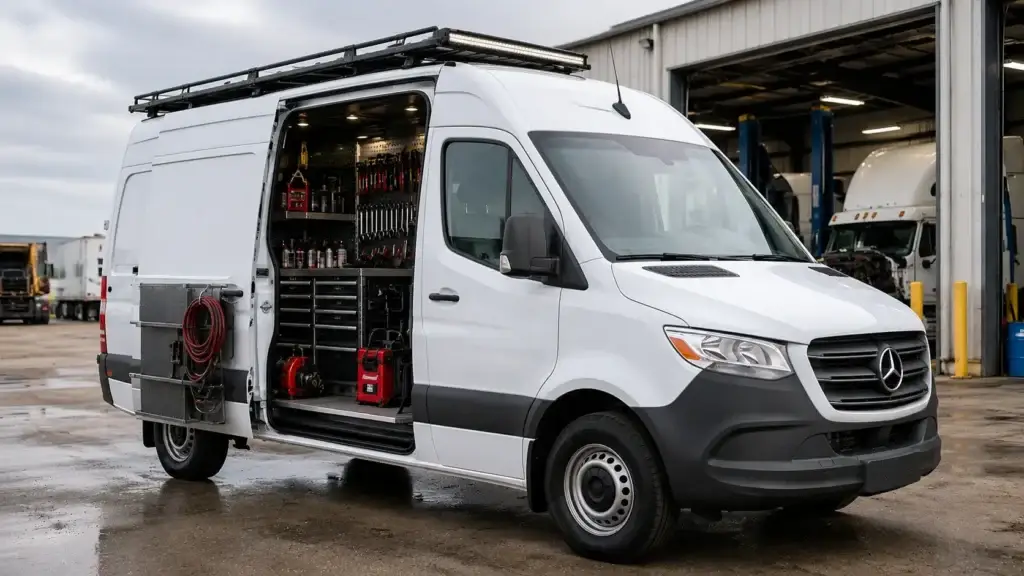
Sprinter van upfitting is the process of customizing a Mercedes-Benz Sprinter cargo van's interior and exterior — shelving, partitions, ladder racks, electrical systems, and flooring — to match the demands of a specific trade. For fleet managers, upfitting is the difference between a van that simply hauls tools and one that functions as a mobile workstation built around how technicians actually work.
But upfitting a Sprinter isn't just a shopping list of racks and bins: every component added changes the van's weight, payload, and — in some cases — its federal vehicle certification. This guide covers what fleet managers need to verify before upfitting a Sprinter: weight and certification requirements, core build components, trade-specific configurations, and the cost factors that actually determine return on investment.
Key Takeaways
- ✓Weight is the real constraint, not storage space. Every shelf, partition, and rack added to a Sprinter eats into a fixed payload margin — GVWR and GAWR limits don't move because a fleet manager needs more room.
- ✓Extensive upfits can trigger federal certification requirements. Installing partitions, bins, or racks can legally make the installer an "alterer" under 49 CFR Part 567, requiring a supplemental compliance label.
- ✓Trade needs diverge sharply. An electrician's spool racks and inverter setup look nothing like a plumber's tank storage or an HVAC tech's refrigerant security requirements.
- ✓Sprinter upfit costs span a wide range. Basic shelving packages start around $3,000; full trade-specific builds with climate control or refrigeration can exceed $25,000 — and the payoff comes from technician efficiency, not appearance.
In This Guide
- What Is Sprinter Van Upfitting?
- The Regulatory Side: GVWR, Certification, and the Alterer Rule
- Core Upfit Components Every Trade Should Consider
- Sprinter Van Upfitting by Trade
- Cost Considerations and ROI
- Retrofitting an Existing Fleet vs. Upfitting New Vans
- Choosing an Upfitter: What to Verify Before You Sign
- Frequently Asked Questions
What Is Sprinter Van Upfitting?
Sprinter van upfitting is the process of installing aftermarket shelving, partitions, racks, electrical systems, and specialized equipment inside a Mercedes-Benz Sprinter cargo van to adapt it for a specific trade or business function. The Sprinter arrives from the factory as a largely empty cargo shell — a chassis, body, and powertrain with no interior fit-out beyond the cab.
Everything a technician needs on-site — tool storage, parts organization, power access, climate control — gets added afterward, either by a dedicated upfitting company, a dealership upfit program, or in-house fleet staff.
The Sprinter remains a default commercial van platform for many trades because of its stand-up interior height (up to roughly 79 inches on high-roof models), multiple wheelbase options (144 or 170 inches), and a wide spread of gross vehicle weight ratings — from around 8,550 lbs up to over 12,000 lbs depending on configuration.
Ford Transit and Ram ProMaster remain common alternatives, and Heavy Duty Journal has covered upfitting principles that apply broadly across all three platforms — but the Sprinter's weight rating range gives fleet managers more flexibility to match a specific van configuration to a specific trade's payload needs.
Roof height and wheelbase decisions should be made before the upfit is designed, not after. A standard-roof van forces technicians to work stooped over inside the cargo area, which slows retrieval and increases fatigue over a full shift — a real factor for trades like HVAC and plumbing where technicians move in and out of the cargo area repeatedly during a single job.
A 170-inch wheelbase adds meaningful shelving length over the 144-inch option but also increases the van's turning radius, which matters for technicians working dense urban routes or tight residential driveways. Fleet managers who lock in roof height and wheelbase first, then design the upfit around that footprint, generally get a more efficient layout than those who select a van on price alone and try to make the upfit work around it afterward.
| Model | Approx. GVWR | Approx. Payload | Best Suited For |
|---|---|---|---|
| Sprinter 2500 | ~8,550–9,050 lbs | ~3,300–4,400 lbs | Electricians, light service techs, single-trade shelving builds |
| Sprinter 3500 | ~9,900–10,360 lbs | ~4,150–6,800 lbs | Plumbers, HVAC techs, ladder + tank rack combinations |
| Sprinter 3500XD | ~11,030–12,125 lbs | Up to ~7,430 lbs | Heavy upfits, refrigeration units, onboard generators, dual rear wheels |
These figures vary by wheelbase, roof height, drivetrain (AWD reduces payload), and engine option, so fleet managers should always confirm the specific configuration's certification label rather than relying on published ranges alone. The gap between a 2500 and a 3500XD is substantial — well over 3,000 lbs of payload in some configurations — which matters enormously once shelving, partitions, tools, and inventory are loaded in.
The Regulatory Side: GVWR, Certification, and the Alterer Rule
This is the part of Sprinter van upfitting most fleet managers never hear about until it becomes a problem. A completed Sprinter leaves the factory with a manufacturer's certification label stating its gross vehicle weight rating (GVWR) and gross axle weight ratings (GAWR) — the maximum weight the vehicle and each axle can safely carry.
Gross vehicle weight rating is the maximum loaded weight a vehicle is designed to carry, including the vehicle itself, cargo, fluids, and occupants. Anything installed after that point — shelving, partitions, ladder racks, tool storage — adds to that loaded weight and eats directly into the payload margin the manufacturer built in.
Under 49 CFR Part 567, anyone who modifies a previously certified vehicle — other than by adding readily attachable components like mirrors or tires — is legally an "alterer" if the modification could affect the vehicle's compliance with Federal Motor Vehicle Safety Standards or invalidate its stated weight ratings.
This isn't a technicality reserved for truck body manufacturers. A NHTSA Chief Counsel interpretation letter addressing "after market upfittings" directly confirms that installing components that aren't readily attachable — the letter's example involves a bench seat and auxiliary springs — makes the installer an alterer under Part 567, regardless of whether the installer thought of the job as a simple accessory install.
Van-specific interior work carries the same exposure: according to NTEA certification guidance reported in Trailer/Body Builders, adding a partition, bin, and racks in a van affects FMVSS 105, FMVSS 110, and FMVSS 201U — meaning the installer takes on alterer responsibilities and must affix a compliance label documenting the alteration.
⚠️ Safety Warning
If an upfit changes a Sprinter's GVWR or GAWR from what's shown on the original manufacturer's label, the alterer must specify the new weight ratings on a supplemental label per 49 CFR 567.7. Operating a van with an inaccurate weight rating label, or one loaded beyond its certified capacity, creates both a compliance exposure and a real safety risk — overloaded vans handle poorly, brake longer, and put uneven stress on axles and tires.
There's a second, less obvious compliance angle: gross combination weight rating (GCWR). Federal rules define a commercial motor vehicle requiring a CDL as one with a gross combination weight rating or gross combination weight of 26,001 lbs or more, inclusive of a towed unit with a GVWR over 10,000 lbs — a threshold set out in the 49 CFR Part 383 definition of a commercial motor vehicle.
Most single-Sprinter setups stay well under that combined threshold, but a heavily upfitted 3500XD towing a loaded equipment trailer is worth running the numbers on before assuming a standard driver's license covers the combination.
Core Upfit Components Every Trade Should Consider
Regardless of trade, most Sprinter upfits draw from the same core component categories. What changes is the configuration, material choice, and placement.
Keep Your Fleet Running at Full Capacity
Get HDJ's maintenance guides, compliance updates, and fleet management strategies delivered weekly — built for working diesel professionals.
Core Upfit Component Categories
- Shelving systems: Steel shelving offers durability and load capacity; aluminum or composite shelving trades some strength for significant weight savings — a meaningful factor once payload gets tight.
- Partitions: Cargo barriers separating the cab from the cargo area protect the driver from shifting cargo in a collision and are a common trigger for alterer certification under FMVSS 201U.
- Flooring: Rubber or composite flooring reduces cargo shift, protects the factory floor pan from corrosion, and cuts interior noise — a real factor for techs spending hours in the van between stops.
- Electrical and power systems: Auxiliary batteries, inverters, and shore-power connections run diagnostic equipment, power tools, and lighting without draining the starting battery.
- Ladder and roof racks: Exterior racks free interior space but add height and wind load; low-profile roof racks matter for vans that need to clear parking garages or loading docks.
- Lighting: Interior LED lighting and rear/side scene lighting improve technician visibility and safety during early-morning or after-dark calls.
Every material choice in a Sprinter upfit is a trade-off between weight, durability, and cost — and on a payload-constrained van, that trade-off is worth running the numbers on before signing off.
Steel shelving remains the most common choice because it's inexpensive and holds up to years of daily loading and unloading, but a fully steel-shelved cargo area can weigh several hundred pounds before a single tool goes in. Aluminum shelving cuts that weight substantially while sacrificing some load rating per shelf.
Composite and high-density polyethylene shelving split the difference — lighter than steel, more corrosion-resistant, and increasingly common in HVAC and plumbing builds where moisture exposure is a factor. For fleets running Sprinter 2500s in heavier trades, the weight saved by switching from steel to aluminum or composite shelving can translate directly into several hundred additional pounds of usable payload — often enough to make the difference between staying under GVWR and running overweight on a fully loaded day.
Sprinter Van Upfitting by Trade
Generic shelving packages exist, but the fleets that get the most value from Sprinter van upfitting configure the build around how a specific trade actually works a job site.
Electricians and Telecom Technicians
Electrical work is wire-and-component-heavy rather than tank-heavy, so a Sprinter 2500 often has ample payload margin. The priority is bin and spool organization: adjustable shelving with removable dividers for wire nuts, breakers, and small parts; dedicated wire spool racks that let a tech pull cable without removing the reel; and a reliable inverter setup to run cordless tool chargers, laptops for panel programming, and diagnostic meters throughout the day.
A secure, lockable cabinet for higher-value components reduces theft exposure — a common and underestimated cost for electrical fleets.
Plumbers and HVAC Technicians
Plumbing upfits carry real weight — pipe stock, fittings, water heaters, and sometimes a small test tank — which pushes many plumbing fleets toward a Sprinter 3500 rather than a 2500. Pipe racks, slide-out shelving for heavier components, and reinforced flooring rated for point loads are standard, and ventilation matters too since PVC cement and certain sealants require airflow.
HVAC upfits juggle two competing needs instead: secure, ventilated storage for refrigerant cylinders and recovery equipment, and climate stability for components sensitive to temperature extremes. Refrigerant cylinder storage isn't just good practice — OSHA's compressed gas standard (29 CFR 1910.101) requires cylinders be maintained in a safe, inspected condition and secured against tipping, which an unsecured cylinder rattling around a cargo area plainly fails.
Field Service, Delivery, and Construction Fleets
Mobile diagnostic and field service work leans on power and connectivity more than raw storage — a robust auxiliary power system for laptops and scan tools, plus a fold-down workstation, typically matters more than trade-specific shelving. HDJ's mobile service truck setup guide covers the power, diagnostic, and storage decisions in more depth for heavier field-repair builds that outgrow a Sprinter-sized platform.
Delivery and mobile retail builds prioritize volume and access speed instead: open shelving with wide walkways, rear and side step access, and — for refrigerated delivery — a certified refrigeration unit rather than a passive cooler. Construction fleets tend to carry the heaviest and most varied load of any trade, usually pointing toward a Sprinter 3500 or 3500XD with reinforced shelving, exterior ladder racks, and a locking cabinet for high-value tools.
Cost Considerations and ROI
Sprinter van upfit costs scale with complexity, not just van size. A basic shelving-and-partition package typically starts around $3,000–$6,000. A full trade-specific build — shelving, ladder racks, electrical system, and flooring — generally lands between $8,000 and $15,000.
High-end builds involving refrigeration, climate control, or specialized equipment mounts can exceed $25,000, and service body conversions for heavier trades commonly run $15,000–$30,000, based on published pricing from service body manufacturers such as Knapheide, Reading, and Stellar.
Key Recommendation
Evaluate upfit cost against technician time saved, not just sticker price. A $12,000 upfit that cuts 10 minutes of searching-and-retrieval time per service call adds up to meaningful recovered labor hours across a fleet within the first year — the upfit pays for itself in efficiency long before it pays for itself in van resale value.
Material choice also affects long-term cost. Lightweight aluminum or composite shelving costs more upfront than steel but preserves more payload capacity — which matters directly for trades already pushing against GVWR limits, like plumbing and HVAC. Fleet managers should request the upfitter's weight documentation for any proposed build before signing off, not just a price quote.
A simple worked example illustrates the payback math: if a $10,000 upfit saves each technician 15 minutes per day in tool and parts retrieval across a 220-workday year, that's roughly 55 recovered labor hours per technician annually. Across a 10-van fleet, that's 550 hours — often equivalent to a quarter of an additional technician's yearly output, without hiring anyone, a pattern heavydutyjournal.com continues to track across the fleets and shops we cover.
Editorial Insight
The HDJ Perspective
Michael Nielsen: the upfit quotes that look cheapest on paper are almost always the ones built with generic steel shelving and no weight documentation — and they're the ones that come back to bite a fleet manager eighteen months later when a loaded van fails a roadside weight check or a tech can't carry a full day's parts without exceeding payload. HVAC and electrical fleets specifically should confirm adequate ventilation and cooling in the upfit itself: refrigerant cylinders and battery-powered tools both perform worse, and less safely, in a cargo area baking in direct sun.
Retrofitting an Existing Fleet vs. Upfitting New Vans
Most fleet managers don't get a clean slate — they're deciding whether to retrofit vans already in service rather than upfit new purchases from scratch. Both paths follow the same weight and certification principles above, but retrofitting carries added considerations.
Any existing wear, rust, or floor pan damage on an in-service van needs to be addressed before new shelving or partitions go in, since mounting hardware into a compromised floor pan is a common point of failure. Retrofitting also gives fleet managers a chance to correct upfit mistakes from the original build — swapping oversized steel shelving for lighter composite units, adding missing cargo securement points, or finally installing the alteration certification label that was skipped the first time around.
The main trade-off is downtime. A new van can be upfitted before it ever enters service, while a retrofit takes an active van out of rotation — which is why many fleets stagger retrofits across their Sprinter fleet in small batches rather than pulling every van off the road at once.
For fleets standardizing a new upfit design across dozens of vans, retrofitting older units to match new builds also simplifies training, since technicians moving between vans find tools and parts in the same place regardless of which Sprinter they're assigned that day.
Choosing an Upfitter: What to Verify Before You Sign
Not every shop that installs van shelving understands its obligations as a potential "alterer" under federal certification rules — and the gap between an experienced upfitter and a general repair shop that "also does shelving" shows up quickly once a van is loaded for real work.
NTEA membership or MVP recognition. The National Truck Equipment Association's guidance on multistage vehicle certification makes clear that upfitters are legally considered manufacturers under NHTSA regulations the moment they participate in any vehicle manufacturing stage — including final-stage manufacturing or altering. NTEA member and MVP-recognized companies are generally well-versed in these obligations; shops with no familiarity with Part 567 or Part 568 certification are a red flag.
Written weight documentation. Ask for the specific weight added by the proposed build and confirm it against the van's certified GVWR and GAWR — not a rough estimate. Critical elements of proper certification include payload analysis, weight distribution calculations, and FMVSS compliance review — steps a qualified upfitter should walk a fleet manager through, not skip.
Alteration certification labeling. If the upfit qualifies as an alteration under 49 CFR Part 567, the upfitter is responsible for affixing a supplemental certification label. Confirm this is included in the scope of work — it shouldn't be an optional add-on.
Cargo securement compliance. Loose tools, dunnage, and unsecured equipment inside an upfitted van are a documented roadside inspection risk. The Commercial Vehicle Safety Alliance's North American Standard Out-of-Service Criteria covers cargo securement as a pass-fail inspection item, and improperly mounted shelving or unsecured tool storage can put a vehicle out of service during a roadside check.
4 Recurring Upfit Mistakes
- Loading against GVWR instead of GAWR
- Skipping alteration certification to save time
- Defaulting to steel shelving without checking payload math
- Standardizing one identical build across every trade, wasting space a specific trade never uses
Frequently Asked Questions
Does upfitting a Sprinter van void the manufacturer's warranty?
Not automatically. Mercedes-Benz's warranty generally covers the chassis, engine, and factory-installed components regardless of aftermarket upfitting, but damage caused directly by an upfit installation — such as drilling into a component that causes a leak or electrical fault — typically falls outside warranty coverage. Working with a reputable, NTEA-affiliated upfitter reduces this risk significantly.
How much weight can I add to a Sprinter cargo van before it affects payload?
Payload capacity is the maximum weight the van can carry — including upfit equipment, tools, inventory, and passengers — before exceeding its certified GVWR. Depending on the specific Sprinter model and configuration, payload ranges roughly from 3,300 to over 7,400 lbs. Every pound of shelving, racking, or flooring installed subtracts directly from that figure, which is why weight documentation from the upfitter matters as much as the price quote.
Is a permit or certification required to upfit a commercial van?
No permit is required in the way a building permit works, but federal certification requirements apply. If the upfit involves adding partitions, bins, or racks that could affect the vehicle's compliance with Federal Motor Vehicle Safety Standards or its stated weight ratings, the installer is considered an "alterer" under 49 CFR Part 567 and must affix a supplemental compliance label documenting the alteration.
What's the difference between a Sprinter 2500 and 3500 for upfitting purposes?
The primary difference is weight rating and payload. The 2500 typically carries a GVWR around 8,550–9,050 lbs with roughly 3,300–4,400 lbs of payload, suited to lighter trades like electrical work. The 3500 steps up to roughly 9,900–10,360 lbs GVWR with 4,150–6,800 lbs of payload, better suited to heavier upfits like plumbing or HVAC that carry tanks, pipe stock, or recovery equipment.
Is it better to retrofit an existing Sprinter or buy a new van with the upfit pre-installed?
It depends on the van's remaining service life and condition. Retrofitting makes sense for Sprinters with several years of usable life left and a sound floor pan and chassis. For vans nearing end-of-life or already showing corrosion or structural wear, upfitting a new van from the start — rather than investing in a build that will outlast the vehicle it's installed in — is typically the better use of capital.
Sprinter van upfitting works best when it's treated as an engineering decision, not just a storage upgrade. According to Michael Nielsen, Heavy Duty Journal's publisher with 15+ years in diesel repair, fleet managers who confirm weight ratings, verify alteration certification, and configure each build around how a specific trade actually works get a mobile workspace that improves technician efficiency for years.
The fleets that skip the weight math or default to a generic build tend to find out the hard way, at a roadside inspection, a warranty dispute, or a technician who can't carry a full day's inventory without exceeding payload.
Planning an Upfit? Share This With Your Fleet Team
If your shop or fleet is evaluating a Sprinter upfit, pass this along to whoever signs off on the purchase order — the weight and certification details here are easy to miss until they show up as a compliance or payload problem after the build is already installed.