By Michael Nielsen, Editor & Publisher | 15+ Years in Diesel Repair & Fleet Operations
Last Updated: June 2026
Adding in-house DPF cleaning is one of the more reliable ways for a diesel shop to turn a recurring customer problem into recurring shop revenue — but the equipment decision locks a shop into a specific cleaning method, a specific footprint, and a specific ongoing cost structure for years. Some OEM replacement diesel particulate filters run over $12,000, which is exactly why customers keep coming back for cleaning instead of replacement — and exactly why the equipment a shop buys to do that cleaning needs to be evaluated as carefully as any other capital purchase.
This guide evaluates four DPF cleaning equipment providers serving independent diesel shops, dealerships, and fleet maintenance operations: FSX Equipment, Redline Emissions Products (Filtertherm), EcoClean, and Enviromotive. Each is scored against five criteria weighted by real-world operational impact — and because none of these manufacturers publish pricing openly, this guide is explicit about what's quote-based versus verifiable, rather than inventing numbers to fill a comparison table.
In This Guide
- How We Evaluated These Providers
- Key Takeaways
- What to Evaluate When Choosing
- FSX Equipment — HDJ Top Pick
- Redline Emissions Products (Filtertherm) — Strong Contender
- EcoClean — Worth Considering
- Enviromotive — Worth Considering
- Quick Comparison Table
- How to Choose the Right System
- Frequently Asked Questions
How We Evaluated These Providers
Every provider in this guide was evaluated against five criteria weighted by their operational impact on a shop adding or growing a DPF cleaning service line: cleaning method and filter compatibility, throughput and cycle time, compliance and waste handling, total cost of ownership, and business-building support. Each provider was assessed based on publicly available information — manufacturer documentation, distributor and dealer listings, and industry trade coverage. No provider was assessed from demo claims or marketing materials alone.
We do not conduct independent product testing. Our editorial ratings reflect the HDJ team's assessment of publicly documented capabilities. DPF cleaning equipment manufacturers generally do not publish pricing — where cost could not be verified from public sources, that is noted directly in the profile rather than estimated.
Last methodology review: June 2026. Provider information verified as of the Last Verified dates shown in each profile.
Key Takeaways
- None of the four providers in this comparison publish equipment pricing publicly — every purchase decision starts with a quote, so budgeting requires getting a written price and financing terms before comparing providers on anything else.
- Cleaning method determines both speed and filter compatibility: aqueous systems from Redline Emissions Products and EcoClean claim same-day, roughly two-hour turnarounds without a bake cycle, while FSX's pneumatic approach and traditional thermal "bake and blow" systems take longer but have a longer track record in high-volume shops.
- Redline Emissions Products bundles a full year of its FILTERtrak service-tracking software (a stated $1,200 value) with any equipment package — a real differentiator for shops that want documentation for warranty claims and compliance, not just clean filters.
- FSX's TrapBlaster line scales from a small-shop JR model (single-phase power, smaller air compressor) to a high-volume flagship rated for 16 filters per 8-hour shift — worth matching the specific model to a shop's actual volume rather than defaulting to the flagship.
- Automated pneumatic and aqueous systems process filters largely unattended once set up; manual systems like Enviromotive's trade a lower equipment cost for more hands-on technician time per filter — a real throughput tradeoff, not just a price difference.
What to Evaluate When Choosing DPF Cleaning Equipment
Every manufacturer in this category claims to restore filters "to like-new condition." The differences that actually determine whether the equipment pays for itself come from five criteria that go deeper than a marketing claim.
Cleaning Method & Filter Compatibility
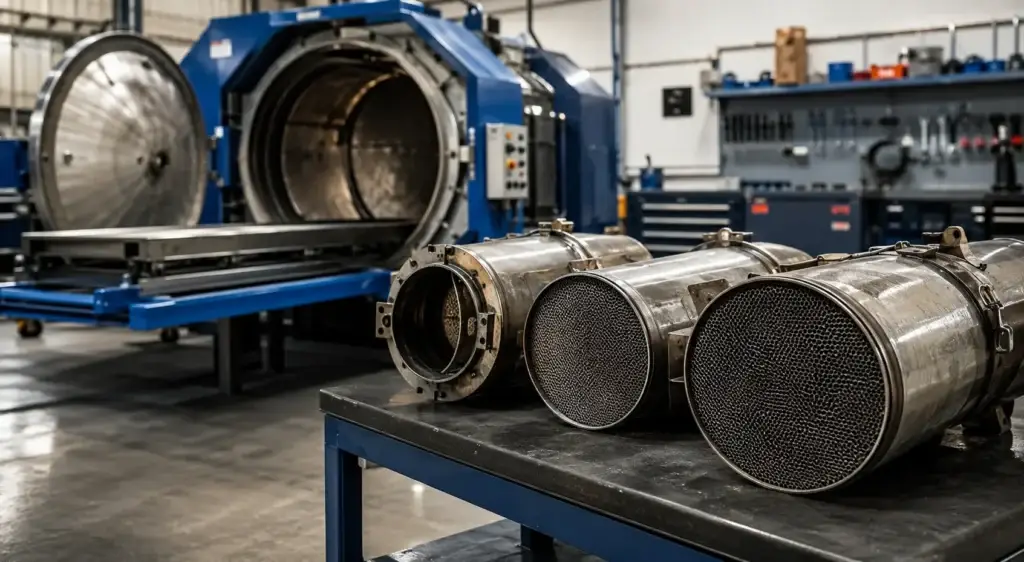
The cleaning method a system uses determines which filters it can actually handle. Pneumatic (air-knife) systems clean cell-by-cell with compressed air and generally require a filter shaped to fit the machine's adapters. Thermal ("bake and blow") systems burn off soot in a controlled oven cycle, well-suited to regularly shaped filters but slower due to bake and cooldown time. Aqueous systems use a low-pressure water and surfactant wash, which several manufacturers position as better suited to odd-shaped filters and light-duty or off-road units without cutting the housing open. A shop's actual filter mix — heavy-duty Class 8 only, or a mix including light-duty and off-road — should drive this decision before anything else.
$12,000+
Cost of some OEM replacement diesel particulate filters, per industry documentation — the financial gap that makes professional cleaning a viable, recurring service line instead of a one-time upsell.
Throughput & Cycle Time
Cycle time and automation level together determine how many filters a shop can realistically clean per day, which is the number that actually drives payback on the equipment. A high-volume automated pneumatic machine rated for 16 filters per 8-hour shift behaves very differently in a shop's schedule than a manual system requiring hands-on operator time per filter, even if the manual system costs less upfront. Compare manufacturer-stated cycle times and confirm whether the process runs unattended or requires an operator standing at the machine for the duration.
Compliance, Dust & Wastewater Handling
DPF cleaning generates hazardous soot and ash particulate that requires proper containment regardless of cleaning method, and aqueous systems add a wastewater handling question on top of that. Pneumatic and thermal systems typically pair with a dedicated dust collector using primary and HEPA filtration stages. Aqueous systems recirculate and filter their water internally, but a shop still needs a plan for periodic disposal of spent surfactant and filtered solids. Confirm exactly what containment and disposal equipment is included versus sold separately before assuming a quoted price covers full compliance.
Total Cost of Ownership & Financing
None of the providers in this category publish pricing, which makes an apples-to-apples cost comparison harder than it should be — every shop starts from a quote, not a price sheet. Beyond the equipment purchase itself, factor in ongoing consumables (surfactant, filter media, replacement HEPA filters), any bundled or required software subscriptions after an introductory period, and whether the manufacturer offers or partners with equipment financing. A system that looks cheaper on the initial quote can cost more over three years once consumables and software renewals are added in.
Business-Building Support
Equipment alone doesn't build a DPF cleaning business — documentation, training, and a way to prove the work to customers and warranty administrators do. Some providers bundle service-tracking software that logs before/after test results and generates customer-facing reports; others leave documentation to the shop's own process. Training quality also varies: some manufacturers include hands-on onboarding sessions, while others expect the shop to learn primarily from written documentation. Both factors affect how fast a shop can turn new equipment into billable, defensible work.
Stay Current on Shop Equipment & Emissions Compliance
Get HDJ's equipment reviews, compliance updates, and shop profitability strategies delivered weekly — built for diesel professionals making real capital decisions.
FSX Equipment
Best ForShops of nearly any volume — from single-bay operations to high-volume dealership service centers — that want automated pneumatic cleaning with the longest documented track record and OEM-level recognition in the category.
HDJ Editorial Rating
HDJ Top Pick
Based on publicly available information. See methodology above.
Profile last verified: June 2026 against fsxequipment.com
FSX Equipment's patented bi-directional air-knife pneumatic cleaning has become what industry sources routinely describe as the category standard, with Peterbilt and Kenworth dealerships among the shops using FSX systems for customer-facing DPF service — a level of OEM-adjacent trust that's harder to find elsewhere in this comparison.
Strengths
FSX's TrapBlaster line scales genuinely across shop sizes — from the JR model built for small shops running on single-phase power and a modest air compressor, up to the flagship TrapBlaster 7 rated for up to 16 filters in an 8-hour shift in high-volume operations.
- Built-in bypass detection identifies a cracked or failed filter within the first two minutes of a cleaning cycle, preventing wasted time cleaning a filter that was never going to pass and stopping a bad filter from being reinstalled.
- The TrapTester airflow test bench is described as an OEM- and dealer-trusted standard for measuring cleaning success, giving shops a documented, repeatable way to confirm and prove a filter passed before it goes back on a truck.
- The automated cleaning cycle runs unattended once set up — average cleaning time on the flagship TrapBlaster 7 is about 22 minutes — freeing a technician to work on other jobs during the cycle.
- A dedicated wet-cleaning option (TrapRinser) and thermal cleaning machines (TrapBurner) let a shop add Stage 2 and Stage 3 cleaning to the same product ecosystem rather than sourcing a second manufacturer for filters that need deeper recovery.
Considerations
FSX does not publish pricing for any of its systems, and unlike Redline Emissions Products, no bundled software, financing partnership, or documentation tool is publicized alongside the equipment — a shop will need to build its own customer reporting and service-tracking process. The flagship-tier system also has real infrastructure requirements: FSX's own materials note the standard high-volume package needs a large air compressor, three-phase power, and roughly 18 feet of floor space, which is a meaningful commitment for a shop that hasn't budgeted for it — though the JR line exists specifically to address this for smaller shops. Independent third-party reviews are also thin; most available public information comes from FSX's own site and its authorized dealers rather than unaffiliated shop testimonials.
Who Should Look Elsewhere
Shops that want service-tracking software and financing bundled into the equipment purchase, rather than sourced separately, should compare Redline Emissions Products' Filtertherm packages directly before committing. Shops working primarily with odd-shaped, light-duty, or off-road filters that don't fit standard adapter sets should confirm compatibility carefully or evaluate an aqueous system instead.
Best Fit: Independent shops, dealerships, and fleet service centers of nearly any volume that want automated pneumatic cleaning with a long track record, built-in filter integrity testing, and a scalable product line matched to shop size.
HDJ Verdict
FSX earns HDJ's Top Pick rating because it's the platform with the deepest documented track record in this comparison — OEM-adjacent dealer usage, a genuinely scalable product line, and built-in filter integrity testing that protects a shop from reinstalling a bad filter. It isn't the most business-tooling-forward option in this lineup, and shops should get a firm, written quote given the real infrastructure requirements at the high-volume tier, but for most shops evaluating their first DPF cleaning system, FSX is where the evaluation should start.
Redline Emissions Products (Filtertherm)
Best ForShops that want a choice between thermal and aqueous cleaning methods from one manufacturer, bundled service-tracking software, and a direct equipment financing option.
HDJ Editorial Rating
Strong Contender
Based on publicly available information. See methodology above.
Profile last verified: June 2026 against rep.direct / filtertherm.com
Redline Emissions Products, an established all-makes aftertreatment parts distributor, brings its Filtertherm equipment line to this comparison with a genuinely different pitch: a choice of cleaning method under one manufacturer, plus bundled software and financing that the equipment-only competitors in this category don't offer.
Strengths
Filtertherm is the only provider in this comparison offering both a traditional thermal "bake and blow" system and a same-day aqueous system under one manufacturer, letting a shop match cleaning method to its actual filter mix without sourcing two different vendors.
- The Aqueous DPF Cleaning system is positioned around a same-day, roughly two-hour turnaround with no bake cycle required, plus a drying cabinet that finishes most filters in 20 minutes or less — a genuine speed advantage over a traditional overnight thermal cycle.
- Every Filtertherm equipment package includes a free first-year subscription to FILTERtrak, the company's own service-tracking software — logging before/after photos, flow-test results, and complete service histories per filter, which doubles as documentation for warranty claims and compliance.
- Redline Emissions Products offers a direct financing partnership (Tri-Lease) for equipment purchases, an option not publicly advertised by FSX, EcoClean, or Enviromotive in this comparison.
- As an established all-makes aftertreatment parts distributor, Redline Emissions Products can supply OEM-spec replacement DPFs, DOCs, gaskets, and sensors alongside its cleaning equipment — useful for a shop building a full aftertreatment service line rather than cleaning equipment in isolation.
Considerations
FILTERtrak's first year is free, but the $1,200 value Redline Emissions Products cites for that subscription implies a real ongoing cost after year one that shops should confirm and budget for rather than assume is permanent. The Aqueous system's 600-gallon recirculating water system also means a shop needs a plan for periodic wastewater and spent-surfactant disposal, on top of the containment a pneumatic or thermal system already requires for dust. And while thermal remains available for shops that prefer the traditional method, it still carries the longer bake-and-cooldown cycle inherent to that approach — the same tradeoff any thermal system in this category has.
Who Should Look Elsewhere
Shops that want the single longest-established, most OEM-recognized pneumatic system with the deepest dealer footprint should compare FSX Equipment directly. Shops without space or environmental permitting for a recirculating water system should lean toward Filtertherm's thermal option or a pneumatic system from FSX instead of the Aqueous line.
Best Fit: Shops that want to evaluate both thermal and aqueous cleaning under one manufacturer, value built-in service documentation for warranty and compliance purposes, and want a direct financing path for the equipment purchase.
HDJ Verdict
Redline Emissions Products earns a Strong Contender rating because Filtertherm is the only provider here solving the business side of DPF cleaning — documentation, financing, and choice of method — as deliberately as the cleaning technology itself. It lands below FSX specifically because FSX's pneumatic system carries a longer, more independently verifiable track record; shops that value proven longevity over bundled business tools should start there instead.
EcoClean
Best ForShops focused specifically on fast aqueous cleaning and comfortable evaluating a smaller, more specialized manufacturer rather than a multi-method product line.
HDJ Editorial Rating
Worth Considering
Based on publicly available information. See methodology above.
Profile last verified: June 2026 against ecleanadvantage.com
EcoClean has focused entirely on patented aqueous DPF cleaning technology since introducing its first machine in 2017, positioning speed as its core differentiator against both thermal systems and — implicitly — the pneumatic approach that dominates the rest of this comparison.
Strengths
EcoClean's core claim is restoring a DPF to OEM operating specifications in two hours or less, positioning its aqueous process as faster than a comparable thermal bake-and-blow cycle without sacrificing the completeness of the clean.
- A dedicated drying stage completes most filters in a single 20-minute duty cycle using airflow and heat, rather than requiring a separate lengthy cooldown period the way thermal systems do.
- A pre-soak filter-aid stage loosens debris before the main cleaning cycle, which EcoClean's own documentation describes as more effective for its process than pneumatic pre-blowing.
- Equipment is manufactured in the USA with quick delivery times cited directly by the company, and accessory soak-tank options let shops scale the pre-soak stage to their specific volume and budget.
Considerations
EcoClean's public product documentation is noticeably thinner than FSX's or Filtertherm's — there's no clearly tiered product line for different shop volumes, no publicized bundled software or financing partnership, and less third-party trade coverage to independently corroborate its performance claims beyond the manufacturer's own site. As a smaller, more specialized manufacturer founded in 2017, EcoClean also has a shorter track record than FSX or Redline Emissions Products' aftertreatment parts business, which matters for a shop weighing long-term parts and service support on a capital purchase.
Who Should Look Elsewhere
Shops that want a manufacturer with a longer independently documented track record, or that want thermal and aqueous options from the same vendor, should compare Filtertherm or FSX first. Shops that want bundled service-tracking software or financing built into the purchase should evaluate Redline Emissions Products directly.
Best Fit: Shops specifically prioritizing aqueous cleaning speed and comfortable vetting a smaller, specialized manufacturer through direct reference checks rather than relying on an extensive public track record.
HDJ Verdict
EcoClean earns a Worth Considering rating for a genuinely fast, focused aqueous process — but the thinner public documentation and shorter track record relative to FSX and Filtertherm mean a shop evaluating EcoClean should lean harder on direct reference checks and a live demonstration than the marketing copy alone.
Enviromotive
Best ForLower-volume shops and Cummins-heavy operations wanting a lower-cost entry point into DPF cleaning, with more manual control over the process in exchange for automated throughput.
HDJ Editorial Rating
Worth Considering
Based on publicly available information. See methodology above.
Profile last verified: June 2026 against enviromotive.net
Enviromotive positions its manual DPF cleaning system as a deliberate alternative to the automated pneumatic and aqueous machines that dominate this comparison — trading hands-on operator involvement for a lower price point and, the company argues, more control over difficult filters.
Strengths
Enviromotive's manual system gives an operator direct control over cleaning intensity and duration on a per-filter basis, which the company positions as an advantage for addressing stubborn, unevenly-loaded, or difficult filters that an automated cycle might not fully address without manual intervention.
- The equipment is Cummins-approved and designed and fabricated in the USA, giving shops with a Cummins-heavy customer base a documented manufacturer endorsement for that engine family specifically.
- Manual operation means a lower equipment cost than a fully automated pneumatic or aqueous system, positioned by the company as delivering the best value-per-dollar in the category — a real consideration for a shop testing whether DPF cleaning demand justifies a bigger capital commitment.
- The system is built for flexibility across filter types, with the company citing ease of use for operators of varying skill levels rather than requiring specialized automated-system training.
Considerations
Manual operation is a genuine throughput tradeoff, not just a lower price point: a technician standing at the machine for the duration of each cleaning cycle means Enviromotive's realistic daily filter volume is lower than an automated system like FSX's flagship TrapBlaster or Filtertherm's Aqueous line, which run largely unattended once set up. Public documentation on Enviromotive's specific cycle times, throughput figures, and product tiers is also thinner than FSX's or Redline Emissions Products', making side-by-side comparison harder without a direct sales conversation.
Who Should Look Elsewhere
Shops expecting to clean high filter volumes per shift should evaluate an automated pneumatic or aqueous system from FSX or Filtertherm instead, where throughput doesn't depend on continuous operator attention. Shops wanting a documented, scalable product line with published tiers for different shop sizes will find more to compare at FSX.
Best Fit: Lower-volume independent shops, and Cummins-focused operations specifically, wanting to test DPF cleaning as a service line at a lower capital commitment before scaling to an automated system.
HDJ Verdict
Enviromotive earns a Worth Considering rating as a genuine lower-cost, lower-commitment entry point into DPF cleaning — a real option for a shop that wants to prove out demand before investing in automated equipment. It's not the right choice for a shop expecting to scale to high daily filter volume, where the manual throughput ceiling becomes the limiting factor rather than the equipment's cleaning quality.
Quick Comparison: DPF Cleaning Equipment
| Provider | HDJ Rating | Best For | Key Strength | Key Consideration |
|---|---|---|---|---|
| FSX Equipment | HDJ Top Pick | Nearly any shop volume | Longest track record; scalable product line; bypass detection | No bundled software/financing; flagship needs real infrastructure |
| Redline Emissions Products (Filtertherm) | Strong Contender | Shops wanting method choice + tools | Thermal & aqueous options; free-year FILTERtrak software; financing | Software renewal cost after year one; wastewater handling |
| EcoClean | Worth Considering | Fast aqueous-focused shops | ~2-hour OEM-spec restoration claim; fast drying stage | Thin public documentation; shorter track record |
| Enviromotive | Worth Considering | Lower-volume & Cummins-heavy shops | Lower cost entry; Cummins-approved; operator control | Manual throughput ceiling; thinner published specs |
The HDJ Perspective
After 15 years around diesel shops, the mistake I see most often with DPF cleaning equipment isn't picking the wrong manufacturer — it's buying more machine than the shop's actual filter volume justifies. A flagship system rated for 16 filters a shift is wasted capital in a shop cleaning three filters a week. Count your actual DPF-related work orders from the last 90 days before you get a single quote, and size the equipment to that number, not to what looks impressive on a showroom floor.
The second thing worth saying plainly: none of these manufacturers publish prices, which means every comparison in this guide has to end with you picking up the phone. Get a written quote that separates equipment, required accessories like dust collection or drying stages, financing terms, and any software subscription cost after an introductory period. A quote that bundles everything into one number without a breakdown is a quote you should ask to see itemized before you sign anything.
How to Choose the Right DPF Cleaning System
What's Your Actual Filter Volume and Mix?
Pull the last 90 days of DPF-related work orders before requesting a single quote. Count how many filters you'd realistically clean per week, and note whether your mix is standard heavy-duty Class 8, or includes odd-shaped, light-duty, or off-road units that push toward an aqueous system. A shop that overbuys automated high-volume equipment for low actual demand has the same problem as a shop that underbuys manual equipment for real volume — both waste money, just in different directions.
What Does the Written Quote Actually Include?
Since no manufacturer in this category publishes pricing, ask every vendor for an itemized written quote separating the core cleaning machine, required accessories (dust collection, drying stage, inspection table), any bundled software and what it costs after an introductory period, and financing terms if offered. Compare vendors on that itemized total, not on the headline number each one leads with.
What Infrastructure Does the System Actually Require?
Confirm power requirements (single-phase versus three-phase), air compressor capacity, floor space, and — for aqueous systems — water supply and wastewater disposal before you commit to a specific model. A high-volume pneumatic flagship and a wet-cleaning aqueous system have genuinely different facility requirements, and discovering a gap after the equipment arrives is a far more expensive problem than confirming it during the quote process.
How Will You Document and Prove the Work?
Ask directly whether documentation and reporting are included, or something the shop needs to build itself. Before/after test results, flow readings, and photo documentation matter for warranty claims, fleet customer reporting, and simply proving a $250-400 cleaning charge was worth it. A bundled tool like FILTERtrak solves this out of the box; other providers leave it to the shop's own process, which is a real cost in setup time even if it doesn't show up on the equipment invoice.
What Training and Support Comes With the Purchase?
Ask specifically whether hands-on training is included with the equipment purchase or billed separately, and what ongoing technical support looks like once the introductory period ends. A shop's first few weeks with new DPF cleaning equipment determine whether the investment gets used to capacity or sits underused — vendor-provided training and a responsive support line materially change that outcome.
Free Professional Fleet Tools
Cost calculators, fault code lookup, maintenance planners, and more — built for owner-operators, fleet managers, and diesel techs. No signup required.
Frequently Asked Questions
What is the best DPF cleaning equipment for an independent diesel shop?
Based on HDJ's editorial assessment across five criteria, FSX Equipment earns the HDJ Top Pick rating for most independent shops evaluating their first DPF cleaning system, on the strength of its scalable pneumatic product line and long documented track record. Redline Emissions Products' Filtertherm line earns a Strong Contender rating for shops that specifically want bundled service-tracking software, financing, and a choice between thermal and aqueous cleaning methods. The right choice depends on filter volume, filter mix, and how much the business side of the service line matters versus the cleaning technology alone.
How much does DPF cleaning equipment cost?
None of the four providers in this comparison publish equipment pricing publicly. All four require a direct quote, which varies based on the specific model, filter volume tier, and included accessories like dust collection or drying stages. Redline Emissions Products includes a free first-year FILTERtrak software subscription (a stated $1,200 value) with equipment purchases, and offers a financing partnership through Tri-Lease. Always request an itemized written quote separating equipment, accessories, software, and financing terms before comparing providers on price.
What's the difference between pneumatic, thermal, and aqueous DPF cleaning?
Pneumatic systems, like FSX's TrapBlaster line, use compressed air knives to clean each cell of the filter individually, typically completing a cycle in around 20-22 minutes. Thermal systems use a controlled bake-and-cooldown oven cycle to burn off soot, a slower but time-tested method. Aqueous systems, offered by Filtertherm and EcoClean, use a low-pressure water and surfactant wash, positioned by both manufacturers as faster than thermal and better suited to odd-shaped or light-duty filters without cutting the housing open.
How many DPF filters can a shop clean per day with this equipment?
Throughput varies significantly by system and automation level. FSX's flagship TrapBlaster 7 is rated for up to 16 filters in an 8-hour shift, while its JR model is built for lower-volume shops around 4 filters per shift. Aqueous systems from Filtertherm and EcoClean claim roughly two-hour total turnarounds per filter including drying. Manual systems like Enviromotive's require continuous operator attention per filter, which generally limits daily throughput compared to automated pneumatic or aqueous equipment.
Is DPF cleaning equipment a profitable investment for a diesel shop?
DPF cleaning can be a genuinely profitable service line given that some OEM replacement filters cost over $12,000, making professional cleaning an attractive alternative for customers. Profitability depends on matching equipment scale to actual filter volume, factoring in consumables and any recurring software costs, and pricing the service to reflect both the equipment investment and technician time. A shop cleaning far fewer filters than its equipment is rated for will take longer to recoup the investment regardless of which manufacturer it chooses.
Do DPF cleaning machines require special power, air, or water infrastructure?
Yes, and requirements vary meaningfully by system. High-volume pneumatic systems can require three-phase power and a large dedicated air compressor, though smaller models like FSX's JR line are built to run on single-phase power and a modest compressor. Thermal systems need adequate ventilation and clearance for the oven and cooldown process. Aqueous systems require a water supply and a plan for periodic wastewater and spent-surfactant disposal. Confirm exact infrastructure requirements for the specific model under consideration before finalizing a purchase.
The Bottom Line
Every provider evaluated in this guide can turn a clogged DPF back into a usable filter. The real decision is whether a given system's cleaning method, throughput, and total cost of ownership match the actual filter volume and mix coming through your bay — not which manufacturer has the most impressive-sounding cleaning claim. For most independent shops adding this service line for the first time, FSX Equipment's scalable pneumatic product line and documented track record make it the strongest starting point in this comparison.
Redline Emissions Products' Filtertherm line earns its Strong Contender rating for shops that want bundled documentation, financing, and a choice of cleaning method solved alongside the hardware. EcoClean and Enviromotive both earn honest Worth Considering ratings — EcoClean for shops prioritizing fast, focused aqueous cleaning, and Enviromotive for lower-volume or Cummins-heavy shops wanting a lower-cost way to test the service line before scaling up.
Pull your last 90 days of DPF work orders before you request a single quote. Get every vendor's pricing itemized in writing. Confirm the actual power, air, and water infrastructure the equipment needs. Then size the purchase to your real volume — not the flagship model on the showroom floor.
Know a Shop Owner Considering a DPF Cleaning Service Line?
This comparison covers the providers most likely to appear on their shortlist — with the scoring and the questions they need before they get a quote. Share it before the sales call, not after.
Explore by Topic: Tools & Equipment Reviews · Buyer's Guides · Fleet Management & Strategy