By Michael Nielsen, Publisher | 15+ Years in Diesel Repair
Last Updated: September 2026
⏱ Estimated reading time: 15+ minutes
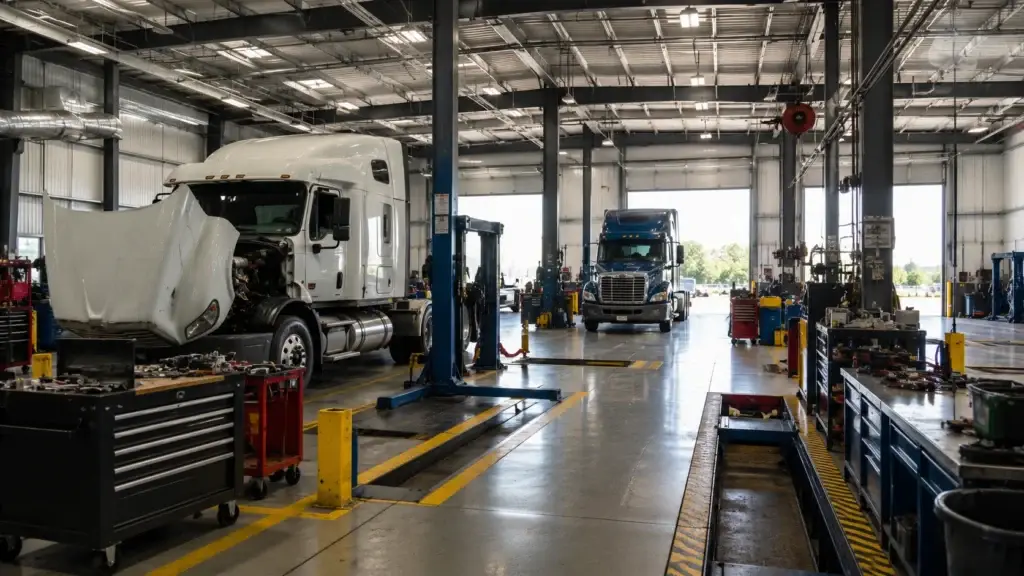
An effective heavy-duty repair shop layout directly determines whether your operation thrives or struggles with constant bottlenecks. The physical design of a diesel repair facility impacts service speed, technician efficiency, and revenue generation more than most shop owners realize. Strategic facility planning meaningfully reduces unnecessary material movement while maintaining OSHA compliance and supporting future expansion.
Commercial truck repair demands specialized considerations that standard automotive layouts cannot address. From accommodating 80-foot combination vehicles to managing diesel exhaust safely, every square foot influences workflow optimization and daily job completion rates.
Whether expanding an existing operation or building from scratch, the difference between a struggling shop and a thriving one often comes down to proper space planning and workflow configuration.
Key Takeaways
- ✓Bay-to-technician ratio: Plan for 1.5-2 service bays per technician to eliminate bottlenecks when parts delays occur.
- ✓Parts accessibility: Position inventory within 30-50 feet of work areas to minimize walking time and boost productivity.
- ✓Layout efficiency: Strategic facility design meaningfully reduces material movement compared to traditional, unplanned configurations.
- ✓Safety compliance: OSHA regulations require specific placement of fire extinguishers, eye wash stations, and ventilation systems — and the cost of getting it wrong keeps climbing.
- ✓Future planning: Design for expandability to accommodate fleet growth over the next 20 years.
In This Guide
- Understanding Space Requirements for Heavy-Duty Facilities
- Optimizing the Bay-to-Technician Ratio
- Seven Effective Bay Configurations for Diesel Shops
- Strategic Tool and Parts Placement
- Lighting Design for Safety and Precision
- Safety Features and OSHA Compliance
- Climate Control and Ventilation Systems
- Customer-Facing Areas That Build Trust
- Planning for Future Growth and Expansion
- Industry Best Practices and TMC Standards
- Implementation Checklist for Shop Layout Planning
- Frequently Asked Questions
Understanding Space Requirements for Heavy-Duty Facilities
Every diesel repair operation needs distinct functional zones that keep work flowing smoothly from customer arrival through vehicle departure. Proper space allocation prevents bottlenecks and supports efficient operations throughout the day.
Reception and administrative space typically requires 200-400 square feet, providing room for a service desk, customer seating, and restroom facilities. The reception area should offer visual connection to the shop floor, building trust through transparency while allowing staff to monitor both entrance and shop operations.
Diagnostic bays need 600-800 square feet to accommodate alignment equipment, scan tools, and technician movement. These specialized areas allow mechanics to identify problems before moving vehicles into repair positions, reducing overall service time and improving first-time fix rates.
Standard repair bays demand 800-1,200 square feet each. This space accommodates heavy-duty vehicle lifts, tool storage, compressed air lines, and technician movement around large commercial trucks. Height clearance matters as much as floor space since many operations involve overhead work on tall trailers and equipment.
Parts storage areas function best with 400-600 square feet, featuring organized shelving and inventory management systems. Central placement between multiple bays provides equal access and reduces walking distance, directly improving productivity throughout every shift.
| Facility Zone | Square Footage | Essential Features |
|---|---|---|
| Reception Area | 200-400 sq ft | Service desk, customer seating, restrooms |
| Diagnostic Bay | 600-800 sq ft | Alignment rack, scan tools, diagnostic equipment |
| Repair Bay | 800-1,200 sq ft | Heavy-duty lifts, tool storage, air lines |
| Parts Storage | 400-600 sq ft | Organized shelving, inventory system |
| Employee Areas | 150-250 sq ft | Break room, lockers, training space |
Building codes significantly influence facility design and must be addressed during initial planning. Most jurisdictions classify diesel fuel as flammable, and OSHA's portable fire extinguisher standard requires a maximum 75-foot travel distance to a Class A extinguisher (50 feet for Class B flammable-liquid hazards) — the same 75-foot figure that shows up again in the safety table below.
Local fire codes also dictate exit requirements and bay door specifications that affect overall layout decisions.
Optimizing the Bay-to-Technician Ratio
Many facilities struggle with a fundamental planning mistake: maintaining a one-to-one relationship between service bays and technicians. This outdated approach creates expensive bottlenecks that limit productivity and revenue potential.
Consider what happens when parts delays occur. A technician working in a single assigned bay must either sit idle or move the vehicle to access another workspace. Both options waste valuable time and reduce daily job completion rates that directly impact revenue.
Industry practice consistently points to a configuration of 1.5 to 2 bays per technician. This ratio allows mechanics to progress multiple jobs simultaneously — when one vehicle needs parts, technicians simply move to another bay and continue working productively.
The benefits extend beyond parts delays. This configuration enables technicians to start diagnostic work while another vehicle undergoes repairs, maintain productivity during cooling or curing processes, reduce time spent moving vehicles between areas, and handle varied job complexity across multiple bays simultaneously.
A well-staffed operation typically runs 8 technicians with 12-16 bays. This structure balances labor costs against maximum throughput while providing flexibility for varying job types and complexity levels. Support staff including service advisors, parts specialists, and shop managers round out the team and ensure smooth workflow coordination.
Getting the physical ratio right is only half the picture — HDJ's guide to shop labor efficiency KPIs covers the utilization and productivity metrics that reveal whether that bay count is actually translating into billable hours once the facility is built.
Seven Effective Bay Configurations for Diesel Shops
Facility layout should match operational needs and service volume. Each configuration offers distinct advantages depending on shop specialization, customer base, and available property dimensions.
Flow-Through Linear Design
Vehicles enter one end and exit the opposite side. This arrangement works exceptionally well for high-volume operations handling 50 or more trucks daily. The unidirectional flow prevents technician path crossings and reduces workplace accidents.
The linear configuration also simplifies vehicle tracking. Customers can easily understand their truck's position in the workflow, and management gains clear visibility into progress and potential bottlenecks without complex tracking systems.
U-Shaped Layout
Service bays surround a central parts storage area in this compact configuration. This design minimizes walking distance since technicians can access inventory from any bay within seconds, making it ideal for smaller facilities or urban locations with space constraints.
Parts specialists stationed in the center can quickly fulfill requests from multiple bays. The configuration also facilitates communication between technicians working on similar repairs, enabling knowledge sharing and faster problem resolution.
Parallel Bay System
Side-by-side bays optimize fleet maintenance operations. This arrangement maintains adequate spacing between lifts while providing dedicated tool storage for each position. Parallel configurations scale easily as businesses grow.
The design supports specialized stations within the facility. Shops can designate specific bays for tire service, brake work, or electrical diagnostics without disrupting overall workflow patterns.
Drive-Through Configuration
Ideal for preventive maintenance and DOT inspections, this layout eliminates backing maneuvers. Vehicles pull straight through dedicated lanes, reducing service time for routine work and supporting higher daily vehicle counts.
Quick-service bays positioned near facility entrances handle oil changes and inspections while major repairs progress in deeper bays. This separation maintains smooth traffic flow and prevents delays.
L-Shaped Design
This configuration maximizes corner lots and irregular property shapes effectively. The design separates customer traffic from service operations, improving safety and professionalism while working effectively for facilities with 6-10 bays.
Office and reception areas typically occupy one wing while repair operations fill the other. This natural division reduces noise in customer-facing spaces and creates a more professional atmosphere that supports premium pricing.
Hub-and-Spoke Pattern
A central diagnostic area anchors the facility with repair bays radiating outward. This arrangement facilitates supervision and quality control since shop foremen can observe multiple bays from a central position.
The pattern works particularly well for operations emphasizing diagnostic accuracy. Complex electrical or engine performance issues benefit from centralized expertise and equipment access.
Modular Grid System
Flexible design allows incremental expansion without disrupting existing workflow. Add bays as business grows, minimizing construction costs during growth phases while maintaining operational continuity.
Utility infrastructure designed with expansion in mind supports future needs. Electrical panels, air lines, and exhaust systems accommodate additional bays without major renovations or service interruptions.
Strategic Tool and Parts Placement
Tool organization directly impacts technician efficiency. Every minute spent searching for equipment represents lost billable time. Strategic placement keeps frequently used items within arm's reach while maintaining organized work areas.
Physical layout is only one piece of the productivity puzzle — HDJ's guide to shop workflow bottlenecks covers the process-level issues — paperwork, communication gaps, scheduling — that a good layout alone won't fix.
Wall-mounted tool boards provide visual organization with shadow outlines showing missing items instantly. This reduces loss and improves accountability. Each bay should feature dedicated storage for commonly used hand tools, reducing the need to share equipment between technicians.
Mobile tool carts offer flexibility between bays. Technicians can move specialized equipment to wherever current jobs require them. Rolling cabinets work particularly well for diagnostic tools and electronic equipment that serve multiple bays.
Overhead storage systems free valuable floor space. Ceiling-mounted racks hold less frequently needed items while keeping them accessible. This vertical approach maximizes usable work area without creating clutter.
Parts room positioning critically affects productivity. Central placement within 30-50 feet of service bays provides balanced access. Pass-through windows allow quick parts delivery without technicians leaving their bays, maintaining focus on repair tasks.
$15,000+ Annual Loss
Illustrative productivity cost from poor parts room placement (50+ feet from bays) for a 5-technician shop, based on typical walking-time math below.
The cumulative impact of parts distance adds up quickly. A 30-foot walk equals approximately 1 minute round trip. With 10 parts trips daily per technician and 5 technicians, that equals roughly 50 minutes of daily productivity loss — translating to over $15,000 annually in wasted labor costs at a typical shop labor rate.
Inventory management systems track parts location and availability in real time. Digital visibility prevents technicians from walking to parts storage only to find items unavailable. These systems integrate with service management software for seamless workflows and automated reordering.
Stay Current on Shop Efficiency Strategies
Get practical facility planning insights, equipment recommendations, and operational best practices delivered to your inbox weekly.
Lighting Design for Safety and Precision
Proper illumination prevents accidents and improves repair accuracy. Heavy-duty work demands clear visibility for safety-critical components like brake systems and suspension where mistakes can have serious consequences.
Natural light provides the foundation for energy-efficient facilities. Skylights and translucent panels reduce electricity costs while improving workspace ambiance. White or light-colored walls reflect illumination into darker corners, maximizing the impact of both natural and artificial light sources.
LED fixtures offer superior performance for shop environments. These systems consume meaningfully less energy than fluorescent alternatives while lasting 50,000 hours or more. Reduced maintenance interruptions keep bays operational and minimize disruption to daily workflow.
Fixture placement follows a systematic approach: install overhead fixtures every 10-12 feet for even coverage without dark spots, position task lights at each workstation for detailed work, add under-hood lighting for engine compartment visibility, and use 5000K color temperature for accurate color rendering.
Color temperature matters more than many realize. The 5000K range closely mimics daylight, allowing technicians to distinguish wire colors, identify fluid leaks, and spot component damage accurately. This precision reduces diagnostic errors and improves first-time fix rates that directly impact profitability.
Safety Features and OSHA Compliance
Heavy-duty repair facilities face strict regulatory requirements that protect workers and ensure environmental compliance. The maximum OSHA penalty for a serious or other-than-serious violation stands at $16,550 per violation as of January 2025 — a figure that carried forward unchanged into 2026 after a lapse in federal data collection prevented the usual annual inflation adjustment.
Willful or repeated violations can run as high as $165,514 per violation, making compliance both a legal and financial priority for every shop owner.
OSHA ventilation standards require exhaust systems designed to prevent dispersion of hazardous substances into work areas. While OSHA has not established a standard specifically for diesel exhaust, exposures to various components are addressed in general industry standards. Shop owners must address diesel particulate matter and carbon monoxide through proper ventilation design.
| Safety Element | Requirement | Strategic Placement |
|---|---|---|
| Fire Extinguishers | Every 75 feet maximum | Near exits, electrical panels, fuel storage |
| Emergency Exits | Minimum 2 routes | Opposite building sides with clear signage |
| Eye Wash Stations | Within 100 feet | Each area with chemical exposure risk |
| Spill Kits | Each bay | Wall-mounted, easily accessible locations |
| First Aid Stations | Central location | Clearly marked, regularly inspected |
Non-slip flooring in high-traffic areas reduces slip and fall accidents. Yellow striping marks walkways and designates safe zones separate from vehicle movement paths. Clear floor markings improve safety while enhancing professional appearance for customers.
Personal protective equipment stations positioned at bay entrances remind technicians to wear required safety gear. Wall-mounted organizers keep gloves, safety glasses, and hearing protection readily available, significantly increasing compliance rates.
Climate Control and Ventilation Systems
Proper ventilation protects technician health and maintains environmental compliance. OSHA's hazard alert on diesel exhaust and particulate matter specifically names auto, truck, and bus maintenance garage workers among those at risk, and recommends source-capture ventilation as a primary engineering control — making ventilation a critical design element for any commercial vehicle repair facility, not an optional add-on.
Source capture exhaust systems provide the most effective solution for diesel facilities. These systems attach directly to vehicle tailpipes, capturing emissions before they enter the workspace. Individual bay systems typically cost $3,000-5,000 but prove essential for worker safety and regulatory compliance.
General ventilation requirements mandate 10-12 air changes per hour minimum for diesel repair facilities. This rate dilutes airborne contaminants and maintains acceptable air quality throughout the shop. Makeup air systems balance exhaust with fresh air introduction, preventing negative pressure that reduces heating and cooling efficiency.
Carbon monoxide monitors installed in each bay provide early warning of dangerous conditions. Audible alarms alert technicians to evacuate if concentrations reach hazardous levels, preventing serious health incidents.
Temperature control strategies vary by climate and facility size. Radiant tube heaters provide efficient winter heating, targeting 65-72°F working temperatures. High-velocity fans deliver summer cooling and air circulation without expensive HVAC systems. Separate climate zones for office and shop areas optimize comfort while controlling energy costs. Programmable thermostats can meaningfully reduce energy expenses through scheduled temperature adjustments.
Insulated overhead doors minimize heat loss during winter months. Rapid-opening doors reduce the duration bays remain open, further improving climate control efficiency and reducing energy waste throughout the year.
Editorial Insight
The HDJ Perspective
According to Michael Nielsen, Heavy Duty Journal's publisher with 15+ years in diesel repair and shop operations, the shops with the highest technician retention rates consistently share one trait: they invest in proper ventilation and climate control before expanding bay counts. Quality exhaust capture systems can pay for themselves within a couple of years through reduced turnover alone — not counting the productivity gains from healthier, more comfortable technicians. Shop owners planning new facilities should budget a real line item for environmental systems, not treat it as an afterthought once the bays are designed.
Customer-Facing Areas That Build Trust
Reception areas create crucial first impressions that influence customer retention and support premium pricing strategies. Professional waiting spaces demonstrate attention to detail and operational excellence that customers associate with quality repair work.
Windows offering shop floor views build transparency and trust. Customers appreciate seeing their vehicles and observing technician expertise firsthand. Strategic window placement maintains visibility while minimizing noise transmission into customer areas.
Essential reception features include comfortable seating for 6-8 customers, coffee station and clean restroom facilities, WiFi access and device charging stations, product displays for additional revenue opportunities, and digital displays showing service progress in real-time.
Service desk positioning enables staff to monitor both entrance and shop floor simultaneously. This strategic placement improves communication efficiency and enhances security. Staff can greet arriving customers while maintaining awareness of shop operations throughout the day.
Professional signage and branding throughout customer areas reinforce business identity. Clean, well-maintained spaces signal attention to detail that extends to repair work quality, justifying premium service rates that improve profit margins.
Planning for Future Growth and Expansion
Successful facilities accommodate growth without major renovations. Design experts recommend buildings that handle current workload while adapting to demands 20 years forward, protecting long-term investments and reducing future disruption.
Site planning allocates space for additional bays even if construction occurs in phases. Utility infrastructure sized for ultimate buildout prevents expensive retrofits. Electrical panels, compressed air systems, and exhaust fans should support planned expansion capacity from day one.
Modular construction approaches enable incremental growth as revenue increases. Adding bays to existing structures costs less than standalone buildings. Shared walls, utilities, and support spaces reduce per-bay construction expenses significantly while maintaining operational continuity during construction.
Equipment selection should consider compatibility with future technology advances. Diagnostic tools, lifts, and service equipment that accept software updates extend useful life. Heavy-duty vehicle lifting systems from established manufacturers, chosen for documented upgrade paths and long-term parts support, protect equipment investments against premature obsolescence.
Industry Best Practices and TMC Standards
Leading industry organizations provide valuable guidance for facility design and operations. The Technology & Maintenance Council (TMC), a division of the American Trucking Associations, publishes more than 400 recommended practices covering equipment maintenance and shop management.
TMC recommended practices address critical aspects of shop operations including equipment specification, maintenance procedures, and facility planning. The organization's annual meetings and technical exhibitions provide opportunities for maintenance professionals to share insights and learn about emerging technologies affecting shop design and operations.
Following established industry standards demonstrates professionalism and can reduce insurance costs. Many commercial insurers offer premium reductions for facilities that comply with TMC recommendations and maintain documented safety programs.
Implementation Checklist for Shop Layout Planning
Successful facility design requires systematic planning and execution. Following this implementation framework guides decision-making and ensures comprehensive coverage of critical elements.
Start by calculating total space requirements based on projected service volume over the next five years. Consider both current demand and anticipated growth to avoid costly expansions shortly after opening or renovation completion.
Select a bay configuration that matches your service specialty and customer base. High-volume preventive maintenance operations benefit from flow-through designs, while complex diagnostic work requires hub-and-spoke patterns with centralized expertise.
Plan for 1.5-2 bays per technician to maximize productivity and eliminate bottlenecks. This ratio proves optimal across various shop sizes and service types based on industry experience.
Position parts storage within 50 feet of all service bays. Measure actual distances during planning to verify accessibility meets productivity targets before finalizing layouts.
Install LED lighting at 10-12 foot intervals throughout the facility. Specify 5000K color temperature for accurate color rendering and reduced eye strain during detailed work.
Add required OSHA safety equipment and emergency systems before operations begin. Verify placement meets regulatory requirements and obtain necessary permits before construction begins.
Design customer areas for comfort and transparency while balancing visibility with noise control. Create professional environments that support premium pricing and build customer confidence.
Install proper ventilation and exhaust capture systems throughout. Source capture provides the most effective protection against diesel emissions and ensures regulatory compliance.
Plan utility infrastructure for future expansion capacity. Size electrical service, compressed air systems, and plumbing for ultimate buildout even if construction occurs in phases.
Implement tool organization and inventory management systems from day one. Digital tracking prevents losses and ensures accountability across the organization while improving daily productivity.
Frequently Asked Questions
What is the ideal bay-to-technician ratio for a heavy-duty repair shop?
The recommended ratio is 1.5 to 2 bays per technician. This allows mechanics to work on multiple jobs simultaneously, maintaining productivity when parts delays occur or vehicles need cooling time between repair steps. A shop with 8 technicians should plan for 12-16 bays to optimize throughput without creating expensive idle time.
How much space does a heavy-duty repair bay require?
Standard repair bays need 800-1,200 square feet each to accommodate heavy-duty vehicle lifts, tool storage, compressed air lines, and technician movement around large commercial trucks. Height clearance is equally important since many operations involve overhead work on tall trailers. Diagnostic bays can be smaller at 600-800 square feet.
What ventilation requirements apply to diesel repair facilities?
OSHA general industry standards require exhaust systems that prevent dispersion of hazardous substances into work areas. Diesel repair facilities should maintain 10-12 air changes per hour minimum, with source capture exhaust systems at each bay for direct tailpipe emissions control. Carbon monoxide monitors provide additional safety protection.
How far should parts storage be from service bays?
Parts storage should be positioned within 30-50 feet of all service bays. Every additional foot of walking distance reduces productivity — a 5-technician shop with parts rooms 50+ feet away can lose approximately $15,000 annually in wasted labor at typical shop labor rates. Central placement with pass-through windows provides optimal access.
What lighting specifications work best for diesel shops?
LED fixtures installed every 10-12 feet with 5000K color temperature provide optimal illumination. This color range closely mimics daylight, allowing technicians to distinguish wire colors, identify fluid leaks, and spot component damage accurately. Task lighting at individual workstations supplements overhead fixtures for detailed work.
How should I plan for future shop expansion?
Size utility infrastructure including electrical panels, compressed air systems, and exhaust capacity for your ultimate planned buildout from day one. Modular grid designs allow incremental bay additions without major renovations. Budgeting extra site space up front for future expansion avoids costly retrofits even if construction occurs in phases.
Heavy-duty repair shop layout decisions directly impact profitability, technician satisfaction, and operational efficiency for years to come. The configuration choices made during planning determine whether a shop operates smoothly or struggles with constant bottlenecks that limit revenue potential.
Strategic parts placement, proper bay-to-technician ratios, and efficient workflow patterns combine to meaningfully boost daily job completion rates compared to poorly designed facilities. These gains compound over time, with well-designed facilities typically recovering planning costs within a few years through productivity improvements alone.
Start your planning with workflow optimization rather than aesthetic considerations. Focus on the fundamentals — 1.5-2 bays per technician, parts within 50 feet of work areas, and configuration matching your service volume. These decisions create the foundation for long-term success in the competitive heavy-duty repair market.
Share This Guide
Know a fleet manager or shop owner planning a facility upgrade? Share this resource to help them make informed layout decisions.