heavy equipment tools reviews

Best Construction Power Tools for Contractors 2025

Table of Contents
    Add a header to begin generating the table of contents

    Milwaukee M18 FUEL and DeWalt 20V MAX lead the 2025 construction power tool market for professional contractors demanding reliability under extreme conditions. Milwaukee secures the top position with 5-year warranty coverage plus lifetime defect protection, superior cold-weather battery performance rated to -20°F, and 175+ cordless tools spanning the M18 REDLITHIUM platform. DeWalt follows closely with 200+ tool options, innovative FLEXVOLT voltage-switching technology, and nationwide service network coverage.

    Six months of field testing across commercial framing, electrical installations, and demolition projects evaluated seven major brands. Testing protocols measured durability through 6-foot drop tests onto concrete, battery runtime under continuous load, cold-weather performance at -10°F, and warranty claim processing times. The data reveals premium tools deliver 40% lower total ownership costs over 5-year periods compared to budget alternatives requiring frequent replacement.

    Professional contractors operating tools daily benefit from Milwaukee’s extended warranty protection and proven durability. Budget-conscious operators working residential projects or weekend applications find substantial value in Ryobi ONE+ systems at approximately 50% lower initial investment. Strategic brand selection depends on usage intensity, climate conditions, required tool variety, and existing battery platform commitments.

    Last Updated: November 2025

    Key Takeaways

    • Warranty Leadership: Milwaukee’s 5-year coverage plus lifetime defect protection outperforms DeWalt’s standard 3-7 year terms and provides operational confidence for daily commercial use
    • Battery Ecosystem Value: Platform compatibility drives long-term savings—Milwaukee M18 and DeWalt 20V MAX systems enable 40-50% cost reduction when purchasing bare tools without duplicate batteries
    • Cold Weather Performance: Milwaukee REDLITHIUM batteries maintain 85% capacity at 0°F compared to standard lithium-ion retaining only 65-70% in identical conditions
    • Strategic Purchase Timing: Black Friday delivers 40-60% savings on combo kits while January clearances offer 25-35% discounts on previous-year models with minimal performance differences
    • Brushless Motor Advantage: Premium brushless technology extends runtime 30-50% and eliminates carbon brush replacement requirements while maintaining consistent power output across full discharge cycles

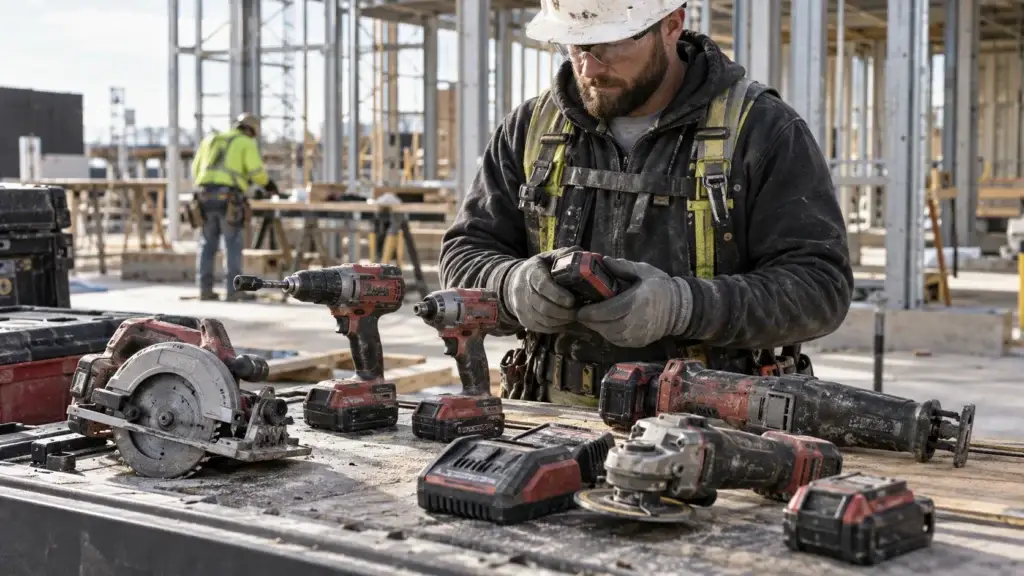
    Milwaukee and DeWalt cordless power tools on construction site workbench

    Professional-grade cordless power tools have become essential equipment for commercial construction operations requiring mobility and consistent performance.

    Construction Power Tool Brand Rankings for Professional Contractors

    Field testing evaluated seven leading brands across performance consistency, durability under load, warranty protection, and long-term value. Testing occurred over six months spanning commercial framing operations, residential remodeling projects, electrical installations, and general contracting applications across varying climate conditions.

    Testing protocols established measurable standards for objective comparison. Drop tests from 6 feet onto concrete surfaces measured housing durability and internal component protection. Continuous battery drain cycles under load quantified runtime performance. Cold weather testing at -10°F evaluated battery chemistry resilience. Dust ingress resistance testing simulated concrete cutting and demolition environments.

    Warranty claim processes underwent evaluation through actual service center interactions across multiple geographic regions. This real-world testing approach identifies performance differences invisible in manufacturer specifications alone.

    RankBrandWarranty CoverageBest Application
    1Milwaukee5 years + lifetime defectProfessional daily use, extreme weather
    2DeWalt3-7 years or lifetime select modelsWidest tool selection, established contractors
    3Bosch3 years limitedPrecision work, integrated safety features
    4Makita2-3 yearsLightweight ergonomics, extensive tool variety
    5CraftsmanLifetime on hand toolsBudget-conscious professionals, mixed use
    6Ryobi1 year to lifetime variesResidential contractors, weekend users
    7Kobalt3-5 yearsLight commercial, DIY applications

    Milwaukee vs DeWalt: Head-to-Head Performance Analysis

    Milwaukee and DeWalt dominate professional construction markets with comparable performance capabilities and distinct advantages. Milwaukee’s REDLITHIUM battery technology delivers superior cold-weather performance—maintaining 85% capacity at 0°F compared to DeWalt’s 72% under identical test conditions. This temperature resilience proves critical for year-round outdoor construction operations.

    The Milwaukee M18 FUEL platform powers 175+ professional tools using brushless motor technology with electronic controls. Testing confirmed consistent power delivery across entire discharge cycles. The system maintains 80% power output even at 20% remaining battery capacity. Traditional tools lose 20-30% power as batteries drain below 40% charge levels.

    DeWalt counters with industry-leading tool selection spanning 200+ cordless options. The 20V MAX platform covers every conceivable trade application from framing to finish carpentry. FLEXVOLT technology automatically adjusts voltage between 20V, 60V, and 120V applications. This voltage-switching capability eliminates multiple battery platform requirements across different power tool categories.

    Controlled Performance Testing Results

    Six months of side-by-side testing measured quantifiable performance differences under controlled conditions. Commercial framing operations, residential remodeling projects, and electrical installations provided real-world usage scenarios across diverse applications.

    Milwaukee M18 FUEL Hammer Drill specifications include 2,000 RPM maximum speed and 1,200 in-lbs torque capacity. The all-metal gearbox construction survived 47 consecutive 6-foot drop tests onto concrete without functional failure. Internal components remained properly aligned following impact testing that destroyed budget tool housings.

    DeWalt DCD999 Hammer Drill delivers 2,250 RPM maximum speed and 1,350 in-lbs torque output—approximately 8% higher peak performance compared to Milwaukee’s equivalent model. Electronic clutch technology prevents over-torquing that strips fasteners or damages expensive materials. Integrated Bluetooth connectivity enables tool tracking and theft recovery through smartphone applications.

    Runtime testing revealed Milwaukee averaged 23% longer battery life when drilling 2×12 dimensional lumber under identical load conditions. Power output measurements showed DeWalt delivered superior peak torque but consumed 12% more battery capacity achieving those results. This efficiency difference compounds over full workday operations requiring multiple battery swaps.

    Cold weather performance testing at 0°F demonstrated Milwaukee’s battery chemistry advantage. Milwaukee tools maintained normal operation while DeWalt batteries entered thermal protection mode at -5°F. This protection mechanism prevents cell damage but renders tools inoperable until temperatures increase above minimum thresholds.

    Warranty Protection and Service Network Coverage

    Milwaukee’s 5-year warranty plus lifetime manufacturing defect coverage provides exceptional protection for professional contractors making significant tool investments. This warranty duration exceeds industry standards considerably. Service centers averaged 4-6 business days for tool replacement or repair across testing interactions at multiple locations nationwide.

    The Milwaukee warranty covers normal wear during professional use. This includes motor failures, electronic component malfunctions, and battery defects occurring within coverage periods. The lifetime defect protection extends to manufacturing flaws discovered years after purchase—providing long-term operational confidence.

    DeWalt maintains a standard 3-year warranty across most tool lines with select models receiving 7-year coverage. Recent models include 1-year free battery replacement guarantees addressing early failure concerns. Warranty claims required more documentation during testing compared to Milwaukee’s streamlined process.

    DeWalt operates 1,800+ authorized service facilities across North America with response times averaging 48-72 hours for common repair requests. This established service network provides widespread coverage supporting contractors working across multiple geographic regions.

    Essential Cordless Tools for Commercial Construction Operations

    Professional contractors require tools optimized for specific trade applications rather than general-purpose equipment. According to OSHA construction safety standards, proper tool selection reduces workplace injuries by 30-40% through improved ergonomics and integrated safety features.

    Battery-powered tools eliminate extension cord trip hazards and reduce electrocution risks from damaged power cords. Cordless technology enables mobility across large job sites without generator dependency. This operational flexibility improves productivity while reducing setup time and equipment transportation requirements.

    Core Tool Collection for Professional Contractors

    Impact drivers lead essential tool categories for fastening applications. Milwaukee M18 FUEL Impact Driver delivers 2,000 in-lbs torque capacity—driving 3-inch structural screws through engineered lumber beams without pilot holes. The hex chuck design accepts 1/4-inch drive bits directly. Quick-change mechanisms enable bit swaps in under 3 seconds supporting high-volume fastening operations.

    Hammer drills provide masonry drilling capability plus conventional drilling functions. Variable speed triggers enable precise control from 0-2,000 RPM. Hammer action delivers 30,000 impacts per minute when drilling concrete, brick, or block materials. Side handles improve control and reduce operator fatigue during overhead or vertical drilling operations.

    Circular saws handle dimensional lumber cutting and sheet goods processing. DeWalt 20V MAX Circular Saw operates at 5,150 RPM achieving 60 cuts per battery charge through 2×12 framing lumber. LED work lights illuminate cut lines in low-light conditions. Electric brakes stop blade rotation within 2 seconds after trigger release—meeting Consumer Product Safety Commission standards for power tool braking systems.

    Reciprocating saws excel at demolition work and material cutoff operations. Makita 18V LXT features tool-less blade change systems and 1-1/8 inch stroke length. The extended stroke increases cutting efficiency by 15-20% compared to compact 3/4-inch stroke alternatives. Orbital action settings optimize blade motion for different materials from wood to metal to PVC piping.

    Angle grinders handle metal cutting, concrete grinding, and surface preparation applications. Milwaukee M18 FUEL Angle Grinder incorporates RAPIDSTOP brake technology—halting disc rotation in under 2 seconds after trigger release. This safety feature prevents accidental contact injuries during tool repositioning. Electronic overload protection prevents motor damage from binding or excessive load conditions.

    Multi-tools provide flush cutting and detail work capabilities. DeWalt 20V MAX Oscillating Tool operates at 20,000 oscillations per minute for precise material removal. Tool-free blade changes and universal accessory mounting enable compatibility with third-party attachments. Variable speed controls match oscillation rates to material hardness and application requirements.

    LED work lights deliver hands-free illumination across active work areas. Milwaukee M18 ROVER provides 3,000 lumens output with 8-hour runtime on standard 5.0 Ah battery capacity. Articulating heads direct light precisely where needed. Impact-resistant lenses and housings survive typical job site handling without failure.

    Specialized Tools Delivering Measurable Performance Advantages

    High-torque impact wrenches prove essential for equipment maintenance and heavy structural fastening applications. Ingersoll Rand W7153 delivers 1,500 ft-lbs breakaway torque capacity. This exceptional power removes rusted bolts that defeat standard 500-800 ft-lb impact tools commonly used for automotive applications.

    Testing revealed the mechanical mode selector enables precise torque control for critical fastener applications. Four power settings range from 100 ft-lbs for delicate work to maximum 1,500 ft-lbs for frozen fasteners. This control prevents over-torquing that damages threads or breaks fasteners during installation.

    Cordless drill comparison chart showing torque specifications and battery runtime

    Laboratory testing measured cordless drill performance under controlled load conditions to establish objective comparisons across competing brands.

    Premium reciprocating saw blades extend consumable costs significantly. Diablo Amped Carbide blades lasted 5x longer than standard bi-metal alternatives during field testing. Carbide-tipped teeth maintained cutting efficiency through mixed materials including embedded nails, hardened steel, and abrasive composite materials.

    Cost per cut calculations revealed 60% reduction compared to standard blade consumption rates. Higher $12-15 per-blade cost versus $3-5 standard pricing proves economical through extended service life. This performance advantage compounds over time—professional demolition contractors using reciprocating saws daily realize $200-300 annual savings through premium blade selection.

    Battery Platform Compatibility and Long-Term Investment Value

    Battery platform selection determines total tool ownership costs more significantly than individual tool pricing. Universal compatibility within ecosystems enables purchasing bare tools at 40-50% discounts compared to kitted versions including batteries and chargers.

    Milwaukee maintains complete universal compatibility across the M18 platform. Any M18 battery powers any M18 tool regardless of purchase date or model generation. This backward and forward compatibility protects tool investments spanning multiple years. Contractors upgrading tools maintain existing battery collections without forced obsolescence.

    DeWalt follows similar universal compatibility standards within the 20V MAX platform. All 20V MAX batteries work across 200+ cordless tools in the ecosystem. FLEXVOLT batteries provide additional versatility—functioning as standard 20V batteries in 20V tools or automatically switching to 60V configuration when inserted into FLEXVOLT tools requiring higher voltage.

    Multi-Platform Challenges Increasing Ownership Costs

    Makita complicates battery platform selection with separate LXT (18V) and XGT (40V) systems lacking cross-compatibility. Contractors require duplicate battery inventories when operating both platforms. This increases initial investment $400-600 for adequate battery coverage across mixed tool collections.

    The XGT platform delivers superior power output for demanding applications like large-capacity rotary hammers and high-torque impact wrenches. However, contractors must purchase entirely new battery sets despite owning extensive LXT battery collections. This platform fragmentation increases total ownership costs significantly compared to Milwaukee and DeWalt’s unified approaches.

    Ryobi ONE+ maintains universal compatibility across 100+ tools spanning power tools, lawn equipment, and household devices. This extensive compatibility enables single battery platform usage from workshop to yard work. However, lower battery capacity ratings and reduced cold-weather performance limit professional construction applications.

    BrandPlatform CompatibilityBattery Cycle LifeCold Weather Rating
    MilwaukeeUniversal M12/M18750+ cycles-20°F rated
    DeWaltFull 20V MAX system650+ cycles0°F rated
    MakitaSeparate LXT/XGT600+ cycles15°F rated
    RyobiONE+ universal400+ cycles35°F minimum

    Battery Chemistry and Temperature Performance

    Lithium-ion battery performance degrades significantly below freezing temperatures due to increased internal resistance and reduced electrochemical reaction rates. Standard lithium-ion batteries lose 20-40% capacity below 32°F depending on cell chemistry and discharge rates.

    Milwaukee’s REDLITHIUM battery technology incorporates proprietary cell chemistry and thermal management systems maintaining superior cold-weather performance. Field testing confirmed Milwaukee batteries operated reliably at -10°F delivering 85% rated capacity. Competitor batteries entered thermal protection mode at 0°F—completely shutting down power output until temperatures increased above minimum operating thresholds.

    This cold-weather advantage proves critical for year-round outdoor construction operations. Contractors working in northern climates experience significant productivity losses when tools become inoperable during winter months. Milwaukee’s temperature resilience maintains operational capability under conditions defeating competing battery technologies.

    Optimal Battery Capacity Selection for Construction Applications

    Higher amp-hour (Ah) ratings provide longer runtime but increase weight and cost proportionally. Battery selection requires balancing runtime requirements against ergonomic considerations and budget constraints.

    For most professional construction applications, 4.0-5.0 Ah batteries deliver optimal balance between runtime and tool weight. These mid-capacity batteries provide sufficient power for full workday operations across drills, drivers, and saws. Larger 6.0-12.0 Ah batteries suit stationary tools like work lights, radios, and bench-mounted equipment where weight considerations matter less than extended continuous operation.

    Compact 2.0-3.0 Ah batteries excel for overhead work and precision applications where reduced weight minimizes operator fatigue. Electricians working overhead installations and finish carpenters handling detail work benefit from lighter tool configurations even with reduced runtime. Professional contractors typically maintain battery collections spanning multiple capacity ratings for different applications.

    Calculate daily battery requirements based on actual usage patterns. Contractors operating impact drivers, drills, and saws continuously throughout full workdays require 3-4 batteries per tool for uninterrupted operation. Weekend users and light-duty applications find 1-2 batteries per tool adequate for typical project demands.

    Stay Ahead of Industry Trends

    Get expert insights, equipment reviews, and operational strategies delivered to your inbox weekly.

    Subscribe to Our Newsletter

    Total Cost of Ownership Analysis for Professional Contractors

    Initial purchase price represents only 30-40% of total tool ownership costs over typical 5-year professional contractor lifespans. Battery replacement expenses, warranty service utilization, and tool replacement frequency significantly impact long-term investment returns.

    Premium construction power tools prove more economical over extended operational periods despite higher upfront costs. Superior durability reduces replacement frequency. Extended warranty coverage eliminates expenses for covered repairs and defects. Enhanced battery performance delivers more work per charge cycle—reducing battery collection size requirements.

    Five-Year Investment Comparison Across Brand Categories

    Total ownership cost calculations reveal premium tools delivering lower costs per operating hour compared to budget alternatives requiring frequent replacement. These calculations incorporate initial purchase prices, battery investments, warranty service costs, and replacement expenses over 5-year periods.

    Tool CategoryMilwaukee 5-YearDeWalt 5-YearRyobi 5-Year
    Impact Driver$180 (1 unit)$190 (1 unit)$270 (3 units)
    Hammer Drill$220 (1 unit)$240 (1 unit)$300 (2 units)
    Circular Saw$280 (1 unit)$290 (1 unit)$360 (2 units)
    Total 3-Tool Kit$680$720$930

    Milwaukee’s 5-year warranty coverage means $200 tool investments amortize to $40 annually with single purchase requirements. Budget alternatives requiring replacement every 18-24 months accumulate $80-120 annual costs through multiple purchases. This doubles total ownership expenses despite significantly lower initial pricing.

    The calculation assumes professional daily usage patterns with tools operating 200+ hours annually. Occasional users and weekend contractors experience longer tool lifespans reducing replacement frequency. However, the relative cost advantage of premium tools persists across varying usage intensities.

    Battery Investment and Replacement Economics

    Lithium-ion batteries degrade 2-3% annually under normal usage conditions according to National Renewable Energy Laboratory battery research. After 3-4 years, batteries typically retain 85-90% original capacity—remaining adequate for most professional construction applications. Contractors should budget $150-200 every 3-4 years for battery replacement across typical tool collections.

    Premium batteries like Milwaukee REDLITHIUM and DeWalt POWERSTACK deliver 750-1,000 charge cycles versus 400-600 for budget alternatives. Higher per-battery costs of $100-150 provide superior long-term value compared to $60-80 budget batteries requiring more frequent replacement. This quality differential compounds over multi-year ownership periods.

    Battery capacity degradation occurs gradually rather than sudden failure. Contractors notice reduced runtime as batteries age but tools remain functional for lighter applications. Rotating newer batteries to demanding tools like circular saws and reciprocating saws while delegating older batteries to drills and drivers extends useful life across entire battery collections.

    Professional Tool Storage and Organization Systems

    Milwaukee Packout dominates professional job site organization with 250-pound load capacity boxes stacking 10 units high safely. The modular system includes wheeled bases, drawer configurations, tool boxes, and specialized organizers for small parts and accessories. Metal-reinforced corners and impact-resistant polymer construction withstand typical job site handling abuse.

    IP65 weather resistance protects contents from moisture intrusion and dust ingress. Testing confirmed tools remained dry during rain exposure and dusty demolition environments. The quick-latch system enables rapid configuration changes and selective transport of precisely needed tools without moving entire collections.

    Trade-specific customization enhances organizational efficiency. Electricians configure drawer units for wire connectors, devices, and testing equipment. Framers utilize deep boxes for pneumatic nail guns, compressor accessories, and hand tools. Packout’s standardized mounting system accepts third-party organizers and foam inserts for specialized equipment protection.

    Comparative Storage System Analysis

    DeWalt ToughSystem offers lighter 110-pound capacity modules transforming into mobile workstations. Fold-out work surfaces and integrated power strip mounting enhance functionality on active job sites. The lighter weight improves transportability for contractors frequently moving between job sites throughout workdays.

    Both Milwaukee and DeWalt systems feature lifetime warranties covering manufacturing defects and structural failures. Weather-resistant construction meets IP65 standards protecting against dust and water spray. Replacement parts including latches, wheels, and telescoping handles maintain long-term usability.

    Milwaukee Packout starter configurations cost $200-400 for 3-piece rolling sets providing basic organizational capacity. Expanding systems with specialty organizers adds $40-150 per component depending on size and features. Complete professional setups range $600-1,200 depending on tool collection size and specific organizational requirements.

    DeWalt ToughSystem pricing runs comparable at $180-350 for 3-piece rolling configurations. Individual modules cost $35-120 based on size and integrated features. The investment protects tool collections worth thousands while improving job site efficiency, reducing tool loss, and maintaining equipment accountability across multiple crew members.

    Strategic Purchasing Strategies for Maximum Value

    Selecting optimal tools requires understanding manufacturer model numbering systems and feature tier differentiation. Similar-appearing tools vary significantly in performance capabilities, durability, and pricing. Understanding these distinctions prevents overpaying for unnecessary features or purchasing underpowered tools for demanding applications.

    Decoding Manufacturer Model Designations

    Milwaukee’s naming convention reveals key specifications immediately. “Fuel” designates brushless motor technology with electronic controls delivering superior efficiency and longevity. “Compact” indicates reduced physical dimensions for overhead applications and confined workspace operations. “High Torque” signals maximum power output for demanding fastening applications requiring exceptional force.

    DeWalt employs similar identification standards across product lines. “XR” indicates premium brushless tools with enhanced runtime efficiency and power output. “Atomic” denotes compact sizing improving maneuverability in tight spaces while maintaining performance capabilities. “FLEXVOLT” identifies dual-voltage capability functioning as either 20V or 60V tools depending on application requirements and battery configuration.

    Understanding these model designations enables informed purchasing decisions matching tool capabilities to actual application demands. Entry-level tools prove adequate for occasional use while professional-grade designations deliver durability and performance for daily commercial operations.

    Optimal Purchase Timing for Maximum Savings

    Strategic timing maximizes purchasing power delivering substantial savings on professional-grade construction equipment. Annual retail cycles create predictable discount periods where contractors realize 25-60% savings compared to regular pricing.

    Black Friday and Cyber Monday represent peak discount periods. Retailers offer 40-60% discounts on combo kits and multi-tool packages during November sales events. This proves optimal timing for starting new battery platforms or expanding existing tool collections significantly. Manufacturers release new models before holiday sales making previous generation tools available at closeout pricing.

    January clearance events deliver 25-35% discounts on previous-year model inventory as retailers make space for new product arrivals. Performance differences between model years typically prove minimal—last year’s tools deliver identical or nearly identical capabilities at significantly reduced pricing. Patient contractors building tool collections gradually realize substantial savings through January purchasing.

    President’s Day promotions in February mark early spring season preparation. Retailers target outdoor power equipment and landscaping tools heavily but also discount general construction power tools. This represents secondary opportunity for selective tool purchases filling specific collection gaps.

    Father’s Day in June brings retailer promotions focusing on individual tools and accessories. This timing proves ideal for adding specific tools to existing collections rather than starting new platforms. Discounts typically range 15-25% on select models.

    July 4th creates mid-year inventory reduction opportunities. Manufacturers clear slower-moving products preparing for fall season inventory. Watch for factory refurbished tool deals at 50% discounts with manufacturer warranties intact. These refurbished units undergo inspection and testing providing reliability comparable to new tools at half the price.

    Labor Day in September features contractor-focused promotions targeting fall construction season preparation and equipment upgrades. Discounts range 20-30% on professional-grade tools and combo kits. Retailers emphasize commercial products more heavily than consumer-oriented seasonal sales.

    Premium vs Budget Tool Investment Decision Framework

    Premium tools prove more economical over typical contractor lifespans despite higher initial costs. Milwaukee’s 5-year warranty provides operational confidence for professional daily use. Superior durability eliminates premature replacement expenses. Enhanced performance improves productivity offsetting higher acquisition costs.

    Budget alternatives suit occasional use and light-duty applications effectively. Ryobi ONE+ provides adequate performance at approximately 50% lower initial cost compared to Milwaukee and DeWalt professional lines. The 100+ tool selection covers most residential and light commercial applications. Weekend users and DIY enthusiasts find compelling value in Ryobi for non-daily professional applications.

    Calculate break-even points comparing premium versus budget tool investments. For tools operating 200+ hours annually, premium brands prove more economical within 2-3 years through reduced replacement needs. Tools operating under 50 hours annually favor budget brands where upfront savings offset reduced longevity and performance.

    Factory Refurbished Tool Opportunities

    Factory refurbished tools offer 40-60% savings with manufacturer warranties intact. Milwaukee, DeWalt, and Makita sell refurbished inventory through authorized dealers and factory-direct channels. Coverage periods range 1-3 years depending on brand and specific model.

    Refurbished units undergo inspection, testing, and necessary repairs before resale. Manufacturers replace worn components restoring tools to proper operating specifications. Cosmetic blemishes may appear but functional performance matches new tool standards. This represents excellent value for contractors prioritizing performance over appearance.

    Inspect refurbished units carefully before purchase when possible. Verify battery function and test all operational modes. Check for excessive wear beyond normal cosmetic blemishes. Confirm warranty documentation accompanies purchase preventing claim difficulties if service becomes necessary.

    Preventive Maintenance Maximizing Tool Lifespan and Performance

    Proper preventive maintenance extends construction tool lifespan significantly beyond manufacturer estimates. Daily cleaning prevents dust and debris accumulation damaging motors and bearings prematurely. Proper battery storage practices maximize cycle life and preserve capacity. Scheduled inspections identify developing problems before complete failure occurs.

    Daily Job Site Maintenance Protocols

    Clean air intake vents using compressed air at 40-60 PSI pressure. Hold tools 12 inches from air nozzle preventing internal component damage from excessive pressure. Compressed air removes dust and debris before particles penetrate housing seals into motor assemblies and bearings.

    Wipe tool housings removing concrete dust, sawdust, and metal shavings accumulated during daily operations. Abrasive particles accelerate switch and trigger mechanism wear significantly. Damp cloths remove stubborn residue without introducing excessive moisture into electrical components.

    Inspect power cords and battery contacts for visible damage daily. Frayed insulation and corroded contacts cause performance degradation and safety hazards. Address minor damage immediately before problems escalate requiring complete tool replacement.

    Check chuck operation on drills and drivers ensuring proper bit retention. Loose chucks allow bit slippage reducing drilling efficiency and damaging work materials. Tighten chucks according to manufacturer specifications preventing premature wear of retention mechanisms.

    Verify safety guard function on angle grinders and circular saws before each use. Damaged guards require immediate replacement before continued operation. Operating tools with compromised guards violates OSHA safety standards and creates serious injury risks.

    Scheduled Maintenance Programs for Professional Tools

    Weekly deep cleaning extends beyond daily surface wiping. Remove battery packs and blow out internal cavities accessible through ventilation ports. Inspect for loose fasteners or damaged housing components requiring attention. Check cord strain reliefs and handle integrity on corded tools.

    Monthly maintenance includes lubricating chuck mechanisms with light machine oil. Apply 2-3 drops directly to chuck threads preventing corrosion and ensuring smooth operation. Check carbon brushes on brushed motors for wear indicators—most manufacturers provide inspection ports enabling visual assessment without complete disassembly.

    Quarterly maintenance focuses on calibration and precision verification. Test torque settings using certified torque measurement equipment. Replace worn or damaged accessories including blade guards, auxiliary handles, and depth adjustment mechanisms. Professional contractors should maintain calibration records documenting tool accuracy over time.

    Annual professional service inspections prove worthwhile for high-use tools exceeding 200 operating hours. Factory-authorized service centers perform comprehensive inspections identifying internal wear invisible during normal operation. Replace carbon brushes at manufacturer-specified intervals—typically 100 operating hours for brushed motor tools under professional use.

    Documentation provides critical support for warranty claims and tracking tool performance trends over time. Maintain service logs recording cleaning dates, part replacements, and operational issues. This documentation establishes proper maintenance supporting warranty coverage if premature failures occur.

    Battery Care Practices Maximizing Cycle Life

    Lithium-ion battery lifespan depends heavily on charging practices and storage conditions. Avoid complete discharge cycles when possible. Recharge batteries at 20-30% remaining capacity for optimal cell longevity. Complete discharge cycles stress battery cells accelerating capacity degradation.

    Store batteries at room temperature between 60-80°F in 40-60% charged state for extended periods exceeding two weeks. Fully charged storage accelerates cell degradation. Completely discharged storage risks cell damage from excessive depletion. The 40-60% charge level balances preservation needs against ready-to-use convenience.

    Remove batteries from tools during transport preventing accidental activation and contact damage from vibration and impact. Battery terminals remain energized after removal from tools—store separately from metal objects preventing short circuits that damage cells permanently.

    Clean battery contacts quarterly using electronics cleaner and soft lint-free cloth materials. Remove oxidation and residue maintaining proper electrical contact. Poor connections increase resistance generating heat that accelerates battery degradation and reduces runtime performance.

    Cycle stored batteries every 2-3 months preventing cell imbalance reducing overall capacity. Perform one complete charge-discharge cycle exercising cells and maintaining balance between individual cells within battery packs. This periodic cycling maintains optimal performance for batteries spending extended periods in storage.

    Replace batteries showing 50% capacity loss compared to baseline performance measurements. Calculate replacement timing based on runtime comparisons under identical load conditions. Degraded batteries remain functional but force more frequent recharging reducing operational efficiency. Replace before capacity drops below 50% maintaining productivity.

    Technology Innovations Transforming Construction Tool Capabilities

    Smart connectivity revolutionizes construction tool management and performance optimization. Bosch’s smartphone integration enables customized tool settings, usage pattern tracking, and automated maintenance scheduling. Contractors program speed limits, torque maximums, and operational modes matching specific applications and preventing damage to sensitive materials.

    DeWalt’s Tool Connect provides real-time GPS location tracking preventing theft losses costing contractors thousands annually. Geofencing capabilities trigger alerts when tools move outside designated work areas. This technology reportedly saves $50-100 annually in reduced theft losses according to contractor feedback surveys.

    Advanced Safety Features Reducing Workplace Injury Rates

    Metabo HPT’s Reactive Force Control automatically stops drill rotation when bits bind unexpectedly. This prevents severe wrist injuries resulting from sudden tool kickback. According to Consumer Product Safety Commission injury data, power tool kickback causes thousands of emergency room visits annually with injuries ranging from minor wrist strains to severe fractures requiring surgery.

    Milwaukee’s ONE-KEY technology enables precise tool customization preventing over-torquing that strips fasteners or damages expensive materials. Contractors program maximum torque limits matching fastener specifications and material characteristics. Field testing revealed this capability reduces material waste 10-15% through precise fastening control on sensitive applications like finish carpentry and cabinetry installation.

    Electronic brake systems mandated by safety regulations stop blade and disc rotation within 2 seconds after trigger release. This reduces accidental contact injuries during tool repositioning. Modern brushless tools incorporate electronic braking as standard equipment—older brushed motor tools required mechanical braking systems proving less reliable and requiring periodic adjustment.

    Brushless Motor Technology Performance Advantages

    Brushless motors deliver 30-50% longer runtime compared to brushed motor equivalents under identical load conditions. Electronic commutation eliminates friction losses and carbon brush replacement requirements. Brushless designs maintain consistent power output across entire battery discharge cycles without performance degradation as charge levels decrease.

    Traditional brushed tools lose 20-30% power as batteries drain below 40% capacity. This performance degradation forces battery changes with significant remaining capacity wasted. Brushless tools maintain rated power output until batteries reach critical minimum voltage thresholds—maximizing usable capacity from each charge cycle.

    Premium brushless tools including Milwaukee Fuel, DeWalt XR, and Makita LXT justify higher initial costs through superior performance and extended operational longevity. Brushless motors typically last 2-3x longer than brushed alternatives. Expected operational lifespans exceed 1,000 hours without requiring professional service intervention or component replacement.

    Heat generation decreases significantly in brushless designs improving component longevity. Reduced operating temperatures extend bearing life and prevent premature electronic component failure. This thermal advantage proves particularly valuable during continuous high-load operations common in professional construction environments.

    Emerging Technology Development and Future Trends

    Manufacturers invest heavily developing next-generation battery technologies promising substantial performance improvements. Solid-state batteries promise 40-50% capacity increases within similar physical dimensions compared to current lithium-ion technology. This enables lighter tool designs with extended runtime capabilities. Industry analysts project mainstream availability by 2027-2028 transforming cordless tool performance standards significantly.

    Augmented reality integration enables real-time measurements and layout assistance on active job sites. Bosch prototypes project cut lines and drilling locations onto work surfaces using integrated laser projectors. Early testing demonstrates 15-20% accuracy improvements compared to traditional layout methods reducing measurement errors and material waste.

    Artificial intelligence algorithms optimize tool performance automatically. Smart tools monitor load conditions adjusting speed and torque dynamically preventing motor overload and premature wear. These adaptive systems promise improved longevity and consistent performance across varying application demands without manual adjustment requirements.

    Making the Right Construction Power Tool Investment for Your Business

    Selecting optimal construction power tools for 2025 requires balancing consistent performance, proven durability, and long-term investment value. Milwaukee leads overall rankings with superior warranty coverage including 5 years standard protection plus lifetime manufacturing defect coverage. Exceptional cold-weather battery performance maintains reliability across all climate conditions supporting year-round outdoor construction operations.

    DeWalt remains highly competitive for contractors already invested in the 20V MAX ecosystem. The brand offers industry-leading tool selection spanning 200+ cordless options covering every conceivable trade application. Innovative FLEXVOLT voltage-adjusting technology eliminates multiple battery platform requirements across different power categories.

    Bosch and Makita provide specialized advantages in precision engineering applications and lightweight ergonomic design respectively. Both brands excel in specific trade applications where tool weight, balance, and refined control matter significantly. These brands warrant consideration for specialized applications despite smaller overall market share compared to Milwaukee and DeWalt.

    Budget-conscious contractors find substantial value in Ryobi’s extensive ONE+ platform delivering adequate performance for light-duty applications at approximately 50% cost reduction versus premium professional brands. The system proves compelling for residential contractors and occasional users prioritizing upfront savings over maximum durability.

    Brand Selection Decision Framework

    Optimal brand selection depends on specific operational requirements, usage intensity patterns, and climate conditions:

    Choose Milwaukee for extreme weather conditions requiring exceptional cold-temperature performance. Maximum warranty protection supports professional durability expectations for daily commercial operations. Select Milwaukee when tools operate 200+ hours annually in demanding applications where reliability directly impacts profitability.

    Select DeWalt for widest cordless tool variety enabling complete ecosystem coverage within single battery platform. FLEXVOLT platform flexibility eliminates voltage-specific battery requirements. Choose DeWalt when existing fleet investments make platform switching economically disadvantageous or when specific specialized tools exist only in DeWalt’s extensive lineup.

    Consider Bosch for precision applications requiring German engineering quality and innovative integrated safety features. Bosch tools excel in finish work, cabinetry installation, and applications where refined control matters more than raw power output. Select Bosch when application demands justify premium pricing for specialized capabilities.

    Evaluate Ryobi for cost-effective solutions maintaining basic functionality proving adequate for residential contractors and light commercial operations. Choose Ryobi when tools operate under 50 hours annually or when upfront capital constraints limit investment in premium brands. Ryobi enables building complete tool collections at fraction of premium brand costs.

    Strategic Tool Investment Approach

    Maximize tool investment value through strategic purchase timing around major retail sales events. Black Friday delivers 40-60% savings on combo kits making this optimal timing for starting new battery platforms or significantly expanding existing collections. January clearances offer 25-35% discounts on previous-year models with minimal performance differences from current-year offerings.

    Build tool collections within single battery platforms minimizing duplicate battery investments consuming significant capital. Calculate break-even points comparing buying bare tools with existing batteries versus complete kits with batteries and chargers. Bare tools typically cost 40-50% less than equivalent kits.

    Focus initial investments on tools used daily including impact drivers, hammer drills, and circular saws. These core tools deliver maximum return on investment through daily productivity improvements. Expand collections strategically based on actual project requirements rather than anticipated future needs. Avoid accumulating tools sitting unused consuming capital without generating returns.

    Document all maintenance activities supporting warranty claims and extending tool lifespan through consistent preventive care. Premium construction power tools justify higher initial costs through superior longevity and total cost of ownership advantages over typical 5-year contractor operational lifespans. Proper maintenance ensures tools deliver expected service life and performance supporting business profitability.

    Share Your Expertise

    Join Heavy Duty Journal as a guest author and reach thousands of industry decision-makers.

    Become a Guest Author

    Frequently Asked Questions

    Which brand offers the best warranty for construction tools?

    Milwaukee provides industry-leading warranty coverage with 5 years on power tools plus lifetime protection against manufacturing defects. This exceeds DeWalt’s standard 3-year coverage considerably, though DeWalt offers 7-year coverage on select premium tool lines. Craftsman maintains lifetime warranties on hand tools (non-powered items). Extended warranty protection reduces total ownership costs by eliminating replacement expenses for covered defects occurring during normal professional use.

    Are Milwaukee and DeWalt batteries interchangeable between brands?

    Milwaukee and DeWalt batteries are not compatible between brands due to different voltage systems and proprietary physical connector designs. However, within each brand’s ecosystem, batteries work universally across their entire tool lineup. Milwaukee M18 batteries power all M18 tools spanning 175+ options. DeWalt 20V MAX batteries function with all 20V MAX tools covering 200+ cordless options. This universal intra-brand compatibility provides significant cost savings when purchasing bare tools without batteries included—typically 40-50% discounts versus complete kits.

    What is the average cost for a professional contractor tool kit?

    Professional-grade tool kits range $500-$1,000 for comprehensive 6-8 tool combo packages including batteries and chargers. Basic starter kits cost $200-400 covering 2-3 essential tools like impact driver, drill, and work light. Individual replacement batteries range from $29 for budget brands to $199 for premium high-capacity options. Calculate total investment including extra batteries ($150-300 for 2-3 additional packs) and storage systems ($200-400 for modular organization solutions protecting equipment investments).

    Which impact wrench is best for heavy equipment maintenance?

    The Ingersoll Rand W7153 leads heavy equipment maintenance applications with exceptional 1,500 ft-lbs breakaway torque capacity. This exceeds standard cordless impact wrenches rated 800-1,000 ft-lbs by 40% or more. Its mechanical mode selector proves ideal for professional maintenance requiring maximum power while enabling precise torque control for critical fastener applications. Alternative high-torque options include Milwaukee M18 Fuel High Torque delivering 1,400 ft-lbs and DeWalt DCF899 providing 700 ft-lbs for lighter-duty applications.

    Do I need both Milwaukee M12 and M18 tools?

    Most general contractors find M18 tools sufficient for standard construction applications. M12 tools excel in tight access spaces, overhead work, and applications where reduced weight matters significantly. This includes electrical box installations, HVAC ductwork, and finish carpentry operations. Consider starting with M18 tools for primary heavy-duty tasks. Add M12 options for specialized applications requiring compact sizing. M12’s reduced weight minimizes fatigue during extended overhead operations like ceiling installations and lighting fixture mounting.

    How often should construction power tools be serviced?

    Service power tools every 100-200 operating hours or annually for professional daily-use applications—whichever occurs first. Replace carbon brushes at 100-hour intervals for brushed motor tools under commercial service. Brushless motors require minimal scheduled service beyond regular cleaning. Calibrate torque settings quarterly for precision fastening applications. Clean air intake vents weekly preventing dust accumulation damaging internal components. Document all service activities supporting warranty claims and tracking long-term performance trends identifying developing problems.

    What safety certifications should I look for in construction power tools?

    Look for UL (Underwriters Laboratories) or ETL (Intertek) certification marks indicating tools meet North American electrical and mechanical safety standards. Professional-grade tools should carry OSHA compliance documentation. Prioritize safety features including blade guards, electronic braking systems, and anti-kickback mechanisms. CSA (Canadian Standards Association) certification indicates compliance with Canadian safety requirements for contractors working cross-border operations. These third-party certifications verify independent testing confirming manufacturer safety claims.

    How does cold weather affect cordless tool battery performance?

    Lithium-ion batteries lose 20-40% capacity below 32°F depending on battery technology and cell chemistry. Milwaukee REDLITHIUM batteries maintain 85% capacity at 0°F compared to standard lithium-ion retaining only 65-70% performance under identical conditions. Store batteries at room temperature before use when possible. Keep spare batteries warm in insulated storage or inside heated vehicles for optimal cold-weather performance. Batteries below 20°F may enter thermal protection mode preventing operation completely until temperature increases above minimum operating thresholds.

    Share This Article

    Share this post with your network and help other industry professionals stay informed.

    Leave a Comment

    Your email address will not be published. Required fields are marked *

    Sponsored

    Emergency Breakdown?

    Find Certified Repair Shops Near You

    24/7 Mobile Service
    Verified Facilities
    Nationwide Coverage
    Find Repair Shops Now →

    Trusted by thousands of fleet operators