By Michael Nielsen, Publisher | 15+ Years in Diesel Repair
Last Updated: September 2026
⏱ Estimated reading time: 13 minutes
Wheel bearing failure is a progression every diesel technician who's spent enough years on the road has seen: a call comes in, a wheel is smoking or already off, and what should have been a routine bearing service has turned into a full hub and spindle replacement on the shoulder of a highway.
Once the damage gets to that point, it's genuinely ugly — a component that should have cost a few hundred dollars and a couple hours of shop time becomes an emergency roadside job with a spindle too heat-damaged to even accept a new bearing.
Michael Nielsen and Heavy Duty Journal's editorial team built this guide because the failure mode is entirely preventable. Understanding exactly how it progresses — from a simple lubrication gap to a destroyed spindle — is the difference between catching it early and finding out the hard way, at highway speed, with a wheel that's no longer securely attached to the truck.
Key Takeaways
- ✓Root cause: the National Transportation Safety Board has found that a wheel bearing seizure resulting in wheel separation stems primarily from a lack of lubrication and improper maintenance, not a manufacturing defect.
- ✓Destruction cascade: a bearing running dry generates extreme heat through metal-to-metal contact, and that heat can physically enlarge the spindle surface — sometimes to the point that a new bearing can no longer be properly fitted.
- ✓Frequency: NTSB's own 1992 special investigation estimated 750 to 1,050 wheel separations per year on medium and heavy trucks — roughly two to three a day nationwide.
- ✓Early warning signs: hub heat, a grinding or humming noise that changes with speed, and visible play when a jacked-up wheel is rocked all precede a catastrophic failure — usually by enough time to catch it.
- ✓Cost of waiting: a caught-early bearing service is a routine repair; a fully seized bearing can require replacing the hub assembly and the axle spindle itself, at dramatically higher cost and downtime.
In This Guide
- How Wheel Bearing Failure Progresses From a Lubrication Gap to a Destroyed Spindle
- Reading the Damage: What Different Failure Modes Actually Look Like
- Why This Failure Is So Dangerous
- Why This Is Also a Regulatory Compliance Issue
- The Roadside Reality: Why This Repair Escalates So Quickly
- Catching It Before the Spindle Is Destroyed
- Bearing Adjustment: Where a Lot of This Actually Starts
- Frequently Asked Questions
How Wheel Bearing Failure Progresses From a Lubrication Gap to a Destroyed Spindle
The mechanism behind this failure is straightforward once you understand it, which makes it all the more frustrating that it happens as often as it does. A wheel bearing's entire job is to let the wheel and hub rotate smoothly around the axle spindle while carrying the full weight of that corner of the vehicle. It does this invisibly for hundreds of thousands of miles — right up until the lubricant protecting it runs low or breaks down.
Stage One: Lubrication Loss
Whether a wheel-end runs on oil or grease, the lubricant's job is to keep metal from touching metal inside the bearing assembly. An oil bath system loses lubrication through a seal leak or a level nobody checked; a grease system dries out over time or gets contaminated with water and debris that breaks down the grease's protective properties. Either way, the moment lubrication drops below what the bearing needs, friction inside the assembly starts climbing — and it climbs fast.
Stage Two: Heat Buildup and Bearing Seizure
Without adequate lubrication, the rolling elements inside the bearing generate heat through direct metal-to-metal contact instead of rolling smoothly against a protective film of oil or grease. That heat compounds on itself: hotter metal expands, tighter clearances generate more friction, and more friction generates more heat. Left running, the bearing eventually seizes entirely, at which point it stops rotating freely and starts dragging or spinning against a surface it was never designed to contact directly.
Stage Three: Spindle Damage
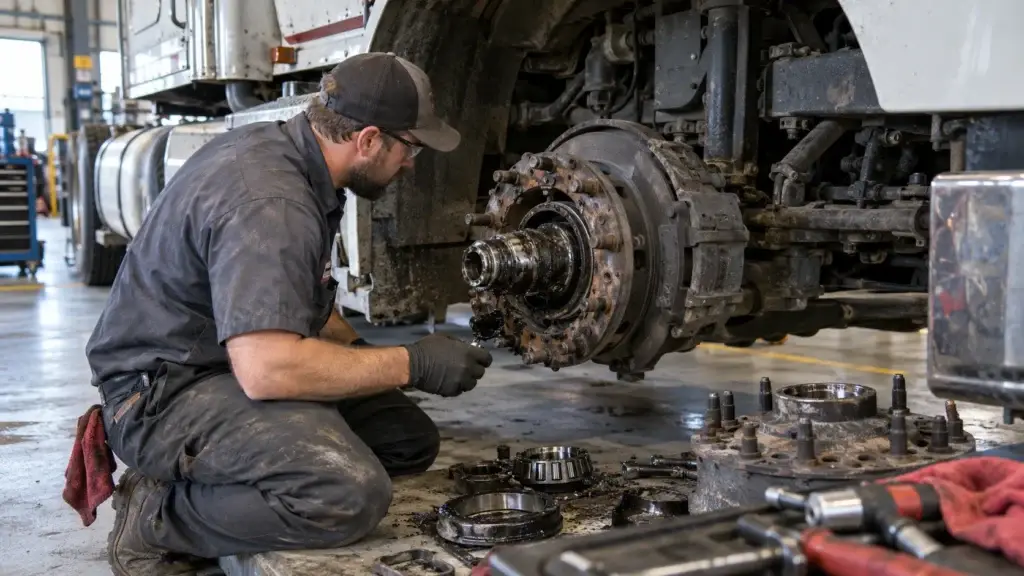
This is the stage that turns a bearing replacement into something far more serious. The heat generated by a seized bearing doesn't stay contained to the bearing itself — it transfers directly into the axle spindle the bearing rides on. Enough heat can cause the spindle's bearing journal surface to physically expand, scoring or enlarging the precise diameter a new bearing needs to seat against correctly.
Once that surface is damaged this way, a new bearing frequently can't be properly fitted at all, and the spindle itself — not just the bearing — needs replacement.
Reading the Damage: What Different Failure Modes Actually Look Like
Not every bearing failure looks the same, and the specific damage pattern on a failed bearing tells a real diagnostic story about what actually went wrong — information that matters both for the immediate repair and for preventing the same failure on the next wheel-end. A technician who takes a moment to examine a failed bearing before discarding it can usually tell whether the root cause was lubrication, contamination, misalignment, or simple fatigue.
Fatigue Spalling
Even a perfectly lubricated, correctly installed bearing has a finite service life, because the repeated stress of a rolling element contacting the raceway eventually causes a subsurface crack that propagates to the surface and flakes away — a process called spalling. An early-stage spalling produces a subtle, rhythmic clicking noise; an advanced spalling leaves a rough, cratered raceway that generates the grinding noise associated with a late-stage failure.
A spalling concentrated in the center of the raceway is consistent with normal radial load, while spalling concentrated at one edge points to misalignment or edge loading rather than simple wear-out.
Brinelling and Fretting Corrosion
A true brinelling occurs when a bearing experiences a massive static overload or shock impact — for example, an impact wrench used carelessly during installation — leaving a smooth, evenly spaced indentation in the raceway that matches the spacing of the rolling elements.
A false brinelling looks superficially similar but has a completely different cause: it results from a microscopic oscillating motion while a bearing sits stationary, such as during transport or an extended idle period, and it typically shows a reddish-brown, oxidized appearance from a fretting corrosion rather than the clean metallic indentation of true brinelling.
Lubricant Condition as a Diagnostic Tool
The condition of the lubricant removed from a failed wheel-end is itself diagnostic evidence, and it's worth photographing and noting before cleaning it away.
| Lubricant Appearance | Likely Cause |
|---|---|
| Brown or darkened, no debris | Oxidation and heat exposure |
| Milky or emulsified | Water contamination |
| Gray or black, metallic | Active bearing wear or electrical erosion |
| Dry, crusty, or hardened | Lubrication failure or over-temperature breakdown |
| Reddish-brown residue at bore or fit surfaces | Fretting corrosion from a loose fit |
Why This Failure Is So Dangerous
A 2024 peer-reviewed study in the Journal of the National Academy of Forensic Engineers examined 100 real-world wheel separation investigations and found that the incidents traced to an axle, bearing, or fastener system failure, with fastener system failures dominating the set — the authors showed that a low fastener clamp force was the necessary and sufficient condition behind those cases.
The study's conclusions echo what the National Transportation Safety Board first identified in a 1992 special investigation into a cluster of fatal wheel-separation accidents: that improper maintenance, not manufacturing defects, is the primary driver of this failure mode — NTSB's report specifically found bearing seizure from a lack of lubrication as one of the two leading causes, alongside improper wheel fastener tightening. More than three decades and one dedicated peer-reviewed study later, the underlying cause hasn't changed.
Wheel separation remains a real and ongoing risk today. NTSB's own 1992 investigation estimated the incidence at 750 to 1,050 wheel separations per year on medium and heavy trucks — a figure NTSB itself noted may run low, since a separation that causes no damage or injury often goes unreported — which works out to roughly two to three incidents per day nationwide.
A destroyed spindle doesn't always end in full wheel separation, but the physics that create one are the same physics that can create the other, which is exactly why this failure mode deserves more attention than a routine maintenance item usually gets.
Why This Is Also a Regulatory Compliance Issue
Wheel-end lubrication problems aren't just a maintenance concern — several specific conditions related to bearing failure are explicit federal Out-of-Service violations under CVSA's North American Standard Out-of-Service Criteria. Under the "Wheels, Rims and Hubs" section of the criteria, a vehicle is placed Out-of-Service for any of the following hub-related conditions found during a roadside inspection:
- Smoking from the wheel hub assembly due to bearing failure
- A bearing cap, plug, or filler plug missing or broken, exposing the hub assembly
- No visible or measurable amount of lubricant showing in the hub
- Lubricant leaking from the hub and present on the wheel surface, with evidence that further leakage will occur
- A leaking wheel seal producing wet contamination of the brake friction material, with evidence that further leaking will occur
These aren't minor citations — an Out-of-Service violation means the vehicle can't legally continue operating until the condition is corrected, regardless of the freight schedule or delivery commitment riding on that truck. A dry hub found during a routine inspection carries the same enforcement weight as a hub that's actively smoking, which underscores just how seriously regulators treat the earliest stage of this failure progression.
The Roadside Reality: Why This Repair Escalates So Quickly
What starts as a routine service call often doesn't stay routine once a technician actually gets the wheel off. A seal that's been leaking for a while has usually already let contamination into the bearing cavity, which means a "simple seal replacement" job frequently reveals a bearing wear that wasn't visible from the outside.
If the bearing has already been running hot, the same inspection can turn up a brake component damage from transferred heat, since a seized or dragging wheel-end doesn't isolate its heat to just the bearing and spindle. HDJ's heavy-duty brake maintenance guide covers how hub seal leaks and bearing play degrade brake friction surfaces specifically.
This kind of scope creep is exactly why a job that looked like an hour of shop time on the estimate can become a multi-hour roadside repair with a tow truck involved. The parts and labor for a straightforward bearing service are modest. The parts and labor for a hub assembly, a damaged spindle, and whatever brake component got cooked in the process — on the shoulder, with a driver and a load both stranded — are an entirely different financial and logistical event.

Catching It Before the Spindle Is Destroyed
The Warning Signs That Precede Catastrophic Failure
- A grinding, humming, or growling noise from a wheel-end that changes with vehicle speed — one of the earliest and most reliable indicators of bearing wear
- Noticeable heat at the hub after driving — warm is normal, hot enough to be uncomfortable to touch isn't
- Vibration through the cab or steering, particularly at highway speed
- Visible play when a jacked-up wheel is grasped at the 12 and 6 o'clock positions and rocked
- Discoloration in an oil bath hub cap window, or oily streaking on the inside of the tire from a leaking seal
- A missing hub cap oil fill plug, which allows contamination directly into the bearing cavity
⚠️ Safety Warning
A wheel-end running hot from a developing bearing failure can be hot enough to cause a burn on contact. Touch a hub carefully — back of the hand first, brief contact — rather than gripping it, and never place a bare hand directly on a hub you suspect is severely overheated. If a hub is too hot to hold a hand against briefly, treat that as an active failure requiring immediate inspection, not a routine warm-hub reading.
Regular inspection intervals catch nearly all of these signs before they progress to seizure. A driver and maintenance staff should physically touch hubs during inspections rather than relying on visual checks alone — a bearing that's dangerously hot often gives no other outward sign until it's already too late to catch it as a routine repair.
This is also a matter of regulatory compliance, not just good practice: 49 CFR 393.205 sets federal requirements for wheel and rim condition on a commercial motor vehicle, and a wheel-end problem serious enough to affect the wheel or rim itself can result in a vehicle being placed out of service during a roadside inspection.
Bearing Adjustment: Where a Lot of This Actually Starts
Lubrication failure gets most of the attention, but improper bearing adjustment is just as often the root cause sitting upstream of it. A bearing set with too much preload runs hot even with adequate lubrication, since there's no operating clearance for the lubricant to actually do its job.
HDJ's trailer bearing adjustment guide covers the torque sequence and endplay measurement that prevent this specific failure path — and it's worth noting that skipping the dial indicator verification step, which happens more often than the industry would like to admit, is one of the most common ways an adjustment error goes undetected until the bearing has already started running hot.
What This Means for Fleets and Owner-Operators
- Treat hub heat as a stop-and-check item during every post-trip inspection, not something to note and address later.
- Check an oil bath hub window for level and clarity, and a grease-lubricated hub cap for its oil fill plug, every trip — this takes seconds and catches the earliest sign of a developing problem.
- Never defer a wheel-end noise or vibration complaint to the next scheduled service; these symptoms indicate an active, progressing wear.
- Use a calibrated torque wrench and dial indicator on every bearing adjustment — the shortcut that skips these steps is exactly the one that leads to premature failure.
- Build a wheel-end inspection into a documented preventive maintenance schedule rather than relying on it being caught incidentally during other service work.
Frequently Asked Questions
Can a destroyed spindle actually be repaired, or does it always need replacement?
It depends entirely on how much damage the spindle's bearing journal surface has sustained. A light scoring can sometimes be addressed by a qualified shop, but once the surface has expanded or enlarged from heat to the point that a new bearing won't seat correctly, the spindle itself needs replacement, not just the bearing. This is why catching a developing bearing problem early matters so much — the window between a routine bearing service and a spindle replacement can close quickly once a bearing actually seizes on the road.
How can I tell if a wheel bearing is failing before it seizes completely?
The most reliable early signs are a grinding or humming noise that changes with vehicle speed, noticeable heat at the hub after driving, vibration through the cab at highway speed, and visible play when a jacked-up wheel is rocked at the 12 and 6 o'clock positions. An oil bath system also shows a warning sign through hub cap window discoloration or a dropping oil level, while a grease system may show an oily streaking on the inside of the tire from a leaking seal.
Is it more common for oil-lubricated or grease-lubricated bearings to fail this way?
Historically, a grease-lubricated bearing has been more prone to this specific failure path, since it's genuinely difficult to tell whether a greased bearing is running low on lubrication without disassembling the hub, whereas an oil bath system allows a visual check through a hub window and tends to show a leak more obviously. That said, either lubrication type can experience this failure if a maintenance interval is skipped or a seal fails without being caught during inspection.
What's the single most important habit for preventing this failure?
Physically touching the hub during post-trip inspections, not just looking at it. A bearing that's dangerously low on lubrication or beginning to seize often runs noticeably hot well before any other symptom becomes obvious, and that heat is one of the easiest warning signs to catch with a simple hands-on check. Combined with checking an oil bath window or hub cap fill plug, this habit catches the overwhelming majority of a developing bearing problem before it progresses to spindle damage.
Can a dry hub actually put a vehicle out of service, even without visible smoke or damage?
Yes. Under CVSA's North American Standard Out-of-Service Criteria, "no visible or measurable amount of lubricant showing in hub" is its own Out-of-Service condition, separate from and well before the more dramatic "smoking from wheel hub assembly" criterion. A roadside inspector doesn't need to see active failure to place a vehicle out of service — a hub that's simply run dry, with no other visible symptom yet, already qualifies. This is precisely why a routine lubrication check matters as a compliance issue and not just a mechanical one.
The Bottom Line
The progression from a simple lubrication gap to a destroyed axle spindle isn't complicated once you understand the mechanism — heat from a dry, friction-heavy bearing transfers directly into the spindle surface it rides on, and once that surface is damaged, the repair job changes entirely. What makes this failure mode so persistently common isn't a lack of understanding in the industry; it's the gap between knowing the warning signs and actually checking for them, trip after trip, on every vehicle.
The technicians and drivers who never end up doing this repair on the shoulder of a highway aren't working with better luck than everyone else — they're the ones who never let a hub heat check become optional.
Share This Wheel-End Safety Guide
Help other technicians, drivers, and fleet managers catch this failure before it becomes a roadside emergency — share this guide with your maintenance team or professional network.