By Michael Nielsen, Editor & Publisher | 15+ Years in Diesel Repair
Last Updated: February 2026
📖 Estimated reading time: 23 minutes
Every year, thousands of roadside breakdowns occur because of improperly maintained wheel assemblies. When hub components fail at highway speeds, the consequences range from costly repairs to catastrophic accidents. Proper trailer wheel bearing adjustment isn’t routine maintenance—it’s a critical safety procedure that protects lives and equipment on every trip.
The difference between reliable towing and a dangerous failure often comes down to precise torquing procedures. According to TMC Recommended Practice RP-618A, acceptable end play ranges from 0.001 to 0.005 inches for most applications. Getting these measurements right requires specific knowledge, calibrated tools, and disciplined technique.
This guide covers everything from spindle nut torque requirements for different weight classes to professional adjustment techniques and verification procedures. Whether you’re a certified mechanic following standardized procedures or an experienced owner performing your own maintenance, understanding wheel bearing torque specifications will help you prevent costly repairs and extend component lifespan.
Key Takeaways
- End play target: Industry standards specify 0.001–0.005 inches for most trailer applications, verified with a dial indicator.
- Weight class matters: Light-duty trailers use 50 ft-lb seating torque with castle nut retention, while heavy-duty systems require 100 ft-lb seating with double-nut configurations up to 300 ft-lb.
- Never tighten to align: Always back off the castle nut to the nearest cotter pin slot—tightening to align creates destructive preload.
- Grease compatibility is critical: Mixing incompatible grease types destroys bearing protection regardless of individual product quality.
- Verify before towing: Every adjustment requires a wheel wobble test, 10-15 mile test drive with temperature check, and bearing noise evaluation.
Understanding Trailer Wheel Bearings and Why Proper Adjustment Matters
Understanding how wheel bearings function separates confident trailer owners from those who face unexpected roadside emergencies. These precision-engineered components form the critical connection between your trailer’s axle and wheels, bearing tremendous loads while maintaining smooth rotation across thousands of miles.

How Tapered Roller Bearings Support Your Trailer
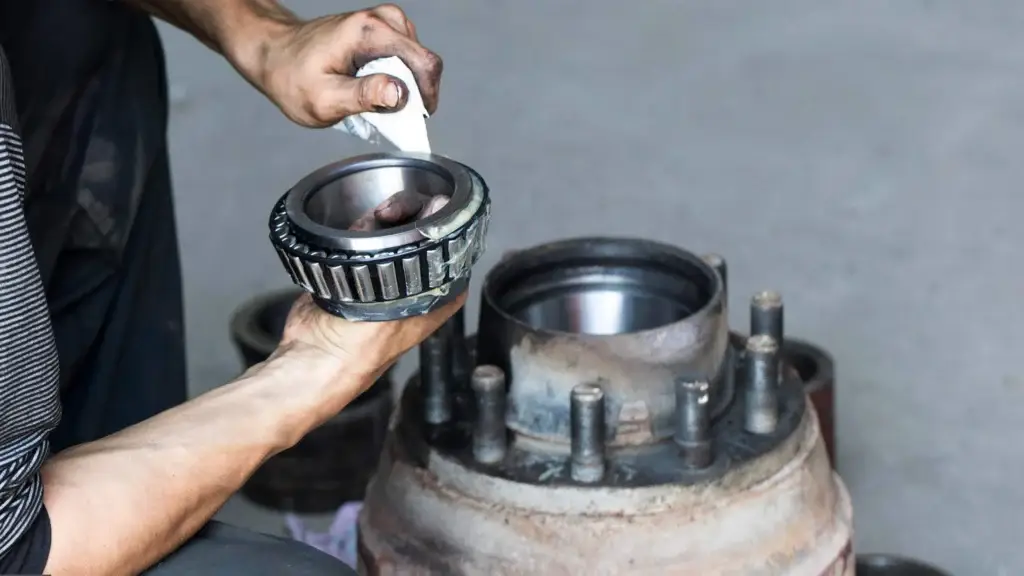
Tapered roller bearings represent the standard design for trailer applications because they handle both radial and thrust loads simultaneously. The bearing assembly consists of several integrated components working as a system: the inner bearing sits closer to the trailer centerline, while the outer bearing positions near the wheel’s exterior edge.
Each bearing contains precision-manufactured rollers that ride between an inner cone and outer race. The tapered design distributes load evenly across the entire roller surface, providing superior load capacity compared to ball bearings of similar size. The spindle nut secures everything in place while allowing controlled rotational freedom, and a cotter pin locks the castle nut at the correct tension.
Grease seals on the inner hub prevent lubricant loss and block water intrusion. These seals must maintain contact with the spindle without creating excessive friction. The dust cap seals the assembly from contaminants while retaining grease inside the hub. The entire assembly must balance protection against contamination with minimal resistance to rotation.
What Happens When Bearing Adjustment Goes Wrong
⚠️ Safety Warning
Improperly adjusted wheel bearings can cause wheel separation at highway speeds, resulting in loss of control and multi-vehicle accidents. Never tow a trailer with suspected bearing problems. Always verify adjustment before returning a trailer to service.
Over-tightened bearings generate excessive friction that converts to destructive heat. This heat breaks down grease lubricant, leaving metal surfaces in direct contact. When lubrication fails, bearing temperatures escalate rapidly—rollers and races develop scoring patterns that accelerate wear. In severe cases, bearings seize completely, locking the wheel and causing immediate loss of control at highway speeds.
Loose bearings create different but equally serious problems. Excessive play allows the wheel to wobble during rotation, hammering the bearing races and creating indentations called brinelling. The damage compounds with every revolution until structural failure occurs. According to industry safety data, improperly adjusted bearings can cause wheels to separate from the trailer while moving—the trailer drops onto the axle stub, sending sparks and debris across traffic lanes.
According to Dexter Axle Company, improper maintenance procedures can damage structural components beyond the bearing assembly itself. Spindle damage requires complete axle replacement, transforming a simple adjustment into a major repair expense.
Recognizing the Warning Signs
Your trailer communicates bearing problems through several distinct symptoms. Wheel bearing noise typically manifests as a low growling or grinding sound that increases with vehicle speed. This differs from tire noise because it maintains a constant rhythm regardless of road surface. The sound may appear intermittent initially but becomes continuous as damage progresses.
Excessive hub temperature after driving indicates friction problems within the bearing assembly. While hubs naturally warm during operation, they should remain touchable after a brief cooling period. A hub too hot to touch with bare hands signals bearing distress requiring immediate attention.
Visible wheel wobble when the trailer is jacked up reveals excessive bearing play. Grasp the tire at the twelve and six o’clock positions and attempt to rock it—any detectable movement indicates worn bearings or improper adjustment. Uneven tire wear patterns sometimes trace back to bearing problems as well, developing when bearings allow abnormal wheel movement.
| Symptom | What It Indicates | Urgency Level | Potential Consequence |
|---|---|---|---|
| Growling or grinding noise | Bearing damage or insufficient lubrication | High – address within 50 miles | Complete bearing failure and wheel seizure |
| Excessive hub heat | Over-tightened bearings or friction problems | Critical – stop immediately | Bearing seizure and potential fire hazard |
| Visible wheel wobble | Loose bearings or damaged races | High – do not tow until repaired | Wheel separation and loss of control |
| Grease leaking from hub | Failed seal or overfilled assembly | Moderate – inspect before next trip | Water contamination and premature wear |
| Uneven tire wear | Bearing play causing alignment issues | Moderate – schedule service soon | Progressive bearing damage and tire expense |
Check your hubs after the first 15 minutes of each trip when components reach operating temperature. This simple habit catches developing problems while they remain manageable.
Essential Tools and Materials for Bearing Service
Having the right equipment on hand makes trailer bearing adjustment safer and more accurate. Without proper tools, you risk damaging components or creating unsafe conditions that compromise your trailer’s performance.
Selecting the Right Torque Wrench
A quality beam-type or click-type torque wrench with a range covering 0–250 ft-lb handles most trailer applications. Heavy-duty trailers exceeding 7,000 pounds require wrenches capable of delivering 300+ ft-lb. The STEMCO procedure specifies 200 ft-lb seating torque, which falls within mid-range capacity. Standard adjustable wrenches cannot deliver the required precision and should never be used for bearing work.

Professional-grade torque wrenches maintain accuracy within ±4% when properly calibrated. Click-type wrenches offer audible and tactile feedback at target torque, while beam-type models display torque on a calibrated scale. Calibration checks should occur annually or after 5,000 cycles.
Complete Tool Checklist
A dial indicator with magnetic base stands out as the most critical measurement tool. Industry sources describe it as the only satisfactory method of checking adjustment for end play verification. The dial indicator measures bearing movement in thousandths of an inch, providing the precision needed to confirm proper adjustment.
| Tool Category | Specific Items | Primary Function | Quality Requirement |
|---|---|---|---|
| Measurement Tools | Torque wrench, dial indicator with magnetic base | Precise torque application and end play verification | Professional-grade with current calibration |
| Bearing Service Tools | Bearing packer, spindle nut socket, seal driver | Remove, install, and pack bearing components | Size-specific to axle specifications |
| Cleaning Supplies | Mineral spirits, parts washer, soft brushes, lint-free rags | Remove old grease and inspect bearing surfaces | Non-residue solvents suitable for bearings |
| Safety Equipment | Jack, jack stands, wheel chocks, PPE | Secure trailer and protect technician | Weight-rated for trailer capacity |
Your spindle nut socket must match your axle size exactly—six-point sockets provide better grip than twelve-point designs. A bearing packer forces lubricant completely through the bearing cage and rollers, eliminating the voids that hand-packing methods often leave behind. Keep several spare cotter pins on hand since they’re single-use components replaced during every adjustment.
Choosing the Right Wheel Bearing Grease
Understanding grease compatibility prevents failures that puzzle many trailer owners. Lithium-complex grease represents the most common choice for standard applications, providing excellent water resistance across temperatures from -40°F to 350°F. Polyurea-based greases offer superior performance in high-temperature and heavy-load applications. Boat trailer owners should exclusively use marine-grade products with enhanced corrosion inhibitors.
NLGI Grade 2 represents the standard consistency for trailer wheel bearings—it flows properly at operating temperatures while staying in place during storage. Never mix incompatible grease types within the same assembly. Different base oils and thickeners can react chemically, causing the mixture to separate or harden. When changing grease types, complete removal of old lubricant with appropriate solvents is mandatory.
| Grease Type | Best Applications | Temperature Range |
|---|---|---|
| Lithium Complex | Standard trailers, general road use, moderate climates | -40°F to 350°F |
| Polyurea Synthetic | Heavy loads, high-speed operation, extreme temperatures | -65°F to 400°F |
| Marine Grade | Boat trailers, frequent water immersion, coastal environments | -20°F to 325°F |
Safety Procedures and Trailer Preparation
Working on trailer bearings without proper safety measures exposes you to serious injury risks that are entirely preventable. Manufacturers consistently warn that failure to follow correct procedures can result in serious injury or death, particularly when wheels come off during operation or improper support causes a trailer to collapse.
Proper Jack Placement and Stabilization
Begin by completely disconnecting the trailer from your tow vehicle. Position wheel chocks on both sides of every wheel that will remain on the ground. Identify manufacturer-approved jack points before raising the trailer—most trailers have designated locations on the axle or frame specifically engineered to handle lifting forces.

Select a hydraulic floor jack rated for at least 150% of the trailer’s loaded weight on that corner. Never rely on the jack alone—once the wheel is off the ground, immediately position jack stands as secondary support. Place jack stands on solid frame members, not on axle components that might shift during bearing removal. Verify stability by attempting to rock the trailer slightly before proceeding.
Personal Protective Equipment
Safety glasses with side shields (ANSI Z87.1) protect against solvent splash and metal particles throughout the service process. Use chemical-resistant nitrile gloves during cleaning operations, then switch to leather or Kevlar-reinforced work gloves when handling sharp-edged bearing races and hub assemblies. Steel-toed boots provide essential protection against dropped wheel assemblies weighing 30+ pounds. If using pneumatic impact wrenches or grinders, hearing protection with NRR 25+ decibels becomes mandatory.
Workspace Setup
Work on a level, stable surface with adequate drainage. Sloped or uneven ground compromises stabilization and increases the risk of trailer movement. Adequate ventilation is non-negotiable when using solvent cleaners—outdoor work provides natural airflow, while garage work requires open doors and exhaust fans.
Organize your workspace to prevent contamination of freshly cleaned bearings. Designate separate areas for dirty components and clean parts ready for reassembly. Keep a properly rated fire extinguisher within reach when working with flammable solvents.
Removing the Hub and Extracting Bearings
Removing wheel bearings demands precision and the right approach to avoid costly damage. Before starting, place a clean work surface beneath the wheel area to catch small parts. Organize removed components in exact removal order—this makes reinstallation straightforward and prevents confusion about component orientation.
Accessing Internal Components
Tap gently around the dust cap perimeter using a rubber mallet, applying even pressure as you work the circumference. For stubborn caps, use a specialized removal tool rather than screwdrivers or chisels, which create dents that prevent proper resealing.

Once the dust cap comes free, straighten both bent legs of the cotter pin using needle-nose pliers. Pull the pin straight out, taking care not to enlarge or damage the spindle hole. Remove the castle nut with the correct socket size—the outer bearing will slide forward as the nut loosens, so be prepared to catch it.
Extracting Bearings Safely
The outer bearing typically slides off easily once the castle nut is removed. Grip the hub with both hands and pull it straight off the spindle with steady, even pressure—never twist or tilt. If it resists, tap the back surface gently with a rubber mallet. Never strike the hub face or braking surface.
Extract the grease seal by prying carefully around its perimeter with a seal removal tool. The inner bearing becomes accessible once the seal is out. For bearings that resist removal, use a bearing driver or soft brass drift against the bearing race edge, tapping gently while rotating position to apply even pressure. Never pry directly against bearing race surfaces—this creates grooves that cause premature failure.
Inspect the spindle surface immediately after hub removal. Examine the entire length for scoring, rust pitting, or wear marks. Run your fingernail along the surface—you should not catch on any rough spots. Document any damage found, as spindle replacement may be necessary before reassembly.
Cleaning and Inspecting Bearings
Thorough cleaning reveals bearing condition that remains hidden beneath layers of old grease. This inspection determines whether components can be safely reused or must be replaced.
Cleaning Methods
Mineral spirits provide the most effective cleaning solvent for bearing work. Submerge bearings completely and rotate them by hand to flush old grease from between rollers and cage. Use a soft-bristled brush for stubborn deposits—never use wire brushes, as metal bristles create microscopic scratches that become failure points.

Never spin bearings with compressed air—this damages races through unlubricated high-speed rotation. Instead, blow air gently across surfaces, then pat dry with lint-free cloths. Apply a light coat of clean lubricant immediately after drying to prevent flash rusting.
Identifying Damage Patterns
Normal wear creates a polished appearance on contact surfaces without material loss. Spalling appears as metal flaking from race surfaces, creating rough patches—this progressive failure always requires immediate replacement. Galling manifests as smeared or welded metal from excessive heat. Brinelling creates distinctive evenly-spaced indentations corresponding to roller positions.
Etching shows as corrosion pitting from moisture contamination, particularly common in boat trailer bearings. Discoloration from overheating ranges from light straw to dark blue or black. Check for cracks using magnification, rotate bearings slowly to feel for roughness, and examine roller ends for chipping.
Key Recommendation
Bearings and races must always be replaced as matched sets—never individually. When doubt exists about bearing condition, replacement is the safer and more economical choice. The cost of new bearings is insignificant compared to roadside breakdown expenses or accident liability.
| Damage Type | Visual Appearance | Required Action |
|---|---|---|
| Spalling | Metal flaking and rough patches | Immediate replacement mandatory |
| Galling | Smeared or welded metal surfaces | Replace bearing and race set |
| Brinelling | Evenly-spaced indentations | Replace bearing and race set |
| Etching | Corrosion pitting across surfaces | Replace if pitting is deep |
| Discoloration | Straw to blue/black coloring | Replace if surfaces feel rough |
Step-by-Step Trailer Bearing Adjustment Process
The complete bearing adjustment combines preparation, installation, torquing, and verification into one precise procedure. Each phase builds on the previous one to create proper bearing geometry and optimal load distribution. Professional technicians recognize that shortcuts during any phase compromise the entire adjustment.
Packing Bearings with Grease
Fresh grease must penetrate completely through the bearing cage and between all rollers. Hand-packing requires working grease from the large end toward the small end—place grease in your palm and press the bearing’s wide edge into it with a rotating motion until grease emerges from the opposite side between all rollers. A bearing packer tool speeds the process and ensures complete penetration under pressure.

Installing Inner and Outer Bearings
Apply a coating of grease to the inner bearing race inside the hub. Install the packed inner bearing, seating it fully against the race. Position the new grease seal squarely and drive it into place—the seal must enter straight without cocking, which would create an immediate leak path. Coat the spindle generously with grease before sliding the hub assembly onto it, then install the outer bearing, washer, and spindle nut.
The Torque Sequence
This multi-step process follows engineering principles that ensure bearings seat properly against their races. The procedure uses a three-phase approach: initial seating, preload release, and final adjustment.
Bearing Adjustment Torque Sequence
Step 1 – Seating torque: Apply 50–200 ft-lb (depending on axle capacity) while continuously rotating the hub in both directions. Continue rotating at least ten complete revolutions while reaching target torque. This seats bearings fully against cups and races.
Step 2 – Release preload: Completely loosen the spindle nut to remove all preload without rotating the hub. This allows bearings to center themselves naturally on the races, correcting any binding from the seating process.
Step 3 – Final adjustment: Hand-tighten the nut until it contacts the bearing with light resistance. Back off 1/6 to 1/4 turn (one to two castellations). Align the castle nut with the cotter pin hole by loosening only—never tighten to reach alignment.
Step 4 – Secure: Install a new cotter pin through the spindle and castle nut. Bend one leg over the spindle end and the other along the nut’s side. Trim excess length. The nut should rotate freely, restrained only by the cotter pin.
Measuring End Play with a Dial Indicator
Mount the dial indicator’s magnetic base to the hub face with the plunger contacting the spindle end. Zero the indicator, then grasp the hub at 3 and 9 o’clock. Push and pull firmly to oscillate the hub while observing the needle. Acceptable end play typically ranges from 0.001 to 0.005 inches for most applications, per TMC RP-618A guidelines. Readings below minimum indicate excessive preload; readings above maximum suggest insufficient tightening or worn components.
Torque Specifications by Trailer Weight Class
Different weight classes demand distinct adjustment procedures. Using incorrect specifications compromises both safety and component longevity. Federal regulations under 49 CFR Part 393 Subpart J require that wheels and rims be properly maintained—proper bearing adjustment is foundational to this compliance requirement.
| Weight Class | Seating Torque | Nut System | Final Adjustment |
|---|---|---|---|
| Under 3,500 lbs | 50 ft-lb | Single castle nut | Finger tight to cotter pin |
| 3,500–7,000 lbs | 50–75 ft-lb | Castle or transition | Varies by system |
| 7,000–15,000 lbs | 100 ft-lb | Double-nut system | Outer jam nut: 100–175 ft-lb |
| 22,500–27,000 lbs | 100 ft-lb | Double-nut system | Outer jam nut: 250–300 ft-lb |
Light-Duty Trailers (Under 3,500 lbs)
Single axle utility trailers use the most straightforward procedure. Apply 50 ft-lb seating torque while continuously rotating the hub. Back off completely, finger-tighten until snug with no perceptible looseness, then back off only enough to align with the nearest cotter pin slot. The spindle nut must remain free to rotate slightly, held only by the cotter pin rather than thread friction.
Mid-Range Tandem Axle (3,500–7,000 lbs)
This weight class represents a transition zone where manufacturers employ various bearing retention systems. Seating torque typically ranges from 50 to 75 ft-lb depending on the axle manufacturer. Many mid-range configurations still use castle nuts with cotter pins following the finger-tight method, though some specify transitional procedures incorporating elements of heavy-duty methods. End play specifications remain in the 0.001 to 0.005 inch range, but verification with a dial indicator becomes increasingly important at higher weights.
Heavy-Duty Systems (Above 7,000 lbs)
Trailers exceeding 7,000 pounds require double-nut retention systems providing superior clamping force. Per Dexter Axle specifications for 9,000–15,000-pound axles: apply 100 ft-lb seating torque while rotating the hub, hand-tighten the inner nut until bearing drag is felt, then back off one-quarter to three-eighths turn. Install a tang washer for positive mechanical retention, then torque the outer jam nut to 100–175 ft-lb.
For Dexter axles rated at 22,500–27,000 pounds, the procedure intensifies. After seating torque, back off the inner nut a maximum of one-quarter turn only. The outer jam nut receives 250–300 ft-lb. These high clamping forces require impact-rated sockets and extension bars. Double-check all torque values after initial installation and again after the first 25 miles.
Boat Trailer Considerations
Launching and retrieving watercraft subjects bearings to pressure differentials, temperature fluctuations, and direct water exposure. Water immersion creates pressure that forces moisture past seals, displacing grease and introducing corrosive elements. Follow torque specifications appropriate for your weight class but use marine-grade grease exclusively, inspect bearings after each immersion, and consider bearing buddy systems that maintain positive hub pressure during submersion.
The HDJ Perspective
After 15 years in the shop, the bearing failures we see most often aren’t from worn components—they’re from well-intentioned owners who overtightened the spindle nut “just to be safe.” That extra quarter-turn past snug generates enough friction heat to cook the grease and score the races within a few hundred miles. The three-phase torque sequence exists for a reason: seat, release, reset. If you take nothing else from this guide, remember that the backing-off step is not optional. A bearing running with even slight preload is a bearing on borrowed time. And always verify with a dial indicator—your fingers can’t measure thousandths of an inch, no matter how experienced you are.
Common Errors That Destroy Bearing Performance
Most bearing failures result not from worn components but from preventable adjustment errors. Understanding these mistakes helps you avoid compromising your trailer’s safety.
Over-Tightening Spindle Nuts
Excessive spindle nut torque creates constant preload pressure between rolling elements and races. Without operating clearance, friction increases dramatically and generates destructive heat. Bearing temperatures rise significantly even during short trips, lubricant breaks down, and catastrophic failure can occur within miles once overheating begins. Hub damage from overheated bearings may require complete replacement rather than simple bearing service.
The backing-off step is not optional. After seating torque, you must loosen the nut to the specified point to create necessary operating clearance. And never tighten a castle nut to align with the cotter pin hole—only loosening is acceptable.
Lubrication Failures
Inadequate grease packing leaves air pockets where heat builds without dissipation. Using old or contaminated grease that has lost its lubricating properties provides inadequate protection. Over-greasing causes seal damage from excessive pressure and overheating from grease churning. Each bearing must be thoroughly hand-packed or machine-packed to ensure complete coverage—simply filling the hub cavity without packing individual bearings leaves critical gaps. The SAE J310 automotive lubricating grease standard provides guidance on proper greasing procedures for various applications.
Improper Cotter Pin Installation
This small component provides the final safety mechanism preventing spindle nut loosening. Using incorrect size pins, failing to bend legs properly, and reusing old pins with stress cracks all compromise security. After inserting the pin, bend both legs outward—one wrapping around the nut edge, the other bending back along the spindle. Always install a new pin during every adjustment.
Free Professional Fleet Tools
Cost calculators, fault code lookup, maintenance planners, and more—built for owner-operators, fleet managers, and diesel techs. No signup required.
Testing and Verification After Adjustment
Comprehensive verification through multiple testing methods catches problems before they become roadside failures. Professional technicians use three primary diagnostics to confirm proper bearing adjustment.
The Wheel Wobble Test
With the trailer on jack stands and lug nuts torqued, grasp the tire at 12 and 6 o’clock positions and apply alternating push-pull force. Any noticeable play or knocking sensation indicates excessive clearance requiring readjustment. Repeat at 3 and 9 o’clock to isolate bearing movement from suspension play. This test takes less than two minutes but prevents hours of potential roadside repairs.
Hub Temperature Check
After a 10–15 mile test drive at highway speed, carefully check hub temperature. Properly adjusted bearings feel warm but not uncomfortably hot—typically 20–40°F above ambient air temperature. An infrared thermometer delivers precise readings. Hubs exceeding 50°F above ambient require immediate readjustment. Compare hub temperature against axle beam temperature for baseline reference. The CVSA out-of-service criteria include wheel hub heat as an inspection checkpoint during roadside safety inspections.
Bearing Noise Evaluation
Properly adjusted bearings operate quietly with only normal road noise. A low growling that increases with speed indicates bearing damage. Cyclic clicking at regular intervals corresponding to wheel rotation signals damaged races. Squealing or grinding means metal-to-metal contact from complete breakdown—stop immediately.
| Verification Method | Normal Result | Problem Indicators | Required Action |
|---|---|---|---|
| Wheel Wobble Test | Minimal movement, no noise | Noticeable play, knocking | Readjust bearing immediately |
| Hub Temperature | 20–40°F above ambient | More than 50°F above ambient | Loosen and readjust for end play |
| Bearing Noise | Quiet operation | Growling, clicking, grinding | Replace bearings and races |
| Rotational Resistance | Smooth spin, gradual stop | Binding, excessive drag | Check adjustment and lubrication |
Complete all three verification procedures before returning the trailer to service. Record test results in your maintenance documentation—this baseline helps identify gradual deterioration during future inspections.
Troubleshooting Post-Adjustment Problems
When freshly adjusted bearings don’t perform as expected, a systematic approach identifies root causes quickly. Most complications fall into three categories requiring different corrective actions.
Excessive End Play
When end play exceeds specifications, repeat the entire adjustment from seating torque—simply tightening the nut without following the complete sequence fails to properly seat bearings against races. The castellated nut design may complicate achieving perfect specifications, as alignment between castellations and the cotter pin hole determines final position. Persistent excessive end play after proper readjustment signals worn bearings requiring replacement.
Binding or Tight Rotation
Difficulty rotating the hub by hand reveals insufficient end play or unwanted preload. Back off the spindle nut by one additional castellation and retest. If binding persists, complete disassembly is necessary to inspect for incorrect race seating, contamination, or misalignment. Monitor hub temperature during a short test run after correction.
Premature Wear Patterns
Wear concentrated on one side indicates misalignment during installation. Evenly distributed rapid wear suggests inadequate lubrication or contamination. Discolored metal with blue or brown tinting results from operating too tight. Spalling or flaking results from impact damage, corrosion, or fatigue—replace any bearings showing spalling immediately, as this damage progresses rapidly toward catastrophic failure.
Maintenance Schedules and Best Practices
Preventive bearing maintenance represents the most cost-effective strategy for avoiding catastrophic wheel-end failures. The FMCSA vehicle maintenance requirements emphasize that systematic inspection programs prevent the types of wheel-end failures that lead to serious accidents.
Service Intervals by Application
Trailers in regular use require annual bearing service or inspection every 12,000 miles, whichever arrives first. Trailers in harsh environments—dusty conditions, frequent water immersion, extreme temperatures—demand more frequent attention. Each annual service should include complete disassembly for inspection, even when the trailer has operated without apparent problems.
| Trailer Type | Inspection Interval | Service Interval | Special Considerations |
|---|---|---|---|
| Utility Trailers | Every 6,000 miles | Annually or 12,000 miles | Increase frequency in dusty conditions |
| Seasonal RV/Equipment | Before each season | Start of season regardless of mileage | Check seals for storage-related cracking |
| Boat Trailers | After every launch | Twice per season minimum | Marine-grade grease exclusively |
| Commercial Trailers | Every 5,000 miles | Every 10,000 miles or annually | Document service for DOT compliance |
Seasonal and Boat Trailer Service
Extended storage allows grease to separate and moisture to accumulate inside hubs. Service bearings before each season regardless of mileage. For boat trailers, inspect after every water immersion—water-infiltrated grease appears milky or separated. Implement quarterly service regardless of mileage, and consider NHTSA trailer safety resources for additional guidance on wheel-end maintenance compliance.
Documentation and Record Keeping
Maintain a dedicated logbook recording the date, mileage, grease type, measured end play, and any wear patterns observed during each service. This documentation helps identify developing problems through trend analysis—gradually increasing end play measurements may indicate progressive bearing wear. Detailed records also support warranty claims if component failures occur, as many manufacturers require proof of proper maintenance intervals.
Frequently Asked Questions
How tight should trailer wheel bearing nuts be?
Trailer bearing nuts should not remain at a fixed high torque for the final setting. The correct procedure starts with seating torque (50–200 ft-lb depending on weight class) while rotating the hub, then backing the nut off completely to release preload. Finger-tighten to snug contact, then back off to the nearest cotter pin alignment. The goal is achieving 0.001–0.005 inches of end play, verified with a dial indicator. The nut should rotate freely with only the cotter pin providing restraint. Never tighten the castle nut to align with the cotter pin hole—always loosen to the next slot to avoid creating destructive bearing preload.
What are the symptoms of bad trailer wheel bearings?
The primary warning signs include a low growling or grinding noise that increases with vehicle speed, excessive hub heat after driving (too hot to touch), and visible wheel wobble when the trailer is jacked up and the tire is rocked at the 12 and 6 o’clock positions. Secondary indicators include grease leaking from the hub assembly (suggesting seal failure) and uneven tire wear across the tread surface. If you detect excessive hub heat, stop immediately—continued operation risks bearing seizure, potential fire, and wheel separation.
How often should trailer wheel bearings be repacked?
Standard utility trailers need bearing service annually or every 12,000 miles, whichever comes first. Seasonal trailers (RVs, equipment haulers) require service before each use season regardless of mileage, since grease degrades and moisture accumulates during storage. Boat trailers demand the most attention—inspect after every water immersion and perform complete service at least twice per boating season. Commercial trailers should follow 10,000-mile or annual service intervals with inspections every 5,000 miles for DOT compliance documentation.
Can you mix different types of wheel bearing grease?
Never mix different grease types in the same bearing assembly. Incompatible thickener chemistries—such as lithium complex and polyurea—react chemically, causing separation, liquefaction, or hardening that destroys all lubricating properties. This chemical reaction occurs regardless of individual product quality. When switching grease types, completely remove all old lubricant with mineral spirits solvent, clean every component thoroughly, and verify no traces remain before applying the new formulation. The safest approach is documenting which grease you use and sticking with that product throughout the bearing’s service life.
What is the correct end play for trailer wheel bearings?
Per TMC RP-618A, acceptable end play for most trailer applications falls between 0.001 and 0.005 inches. Some heavy-duty Dexter axles allow up to 0.010 inches, and certain specialized designs permit up to 0.020 inches maximum. End play must be verified using a dial indicator mounted to the hub face—the plunger contacts the spindle end while you push and pull the hub at the 3 and 9 o’clock positions. Readings below minimum indicate excessive preload that generates heat; readings above maximum suggest insufficient tightening or worn components requiring replacement.
What torque should I use for heavy-duty trailer spindle nuts?
Heavy-duty trailers above 7,000 pounds use a double-nut system. Apply 100 ft-lb seating torque while rotating the hub. Hand-tighten the inner adjustment nut until bearing drag is felt, then back off one-quarter to three-eighths turn for 9,000–15,000 lb axles. Install a tang washer, then torque the outer jam nut to 100–175 ft-lb. For 22,500–27,000 lb axles, back off the inner nut one-quarter turn maximum and torque the outer jam nut to 250–300 ft-lb. Always verify end play with a dial indicator and recheck torque values after the first 25 miles of operation.
Protect Your Investment with Proper Bearing Adjustment
Trailer wheel bearing adjustment is a precision maintenance task that directly impacts your safety on every trip. The complete torque sequence—seating, releasing preload, and achieving proper end play—must be executed precisely using calibrated tools and verified with a dial indicator. Shortcuts create hazards that no amount of driving skill can compensate for.
Commit to the service intervals appropriate for your trailer type, document every adjustment, and never compromise on grease compatibility or cotter pin installation. The time invested in proper technique delivers thousands of miles of reliable operation, reduced maintenance costs, and the confidence that comes from knowing your wheel-end assemblies are adjusted to specification.
Help a Fellow Trailer Owner Stay Safe
Know someone who tows regularly? Share this torque specification guide so they can keep their bearings adjusted correctly and their wheels where they belong.