By Michael Nielsen, Publisher | 15+ Years in Diesel Repair
Last Updated: September 2026
⏱ Estimated reading time: 15+ minutes
Air brake maintenance keeps commercial trucks stopping safely when hauling tens of thousands of pounds down the highway. Unlike hydraulic brakes in passenger cars, pneumatic systems store energy and continue working even when small leaks develop — but only when properly maintained. Michael Nielsen and Heavy Duty Journal's editorial team built this guide because failure here isn't just inconvenient; it's catastrophic for drivers, fleets, and everyone sharing the road.
Federal regulations mandate regular inspections and proper maintenance to prevent accidents that claim lives and destroy businesses. This guide covers everything from basic system operation to advanced troubleshooting, backed by current regulatory requirements. Whether managing a fleet, operating independently, or working as a technician, these are the actionable standards that keep a stopping system in peak condition.
Key Takeaways
- ✓Operating pressure standards: Air brake systems require 100–120 PSI for consistent braking force, with pressure build-up from 85–100 PSI required within 45 seconds.
- ✓Compliance impact: Brake defects account for roughly 39% of all vehicle out-of-service violations during CVSA roadside inspections, making systematic maintenance critical for CSA scores.
- ✓Cost avoidance: Emergency roadside brake repairs reliably cost more than the equivalent scheduled service — proper air dryer maintenance alone prevents a lot of downstream component replacement expense.
- ✓Moisture management: Water contamination causes system freezing and internal corrosion, requiring daily tank draining and air dryer cartridge replacement every 100,000–200,000 miles.
- ✓Adjustment violations: Out-of-adjustment brakes rank among the top roadside violations, with pushrod stroke limits varying by chamber type and requiring verification during every pre-trip inspection.
In This Guide
- Understanding Air Brake Systems in Heavy Duty Vehicles
- Essential Safety Protocols for Brake System Work
- Daily and Pre-Trip Brake Inspection Procedures
- Heavy Duty Brake Maintenance Schedules and Intervals
- Air Compressor and Air Dryer Maintenance
- Brake Chamber and Slack Adjuster Service
- Brake Drum, Rotor, and Lining Maintenance
- Air Line, Valve, and Reservoir System Maintenance
- Troubleshooting Common Air Brake System Problems
- Frequently Asked Questions
Understanding Air Brake Systems in Heavy Duty Vehicles
Heavy-duty vehicles rely on sophisticated air brake systems that transform compressed air into stopping force. From the moment a driver presses the brake pedal to the instant the wheels stop turning, multiple parts work together in precise sequence to stop vehicles weighing up to 80,000 pounds safely and predictably.
Major Components That Power Commercial Braking
The air compressor serves as the heart of the entire braking system. Mounted directly on the engine, this device continuously compresses ambient air and forces it through the system at pressures reaching 120 PSI. SAE J2743 provides the standardized procedure for rating compressor capacity in this application, giving OEMs and technicians a common basis for comparing compressor output.
The air dryer plays a critical role in system longevity and reliability. Positioned immediately after the compressor, this component removes water vapor and oil contaminants from compressed air before it enters the storage system. Without effective moisture removal, water can freeze in brake lines during cold weather, causing complete brake failure. The air dryer also prevents corrosion that would otherwise destroy metal components over time.
Compressed air tanks act as energy reservoirs throughout the vehicle. Most heavy-duty trucks feature multiple tanks that store pressurized air until the driver applies the brakes — a redundant storage design that provides backup capacity if one tank develops a leak or the compressor temporarily fails.
Key air brake components include these essential elements:
- Service chambers: Convert air pressure into mechanical force by pushing a diaphragm against a pushrod
- Pushrods: Transfer force from the chamber to the slack adjuster mechanism
- Slack adjusters: Provide leverage to rotate the brake camshaft with proper mechanical advantage
- S-cam: Pushes brake shoes outward against the drum surface to create friction
- Brake shoes and linings: Generate the actual friction needed to slow or stop the wheel
How Pneumatic Braking Creates Stopping Power
Understanding brake operation requires following the air pressure path from pedal to wheel. When a driver presses the brake pedal, air flows from the storage tanks through control valves to the service chambers at each wheel. The system requires 100 to 120 PSI for optimal braking performance across all conditions.
The braking sequence follows these precise steps:
- Driver applies foot pressure to the brake pedal
- Brake valve opens, releasing stored compressed air into service lines
- Air pressure enters service chambers at each wheel position
- Chamber diaphragms push pushrods outward with proportional force
- Slack adjusters convert linear pushrod motion into rotational camshaft movement
- S-cams rotate and spread brake shoes against drum surfaces
- Friction between shoes and drums slows wheel rotation
The entire process occurs in milliseconds. Pressure regulation maintains consistent braking force regardless of how many times the driver applies the brakes — a continuous air supply that distinguishes pneumatic systems from hydraulic alternatives, which can lose all braking ability if fluid leaks from a single point.
Why Air Systems Outperform Hydraulic Alternatives
Commercial fleets choose air brakes over hydraulic systems for several compelling reasons. The unlimited supply of working medium stands out as the primary advantage. While hydraulic systems depend on finite fluid quantities, air brake systems draw from an inexhaustible atmospheric source — even if minor leaks develop, the compressor continuously replenishes the supply.
Air brakes deliver superior performance with heavy loads. A fully loaded tractor-trailer combination creates demands that would overwhelm hydraulic systems designed for lighter vehicles.
Under Federal Motor Vehicle Safety Standard No. 121, most loaded heavy truck tractors must now stop from 60 mph within 250 feet — down from the original 355-foot standard — with a 310-foot allowance for the small minority of very heavy tractor configurations (roughly the heaviest 3-axle and 4-or-more-axle tractors). The Reduced Stopping Distance rule phased in fully by 2013, so a properly maintained modern air brake system should meet the tighter standard, not the older 355-foot figure some older references still cite.
Multi-trailer configurations benefit enormously from air brake technology. Connecting additional trailers simply requires coupling air lines through gladhands — each trailer receives full braking force without complex hydraulic plumbing or concerns about fluid contamination between units.
39.1%
of all vehicle out-of-service violations during CVSA's 2026 International Roadcheck involved brake system defects (combined brake-system and "20% defective brakes" categories) — the single largest violation category, ahead of tires, cargo securement, and lighting.
System reliability reaches exceptional levels because small air leaks don't cause catastrophic failure. A hydraulic system loses all braking ability when fluid escapes, but air brake systems continue functioning despite minor leakage — the compressor compensates by producing additional air to maintain pressure.
Temperature stability provides another crucial advantage. Hydraulic fluid can boil under extreme heat, creating vapor bubbles that destroy brake pedal feel and stopping power. Compressed air remains stable across the full temperature range encountered in commercial operations, from arctic cold to desert heat.
Essential Safety Protocols for Brake System Work
Brake system maintenance begins long before wrenches touch components — it starts with proper safety measures. Working on heavy duty air brake systems exposes technicians to serious hazards including high air pressure, heavy components, and potential vehicle movement.
OSHA Standard 1910.147 (Control of Hazardous Energy / Lockout-Tagout) and FMCSA regulations both bear on commercial vehicle brake work. These exist because brake system failures can lead to catastrophic accidents and severe injuries — every technician should understand and apply these requirements before beginning any maintenance task.
⚠️ Safety Warning
Spring brake chambers contain powerful springs held compressed by air pressure. Never disassemble spring brake chambers without proper caging tools that safely compress and lock the spring mechanism. Uncontrolled spring release can cause severe injury or death.
Required Protection Gear and Safe Work Environment
Personal protective equipment forms the first line of defense against brake system hazards. Safety glasses with side shields protect eyes from compressed air blasts and flying debris during disassembly and should meet ANSI Z87.1 standards for impact resistance.
Heavy-duty work gloves protect hands from sharp edges, hot brake components, and chemical exposure. Steel-toed boots with real impact protection prevent foot injuries from dropped parts — brake drums and chambers can weigh over 100 pounds.
Respiratory protection becomes essential when working with brake dust or friction materials. NIOSH-approved N95 respirators filter harmful particles that can cause respiratory issues. Some older brake linings may contain asbestos, requiring specialized respiratory equipment and proper disposal procedures.
Securing Vehicles and Preventing Unexpected Movement
Vehicle chocking prevents rollaways during brake service. Wheel chocks must be placed on both sides of at least two wheels on the opposite axle from where work occurs, using commercial-grade chocks rated for heavy duty vehicles.
Jack stands rated for the vehicle's weight capacity support the chassis during wheel-off procedures. Never rely solely on hydraulic jacks, which can fail or leak down over time — position stands on frame rails or the lift points specified in the service manual.
Lockout-tagout procedures prevent accidental system activation while technicians work on brake components. Disconnect the battery negative cable to prevent electrical system operation, and place a tag on the steering wheel indicating brake system work in progress.
Controlled System Depressurization Methods
Careful depressurization is essential before opening any brake system component — stored air pressure can exceed 120 PSI, creating serious injury risk if released suddenly. Begin by shutting off the engine and removing the ignition key. Pump the brake pedal repeatedly until the low air pressure warning activates, and continue pumping until no more air releases from the system. Verify complete pressure release by checking all air gauge readings.
Wait several minutes after depressurization before opening air line connections — residual pressure can remain in lines and components. Use appropriate wrenches to slowly crack fittings while standing to the side, not directly in front of the connection point.
Daily and Pre-Trip Brake Inspection Procedures
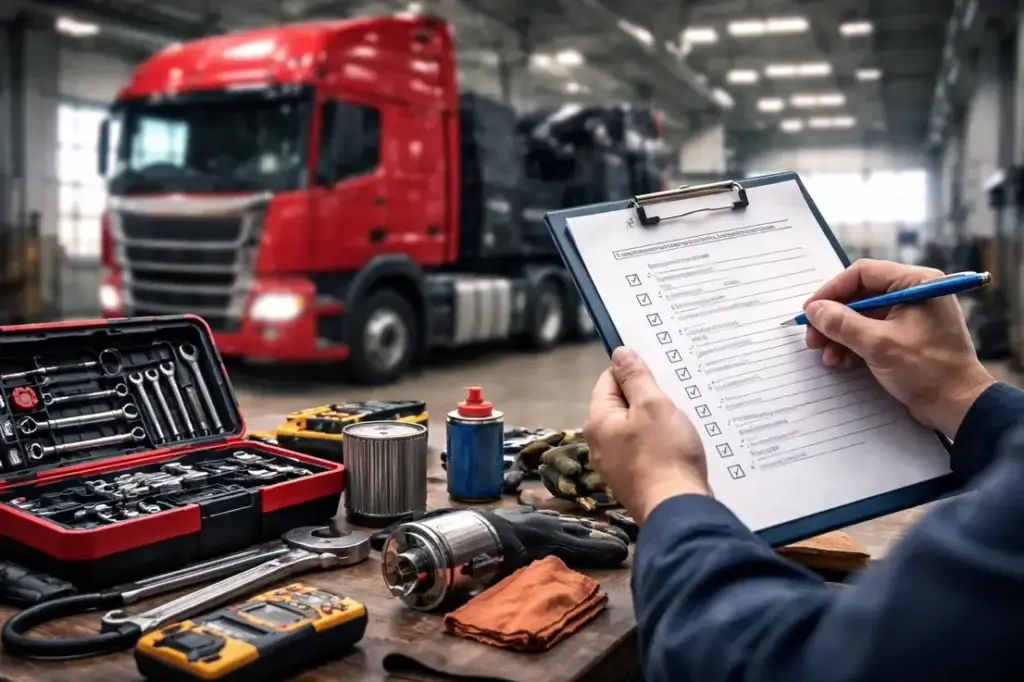
Pre-trip brake inspection procedures provide the essential foundation for preventing roadside violations and ensuring fleet safety. These daily checks protect commercial drivers from equipment failures that can lead to accidents, costly repairs, and compliance issues. HDJ's complete DOT inspection checklist covers the full 37-point Level 1 inspection scope this feeds into.
Complete Visual Inspection Checklist
A thorough visual inspection begins with a systematic examination of all visible brake components. Start at one corner of the vehicle and work methodically around the entire unit, including the tractor and trailer for combination vehicles, so nothing gets overlooked.
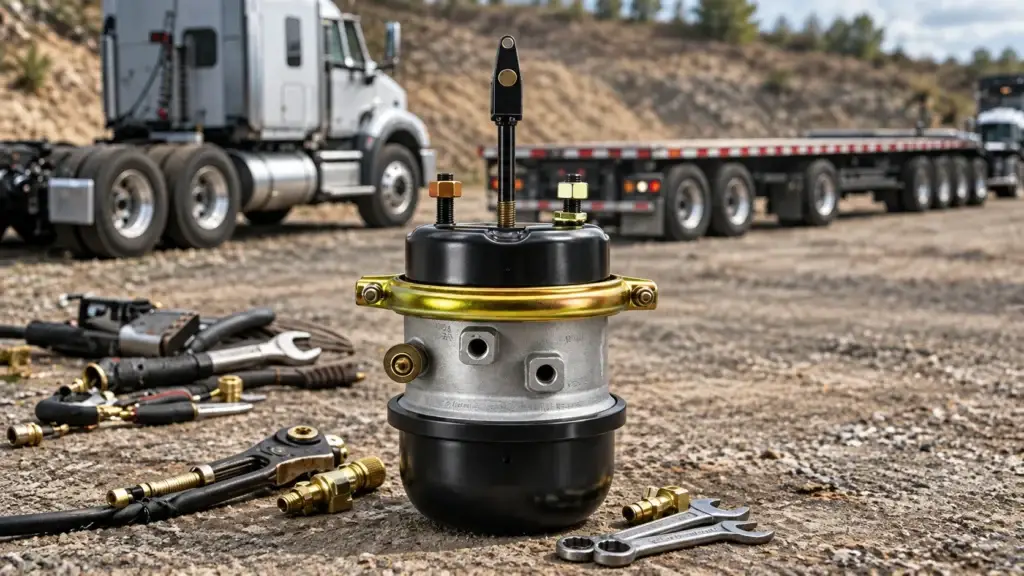
Brake chambers require close attention for any signs of physical damage or air leaks. Look for cracks in the housing, bent or damaged pushrods, and loose mounting bolts. Listen carefully for the characteristic hissing sound that indicates escaping compressed air.
Air lines deserve careful scrutiny for multiple potential problems:
- Abrasion or chafing where lines contact frame members or other components
- Cuts, cracks, or deterioration in the rubber or nylon tubing
- Loose fittings or connections that might leak under pressure
- Heat damage near exhaust components or other high-temperature areas
- Proper routing without excessive tension or sharp bends
Air Pressure Build-Up and Leakage Rate Testing
Air pressure testing validates that compressed air systems operate within manufacturer specifications and regulatory requirements, identifying compressor problems, system leaks, and pressure regulation issues before they cause brake failures on the road.
The pressure build-up test measures compressor performance under standard conditions. With the engine at maximum recommended RPM, time how long the system takes to build from 85 PSI to 100 PSI — this should occur within 45 seconds for a properly functioning system. Longer build times indicate compressor wear, drive belt slippage, or significant air leaks.
Leakage rate testing reveals air loss that reduces system capacity and wastes fuel through excessive compressor cycling. Perform this test with the engine off and brakes fully released. Build air pressure to the governor cutout point, then shut down the engine and note the starting pressure.
Monitor the pressure gauge for one minute and record the pressure drop. Single vehicles must not lose more than 2 PSI per minute, while combination vehicles have a 3 PSI per minute limit. Excessive leakage requires immediate investigation to locate and repair the source.
Brake Adjustment and Pushrod Stroke Verification
Proper brake adjustment ensures maximum stopping power and prevents premature component wear. Out-of-adjustment brakes rank among the most common violations during roadside inspections, making pushrod stroke verification a critical compliance requirement.
Pushrod stroke measurement determines whether automatic slack adjusters maintain correct clearance. To measure stroke manually, mark the pushrod at the brake chamber with chalk or a marker, then apply the brakes fully while someone measures how far the pushrod extends from its released position.
| Chamber Type | Chamber Size | Maximum Stroke | Adjustment Action |
|---|---|---|---|
| Standard | Type 20 | 2.0 inches | Adjust if exceeds 1.75 inches |
| Standard | Type 24 | 2.0 inches | Adjust if exceeds 1.75 inches |
| Long Stroke | Type 24 | 2.5 inches | Adjust if exceeds 2.25 inches |
| Long Stroke | Type 30 | 2.5 inches | Adjust if exceeds 2.25 inches |
Automatic slack adjusters should maintain proper clearance without manual intervention. If excessive stroke is found, the slack adjuster may have failed or been manually adjusted incorrectly — never manually adjust automatic slack adjusters as a routine maintenance practice; if adjustment is needed, the adjuster requires diagnosis or replacement.
Proper Documentation and FMCSA Compliance
Documentation creates the permanent record that validates maintenance programs during audits and inspections. Driver Vehicle Inspection Reports (DVIRs) must be completed for every vehicle after each day's work — drivers must note any defects discovered during operation or post-trip inspection, and even when no defects exist, the report must state "no defects" and be signed by the driver.
Maintenance facilities must review every DVIR and certify that listed defects have been repaired or are unnecessary for safe operation, with a mechanic's signature, date, and identification of repairs performed.
HDJ's CSA score improvement guide covers how this documentation flows into the Vehicle Maintenance BASIC specifically — including the detail that FMCSA caps the severity weight a single inspection can contribute, which changes how a fleet should prioritize fixing recurring small defects versus one-off ones. Per 49 CFR 396.25, technicians performing brake inspections must demonstrate competence in brake inspection and maintenance specifically — not just general mechanical aptitude.
Free Diesel Maintenance Checklist
Get HDJ's free, field-tested diesel maintenance checklist delivered instantly to your inbox — print it, laminate it, keep it in the shop.
Instant PDF • 100% Free • No Spam
Heavy Duty Brake Maintenance Schedules and Intervals
Systematic preventive brake maintenance separates successful fleets from those plagued by costly breakdowns and violations. Establishing proper maintenance schedules keeps vehicles on the road, drivers safe, and inspection records clean, while reducing emergency repairs and extending component lifespan.
Manufacturer Guidelines for Critical Brake Components
Vehicle manufacturers engineer brake systems with specific service life expectations for each component, reflecting extensive testing and real-world field data. Air compressors typically require inspection every 25,000 miles with complete service at 100,000-mile intervals, including drive belt replacement, mounting bolt torque verification, and internal component assessment — compressor failure can ground an entire vehicle, making adherence to these intervals genuinely important.
Air dryer cartridges represent another critical maintenance point. Standard usage allows for 24-month or 200,000-mile intervals, while high-use applications require more frequent replacement, as often as annually at 100,000 miles. Vehicles operating in humid climates often need more frequent changes still.
Distance-Based Preventive Maintenance Framework
Creating mileage-based preventive maintenance tasks gives technicians clear service triggers, eliminating guesswork and ensuring consistent attention to all brake system components.
| Service Interval | Primary Tasks | Typical Duration | Critical Components |
|---|---|---|---|
| 25,000 Miles | Adjustment check, leak test, visual inspection | 45–60 minutes | Slack adjusters, air lines, chambers |
| 50,000 Miles | Lining measurement, drum inspection, valve testing | 2–3 hours | Friction materials, drums, foundation brakes |
| 100,000 Miles | Air dryer replacement, complete system evaluation | 3–4 hours | Air dryer, all valves, compressor service |
| Annual/DOT | Comprehensive safety inspection, documentation | 4–6 hours | Entire brake system, all safety components |
Every 25,000 miles, technicians should perform brake adjustment verification and complete air system leak testing, including automatic slack adjuster function and pushrod stroke measurement at each wheel. Every 50,000 miles, conduct thorough brake lining thickness measurements and drum or rotor inspection — remove wheels to directly measure remaining friction material and check drums for out-of-round conditions. Every 100,000 miles, replace air dryer cartridges and inspect all air system components comprehensively, including all valves, air line condition, and reservoir moisture.
Seasonal and Climate Considerations
DOT annual inspections must include a complete brake system evaluation regardless of mileage accumulated, verifying that all components meet minimum safety standards. HDJ's own diesel engine maintenance schedule guide covers how these brake intervals fit into the broader PM program.
Seasonal changes create specific maintenance challenges for air brake systems. Winter operations demand special attention to moisture management since freezing temperatures can cause ice formation in air lines and valves — pre-winter inspections should verify air dryer function and include a complete moisture purge from all reservoirs. Summer heat affects brake performance differently, increasing friction material temperatures and accelerating wear; post-summer inspections should check for heat-related damage including cracked drums, glazed linings, and degraded rubber components.
Air Compressor and Air Dryer Maintenance
Air compressor maintenance and air dryer service represent two of the most important preventive maintenance tasks for ensuring reliable brake system operation. These components work together to generate and condition the compressed air that powers every braking function.
Drive Belt Condition and Mounting Security
The compressor drive belt transfers engine power to the air compressor, making its condition critical for proper air system function. Inspect the belt for cracking, glazing, fraying, or excessive wear during every preventive maintenance service — a deteriorated belt can slip under load, preventing the compressor from building adequate pressure even when the compressor itself functions correctly.
Check belt tension using the manufacturer's specifications, typically allowing one-half to three-quarters inch deflection when pressed firmly at the midpoint between pulleys. Too much tension causes premature bearing failure in the compressor; too little tension results in belt slippage and inadequate air pressure build-up.
Examine all compressor mounting bolts for proper torque specification. Loose mounting hardware allows the compressor to vibrate excessively, leading to cracked mounting brackets, air line connections working loose, premature bearing failure from misalignment, and oil leaks at compressor gaskets and seals.
Air Dryer Cartridge Replacement and Purge Valve Testing
The air dryer cartridge contains desiccant material that absorbs moisture and oil from compressed air before it enters the brake system. Standard usage applications should replace cartridges every 24 months or 200,000 miles, while humid-climate or high-use operations require more frequent replacement — as often as annually or at 100,000 miles.
Several symptoms indicate a saturated or failing air dryer cartridge that needs immediate replacement:
- Water appearing in air tanks despite regular draining
- Ice formation in valves or air lines during cold weather operation
- Premature compressor governor cycling
- Visible oil contamination in discharged air during purge cycles
Test the purge valve after cartridge replacement to verify automatic moisture ejection functions correctly. The purge valve should emit a sharp burst of air when the compressor reaches cutout pressure — this automatic purge cycle removes accumulated moisture from the air dryer before it can enter the brake system.
Moisture Contamination Prevention Strategies
Moisture contamination prevention requires multiple defensive strategies beyond air dryer service alone. Water vapor enters the air brake system through the compressor intake and condenses as compressed air cools in the storage tanks — even a properly functioning air dryer can't remove all moisture, especially during high-humidity conditions.
Daily air tank draining remains essential even with functioning air dryers installed. Manually drain all air tanks at the end of each operating day to remove accumulated condensation, paying special attention to this task after summer storms or periods of high humidity when moisture levels increase dramatically.
Cold weather creates particularly dangerous moisture contamination scenarios. Water in the air system freezes in valves, air lines, and brake chambers, causing complete brake failure — making winter moisture prevention absolutely critical for safe vehicle operation.
Brake Chamber and Slack Adjuster Service
Proper brake chamber service and slack adjuster adjustment directly impact stopping power and regulatory compliance. These components work together to convert air pressure into the mechanical force that pushes brake shoes against drums.
Identifying Chamber Damage and Air Leaks
Start every brake chamber inspection with a thorough visual examination of the housing. Look carefully for cracks around mounting areas and where the pushrod emerges from the chamber — these high-stress zones frequently develop fractures that compromise structural integrity.
Test for air leaks by applying the service brakes while listening and feeling for escaping air. Even small leaks waste system pressure and indicate diaphragm damage or seal failure. A brake chamber should hold pressure without any detectable air loss.
Testing Automatic Adjuster Function
Automatic slack adjusters represent a significant safety advancement over manual systems, but they require proper testing to verify correct operation. These devices should automatically compensate for brake lining wear without any routine manual adjustment — federal regulations prohibit manual adjustment of automatic slack adjusters during routine maintenance.
Test automatic slack adjuster function by measuring pushrod travel before and after several brake applications. Make six full brake applications from approximately 90 PSI to 100 PSI. If the pushrod travel increases progressively with each application, the automatic slack adjuster has failed and requires replacement.
Warning signs of automatic slack adjuster failure include:
- Progressively increasing pushrod travel over time
- Need for more pedal force to achieve effective braking
- Audible clicking or grinding from the adjuster mechanism
- Visible damage to the automatic adjustment mechanism
- Inconsistent brake performance between wheels on the same axle
Measuring Pushrod Travel and Adjustment Standards
Pushrod stroke measurement represents the most critical inspection point for FMCSA compliance. Out-of-adjustment brakes consistently rank among the top violations during roadside inspections and contribute heavily to CSA scores.
Mark the pushrod at the brake chamber face using chalk or a marker. Have an assistant make a full brake application while measuring how far the pushrod extends, from the original mark to the chamber face. This distance represents the applied stroke, or pushrod travel — any brake chamber exceeding the maximum allowable stroke for its type and size is considered out-of-adjustment.
Brake Drum, Rotor, and Lining Maintenance
Maintaining the friction surfaces of air brake systems directly determines whether a loaded truck stops safely. The S-cam and brake shoes work together to create the friction against the brake drum that brings heavy-duty vehicles to a controlled stop.
Measuring Brake Drum and Rotor Wear Limits
Accurate measurement forms the foundation of effective brake drum inspection. Every brake drum manufactured for commercial vehicles has a maximum diameter stamped directly on the friction surface — this discard diameter represents the absolute wear limit beyond which the drum becomes unsafe for continued operation.
Inside micrometers and specialized drum gauges provide the precision needed for proper measurement. Position the measuring tool perpendicular to the drum surface and take readings at multiple points around the circumference, recording measurements at the open edge, center, and deep section of the friction surface to identify uneven wear patterns.
Compare measurements against the stamped discard specification. Most heavy-duty brake drums start with diameters between 16.5 and 16.75 inches, with maximum wear limits typically 0.120 inches over the original diameter. Never operate a vehicle with drums exceeding the discard limit — the weakened metal can crack or fail under thermal stress.
Friction Material Thickness and Condition Assessment
Friction material assessment requires both measurement and visual evaluation. Standard minimum thickness for brake linings in heavy-duty applications is typically one-quarter inch (6.4 mm), though some manufacturers specify different limits based on lining design and attachment method.
Measure lining thickness at multiple points across the friction surface using a brake lining gauge or depth micrometer. Take readings at the center and both edges of each brake shoe — uneven wear often indicates problems with automatic slack adjusters, bent components, or contamination issues.
Identifying Glazing, Heat Cracks, and Oil Contamination
Surface condition problems reduce braking effectiveness even when friction material thickness remains adequate. Glazing appears as a hard, glossy surface on brake linings that develops from excessive heat or light brake dragging — this condition reduces the friction coefficient and extends stopping distances dangerously.
Heat checking presents as fine cracks in brake drums that radiate from the friction surface, developing from repeated heating and cooling cycles, particularly during brake fade situations. Inspect drums carefully under good lighting for crack development — deep cracks or any crack extending to the mounting flange require immediate drum replacement.
Oil or grease contamination drastically reduces braking effectiveness and requires comprehensive corrective action. Contaminated linings appear dark and feel slick to the touch. Never attempt to clean contaminated brake linings for reuse — the oil penetrates deeply into the friction material and cannot be fully removed. Replace all contaminated components and identify the contamination source before returning the vehicle to service.
Air Line, Valve, and Reservoir System Maintenance
Air lines, valves, and reservoirs form the critical pathway that delivers compressed air from generation to application points throughout the brake system, connecting the compressor and air dryer to the brake chambers at each wheel.
Inspecting Air Lines for Damage and Pressure Loss
Comprehensive air line inspection begins with a thorough visual examination of every line from the compressor to the brake chambers. Start at the air dryer outlet and trace each line through its entire route, paying special attention to contact points where lines run near frame members, suspension components, or the engine.
Age-related deterioration affects air lines even without visible external damage. Check the manufacture date stamped on each line during inspection — most manufacturers recommend replacing air lines every seven to ten years regardless of appearance, since the rubber compounds deteriorate over time, losing flexibility and strength.
Leak detection requires both visual inspection and auditory checks. Listen carefully for hissing sounds with the system pressurized and the engine off. The soap bubble test provides the most reliable method for locating small leaks — mix dish soap with water and apply the solution to suspected leak points, connections, and fittings.
Valve Function Verification and Testing
Brake valve testing covers several pneumatic components that control air distribution throughout the system. Relay valves speed up brake application and release in trailer systems by providing a shorter air path from the reservoir to the brake chambers. Quick release valves improve brake release speed by venting air directly to atmosphere rather than routing it back through the entire system.
Testing relay valves requires observing brake application timing with and without trailer connection. Apply the brakes while listening for immediate air movement to the trailer brake chambers — delayed response or uneven application between axles indicates a failing relay valve that needs replacement.
Reservoir Service and Connection Point Maintenance
Proper air reservoir maintenance begins with daily drainage to remove moisture and contaminants from the compressed air system. Open the manual drain valve completely and allow air to exhaust until only dry air emerges — water and oil contamination will appear as liquid discharge during the draining process.
Compressed air tanks store pressurized air until the brakes are applied, and most heavy duty trucks have multiple tanks to ensure backup reserve capacity. 49 CFR 393.50 requires that each service reservoir system be protected against air pressure loss due to failure or leakage by check valves or equivalent devices.
Gladhand maintenance protects the critical connection points between towing and towed vehicles — these coupling devices create the air link that allows the tractor to control trailer brakes. Inspect gladhand seals for cracks, hardening, or deterioration during every pre-trip inspection, and replace them at the first sign of wear or damage.
Troubleshooting Common Air Brake System Problems
When air brake systems fail, quickly identifying and correcting the problem becomes critical for safety and operational efficiency. Effective troubleshooting separates experienced technicians from those who waste time replacing parts without understanding root causes.
Identifying Pressure Build-Up Failures
Insufficient pressure build-up represents one of the most critical air system problems in commercial vehicles. Pressure must increase from 85 to 100 PSI within 45 seconds during a system test — any delay beyond this timeframe indicates a compressor deficiency or excessive air leakage that requires immediate attention.
A weak or failing air compressor typically shows gradual performance degradation over time. Worn piston rings, damaged valves, or accumulated dirt and grime reduce compression efficiency. Testing involves monitoring build-up time with the engine at operating RPM while applying no brakes.
Diagnostic procedures for pressure build-up issues follow this systematic approach:
- Check governor cut-in and cut-out settings with accurate pressure gauges
- Inspect compressor drive belt tension and condition for proper engagement
- Examine air intake filter for restrictions that limit compressor efficiency
- Test system for excessive leakage exceeding 3 PSI drop in one minute
- Verify unloader valve operation during pressure cycling
Resolving Application and Release Delays
Brake application delay increases stopping distances and creates dangerous driving conditions. Diagnosis for delayed response examines air flow restrictions, valve failures, and moisture contamination — normal application time from pedal depression to full brake engagement should occur within about two seconds.
Frozen brake lines represent a serious risk during cold months, especially when the air dryer fails to remove moisture adequately. Ice formation restricts or completely blocks air passage through lines and fittings, and this condition often appears suddenly when temperatures drop below freezing.
| Symptom | Probable Cause | Diagnostic Test | Repair Solution |
|---|---|---|---|
| Slow brake application | Restricted air lines or frozen moisture | Measure application time at each axle | Replace damaged lines, drain moisture |
| Delayed brake release | Sticking relay or quick release valve | Monitor release time and valve operation | Clean or replace faulty valves |
| Gradual pressure loss | Leaking chambers or line fittings | Apply soap solution to connections | Replace chambers, tighten fittings |
| Inconsistent braking | Contaminated valves or worn seals | Disassemble and inspect valve internals | Rebuild valves with new seals |
Systematic Air Leak Detection Methods
Air leaks drain system pressure with each braking action, eventually leading to brake lockup or loss of control. Effective leak repair requires methodical inspection of every component and connection — the soap solution method remains the most reliable technique for locating small leaks that escape visual and auditory detection.
Common leak locations include gladhands, line fittings, brake chamber diaphragms, and valve seals. Gladhands develop leaks from worn rubber seals or damaged sealing surfaces — these connections between tractor and trailer require regular inspection and seal replacement.
Correcting Brake Imbalance Issues
Uneven braking correction addresses problems where the vehicle pulls to one side during brake application — a dangerous condition resulting from imbalanced brake forces between left and right wheels. Multiple factors contribute to brake imbalance, requiring systematic diagnosis to identify the specific cause.
Faulty slack adjusters create unequal brake shoe-to-drum clearance on opposite wheels. Automatic slack adjusters that fail to maintain proper adjustment cause one brake to apply before the other, generating steering pull during braking.
Contaminated friction materials from oil or grease reduce braking force on the affected wheel. The contamination source must be identified and eliminated before installing new brake components — common sources include leaking wheel seals, over-greased bearings, and damaged slack adjuster seals.
Frequently Asked Questions
What is the typical air pressure requirement for optimal heavy duty air brake system performance?
Heavy duty air brake systems typically operate at 100–120 PSI. The system must build pressure from 85 to 100 PSI within 45 seconds at maximum recommended engine RPM during a proper function test. This range ensures brake chambers receive adequate force for effective stopping power on vehicles carrying loads up to 80,000 pounds.
How often should I drain the air tanks on my commercial vehicle?
Daily, as part of the pre-trip routine — even with an automatic air dryer installed. Automatic drain valves may not remove all accumulated moisture, so manual drainage remains best practice for preventing freezing, corrosion, and reduced system efficiency.
What are the maximum allowable air leakage rates for air brake systems?
With brakes released and the system fully charged, air loss must not exceed 2 PSI per minute for single vehicles or 3 PSI per minute for combination vehicles. With brakes fully applied, the limit is 3 PSI per minute for single vehicles or 4 PSI per minute for combination vehicles.
Can I manually adjust automatic slack adjusters during routine maintenance?
No. These devices are designed to compensate automatically for lining wear. If manual adjustment is needed to bring pushrod travel within limits, the adjuster has likely failed and needs replacement, or another component (worn linings, a damaged S-cam) needs service. Manual adjustment masks the underlying problem.
What causes uneven braking or vehicle pull during brake application?
Most often unequal brake adjustment between sides, oil or grease contamination on one side's friction material, a seized S-cam or chamber preventing proper application on one wheel, or a failed chamber eliminating braking force entirely. Diagnosis requires side-by-side measurement comparison and visual inspection for contamination.
Putting Air Brake Maintenance Into Practice
Air brake maintenance represents the critical barrier between safe operations and catastrophic failure. Every mile traveled demands that these systems function flawlessly to protect drivers, cargo, and everyone sharing the road. The procedures in this guide — from daily tank draining to systematic air dryer replacement — contribute directly to commercial vehicle safety and fleet reliability.
Assess current maintenance practices against these standards, schedule a comprehensive brake inspection if service intervals have lapsed, and build a systematic maintenance program that prioritizes safety over shortcuts. The cost of regular inspection and scheduled component replacement stays far below the cost of roadside breakdowns, accident liability, and regulatory penalties — the same standard Michael Nielsen and Heavy Duty Journal's editorial team hold every guide on heavydutyjournal.com to.
Share This Guide
Help other fleet managers and technicians stay safe — share this air brake maintenance guide with your network.